
Eucalyptus is one of those plants that most people recognize immediately — the silvery-blue rounded leaves, the sharp medicinal scent, the distinctive look in florist arrangements — but rarely think of as a living houseplant. That is a missed opportunity.
The eucalyptus plant indoor benefits are among the most practical and well-documented of any aromatic houseplant: genuine air quality effects, natural aromatherapy backed by research, pest deterrence, and a visual elegance that works in both rustic farmhouse and modern minimalist interiors.
Growing eucalyptus indoors requires meeting some specific conditions — it is not a beginner-friendly low-maintenance plant — but for growers willing to provide bright light and appropriate care, the rewards are substantial. Here are eight reasons to bring eucalyptus inside.
1. Air Purification and VOC Reduction
The most evidence-backed of all eucalyptus plant indoor benefits is the plant’s contribution to indoor air quality. Eucalyptus produces and releases eucalyptol (1,8-cineole), a natural compound that has demonstrated antimicrobial properties in laboratory settings — including activity against common airborne bacteria and certain mold spores.
Beyond the antimicrobial properties of its volatile compounds, eucalyptus functions as a phytoremediation plant: its leaves absorb volatile organic compounds (VOCs) through stomata as part of normal gas exchange. Compounds including formaldehyde (from furniture, flooring, and building materials), benzene (from cleaning products and paints), and toluene (from adhesives and solvents) are absorbed and broken down through leaf-surface and root-zone microbial processes.
The NASA Clean Air Study and subsequent research on phytoremediation plants consistently identify aromatic plants — particularly those in the Myrtaceae family, which includes eucalyptus — as effective VOC absorbers. The dual mechanism of VOC absorption plus the natural antimicrobial action of released eucalyptol gives eucalyptus an advantage over non-aromatic plants in air quality applications.
For best results, position eucalyptus in rooms where air quality improvement is most desired: home offices with new furniture, recently painted rooms, or any space with limited fresh-air ventilation.
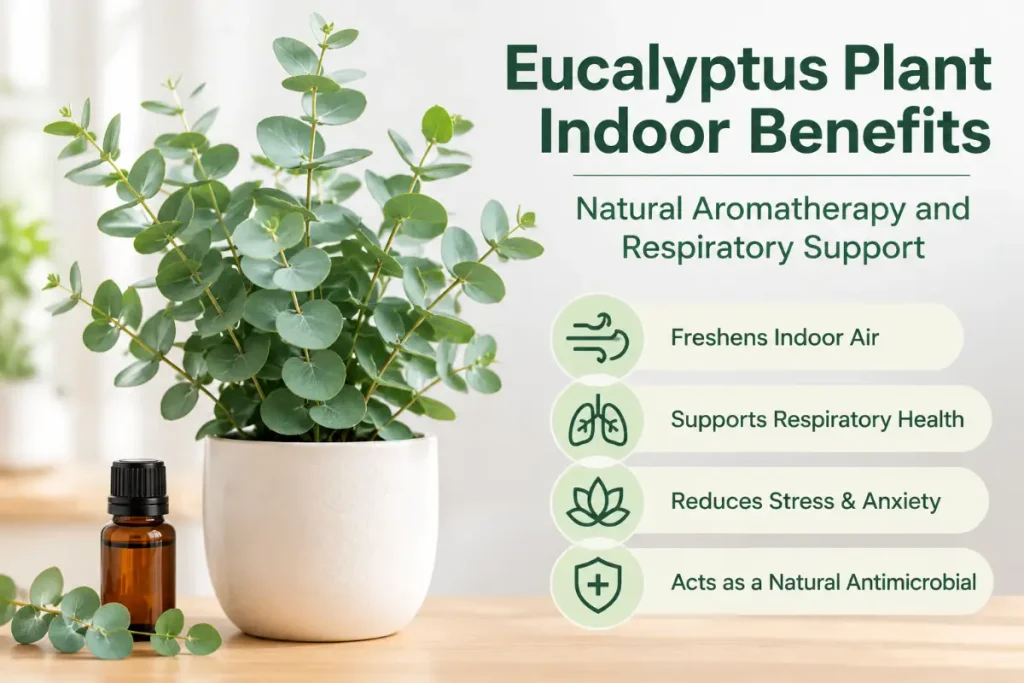
2. Natural Aromatherapy and Respiratory Support
The characteristic scent of eucalyptus — sharp, clean, and slightly medicinal — is not incidental. The primary volatile compound, eucalyptol (1,8-cineole), is a clinically studied compound with documented effects on respiratory function and cognitive performance.
Respiratory support: Eucalyptol is the active compound in many over-the-counter decongestant products (including VapoRub). Research published in clinical respiratory journals has found that inhaled eucalyptol reduces mucus production, acts as a bronchodilator (relaxing airway muscle to ease breathing), and has anti-inflammatory effects in the airways. A living eucalyptus plant continuously releases small quantities of eucalyptol into the surrounding air — providing a mild, ongoing aromatherapy effect distinct from the concentrated doses in clinical preparations.
Cognitive performance: Research on eucalyptus aromatherapy has found improvements in mental clarity, alertness, and working memory performance in controlled studies. The scent of eucalyptol appears to stimulate the central nervous system mildly — making a eucalyptus plant in a home office a potentially practical tool for maintaining alertness during cognitive work.
Mood effects: Eucalyptus aromatherapy has been associated with reduced anxiety and mental fatigue in research settings. The clean, invigorating scent is consistently rated as refreshing and energizing rather than sedating — distinct from lavender aromatherapy, which tends toward relaxation, eucalyptus tends toward activation and mental clarity.
These effects are maximized when the plant is in a warm, relatively humid environment where volatile compound release is highest, and when leaves are gently bruised (rubbing a leaf between your fingers intensifies the scent release significantly).
3. Natural Pest Deterrent
One of the most practical eucalyptus plant indoor benefits for US homeowners is the plant’s natural pest deterrence. Eucalyptol and the range of other volatile compounds eucalyptus releases are aversive to many common household insects.
Mosquitoes: Research published in the journal Pest Management Science has found that eucalyptus volatile compounds deter mosquito host-seeking behavior. The plant itself provides ambient deterrence in the room where it is growing — a small-scale effect compared to applied repellents, but meaningful as a passive background deterrent near windows or outdoor-adjacent spaces.
Moths and clothes-eating insects: Eucalyptus leaves and essential oil are traditional natural repellents for clothes moths (Tineola bisselliella). Sachets of dried eucalyptus leaves in closets and drawers have been used for generations as a natural alternative to mothballs. A living plant in a bedroom or closet-adjacent space provides ongoing deterrence.
Ants and other crawling insects: The strongly scented essential oils that eucalyptus releases are disorienting to ants, which navigate by pheromone trails. Eucalyptus oil applied to entry points is a traditional natural ant deterrent — the ambient scent from a living plant provides a milder version of this effect.
Flies: Eucalyptus is among the aromatic plants traditionally used to deter flies in food preparation and storage areas. A plant on or near a kitchen windowsill provides passive fly deterrence during warm months when flies are most active.
This natural pest deterrence does not replace conventional pest control for established infestations but provides meaningful passive background protection as part of an integrated pest management approach.
4. Stress Reduction and Mental Wellbeing
The psychological benefits of indoor plants are well-established in environmental psychology research, and eucalyptus adds specific aromatherapeutic dimensions to the general plant wellbeing benefits.
Studies on forest bathing (shinrin-yoku) — the Japanese practice of spending time in forested environments for health benefits — have found that the volatile compounds released by aromatic trees, including eucalyptus species native to Australian forests, contribute significantly to the stress-reduction and immune-boosting effects of forest environments. Indoor eucalyptus brings a portion of this effect into the home environment.
Research on the stress-reduction effects of indoor plants specifically finds that visual contact with plants lowers cortisol levels, heart rate, and blood pressure in experimental conditions. For eucalyptus, the aromatic component adds an additional pathway: inhaled eucalyptol has been found to reduce cortisol levels in studies on eucalyptus aromatherapy, independent of the visual effect.
The combined visual and olfactory stress-reduction pathways make eucalyptus one of the most multidimensional plants for psychological wellbeing — it delivers the visual calming effect of any healthy green plant plus the scent-based cognitive and mood effects of eucalyptol.
5. Shower Eucalyptus: A Specific High-Value Application
One of the most popular and highly valued eucalyptus plant indoor benefits in US homes is the shower eucalyptus method — hanging fresh eucalyptus branches in the shower where steam and heat activate volatile compound release, creating an at-home spa experience.
The method: cut several stems of eucalyptus (6–12 inches each), bundle them with twine, and hang from the showerhead or a hook near the shower. The steam from a hot shower heats the leaves, dramatically increasing eucalyptol release. The resulting scented steam provides a concentrated aromatherapy session during each shower — the warm, humid air carries eucalyptol directly to the respiratory system, maximizing both the respiratory support and stress-reduction effects.
A living eucalyptus plant provides a renewable, ongoing source of stems for this application rather than requiring purchased cut eucalyptus. Fresh stems from a living plant can be replaced every 1–3 weeks as older stems lose potency. This practical application alone makes growing eucalyptus indoors worthwhile for many US homeowners.
The shower eucalyptus trend has become genuinely mainstream — searches for “shower eucalyptus” have grown substantially in recent years, and products for this purpose are sold by retailers including Anthropologie, Urban Outfitters, and specialty wellness retailers. Growing your own provides a sustainable, lower-cost alternative to purchasing cut eucalyptus bundles.

6. Visual Interest: Silver-Blue Foliage and Architectural Form
Beyond its functional benefits, eucalyptus offers distinctive visual qualities that make it a valuable addition to interior spaces on purely aesthetic grounds.
The juvenile foliage of most indoor eucalyptus varieties — particularly Eucalyptus cinerea (silver dollar eucalyptus), the most common indoor type — features perfectly round, silvery-blue leaves that appear almost artificial in their regularity and color. This blue-gray tone is unusual among houseplants and provides a cooling, sophisticated palette note that complements both warm and cool interior color schemes.
As the plant matures, the leaf shape often changes — transitioning to longer, lance-shaped adult leaves — while retaining the silvery-blue color. This developmental change itself is visually interesting and provides evolving character as the plant grows.
The form of indoor eucalyptus is equally distinctive: an upright shrubby structure with stems that arch gracefully under the weight of leaf clusters. In a tall floor pot, a 3–4 foot eucalyptus creates a sculptural presence different from both broad tropical plants and narrow upright specimens.
For florists and home designers, eucalyptus stems are among the most versatile cutting materials: they dry well (retaining shape and scent for weeks to months), combine with almost any other flower or foliage, and work in both formal and informal arrangements.
7. Humidity Indication
A practical and somewhat unusual benefit of growing eucalyptus indoors is its use as a living humidity indicator. Eucalyptus is sensitive to low humidity — it is a drought-adapted plant from Australian climates that nonetheless needs reasonable atmospheric moisture to thrive indoors — and its leaf appearance responds noticeably to humidity changes.
In conditions of adequate humidity (40–60% RH), eucalyptus leaves are plump, flexible, and strongly fragrant. When humidity drops below 30% — common in winter-heated US homes — leaves begin to look slightly dull, curl slightly at the edges, and lose some fragrance intensity. This visual change serves as an early indicator that the room’s humidity has dropped to levels that affect both the plant and human comfort.
This indirect feedback mechanism is one of the more subtle eucalyptus plant indoor benefits: the plant tells you when your indoor environment has become too dry for optimal human health (below 40% RH) before the dryness creates obvious symptoms like dry skin or respiratory irritation.
A hygrometer ($10–$15 at Home Depot) measures humidity precisely, but the eucalyptus plant’s visible response provides a rough ambient indicator at no additional cost.
8. Educational and Cultural Connection
Eucalyptus is one of the most culturally significant plants in the world — it comprises the primary diet of koalas, represents over 700 species native to Australia, and has been used medicinally by Aboriginal Australians for thousands of years. Growing eucalyptus indoors provides an educational connection to this ecological and cultural significance that more common houseplants do not offer.
For children and families, the plant provides accessible conversation starters about Australian ecology, plant chemistry, and the relationship between plants and animals. The distinctive scent and visually striking leaves create memorable sensory experiences that reinforce botanical learning.
For plant enthusiasts interested in useful plants — those with medicinal, culinary, or functional applications beyond decoration — eucalyptus represents one of the most multifunctional choices available as a houseplant.
Growing Eucalyptus Indoors: What You Need to Know
These benefits are only fully realized when the plant is kept healthy. Eucalyptus has specific requirements that make it more demanding than average houseplants:
Light: This is the non-negotiable requirement. Eucalyptus needs 6+ hours of bright direct or near-direct sun per day. In most US homes, this means a south-facing window in winter, or a south or west-facing window in summer. Without adequate light, eucalyptus grows weakly, loses fragrance, and becomes susceptible to pests and disease. A supplemental grow light (full-spectrum LED, 6500K, 16-hour timer) is necessary for growers without a suitable south window.
Water: Eucalyptus prefers evenly moist but well-drained potting mix. It is drought-tolerant once established but drops leaves rapidly if severely water-stressed indoors. Allow the top inch of potting mix to dry between waterings; never allow the pot to sit in standing water.
Potting mix: Use a fast-draining potting mix — standard potting mix cut with 20–30% perlite. Eucalyptus is highly susceptible to root rot in poorly draining soil.
Temperature: 55–80°F. Eucalyptus tolerates cool temperatures (down to 25–28°F for some species) but grows most actively in warm conditions. Keep away from cold drafts and air conditioning vents.
Humidity: 40–60% RH preferred. Eucalyptus handles lower humidity better than most tropical houseplants but drops leaves in very dry conditions (below 25% RH).
Fertilizer: Apply a balanced liquid fertilizer (such as 10-10-10) monthly during active growth (spring through summer). Eucalyptus is a fast grower and benefits from regular feeding during the growing season.
Varieties for indoor growing: Eucalyptus cinerea (silver dollar eucalyptus) is the most widely grown indoor variety — compact relative to outdoor eucalyptus, with the round silver-blue juvenile leaves most valued for cutting and shower use. Eucalyptus gunnii (cider gum) is slightly more cold-tolerant and also does well indoors. Both are available from specialty plant retailers and online from The Sill and similar US sellers.
Eucalyptus Varieties: Choosing the Right One for Indoors
Understanding the range of eucalyptus species helps you select the variety best suited to your indoor environment and intended use.
Eucalyptus cinerea (Silver Dollar Eucalyptus): The most popular indoor variety by far. Juvenile leaves are perfectly round, silvery-blue, and highly fragrant — the classic eucalyptus look used in florist arrangements and wedding decor. Grows as a shrub or small tree; manageable to 3–5 feet indoors with regular pruning. The stems are ideal for shower use and dried arrangements. Available at Home Depot garden centers seasonally and year-round through Bloomscape and specialty online retailers.
Eucalyptus gunnii (Cider Gum): Slightly more cold-tolerant than E. cinerea (hardy to USDA Zone 7 outdoors), making it a good choice for cool rooms or sunrooms in northern US states. Juvenile leaves are round and blue-green; adult leaves are sickle-shaped. Strong fragrance; grows similarly to E. cinerea indoors.
Eucalyptus globulus (Blue Gum): This is the species most commonly used for commercial eucalyptus oil production. The highest eucalyptol content of commonly available species means the strongest aromatic and air quality benefits — but it is also the most vigorous grower and requires more aggressive pruning to stay manageable indoors. Best suited to a large pot in a sunroom or conservatory.
Eucalyptus deglupta (Rainbow Eucalyptus): A striking ornamental species with multi-colored bark (green, blue, purple, orange, maroon) as it sheds. Primarily grown as a container specimen for its visual rather than aromatic qualities. Requires very warm conditions (above 50°F at all times) and high humidity — better suited to a greenhouse or very warm sunroom than a standard home.
For most US homeowners seeking the practical benefits — aromatherapy, shower use, air quality, pest deterrence — Eucalyptus cinerea is the clear choice. It is the most available, most fragrant for its size, and most manageable indoors.

Pairing Eucalyptus with Other Indoor Plants
Eucalyptus grows well alongside other bright-light indoor plants and can be positioned as the aromatic centerpiece of a plant grouping that also provides visual texture and complementary benefits.
Good companions for eucalyptus indoors:
Lavender: Shares the high-light requirement and aromatic properties of eucalyptus. The two plants together create a combined aromatherapy environment — lavender’s calming scent complementing eucalyptus’s invigorating quality. Both prefer similar watering frequency (allow to dry slightly between waterings) and fast-draining potting mix.
Rosemary: Another Mediterranean-climate aromatic plant that shares eucalyptus’s need for bright direct sun and infrequent watering. Rosemary’s resinous scent adds another dimension to the aromatic environment and provides a culinary herb harvest.
Citrus trees: Dwarf citrus (Meyer lemon, Calamondin orange) require the same 6+ hours of direct sun as eucalyptus and create a bright-window plant grouping with strong aromatic diversity and visual interest.
Avoid pairing eucalyptus with: Tropical plants that prefer lower light and consistent moisture (pothos, calathea, philodendrons) — the care requirements are incompatible, and grouping them in the same position results in compromised care for one or both plants.
The bright-light plant grouping approach — eucalyptus, lavender, rosemary, and perhaps a dwarf citrus — creates a highly functional indoor plant environment that maximizes the aromatic, air quality, and pest deterrence benefits of multiple aromatic species simultaneously.
Conclusion
The eucalyptus plant indoor benefits combine functional, aesthetic, and psychological value in ways that few other houseplants match: documented air purification, natural aromatherapy with respiratory and cognitive benefits, passive pest deterrence, and the renewable supply of fragrant stems for the increasingly popular shower eucalyptus application. Meeting its high light requirement is the main challenge — but for growers who can provide a bright south window or supplemental grow lighting, eucalyptus delivers a distinctive, multidimensional indoor plant experience.
For comprehensive guidance on growing aromatic plants indoors and their documented health effects, the University of Florida IFAS Extension guide to indoor plants and air quality covers the research on phytoremediation and aromatic plant care in US home environments.
FAQs
Can eucalyptus grow indoors?
Yes — with adequate bright light (6+ hours of direct or near-direct sun), eucalyptus grows well indoors. Eucalyptus cinerea (silver dollar eucalyptus) is the most practical indoor variety, available from specialty plant sellers across the US.
What are the benefits of eucalyptus in the home?
Eucalyptus provides air quality improvement through VOC absorption and release of antimicrobial eucalyptol, natural aromatherapy with documented respiratory and cognitive benefits, passive pest deterrence against mosquitoes and moths, and a renewable source of fragrant stems for shower use and home fragrance.
Does eucalyptus purify air indoors?
Yes — eucalyptus contributes to indoor air quality through phytoremediation (VOC absorption) and the release of eucalyptol, which has demonstrated antimicrobial properties. It is among the more effective plants for indoor air quality improvement per unit of leaf surface area.
How do you use eucalyptus in the shower?
Cut several stems (6–12 inches) from a living plant, bundle with twine, and hang from your showerhead or a nearby hook. Hot shower steam heats the leaves and dramatically increases eucalyptol release, creating a spa-like aromatherapy effect. Replace stems every 1–3 weeks.
Is eucalyptus toxic to pets?
Yes — eucalyptus is toxic to cats and dogs if ingested. The essential oils can cause drooling, vomiting, and lethargy. Place eucalyptus out of reach of pets or choose a pet-safe alternative like spider plant or calathea for homes with animals that chew plants.
Why is my indoor eucalyptus dropping leaves?
The most common causes: insufficient light (most likely — eucalyptus needs 6+ hours of bright light), water stress (either too dry or root rot from poor drainage), or low humidity in winter-heated rooms. Check light levels first, then inspect soil moisture and drainage.