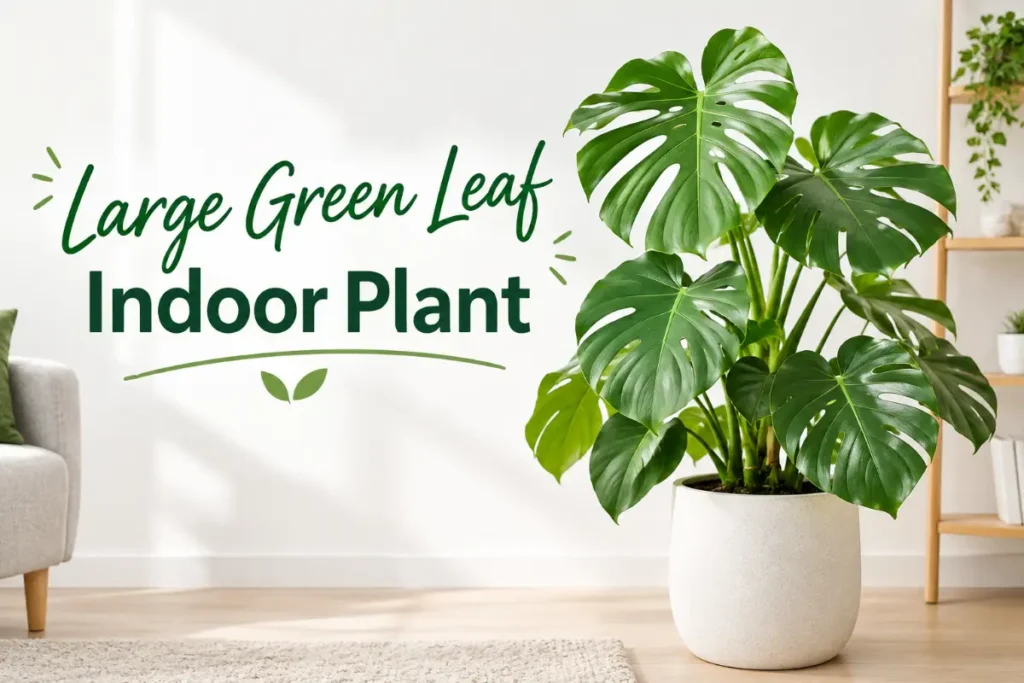
There is something immediately transformative about a large green leaf indoor plant. Where small-leaved plants create texture and detail, a large-leaved specimen commands space — it changes the scale of a room, draws the eye upward, and brings a genuinely tropical quality to an interior that smaller plants simply cannot achieve. A single well-positioned large green leaf indoor plant can anchor a living room, fill an awkward corner with purpose, or give a hallway the drama it has been missing.
This guide covers the best large-leaved varieties for indoor growing — from the familiar Monstera deliciosa to the less commonly grown but equally striking Alocasia and Philodendron species — with practical care guidance for keeping large leaves healthy, glossy, and free from the common problems that affect them.
Why Large-Leaved Plants Work So Well Indoors
Large leaves are evolutionary adaptations to low-light forest floor environments — broad surface area maximises the amount of light captured relative to the investment in leaf tissue. This is directly useful indoors, where light levels are a fraction of those outside. A Monstera or Fiddle Leaf Fig can gather light effectively from a position that would starve a sun-loving plant.
Large leaves also have practical care implications. They lose water more slowly per unit of surface area than small, thin leaves (the ratio of stomata to leaf area is lower), which means many large-leaved species are more drought-tolerant than they appear. They accumulate dust more visibly, however — a regular wipe with a damp cloth keeps large leaves clean and maximises light absorption.
Best Varieties: The Classics
Monstera deliciosa (Swiss Cheese Plant)
The definitive large green leaf indoor plant of the modern era, Monstera deliciosa has become one of the most recognisable houseplants in the world. Its deeply split, fenestrated leaves — the holes and splits that give it the “Swiss cheese” nickname — develop on mature plants in good light, though younger plants produce solid, unfenestrated leaves. Mature leaves can reach 60–90 cm across on well-established specimens.
Care: Bright to moderate indirect light produces the most vigorous growth and the most pronounced fenestration. Water when the top 5 cm of compost dries. Feed fortnightly in spring and summer with a balanced liquid fertiliser. Provide a moss pole or sturdy support — Monstera is a climbing plant in the wild and produces its largest leaves when allowed to climb. Wipe leaves with a damp cloth monthly to remove dust.
Size: Potentially very large — 2–3 m height over several years in good conditions. Can be managed by pruning and restricting pot size.
Fiddle Leaf Fig (Ficus lyrata)
One of the most dramatic large green leaf indoor plants available, Ficus lyrata produces large, violin-shaped leaves with prominent venation and a slightly wavy margin. Individual leaves can reach 45–60 cm long. It has a reputation for being temperamental — and that reputation is deserved — but understanding its specific sensitivities makes it very manageable.
Care: Bright indirect light is essential — Ficus lyrata is more light-demanding than Monstera. Water when the top 3–4 cm dries, ensuring thorough drainage — it is extremely sensitive to root rot. Do not move it once settled (it drops leaves in response to relocation). Avoid cold draughts, direct sun through glass in summer, and overwatering. Wipe leaves monthly with a damp cloth.
Key sensitivity: Consistency. Ficus lyrata thrives when its position, watering schedule, and temperature remain constant. Changes — even seemingly minor ones like being moved for a visitor — trigger leaf drop.
Bird of Paradise (Strelitzia nicolai and S. reginae)
Strelitzia nicolai (white bird of paradise) produces enormous paddle-shaped leaves in deep green, growing to 1 m long on mature plants. It is the largest-leaved of the two common indoor species and one of the most impressive large green leaf indoor plant choices for rooms with high ceilings and bright light. Strelitzia reginae is smaller-leaved but produces the familiar orange and blue flowers if given sufficient sun.
Care: Bright indirect light or some direct sun (particularly for S. reginae to flower). Water when the top 4–5 cm dries — Bird of Paradise is moderately drought-tolerant once established. Feed monthly in the growing season. Wipe leaves — they split naturally at the margins over time, which is a normal stress adaptation rather than a sign of damage.
Size: S. nicolai reaches 2–3 m indoors over many years. Allow adequate space — it is not a plant for small rooms.
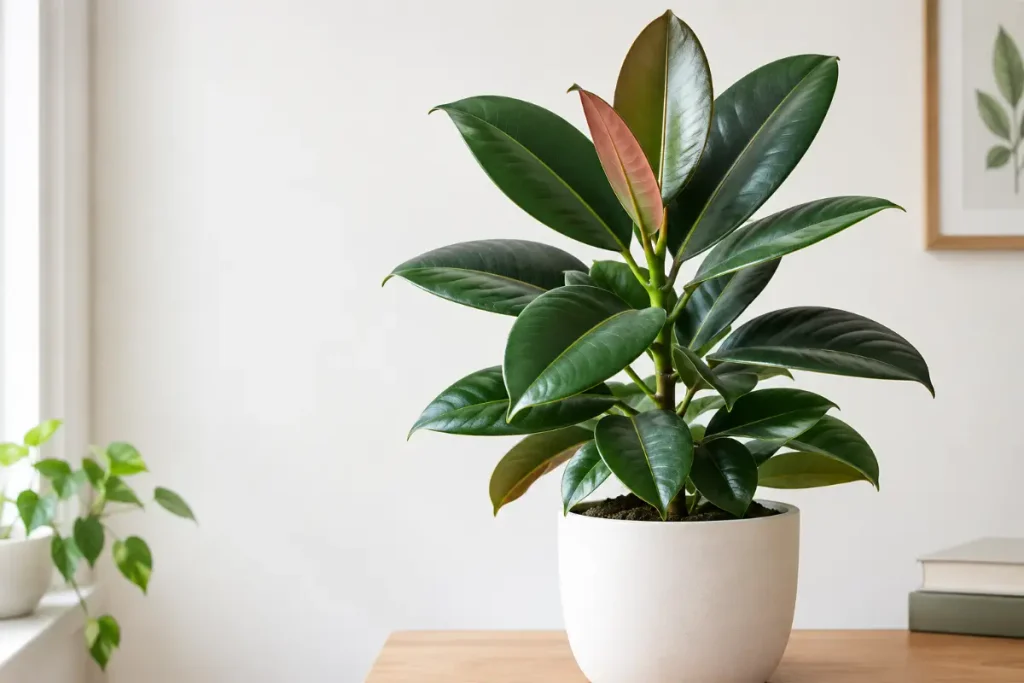
Rubber Plant (Ficus elastica)
Ficus elastica produces large, oval, glossy leaves in deep green (standard) or burgundy-red (in the ‘Burgundy’ cultivar). More forgiving than Ficus lyrata and faster-growing, the Rubber Plant is an excellent large-leaved choice for moderately lit spaces. Individual leaves reach 20–30 cm on healthy plants.
Care: Bright to moderate indirect light. Water when the top 3 cm dries. Wipe the glossy leaves regularly — they accumulate dust quickly and lose their visual appeal when dirty. Prune to maintain height and shape; cuts produce a milky latex sap — wash from hands and clothing immediately.
Best Varieties: Less Common but Equally Striking
Alocasia (Elephant Ear)
Alocasia species produce some of the most architecturally dramatic large leaves in the houseplant world — arrowhead or shield-shaped leaves on long petioles, held upright to catch overhead light. Alocasia macrorrhiza (Giant Taro) produces the largest leaves; Alocasia zebrina has distinctive zebra-striped stems; Alocasia ‘Regal Shields’ has large, deeply ribbed dark green leaves.
Care: Bright indirect light is essential — Alocasia in low light becomes weak and prone to root rot. Water when the top 3 cm dries, but avoid overwatering — Alocasia is very susceptible to root rot in consistently wet conditions. High humidity (above 60%) is strongly preferred; low humidity causes brown leaf margins and tips. In winter, Alocasia may go dormant — leaves die back and the corm remains viable underground. Do not discard the pot; resume watering in spring when new growth appears.
Note: Alocasia sap is an irritant and the plant is toxic to pets and children if ingested. Handle with care.
Philodendron bipinnatifidum (Tree Philodendron)
This large, self-heading (non-climbing) Philodendron produces deeply lobed, glossy green leaves up to 60 cm across on well-established specimens. Less fussy than Monstera and faster-growing, it is an underrated choice for large-leaved impact in moderately lit rooms.
Care: Bright to moderate indirect light. Water when the top 4 cm dries. Feed fortnightly in summer. Provide space — this plant naturally spreads outward as it matures, with a diameter potentially exceeding 1.5 m.
Colocasia (Taro)
Colocasia produces enormous heart-shaped leaves — some varieties reaching 70–90 cm across — on vigorous upright stems. Grown outdoors in warm climates as a food crop (the corm is edible), Colocasia can be grown as an impressive large green leaf indoor plant in warm, bright, humid rooms or conservatories.
Care: Bright indirect light, consistently moist compost (unlike most large-leaved plants, Colocasia prefers consistently moist rather than drying out between waterings), warmth (minimum 18°C), and high humidity. More demanding than Monstera or Bird of Paradise but produces extraordinary leaf size in the right conditions.
Banana (Musa)
Musa basjoo and Musa acuminata ‘Dwarf Cavendish’ produce the iconic large paddle leaves associated with tropical landscapes. Indoors, a banana plant is a dramatic statement — leaves can reach 1–1.5 m on vigorous specimens — though fruiting indoors requires exceptional conditions and is rarely achieved in UK homes.
Care: The brightest position available — south or west-facing with some direct sun. Consistently moist compost. High humidity. Feed generously in the growing season. Banana plants grow fast in good conditions but stall in insufficient light. The leaves naturally split along their margins — this is normal, not damage.
Keeping Large Leaves Looking Their Best
Large leaves have specific maintenance needs that smaller-leaved plants do not:
Regular cleaning: Large leaves attract and hold dust, which blocks light and reduces photosynthetic efficiency. Wipe both sides of leaves with a damp cloth (microfibre works well) monthly — or more often in dusty environments. Support the leaf from underneath with one hand while wiping with the other to avoid stressing the petiole.
Avoid leaf shine products: Commercial leaf shine sprays block stomata and can cause long-term damage to leaf function. A damp cloth is sufficient for cleaning and restoring the natural lustre of large glossy leaves.
Manage splits and tears: Many large-leaved plants naturally split at the margins (Strelitzia, banana) as leaves flex in air movement — this is not a sign of disease or poor care. Tears caused by physical damage (furniture, doorways) are permanent but do not harm the plant’s function. Only remove leaves that are more than 50% damaged.
Support as needed: As Monstera, Philodendron, and similar plants grow tall and produce increasingly large leaves, the stems may need support. A sturdy moss pole, bamboo stake, or decorative trellis prevents stems from leaning or toppling.
Light for Large-Leaved Indoor Plants
Most large green leaf indoor plants evolved as understorey forest species and are adapted to bright but filtered light — not direct harsh sun, which scorches large, thin-cuticled leaves, but not deep shade either.
Optimal position: Within 1–2 m of a large window (east, south-east, or west-facing) where bright indirect light is available for most of the day. South-facing positions may need light filtering in peak summer to prevent leaf scorch on species like Ficus lyrata and Alocasia.
Growth light vs maintenance light: Many large-leaved plants can survive in lower light but only grow and produce new leaves with adequate brightness. A Monstera in a north-facing room will stay alive indefinitely but may produce only one or two small leaves per year; in bright indirect light, the same plant produces monthly new growth with full fenestration.
Supplementing with grow lights is the most practical solution for dark rooms. For guidance on selecting appropriate grow lights, see the post on grow lights for indoor tomato plants — the specifications for lumen output, spectrum, and positioning apply equally to large-leaved ornamental plants.
Watering Large-Leaved Plants
The scale of large-leaved plants means they hold more water in their stems and tissues and dry out more slowly than small plants — but this varies considerably by species and pot size.
A consistent, structured watering approach prevents the two most common problems: root rot from overwatering and chronic underwatering stress that produces small, unimpressive new leaves. Using a moisture meter for indoor plants takes the guesswork out of timing — probe at mid-depth in the pot rather than just checking the surface, which dries faster than deeper roots.
Large plants in large pots can hold significant water — it is easy to water a large Monstera every week out of habit when the pot may still be adequately moist from the previous watering. Let the plant, not the calendar, set the schedule.
Feeding and Repotting
Large-leaved plants produce substantial new tissue regularly in the growing season and are commensurately hungry. Feed fortnightly from April to September with a balanced liquid fertiliser. A fertiliser slightly higher in nitrogen (N) than the NPK ratio supports vigorous foliage production.
Repot in spring every 1–2 years, moving up one pot size each time. Very large specimens — mature Monstera, Strelitzia — can be maintained in the same large pot for longer by top-dressing: remove the top 5–8 cm of old compost and replace with fresh, nutrient-rich material.
Positioning Large-Leaved Plants in an Interior
A large green leaf indoor plant is a design decision as much as a horticultural one — the scale of a 1.5 m Strelitzia or a mature Monstera with a 90 cm spread demands thoughtful placement.
Corners: The most common and effective position for large-leaved plants. A corner placement allows the plant to spread in two directions without blocking foot traffic, and the convergence of two walls creates a natural frame that makes the plant feel deliberately placed rather than incidental. Use a large-format plain pot in a material — terracotta, stone-effect, or white ceramic — that complements rather than competes with the foliage.
Adjacent to seating: Positioning a large-leaved plant beside a sofa or reading chair creates the impression of being within a landscape — the leaves create an enclosing canopy above and beside the seating area. This works particularly well with upright Strelitzia and Fiddle Leaf Fig, whose growth habit naturally creates an overhead presence.
As room dividers: In open-plan spaces, large-leaved plants in a line (three Monstera in matching pots, for example) can define the boundary between a living area and dining space without building a wall. The visual permeability — you can see through and around the plants — maintains the open feel while creating a clear spatial division.
Stairwells and high-ceilinged spaces: Large-leaved plants placed at the base of a staircase or in a double-height space grow toward available light and fill vertical space that is otherwise dead. This works particularly well for climbing species — Monstera with a tall moss pole, or trained Philodendron — that develop upward over time rather than spreading outward.
Scale matching: The pot size should be in proportion to the plant and the room. A large Monstera in a small nursery pot looks awkward; the same plant in a substantial 35–40 cm diameter pot looks considered and complete. As a general rule, the pot diameter should be roughly one-third to one-half the height of the plant for visual balance.
Pest and Problem Management for Large-Leaved Plants
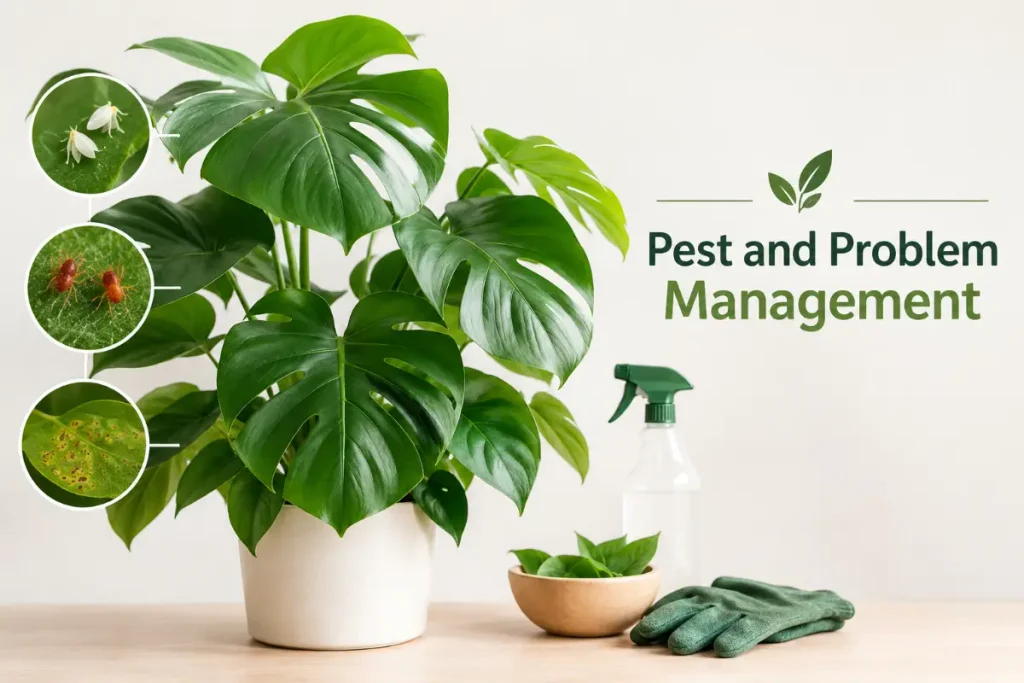
Large leaves provide ample real estate for pests, and the scale of a mature specimen means an infestation can be more extensive and damaging before it is noticed.
Scale insects are particularly problematic on Ficus species — they attach to stems and the undersides of leaf midribs and are protected by a hard waxy shell. Monthly inspection with a hand lens, particularly along the main stem and petioles, catches infestations early. Treat with horticultural oil spray and manual removal using a soft toothbrush.
Spider mites proliferate on Monstera, Alocasia, and Strelitzia in hot, dry conditions. Signs are stippling on the upper leaf surface, fine webbing on undersides, and eventual leaf yellowing. Increase humidity and treat with neem oil spray weekly for 4–6 weeks.
Root rot is the most serious and least reversible problem for large-leaved plants — a consequence of consistent overwatering in large pots. Prevention is far easier than treatment. The best protection is accurate moisture monitoring before each watering, adequate drainage, and ensuring pots are not standing in saucers of water. A drip system with a timer can help maintain consistent (but not excessive) moisture — see the post on drip irrigation for indoor plants for setup guidance on using drip systems with larger indoor plant specimens.
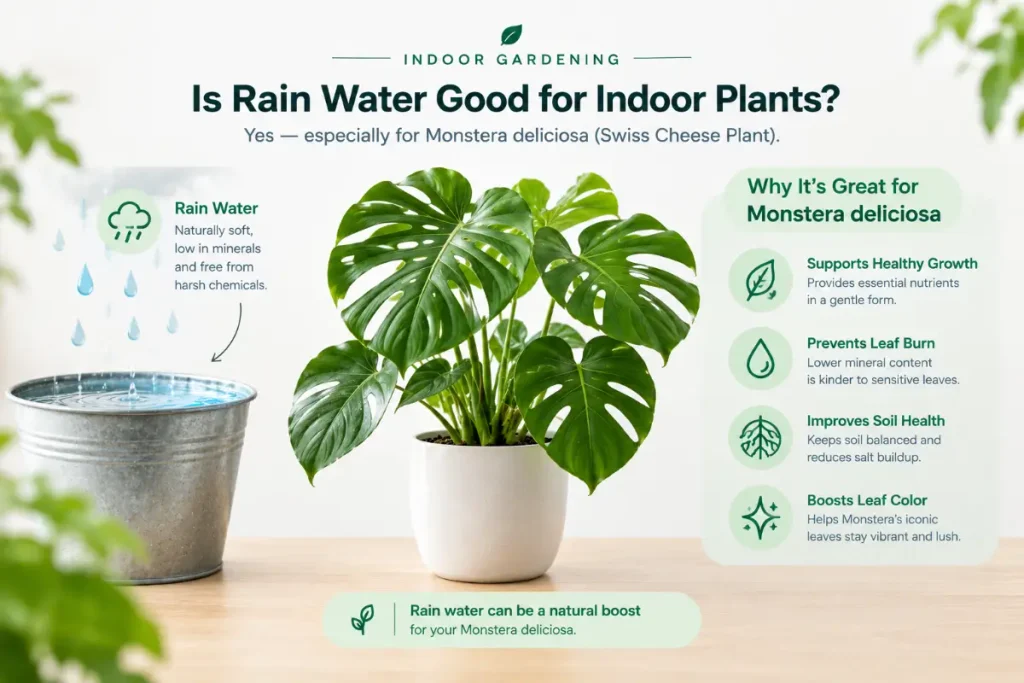
Brown leaf tips and edges — the most common cosmetic issue — result from low humidity, fluoride in tap water, or salt build-up in compost. They do not reverse, but switching to rainwater, improving humidity, and flushing compost seasonally prevents new browning on subsequent leaves.
Leaf drop (particularly on Ficus lyrata) is a stress response to environmental change. If your Fiddle Leaf Fig drops multiple leaves after being moved, do not move it again — allow it to stabilise in its new position. New growth resumes once the plant acclimatises, typically within 4–8 weeks. For Monstera and Philodendron, leaf drop is less common and usually signals root rot or severe drought.
For broader pest management strategies including spray options and application techniques, the guide on indoor plant spray for bugs covers the most effective approaches for all the pests that commonly affect large-leaved indoor plants.
Conclusion
A large green leaf indoor plant adds scale, drama, and genuine botanical presence to an interior. Whether you choose a Monstera for its sculptural fenestrated leaves, a Ficus lyrata for its architectural silhouette, or a Strelitzia for its towering elegance, the investment in space and light pays back in year-round visual impact that smaller plants cannot match. The care principles are consistent across the category: bright indirect light, measured watering, regular leaf cleaning, and adequate feeding through the growing season.
The RHS covers large-leaved tropical houseplants in detail — a reliable starting point for species-specific guidance beyond what this guide covers.
FAQs
What is the best large green leaf indoor plant for low light?
Philodendron bipinnatifidum (Tree Philodendron) and Monstera deliciosa tolerate lower light better than most large-leaved species. Both survive in moderate indirect light, though growth slows significantly. Avoid large-leaved species like Ficus lyrata, Alocasia, and Strelitzia in genuinely low-light positions — they require bright indirect light to perform.
How do I get my Monstera leaves to develop holes (fenestration)?
Fenestration develops on mature leaves in good light. Young Monstera plants produce solid, unfenestrated leaves regardless of care — the splits develop naturally as the plant matures (typically after 2–3 years of growth). Providing a moss pole for the plant to climb speeds maturity. Bright indirect light accelerates the development of more pronounced fenestration on each successive leaf.
Why are my large indoor plant leaves turning yellow?
Yellowing large leaves can result from overwatering (most common), underwatering, nutrient deficiency (particularly nitrogen or magnesium), or natural senescence of the oldest lower leaves. Check compost moisture first — if the compost has been wet for more than a week, reduce watering and check for root rot. If correctly watered, start fortnightly feeding with a balanced fertiliser.
How big do indoor Monstera plants get?
Without restriction, Monstera deliciosa can reach 3 m or more indoors over several years. Most gardeners manage height by restricting pot size (a smaller pot limits root growth and consequently overall plant size) and occasional pruning of growing tips. Pruned stems can be propagated from cuttings.
Can I grow a Fiddle Leaf Fig in a north-facing room?
Ficus lyrata needs bright indirect light — a north-facing room in the UK typically does not provide enough. In a north-facing room, the plant will survive short-term but growth stalls, lower leaves drop, and the plant gradually declines. A grow light on a 12-hour timer can compensate, but Ficus lyrata is really suited to well-lit rooms.
How often should I wipe the leaves of my large indoor plant?
Monthly as a minimum — more often in dusty environments or kitchens where grease particles accumulate. Dusty leaves lose up to 30% of their photosynthetic efficiency — regular cleaning is not merely aesthetic.
Do large indoor plants need bigger pots every year?
Not necessarily — repotting every 1–2 years is a general guideline, but the actual trigger is roots filling the pot (visible through drainage holes or the plant drying out unusually quickly). Very large plants can be top-dressed instead of full repotting, which is less disruptive and avoids the risk of going into a pot too large.
Why are my Alocasia leaves drooping?
Alocasia droops most commonly from underwatering, low humidity, or cold temperatures — though overwatering can also cause drooping as damaged roots fail to supply water to the leaves. Check compost moisture, move the plant away from cold draughts, and assess humidity. Alocasia in very dry indoor air (common in winter) droop even with adequate soil moisture.
Is a Monstera or Fiddle Leaf Fig easier to care for?
Monstera is considerably easier. It tolerates a wider range of light levels, is more forgiving of irregular watering, and does not react dramatically to being moved. Ficus lyrata is beautiful but demands consistency — same position, consistent watering, consistent temperature — and punishes changes with leaf drop. Start with Monstera and consider Ficus lyrata once you are comfortable managing the care variables.
What large-leaved indoor plant is safe for pets?
Most large-leaved houseplants are toxic to pets — Monstera, Philodendron, Ficus, and Alocasia all contain compounds that cause irritation or toxicity if ingested. Bird of Paradise (Strelitzia) is mildly toxic. The safest large-leaved option for pet owners is Calathea orbifolia, which is non-toxic and produces impressively large, patterned leaves, though it is more demanding in care than Monstera.