Few things transform a room as immediately as plants with bold, two-tone foliage. An indoor plant red and green leaves combination draws the eye in a way that plain green simply cannot — the contrast is dynamic, the colouring often more striking than flowers, and unlike blooms, the display lasts all year. Whether you are after a deep burgundy-and-green Rubber Plant in the corner or a low-growing Caladium with vivid painted leaves on a windowsill, there is a species for every light level and every style of room.
This guide covers the best varieties of indoor plant red and green leaves across size categories, explains the science behind red pigmentation in plants, and gives you practical care guidance for keeping foliage colour vibrant long-term.
Why Do Some Plants Have Red and Green Leaves?
The red in plant foliage comes from pigments called anthocyanins — water-soluble compounds produced in the vacuoles of leaf cells. While chlorophyll (which drives photosynthesis) is green, anthocyanins can be red, purple, or blue depending on cellular pH and co-pigments.
In nature, red pigmentation serves several functions. In many tropical species, young leaves emerge red before they harden — the anthocyanins act as a sunscreen, protecting photosensitive chlorophyll in young tissue from UV damage until cell walls thicken. In other species, red colouration in mature leaves deters herbivores by signalling chemical defences, or reflects light wavelengths that are poor for photosynthesis.
For indoor gardeners, the practical implication is this: light intensity directly affects the vibrancy of red colouring. Most indoor plant red and green leaves varieties produce the richest, most saturated reds in bright, indirect light. Move the same plant to a shaded corner, and the red often fades to a muddy green-bronze. Understanding this principle is the key to maintaining stunning foliage year-round.
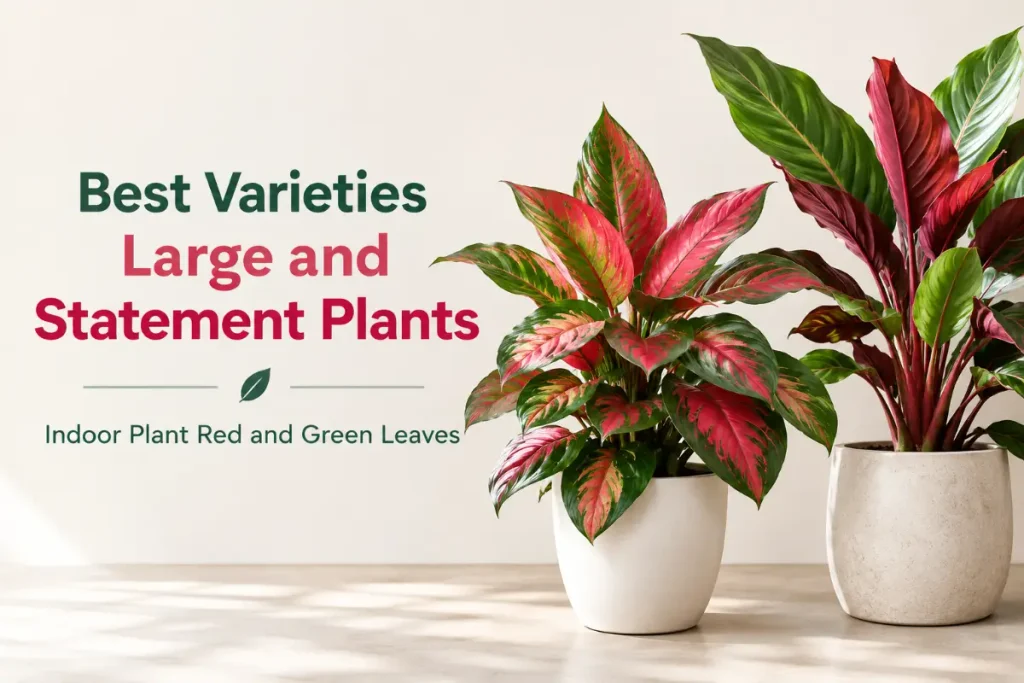
Best Varieties: Large and Statement Plants
Rubber Plant (Ficus elastica ‘Burgundy’)
One of the easiest and most dramatic large-leaved indoor plants, Ficus elastica ‘Burgundy’ produces deep burgundy-red leaves with a glossy, almost lacquered surface. New leaves emerge from a red sheath, unfurling slowly to reveal the full dark red upper surface contrasted with a paler green-red underside. In bright indirect light, the colour remains rich and deep; in lower light, it shifts toward green-bronze.
Care: Bright indirect light, water when the top 3–4 cm of compost dries, and avoid waterlogging. Wipe leaves with a damp cloth occasionally to keep the glossy surface clean and maximise light absorption. Feed fortnightly with a balanced liquid fertiliser in spring and summer.
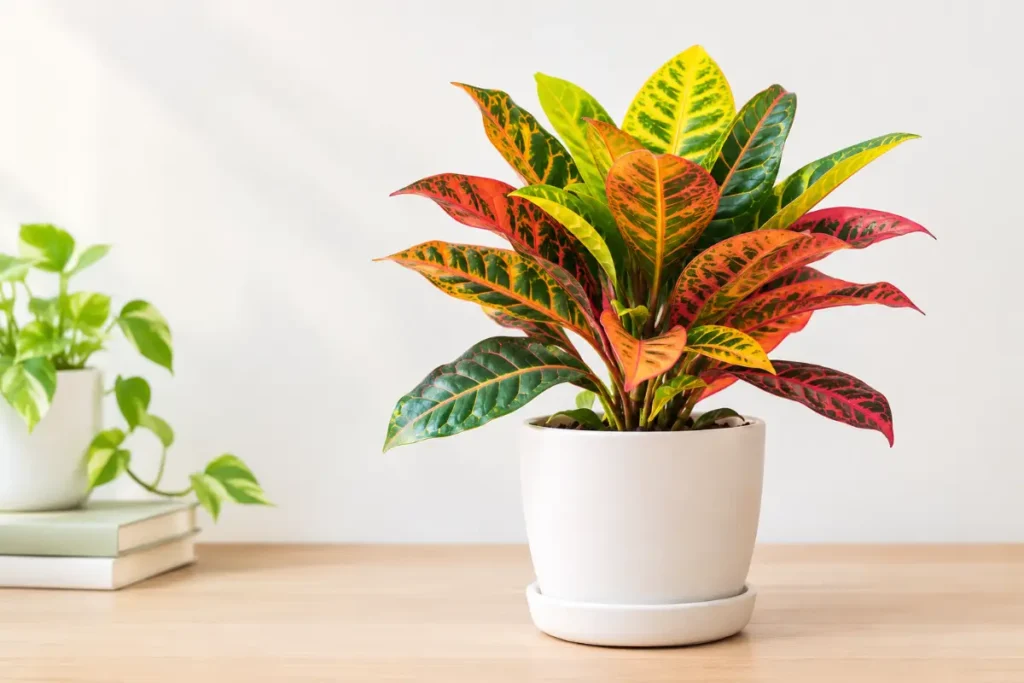
Croton (Codiaeum variegatum)
Few indoor plants match the colour intensity of Croton. Depending on the cultivar, leaves display combinations of red, orange, yellow, and green — sometimes all four on a single plant. ‘Petra’ is among the most popular, with large ovate leaves streaked in scarlet and gold against deep green.
Care: Croton demands bright, direct or very bright indirect light — without it, the red and orange tones fade rapidly and the plant becomes leggy. Croton is also sensitive to cold draughts and temperature fluctuation, which cause leaf drop. Keep above 15°C, maintain moderate humidity, and water consistently. This is not a low-maintenance plant, but its colour display is unrivalled.
Dracaena marginata (Dragon Tree)
Dracaena marginata produces long, narrow leaves edged in deep red-purple against a grey-green centre, giving the plant a graphic, architectural quality. It grows slowly to 1.5–2 m over several years, making it an excellent long-term statement plant for living rooms and offices. Tolerant of lower light than most red-foliage plants, though colour remains best in a bright spot.
Care: Allow compost to dry between waterings — Dracaena is susceptible to root rot in consistently wet conditions. Use rainwater or filtered water where possible, as it is sensitive to fluoride in tap water, which causes brown leaf tips.
Best Varieties: Medium-Sized Plants
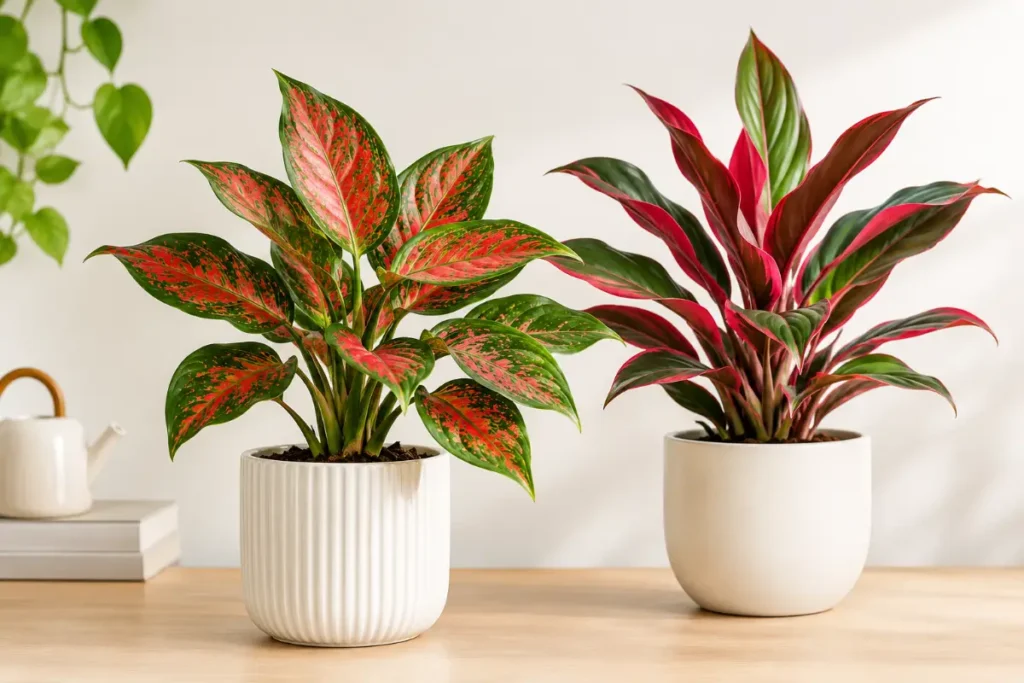
Chinese Evergreen (Aglaonema) Red Varieties
The Aglaonema genus has been hybridised extensively to produce varieties with extraordinary red colouring — ‘Red Siam’, ‘Siam Aurora’, and ‘Red Emerald’ all display vivid red-pink colouring against green, particularly intense on the central leaf surface. They are among the most forgiving of all indoor plant red and green leaves options — tolerating lower light better than almost any other colourful species.
Care: Moderate to bright indirect light deepens the red tones, but Aglaonema performs reasonably well in lower light conditions. Water when the top 3 cm of compost dries. Feed monthly in growing season. Avoid cold draughts and temperatures below 15°C.
Peace Lily — Red-Tinged Varieties
While most Peace Lilies are primarily green, some cultivars — including ‘Mauna Loa’ in certain conditions — produce red-tinged new growth. More notably, the closely related Spathiphyllum cochlearispathum produces bronze-red new leaves that mature to deep green, giving the plant a two-toned quality during the growing season.
Caladium
Caladiums are the kings of decorative indoor plant red and green leaves foliage — their paper-thin, almost translucent leaves display combinations of white, pink, red, and green in patterns that resemble watercolour paintings. ‘Red Flash’ features deep red centres with green edges and pink spots; ‘Florida Red Ruffles’ produces ruffled red leaves with green margins; ‘Postman Joyner’ has bright red centres edged in dark green.
Care: Caladiums require warmth (minimum 18°C), bright indirect light, and consistent moisture. They die back in winter — this is normal, not failure. Store the tubers in barely moist compost and resume watering in spring when new growth appears. Caladiums are not permanent houseplants in the way a Rubber Plant is, but their summer colour display is spectacular.
Coleus (Solenostemon)
Coleus are grown entirely for their foliage, producing some of the most intensely coloured leaves available for indoor growing. Cultivars range from deep burgundy-red with green edges to lime-green centres with crimson borders. They are fast-growing, easy to propagate from cuttings, and very responsive to pinching — removing growing tips keeps plants bushy and the foliage colour dense.
Care: Bright indirect light is essential for the richest colouring. Direct summer sun can bleach the colours, while low light causes them to fade to muddy green. Keep compost consistently moist, feed fortnightly during the growing season, and pinch regularly to prevent flowering — once a Coleus sets flower, foliage production slows and the plant begins to decline.
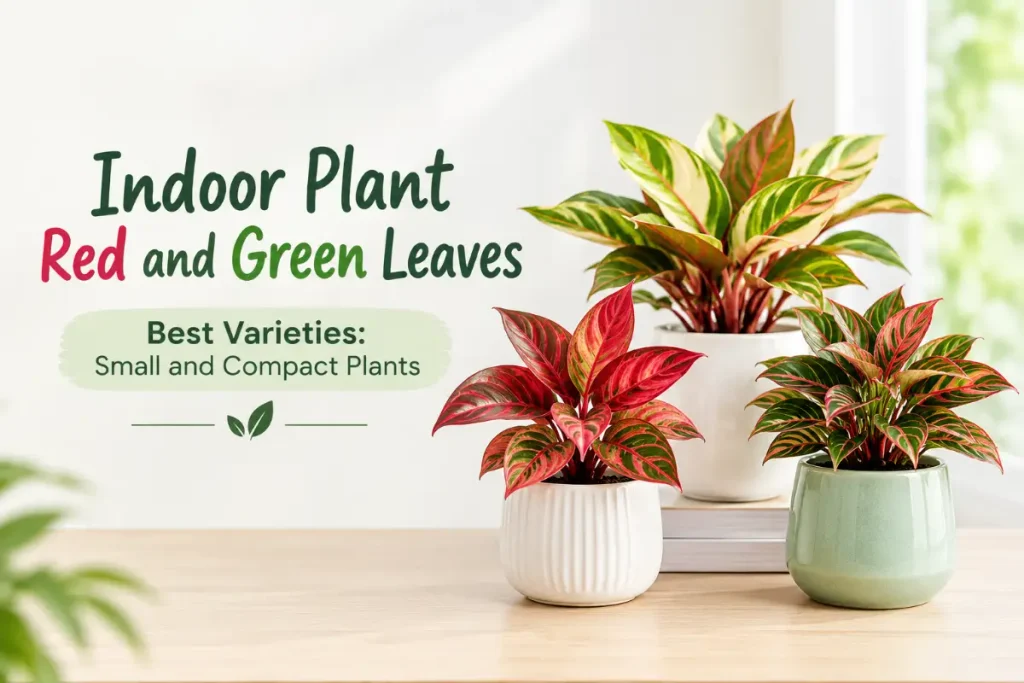
Best Varieties: Small and Compact Plants
Nerve Plant (Fittonia)
Fittonia are small, low-growing plants with a network of vivid veins — red, pink, or white — running across deep green leaves. The red-veined varieties create a striking miniature display that suits terrariums, small pots on desks, and tabletop arrangements perfectly. They are slow-growing, remaining compact for years.
Care: Fittonia are among the most humidity-sensitive houseplants — they flag dramatically at low humidity and recover equally dramatically when humidity is restored. They prefer indirect light and consistent moisture. Terrariums suit them well, providing the enclosed humidity they prefer.
Hypoestes phyllostachya (Polka Dot Plant)
The Polka Dot Plant produces green leaves spotted generously with red, pink, or white markings. Red-spotted varieties create a lively, cheerful display that suits colourful interiors. They are fast-growing and can become leggy — regular pinching keeps them compact and maintains the colour density of the foliage.
Care: Bright indirect light is essential for colour vibrancy. Low light causes the spots to fade significantly. Water when the top 2–3 cm of compost dries. Feed fortnightly in the growing season.
Rex Begonia
Rex Begonias are cultivated almost entirely for their foliage rather than their flowers — and what foliage it is. Many cultivars produce complex patterns of red, silver, green, and bronze in swirling, almost iridescent combinations. ‘Escargot’ has a distinctive spiralling pattern; ‘Red Kiss’ produces deep crimson-red leaves with a metallic sheen and green margins.
Care: Bright indirect light, moderate humidity, and careful watering are the keys to success with Rex Begonias. They are susceptible to both overwatering and drought — water when the surface just dries, never allowing the compost to dry out completely or to remain saturated. Avoid wetting the leaves, as they are prone to powdery mildew.
How to Maximise Red Colour Intensity
Maintaining rich, saturated red colouring in an indoor plant red and green leaves variety requires attention to three key factors:
Light
This is the primary lever. Bright, indirect light — close to a window but out of direct harsh sun — consistently produces the most intense red colouring in anthocyanin-rich species. In winter, moving plants closer to the window as daylight hours shorten helps maintain colour that might otherwise fade. Grow lights set to 12–14 hours daily can substitute for natural light in darker positions.
Temperature and Seasonal Stress
Some plants intensify their red colouring in response to mild stress — slightly cooler temperatures in autumn, for example, can deepen the reds in Croton and Aglaonema. This mirrors the anthocyanin response seen in deciduous trees turning red in autumn. Mild, managed stress (not damage) can be used strategically.
Feeding
Feeding with a fertiliser lower in nitrogen and higher in potassium can shift the plant’s energy allocation toward secondary metabolites including anthocyanins, potentially deepening red colouring. A tomato feed (high in potassium) applied monthly in summer is sometimes used for this purpose with Croton and Coleus, though the effect is modest.
Common Problems with Red-Foliage Plants
Colour fading to green: The most common problem. Almost always caused by insufficient light. Move the plant closer to a window or supplement with a grow light.
Leaf drop (Croton): Caused by temperature fluctuation, draughts, or being moved. Croton is notoriously sensitive to its position being changed. Once settled in a warm, bright spot, it stabilises.
Brown leaf tips: Usually low humidity, fluoride sensitivity (especially in Dracaena), or inconsistent watering. Address the root cause rather than trimming — trimming removes the brown tip but the underlying cause will produce new browning.
Leaf curl alongside fading colour: Watering inconsistency combined with low humidity, common in winter. Review your watering routine — consider tracking moisture levels and learn more about the full range of indoor plant leaves curling inward causes to troubleshoot effectively.
Pests: Spider mites favour Rubber Plants and Croton in warm, dry conditions. Check undersides of leaves monthly.
Indoor Plant Red and Green Leaves in Interior Design
Beyond horticulture, the design dimension of red-foliaged plants is significant. Red and green are complementary colours on the colour wheel — opposite each other, creating the highest inherent contrast. This makes an indoor plant red and green leaves specimen an effective focal point in a room, particularly against neutral backgrounds like white or grey walls.
Dark-leaved plants — Rubber Plant ‘Burgundy’, Dracaena marginata, Rex Begonias with deep crimson colouring — read as sophisticated and moody, suiting contemporary and industrial interior styles. Brighter, more graphic plants — Caladiums, Coleus, Croton — suit eclectic or tropical-inspired interiors where abundant colour is welcome.
Using terracotta pots with red-foliage plants creates a warm, earthy palette that feels cohesive rather than competing. White ceramic pots maximise the contrast and create a crisper, more graphic effect. For a curated, layered look, group plants of varying heights — a tall Dracaena, a mid-height Aglaonema, and a low Fittonia — using the same pot material to unify the display.
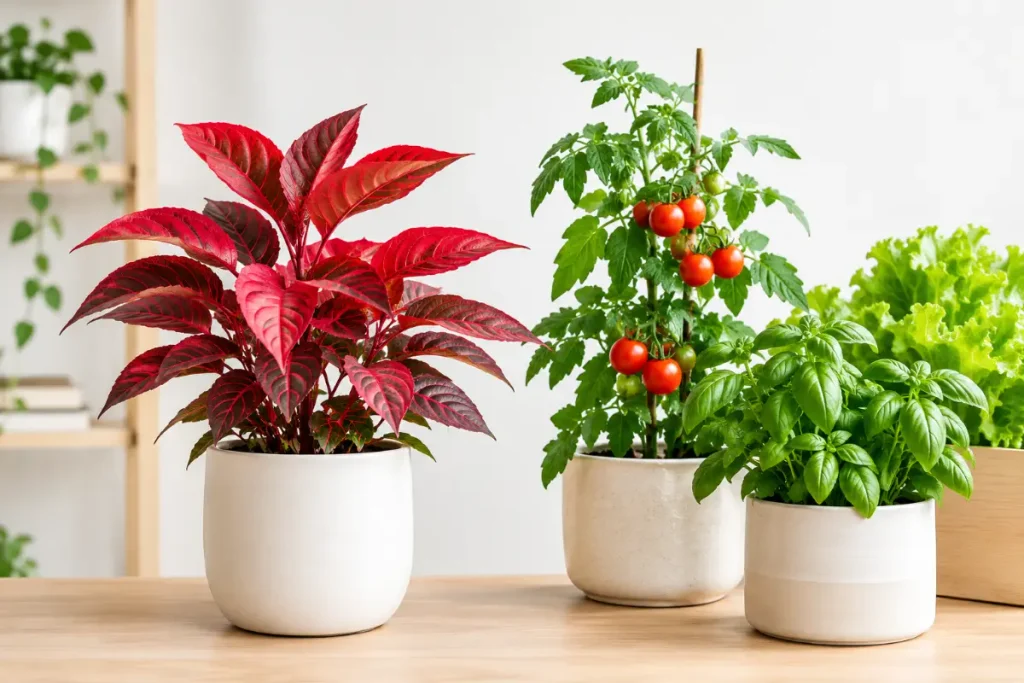
Pairing Red-Foliage Plants with Food Crops
Growing edibles alongside ornamentals is a rewarding approach that makes use of the same environmental conditions. Several food crops produce attractive red-and-green foliage and can hold their own decoratively:
Red-stemmed chard and Rainbow chard: Striking edibles with vivid red, orange, and yellow stems against deep green leaves. Grow in bright windowsills in deep pots and harvest outer leaves as needed.
Red-leaf lettuce varieties: ‘Lollo Rosso’ and ‘Red Oak Leaf’ are compact, colourful, and productive on windowsills. They complement ornamental red-foliage plants beautifully in mixed displays.
Burgundy basil: Deep purple-red basil varieties such as ‘Purple Ruffles’ are both ornamental and edible — harvest regularly to keep the plant bushy and the colour intense.
Chilli peppers: Many chilli cultivars produce deep red fruits against green foliage, creating a vivid display. A self watering system for indoor plants keeps moisture consistent for both ornamentals and food crops in a mixed display, reducing the risk of underwatering-related colour fade.
Propagating Red-Foliage Plants
Many of the most striking indoor plant red and green leaves varieties propagate readily, letting you multiply a single plant into a collection — or share plants with others — without cost.
Rubber Plant (Ficus elastica): Propagate by stem cuttings in late spring or summer. Take a cutting just below a node, remove the lower leaves, and insert into moist perlite or a mix of equal parts compost and perlite. Cover loosely with a clear plastic bag to maintain humidity and place in bright, indirect light. Roots develop in 4–6 weeks.
Coleus: The easiest of all to propagate — stem tip cuttings root in water within 10–14 days. Simply place a non-flowering shoot tip in a glass of water, ensure the node is submerged, and change the water weekly. Once roots are 2–3 cm long, pot into compost and grow on normally.
Caladium: Propagated by dividing tubers in spring when new growth begins. Use a sharp, clean knife to separate the tuber into sections, each with at least one growing point. Dust cut surfaces with sulphur powder or cinnamon to prevent fungal infection, and plant in moist compost with the growing point just below the surface.
Aglaonema: Propagated by stem cuttings or division during repotting. Stem cuttings with at least two nodes root in moist compost or water. Division is simpler — the plant naturally produces offset stems that can be separated and potted independently.
Rex Begonia: Leaf cuttings are the classic method. Remove a healthy leaf with its stalk, insert the stalk into moist propagating compost, and cover with a clear propagator lid. Plantlets develop at the base of the stalk within 4–6 weeks. Alternatively, cut a leaf into sections, each containing a prominent vein, and lay them flat on moist compost, pressing lightly to ensure contact.
Propagation is not merely economical — it is also a useful insurance policy. If a plant declines due to a care problem or age, having rooted cuttings ready ensures the variety is not lost.
Building a Red-Foliage Indoor Garden
If you find yourself drawn to the red-and-green combination, there is a case for building a dedicated display around this palette rather than treating colourful plants as isolated specimens. A curated collection creates a coherent visual impact that individual plants cannot achieve alone.
A practical approach is to work in three height tiers:
Tall tier (60–150 cm): Rubber Plant ‘Burgundy’, Dracaena marginata, or Croton as the anchor plant. These provide structural height and a bold centrepiece.
Mid tier (30–60 cm): Aglaonema red varieties, Rex Begonias, or Coleus at medium height. These fill out the middle ground and add variety of leaf shape and texture.
Low tier (5–30 cm): Fittonia, Hypoestes (Polka Dot Plant), or small Caladiums at the front and edges. Low growers soften the base of taller plants and extend the colour palette to ground level.
Grouping plants this way also creates a beneficial humidity microclimate — as plants transpire, the shared air around a group maintains higher humidity than the surrounding room. This directly benefits the more humidity-sensitive species like Fittonia and Caladium.
Consistent pot materials and colours tie a mixed display together visually. Terracotta is a natural partner for red-foliage plants — its warm orange-red tone complements rather than conflicts with the foliage colour. White ceramic creates more contrast and a cleaner look. Avoid mixing pot styles and colours within a single display unless going for a deliberately eclectic effect.
A well-considered red-foliage indoor plant collection is genuinely low-maintenance once established. The majority of these species share similar care requirements — bright indirect light, moderate watering, monthly feeding in the growing season — making it possible to care for the whole display with a consistent routine rather than managing each plant as an entirely separate project.
Conclusion
The variety available within the indoor plant red and green leaves category is genuinely remarkable — from the bold architectural presence of a Rubber Plant to the intricate watercolour patterns of a Caladium or the graphic precision of a Nerve Plant. The unifying principle across all of them is light: provide bright, indirect light, and the red pigments remain vivid and saturated. Reduce light, and they fade.
For detailed growing guidance on specific species mentioned in this article, the RHS Houseplant Advice pages are an excellent resource, covering care requirements for Croton, Ficus, Dracaena, and many other species in depth.
FAQs
What indoor plant has red and green leaves that is easy to care for?
Aglaonema (Chinese Evergreen) red varieties are among the easiest — they tolerate lower light than most colourful plants, are forgiving of occasional missed waterings, and maintain their red colouring reliably. They are an excellent starting point for anyone new to colourful foliage plants.
Why is my red plant turning green?
Almost certainly insufficient light. Anthocyanin pigments — which produce the red colouring — are produced in response to light exposure. Move the plant to a brighter position (closer to a window or under a grow light) and the red colour should intensify within a few weeks as new growth emerges.
What is the most dramatic indoor plant with red and green leaves?
Croton (Codiaeum variegatum) produces the most intensely coloured foliage of any common houseplant, combining red, orange, yellow, and green in single leaves. However, it demands bright light and consistent care. For large-leaved drama without Croton’s demands, Ficus elastica ‘Burgundy’ is a close second.
Are red-leaved plants harder to care for than green plants?
Many are not significantly harder — Aglaonema, Dracaena marginata, and Rubber Plants are all straightforward. The more intensely coloured species (Caladium, Croton, Coleus) do have more specific requirements, particularly for light and humidity. The trade-off is that their display is also more spectacular.
Can red-leaved plants grow in low light?
Some can cope with lower light, but almost all will lose some colour vibrancy in shade. Aglaonema is the most tolerant of lower light while retaining reasonable colouring. Croton, Caladium, and Coleus need genuinely bright light and should not be placed in shaded positions.
How do I keep Croton from dropping its leaves?
Avoid moving the plant once it has settled in a warm, bright position — Croton is extremely sensitive to environmental change and typically drops leaves in response to being relocated. Maintain consistent temperature above 15°C, avoid draughts, and water regularly. Given stable conditions, Croton is a long-lived and rewarding plant.
Are Caladiums permanent houseplants?
No — Caladiums are tuberous plants that die back in winter. The tubers should be kept barely moist in their compost through the dormant period and will reshoot in spring when warmth and watering resume. This is not plant failure; it is part of the normal growth cycle.
What red-foliage plant works well in a terrarium?
Fittonia (Nerve Plant) with red veining is ideal — it stays compact, loves the enclosed humidity of a terrarium, and its intricate vein patterns create a vivid display. Rex Begonias with red colouring also suit terrariums, though they grow larger over time.
Why does my Dracaena marginata have brown leaf tips rather than red edges?
Brown tips on Dracaena are usually caused by fluoride sensitivity (from tap water), low humidity, or inconsistent watering. The red colouring on Dracaena marginata is in the leaf margins and is a fixed characteristic of the plant — if your plant has lost its reddish margin colour and the whole leaf has become uniformly green, check light levels.
Can I use red-foliage plants alongside food crops indoors?
Absolutely. Red chard, red-leaf lettuce, burgundy basil, and chilli peppers all produce attractive red-and-green colouring and integrate well with ornamental red-foliage plants in mixed indoor displays. They share similar light and water requirements, making them easy to manage together.