
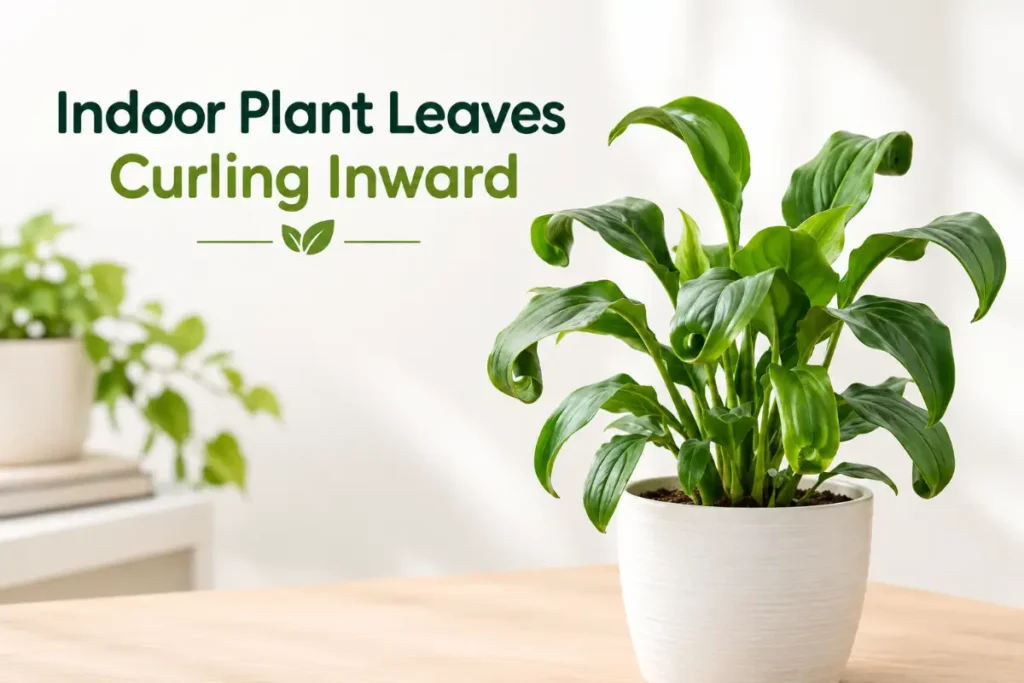
Healthy leaves hold themselves open and flat — they are, in effect, solar panels designed to capture light. So when you notice indoor plant leaves curling inward, your plant is telling you something has gone wrong. The curling is a physical response: the leaf blade rolls towards its underside to reduce the surface area exposed to whatever stress the plant is experiencing. Understanding what is driving that response is the first step to reversing it.
The good news is that most cases of indoor plant leaves curling inward are correctable once you identify the root cause. This guide works through every common trigger — from watering issues and humidity to pests, temperature, and root problems — and gives you a clear, practical fix for each.
Why Leaves Curl: The Basic Science
Leaves are made up of cells that maintain their shape through turgor pressure — the internal water pressure that keeps cell walls rigid. When that pressure drops unevenly across a leaf, one side contracts more than the other, and the leaf curls. In indoor plants, this uneven cell pressure is almost always caused by environmental stress rather than disease.
There are two directions leaves can curl: upward (cupping) and inward (rolling lengthwise along the central vein). Inward rolling is the more common distress signal and the one we focus on here. It tends to appear first on younger growth at the tips of stems, though in severe cases it spreads to mature leaves throughout the plant.
1. Underwatering — The Most Common Cause
When a plant lacks water, it triggers a hydraulic response: the stomata close, transpiration slows, and leaves curl inward to reduce moisture loss. This is the plant’s emergency drought protocol, and it is remarkably effective in the short term — but prolonged underwatering causes irreversible cell damage.
Signs this is the cause:
- Compost feels dry several centimetres below the surface
- Pot feels very light when lifted
- Lower leaves may yellow or drop as well as curl
- Soil has pulled away from the pot edges
The fix: Water thoroughly until it drains freely from the base, then allow the top third of compost to dry before watering again. For plants left very dry, bottom-watering for 30 minutes helps rehydrate compacted compost that surface watering runs straight through. A moisture meter for indoor plants takes the guesswork out of timing so you never let plants reach drought stress again.
2. Overwatering and Root Rot
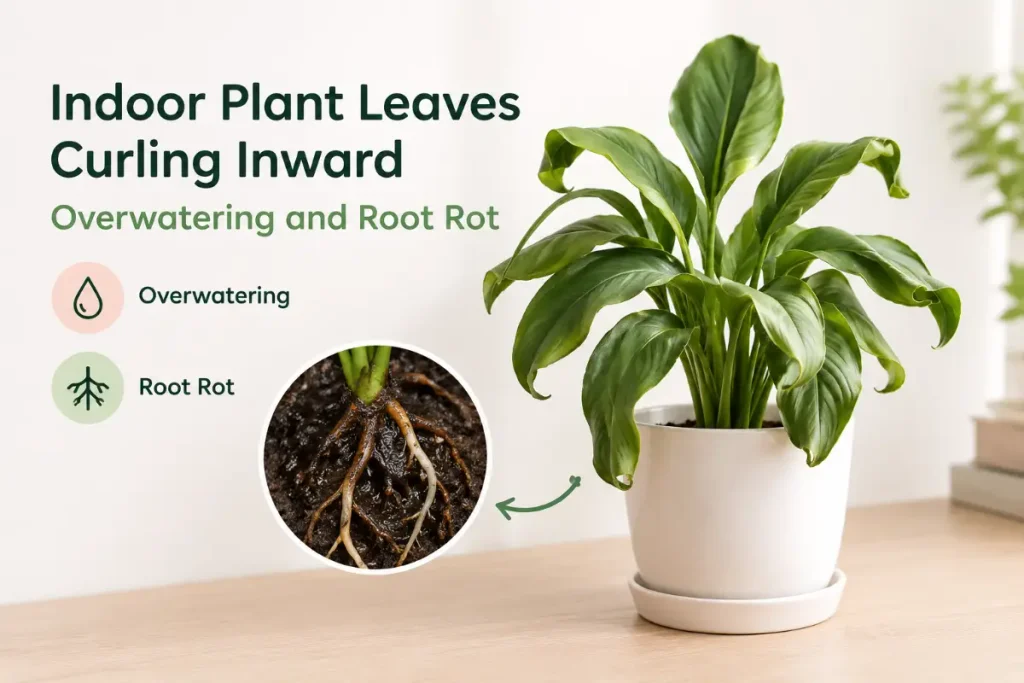
Counterintuitively, indoor plant leaves curling inward can also signal overwatering. When roots sit in waterlogged compost, they suffocate and begin to rot. Rotten roots cannot transport water to the leaves, so the plant behaves as though it is in drought — curling its leaves despite being surrounded by moisture.
Signs this is the cause:
- Compost stays wet for more than a week without drying
- Pot feels very heavy
- Yellowing leaves alongside curling
- A sour or musty smell from the compost
- Dark, mushy roots visible if you slide the plant out
The fix: Reduce watering immediately and improve drainage. If root rot is present, unpot the plant, trim all brown or black roots back to healthy white tissue, dust cuts with powdered cinnamon (a natural fungicide), and repot into fresh, well-draining compost. Ensure the new pot has adequate drainage holes. Review your drainage for indoor plants — adding perlite or grit to your compost mix improves aeration significantly.
3. Low Humidity
Many popular houseplants — tropical species like Calathea, Alocasia, Ficus, and Monstera — evolved in environments where humidity sits between 60–80%. Most UK homes run at 40–50% and can drop to 30% or lower in winter when central heating runs continuously. At these levels, the leaf’s outer surface loses moisture faster than roots can replace it, and the leaf curls defensively.
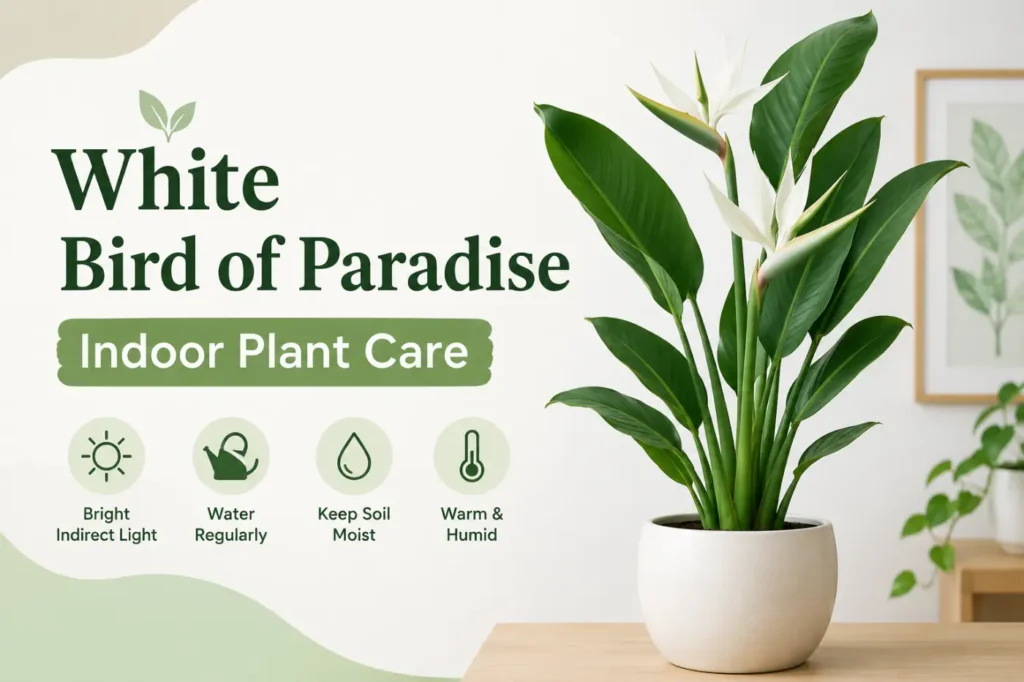
Most affected plants: Calathea (especially), Anthurium, Ficus lyrata, Bird of Paradise, Orchids, Ferns, Peace Lily.
Signs this is the cause:
- Curling accompanied by brown leaf tips
- Worse in winter or near radiators
- Plants near windows on cold nights may show overnight curling that eases by midday
The fix:
- Group plants together to create a humidity microclimate
- Place pots on trays filled with damp pebbles (the water evaporates around the foliage)
- Use a cool-mist humidifier — a 2–4 litre unit near the affected plants makes a significant difference
- Move plants away from heat sources and cold draughts
Misting is discussed everywhere but is only marginally helpful for humidity — it raises moisture for 20–30 minutes at most. A humidifier is the only reliable solution for humidity-sensitive species.
4. Heat Stress and Draughts
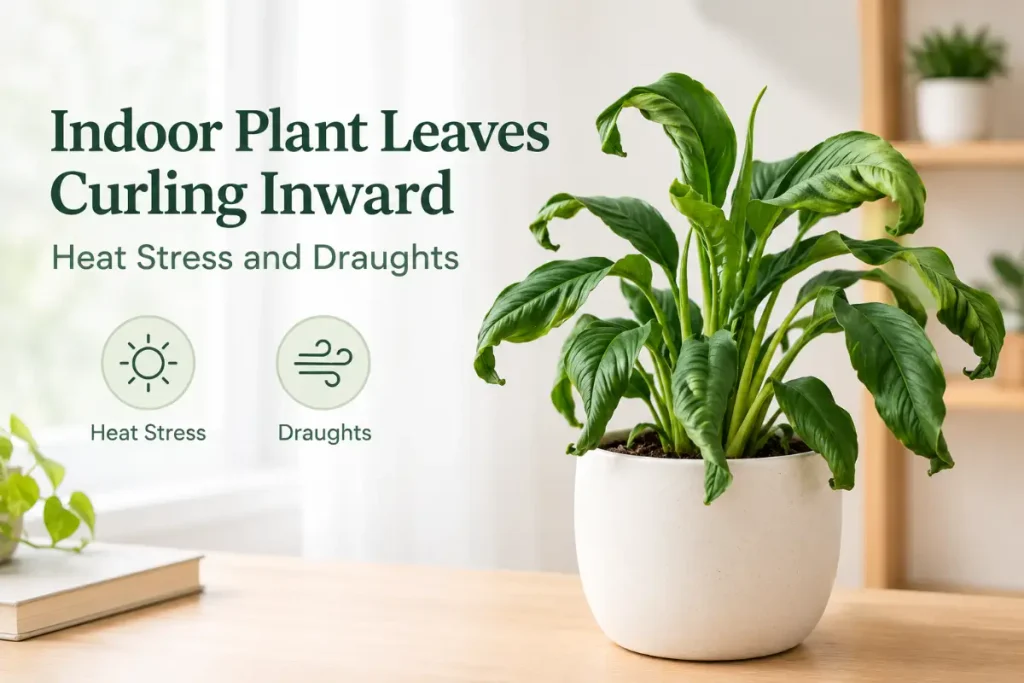
Both excessive heat and cold draughts trigger leaf curling in indoor plants — heat by accelerating water loss, cold by shocking the cells and disrupting normal water uptake.
Heat stress: Leaves exposed to direct summer sun through glass, or plants sitting directly above a radiator, can experience leaf surface temperatures 10–15°C higher than the ambient room. The plant responds by curling inward to reduce exposure.
Cold draughts: Even cold-tolerant plants will curl leaves if placed directly in front of an air conditioning vent, a leaky window frame, or in a hallway that drops sharply in temperature at night.
The fix: Move plants away from direct heat sources and cold draughts. A distance of 30–60 cm from a radiator is usually enough. South-facing windowsills receive intense summer sun — consider moving sensitive plants back from the glass or adding sheer curtaining to diffuse the light. Check minimum night-time temperatures; tropical plants should not drop below 15°C.
5. Lighting Problems
Both too much direct light and too little light can cause indoor plant leaves curling inward, though the mechanism differs.
Too much direct sun: Strong, unfiltered sunlight causes rapid water loss from leaf surfaces, especially in species not adapted to full sun. The leaf curls to reduce its effective surface area. You may also notice bleached or scorched patches alongside the curling.
Too little light: Light-deprived plants often experience poor water management — they cannot photosynthesize efficiently enough to fuel normal cellular processes, and leaves may curl as part of a general stress response, often accompanied by etiolation (leggy, stretched growth).
The fix: Assess your light levels honestly. East-facing windowsills offer gentle morning sun suitable for most tropicals. South or west facing positions are better for Mediterranean herbs, citrus, and succulents. Grow lights can supplement low natural light in winter — grow lights for indoor tomato plants covers the key specifications that apply equally to ornamentals and food crops.
6. Pest Infestations
Several common houseplant pests cause indoor plant leaves curling inward by feeding on leaf tissue or plant sap. The physical damage or the plant’s chemical response to feeding disrupts normal cell function and turgor pressure.
Spider mites are among the most common culprits — they colonise the undersides of leaves and pierce cells to feed on sap. Heavy infestations cause stippling, fine webbing, and pronounced inward leaf curl, often spreading rapidly in hot, dry conditions.
Thrips damage leaves by rasping the surface and sucking the contents. Infested leaves develop a silvery streaked appearance alongside curling.
Aphids and whitefly colonise new growth and exude honeydew, causing distortion and curl in soft young leaves.
The fix: Check undersides of leaves carefully with a magnifying glass. Spider mites can be treated with a strong water spray to dislodge colonies, followed by insecticidal soap or neem oil applied weekly for three weeks. Thrips are harder to eliminate — systemic treatments or repeated neem oil applications over four to six weeks are usually needed. Isolate affected plants immediately to prevent spread.
7. Nutrient Deficiencies and Toxicities
Nutrient imbalances can cause indoor plant leaves curling inward, though this is usually lower on the list of causes compared to watering and environmental issues.
Calcium deficiency is particularly associated with inward leaf curl — calcium is essential for cell wall integrity, and without it, new growth becomes distorted and cups inward. This is most common in plants given very soft water, which is low in calcium, or in fast-draining media that leaches minerals quickly.
Magnesium deficiency produces interveinal yellowing alongside curling, typically on older leaves first.
Nitrogen toxicity from over-feeding can cause leaves to cup and curl, particularly in plants given high-nitrogen liquid feeds during winter when growth is slow.
The fix: Feed with a balanced liquid fertiliser (NPK roughly equal, such as 5-5-5 or a purpose-made houseplant feed) at half the recommended dose fortnightly during the growing season. Avoid feeding during winter dormancy. If you suspect calcium deficiency, water with tap water rather than filtered, and consider a dedicated calcium supplement. Always check that the pH of your growing medium is appropriate — extreme pH prevents nutrient uptake even when nutrients are present.
8. Root Bound Conditions
A plant that has outgrown its pot cannot store enough water in its root mass to meet the demands of its foliage. Roots that have filled every cubic centimetre of the pot dry out within hours of watering, and the plant quickly returns to water stress — causing leaves to curl repeatedly.
Signs this is the cause:
- Roots are visible through drainage holes
- The plant dries out unusually fast — within a day or two of watering
- Growth has slowed or stalled despite feeding
- Roots emerge in a tight mass when the pot is removed
The fix: Repot into a container 2–3 cm wider in diameter — no larger, as an oversized pot holds excess moisture and increases rot risk. Use fresh, quality compost appropriate to the plant type. Spring is the best time to repot, though plants in genuine distress should be moved whenever the issue is identified.
9. Chemical Damage and Fluoride Sensitivity
Some plants — particularly Spider Plants, Peace Lilies, Dracaena, and many bromeliads — are sensitive to fluoride and chlorine in tap water. Over time, these chemicals accumulate in leaf tissue and cause cell damage that manifests as brown tips alongside inward leaf curl.
Salt build-up from fertilisers or tap water minerals can also cause osmotic stress at the root zone, drawing water out of roots rather than into them.
The fix: Water sensitive plants with rainwater, distilled water, or tap water left overnight in an open container (chlorine dissipates, though fluoride does not). Flush the pot thoroughly every few months with generous amounts of clean water to wash out accumulated salts. Repot into fresh compost annually for the most sensitive species.
Diagnosing Your Plant: A Step-by-Step Approach
When you see indoor plant leaves curling inward, work through this checklist in order:
- Check the compost — is it bone dry or waterlogged?
- Check the roots — are they root-bound, rotted, or healthy?
- Check for pests — look under leaves with a hand lens
- Assess the location — heat source, cold draught, light level
- Review your care routine — watering frequency, last feed, water source
Most cases resolve at step 1 or 2. If you reach step 5 without a clear answer, consider humidity and fluoride sensitivity as the likely culprits.
Plant-Specific Leaf Curl Guide
Different plants have specific vulnerabilities. Here is a quick reference:
Calathea / Marantaceae: Almost always humidity and/or water quality. These are the most demanding species for leaf curl — they require distilled or rainwater, humidity above 60%, and consistent soil moisture.
Fiddle Leaf Fig (Ficus lyrata): Usually inconsistent watering or low humidity. Also prone to curling after being moved.
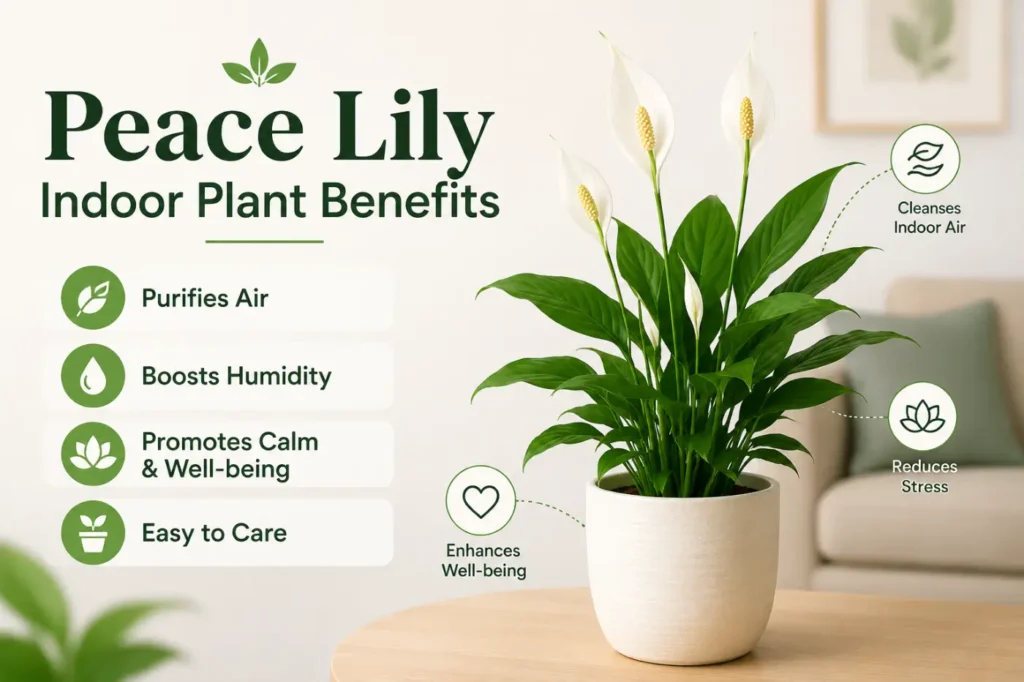
Peace Lily (Spathiphyllum): Typically underwatering — peace lilies are dramatic droopiers and curlers when thirsty. Recover quickly with thorough watering.
Monstera deliciosa: Underwatering, low humidity, or root bound. Relatively tolerant overall.
Pothos / Devil’s Ivy: Almost always underwatering if curling — one of the toughest houseplants, so curl indicates significant neglect.
Tomatoes grown indoors: Indoor tomato leaves curl inward in response to heat stress, erratic watering, or mosaic virus. Consistent watering using a drip irrigation for indoor plants setup keeps moisture levels even and significantly reduces heat-related curl.
Preventing Leaf Curl Long-Term
Prevention comes down to consistent environmental management:
- Water on a schedule calibrated to the season — plants need less in winter. Track dryness with a moisture meter rather than guessing by days elapsed.
- Maintain humidity above 50% for tropical species — a hygrometer costs very little and tells you exactly where you stand.
- Keep plants away from heat sources and draughts — especially in winter when both radiators and window draughts intensify.
- Check for pests monthly — catching an infestation early makes treatment far simpler.
- Repot every 1–2 years depending on growth rate — spring is the ideal time.
- Flush compost seasonally to remove salt build-up.
Maintaining a consistent watering routine is the single most impactful change most indoor gardeners can make. Many indoor plant problems — from root rot to chronic underwatering — stem from erratic care rather than specific deficiencies.
Seasonal Patterns in Leaf Curl
One of the most overlooked aspects of indoor plant leaves curling inward is the seasonal pattern. The same plant in the same spot can behave very differently across the year, and understanding the seasonal rhythm helps you anticipate problems before they develop.
Autumn and winter: This is peak leaf-curl season for two compounding reasons. First, central heating reduces indoor humidity dramatically — a room at 45% humidity in summer can drop to 25–30% when heating runs continuously. Second, light levels drop significantly, slowing growth and reducing the plant’s capacity to move water efficiently. Tropical plants that sailed through summer may suddenly curl and brown at the tips as conditions shift. Move plants closer to windows as light fades, run a humidifier, and reduce watering frequency to match the slower growth rate.
Spring: New growth in spring is particularly vulnerable to curl. Young, soft leaves have thinner cuticles and are more sensitive to water stress, temperature fluctuation, and pest pressure. Spider mites and aphids often resurge in spring as temperatures rise. Check plants carefully as they come out of their winter rest.
Summer: Heat stress and drought stress are the dominant causes in summer, particularly for plants near south or west-facing windows. The combination of high temperatures, direct sun through glass, and faster compost drying creates conditions where leaf curl can develop within a day or two of missing a watering.
Understanding these seasonal patterns allows you to adjust care proactively — increasing watering frequency in summer, boosting humidity in winter, and checking for pests in spring — rather than reacting after curl has already developed.
The Role of Pot Material in Leaf Curl
The material your plant grows in affects how quickly compost dries and how that drying process unfolds — both of which have a direct bearing on the frequency of moisture-stress leaf curl.
Terracotta is porous and allows air movement through the pot wall, which accelerates drying and is excellent for drought-tolerant plants like cacti, succulents, lavender, and citrus. However, the same porosity means moisture-loving tropicals — Calathea, Ferns, Peace Lily — can dry out faster than in plastic or glazed ceramic pots, increasing the risk of underwatering-related leaf curl.
If you grow moisture-sensitive species that curl readily when dry, consider switching to glazed ceramic or plastic — these retain moisture longer and reduce the frequency of watering needed. Conversely, if you tend to overwater, terracotta’s inherent drainage is your ally.
Pot size matters too. Undersized pots dry out faster and reach drought stress more quickly. Oversized pots hold water too long, increasing root rot risk. Matching pot size to the root ball — with 2–3 cm of growing room — optimises moisture retention and drainage simultaneously.
When to Seek Further Help
Most indoor plant leaves curling inward cases resolve with the fixes covered in this guide. There are situations, however, where the curl persists despite addressing all obvious environmental and care factors. At this point, consider:
Viral or bacterial infection: Some plant viruses produce leaf distortion and curl alongside mottled colouration or stunted growth. There is no treatment for viral infections — affected plants should be disposed of to prevent spread to other houseplants.
Systemic soil problems: Compost that has become hydrophobic (water-repellent) after severe drying, or compacted compost that no longer drains, can prevent normal water uptake even with correct watering frequency. The solution is repotting into fresh compost.
Severe root damage: Beyond the root rot discussed earlier, roots can be damaged by strong fertiliser salts, persistent soil pests like fungus gnat larvae, or physical damage during repotting. If a plant continues to curl despite correct watering and humidity after several weeks, unpotting and inspecting the root system is a worthwhile step.
Persistent, unresolved leaf curl accompanied by general decline — loss of leaves, stalled growth, yellowing — is a sign that multiple factors may be at play simultaneously, or that an underlying issue has not been fully addressed. Systematic troubleshooting, patience, and a willingness to repot and start fresh with new compost often resolves cases that appear resistant to simpler fixes.
Conclusion
Indoor plant leaves curling inward is your plant communicating stress — and once you understand the language, it becomes a useful diagnostic signal rather than a worrying mystery. Work through the causes systematically: check water first, then environmental factors, then pests and nutrients. The majority of cases resolve with a watering adjustment or a change in positioning.
For deeper reading on plant health and common care problems, the RHS houseplant care guide covers a wide range of species with detailed, evidence-based advice. Pair that with attentive observation of your plants, and curling leaves will become easy to interpret — and easy to fix.
FAQs
Why are my indoor plant leaves curling inward suddenly?
A sudden change usually points to a recent environmental shift — you moved the plant, the weather changed, you changed your watering routine, or the heating came on for winter. Review what changed in the last week or two and work from there.
Can indoor plant leaves uncurl once the problem is fixed?
Yes, in most cases. Young leaves that have not yet hardened will fully uncurl within days of the stress being resolved. Older leaves may partially recover but often retain some curl — the plant’s energy goes into new healthy growth rather than reversing damage in mature leaves.
Is leaf curl always a sign of a serious problem?
Not always. Slight inward curl on a hot afternoon, particularly in direct sun, is normal — many plants curl temporarily to reduce water loss and recover overnight. Persistent curl across multiple leaves is the signal to investigate further.
My Calathea leaves curl every night — is this normal?
Yes. Calathea and other Marantaceae “pray” — their leaves move upward and inward at night as part of a normal nyctinastic response. This is not distress. The concern is when leaves remain curled and do not open during the day.
Can overwatering cause leaf curl?
Yes. When roots rot from overwatering, they cannot transport water to the leaves, so the plant behaves as though it is drought-stressed even when the compost is wet. Leaf curl alongside wet, heavy compost and yellowing lower leaves strongly suggests root rot.
Does misting help with leaf curl caused by low humidity?
Misting raises humidity very briefly — 20–30 minutes at most. For plants that curl due to humidity deficit, misting is insufficient on its own. A cool-mist humidifier placed nearby is the only reliably effective solution.
Why do my tomato plants grown indoors have curling leaves?
Indoor tomato leaves curl most commonly due to heat stress, inconsistent watering, or occasionally physiological leaf roll (a harmless response to vigorous growth). Keep watering consistent, ensure adequate ventilation, and avoid placing plants directly in intense sun through glass. Viral causes (mosaic virus) produce a more distorted, mottled curl — destroy affected plants to prevent spread.
How do I tell if leaf curl is from pests or watering?
Check the undersides of leaves carefully with a magnifying glass. Pest-related curl usually comes with visible insects, stippling, fine webbing (spider mites), or silvery streaking (thrips). Watering-related curl typically affects the whole plant relatively evenly without visible pest damage.
Should I remove curled leaves from my plant?
Only if they are fully dead or severely damaged — photosynthetically active leaves, even curled ones, contribute to the plant’s energy budget. Removing them prematurely slows recovery. Once the underlying problem is fixed and new healthy growth appears, you can tidy up any leaves that have not recovered.
What is the fastest way to fix curling leaves?
If caused by underwatering, thorough watering produces visible improvement within hours — leaves begin to uncurl as turgor pressure is restored. Other causes — humidity, root rot, pests — take days to weeks to resolve as treatment takes effect and new growth emerges. There is no shortcut; addressing the root cause is always the fastest route.
Pingback: Is Rain Water Good for Indoor Plants? 7 Things to Know (2026) - Plant Quill