
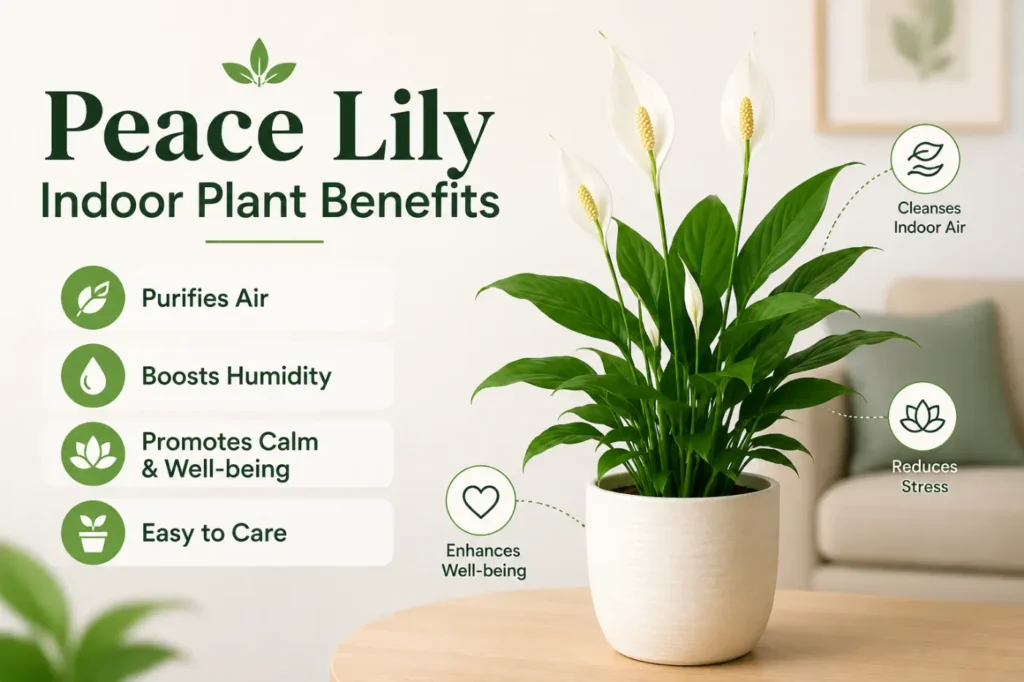
Peace lily indoor plant benefits go well beyond looking good on a shelf. This is one of the few houseplants that earns its space on multiple fronts simultaneously: it improves the air quality in the room it grows in, it signals when it needs water before damage occurs, it blooms reliably in low light conditions where most flowering plants refuse to perform, and it has documented effects on the psychological and physical wellbeing of the people who live around it. For a plant that thrives on relative neglect and costs under fifteen dollars at most garden centers, the return on investment is genuinely remarkable.
If you already own a peace lily you probably know it is easy to care for. What you might not know is the full range of what it is doing for your home environment while it sits there growing quietly. This guide covers all 9 benefits with the science behind each one, plus the specific care practices that keep a peace lily healthy enough to deliver these benefits long term.
Quick Answer
Peace lily indoor plant benefits include NASA-documented air purification removing benzene, formaldehyde, and other VOCs, improved sleep quality from nighttime oxygen production and high transpiration rates, reduced psychological stress through contact with living plants, mold spore reduction in rooms with high humidity, low light tolerance that makes them useful in rooms other plants cannot survive in, reliable blooming without direct sunlight, low allergen risk compared to many flowering plants, visual signaling of watering needs, and genuine longevity with proper care often lasting decades.
1. NASA-Documented Air Purification
The peace lily’s reputation as an air purifier is backed by real research. NASA’s Clean Air Study, conducted to identify plants that could improve air quality in sealed space station environments, found peace lilies among the most effective plants tested at removing volatile organic compounds from indoor air.
Specific compounds peace lilies remove from indoor air include benzene, which off-gases from paints, plastics, and synthetic fibers, formaldehyde from furniture, flooring, and cleaning products, trichloroethylene from varnishes and cleaning agents, and ammonia from cleaning products and some fertilizers.
The mechanism involves both leaf absorption through stomata and microbial activity in the root zone where soil bacteria break down absorbed compounds before they can re-release. The plant essentially operates as a biological air filter running continuously.
The practical caveat is that the air purification effect, while real, requires a meaningful number of plants to measurably affect air quality in a standard room. Research suggests approximately one plant per 100 square feet for noticeable air quality improvement. A single peace lily on a bookshelf improves the air quality of a standard bedroom meaningfully over time, though it is not a substitute for ventilation in heavily contaminated spaces.
2. Improved Sleep Quality
Peace lilies are particularly well-suited to bedrooms for two specific reasons that contribute to sleep quality.
First, like all plants, peace lilies produce oxygen through photosynthesis during daylight hours. Their high transpiration rate, the release of water vapor through leaves, also raises humidity in dry indoor air. Slightly elevated humidity of 40 to 60% is associated with more comfortable breathing during sleep, fewer dry throat symptoms, and reduced snoring frequency in some individuals.
Second, peace lilies are among the plants that continue releasing small amounts of oxygen at night through a metabolic pathway called Crassulacean Acid Metabolism, though this effect is smaller than daytime oxygen production. More significantly, their transpiration continues at night, maintaining the humidity benefit through sleeping hours.
The air purification benefit is also particularly valuable in bedrooms where people spend seven to nine hours breathing the air with windows typically closed. A bedroom peace lily works as a passive overnight air quality improvement that requires no active management.
3. Psychological Stress Reduction
Research in environmental psychology consistently shows that the presence of plants in indoor environments reduces measured stress markers including cortisol levels, heart rate, and self-reported anxiety. Peace lilies are particularly effective in this context because their large, smooth, dark green leaves create a calming visual contrast to the hard surfaces and screens that dominate most indoor environments.
A study published in the Journal of Physiological Anthropology found that actively interacting with indoor plants, including simple tasks like watering and repotting, produced measurable reductions in physiological stress compared to computer-based tasks. The routine care of a peace lily provides this low-effort, regular interaction with a living organism that has documented stress-reducing effects.
This benefit is not limited to people who consider themselves plant enthusiasts. The stress reduction from plant presence occurs whether or not the person is consciously aware of or interested in the plant.
4. Mold Spore Absorption
Peace lilies absorb mold spores from the air through their leaves alongside the chemical VOCs discussed above. In rooms with elevated humidity like bathrooms and kitchens where mold growth on surfaces is a concern, a peace lily provides passive mold spore reduction that complements regular surface cleaning.
The peace lily’s tolerance for the higher humidity environments where mold is most likely to be a concern makes it well-matched to exactly the rooms where this benefit matters most. Many plants struggle in bathroom humidity but peace lilies actually prefer it.
One important balance to maintain: the peace lily’s mold spore absorption benefit works in environments with moderate humidity. If the pot itself becomes overwatered to the point where mold grows on the soil surface, this negates the ambient mold reduction benefit. Appropriate watering that keeps the soil moist but not waterlogged maximizes the plant’s function while preventing it from becoming a mold source rather than a mold reducer. For a complete guide to managing mold in indoor plant soil, mold in indoor plant soil covers every cause and treatment.
5. Low Light Tolerance That Goes Where Other Plants Cannot
Most flowering houseplants need bright indirect light at minimum to bloom reliably. Peace lilies bloom in conditions that would prevent most other flowering plants from producing a single flower. A north-facing window, a shaded corner that receives only ambient room light, a hallway with no direct window access: peace lilies survive and bloom in all of these while orchids, gardenias, and most other flowering houseplants would decline to nothing but green stems.
This tolerance for low light makes peace lilies useful in rooms and spaces that plant owners often assume cannot support houseplants at all. Offices with only fluorescent lighting, interior rooms without windows, and basement living spaces can all support a peace lily when nothing else would work.
The practical benefit is filling spaces with living greenery that actively purifies air and reduces stress in exactly the locations, dark offices and interior rooms, where stressed people spend the most time without access to outdoor views or natural light.
6. Reliable Blooming Without Direct Sunlight
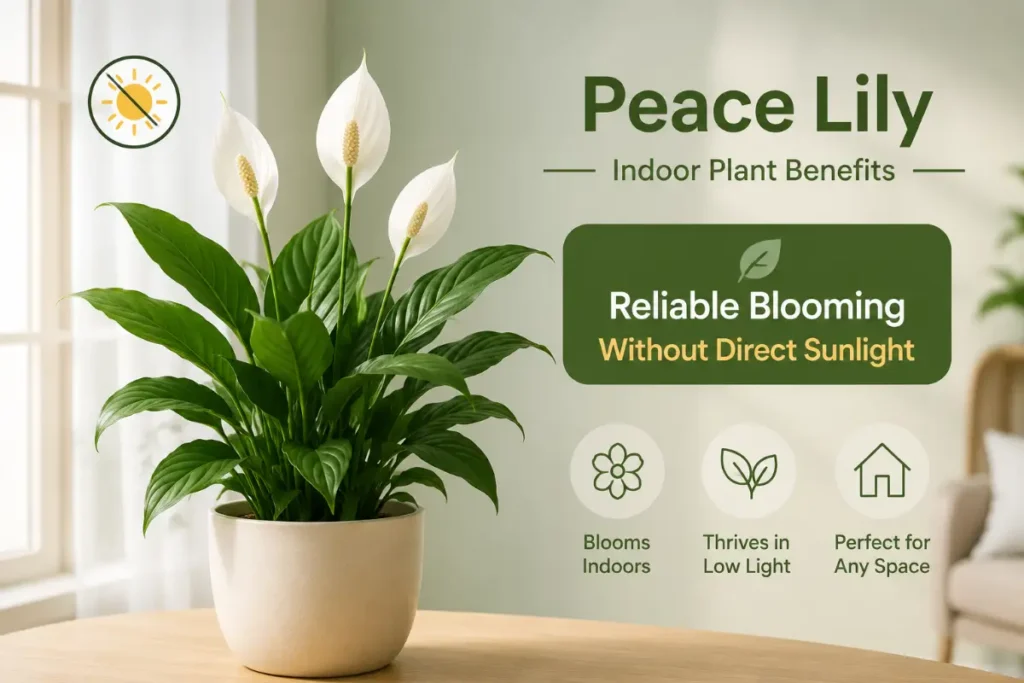
Peace lilies bloom in spring and often again in fall without any special treatment or grow lights. The white spathe (what most people call the flower) is actually a modified leaf rather than a true flower, which is partly why it lasts so much longer than typical cut flowers, often remaining attractive for four to six weeks.
For plant owners who want flowering plants but cannot provide the bright direct light most flowering species require, peace lilies deliver bloom cycles that other plants in equivalent light conditions simply cannot match. This flowering without bright light is one of the reasons peace lilies are among the most popular houseplants across all skill levels.
To encourage reliable blooming, move the plant to slightly brighter indirect light in late winter and early spring. A few weeks of improved light conditions before the natural spring bloom period triggers reliable flower production. Keeping it too dark year-round reduces blooming frequency without harming the plant’s overall health.
7. Low Allergen Risk
Most flowering plants produce pollen that circulates in indoor air and triggers allergic responses in sensitive individuals. Peace lily pollen is heavy and does not become airborne easily, staying close to the spadix (the yellow column at the center of the spathe) rather than distributing through room air the way grass pollens and some flowering plant pollens do.
For households with pollen allergies, this makes peace lilies one of the safer choices among flowering indoor plants. The air purification benefit without significant pollen release is a combination that genuinely matters for allergy sufferers who want indoor plants.
One caveat: the plant contains calcium oxalate crystals in its leaves and stems that cause irritation if chewed or consumed. Peace lilies are not the right choice for households where curious pets or toddlers are likely to chew on houseplants. Keep them elevated and out of reach in pet and toddler households or choose a pet-safe alternative.
8. Built-In Watering Signal
One of the most practically useful peace lily characteristics is its reliable visual response to being underwatered. When a peace lily needs water, its leaves droop dramatically and visibly, giving you a clear signal before the plant enters the damaging dehydration phase that harms other plants silently.
This drooping is reversible. Water a drooping peace lily and it recovers to full upright posture within hours in most cases. The plant is essentially communicating its needs in a language any plant owner can read without checking soil moisture, counting days since the last watering, or using any tools.
For new plant owners still developing their intuition for when plants need water, the peace lily’s expressive communication makes it a forgiving and educational starting plant. It tells you when you are getting the watering wrong before permanent damage occurs, which no plant feature chart or care guide can do as effectively as the plant itself drooping and then recovering when you get it right.
9. Exceptional Longevity
A well-cared-for peace lily can live for decades. Unlike many houseplants that have natural lifespans of several years before declining regardless of care quality, peace lilies are genuinely long-lived plants that become more attractive with age as they develop into large, full specimens with multiple crowns producing simultaneous bloom cycles.
This longevity makes the initial investment of fifteen to thirty dollars and the learning curve of the first year genuinely worthwhile. A peace lily purchased today, cared for properly, will likely still be thriving when your current phone is four generations obsolete.
The plant also propagates easily through division when it produces multiple crowns, allowing you to share divisions with friends or expand your collection without any additional purchase. A single peace lily can become two or three healthy plants at the cost of only a few minutes of careful root separation.
Peace Lily Care Essentials That Protect These Benefits
All nine benefits above depend on the plant being healthy. A struggling peace lily purifies less air, blooms less reliably, and signals stress rather than wellbeing. These care practices keep yours performing at its best.
Watering: Keep soil consistently moist but never waterlogged. Water when the top inch of soil feels dry, which in most homes means every seven to ten days. Peace lilies are more forgiving of slight underwatering than overwatering. Root rot from consistently wet soil is the most common way peace lilies die in indoor collections.
Light: Bright indirect light produces the strongest growth and most reliable blooming. Low ambient light keeps the plant alive and green but reduces bloom frequency. No direct sun: peace lily leaves burn in direct sun exposure.
Humidity: Peace lilies prefer humidity above 40%. Most homes are drier than this in winter when heating runs. A pebble tray with water beneath the pot or a nearby humidifier maintains the humidity that keeps leaves glossy and prevents brown tips.
Fertilizing: Feed every two to four weeks through spring and summer with a balanced liquid fertilizer at half strength. Organic options suit the peace lily’s sensitivity particularly well. For a complete guide to the fertilizer options that work best for peace lilies specifically, natural fertilizer for indoor plants covers every gentle feeding approach appropriate for sensitive tropical plants.
Temperature: Keep between 65 and 85 degrees Fahrenheit. Avoid cold drafts from windows in winter and cold air conditioning vents in summer. Temperature stress shows up as yellow leaves before any other visible symptom.
Common Peace Lily Problems and What They Tell You
Understanding what goes wrong with peace lilies helps you maintain the healthy plant that delivers all nine benefits above. Most problems have straightforward causes and solutions.
Brown leaf tips are the most common peace lily complaint and almost always trace to one of three causes: low humidity drying out leaf edges, fluoride in tap water accumulating in leaf tissue over time, or inconsistent watering that allows the plant to dry out more than it prefers before each watering. Switch to filtered or distilled water for a plant with persistent brown tips despite adequate humidity and watering. The fluoride sensitivity of peace lilies is one reason filtered water produces noticeably better long-term leaf condition than tap water in many areas.
No flowers despite otherwise healthy growth means the plant is not receiving enough light to trigger bloom cycles. Healthy green leaves with no flowers is almost always a light issue rather than a fertilizer or care issue. Move the plant to better indirect light for four to six weeks and the bloom cycle typically activates.
Drooping that does not recover after watering is a more serious signal than the normal thirst-indicating droop that recovers within hours. Persistent drooping after watering suggests root rot from overwatering has damaged the root system’s ability to absorb water even when it is available. Remove the plant from its pot, examine the roots, and remove any black or mushy sections before repotting into fresh well-draining soil. For comprehensive soil mix guidance that prevents the overwatering conditions that cause root rot, soil mixture for indoor plants covers the drainage-improving amendments that help moisture-loving plants like peace lilies maintain healthy roots long term.
Yellow leaves on lower sections of the plant that progress upward suggest nitrogen deficiency from extended periods without fertilizing or in old depleted potting mix. A dose of balanced liquid fertilizer at half strength and fresh soil at the next repot typically resolves this within four to six weeks. For the complete guide to natural fertilizer options that work best for peace lilies without the burn risk that sensitive roots are prone to, worm castings for indoor plants covers the gentle organic feeding approaches that maintain peace lily health through the growing season.
Conclusion
Peace lily indoor plant benefits make it one of the most genuinely useful houseplants you can own. Air purification backed by NASA research. Improved sleep from elevated humidity and nighttime oxygen production. Documented stress reduction. Mold spore absorption. Reliable blooming in low light where almost nothing else flowers. Low allergen risk. Clear watering signals that prevent permanent damage. And a lifespan measured in decades rather than years.
The combination of practical benefits, forgiving care requirements, and visual beauty in a plant that costs less than a dinner out makes the peace lily one of the most defensible houseplant purchases available. Put one in the bedroom for sleep quality, one in the office for stress reduction and air purification, one in the bathroom where its humidity tolerance matches the environment, and you have covered the three indoor spaces where its specific benefits matter most.
Frequently Asked Questions
Do peace lilies really purify air indoors?
Yes, within realistic expectations. NASA’s Clean Air Study confirmed peace lilies remove benzene, formaldehyde, trichloroethylene, and ammonia from indoor air through leaf absorption and root zone microbial activity. One plant per 100 square feet is the commonly cited guideline for noticeable air quality improvement. A single peace lily improves the air in a standard bedroom over time but is not a substitute for ventilation in heavily contaminated spaces.
Are peace lilies good for bedrooms?
Peace lilies are among the best plants for bedrooms specifically. Their high transpiration raises indoor humidity toward the 40 to 60% range associated with more comfortable sleep. Their air purification removes VOCs that accumulate in closed bedroom environments overnight. Low light tolerance means they thrive in the lower light conditions typical of bedrooms. The low allergen risk from their heavy, non-airborne pollen makes them safer than many flowering alternatives for allergy-sensitive sleepers.
How do I get my peace lily to bloom indoors?
Move the plant to slightly brighter indirect light for four to six weeks in late winter and early spring. The combination of increasing day length and slightly improved light conditions triggers the natural spring bloom cycle. Fertilizing with a phosphorus-forward liquid fertilizer during this pre-bloom period also supports flower development. Peace lilies in consistently dim conditions bloom less reliably than those with periodic exposure to better light even if that light exposure is brief.
Are peace lilies toxic to cats and dogs?
Yes. Peace lilies contain calcium oxalate crystals throughout their leaf and stem tissue that cause immediate oral irritation, excessive drooling, difficulty swallowing, and vomiting if chewed or consumed by cats or dogs. They are not fatally toxic in the way true lilies (Lilium species) are to cats, but the discomfort is significant. Keep peace lilies elevated and inaccessible in households with pets that chew on plants.
Why are my peace lily leaves turning yellow?
Yellow leaves on peace lilies most commonly indicate overwatering where roots are sitting in consistently wet soil and beginning to rot. The second most common cause is direct sun exposure burning leaf tissue from above. Less commonly, yellow leaves indicate nitrogen deficiency from extended periods without fertilizing or cold temperature stress from drafts or cold windowsills. Check soil moisture and light conditions first since these account for the majority of peace lily yellowing.
How long do peace lilies live indoors?
Peace lilies are genuinely long-lived houseplants capable of thriving for twenty years or more with proper care. Unlike many popular houseplants that naturally decline after several years regardless of care quality, peace lilies become larger and more impressive specimens with age, eventually producing multiple crowns that bloom simultaneously. Regular division every three to four years when the plant becomes crowded keeps it vigorous and allows you to share or expand your collection without additional cost.
Pingback: How to Keep a Lily Plant Alive Indoors: 8 Steps That Actually Work - Plant Quill
Pingback: Indirect Light Plants Indoor: 12 Best Picks for Every Room (2026) - Plant Quill
Pingback: Indoor Plants in the Bedroom: 9 Best Picks for Better Sleep and Air - Plant Quill