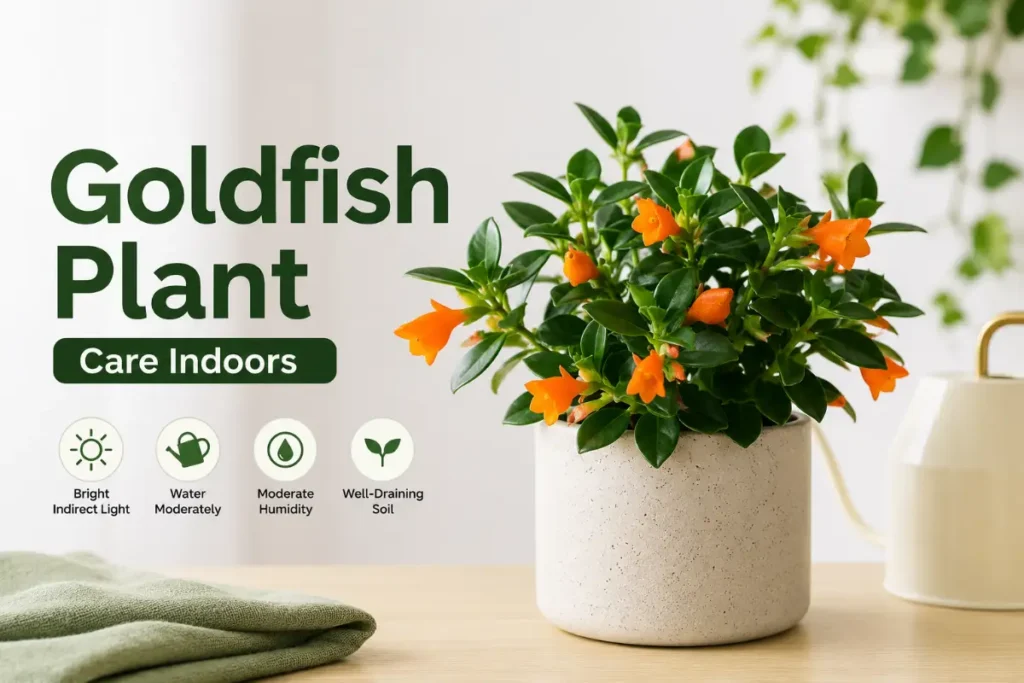
Goldfish plant care indoors is one of the more specific flowering houseplant challenges because this plant produces one of the most charming and distinctive flowers available from any commonly grown houseplant, a small orange-red bloom shaped unmistakably like a leaping goldfish, but it requires specific conditions to bloom consistently and abundantly rather than producing sporadic flowers on an otherwise green trailing plant.
The goldfish plant (Nematanthus gregarius, sometimes still sold as Hypocyrta) is native to the tropical rainforests of Brazil where it grows as an epiphyte on trees in warm, humid, brightly lit forest canopy conditions. Those three words, warm, humid, and bright, define the care approach that produces the abundant blooms this plant is capable of delivering.
Quick Answer
Goldfish plant care indoors requires very bright indirect light (the brightest position available short of direct harsh sun), consistently moist but never waterlogged soil, temperatures between 65 and 85 degrees Fahrenheit, high humidity above 50%, fertilizing with a high-phosphorus formula every two weeks through the growing season, a brief cool dry period in fall to trigger the bloom cycle, and protection from cold drafts and temperature fluctuations that cause bud drop before flowers open.
Understanding Goldfish Plant
Nematanthus gregarius is a tropical epiphyte that clings to tree bark in the humid upper canopy of Brazilian rainforests where it receives dappled but bright light filtered through the canopy above, consistently warm temperatures, high ambient humidity from the surrounding forest, and excellent drainage through the bark and organic debris it grows in rather than any true soil.
The distinctive orange-red flowers emerge from the leaf axils along the trailing stems and are shaped with a characteristic pouch at the base that has given the plant its common name. Each flower lasts one to three weeks and an abundantly blooming plant can carry dozens of flowers simultaneously, creating a striking display that makes this trailing plant genuinely impressive in hanging baskets and elevated positions.
The plant has a natural semi-dormant period in winter when flower production slows and the following spring bloom cycle is enhanced by the rest period. Managing this dormancy period correctly is one of the keys to consistently abundant blooming.
Step 1: Provide the Brightest Available Indirect Light
Light is the single most important factor driving bloom production in goldfish plant. This is a brighter-light tropical plant than most other flowering houseplants in the epiphyte category and the correlation between light quality and bloom abundance is direct and significant.
What works: The brightest indirect light available. An east-facing window with morning sun is excellent. A position within one to two feet of a south or west-facing window where bright light is intense without direct afternoon sun rays hitting the leaves. Under artificial grow lights running twelve to fourteen hours daily for indoor spaces without adequate natural light.
What causes problems: Insufficient light produces a healthy-looking green plant that produces few or no flowers regardless of how good other care conditions are. This is the most common cause of goldfish plant failure to bloom in typical indoor collections. The plant tolerates lower light but reserves its flowering for conditions where light is sufficient to support the energy-intensive bloom production process.
Direct sun: Brief morning direct sun from an east-facing window is tolerated and even beneficial for bloom production. Harsh direct afternoon sun from south or west-facing windows without any filtering causes leaf bleaching and flower scorching.
Grow lights: Goldfish plant responds particularly well to grow lights since the consistent high-intensity light they provide mimics the steady bright light of the tropical canopy environment far better than the variable natural light of indoor windows. A high-output LED grow light running twelve to fourteen hours daily positioned within six to twelve inches of the plant produces abundant consistent blooming that is difficult to achieve with natural indoor light alone in most homes.
Step 2: Water Carefully for Moist but Not Wet Conditions
As an epiphyte that evolved on tree bark rather than in soil, goldfish plant roots need excellent aeration and are highly susceptible to root rot from chronically wet conditions. The balance between consistent moisture and excellent drainage is more critical for goldfish plant than for soil-growing tropical plants.
The correct approach: Allow the top one to two inches of the growing medium to dry between waterings. Check by pushing your finger two inches into the mix. Water only when that depth feels dry. In a bright position during summer this typically means every seven to ten days. In lower light or winter every ten to fourteen days.
Water temperature: Use room temperature water. Cold water causes temperature shock to the roots and triggers the bud drop that is one of the most frustrating goldfish plant problems. Fill the watering can the day before use to bring it to room temperature naturally.
Avoiding bud drop: Bud drop (buds falling before opening) in goldfish plant is triggered by multiple stress factors of which cold water and temperature shock from watering are among the most common. Use room temperature water consistently and water at soil level without wetting the foliage or flower buds directly.
Signs of overwatering: Yellowing leaves starting from the lower stems. Soft, mushy stem sections near the soil. The distinctive musty smell of anaerobic decomposition from waterlogged growing medium. Goldfish plant root rot progresses quickly and is often fatal once it becomes visible above ground.
Step 3: Use a Well-Draining Epiphyte-Appropriate Growing Medium
Standard potting mix holds too much moisture for goldfish plant’s epiphyte roots. The bark-based, highly aerated growing medium that suits orchids and other epiphytes produces significantly better results for goldfish plant than any standard potting mix.
The right mix: A combination of 40 to 50% orchid bark (small to medium chips), 30% standard potting mix, and 20 to 30% perlite creates the drainage and aeration that goldfish plant roots need. This mix drains freely within thirty seconds of watering and the bark chips create the large pore spaces that keep roots well-aerated between waterings.
Alternative approach: Commercial African violet or gesneriad potting mix (goldfish plant is in the gesneriad family along with African violets and streptocarpus) is formulated for the moisture sensitivity of gesneriad roots and works well for goldfish plant with a small amount of perlite added.
Pot selection: Small pots appropriate to the root ball size with multiple drainage holes. Goldfish plant flowers most abundantly when slightly root-bound rather than in an oversized pot with excess soil volume. Terracotta pots provide additional drainage benefit through their porous walls.
For the complete guide to building appropriate growing media for epiphytic tropical plants, soil mixture for indoor plants covers every component including orchid bark and its role in creating the drainage and aeration that epiphyte roots require.
Step 4: Maintain Warm Temperature and Protect From Drafts
Goldfish plant blooms most abundantly in consistently warm conditions but is acutely sensitive to temperature fluctuations that cause bud drop, which is why draft protection is as important as temperature range for this plant.
Ideal temperature range: 65 to 85 degrees Fahrenheit during the active growing and blooming season. This range aligns with comfortable home temperatures for most people.
Cold sensitivity: Below 60 degrees bud drop becomes likely. Below 55 degrees the plant shows visible stress with foliage yellowing and growth stalling. Cold air from open windows, exterior doors, and air conditioning vents blowing directly on the plant is the most common environmental trigger for bud drop in goldfish plant in typical home conditions.
The draft problem: A goldfish plant positioned near a window that is opened regularly in spring or fall, or near an air conditioning vent in summer, experiences repeated cold air pulses that consistently drop buds before they open. Identifying and eliminating draft sources is often the single most effective action for plant owners frustrated by consistent bud drop in an otherwise healthy-seeming plant.
Winter dormancy temperature: A brief cool period of 55 to 60 degrees Fahrenheit for six to eight weeks in fall helps trigger a strong bloom cycle the following spring. This cool period should be above the bud-drop threshold but cool enough to signal the plant that a rest period is appropriate.
Step 5: Maintain High Humidity
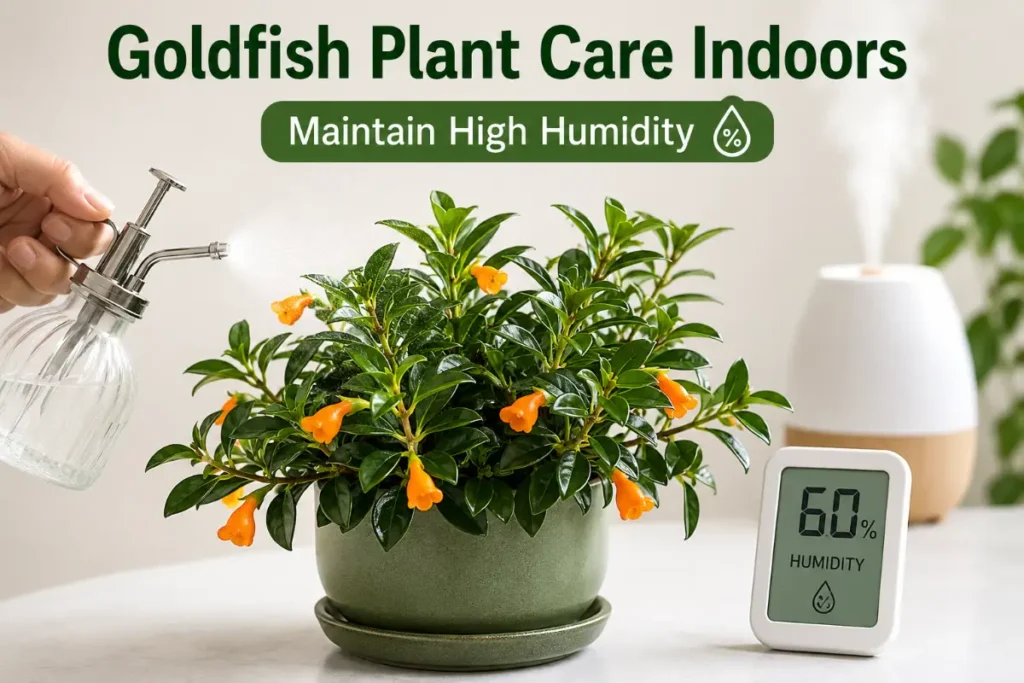
As a rainforest epiphyte, goldfish plant originates in some of the most consistently humid environments on earth and shows its humidity preferences through flower quality and stem health in dry indoor conditions.
Target humidity: Above 50% throughout the growing season. Above 60% during the bloom period produces the most flower quality and longest individual flower duration.
Signs of inadequate humidity: Brown stem tips. Flower petals that develop brown edges before fully opening. Bud drop in the absence of obvious temperature fluctuation (low humidity alone can trigger bud drop in sensitive plants like goldfish plant).
Effective solutions: A humidifier positioned within three to four feet of the plant. A large pebble tray with water beneath the pot. Grouping with other tropical plants to raise collective humidity through combined transpiration.
What to avoid: Misting directly onto flowers or buds since this creates conditions for botrytis grey mold on the dense flower tissue in the cool conditions near windows. Misting foliage is acceptable but keep moisture away from flowers and buds entirely.
Step 6: Fertilize With Phosphorus-Forward Formula for Blooming
Nutrition for goldfish plant differs from general foliage plant fertilizing because the goal is abundant bloom production rather than maximum vegetative growth. Phosphorus is the primary nutrient driving flowering and fruit production in plants and a fertilizer formula with elevated phosphorus (the middle number in the NPK ratio) produces significantly better bloom results than a balanced or nitrogen-forward formula.
What to use: A fertilizer with an NPK ratio emphasizing phosphorus such as 5-10-5, 10-30-10, or products specifically marketed for flowering and blooming plants. Apply every two weeks through spring and summer at half the label rate.
Organic alternatives: Bone meal incorporated into the growing medium at potting time provides a slow-release phosphorus source. Banana peel water applied every two to three weeks provides potassium alongside phosphorus for flowering support. For the complete guide to phosphorus-supporting natural fertilizer options for blooming tropical plants, natural fertilizer for indoor plants covers every effective natural approach with specific guidance on timing and application for flowering houseplants.
During the cool dormancy period: Stop fertilizing entirely during the six to eight week cool rest period in fall. Resume when growth activity picks up following the dormancy period.
What to avoid: High-nitrogen fertilizers drive leafy vegetative growth at the expense of flower production. A plant receiving nitrogen-heavy feeding may look lush and green while producing few flowers. Switching to a phosphorus-forward formula often produces noticeable bloom improvement within four to six weeks even without changing any other aspect of care.
Step 7: Manage the Annual Bloom Cycle With a Rest Period
This is the care step that separates consistent, abundant bloomers from plants that produce sporadic flowers without ever delivering the spectacular display they are capable of. Goldfish plant benefits from an annual rest period that mimics the seasonal variation of its native tropical environment and triggers a strong bloom response.
When to provide the rest period: Fall, approximately October through November for most US growers. The shortening days of fall naturally correspond to the plant’s reduced growth period.
What the rest period involves: Move the plant to a position that is slightly cooler than its normal location, ideally 55 to 60 degrees Fahrenheit. Reduce watering to every fourteen to twenty-one days, allowing the growing medium to dry more thoroughly than during the growing season. Stop fertilizing entirely. Allow the plant to sit quietly without significant intervention for six to eight weeks.
What happens during rest: Growth slows significantly. The plant may look temporarily less vibrant as it diverts energy from active production. New growth points develop quietly without pushing into active shoots.
Breaking dormancy: In December or January, return the plant to its normal warm, bright position. Resume normal watering and begin a phosphorus-forward fertilizer program. Within four to eight weeks new growth flushes with abundant bud development follow. The spring bloom cycle after a properly managed rest period is typically more abundant than blooming from plants maintained in uniform conditions year-round without a rest.
Preventing and Responding to Bud Drop
Bud drop is the most frustrating goldfish plant problem and deserves specific attention because it has multiple causes that require different responses.
Cold water shock: Water applied directly from the cold tap causes root temperature shock that triggers bud drop within one to two days of watering. Always use room temperature water.
Cold air drafts: Air conditioning vents, open windows, and exterior doors all expose the plant to cold air pulses that trigger bud drop. Position away from all draft sources.
Sudden environmental change: Moving the plant to a new location, even a better one, can trigger bud drop as the plant adjusts to new conditions. When buds are present, avoid moving the plant until after the bloom cycle is complete.
Low humidity: Chronic low humidity below 40% causes bud desiccation before opening, which appears as bud drop. Increase humidity with a humidifier or pebble tray.
Overwatering: Root rot impairs the plant’s ability to deliver water to developing buds. If bud drop is accompanied by yellowing foliage and musty soil smell, overwatering is the cause. Allow the medium to dry more thoroughly and check root health.
Goldfish Plant Varieties
Several distinct varieties of goldfish plant are available through specialty houseplant retailers and online sellers, each with slightly different flower colors and growth habits.
Nematanthus gregarius (the most common species) produces the classic orange-red goldfish-shaped flowers on trailing stems with dark green, slightly waxy leaves. This is the variety most buyers encounter at garden centers and florists.
Nematanthus ‘Black Gold’ has the same orange flowers as the species but with very dark, almost black-green leaves that create a striking contrast with the vivid flowers. It requires slightly less light than lighter-leaved varieties while maintaining acceptable bloom production.
Nematanthus ‘Tropicana’ produces yellow and orange bicolor flowers that are slightly larger than the standard species. It is less commonly available but sought out by collectors for its distinctive flower coloring.
Nematanthus ‘Christmas Holly’ has slightly holly-shaped leaves alongside the standard orange flowers and is often sold specifically as a holiday plant. Care requirements are identical to the standard species.
For most buyers, the standard Nematanthus gregarius available at garden centers is the most accessible starting point. Specialty varieties are available through gesneriad societies and online specialty retailers for growers who want to expand their collection beyond the standard form.
Goldfish Plant as Part of a Mixed Tropical Display
Goldfish plant works particularly well in hanging baskets and elevated positions where its trailing stems cascade downward and the flowers are visible from below, which is where the goldfish shape of the blooms is most apparent and most charming.
In mixed tropical displays, goldfish plant pairs effectively with other gesneriad family members including African violets and streptocarpus, which share similar care requirements for humidity, bright indirect light, and temperature stability. The trailing habit of goldfish plant contrasts well with the rosette forms of its gesneriad relatives and creates a layered display where different plant forms complement each other visually.
For the complete guide to African violet care and how it parallels goldfish plant care in terms of humidity requirements, temperature sensitivity, and phosphorus-forward fertilizing for bloom production, indoor azalea plant care covers the flowering plant care principles that apply across the category of indoor flowering plants with high humidity and cool-draft sensitivity.
Conclusion
Goldfish plant care indoors produces one of the most uniquely charming flowering displays available from any commonly grown houseplant when the plant’s specific needs are met. Abundant bright indirect light that most indoor positions underestimate in quantity. Epiphyte-appropriate growing medium that drains freely after watering. Room temperature water applied carefully to soil level. Warm, consistent temperatures with protection from drafts. High humidity. Phosphorus-forward fertilizing during the growing season. And a managed annual rest period that triggers the strong bloom cycle this plant is genuinely capable of delivering.
The goldfish plant that sits green and flowerless for months in typical indoor conditions is not a failed plant. It is a plant in insufficient light receiving balanced fertilizer without a rest period. Address those three specific factors and the same plant produces the abundant orange-red bloom display that makes it one of the most distinctive and rewarding flowering houseplants available.
Frequently Asked Questions
Why is my goldfish plant not blooming indoors?
The three most common causes of goldfish plant failure to bloom are insufficient light, balanced or nitrogen-heavy fertilizer rather than a phosphorus-forward blooming formula, and the absence of an annual rest period that triggers the bloom cycle. Improve light to the brightest available indirect position, switch to a fertilizer with elevated phosphorus, and provide a six to eight week cool rest period in fall followed by resuming care in a warm bright position.
How do I stop my goldfish plant buds from dropping?
Bud drop in goldfish plant is caused by cold water shock, cold air drafts from vents or windows, sudden position changes when buds are present, very low humidity, or overwatering causing root damage. Use room temperature water consistently, eliminate draft sources near the plant, avoid moving the plant while buds are developing, maintain humidity above 50%, and ensure the growing medium drains freely and does not stay wet between waterings.
How often should I water a goldfish plant?
Water when the top one to two inches of the growing medium feel dry, typically every seven to ten days in a bright position during summer and every ten to fourteen days in lower light or during the fall rest period. Use room temperature water to avoid the cold shock that triggers bud drop. Never let the plant sit in standing water in its saucer since the epiphyte roots are highly susceptible to root rot in waterlogged conditions.
What fertilizer is best for goldfish plant blooming?
A phosphorus-forward fertilizer with an NPK ratio emphasizing the middle number such as 5-10-5 or 10-30-10. Phosphorus is the primary nutrient driving flowering in plants and goldfish plant responds visibly to phosphorus-forward feeding compared to balanced or nitrogen-heavy formulas that drive vegetative growth at the expense of bloom production. Apply every two weeks through spring and summer at half the label rate and stop entirely during the fall rest period.
Can goldfish plant grow in low light?
Goldfish plant survives in low light but does not bloom in insufficient light regardless of how good every other aspect of care is. Bloom production requires more light energy than vegetative growth, and a plant in low light directs all available photosynthetic energy to maintaining its foliage rather than producing the energy-intensive flowers that make this plant worth growing. Provide the brightest available indirect light for consistent flowering.
How long do goldfish plant flowers last indoors?
Individual goldfish plant flowers last one to three weeks in good conditions with appropriate humidity and stable temperatures. On an abundantly blooming plant, flowers at different stages of development open in succession over a period of weeks to months, creating a continuous display rather than a single mass blooming event. The total bloom period in a well-managed plant with a proper rest period can last three to four months in spring through summer with adequate light and phosphorus-forward fertilizing.