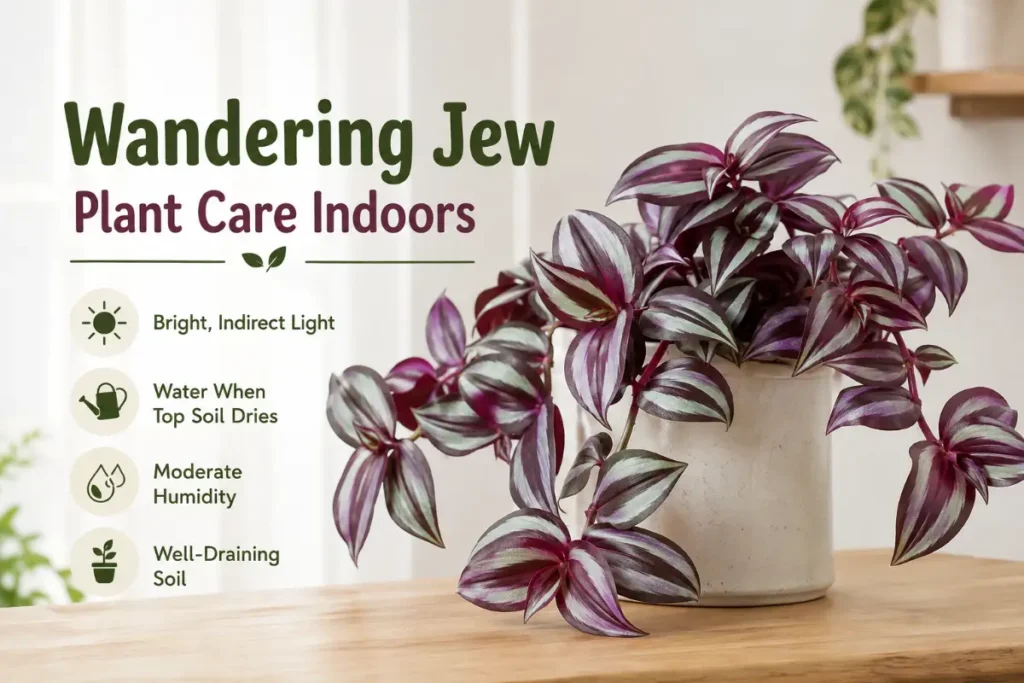
Wandering jew plant care indoors is genuinely one of the easiest care routines of any trailing houseplant, which is exactly why this plant is recommended to beginners and why it is consistently among the most popular indoor plants in the country. The wandering jew (Tradescantia zebrina and related species) is fast-growing, colorful, forgiving of occasional neglect, and propagates so easily from cuttings that a single plant can fill a hanging basket, trail from a shelf, and provide cuttings for a dozen new plants all within a single growing season.
The two things that most commonly go wrong with indoor wandering jew are the same two things that go wrong with most other colorful trailing plants: insufficient light causing color fade and leggy growth, and not pruning often enough to keep the plant full and dense rather than sparse and stringy. Get those two right and wandering jew is one of the most rewarding plants you can grow indoors.
Quick Answer
Wandering jew plant care indoors requires bright indirect light for the most vibrant purple, silver, and green leaf color, watering when the top inch of soil dries out, temperatures between 50 and 80 degrees Fahrenheit, moderate humidity, fertilizing every two weeks through spring and summer, regular pruning of stem tips to encourage fullness, and easy propagation from cuttings to refresh the plant when it becomes leggy with age. It tolerates more neglect than most colorful tropical plants while still producing impressive color when conditions are good.
Understanding Wandering Jew Plant
The plants commonly called wandering jew belong primarily to the Tradescantia genus, with Tradescantia zebrina (spiderwort, inch plant) being the most common species in indoor cultivation. The name wandering jew refers to the plant’s vigorous, spreading growth habit rather than to any human group, though the common name has become increasingly contested and many growers now prefer the alternative names inch plant, spiderwort, or simply Tradescantia.
In its natural habitat across Mexico and Central America, Tradescantia grows as a low, spreading groundcover in partially shaded, warm, humid forest margins and disturbed ground. It spreads aggressively when conditions suit it, which explains both its remarkable ease of propagation indoors and its invasive status in some warm outdoor climates where it has escaped cultivation.
The distinctive striped leaves in combinations of purple, silver-green, and dark green that make this plant so attractive are produced most intensely in bright indirect light and fade toward plain green in insufficient light just as with polka dot plant and Hawaiian ti plant. The underlying biology is similar: non-photosynthetic pigments are reduced when the plant needs to maximize chlorophyll for light capture.
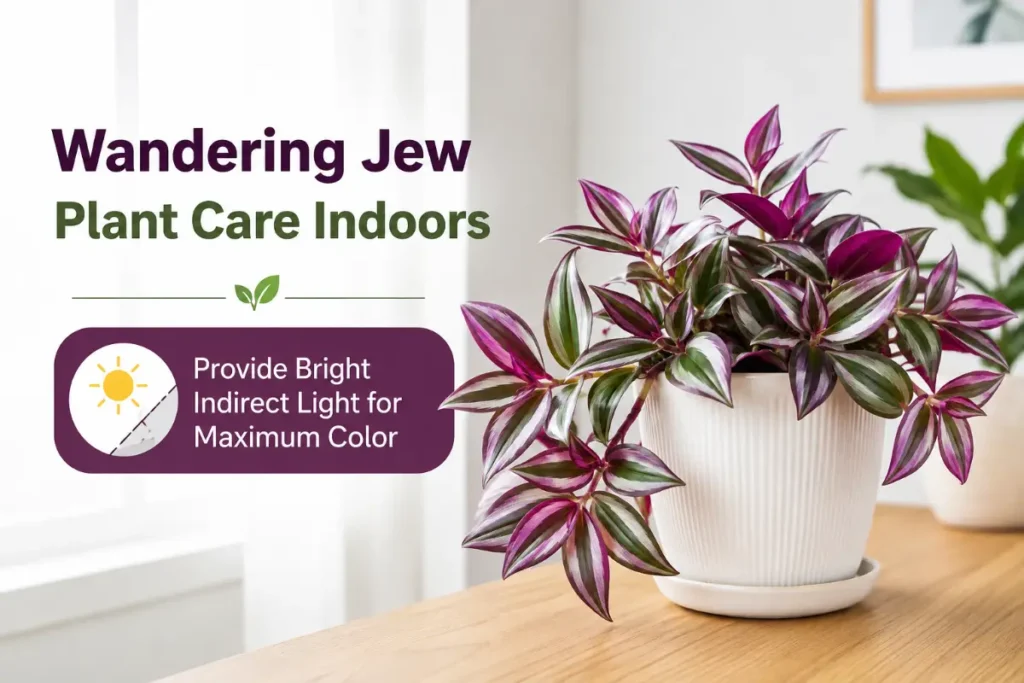
Step 1: Provide Bright Indirect Light for Maximum Color
Light is the primary determinant of leaf color vibrancy in wandering jew and the factor that most directly separates the dramatically colored plants you see in well-lit spaces from the dull green versions that result from placing this plant in dim corners.
What works: Bright indirect light from an east or west-facing window. Morning sun from an east-facing window is particularly beneficial for Tradescantia zebrina, which tolerates more direct sun than some other colorful foliage plants without significant scorching. A few feet back from a bright south-facing window.
What fades color: Insufficient light causes the purple and silver markings to fade toward plain green within weeks as the plant reduces non-photosynthetic pigment production. In very low light, new leaves emerge almost entirely green regardless of how vibrant the older leaves appear.
Direct sun tolerance: Unlike some other colorful tropical plants, wandering jew tolerates filtered direct sun reasonably well. Morning direct sun from an east-facing window or dappled light through a sheer curtain in a south-facing window actually produces the most vivid color in many Tradescantia varieties. Harsh afternoon sun without any filtering bleaches leaves and causes brown patches.
The outdoor summer option: Moving wandering jew outdoors for summer in partial shade produces the most vibrant color of any indoor or outdoor position. The natural light intensity outdoors even in shade is significantly higher than typical indoor bright indirect light and produces deeper, richer coloration. Transition gradually from indoor to outdoor conditions over one to two weeks to prevent sun shock.
Step 2: Water When the Top Inch Dries
Wandering jew is more drought-tolerant than its soft, succulent-textured stems suggest. The stems store moisture, giving the plant reasonable tolerance for occasional missed waterings without the dramatic immediate wilting that affects plants like polka dot plant.
The correct approach: Water when the top inch of soil feels dry. In a bright position during summer this typically means every five to seven days. In lower light or winter every seven to ten days. The plant signals mild underwatering through slightly limp, less upright stems before any visible wilting occurs, giving you an early warning to water before stress becomes significant.
Overwatering risk: Despite its moisture storage in stems, wandering jew is susceptible to root rot in chronically wet soil. The soft stems that look so full and healthy in good conditions collapse quickly from root damage caused by consistently overwatered soil. Always allow the top inch to dry between waterings rather than keeping the soil constantly moist.
Drainage: Use a pot with drainage holes and empty the saucer within thirty minutes of watering. Never leave wandering jew sitting in standing water since root rot from waterlogging develops faster than stem moisture storage can compensate.
Seasonal adjustment: Reduce watering frequency significantly in fall and winter as growth slows. One of the most reliable causes of wandering jew decline in otherwise good conditions is continuing summer watering frequency through winter months.
Step 3: Keep Temperatures Moderate and Consistent
Wandering jew is more cold-tolerant than most tropical houseplants, which increases its practical versatility in indoor growing conditions.
Ideal range: 50 to 80 degrees Fahrenheit. This wide range accommodates most indoor environments without any special temperature management and extends to cooler spare rooms and less-heated spaces that would stress more tropical species.
Cold tolerance: Wandering jew handles temperatures down to about 45 to 50 degrees without damage, making it suitable for cool sunrooms, enclosed porches, and less-heated interior spaces that many other tropical plants cannot tolerate. This cold tolerance also makes outdoor placement easier in spring and fall when nighttime temperatures drop into ranges that would damage true tropical plants.
Heat tolerance: The plant handles typical indoor summer temperatures well with adequate moisture and moderate humidity. Above 85 degrees in dry conditions the stems become noticeably more limp between waterings but recover immediately after watering without lasting damage.
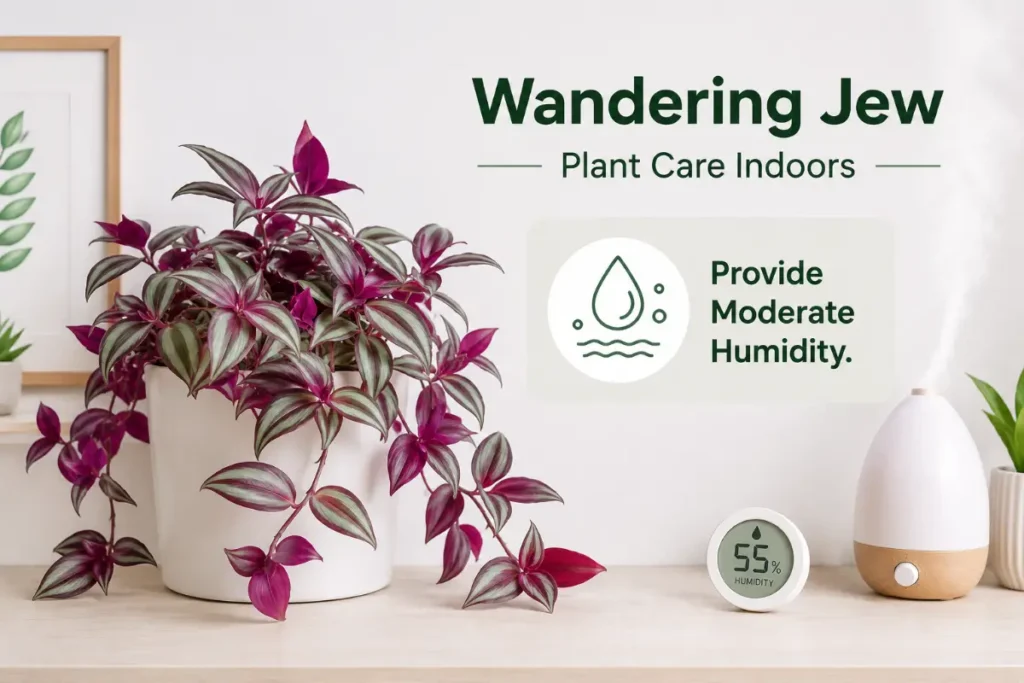
Step 4: Provide Moderate Humidity
Wandering jew is among the more humidity-tolerant indoor plants and performs well in the 40 to 60% humidity range typical of most US homes without requiring the active humidity management that more sensitive tropical plants need.
What adequate humidity looks like: Full, plump stems with the slight sheen that healthy moisture-sufficient Tradescantia stems display. No browning of stem tips. Consistent leaf color throughout the plant.
Signs of low humidity: Brown, dry stem tips particularly on the growing ends. Slightly less plump stem texture than in normal conditions. More rapid drying of the soil between waterings as the plant loses more moisture through transpiration in dry air.
Simple management: A pebble tray with water beneath the pot is typically sufficient for wandering jew in most indoor environments. The plant does not require a humidifier the way more sensitive tropical plants do. In very dry heated winter air, occasional misting of the stems (not in cold drafts) provides brief relief from desiccation without the disease risk that misting creates for plants with denser foliage structures.
Step 5: Fertilize Consistently Through the Growing Season
Wandering jew is a fast-growing plant during its active season and benefits from regular fertilizing to support the continuous new growth that keeps it looking full and colorful.
Through spring and summer: Feed every two weeks with a balanced liquid fertilizer at half the label rate. The rapid growth of wandering jew means it uses nutrients at a higher rate than slower-growing tropical plants and benefits from the consistent biweekly supply more than plants that grow more slowly.
What supports best color: A balanced NPK ratio rather than a high-nitrogen formula produces the best combination of growth vigor and color intensity. Excessive nitrogen drives lush pale green growth that dilutes the colored variegation in striped Tradescantia varieties. A balanced formula at half rate maintains both growth and color simultaneously.
Organic options: Worm casting tea applied every two weeks provides the gentle, burn-safe nutrition appropriate for the fast-growing but somewhat sensitive root systems of Tradescantia. For the complete organic fertilizer guide, worm castings for indoor plants covers every application method with timing guidance for fast-growing tropical plants.
Fall and winter: Reduce to monthly feeding or stop entirely when growth slows. Wandering jew can slow noticeably in winter even in adequate light as day length decreases, and continuing summer fertilizing frequency into the slow-growth period accumulates salts in the limited pot volume.
Step 6: Prune Regularly to Maintain Fullness
This is the care step most critical to long-term wandering jew appearance and the one most commonly skipped by owners who enjoy watching the plant trail and spread without intervention.
The problem with unpruned wandering jew: Stems extend and root contact with soil decreases as the lower portions of long stems become woody and less actively growing. The plant looks increasingly sparse with long bare sections of stem punctuated by leaf clusters at the tips. This is the natural growth habit of a groundcover plant that roots as it spreads, but in a pot without the ability to root into new soil, long bare stems are simply unattractive.
How to prune: Pinch or cut stem tips back to a node every two to four weeks during the growing season. Remove the top two to four inches of each stem. The plant produces new branches from the node below the cut within seven to ten days.
More aggressive pruning: When an established plant has developed many long bare stems, cut all stems back to within three to four inches of the soil surface. This seems severe but wandering jew regenerates vigorously from this level of pruning within three to four weeks, producing a fresh, dense new growth flush that restores the compact, full appearance of a young plant.
Using pruned material: Every pruned cutting from wandering jew is a propagation opportunity. Place stem cuttings in water and roots develop within one to two weeks. Pot in fresh moist potting mix and the cutting establishes as a new compact plant within a month. Adding cuttings back into the parent plant’s pot increases density immediately while the main plant regenerates from pruning.
Step 7: Propagate Freely and Often
Propagation is not just a way to make more plants with wandering jew. It is a core part of the care strategy that keeps your display looking its best through multiple generations of parent and cutting plants.
How easy propagation is: Cut a four to six inch stem section just below a node, remove the lower leaves, and place in water. Roots develop within one to two weeks without any special treatment, rooting hormone, or humidity tent. Pot the rooted cutting into moist well-draining potting mix and it establishes fully within three to four weeks.
When to propagate: Any time through the growing season when the parent plant is producing vigorous growth. Propagating annually in spring ensures you always have young, compact cuttings ready to replace aging parent plants when they become too leggy or sparse to restore through pruning alone.
Refreshing old plants: A wandering jew that has become very leggy, sparse, or has developed many bare woody stems is typically better replaced with fresh cuttings than rehabilitated through pruning. The cuttings start compact and full rather than starting from the bare section of an old stem and developing slowly.
Sharing: Wandering jew produces cuttings so readily and roots so easily that it is one of the standard plants for sharing among gardening communities, plant swaps, and friends. A single vigorous plant provides enough cutting material to start dozens of new plants in a single pruning session.
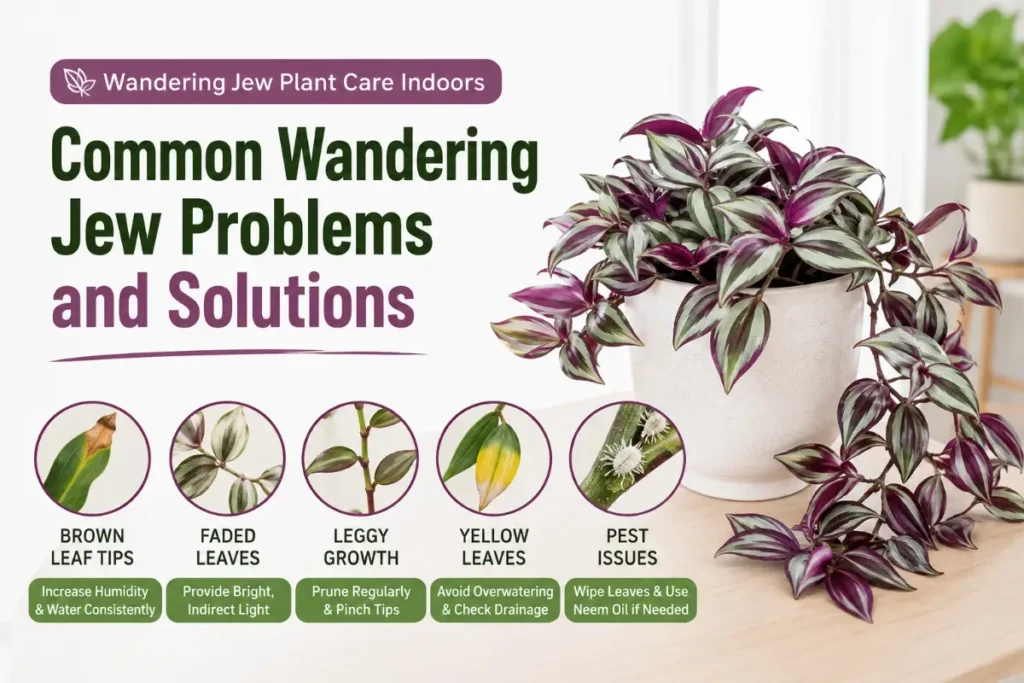
Common Wandering Jew Problems and Solutions
Color fading to green: Insufficient light. Move to brighter indirect light or add a grow light. New growth in better light emerges with full color within two to three weeks.
Leggy sparse stems with leaves only at tips: Combination of insufficient pruning and often insufficient light. Prune back aggressively and improve light simultaneously. Add cuttings back to the pot to increase immediate density.
Soft, collapsing stems near the soil: Root rot from overwatering. Remove from pot, inspect roots, trim any black or mushy sections, repot into fresh well-draining mix, and allow to dry more thoroughly between future waterings.
Brown stem tips: Low humidity in dry winter air. Increase humidity with a pebble tray. If using tap water in a hard water area, switch to filtered water since fluoride and mineral accumulation can also cause tip browning in wandering jew.
Pale, washed-out color despite adequate light: Possible nutritional deficiency. Begin or resume biweekly fertilizing at half rate. If the plant has been in the same potting mix for more than a year, repotting into fresh soil often produces immediate color improvement as fresh nutrients become available.
Wandering Jew Varieties Worth Knowing
The plants sold under the wandering jew name include several Tradescantia species and hybrid varieties with noticeably different leaf patterns and growth habits.
Tradescantia zebrina is the most common and most distinctively colored variety with its three-stripe leaf pattern of silver-green and purple-green stripes on the upper surface and solid purple on the underside. This is the variety most people picture when they think of wandering jew.
Tradescantia fluminensis produces smaller, solid green or white-striped leaves on a more delicate trailing stem. It is less colorful than T. zebrina but very easy to grow and propagate and often used as a filler plant in mixed tropical displays.
Tradescantia pallida ‘Purple Heart’ produces solid deep purple leaves on trailing to upright stems. This variety tolerates more direct sun than T. zebrina and actually develops deeper purple color in brighter conditions. It is one of the most drought-tolerant of the common Tradescantia varieties.
Tradescantia sillamontana has woolly white hair covering its leaves and stems creating a distinctive fuzzy texture unlike the smooth-leaved species. It requires more direct sun and better drainage than other varieties and is somewhat more challenging to grow in typical indoor conditions.
For most indoor growing situations, T. zebrina and T. pallida Purple Heart are the most reliable and most visually striking choices. Both maintain their color reasonably well in bright indirect indoor light and propagate with the same ease as all Tradescantia species.
Seasonal Care Adjustments for Wandering Jew
Spring: Resume biweekly fertilizing as day length increases and growth accelerates. Begin regular fortnightly pruning to establish the compact form before summer growth becomes vigorous. Consider starting fresh cuttings from the most colorful growth if the parent plant is more than twelve months old.
Summer: Full fertilizing and pruning schedule. If moving outdoors, transition gradually over two weeks. Watch for spider mites in dry air-conditioned environments. This is the peak propagation season when cuttings root fastest and new plants establish most quickly.
Fall: Reduce fertilizing to monthly as growth slows. Continue pruning but expect slightly slower branching response. If outdoors, bring inside before nighttime temperatures drop below 45 degrees. Inspect for pests before bringing inside.
Winter: Stop fertilizing or reduce to once every six to eight weeks. Water less frequently as growth slows. Maintain humidity since winter heating drops indoor humidity significantly and wandering jew develops brown stem tips in very dry air. Monitor for spider mites which peak in warm dry winter indoor conditions.
For companion planting ideas that pair well with wandering jew’s trailing purple and silver coloring in mixed tropical displays, hawaiian ti plant indoor care covers the tall upright statement plants that create the most visually dynamic contrast with low trailing wandering jew as a companion groundcover layer in mixed indoor arrangements.
Conclusion
Wandering jew plant care indoors is one of the most accessible and most rewarding of all trailing houseplant care routines. The combination of remarkable ease of propagation, vivid leaf color in good light, tolerance for a wide temperature range, and rapid recovery from occasional care lapses makes this plant consistently one of the best recommendations for both new and experienced indoor gardeners.
Provide bright indirect light for vivid color. Water when the top inch dries. Prune regularly to maintain fullness. Propagate from cuttings to refresh the plant annually. Those four practices cover the essence of wandering jew care and produce the lush, colorful, trailing display that makes this plant such a consistent favorite in indoor plant collections of every size and style.
Frequently Asked Questions
Why is my wandering jew plant turning green and losing its color?
Color loss toward green in wandering jew almost always indicates insufficient light. The purple and silver markings fade as the plant reduces non-photosynthetic pigment to prioritize chlorophyll in low light. Move to a brighter position with more bright indirect light and new growth will emerge with full color within two to three weeks. Already-faded leaves will not recover their color but new growth in better light shows full intensity.
How often should I water wandering jew indoors?
Water when the top inch of soil feels dry, typically every five to seven days in a bright position during summer and every seven to ten days in lower light or winter. Wandering jew stores some moisture in its stems and is more drought-tolerant than its soft texture suggests, but root rot from chronically wet soil is still a real risk. Allow the top inch to dry between waterings consistently.
How do I make my wandering jew plant fuller and less leggy?
Prune stem tips back to a node every two to four weeks throughout the growing season. Each pruned tip produces two new branches from the node below creating a progressively fuller plant over multiple pruning sessions. For very leggy plants, cut all stems back to within three to four inches of the soil surface. The plant regenerates vigorously within three to four weeks. Add rooted cuttings back to the parent pot to increase immediate density.
Can I grow wandering jew outdoors?
Yes, in USDA zones 9 to 12 as a perennial groundcover. In zones below 9, it can be grown outdoors as an annual during warm months. Note that wandering jew is considered invasive in some warm regions where it escapes cultivation and spreads aggressively. Check local invasive species guidelines before planting outdoors in warm climates. For summer outdoor placement in a pot, it produces the most vivid color of any growing condition and can be brought back indoors before the first frost.
Is wandering jew toxic to pets?
Yes, moderately. Tradescantia species cause contact dermatitis in both humans and animals when the sap contacts skin, and gastrointestinal symptoms if ingested by cats or dogs. The toxicity is generally considered mild to moderate rather than severe, but the skin irritation from contact with the sap can be significant in sensitive animals. Keep out of reach of pets that regularly chew on or brush against houseplants.
How long does a wandering jew plant live indoors?
Individual stems naturally become woody and less vigorous after one to two years but the plant as a whole lives indefinitely through propagation from cuttings. A wandering jew kept through regular propagation, where cuttings are taken from the most vigorous growth annually and used to replace aging stems in the display, essentially lives forever as a continuously refreshed collection of young vigorous stems rather than a single aging specimen.