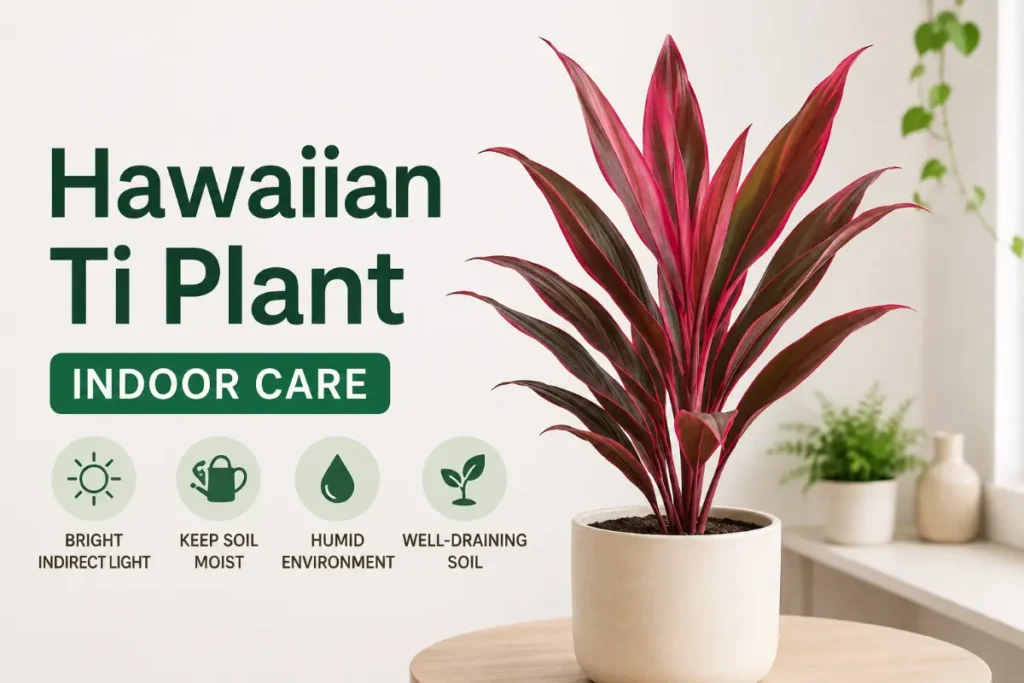
Hawaiian ti plant indoor care is one of those topics where the common name creates confusion before care even begins. The Hawaiian ti plant (Cordyline fruticosa) is not the same plant as the New Zealand cabbage tree (Cordyline australis) which shares a common name in some regions, and it is not related to the tea plant despite a similar sounding name. It is a tropical plant native to Southeast Asia and the Pacific Islands grown primarily for its dramatic, often strikingly colored foliage in shades of red, purple, pink, green, and multicolored combinations that make it one of the boldest statement plants available for indoor use.
Getting Hawaiian ti plant care right is genuinely rewarding. This plant produces some of the most vivid, dramatic foliage of any commonly available indoor plant and maintains that drama for years with appropriate care. Getting it wrong produces the brown tipping and leaf drop that are the most common ti plant complaints and that trace to three correctable causes in the vast majority of cases.
Quick Answer
Hawaiian ti plant indoor care requires bright indirect light for the most vivid leaf color, watering when the top inch of soil dries out, temperatures between 65 and 95 degrees Fahrenheit, high humidity above 60% to prevent the brown tips that are this plant’s most common complaint, fertilizing every two weeks through spring and summer, protection from fluoride in tap water which causes brown tips more than any other single factor, and a stable position since it dislikes being moved repeatedly.
Understanding Hawaiian Ti Plant
Cordyline fruticosa grows naturally in the tropical rainforests of Southeast Asia, Papua New Guinea, and the Pacific Islands including Hawaii where it has been cultivated for thousands of years for its leaves used in clothing, food wrapping, ceremonial practices, and medicine. In its natural habitat it grows in warm, humid, partially shaded rainforest understory conditions with consistently moist, well-draining soil and high ambient humidity from the surrounding forest environment.
The striking leaf colors in pink, red, and purple varieties result from anthocyanin pigments that are most vividly expressed in good indirect light and suppress in insufficient light where the plant prioritizes chlorophyll for photosynthesis. This is the same pigment-light relationship that explains color fading in polka dot plants and other variegated species.
The plant grows as a multi-stemmed shrub in its native habitat, eventually reaching six to ten feet with layered tiers of leaves radiating from the stem tips. Indoors with pot restriction and lower light, growth is significantly slower and the plant typically stays within three to six feet of height over many years.
Step 1: Light for Maximum Color Intensity
Light is the primary determinant of leaf color vibrancy in Hawaiian ti plant. The vivid reds, purples, and pinks that make this plant so striking are most intensely expressed in good bright indirect light and fade toward green in insufficient light as the plant reduces anthocyanin production to prioritize chlorophyll for photosynthesis.
What works: Bright indirect light from an east or west-facing window. A few feet back from a south-facing window where direct afternoon sun rays do not hit the leaves. Morning sun from an east-facing exposure is well-tolerated by most varieties.
What causes problems: Direct harsh afternoon sun bleaches and scorches the leaves, creating the brown dried patches on leaf surfaces that damage both the plant’s appearance and its photosynthetic capacity. Very low light causes the dramatic reds and purples to fade toward dull green over several months.
Variety-specific light needs: Deeper red and purple varieties like Red Star and Purple Prince maintain color better in lower light than highly variegated pink and multicolored varieties that fade more readily. If your space has limited light, choosing a solid deep-colored variety produces more stable color than a complex multicolored one.
The color check: New leaves emerging at the growth tip are the most reliable indicator of whether current light conditions are supporting maximum color. New leaves in good light emerge with vivid color immediately. New leaves in insufficient light emerge pale or greenish and never develop full color intensity regardless of subsequent light improvements.
Step 2: Water Carefully for Moist but Not Wet Soil
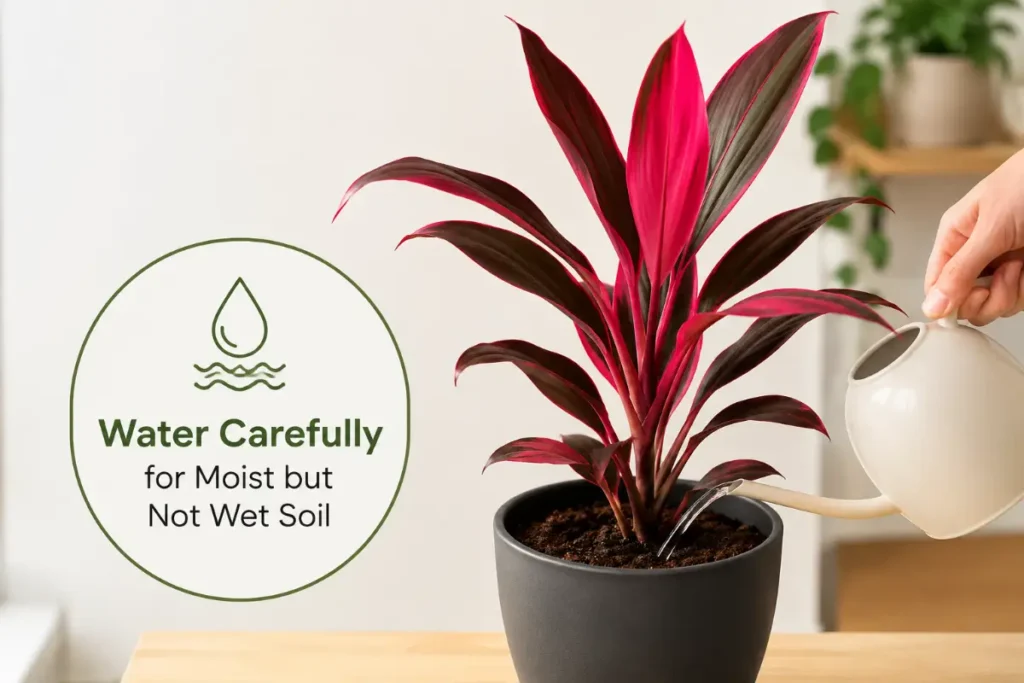
Hawaiian ti plant prefers consistently moist soil but is susceptible to root rot in chronically wet conditions. The balance between adequate moisture and good drainage is the same as for many tropical foliage plants but ti plant roots are particularly sensitive to both fluoride in water and to overwatering.
The correct approach: Water when the top inch of soil feels dry. In a bright position during summer this typically means every seven to ten days. In winter or lower light, every ten to fourteen days.
Water quality is critical: This is the most important water-related note for Hawaiian ti plant care. Fluoride in tap water causes the brown leaf tips that are the most common ti plant complaint and the most frequently misdiagnosed problem. Many plant owners assume brown tips indicate underwatering or low humidity and respond by watering more frequently, which worsens root conditions without addressing the fluoride problem.
If your ti plant has persistent brown tips despite adequate watering and humidity, switch entirely to distilled water, filtered water, or collected rainwater. The improvement in new leaf tip condition appears within four to six weeks of switching.
Flushing the soil: Even with filtered water, mineral and salt accumulation from fertilizing and natural soil chemistry gradual. Flushing the soil thoroughly every month or two by watering with two to three times the normal amount until water flows freely from drainage holes for several minutes leaches accumulated minerals and resets the salt balance in the root zone.
Step 3: Maintain High Humidity
As a rainforest plant, Hawaiian ti plant prefers humidity above 60% and shows the deficit most visibly through brown tips and edges that progress inward from the leaf margins when ambient humidity is chronically low.
Realistic assessment: Most US homes run between 30 and 45% relative humidity in winter when heating systems are active and between 45 and 60% in summer depending on climate. This means winter is the highest-risk period for humidity-related ti plant stress.
Effective solutions: A humidifier positioned within three to four feet of the plant is the most effective approach for maintaining above 60% humidity consistently. A large pebble tray with water beneath the pot provides modest local humidity increase. Grouping with other large tropical plants raises collective humidity through combined transpiration.
What does not work well: Misting provides humidity for only minutes before the water evaporates. For a plant that needs sustained above-60% humidity rather than brief moisture on leaf surfaces, misting is an inefficient approach. It also risks leaving water spots on the colorful leaf surfaces that detract from the plant’s appearance.
Step 4: Maintain Warm Temperature
Hawaiian ti plant is a genuine tropical plant with the temperature preferences to match.
Ideal range: 65 to 95 degrees Fahrenheit. The plant actively grows throughout this range with peak growth in the upper portion. This makes it well-suited to the warm conditions most people maintain in their homes.
Cold sensitivity: Below 55 degrees the plant shows visible stress with leaf discoloration and dropping. Below 45 degrees cold damage becomes significant and permanent in many varieties. Keep the plant well away from exterior doors, cold windowpanes in winter, and air conditioning vents that blow cold air directly on the foliage.
The warm preference advantage: Unlike the cool-preferring flowering plants in this cluster, Hawaiian ti plant genuinely thrives in the warm indoor conditions that most tropical houseplant owners maintain. This makes temperature management one of the simpler aspects of ti plant care in typical US homes.
Step 5: Use Well-Draining Soil
Hawaiian ti plant roots require good drainage alongside consistent moisture. The combination is achieved through the right soil composition rather than through any particular watering frequency.
The right mix: 60% quality potting mix combined with 20 to 30% perlite provides the balance of moisture retention and drainage that ti plant roots need. This drains freely after watering while retaining adequate moisture for the period between waterings.
Pot selection: Always use a pot with drainage holes. Terracotta pots provide additional drainage benefit through their porous walls but glazed ceramic and plastic pots with adequate drainage holes work well. The key is that no drainage hole is blocked and the saucer is emptied within thirty minutes of watering.
For the complete guide to building well-draining soil mixes for tropical foliage plants with drainage-sensitive root systems, soil mixture for indoor plants covers every component and the specific ratios that prevent the overwatering problems that ti plant roots are prone to in standard commercial mixes.
Step 6: Fertilize Through the Growing Season
Hawaiian ti plant is a moderate feeder that produces its best growth and most vivid color with consistent nutrition through the active growing period.
Through spring and summer: Feed every two weeks with a balanced liquid fertilizer at half the label rate. A formula that includes micronutrients supports both overall plant health and the pigment production that drives the leaf coloring that makes ti plant worth growing.
What to avoid: High-nitrogen formulas at full rate drive soft, pale-colored new growth that lacks the vivid color of growth produced under more moderate nutritional conditions. Excess nitrogen specifically reduces anthocyanin production, making deeply colored varieties look less vivid. A balanced formula at half rate produces better color than a high-nitrogen formula at any rate.
Organic options: Worm casting tea applied every two weeks provides gentle balanced nutrition alongside beneficial soil microorganisms. The slow-release nature of organic nutrition tends to produce more consistent growth quality and color than the boom-and-bust cycle of full-rate synthetic fertilizer applications. For the complete worm casting application guide, worm castings for indoor plants covers every method with specific timing guidance for tropical foliage plants.
Fall and winter: Reduce to monthly feeding or stop entirely when growth visibly slows. Ti plant in insufficient winter light that receives fertilizer it cannot use accumulates the salt residue that exacerbates the brown tip problem.
Step 7: Keep It in One Place
Hawaiian ti plant is more sensitive to position changes than many other common indoor tropical plants. Repeated relocation causes stress responses including lower leaf yellowing and drop that can take weeks to months to stabilize.
Why it matters: Ti plant adjusts its leaf angle, transpiration rate, and metabolic processes to the specific light, humidity, and airflow conditions of its position over time. Moving it to a different position, even one with similar or better conditions, requires the plant to readjust all of these processes simultaneously. During the readjustment period the plant looks worse than before the move even if it ultimately settles into a better position.
The practical implication: Choose the best available position for ti plant based on light quality, distance from heating and cooling vents, humidity level, and temperature stability. Make that choice once and commit to it. Do not move the plant to improve its appearance during periods of stress since the move itself typically extends the stress period rather than shortening it.
The exception: A plant in genuinely inadequate light that is declining from insufficient light is worth moving despite the temporary stress of relocation. A plant that is stable and healthy in its current position should stay there.
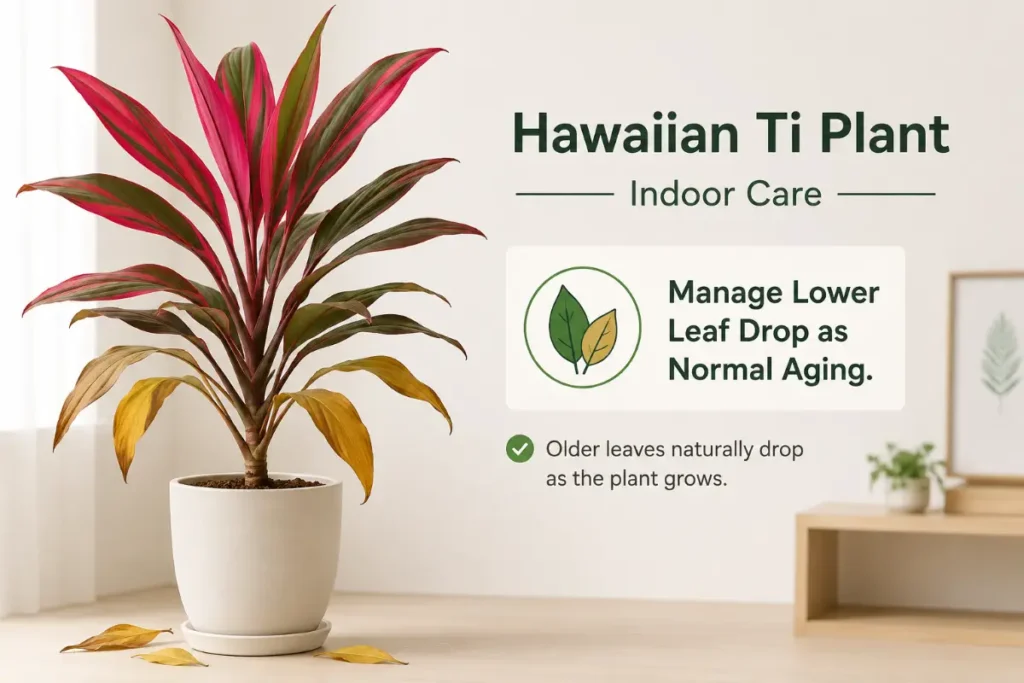
Step 8: Manage Lower Leaf Drop as Normal Aging
Hawaiian ti plant naturally drops its older lower leaves as it grows and produces new leaves from the stem tip. This creates the characteristic palm-like appearance of mature specimens with a bare lower stem and a crown of leaves at the top. This is not a problem to fix. It is the plant’s natural growth pattern.
What is normal: Lower leaves that have been on the plant for six to twelve months or longer gradually yellow and drop as the plant produces new growth from the tip. A single lower leaf yellowing and dropping every few months is entirely normal in a healthy plant.
What indicates a problem: Multiple simultaneous leaf yellowing and dropping throughout the plant, not just at the base. Yellowing that starts at the leaf tip and progresses inward indicating fluoride or salt damage rather than natural aging. Yellowing accompanied by soft or mushy areas at the stem base near the soil indicating root rot.
Managing the appearance: If the bare stem that develops as lower leaves drop is visually unappealing in the display context, placing companion low-growing plants around the base of the ti plant covers the bare stem while creating a layered tropical display. Lower-growing tropical companions including polka dot plant, pothos, or small ferns complement the ti plant’s bold upper foliage while filling the visual gap at the base.
For context on companion planting and how polka dot plant specifically works as a companion for taller tropical statement plants with bare lower stems, polka dot plant indoor care covers the low-growing companion role and the specific care overlap between polka dot plant and Hawaiian ti plant in mixed tropical displays.
Hawaiian Ti Plant Varieties for Indoor Growing
The Hawaiian ti plant category includes dozens of named varieties with dramatically different leaf colors and patterns. Knowing which varieties suit indoor conditions best helps you choose a plant that maintains its appearance in the light levels your home realistically provides.
Cordyline fruticosa ‘Red Star’ produces deep burgundy-red leaves that maintain their color better in lower light than most other colored varieties. It is among the most forgiving of common ti plant varieties for typical indoor light conditions and is a good choice for spaces where bright indirect light is available but not intense.
Cordyline fruticosa ‘Purple Prince’ has deep purple-green leaves with a metallic sheen that is distinctive among common houseplants. It maintains color in medium indirect light without the dramatic fading that affects more vibrant pink and tricolor varieties in the same conditions.
Cordyline fruticosa ‘Kiwi’ produces tricolor leaves combining cream, pink, and green that are visually striking but require the most light of any commonly available variety to maintain their color pattern. In insufficient light the cream and pink portions fade toward green within weeks. Best suited to the brightest available indoor positions.
Cordyline fruticosa ‘Firebrand’ has vibrant magenta-red new leaves that mature to deep red-green. The contrast between new and old growth creates a dynamic, multi-toned appearance that makes this variety particularly interesting as a specimen plant.
For most indoor environments where light is the limiting factor, solid-colored deep red and purple varieties maintain their appearance more reliably than complex multicolored varieties. Reserve highly variegated and tricolor varieties for your brightest window positions where they deliver their full visual potential.
Repotting Hawaiian Ti Plant
Ti plant grows moderately and needs repotting every two to three years as roots fill the current container.
Signs it needs repotting: Roots emerging from drainage holes. The plant drying out within three to four days of thorough watering. Significantly slowed growth during the active growing season despite adequate light and fertilizing.
Best timing: Spring when the plant is entering its most active growth phase and roots establish quickly in new soil.
Pot size: Choose a container two inches larger in diameter than the current one. Avoid large pot jumps since excess soil volume stays wet longer than ti plant roots tolerate, increasing root rot risk.
After repotting: Wait four to six weeks before fertilizing. Ti plant is somewhat sensitive to root disturbance and benefits from the establishment period in fresh soil before additional nutritional inputs are added. For the complete guide on post-repotting care and nutrition timing that applies to tropical foliage plants like Hawaiian ti plant, do you need nutrients after repotting a indoor plants covers exactly when to start and what rate to use for plants recovering from root disturbance.
Conclusion
Hawaiian ti plant indoor care produces one of the most dramatically beautiful results available from any common indoor plant when the specific needs of this tropical rainforest native are met. Bright indirect light for maximum color intensity. Filtered or distilled water to prevent the fluoride-induced brown tips that are the most commonly misdiagnosed ti plant problem. High humidity above 60%. Warm temperatures in the comfortable range for most tropical plants. Well-draining soil. Balanced biweekly fertilizing through the growing season. A stable position chosen once and maintained. And acceptance of natural lower leaf drop as part of the plant’s aging process rather than a care failure.
Address the fluoride and humidity issues that account for the majority of ti plant brown tip complaints and the rest of the care program falls into place naturally. This is a plant that rewards the gardener who understands its tropical origin and provides conditions that reflect that origin rather than treating it as a generic tropical foliage plant with standard care.
Frequently Asked Questions
Why does my Hawaiian ti plant have brown tips?
Brown tips on Hawaiian ti plant are most commonly caused by fluoride in tap water accumulating in leaf tissue, low humidity causing tip desiccation, or both occurring simultaneously. Switch to distilled, filtered, or rainwater immediately if you have been using tap water. Increase humidity with a humidifier or large pebble tray. The improvement in new leaf tip condition appears within four to six weeks of addressing both issues simultaneously.
How much light does a Hawaiian ti plant need indoors?
Bright indirect light from an east or west-facing window produces the most vivid leaf colors. Direct afternoon sun bleaches and scorches leaves. Very low light fades the reds, purples, and pinks toward green over several months. The most colorful new leaves emerging at the growth tip indicate adequate light conditions. Pale or greenish new leaves indicate insufficient light regardless of how vivid the existing older leaves appear.
Why are my ti plant leaves fading to green?
Color fading toward green in Hawaiian ti plant almost always indicates insufficient light. The anthocyanin pigments responsible for red, purple, and pink colors are reduced when light is inadequate as the plant prioritizes chlorophyll production for photosynthesis. Move to brighter indirect light and new leaves will emerge with more vivid color within two to four weeks. Already-faded leaves will not recover their color but new growth in better light shows full intensity.
How often should I water a Hawaiian ti plant?
Water when the top inch of soil feels dry, typically every seven to ten days in a bright position during summer and every ten to fourteen days in winter or lower light. Use distilled, filtered, or rainwater rather than tap water to prevent fluoride accumulation in leaf tissue that causes brown tips. Water thoroughly until drainage flows from the pot base and empty the saucer within thirty minutes.
Can I cut back a Hawaiian ti plant that has gotten too tall?
Yes. Cut the main stem to the desired height using clean sharp pruning shears. The plant produces new growth from buds below the cut within four to eight weeks. The cut stem section can itself be used as a propagation piece by placing it horizontally on moist potting mix or standing it upright in a container of water where it produces roots and new growth from its nodes. This propagation method, called tip or cane cutting, produces multiple new plants from a single pruning session.
Is Hawaiian ti plant toxic to pets?
Yes. Hawaiian ti plant contains saponins throughout its tissue that cause vomiting, drooling, loss of appetite, and depression in cats and dogs. Cats specifically may also experience dilated pupils and excessive drooling from contact with the plant’s sap. Keep Hawaiian ti plant out of reach of pets that regularly interact with or chew on houseplants, or choose non-toxic tropical alternatives for households with animals that cannot be kept away from plants.