

Learning how to care for rosemary plant indoors through the lens of what goes wrong rather than what to do right is often more useful than a standard care guide. Most indoor rosemary plants do not die from exotic disease or complicated problems. They die from the same nine mistakes that repeat across thousands of households every year, mistakes that are entirely predictable and entirely preventable once you know what they are.
This guide covers those nine mistakes in the order they most commonly occur, from the decision made at the garden center through the care practices that either preserve or kill the plant in the following months.
Quick Answer
How to care for rosemary plant indoors: provide six or more hours of direct sunlight through a south-facing window, use soil with 30 to 40% perlite for fast drainage, water only when the top two full inches of soil are dry, ensure excellent air circulation to prevent powdery mildew, keep temperatures between 55 and 80 degrees Fahrenheit, fertilize lightly every four to six weeks through spring and summer only, and prune regularly to maintain compact bushy growth. The three mistakes that kill most indoor rosemary are overwatering, insufficient light, and poor soil drainage.
Why Rosemary Is Particularly Unforgiving Indoors
Rosemary (Salvia rosmarinus) evolved on the rocky, sun-drenched limestone hillsides of the Mediterranean coast where virtually every environmental condition is the opposite of what the average indoor environment provides. The soil drains in seconds after rain. The sun shines with a UV intensity that glass substantially filters. The air moves constantly from coastal winds. The rainfall is seasonal, not year-round.
Indoor environments provide none of these conditions by default. Standard potting mix retains moisture for days. South-facing windows still provide only a fraction of Mediterranean sun intensity. Indoor air is still. And well-meaning plant owners water on a schedule rather than checking whether the soil has actually dried.
The result is predictable: a plant that looks healthy for weeks and then declines rapidly as the accumulated effects of one or more mismatched care practices reach a tipping point.
Mistake 1: Buying a Plant That Has Already Been Weakened
The decline of many indoor rosemary plants begins at the garden center before any care choices are made. Most retail rosemary is grown in moist, moderately lit greenhouse conditions and then displayed in warm, low-light garden center environments where overwatering by staff is common.
What to look for when buying: A plant with silver-grey-green foliage that is firm and aromatic when touched. No yellowing at the base. No musty smell from the soil. Soil that feels slightly moist but not soggy. Avoid plants that have been displayed indoors in low-light conditions for extended periods since these are already compromised before purchase.
The transition challenge: Even a healthy rosemary from the garden center needs careful transition to indoor conditions. Move it to the best available light immediately rather than starting it in moderate conditions and gradually improving. The longer it spends in inadequate light, the weaker it becomes before you have even begun active care.

Mistake 2: Using Standard Potting Mix Without Amendment
This is the second most common killer after insufficient light. Standard commercial potting mix holds moisture for three to five days after watering in typical indoor conditions. Rosemary roots in this environment begin developing root rot within weeks of being established.
The correct soil: Mix standard potting mix with 30 to 40% perlite or coarse horticultural sand before planting. This mixture drains completely within thirty to sixty seconds of watering and dries to two inches depth within three to four days in most indoor environments. If you have already planted in unamended mix, repot into the correct mix at the first opportunity rather than trying to manage watering around a soil that is fundamentally wrong for the plant.
The pot matters too: Terracotta is significantly better than plastic or glazed ceramic for rosemary because moisture evaporates through the porous walls as well as from the soil surface and drainage holes. A six-inch terracotta pot in good light dries to two inches within three to four days of watering, which matches the watering interval rosemary needs. The same plant in a plastic pot may still be moist at two inches five to seven days after watering.
For complete guidance on building fast-draining soil mixes for Mediterranean herbs, soil mixture for indoor plants covers every component with specific ratios.
Mistake 3: Choosing the Wrong Window
Rosemary needs direct sunlight, not just bright light, for at least six hours daily. The word direct is critical. Bright indirect light that suits most tropical houseplants does not provide sufficient UV and photon intensity for rosemary to maintain healthy, compact, essential-oil-rich growth.
The window hierarchy for rosemary:
- South-facing with afternoon sun: excellent
- West-facing with afternoon sun: acceptable
- East-facing with morning sun only: marginal, expect slower decline
- North-facing: will not sustain rosemary regardless of other care
What the wrong window produces: Stems that grow long and thin with leaves spaced far apart. Loss of the compact bushy form. Pale grey-green color rather than the deep grey-green of well-lit rosemary. Reduced fragrance as essential oil production drops. Increased susceptibility to powdery mildew as the plant weakens.
The grow light solution: If no adequate south or west-facing window is available, a high-output LED grow light running fourteen hours daily positioned six to ten inches above the plant provides sufficient light for healthy indoor rosemary regardless of natural light availability. This is the practical solution for apartments and north-facing homes.
Mistake 4: Watering on a Fixed Schedule
Watering rosemary every seven days or every ten days regardless of soil moisture is one of the most reliable ways to kill it. Fixed-schedule watering overwatering some weeks (particularly in winter when growth slows and water uptake drops significantly) and potentially underwatering others.
The correct method: Push your finger two full inches into the soil. Water only when that depth feels completely dry with no hint of coolness or moisture. This check replaces any calendar-based schedule and correctly adjusts for seasonal changes in light, temperature, and plant growth rate.
How long between waterings: In a south-facing window during summer, completely dry at two inches typically happens every ten to fourteen days. In winter or in any lower-light position, every eighteen to twenty-five days. Following the soil check rather than the calendar ensures you are responding to the plant’s actual moisture state rather than an approximation of it.
The consequence of ignoring this: Most indoor rosemary root rot is established in October through December when plant owners continue summer watering frequency into the reduced-growth fall period. The plant takes up far less water in fall and winter but receives the same amount, and the soil stays moist far longer than it did in summer when the same watering interval was appropriate.
Mistake 5: Allowing Water to Sit in the Saucer
A pot sitting in a saucer of water has soil that is permanently wetter at the root zone than the soil surface suggests. The drainage holes that should allow excess water to escape become pathways for water to continuously re-enter from below, creating the chronically moist root conditions that kill rosemary roots.
The correct approach: Water thoroughly until it drains from the holes. Then empty the saucer within fifteen minutes of watering. Do not allow water to remain in the saucer between watering events. This single practice eliminates one of the consistent background causes of rosemary root rot that continues regardless of correct surface-level soil moisture management.
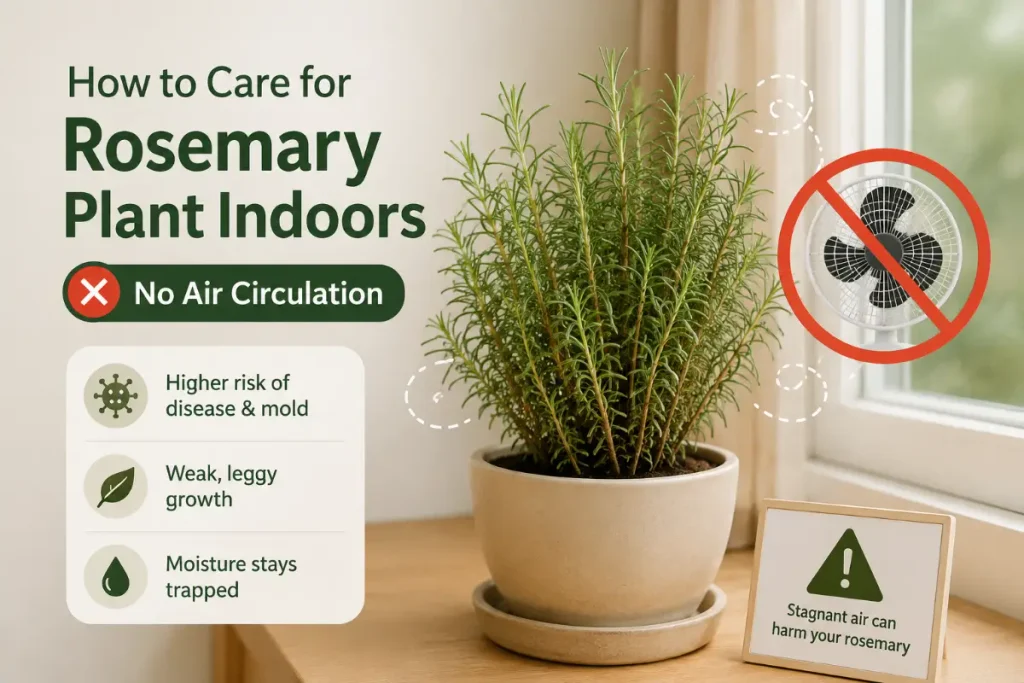
Mistake 6: No Air Circulation
Powdery mildew is the most common disease affecting indoor rosemary and is almost entirely caused by stagnant indoor air allowing fungal spores to settle on foliage and germinate without the wind dispersal that prevents this outdoors.
Signs of powdery mildew: White powdery coating on leaves and stems. Affected areas yellow and die as the infection spreads.
Prevention is the only reliable strategy: Run a small fan nearby on the lowest setting for several hours daily. Space the plant away from walls and other plants so air moves freely around it. Open windows briefly during mild weather. Once powdery mildew is established on indoor rosemary it is difficult to fully eliminate without removing significant plant material.
Treatment when it appears: Remove all affected stems and leaves immediately. Apply diluted neem oil spray every seven days for three to four weeks. Improve air circulation simultaneously since treatment without improved airflow creates the same conditions for immediate reinfection.
Mistake 7: Fertilizing Too Much or With the Wrong Product
Rosemary evolved in nutrient-poor rocky Mediterranean soil. High-nitrogen fertilizers applied at the rates appropriate for heavy-feeding tropical houseplants drive soft, pale, weak growth that is both less fragrant and more disease-susceptible than the compact, essential-oil-rich growth produced in lean conditions.
What works: A balanced fertilizer at one-quarter to half the label rate every four to six weeks through spring and summer only. This is significantly less than most houseplant fertilizer recommendations and reflects rosemary’s adaptation to lean conditions.
What to avoid: High-nitrogen synthetic fertilizers at full rate. Monthly or biweekly fertilizing. Any fertilizing in fall and winter. All of these produce the soft growth that shortens indoor rosemary’s productive life.
Mistake 8: Skipping Regular Pruning
Unpruned rosemary grown indoors develops long woody stems with leaves increasingly concentrated at the tips rather than along the stem length. The bottom portions of stems become bare and woody. New growth from the woody base becomes increasingly sparse. This progression is both unattractive and difficult to reverse.
How to prune correctly: Cut stems back by no more than one-third of their length using clean sharp scissors. Cut just above a leaf node where two small leaves or buds are visible. Never cut into the brown woody stems below the green growth since rosemary does not reliably regenerate from old wood.
When to prune: Every four to six weeks through the growing season. Regular culinary harvesting from stem tips functions as pruning since it removes terminal growth at the same nodes where deliberate pruning would occur.
What pruning accomplishes: Keeps the plant compact. Stimulates branching at cut points producing more stems overall. Improves air circulation through the plant’s interior by reducing dense growth. Maintains production of the fresh new growth with the highest essential oil content.
Mistake 9: Not Moving It Outside in Summer
The single most effective care strategy for indoor rosemary that most plant owners never try is moving the plant outdoors for the warm months. The direct sun, natural air movement, appropriate humidity, and temperature variation of an outdoor summer position in full sun produces plant health and vigor that no indoor care approach can match.
When to move it outside: After the last frost date for your area and once nighttime temperatures stay above 45 degrees consistently.
Where outdoors: Full sun on a patio, balcony, or outdoor windowsill. Rosemary handles direct all-day summer sun outdoors without the scorching that occurs through glass indoors.
The transition: Acclimate over one to two weeks by starting with morning sun and afternoon shade before full outdoor sun exposure. Plants adapted to indoor light levels need this gradual increase to avoid the sun scorch that can occur even on a sun-loving plant making a sudden transition.
Before bringing back inside in fall: Inspect for pests including spider mites and aphids that may have established during outdoor summer. Treat any found problems before introducing the plant to your indoor collection. For guidance on the pests most likely to accompany rosemary moved indoors, indoor plants that repel bugs covers the pest deterrent properties of rosemary itself alongside the pests that occasionally establish on it despite its aromatic defenses.

What Successful Indoor Rosemary Looks Like
Understanding what a healthy, well-cared-for indoor rosemary looks like helps you assess your plant honestly and catch problems early.
Healthy appearance: Compact, bushy growth with leaves well-distributed along the stems rather than concentrated at tips. Silver-grey-green leaf color that is rich and saturated rather than pale or yellowed. Firm, upright stems that do not droop or lean. Strong fragrance when foliage is touched or brushed. New growth emerging regularly through the growing season from both existing stem tips and from branching points below previous pruning cuts.
Early warning signs: Any yellowing at the base of the plant. Stems that feel slightly soft or mushy near the soil level. Reduced fragrance compared to when the plant was purchased. White powdery patches on any leaf surface. These early signals appear before the rapid decline that makes rosemary seem to die suddenly when it is actually the end stage of a longer deterioration.
Catching and correcting these signs while the plant still has healthy tissue to recover from gives you the best chance of reversing decline before it becomes irreversible. For the complete guide to proactive rosemary care that prevents these problems from developing, care for rosemary plant indoors covers the full positive care program that the mistake-avoidance approach in this guide is built around.
Recovering Rosemary From Each of the Nine Mistakes
Understanding how to recover from each mistake is as valuable as avoiding them in the first place since many plant owners arrive at this guide after a problem has already begun rather than before.
Recovering from wrong window placement: Move immediately to the best available direct sun position. Accept two to four weeks of adjustment period where the plant looks unchanged or slightly worse before it begins responding positively to better light. Do not move back to the original position if the plant looks temporarily stressed since stress during light adjustment is normal and reversible while the chronic stress of insufficient light is not.
Recovering from wrong soil: Repot into the correct fast-draining mix at the first opportunity. Do not wait for the next scheduled repotting time if root rot is developing. Repotting into correct soil is one of the most effective single interventions for a declining indoor rosemary.
Recovering from overwatering: Allow the soil to dry to two inches depth immediately. If root rot has developed, remove from the pot, trim affected roots, and repot into fresh fast-draining mix. Resume watering only when the two-inch check confirms complete dryness.
Recovering from powdery mildew: Remove all affected tissue. Improve airflow dramatically with a fan nearby. Apply neem oil spray every seven days for three to four weeks. Prevention through consistent airflow is more effective than treatment after establishment.
For the companion guide covering rosemary care from a positive best-practices perspective rather than the mistake-avoidance focus of this guide, how to care for a rosemary plant indoors covers the complete proactive care approach alongside variety selection and companion herb growing guidance.
Recovering a Struggling Indoor Rosemary
Many plant owners reach this guide after their rosemary has already begun declining. The recovery approach depends on which of the nine mistakes is responsible.
For root rot (soft stems, mushy smell, grey needles): Remove from pot immediately. Trim all dark, soft roots with clean scissors. Dust all cut surfaces with ground cinnamon which has antifungal properties. Repot into fresh mix with 40% perlite. Place in maximum available light. Water only when completely dry at two inches depth. Do not fertilize for six weeks. Recovery is possible if at least 30 to 40% of the root system remains healthy and firm.
For powdery mildew (white powder on leaves and stems): Remove all affected growth entirely. Improve air circulation immediately with a fan. Apply diluted neem oil (two teaspoons per quart of water) every seven days for four weeks. Do not mist or wet the foliage with water during treatment.
For insufficient light decline (leggy weak growth, pale color): Move to maximum available light immediately. Prune leggy stems back by one-third to stimulate compact new growth. Begin a light fertilizing program at quarter rate every six weeks. Expect four to eight weeks before visible improvement in new growth quality.
For salt accumulation from over-fertilizing (white crust on soil, brown needle tips): Flush the soil thoroughly with three times the normal watering volume, allowing water to run freely through the drainage holes for five full minutes. Stop fertilizing for six to eight weeks. Resume at quarter rate every six weeks when growth resumes.
For the complete understanding of all natural fertilizer options for Mediterranean herbs that avoid the over-fertilizing problem that causes salt accumulation in rosemary, natural fertilizer for indoor plants covers every gentle approach appropriate for the lean soil conditions rosemary prefers.
Seasonal Mistake Patterns: When Each Problem Most Commonly Occurs
Understanding the seasonal timing of indoor rosemary mistakes helps you anticipate and prevent problems before they develop rather than responding to them after visible symptoms appear.
Spring mistakes: Applying full-rate fertilizer too early before the plant has fully resumed active growth. Starting with aggressive pruning before the plant has produced sufficient new growth to support it. Moving directly to outdoor conditions without the two-week acclimation transition.
Summer mistakes: Forgetting to water when the hot sunny days increase water demand. Keeping the plant indoors in insufficient light when outdoor placement would provide dramatically better conditions. Not pruning after flowering, which allows the plant to put energy into seed production rather than vegetative growth.
Fall mistakes: This is the highest-risk season for fatal indoor rosemary mistakes. Continuing summer watering frequency as growth slows and water uptake decreases. Bringing an outdoor plant inside without inspecting for pests first. Failing to move the plant away from cold windowpanes as outdoor temperatures drop and glass surfaces radiate cold toward nearby plants.
Winter mistakes: Placing the plant near radiators or heating vents where warm dry air desiccates needles and creates the soft growth that is most susceptible to disease. Misting the plant thinking this helps humidity when it actually creates the moist foliage surface that powdery mildew requires. Fertilizing through winter when the plant is in slow or dormant growth and cannot use the nutrients provided.
Repotting Rosemary Correctly
Repotting rosemary incorrectly is a common mistake that stresses the plant unnecessarily and can trigger the root disruption that initiates rot.
When to repot: When roots emerge from drainage holes, when the plant dries out very rapidly after thorough watering indicating root mass has displaced most of the soil, or when transitioning from standard potting mix into the correctly amended fast-draining mix. Spring is the ideal time for repotting.
How to repot: Choose a pot only one to two inches larger in diameter than the current one. Larger pot jumps create excess soil volume that stays wet far longer than rosemary roots tolerate. Use the correctly amended fast-draining mix. Handle the root ball gently, disturbing roots as little as possible. Position the plant at the same depth it was in the previous pot.
After repotting: Wait four to six weeks before resuming fertilizing. The disturbed root system needs the establishment period before additional nutritional inputs are added. For the complete guide on post-repotting care timing that applies to rosemary and all Mediterranean herbs, do you need nutrients after repotting a indoor plants covers exactly when to start and what rate to use for drought-adapted plants recovering from root disturbance.
Conclusion
How to care for rosemary plant indoors is most effectively learned through understanding what kills it rather than through memorizing what to do. Avoid the nine mistakes in this guide and rosemary becomes significantly more manageable than its reputation suggests. Use fast-draining soil with plenty of perlite. Position in maximum available direct sun. Water by checking soil at two inches depth rather than on a calendar. Empty saucers immediately after every watering. Keep air moving around the plant. Fertilize lightly and seasonally. Prune regularly. And move it outside in summer whenever possible.
Each of those practices addresses one of the nine specific failure points that claim most indoor rosemary plants. Address all nine consistently and the same plant that dies for most owners becomes a fragrant, compact, productive herb that earns its place on the sunniest windowsill in your home.
Frequently Asked Questions
What kills indoor rosemary most often?
The three most common causes of indoor rosemary death are root rot from overwatering in poorly draining soil, insufficient light causing weakened plants susceptible to disease, and powdery mildew from stagnant indoor air. These three problems often occur together since a plant in insufficient light uses less water, causing the soil to stay moist longer than it would in good light, which increases root rot risk while the still indoor air creates mildew conditions simultaneously.
How do I know if my rosemary has root rot?
Early signs include grey or softening needles at the base of the plant, a musty smell from the soil, and soil that stays moist for more than a week after watering. To confirm, gently remove the plant from its pot and examine the roots. Healthy roots are white or tan and firm. Roots affected by rot are dark brown or black, soft, and often mushy. If less than half the root system is affected, trim rotted roots and repot in fresh fast-draining mix. If most roots are affected, recovery is unlikely.
Why does my indoor rosemary smell less fragrant over time?
Reduced fragrance indicates one or more of these conditions: insufficient light reducing essential oil production, overwatering diluting the essential oil concentration in leaves, excessive nitrogen fertilizing driving leaf tissue growth at the expense of oil production, or advancing age of stems where woody older tissue has lower oil content than fresh new growth. Improving light, reducing fertilizing, and pruning regularly to stimulate fresh new growth addresses all four causes simultaneously.
Can I save rosemary that has already turned grey?
Grey needles that drop when touched indicate advanced root rot. Remove from the pot immediately and examine roots. If a meaningful portion of roots are still firm and white or tan, trim all dark mushy roots with clean scissors, dust cuts with cinnamon or sulfur powder, and repot into very fast-draining mix. Improve light and air circulation simultaneously. If most roots are gone, the plant is unlikely to recover but it is worth attempting the rescue with nothing to lose.
How do I prevent powdery mildew on indoor rosemary?
Run a small fan nearby on low setting for several hours daily to maintain air circulation around the plant. Space away from walls and other plants so air moves freely around all surfaces. Open windows periodically during mild weather. Apply diluted neem oil spray preventively every three to four weeks during the growing season as a fungal deterrent before mildew appears. Prevention is significantly more effective than treatment once mildew is established.
Is it normal for indoor rosemary to drop needles?
A small amount of needle drop from the oldest growth at the base of the plant is normal as the plant ages and produces new growth from the tips. Sudden widespread needle drop, particularly if the fallen needles are green rather than brown and dry, indicates a stress event such as overwatering, drought, cold shock, or sudden environmental change. Gradual needle drop from the base progressing upward indicates ongoing root rot or chronic insufficient light.