
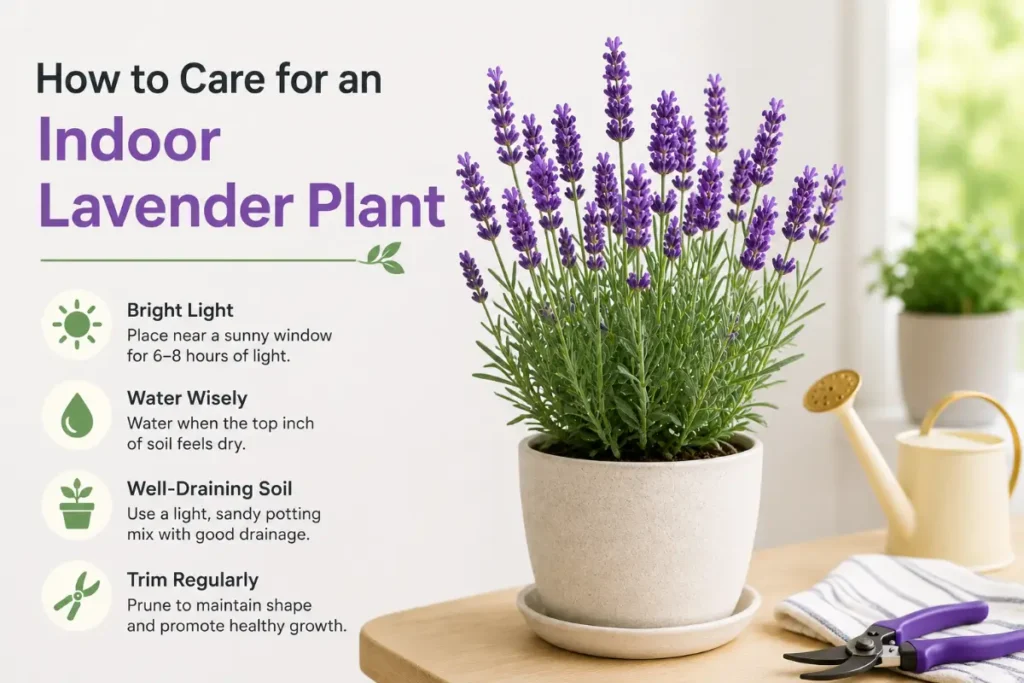
Knowing how to care for an indoor lavender plant is genuinely different from knowing how to grow lavender outdoors, and that difference explains why so many lavender plants purchased at garden centers and grocery stores die within weeks of being brought inside. Lavender is a Mediterranean subshrub with requirements so specific that the average well-intentioned indoor care approach kills it faster than neglect would.
The honest truth is that lavender is one of the more challenging plants to grow indoors successfully and certain care approaches that seem intuitive, keeping the soil moist, placing in moderate light, protecting from drafts, produce the opposite of what lavender needs. Understanding exactly why the Mediterranean environment that produced lavender is so different from the average indoor environment explains every care decision in this guide.
Quick Answer
How to care for an indoor lavender plant: provide at least six hours of direct sunlight daily through a south-facing window, use fast-draining soil with 50% perlite or coarse sand, water only when soil is completely dry two inches down, maintain temperatures between 50 and 80 degrees Fahrenheit, ensure excellent air circulation to prevent the fungal diseases that kill indoor lavender, fertilize sparingly only twice per year in spring and summer, and accept that indoor lavender is significantly more challenging than outdoor lavender with a lower long-term success rate.
The Honest Assessment of Indoor Lavender
Before the care steps, a frank assessment saves significant frustration. Lavender is not a natural indoor plant. It evolved on the sun-drenched, wind-swept, rocky limestone hillsides of the Mediterranean basin where it receives ten to twelve hours of intense direct sun, rainfall only in winter and spring, excellent drainage through shallow rocky soil, and constant movement of dry coastal air.
No typical indoor environment provides all of these conditions simultaneously. The best south-facing window provides three to five hours of sun through glass that filters UV radiation. Standard potting mix holds far more moisture than Mediterranean rocky soil. Indoor air is still and often more humid than lavender prefers. The result is that even attentively cared-for indoor lavender typically lives for one to two years before declining, compared to outdoor lavender that thrives for years with minimal management.
Understanding this honestly lets you decide: is indoor lavender worth the effort for the fragrance and beauty it provides for one to two years, or would a longer-lived indoor plant better suit your goals? For those who want to try, the following seven steps give indoor lavender the best possible chance.
Step 1: Light Is More Critical Than Any Other Factor
The single most common cause of indoor lavender failure is insufficient light. Most homes simply cannot provide the six-plus hours of direct sun lavender needs through a window, and the plant declines slowly but consistently in the dimmer conditions of typical indoor positions.
The minimum requirement: Six hours of direct sunlight daily through a south-facing window. Not bright indirect light. Not a well-lit room. Direct sun through glass. A south-facing window that receives sun from mid-morning through late afternoon is the only natural light position that consistently works for indoor lavender.
What insufficient light produces: Stretched, weak stems. Grey-green leaves that lose their silvery appearance. Reduced essential oil production and therefore reduced fragrance. Susceptibility to the fungal diseases that kill indoor lavender since stressed plants in insufficient light have weakened defenses.
The grow light option: A high-output LED grow light positioned six to twelve inches above the plant and running fourteen to sixteen hours daily is the most reliable solution for homes without adequate south-facing window light. Grow lights allow indoor lavender growing in spaces where natural light is genuinely insufficient and produce significantly better plant health than struggling with inadequate natural light.
Step 2: Soil Drainage Is Life or Death
Lavender root rot from overwatering in poorly draining soil is the most common direct cause of indoor lavender death and it progresses faster than with almost any other common indoor plant. The succulent-like roots of lavender that evolved in rocky Mediterranean soil have essentially no adaptation to wet conditions and rot with alarming speed.
The right soil: 50% standard potting mix with 50% coarse perlite or horticultural grit (coarse sand). This mixture drains completely within thirty seconds of watering and returns to dry conditions within two to three days in typical indoor environments. Standard potting mix without significant amendment holds far too much moisture for lavender roots.
The right pot: Terracotta is the best choice for indoor lavender. The porous walls allow moisture to evaporate from all surfaces rather than only from the drainage holes, producing the fast-drying cycle lavender roots require. A drainage saucer that is emptied immediately after every watering prevents the waterlogged base conditions that initiate root rot.
Testing the mix: After watering, count to thirty. Water should be draining freely from the holes throughout that count. If flow stops before thirty seconds, add more perlite to the mix at the next repotting.
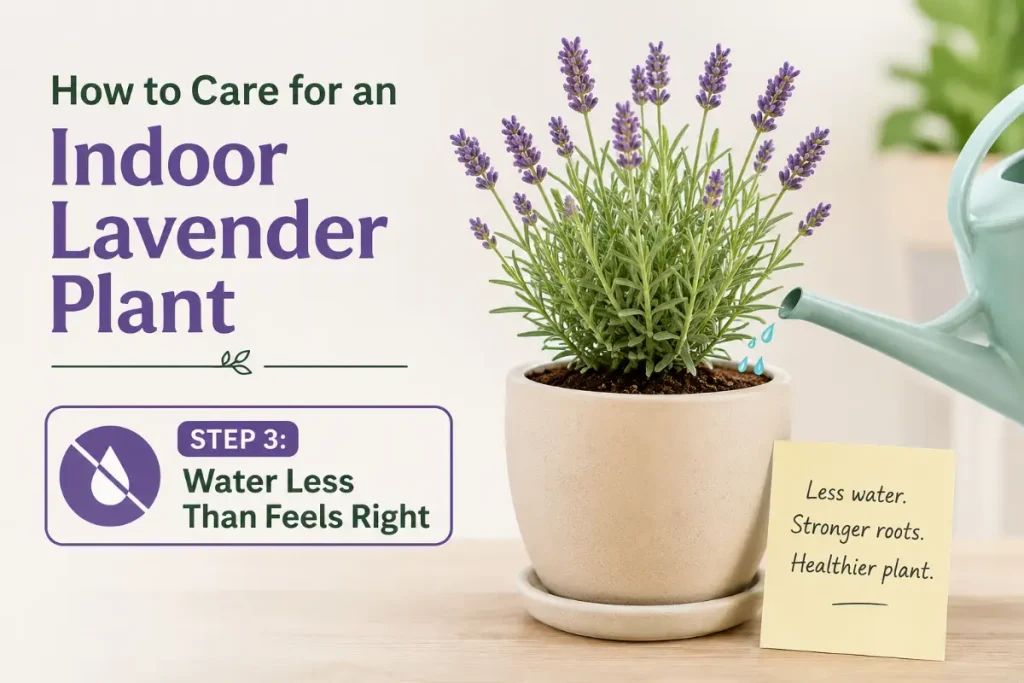
Step 3: Water Less Than Feels Right
This is where the intuitive care approach most often fails lavender. The plant looks thirsty in the average home because its grey leaves and small size suggest a delicate plant that needs regular moisture. In reality it is a drought-adapted subshrub that is far more harmed by overwatering than underwatering.
The correct check: Push your finger two full inches into the soil. Water only when that depth feels completely dry. In a sunny south-facing window during summer this might mean watering every twelve to sixteen days. In winter or lower light, every twenty-one to twenty-eight days or longer.
The thorough-then-dry cycle: When you water, water thoroughly until it flows from the drainage holes. Then allow the soil to dry completely to two inches depth before the next watering. The drying between waterings is not a neglect of the plant. It is the natural condition the plant evolved in and prefers.
What happens when you water too often: Roots begin to rot within days to weeks of chronic overwatering in an indoor pot. The first visible symptom above ground is typically a greyish, dull appearance to the foliage followed by softening of stem bases near the soil. By the time these symptoms appear, significant root damage has often already occurred.
Seasonal reduction: Lavender needs dramatically less water in winter. A common mistake is maintaining summer watering frequency through fall and winter as the plant’s growth slows, resulting in chronic winter overwatering that causes the spring decline many indoor lavender owners experience.
Step 4: Ensure Excellent Air Circulation
Lavender’s native Mediterranean environment is characterized by consistently moving air from coastal breezes. Indoors, stagnant air creates conditions for the botrytis grey mold and root crown rot that kill indoor lavender faster than any other disease problem.
The specific risk: Lavender with poor air circulation in moderately humid indoor conditions develops grey mold on stems and crown tissue that spreads rapidly and is very difficult to reverse once established. The combination of still air, moderate humidity, and the close planting typical of indoor displays creates ideal botrytis conditions.
Prevention: Space lavender away from other plants and walls so air circulates freely around all surfaces. Run a small fan nearby on low setting for several hours daily particularly during fall and winter when windows are closed. Open windows periodically in mild weather.
If grey mold appears: Remove all affected tissue immediately using clean sharp scissors. Improve air circulation dramatically. Apply a diluted neem oil spray every seven days for three weeks. Prognosis is poor once botrytis is established in the crown of lavender, which is why prevention through consistent airflow is critical.
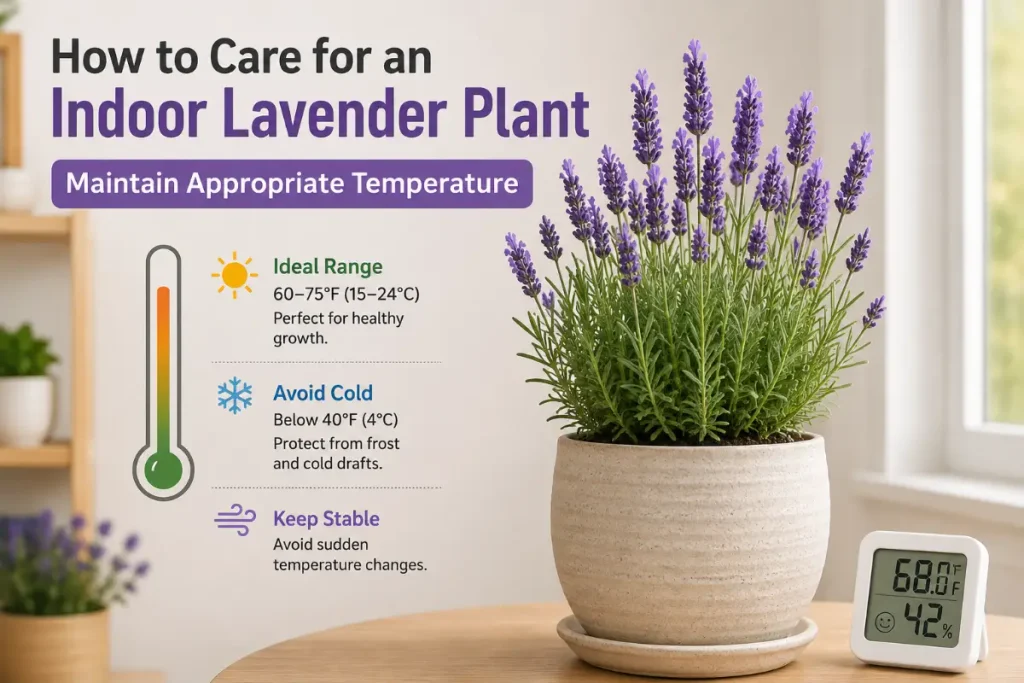
Step 5: Maintain Appropriate Temperature
Lavender is more cold-tolerant than most plants discussed in this guide, which provides some practical flexibility in placement.
Ideal range: 50 to 80 degrees Fahrenheit. Lavender actually performs better at the cooler end of this range for indoor growing. Consistent warmth above 80 degrees combined with the lower light of indoor conditions drives soft, weak growth more susceptible to disease than the compact, essential-oil-rich growth produced in cooler conditions.
Cold tolerance advantage: Lavender tolerates temperatures down to approximately 10 to 20 degrees Fahrenheit depending on variety, which makes it suitable for cool sunrooms, enclosed porches, and even garages with light access that would kill tropical houseplants. This cold tolerance is a practical advantage for growers with limited south-facing window space in heated rooms.
The cool bright position: A cool (55 to 65 degree) south-facing room or sunroom is often the best indoor environment for lavender. The combination of adequate direct light and cool temperatures produces more compact, disease-resistant, and fragrant growth than a warm room with equivalent light.
Step 6: Fertilize Minimally and Seasonally
Lavender evolved in nutrient-poor Mediterranean limestone soils and is one of the few commonly grown plants that performs better in lean conditions than in rich soil. Heavy fertilizing drives soft, disease-prone growth with reduced essential oil content and therefore reduced fragrance.
The correct approach: A single application of a low-nitrogen, slightly phosphorus and potassium-forward fertilizer in early spring and a second application in early summer. That is the full annual fertilizing schedule for indoor lavender. Nothing more through the rest of the year.
What to use: A fertilizer formulated for Mediterranean herbs or succulents with a low nitrogen content. Tomato fertilizer, which is high in potassium and moderate in phosphorus, is a practical option that suits lavender better than balanced general-purpose fertilizers. Apply at half the label rate.
What to avoid: High-nitrogen fertilizers at any rate. Monthly or biweekly fertilizing schedules appropriate for tropical houseplants. Both drive the soft growth that reduces fragrance and increases disease susceptibility in lavender.
Step 7: Choose the Right Lavender Variety for Indoors
Not all lavender varieties perform equally well in indoor conditions. Understanding the differences between the main lavender groups helps you choose the variety most likely to succeed in your specific indoor environment.
English lavender (Lavandula angustifolia) varieties including Hidcote, Munstead, and Vera are the most cold-hardy and the most tolerant of the imperfect conditions of indoor growing. They handle cooler temperatures, produce the classic lavender fragrance most people associate with the plant, and are generally more adaptable than French or Spanish types. Best choice for indoor growing in most situations.
French lavender (Lavandula dentata) has distinctive toothed leaves and blooms more continuously than English lavender including during winter months. It is less cold-hardy than English lavender but more tolerant of slightly higher humidity, which makes it marginally better suited to the humidity of typical indoor environments. Good choice for homes in warm climates or for growers who want continuous winter blooming.
Spanish lavender (Lavandula stoechas) with its distinctive rabbit-ear bracts is visually striking but the least tolerant of the humid, lower-light conditions typical of indoor growing. Not recommended for indoor cultivation in most situations.
Compact varieties: Within English lavender, the most compact varieties including Nana Alba, Little Lottie, and Baby Blue are better suited to pot cultivation than full-sized varieties since they stay smaller and require less aggressive pruning to maintain manageable size in indoor positions.
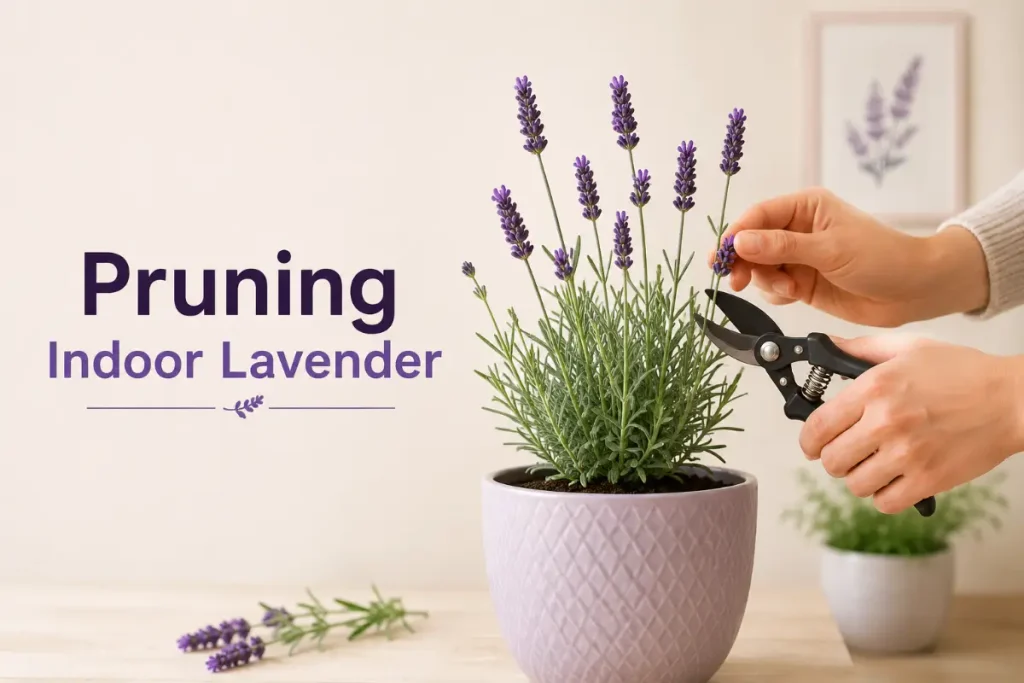
Pruning Indoor Lavender
Pruning is essential for keeping indoor lavender compact, preventing the woody die-back that occurs in unpruned lavender, and encouraging the fresh new growth from which the best fragrance and flowers emerge.
Annual pruning: In early spring before new growth begins, cut the entire plant back by one-third, cutting into the green growth above the woody base. Never cut into the woody brown sections below the green growth since lavender does not regenerate from old wood reliably.
After flowering: Remove spent flower stems by cutting back to just above the first set of leaves below the flower head. This prevents seed set which diverts energy from vegetative growth and maintains the plant’s compact form.
What not to do: Do not prune into woody stems below the current season’s green growth. Do not prune in fall since new growth stimulated by fall pruning is vulnerable to winter conditions. Do not skip annual pruning since unpruned lavender becomes increasingly bare at the base and sparse at the top over time.
For the complete guide to rosemary care, which shares lavender’s Mediterranean origin and many of its specific indoor care requirements, how to care for a rosemary plant indoors covers the full Mediterranean herb indoor care approach that applies to lavender with the specific differences noted in this guide.
Indoor Lavender Aromatherapy and Practical Uses
Despite the care challenges, lavender’s aromatic properties make it one of the most functionally useful plants you can grow indoors, and the practical applications of fresh and dried indoor lavender extend well beyond simple visual enjoyment.
Fresh lavender stems: Cut stems with open flower heads for use in small vases near work areas, bedside tables, and in bathrooms where the essential oil release provides a calming aromatic benefit. Research on lavender essential oil aromatherapy consistently shows measurable reduction in anxiety and improved sleep quality from exposure to linalool and linalyl acetate, the primary aromatic compounds in lavender.
Dried lavender sachets: Cutting stems just before the flowers fully open and bundling them for drying produces the most fragrant dried lavender. Hang bundles upside down in a warm airy location for two weeks. The dried bundles can be used in sachets for drawers and closets where their fragrance provides both a pleasant scent and some deterrent effect against fabric-eating moths.
Lavender-infused products: Fresh lavender from a healthy indoor plant can be used in homemade linen sprays (steep dried lavender in vodka, strain, dilute with water), bath products, and culinary applications in both sweet and savory cooking. Culinary lavender use favors the flowers and young leaves of English lavender varieties specifically, which are considered food-safe, while French and Spanish lavender have more camphor in their oil profile and are less appropriate for cooking.
The practical value of even one season of successful indoor lavender growth in terms of these applications makes the effort worthwhile for many growers even if the plant does not achieve the multi-year longevity that outdoor lavender routinely delivers.
Lavender Alongside Other Mediterranean Herbs Indoors
Growing lavender alongside other Mediterranean herbs that share its specific requirements creates a cohesive Mediterranean herb garden that is manageable as a single-care-approach group rather than multiple plants with different needs.
Rosemary shares essentially identical care requirements with lavender: maximum direct sun, fast-draining lean soil, infrequent deep watering, minimal fertilizing, and excellent airflow. A south-facing windowsill housing both rosemary and lavender in terracotta pots can be managed with a single consistent care routine.
Thyme is the other primary Mediterranean herb that fits this same care group. It is slightly more cold-hardy than lavender and slightly more tolerant of occasional overwatering, but its preference for lean fast-draining soil and maximum direct sun aligns well with lavender and rosemary care.
Oregano joins this group with similar Mediterranean preferences though it is somewhat more forgiving of imperfect conditions than lavender specifically.
The practical advantage of grouping these herbs is that their identical care requirements, particularly the infrequent watering schedule that lavender demands, become natural rather than requiring individual assessment of each plant’s moisture needs. When lavender tells you it is ready for water by the two-inch-dry soil check, the rosemary and thyme alongside it are almost certainly also ready. For the complete guide to rosemary indoor care that covers the Mediterranean herb approach that applies equally to lavender, care for rosemary plant indoors covers every specific detail of the same light, soil, watering, and airflow requirements that lavender demands.
Conclusion
How to care for an indoor lavender plant comes down to providing conditions as close to the Mediterranean hillside as your home allows. Maximum direct sunlight through the sunniest south-facing window. Soil that drains in seconds and dries completely between waterings. Watering so infrequently it feels like neglect. Excellent air circulation that prevents the fungal diseases stagnant indoor air creates. Cool temperatures rather than the warmth you might assume a Mediterranean plant needs. Minimal fertilizing twice per year. And the right variety chosen for indoor tolerance.
Those steps give indoor lavender its best chance at the one to two years of fragrant, beautiful growth it can realistically provide in most home environments. Manage expectations honestly, provide the specific conditions that work, and lavender rewards you with one of the most distinctive fragrances any indoor plant produces.
Frequently Asked Questions
Why does my indoor lavender keep dying?
The most common causes of indoor lavender death are overwatering in poorly draining soil causing root rot, insufficient light in a position that receives less than six hours of direct daily sun, and stagnant indoor air causing the botrytis grey mold that spreads through lavender crown tissue rapidly. Check all three factors simultaneously since they often occur together. Fast-draining soil with 50% perlite, a south-facing window with direct sun, and daily air movement from a nearby fan on low setting address all three primary failure causes.
How much sunlight does indoor lavender need?
A minimum of six hours of direct sunlight daily through a south-facing window. This is one of the highest light requirements of any commonly grown indoor plant. In positions receiving less direct sun, lavender declines slowly over months with increasingly weak, disease-prone growth and minimal blooming. A high-output LED grow light running fourteen to sixteen hours daily is the reliable solution for homes without adequate south-facing window light.
How often should I water indoor lavender?
Water only when the soil is completely dry two inches down, typically every twelve to twenty-one days in summer depending on light levels and pot size, and every twenty-one to twenty-eight days or longer in winter. This is significantly less frequent than watering most other houseplants and feels insufficient by intuitive comparison. Overwatering is far more damaging to lavender than underwatering. When in doubt, wait one more day.
Can lavender survive indoors in winter?
Yes, with appropriate care adjustments. Reduce watering very significantly in winter since lavender growth slows dramatically and requires much less water than in summer. Maintain the best available light since winter sun angles reduce natural indoor light intensity. Keep air circulating to prevent botrytis in the still air of closed winter homes. Cool temperatures in the 50 to 60 degree range are appropriate and preferred over warm indoor winter conditions for most lavender varieties.
What is the best lavender variety for indoor growing?
English lavender (Lavandula angustifolia) varieties including Hidcote, Munstead, and compact forms like Nana Alba are the most appropriate for indoor growing. They handle the cool temperatures and imperfect humidity of indoor environments better than French or Spanish lavender types. Among English varieties, the most compact cultivars suit indoor pot culture best since they require less pruning to maintain manageable size and fit better in the pot sizes practical for indoor use.
Why is my indoor lavender turning grey and dying?
Grey, dying lavender almost always indicates advanced root rot from overwatering in poorly draining soil. Remove from the pot immediately and examine roots. If most roots are dark, soft, and mushy, the plant may not be recoverable. If some firm, healthy white or tan roots remain, trim all affected material with clean scissors, dust cuts with cinnamon or sulfur powder, and repot into very fast-draining mix with 50% perlite. Reduce watering dramatically and improve light and airflow. Recovery depends on how much healthy root tissue remains, but early intervention significantly improves the odds.
Pingback: Indoor Plants That Like Direct Sunlight: 11 Sun-Loving Choices (2026) - Plant Quill