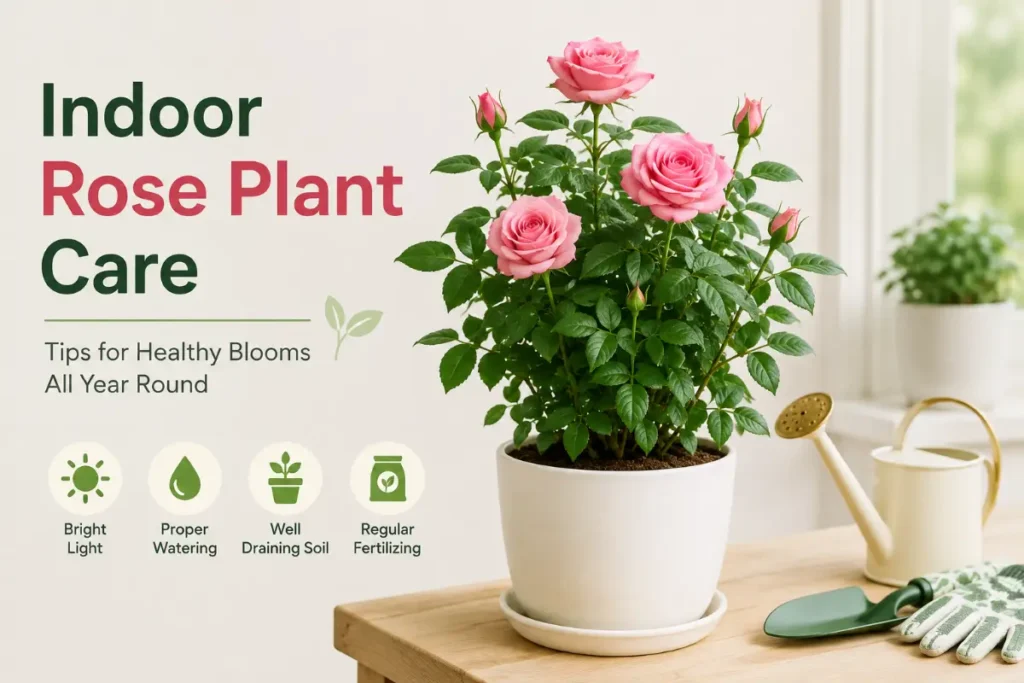
Indoor rose plant care is one of the most challenging flowering plant topics because roses are genuinely demanding plants with requirements that most home interiors struggle to provide, yet the desire to grow roses indoors is as strong as ever. The good news is that miniature rose varieties bred specifically for indoor and container growing can thrive indoors with the right approach. The less good news is that the standard advice of bright light and regular watering only scratches the surface of what indoor roses actually need to stay healthy and bloom consistently.
This guide covers the complete indoor rose care approach with specific attention to the problems that derail most indoor rose attempts and the solutions that actually work.
Quick Answer
Indoor rose plant care requires at least six hours of direct sunlight daily through a south-facing window or under grow lights, watering when the top inch of soil dries with good drainage to prevent root rot, humidity above 50% to prevent spider mites, temperatures between 60 and 75 degrees Fahrenheit, fertilizing every two weeks through the growing season with a rose-specific or high-phosphorus formula, regular deadheading of spent blooms, and vigilant pest management since roses attract spider mites and aphids more aggressively than almost any other houseplant.
Choosing the Right Rose for Indoors
This is the most important decision in indoor rose success and the one made incorrectly most often. Not all roses are created equal for indoor growing.
Miniature roses (Rosa chinensis minima and hybrids) are the most appropriate roses for indoor cultivation. They have been bred for compact size, continuous blooming, and tolerance of container conditions. Look for varieties labeled as patio, miniature, or mini roses at garden centers. These stay under two feet tall, bloom prolifically, and handle the indoor environment better than any other rose type.
Compact floribunda varieties like Cupcake, Cinderella, and Sweet Chariot are miniature roses with particularly good indoor track records. These varieties are worth seeking specifically rather than accepting whatever miniature rose is available.
What not to grow indoors: Hybrid tea roses, climbing roses, shrub roses, and large-flowered grandifloras are outdoor garden plants that do not adapt to indoor pot growing. They need the air circulation, light intensity, and root space of an outdoor garden to perform and will decline rapidly indoors regardless of care quality.
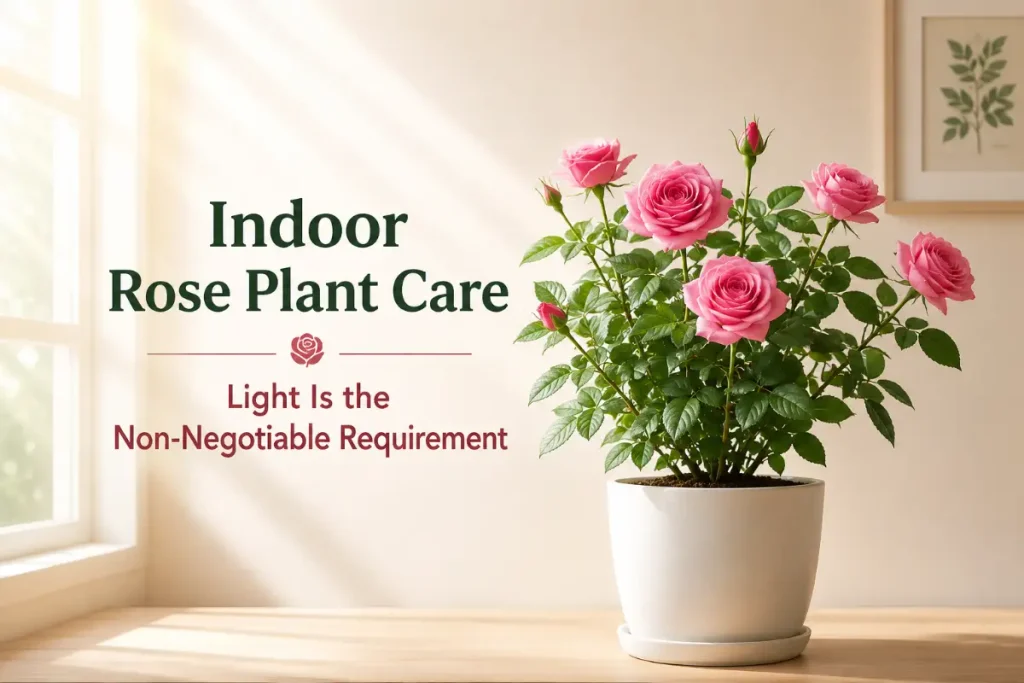
Step 1: Light Is the Non-Negotiable Requirement
Indoor roses need more light than almost any other flowering houseplant. Six hours of direct sunlight daily is the minimum, and more is better. This requirement immediately limits indoor rose growing to homes with very sunny south-facing windows or to growers willing to invest in grow lights.
South-facing window: The only natural light source that realistically provides six or more hours of direct sun indoors in most US locations. A south-facing window with no obstructions outside and clean glass provides the best natural light for indoor roses.
Grow lights: A high-output LED grow light positioned six to twelve inches above the rose and running fourteen to sixteen hours daily is the most reliable way to grow roses indoors regardless of natural light availability. Grow lights allow indoor rose growing in apartments, north-facing rooms, and any space where natural light is insufficient. The investment is meaningful but produces dramatically more consistent blooming than struggling with inadequate natural light.
Signs of insufficient light: Long, thin stems with widely spaced leaves. Buds that fail to open fully. Very few flowers despite otherwise adequate care. Pale, leggy growth. Insufficient light is the most common cause of indoor rose failure.
Step 2: Water Correctly to Avoid the Two Extremes
Roses are sensitive to both overwatering and underwatering in ways that create distinct and damaging problems. Getting the moisture balance right is more critical for roses than for most other houseplants.
The correct approach: Water when the top inch of soil feels dry. Do not allow roses to dry out completely since drought stress causes immediate bud drop and leaf drop. Do not keep the soil consistently wet since root rot develops quickly in waterlogged rose soil.
How to water: Water at the soil surface without wetting the foliage. Wet foliage is one of the primary triggers for black spot fungal disease on roses. Use room temperature water since cold water stresses rose roots.
Drainage: Always use pots with drainage holes. Rose roots are highly susceptible to root rot in standing water. Empty saucers within thirty minutes of watering.
Signs of underwatering: Sudden bud drop and leaf drop simultaneously. Soil pulling away from pot sides. Leaves that curl inward before drooping.
Signs of overwatering: Yellow lower leaves. Soft, mushy stem base. Musty soil smell. These symptoms indicate root rot that progresses quickly in roses.
Step 3: Soil for Indoor Roses
Rose roots need well-draining soil with adequate nutrient content since roses are heavy feeders with sensitive root systems.
The right mix: A mix of 60% quality rose-specific potting mix or general potting mix with 20% perlite and 20% worm castings. The perlite improves drainage. The worm castings provide slow-release nutrition and beneficial soil biology that supports healthy rose roots.
Pot size: Miniature roses in pots between six and ten inches in diameter perform well. Pots that are too small dry out too quickly and stress the root system. Pots that are too large hold excess wet soil that encourages root rot.
For the complete guide to building appropriate soil mixes for flowering plants with high nutrition and drainage requirements, soil mixture for indoor plants covers every component with specific guidance for the moisture and drainage balance roses require.
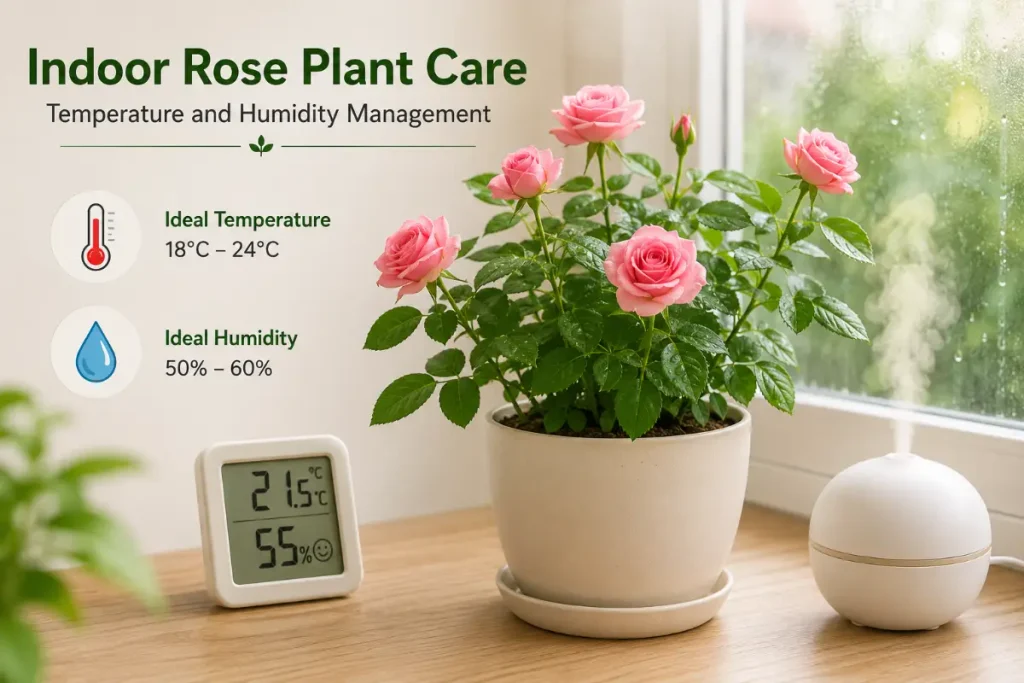
Step 4: Temperature and Humidity Management
Temperature: Roses prefer temperatures between 60 and 75 degrees Fahrenheit. This range is slightly cooler than what most tropical houseplants prefer and aligns with the cool greenhouse conditions that commercial rose growers use. Consistent warmth above 80 degrees reduces flower quality and increases spider mite pressure. Cooler room temperatures between 60 and 68 degrees produce longer-lasting individual flowers than warmer conditions.
Humidity and spider mites: This is one of the most critical connections in indoor rose care. Spider mites are the most common and most damaging pest on indoor roses and they specifically thrive in warm, dry conditions. Maintaining humidity above 50% significantly reduces spider mite pressure since these pests struggle in consistently humid conditions.
Humidity solutions: A pebble tray with water beneath the pot. A humidifier running nearby. Grouping with other tropical plants to raise collective humidity. For a plant as pest-susceptible as indoor rose, maintaining humidity is as much a pest prevention strategy as a plant comfort measure.
Step 5: Fertilize Consistently With the Right Formula
Roses are among the heaviest-feeding commonly grown plants. Their continuous bloom production requires consistent nutritional support that most other flowering houseplants do not need at the same frequency or concentration.
What to use: A fertilizer formulated specifically for roses, or any balanced fertilizer with elevated phosphorus and potassium. Phosphorus drives bloom production. Potassium supports overall plant health and disease resistance. A formula like 5-10-5 or similar phosphorus-forward ratio produces better blooming than a nitrogen-heavy general fertilizer.
How often: Every two weeks through spring and summer during active growth and blooming. Roses use nutrients quickly during bloom production and the biweekly schedule prevents the nutritional gaps that cause weak growth and reduced blooming.
Organic support: Worm castings top-dressed every six to eight weeks alongside the liquid fertilizer program provide slow-release nutrition and the beneficial microorganism community that keeps rose roots healthy. For the complete guide to worm casting applications for blooming plants, worm castings for indoor plants covers every method.
Banana peel water: Applied every two to three weeks provides the potassium that supports flower production alongside phosphorus from the regular fertilizer program. For the complete DIY fertilizer options that complement rose feeding programs, diy fertilizer for indoor plants covers every kitchen-based recipe with specific guidance for flowering plants.
Fall and winter: Reduce to monthly feeding or stop entirely during the dormancy period when growth slows significantly.
Step 6: Deadhead and Prune Correctly
Deadheading spent rose blooms is essential for continuous reblooming and the technique for roses differs from casual pinching used for other flowering plants.
How to deadhead: Cut spent flower stems back to just above the first set of five-leaflet leaves below the flower. This is different from simply removing the flower head. Cutting back to the five-leaflet leaf stimulates new flowering stem production from that node rather than just removing the spent flower while leaving a bare stem stub.
Light pruning during the growing season: Throughout the blooming period, remove any weak, crossing, or damaged stems. This improves air circulation and directs the plant’s energy toward productive flowering stems rather than maintaining non-productive ones.
Annual pruning: In late winter or early spring before new growth begins, cut the entire plant back by one-third to one-half. Remove any dead wood (stems that are shriveled and brown throughout rather than just at the surface). This reset prune stimulates the vigorous new growth from which the season’s best flowering emerges.
Tools: Always use clean, sharp pruning tools. Wipe blades with diluted rubbing alcohol between plants to prevent disease transmission. Dull tools crush stem tissue rather than cutting cleanly and increase disease entry risk at cut surfaces.
Step 7: Pest Management Is Ongoing, Not Reactive
Roses attract pests more aggressively than almost any other commonly grown indoor plant. Waiting for pest problems to become visible before responding allows infestations to reach damaging levels. Indoor rose care requires a proactive pest prevention and monitoring program rather than the reactive approach that works for less pest-susceptible plants.
Spider mites: The most serious indoor rose pest. They are almost invisible individually but their feeding damage appears as fine stippling across leaf surfaces and fine webbing between leaves and stems. Spider mites specifically thrive when humidity is low, which is why humidity management described in Step 4 is the primary prevention strategy. Weekly inspection of leaf undersides catches early infestations before they become severe. Neem oil spray every seven days for three weeks treats active infestations.
Aphids: Cluster on new growth and bud stems where sap concentration is highest. Inspect new growth weekly. A firm spray of water dislodges colonies before they establish. For the complete treatment escalation for aphids on indoor plants including roses, how to get rid of aphids on indoor plants covers every method from manual removal through organic treatment.
Black spot: A fungal disease that causes circular black spots with yellow halos on leaves, followed by leaf drop. Prevented by watering at soil level without wetting foliage and ensuring good air circulation around the plant. Remove affected leaves immediately when spotted. Apply a diluted baking soda spray (one teaspoon per quart of water with a drop of dish soap) preventively every two weeks through the growing season.
Powdery mildew: White powdery coating on leaves and young stems. Caused by poor air circulation combined with moderate humidity. Improve airflow and apply diluted neem oil spray every seven days for three weeks.
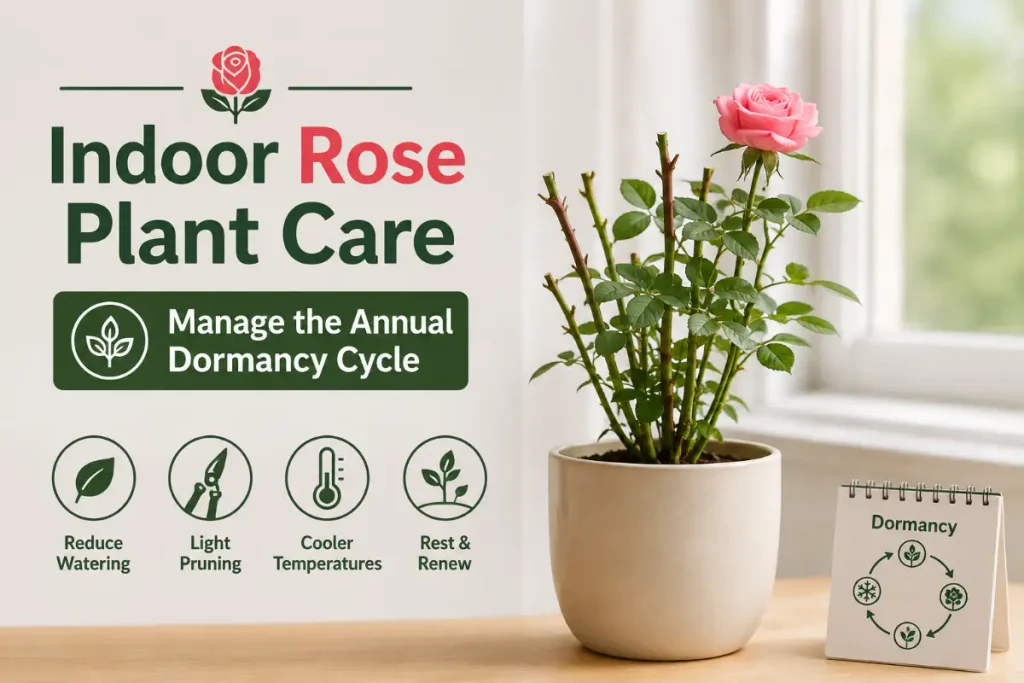
Step 8: Manage the Annual Dormancy Cycle
Indoor roses, like their outdoor counterparts, benefit from an annual dormancy period that allows the plant to rest and prepare for a strong blooming season the following year.
When dormancy occurs: Late fall through early winter as day length decreases and temperatures cool in most US homes. Some indoor roses in very warm, well-lit environments do not enter true dormancy and continue producing growth year-round, but even these benefit from a brief rest.
Managing dormancy: Allow the plant to slow growth naturally in fall. Reduce watering to every ten to fourteen days. Stop fertilizing. Allow the plant to stay in a slightly cooler position if available. Some leaf drop during this period is normal and not a sign of declining health.
Breaking dormancy: In late winter (January through February for most US locations), perform the annual pruning described in Step 6. Move to the brightest available position. Resume regular watering and begin the fertilizing schedule. New growth emerges within two to three weeks and the spring bloom cycle begins.
The outdoor option: In USDA zones 5 through 9, miniature rose plants kept indoors through winter can be planted outdoors in spring where they transition to garden plants that bloom reliably each summer. The outdoor environment, with its natural seasons, air circulation, and light intensity, typically produces more vigorous and abundant flowering than indoor conditions for most rose varieties.
Common Indoor Rose Problems and Solutions
Sudden leaf and bud drop simultaneously: Drought stress from underwatering. Water immediately and maintain more consistent moisture.
Yellowing lower leaves: Overwatering or natural aging. Check soil moisture and adjust watering if overwatering is suspected.
Brown leaf edges and tips: Low humidity combined with warm temperatures. Increase humidity and move away from heat sources.
Black circular spots on leaves: Black spot fungal disease. Remove affected leaves, improve air circulation, water at soil level only, apply baking soda spray preventively.
Fine webbing between leaves: Spider mites. Begin neem oil spray treatment immediately and increase humidity. Spider mites in advanced infestations cause rapid defoliation if not treated quickly.
Buds that do not open: Insufficient light or sudden temperature drop. Improve light and check for cold draft sources.
Indoor Rose Fragrance and Variety Selection
Fragrance is one of the primary reasons people grow roses and indoor varieties vary significantly in scent intensity. Understanding fragrance characteristics before purchase helps you choose a rose that delivers the aromatic experience you are seeking alongside its blooms.
Most fragrant miniature varieties: Cupcake produces a mild sweet rose fragrance. Cinderella has light fragrance. Sweet Chariot is one of the most fragrant miniature roses available with a pronounced damask rose scent. Loving Touch produces a moderate fruity fragrance.
Nearly scentless varieties: Many modern miniature rose hybrids bred primarily for color and bloom abundance have minimal fragrance. If scent is important to you, confirm with the seller or look specifically for varieties described as fragrant rather than assuming all roses are fragrant.
Fragrance intensity and conditions: Rose fragrance is most pronounced in warm conditions with good humidity and when the plant is actively blooming in good light. Cold temperatures and dry air reduce fragrance intensity. The midday period when temperatures are highest and the plant is most actively metabolizing produces the strongest fragrance release from blooms.
Indoor Rose Care Compared to Outdoor Roses
Understanding how indoor rose care differs from the outdoor rose care most people are more familiar with prevents the application of outdoor rose practices to indoor conditions where they do not translate well.
Watering: Outdoor roses in garden beds receive rainfall and have extensive root systems accessing a large soil volume. Indoor roses in pots dry out faster and depend entirely on you for moisture. The frequency needed indoors (checking every three to four days) is much higher than outdoor rose watering.
Pest management: Outdoor roses benefit from beneficial insect populations including ladybugs that naturally control aphid populations. Indoor roses have no natural predator population and pest problems escalate faster without natural control. Indoor management must be more proactive and consistent than outdoor management.
Pruning: Outdoor roses are typically pruned once or twice annually in most climates. Indoor roses benefit from more frequent light pruning throughout the blooming season to maintain compact form in the limited space of indoor cultivation.
Disease: Black spot and powdery mildew affect both outdoor and indoor roses but outdoor conditions with natural airflow and rainfall that washes spores from leaves create different disease dynamics than the still, enclosed indoor environment. Preventive fungal management is more critical indoors than for roses in open garden conditions.
For natural fertilizer options that support indoor rose health including the phosphorus and potassium sources that drive blooming, natural fertilizer for indoor plants covers every effective approach with guidance on combining multiple natural sources for complete nutritional support of heavy-feeding flowering plants like roses.
Conclusion
Indoor rose plant care is genuinely demanding but genuinely rewarding when you meet the plant’s non-negotiable requirements. Maximum available light, ideally through grow lights if natural light is insufficient. Consistent moisture management avoiding both drought and waterlogging. Humidity above 50% as pest prevention as much as plant comfort. Consistent biweekly fertilizing with a phosphorus-forward formula. Correct deadheading technique that stimulates reblooming. Proactive weekly pest monitoring rather than reactive treatment after infestations establish. And annual dormancy management that sets up the following season’s bloom cycle.
A miniature rose that receives all of these consistently produces continuous blooming from spring through fall that justifies every bit of the attention it requires. It is not the plant for low-maintenance indoor gardening. It is the plant for people who enjoy the engagement of attentive plant care and want blooms that no other houseplant category can match.
Frequently Asked Questions
What type of rose grows best indoors?
Miniature roses (Rosa chinensis minima hybrids) are the only rose type genuinely suited to indoor pot growing. Look for varieties labeled patio, miniature, or mini rose. Specific varieties with good indoor track records include Cupcake, Cinderella, and Sweet Chariot. Standard hybrid tea roses, climbing roses, and shrub roses are outdoor garden plants that do not adapt to indoor conditions regardless of care quality.
How many hours of light do indoor roses need?
A minimum of six hours of direct sunlight daily through a south-facing window or under grow lights running fourteen to sixteen hours daily. Roses need more light than almost any other flowering houseplant and insufficient light is the most common cause of indoor rose failure including poor blooming, leggy growth, and general decline.
Why do my indoor rose buds keep dropping before opening?
Bud drop in indoor roses is most commonly caused by drought stress from inadequate watering, sudden temperature changes, low humidity, or spider mite damage. Check soil moisture first since even brief drought causes immediate bud drop in roses. If soil moisture is adequate, check for spider mites on leaf undersides and increase humidity to above 50%.
How do I keep indoor roses from getting spider mites?
Maintain humidity above 50% consistently since spider mites thrive in warm dry conditions and struggle to establish when humidity is adequate. Inspect leaf undersides weekly and treat at first sign of stippling or webbing with neem oil spray every seven days for three weeks. Keeping the plant near other humidity-raising plants reduces mite pressure compared to isolating the rose in dry indoor air.
Should I bring my indoor rose outside in summer?
Yes if you have outdoor space and live in a climate where frosts have passed. Moving indoor miniature roses outside for summer in partial sun provides significantly better light, natural air circulation, and more appropriate conditions than most indoor environments can provide. Transition gradually over two weeks from indoor to outdoor conditions. Bring back inside before the first frost in fall. The outdoor summer period typically produces stronger late-season blooming and better plant health heading into winter dormancy.
How long does an indoor rose plant live?
With proper care including annual pruning, regular fertilizing, and consistent pest management, miniature roses live for many years as indoor plants. Individual plants commonly produce vigorous growth and abundant blooming for five to ten years before declining from accumulated age. The annual pruning that removes one-third to one-half of growth each winter effectively renews the plant and extends its productive life significantly compared to plants that are never hard-pruned.