
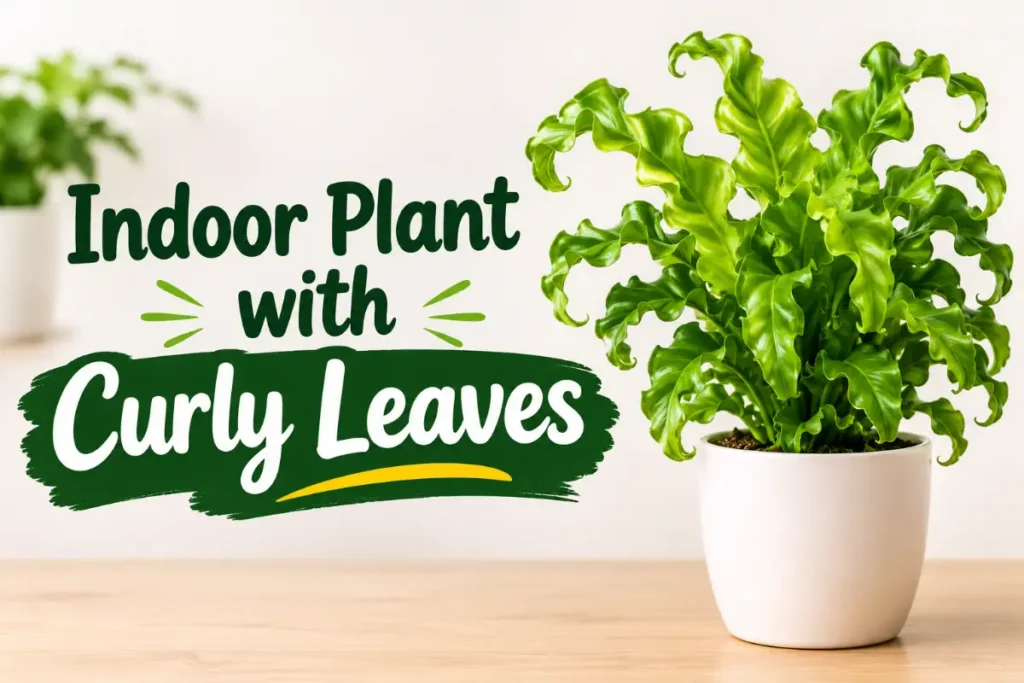
Curly, wavy, and spiraling leaves add a dimension to indoor plant displays that flat-leaved species cannot match — the texture catches light differently at every angle, creates movement even in a still room, and gives a plant a distinctive silhouette that reads clearly from across the room. An indoor plant with curly leaves tends to become a conversation piece in a way that a standard smooth-leaved pothos or snake plant simply does not.
This guide covers eleven species — from the tightly spiraling corkscrew rush to the dramatically ruffled bird’s nest fern — what causes their leaf forms, and how to keep their foliage looking its best.
Why Leaves Curl: The Biology Behind the Texture
Curled, wavy, and spiraling leaf forms arise from different mechanisms, and understanding the cause helps distinguish healthy natural curl from stress-related curling that signals a problem.
Natural genetic curl: Many plants have evolved curled or wavy leaves as their normal form — bird’s nest fern, curly spider plant, and corkscrew rush all produce curved leaves naturally throughout their lives. No amount of altered care will straighten them.
Growth-rate differential: Some curling results from the upper and lower surfaces of a leaf growing at different rates — the faster-growing surface forces the leaf to curve away from it. This is how the ruffled edges of some calathea and begonia leaves form.
Stress-induced curling: Leaves that normally grow flat but begin curling are sending a distress signal. Underwatering causes leaves to curl inward (the plant reduces its surface area to limit water loss). Overfertilizing causes leaf edge curling and browning. Pest damage (spider mites, thrips) produces irregular curling accompanied by speckling or silvering. When a normally flat-leaved plant begins to curl, check soil moisture, fertilizer history, and examine leaf undersides for pests before concluding the cause.
This guide focuses on plants with natural, decorative curl — not plants showing stress symptoms.
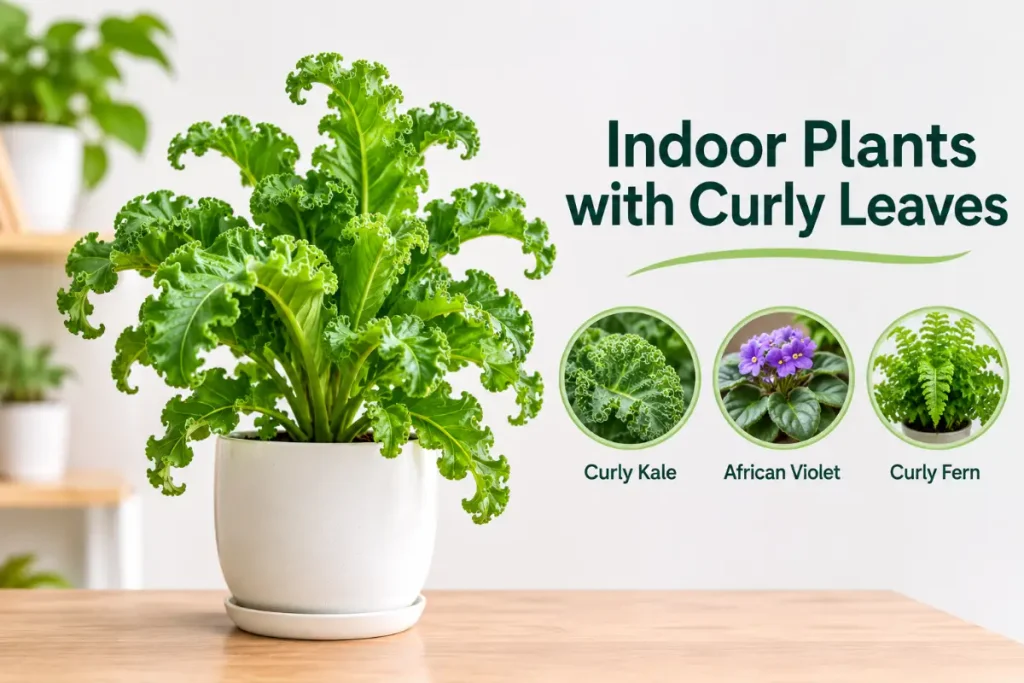
11 Indoor Plants with Curly Leaves
1. Bird’s Nest Fern (Asplenium nidus)
The bird’s nest fern produces long, strap-like fronds with wavy, crinkled edges that create a ruffled effect across the entire plant. Younger fronds emerge tightly coiled from the central “nest” — a rosette of overlapping frond bases — before unfurling and developing their characteristic wave. The effect is lush and tropical, with a fresh bright green that lightens any indoor space.
Light: Low to moderate indirect light — one of the most shade-tolerant of all ferns. Avoid direct sun, which scorches the fronds.
Water: Keep the potting mix evenly moist; never water directly into the central nest, which can cause rotting of new emerging fronds. Water around the edge of the pot.
Humidity: Prefers moderate to high humidity (50%+). In dry centrally heated rooms, frond edges brown and lose their fresh appearance. A bathroom with a window is an ideal location.
Size: Fronds reach 12–24 inches in good conditions; the overall plant becomes substantial over 3–5 years.
2. Curly Spider Plant (Chlorophytum comosum ‘Bonnie’)
The ‘Bonnie’ cultivar of spider plant produces tightly curled, spiraling leaves rather than the straight arching foliage of the standard spider plant — giving it a more compact, textured appearance and making it an indoor plant with curly leaves that is simultaneously one of the easiest houseplants to grow.
Light: Bright to moderate indirect light. The variegated form (green with a cream center stripe) produces the strongest curl in bright light.
Water: Allow the top inch of potting mix to dry between waterings. Spider plants store water in their thick roots and tolerate some neglect.
Propagation: Produces the same trailing spiderettes as the standard type — plantlets form on long runners and can be rooted in water or potting mix.
Beginner-friendly: Extremely so — one of the most tolerant houseplants available.
3. Corkscrew Rush (Juncus effusus ‘Spiralis’)
Corkscrew rush is one of the most dramatic curly-leaved houseplants — its cylindrical stems (technically stems, not true leaves) grow in tight corkscrewing spirals, creating a plant that looks like green telephone cords spiraling upward. The effect is architectural and immediately distinctive.
Light: Full sun to bright indirect light. More light produces the tightest, most pronounced spirals.
Water: Unlike most houseplants, corkscrew rush actively enjoys wet conditions — it is a semi-aquatic plant and can be grown with the pot sitting in a saucer of water at all times. Never allow to dry out.
Size: Typically 12–18 inches tall in a pot.
Note: Occasional straight stems appear alongside the curled ones — this is normal. Remove completely straight stems at the base to maintain the curly appearance.
4. Calathea ‘Freddie’ and ‘Ornata’ (Wavy-Leaved Calatheas)
Several calathea species and cultivars produce leaves with a distinctly wavy or rippled surface texture — ‘Freddie’ has narrow leaves with an undulating surface, while ‘Ornata’ (pinstripe calathea) has broader leaves with gently curved edges. The combination of the wave pattern and the decorative coloring (dark green with patterned markings) makes these among the most visually complex of all foliage houseplants.
Light: Low to moderate indirect light — calatheas are adapted to the dim floor of tropical forests and are damaged by direct sun.
Water: Keep evenly moist with room-temperature water. Calatheas are sensitive to fluoride and chlorine in tap water — filtered water or water left standing overnight reduces leaf tip browning.
Humidity: High humidity (60%+) is preferred. Dry air causes leaf edge browning and curling of the tips beyond the natural leaf wave.
Movement: Calatheas fold their leaves upward at night — this is normal and is called nyctinasty. It is not a stress response.
5. Boston Fern (Nephrolepis exaltata) — Curly Varieties
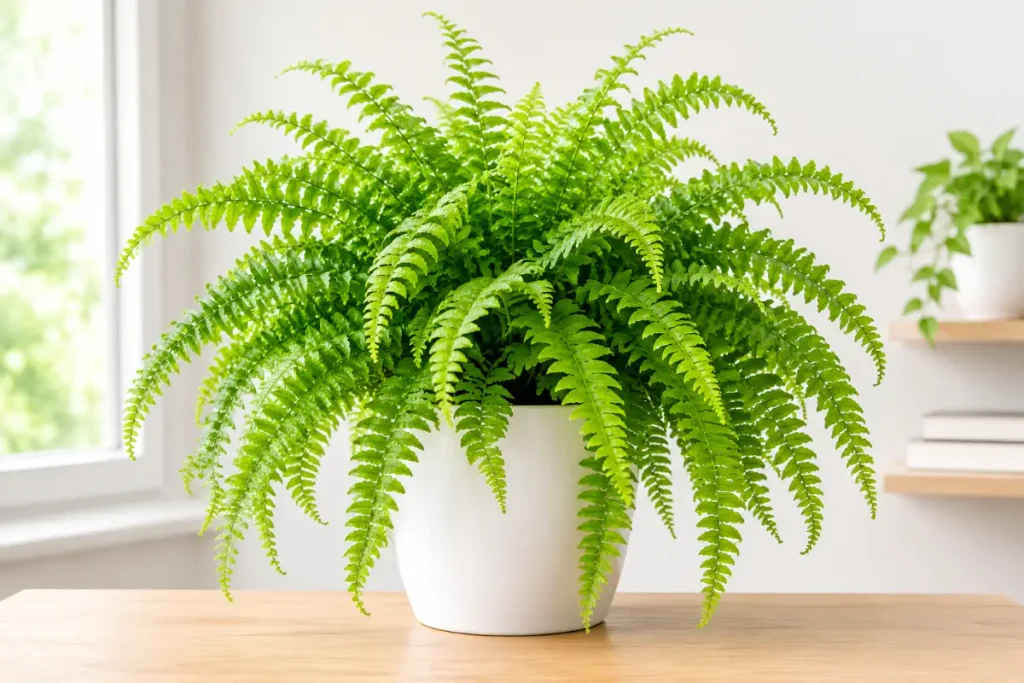
Standard Boston ferns have straight-pinnate fronds, but several cultivars — including ‘Fluffy Ruffles’ and ‘Whitmanii’ — produce fronds with deeply ruffled, finely divided leaflets that create an exceptionally textured, feathery appearance. The ruffled Boston fern cultivars are more compact than the standard type and often easier to manage indoors.
Light: Bright indirect light; a north or east-facing window is ideal.
Water: Keep the potting mix evenly moist — Boston ferns drop leaflets rapidly when they dry out. Check every 2–3 days in warm weather.
Humidity: Requires moderate to high humidity. In dry rooms, elevate the pot on a pebble tray with water, or use a cool-mist humidifier nearby.
6. Anthurium ‘Ruffles’ (Anthurium crystallinum and related)
While most anthuriums are grown for their smooth, heart-shaped leaves or their waxy spathe flowers, certain anthurium species and cultivars produce leaves with distinctly ruffled or undulating edges — particularly some Anthurium crystallinum and Anthurium clarinervium specimens, and specialty cultivars bred specifically for ruffled foliage.
Light: Bright indirect light; avoid direct sun which bleaches the leaves.
Water: Allow the top inch of potting mix to dry between waterings. Well-draining potting mix is essential — anthuriums in dense wet mix develop root rot quickly.
Why it’s special: The combination of large, ruffled heart-shaped leaves with prominent light-catching veins makes ruffled anthurium varieties among the most impressive foliage plants available.
7. Lettuce-Leaved Begonia (Begonia ‘Curly Fireflush’ and similar)
Begonia species and hybrids with ruffled or spiraling leaves are a specialized category — the rex begonia group in particular includes cultivars with dramatically spiraling or ruffled leaf edges in combinations of green, red, silver, and purple. ‘Curly Fireflush’ is one example, with leaves that spiral slightly at the center and have intensely colored surface texture.
Light: Bright indirect light; never direct sun.
Water: Allow the top half-inch of potting mix to dry between waterings. Begonias are particularly susceptible to root rot in wet conditions.
Humidity: Moderate humidity is helpful but do not mist directly — wet leaves on begonias invite powdery mildew.
Note: Rex begonias are grown for foliage, not flowers. The small flowers that appear are typically removed to keep the plant’s energy directed to its dramatic leaf production.
8. Curly Pothos (Epipremnum aureum — Unusual Growth Forms)
Standard pothos does not curl, but certain growing conditions can produce unusual leaf forms — very young leaves emerging in tight spirals, or leaves with slight undulation when grown in lower light. More reliably, Epipremnum ‘Manjula’ produces leaves with wavy edges as a consistent cultivar characteristic. If curl is the priority in a pothos-type plant, ‘Manjula’ is the cultivar to seek out.
Light: Low to bright indirect light — one of the most adaptable houseplants.
Water: Allow the top inch of potting mix to dry before watering.
9. Pitcher Plant (Nepenthes species — Curling Tendrils)
Nepenthes pitcher plants produce leaves that extend into long, curling tendrils at the tip — each tendril develops into a pitcher (a modified leaf that traps and digests insects). The combination of normal flat leaves with curling, twisting tendrils gives nepenthes a uniquely dynamic appearance unlike any other houseplant.
Light: Bright indirect light; some direct morning sun is beneficial.
Water: Keep the potting mix moist with distilled or rainwater — nepenthes, like all carnivorous plants, are adapted to nutrient-poor conditions and are damaged by the minerals in tap water. Keep a small amount of distilled water in the pitchers.
Humidity: Requires high humidity (60%+). A terrarium or plant cabinet is the ideal environment for nepenthes indoors.
10. Elephant Bush (Portulacaria afra ‘Variegata’ — Curly Form)
The standard elephant bush has small, flat, succulent leaves, but the ‘Medio-picta’ or occasionally mislabeled ‘Curly’ forms produce leaves with a slightly cupped or curved surface. More dramatically curled succulent options include certain Crassula species, particularly Crassula ‘Corkscrew’ or Crassula muscosa, which produce tightly stacked or spiraling stems and leaves.
Light: Bright light to full sun — succulents require more light than most houseplants.
Water: Allow the potting mix to dry completely before watering. Succulents store water in their leaves and are very tolerant of drought.
11. Crinkle-Leaf Plant (Adromischus cristatus)
A specialist succulent with dramatically crinkled and wavy leaf edges — the leaves are thick, club-shaped, and have a distinctly wavy, ruffled top edge that gives them an almost hand-made quality. A compact plant reaching 4–6 inches, it is ideal for a sunny windowsill where larger curly-leaved plants would be too big.
Light: Full sun to very bright indirect light.
Water: Allow to dry completely between waterings; very drought-tolerant.
Why it stands out: One of the most textured succulent leaves available as a houseplant, with a wavy edge that is immediately noticeable at close range.
Displaying Curly-Leaved Plants Effectively
Single-species display: A large bird’s nest fern — one of the most striking indoor plants with curly leaves — in a simple pot on a stand or elevated surface — allows the leaf texture to be the entire visual focus. This works best for plants with a strong overall silhouette.
Textural contrast groupings: Curly-leaved plants gain visual impact when placed alongside smooth-leaved species. A ruffled Boston fern next to a smooth-leaved rubber plant, or a corkscrew rush next to a flat-leaved snake plant, creates a contrast that makes both plants more interesting than either would be alone.
Low-light display: Bird’s nest fern and calathea ‘Freddie’ are among the best choices for low-light positions where many other houseplants fail. Their curly forms add visual interest to corners and north-facing rooms that would otherwise support only the most tolerant foliage plants.
Common Problems with Curly-Leaved Plants
Leaves losing curl: In low light, some naturally curly plants produce less pronounced curl on new leaves. Improve light levels to encourage the characteristic leaf form.
Brown leaf edges: The most common issue with ferns and calatheas — caused by low humidity, fluoride in tap water, or occasional drying out. Switch to filtered or standing water and increase ambient humidity.
Straight stems on corkscrew rush: Normal — remove at the base to maintain the curled appearance. Do not worry about occasional straight growth.
Leaf uncurling in recently purchased plants: Some plants (bird’s nest fern in particular) may arrive with tightly curled new fronds that unfurl over the first few weeks as they acclimate to indoor conditions. This is normal new growth, not a problem.
Buying Guide: Where to Find Curly-Leaved Houseplants in the US
Some curly-leaved species are widely available at big-box stores and grocery stores; others require specialty retailers. Here is where to look for each:
Widely available (Home Depot, Lowe’s, grocery stores, Trader Joe’s):
- Curly spider plant ‘Bonnie’ — increasingly common at most garden centers
- Bird’s nest fern — widely stocked at big-box garden centers year-round
- Boston fern (standard cultivar) — very common; ruffled cultivars are harder to find
- Calathea (various) — widely available, though specific cultivars vary
Garden centers and nurseries (better selection):
- Corkscrew rush — available at garden centers with aquatic or unusual plant sections
- Rex begonias and curly-leaved begonia cultivars — specialty nurseries and garden center houseplant sections
- Ruffled Boston fern cultivars (‘Fluffy Ruffles,’ ‘Whitmanii’) — specialty fern growers
Online specialty retailers (The Sill, Bloomscape, Etsy plant sellers, rare plant auctions):
- Ruffled anthurium varieties — rare; typically only available from specialty collectors
- Nepenthes pitcher plants — specialty carnivorous plant retailers (California Carnivores, Sarracenia Northwest)
- Adromischus cristatus — succulent specialty retailers
- Calathea ‘Freddie’ — sometimes easier to find online than locally
What to look for at purchase: Choose plants with multiple healthy leaves showing the characteristic curl — avoid any with brown edges, yellowing, or signs of pest damage (webbing, sticky residue, pale speckling on leaf surfaces). Check the underside of several leaves before buying, as spider mites and scale insects are common on ferns and calatheas in garden center conditions.
Potting and Soil for Curly-Leaved Plants
Ferns (bird’s nest, Boston fern cultivars): A moisture-retaining but well-aerated mix works best — standard indoor potting mix with added peat or coco coir to retain moisture, but with enough perlite (20–25%) to prevent compaction and waterlogging. Ferns suffer in dense, compact mixes that stay wet at the root zone while appearing moist at the surface.
Calatheas: Standard indoor potting mix with perlite (1 part perlite to 3 parts mix) — calatheas need consistent moisture but cannot tolerate waterlogged roots. A slightly moisture-retaining mix is better than a very fast-draining one.
Corkscrew rush: Any standard potting mix is fine — the plant is adapted to wet conditions and the mix specification matters less than ensuring the pot is never allowed to dry out. A tray of water with the pot sitting in it is the simplest approach.
Succulents (Adromischus, Portulacaria, Crassula curly types): Fast-draining cactus and succulent mix, or standard potting mix cut with 40–50% perlite. Dense moisture-retaining mixes are the primary cause of succulent failure.
Rex begonias: A peat-based or coco coir mix with good drainage — begonias prefer consistent moisture but are very prone to root rot in wet conditions. African violet potting mix works well as an alternative to standard houseplant mix.
Anthuriums: A chunky, well-draining mix — standard potting mix with added orchid bark and perlite. Anthuriums are semi-epiphytic and their roots need air as much as moisture.
Seasonal Care Adjustments for Curly-Leaved Plants
Most curly-leaved foliage plants are tropical or semi-tropical in origin and do not have a strong seasonal cycle in their natural habitat. In US homes, seasonal changes in light and indoor heating affect them significantly:
Winter challenges:
- Central heating reduces indoor humidity dramatically — the most common cause of brown leaf edges and tip browning on ferns and calatheas in winter
- Lower light levels mean some plants (calathea, bird’s nest fern) may produce slower, slightly less pronounced new leaf curl
- Reduce watering frequency slightly as growth slows — but do not allow the potting mix to dry out completely for moisture-loving curly species
Summer management:
- Air conditioning can reduce humidity similarly to heating — monitor plant condition and increase humidity measures if leaf edges begin to brown
- Growth accelerates; resume regular fertilizing (balanced liquid fertilizer at half strength, every 2–3 weeks) for ferns, calatheas, and begonias
- Avoid positioning ferns or calatheas in direct summer sun through south or west windows — intensity increases significantly in summer and foliage burns quickly
Moving plants seasonally:
- Many curly-leaved houseplants benefit from spending summer outdoors in a shaded or dappled-light position — the higher natural humidity and indirect outdoor light improves leaf quality significantly for ferns in particular
- Bring back indoors before nighttime temperatures drop below 55°F (most tropical foliage species); 50°F is the safe minimum for calatheas
Feeding Curly-Leaved Foliage Plants
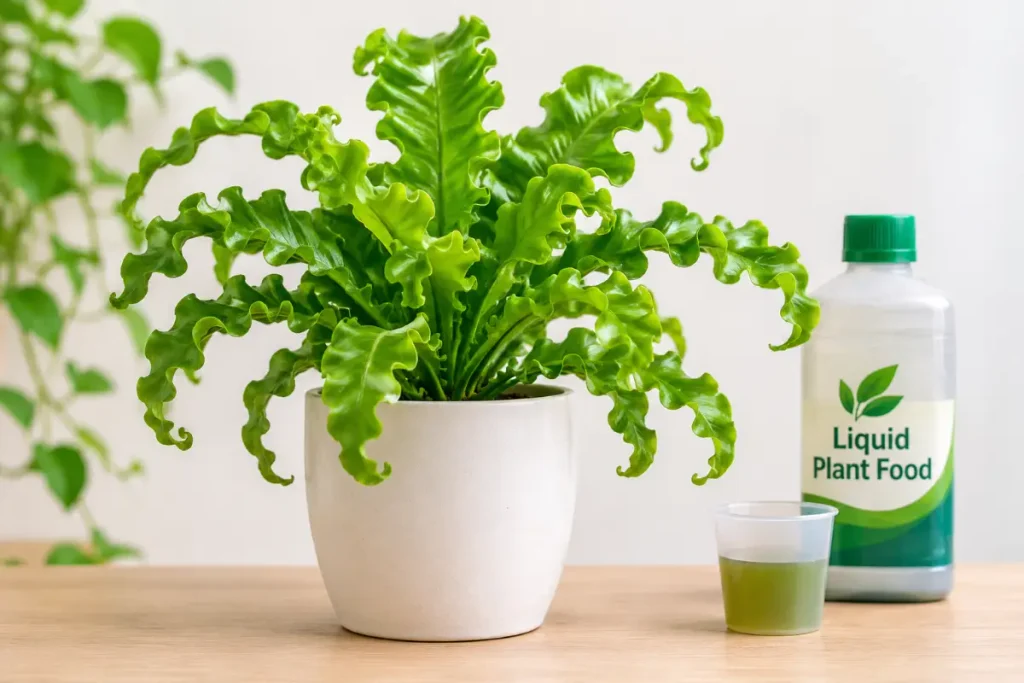
Foliage plants grown for their leaf texture rather than flowers generally need less fertilizer than flowering houseplants, but regular feeding during the growing season supports the strong new leaf production that keeps the display looking its best.
General schedule: Balanced liquid fertilizer (20-20-20 or similar) at half the recommended strength, every 3–4 weeks from March through September. Do not fertilize in winter when growth is slow — unused fertilizer salts build up in the potting mix and cause the leaf edge browning and tip burn that is often misattributed to underwatering or low humidity.
Calathea exception: Calatheas are sensitive to fertilizer salts — use at quarter strength rather than half, and flush the pot with plain water every 2–3 months to remove accumulated salts from the mix.
Corkscrew rush: Minimal fertilizer needed — as a semi-aquatic plant adapted to low-nutrient conditions, rush is easily over-fertilized. A single light feeding in spring and one in midsummer is sufficient.
Succulents (Adromischus, Crassula): Feed once in spring and once in early summer only, with a low-nitrogen fertilizer (5-10-10 or cactus formula). High-nitrogen fertilizer promotes soft, fast growth that dilutes the compact, textured form that makes curly-leaved succulents distinctive.
Conclusion
The best indoor plant with curly leaves for your space depends on the light available and how much attention you can give. For ease and adaptability — curly spider plant ‘Bonnie’ and bird’s nest fern are hard to beat. For drama and architectural impact — corkscrew rush makes an immediate statement. For those willing to meet high humidity requirements — ruffled Boston fern cultivars and calathea varieties reward the effort with extraordinary texture. Whatever the choice, curly-leaved plants add a dimension of visual interest to indoor spaces that flat-leaved species simply cannot replicate.
For detailed guidance on fern and tropical foliage care, the University of Florida IFAS Extension houseplant care guide covers cultural requirements for a wide range of indoor foliage species.
FAQs
What is the easiest indoor plant with curly leaves?
The curly spider plant (‘Bonnie’ cultivar) is the easiest — it tolerates a wide range of light levels, is forgiving of irregular watering, and produces consistently curled leaves without any special conditions. It’s available at most garden centers.
Why are my normally flat plant’s leaves curling inward?
Inward curling on a normally flat-leaved plant is almost always a stress response — most commonly underwatering, but also low humidity, pest damage (check leaf undersides for mites or thrips), or root bound conditions. Check soil moisture first; if the potting mix is dry, water thoroughly and monitor recovery over 24 hours.
Can curly-leaved plants grow in low light?
Some can. Bird’s nest fern and calathea species are the best curly-leaved options for genuinely low-light conditions. Corkscrew rush, Boston fern cultivars, and most succulents need bright to full light to maintain their characteristic curl and healthy growth.
Do curly leaves need special care compared to flat-leaved plants?
Not necessarily — but several of the most dramatic curly-leaved species (ferns, calatheas) do need higher humidity than average houseplants. The curl itself does not require special treatment, but the species that happen to have curly leaves often come from humid tropical environments.
How do I increase humidity for my curly-leaved fern or calathea?
The most effective methods: grouping plants together (they create a shared humid microclimate), placing the pot on a tray of pebbles kept topped up with water (with the pot elevated above the waterline), or running a cool-mist humidifier nearby. Misting provides only very temporary humidity and is less effective than these approaches.
Pingback: Indoor Plant with Purple and Green Leaves: 13 Striking Varieties - Plant Quill