
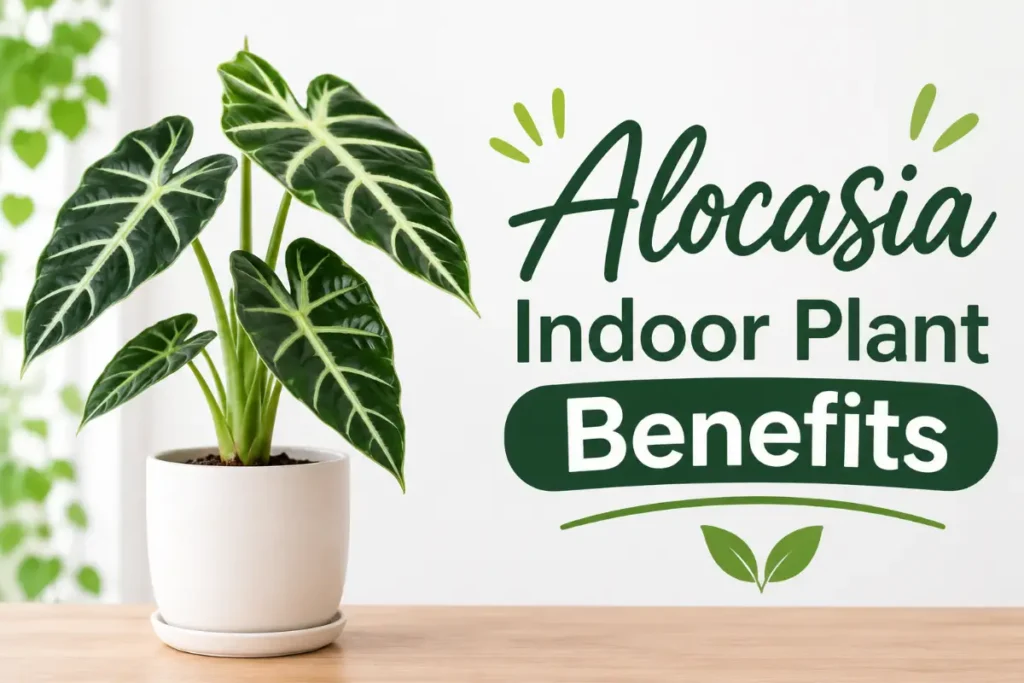
If you have ever walked into a room anchored by a dramatic elephant-ear plant with deep green, arrow-shaped leaves veined in silver or white, you have already experienced one of the most striking alocasia indoor plant benefits — the immediate visual transformation a single specimen delivers. But alocasia offers considerably more than aesthetics.
This genus of tropical aroids, native to the rainforests of Southeast Asia and the Pacific, brings genuine functional advantages to indoor spaces: measurable air quality improvements, humidity regulation, stress reduction backed by research, and the kind of living architecture that no decorative object can replicate.
Here are nine reasons to grow alocasia indoors — and what you need to know to keep one thriving in a US home.
1. Dramatic Architectural Impact in Any Room
The most immediate of all alocasia indoor plant benefits is visual: no other commonly available houseplant delivers the same scale and drama per square foot of floor space. Alocasia varieties range from tabletop specimens like Alocasia amazonica ‘Polly’ (12–18 inches) to full-sized floor plants like Alocasia macrorrhiza (elephant ear) that reach 6–8 feet indoors with leaves spanning 2–3 feet across.
The leaf shapes — deeply lobed, arrow-shaped, or shield-like depending on variety — create a layered tropical canopy effect that transforms a plain corner into a focal point. The contrasting vein patterns in popular varieties like ‘Black Velvet’ (white veins on near-black leaves), ‘Dragon Scale’ (silver veins with hammered texture), and ‘Zebrina’ (striped stems, bright green leaves) add a graphic quality that works in both modern minimalist interiors and maximalist plant-filled spaces.
For interior designers and plant enthusiasts, this structural impact is not trivial — a mature alocasia in the right position does the work of an expensive piece of furniture in defining and elevating a room.
2. Air Quality Improvement Through Phytoremediation
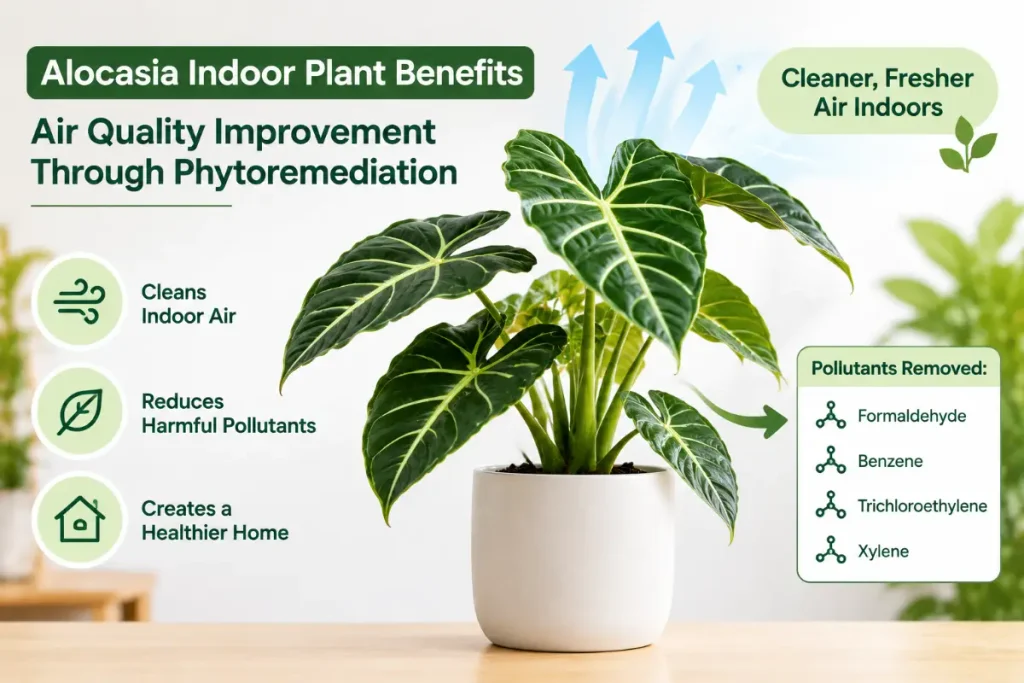
Alocasia, like other large-leafed tropical aroids, contributes to indoor air quality through the process of phytoremediation — the absorption and breakdown of volatile organic compounds (VOCs) through leaf surfaces and root-zone microbial activity.
The 1989 NASA Clean Air Study identified tropical aroids (the plant family that includes alocasia, peace lily, and pothos) as among the most effective VOC-absorbing plants. While more recent research has refined understanding of how many plants are needed for measurable air quality effects in a typical room, the mechanism is real: alocasia leaves absorb gases including formaldehyde (from furniture, flooring, and adhesives), benzene (from cleaning products and paint), and xylene (from adhesives and solvents) through their stomata.
Large-leafed varieties like Alocasia macrorrhiza and Alocasia odora have a significant leaf surface area advantage over smaller houseplants — more surface area means more stomata and more potential absorption capacity. For meaningful air quality effects, multiple plants throughout a space are more effective than a single specimen, but alocasia contributes meaningfully per plant given its leaf mass.
3. Natural Humidity Regulation
One of the most practical alocasia indoor plant benefits in US homes — particularly during winter months when central heating drops indoor humidity to 20–30% RH — is the plant’s contribution to ambient humidity through transpiration.
Alocasia is a rainforest plant that prefers 60–80% humidity, and in pursuit of these conditions it transpires actively: releasing water vapor through leaf stomata as part of its normal metabolic process. A well-hydrated, actively growing alocasia in a warm room transpires measurable quantities of water daily — a large specimen with multiple mature leaves can release a cup or more of water vapor into the surrounding air each day.
This natural humidification is beneficial for:
- Human health: Indoor humidity between 40–60% RH reduces respiratory irritation, dry skin, and static electricity; levels below 30% are associated with increased susceptibility to respiratory infections
- Other plants nearby: Alocasia and other moisture-loving plants grouped together create a shared microclimate with higher local humidity than the surrounding room
- Wood furniture and flooring: Adequate humidity prevents the cracking and shrinkage that very dry winter air causes in solid wood
This benefit is most pronounced in heated winter rooms in northern US states, where forced-air heating creates the driest indoor conditions.
4. Stress Reduction and Psychological Wellbeing
A growing body of research supports what many plant owners know intuitively: the presence of living plants in indoor spaces measurably reduces stress. Studies published in the Journal of Physiological Anthropology have found that interaction with indoor plants — including simply viewing them — reduces physiological stress markers including cortisol levels, heart rate, and blood pressure compared to equivalent tasks performed in plant-free environments.
Alocasia’s particular contribution to this benefit is its visual complexity. Research on attention restoration theory (developed by environmental psychologists Rachel and Stephen Kaplan) identifies natural visual complexity — the layered, fractally detailed patterns found in leaves, plants, and natural environments — as a key driver of the restorative effect of nature on directed attention fatigue.
The deeply ridged, intricately veined leaves of alocasia varieties like ‘Dragon Scale’ and ‘Silver Dragon’ represent exactly the kind of soft-fascination visual complexity that attention restoration theory predicts will support mental recovery from cognitive fatigue. Having an alocasia visible from a desk or seating area may provide ongoing micro-restorations of focused attention across a workday.
5. Connection to Biophilic Design Principles
Biophilic design — the intentional incorporation of natural elements into built environments to satisfy humans’ innate need for connection with nature — has become a significant framework in commercial interior design, and its principles apply equally to home spaces.
Among common houseplants, alocasia is exceptionally well-suited to biophilic design applications because of its combination of large scale, strong visual presence, and distinctly non-artificial appearance. The deeply lobed leaves and prominent vein patterns read as unambiguously natural in a way that some highly bred ornamental plants do not.
Research on biophilic design consistently finds that workspaces and home environments incorporating significant plant presence report higher occupant wellbeing, greater creativity, and reduced sick days compared to equivalent plant-free spaces. Alocasia’s scale makes it one of the most efficient single-plant contributions to biophilic design goals — one large alocasia specimen delivers more visual plant presence than a shelf of small succulents.
6. Educational Value for Children and Families
Alocasia offers distinctive educational opportunities for families with children — these are benefits that are often overlooked but genuinely valuable.
The guttation process — where alocasia leaves exude water droplets along their margins and tips in conditions of high humidity or when the plant has absorbed excess water — is a dramatic and visually striking plant biology phenomenon that children find fascinating. Discovering water beads sitting perfectly along the serrated edge of an alocasia leaf in the morning is a natural starting point for discussions of plant physiology, transpiration, and water movement.
Alocasia also demonstrates rapid visible growth responses: new leaves emerge tightly rolled, unfurl over the course of a day or two, and expand to full size over 1–2 weeks — a growth timeline visible enough to maintain a child’s interest and provide observable evidence of plant biology in real time.
The care requirements of alocasia — consistent watering, humidity, light — provide a structured responsibility for older children learning about living systems and their needs.
7. Variety and Collectibility
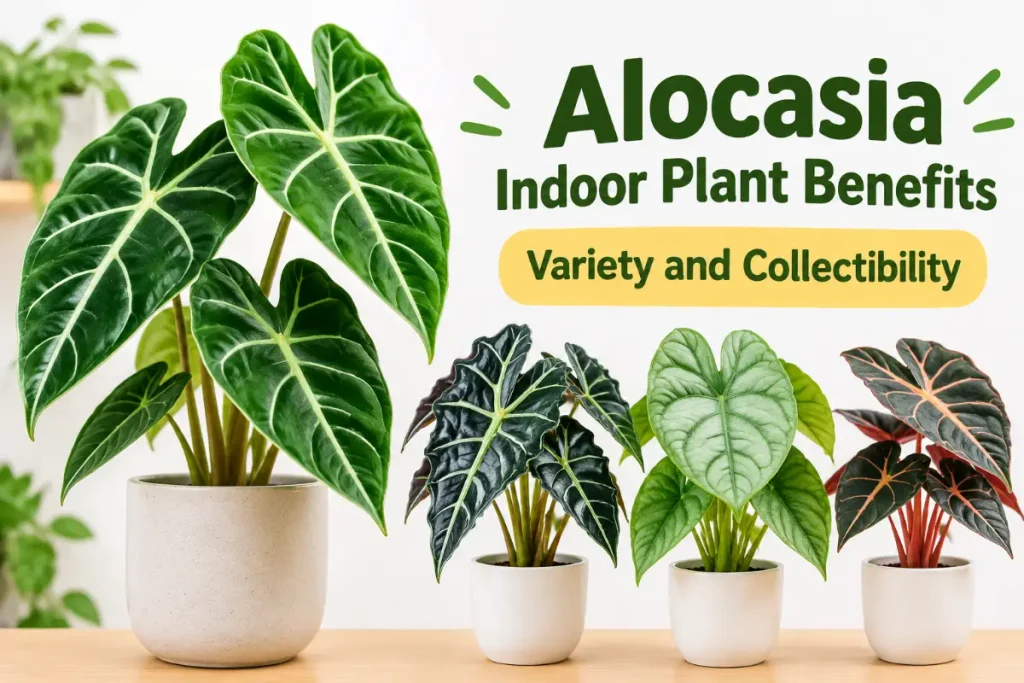
The alocasia genus contains over 90 species and an ever-expanding range of cultivars, making it one of the most collectible genera in the houseplant hobby. This collectibility is a genuine benefit for plant enthusiasts — the genus provides a lifetime of botanical exploration within a consistent care framework.
Popular varieties available through US retailers and specialty online sellers include:
Alocasia amazonica ‘Polly’ — the most widely available variety; compact (12–18 inches), deep green with white veins, available at Home Depot, Lowe’s, and most garden centers.
Alocasia ‘Dragon Scale’ — hammered silver-green leaves with dark veining; one of the most visually distinctive varieties. Available through specialty sellers including The Sill and Bloomscape.
Alocasia ‘Black Velvet’ — a compact jewel alocasia; velvety near-black leaves with brilliant white veins. Prefers lower light than larger varieties.
Alocasia zebrina — arrow-shaped green leaves on dramatically striped black-and-yellow stems. The stems are as decorative as the leaves.
Alocasia macrorrhiza ‘Stingray’ — leaves shaped like stingray wings with a pointed tail extension; one of the most architecturally unusual houseplants available.
Alocasia odora — a large, fragrant species with upward-facing leaves; can reach 5–6 feet indoors and produces fragrant flowers under good conditions.
Most alocasias propagate readily through offsets (pups that emerge from the base of the mother plant), making them easy to share with other plant enthusiasts and gradually build a collection from a single original purchase.
8. Adaptability to Indoor Light Conditions
A practical benefit that makes alocasia viable for a wide range of US home environments is its adaptability to indoor light — particularly bright indirect light, which is the most common good-light condition in US homes.
Alocasia is a rainforest understory plant adapted to bright, filtered light rather than direct sun. This translates directly to thriving in indoor positions near east or north-facing windows, or a few feet back from south or west-facing windows — conditions where many other dramatic tropical plants would etiolate or burn.
The key requirements:
- Bright indirect light: 2–4 feet from a south or west window, or directly in an east window. Avoid direct afternoon sun, which scorches the leaves.
- No deep shade: Unlike pothos or snake plants, alocasia does not thrive in dim conditions. At least 1,000–2,000 lux of indirect light for 8–10 hours daily.
- Grow lights work well: A 6500K full-spectrum LED positioned 12–18 inches above the plant on a 12-hour timer supports excellent growth in windowless rooms or north-facing apartments.
This light flexibility makes alocasia a practical choice across a wide range of US home environments — from bright South Florida condos to smaller northern apartments where direct sun is limited.
9. Seasonal Dormancy Teaches Plant Cycles
One of the more nuanced alocasia indoor plant benefits — particularly for new plant owners — is the opportunity the plant provides to understand and work with seasonal plant cycles.
Many alocasia varieties go through a dormancy period in late fall and winter, particularly in homes where temperatures drop below 60°F and light levels decrease with shorter days. During dormancy, the plant may drop most or all of its leaves, leaving only the corm (underground storage structure) alive. This is alarming for new owners who assume the plant has died — but understanding and responding correctly to dormancy (reduce watering, stop fertilizing, wait for spring warmth) teaches plant owners foundational concepts about seasonal plant physiology that transfer across many other houseplants and outdoor gardening.
An alocasia that re-emerges from dormancy in spring — pushing up new rolled leaves from an apparently bare pot — is one of the most rewarding plant moments. The cycle of dormancy and re-emergence provides a direct, tangible experience of plant seasonal biology that no evergreen houseplant can offer.
Alocasia Care Essentials for US Homes
To realize all of these benefits, keeping alocasia thriving requires meeting a few non-negotiable needs:
Water: Keep potting mix consistently moist but never waterlogged. Allow the top inch to dry between waterings — alocasia does not tolerate drought, but root rot from soggy soil is the most common cause of decline. A well-draining potting mix (standard tropical houseplant mix with added perlite at a 3:1 ratio) prevents waterlogging.
Humidity: 50–80% RH is ideal. In dry US winters, group alocasia with other plants, use a pebble tray with water, or run a humidifier nearby. Misting is less effective than these methods.
Temperature: 65–85°F. Protect from cold drafts and air conditioning vents — alocasia is cold-sensitive and declines below 55°F. Keep away from exterior doors and cold windows in northern states during winter.
Fertilizer: Apply a balanced liquid fertilizer (such as 20-20-20) every 2–4 weeks during active growth (spring through early fall). Reduce to monthly in winter; stop entirely during dormancy.
Repotting: Repot when roots circle the drainage holes or when offsets crowd the pot, typically every 1–2 years. Use a pot 1–2 inches larger than the current one — oversized pots hold excess moisture and increase root rot risk.
Toxicity note: Alocasia is toxic to dogs, cats, and humans if ingested — the calcium oxalate crystals in the leaves and stems cause mouth irritation and GI distress. Place out of reach of pets and children and wash hands after handling.
Alocasia vs. Other Large-Leafed Houseplants
If you are drawn to the dramatic scale and tropical feel of alocasia but wondering how it compares to similar large-leafed options, understanding the differences helps you choose the right plant for your space and care capacity.
Alocasia vs. Colocasia (Taro): Alocasia and colocasia are frequently confused — both are elephant ear plants with large arrow-shaped leaves. The main distinction: alocasia leaves point upward from the stem attachment point, while colocasia leaves droop downward. Alocasia is better suited to indoor growing because it handles lower light and drier conditions better than colocasia, which prefers consistently moist to wet soil and outdoor conditions.
Alocasia vs. Monstera deliciosa: Both are dramatic large-leafed aroids with high visual impact. Monstera is significantly more forgiving — it tolerates lower humidity, irregular watering, and lower light than alocasia. For first-time large-plant owners, monstera is a more reliable starting point; alocasia is the step up once you have mastered tropical care basics.
Alocasia vs. Bird of Paradise (Strelitzia reginae): Bird of paradise delivers comparable height and architectural impact at maturity, with less demanding humidity requirements. It needs more direct sun than alocasia (4–6 hours of direct sun or very bright indirect light) but tolerates drier soil. For sunny rooms with low humidity, bird of paradise may be more practical; for shadier rooms with moderate humidity, alocasia is the stronger choice.
Alocasia vs. Fiddle Leaf Fig (Ficus lyrata): Fiddle leaf fig is more finicky about drafts and position changes but tolerates lower humidity than alocasia. Both require bright indirect light and consistent care. Alocasia provides a denser, more tropical aesthetic; fiddle leaf fig offers a more architectural, less overtly tropical look.
Best Alocasia Varieties for Beginners in the US
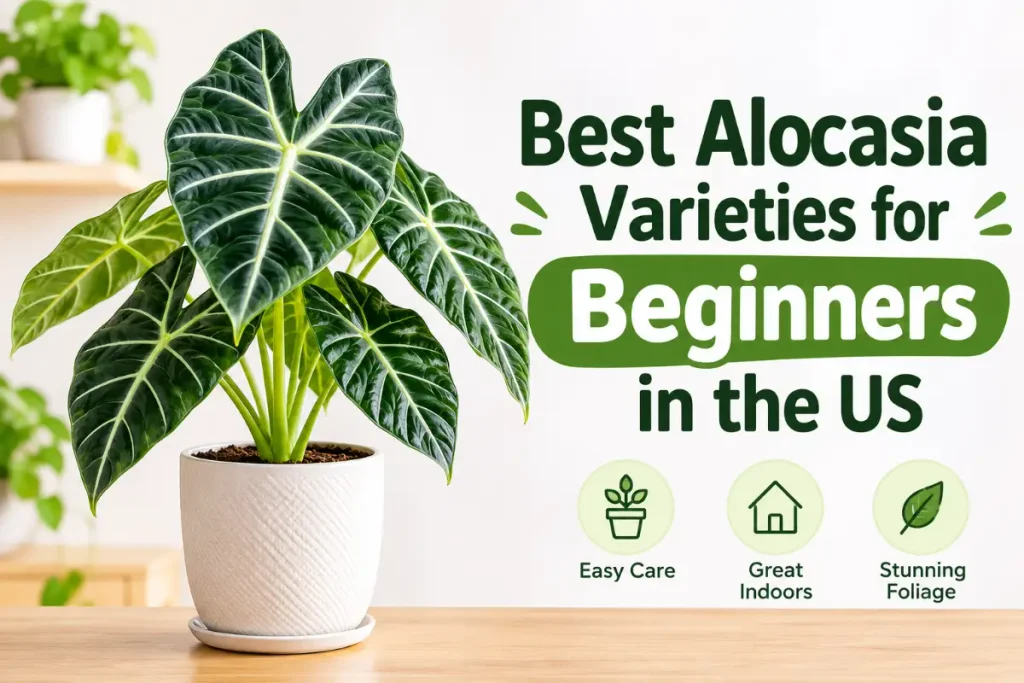
If you are new to alocasia, starting with a forgiving, widely available variety gives you the best chance of experiencing the plant’s benefits before moving to more demanding cultivars.
Alocasia amazonica ‘Polly’ remains the best beginner choice — widely sold at Home Depot, Lowe’s, and most large garden centers for $15–$30, compact enough to fit on a table or plant stand, and reasonably forgiving of imperfect humidity compared to jewel alocasia varieties. Its deep green leaves with white veins are among the most striking in the genus.
Alocasia ‘Regal Shields’ is a good step up — a large-growing variety (up to 4–5 feet indoors) with deep olive-green leaves with purple undersides, more tolerant of lower humidity than many varieties and faster-growing than ‘Polly.’ Available from Bloomscape and specialty online retailers for $30–$60.
Alocasia zebrina is another beginner-friendly choice for its tolerance and the visual interest of its striped stems, which are as decorative as the leaves. Available through The Sill and online specialty sellers.
Avoid jewel alocasias (Black Velvet, Silver Dragon, Dragon Scale) as first alocasia plants — these compact varieties are slower-growing and significantly more sensitive to low humidity and irregular watering than the larger-leafed varieties, making them better suited to growers who have already established a humidity-managed plant corner or use a grow cabinet.
Where to Position Alocasia for Maximum Benefit
Placement significantly affects how many of the alocasia indoor plant benefits you actually experience. The wrong position limits both plant health and the benefits the plant delivers.
Living room corners near east or north-facing windows: The classic position for large alocasia specimens. A 4–5 foot alocasia in a corner near a large east-facing window gets morning sun without afternoon heat, creating the ideal bright-indirect-light condition. The corner placement also shields the plant from drafts while making it visible from the main seating area — maximizing the stress-reduction and biophilic benefits.
Home office spaces: Placing an alocasia within the sightline from a desk position provides ongoing exposure to the natural visual complexity that attention restoration research associates with cognitive recovery. Even a compact ‘Polly’ on a shelf behind a monitor contributes to this effect.
Bathroom windowsills (east or north-facing): Bathrooms with adequate light and naturally higher humidity from shower steam are excellent alocasia environments. The naturally elevated humidity reduces the humidification effort required and benefits the plant’s health.
Avoid: Air conditioning vents, heating registers, exterior doorways in northern states, and south or west-facing windowsills where direct afternoon sun reaches the plant. These positions stress the plant and prevent you from experiencing its benefits fully.
Conclusion
The alocasia indoor plant benefits extend well beyond the plant’s undeniable visual drama: measurable air quality improvement, natural humidification, documented stress reduction, and the educational and collectibility value of a genus with 90+ species to explore. Meeting the plant’s specific needs — bright indirect light, consistent moisture, and adequate humidity — unlocks a dramatic, long-lived houseplant that delivers genuine functional and psychological value alongside its architectural presence.
For detailed guidance on tropical houseplant care in US home environments, the University of Florida IFAS Extension guide to interior tropical foliage plants covers light, watering, fertilization, and pest management for the aroid family and related tropical species.
FAQs
Is alocasia a good indoor plant?
Alocasia is an excellent indoor plant for homes that can provide bright indirect light and moderate-to-high humidity. It is more demanding than beginner plants like pothos or snake plants, but its dramatic appearance and range of benefits make it well worth the additional attention.
Does alocasia purify air indoors?
Alocasia contributes to air quality improvement through phytoremediation — absorbing VOCs including formaldehyde, benzene, and xylene through its leaves. Its large leaf surface area gives it a meaningful advantage over smaller houseplants for this purpose.
How much light does alocasia need indoors?
Alocasia prefers bright indirect light — 2–4 feet from a south or west-facing window, or directly in an east-facing window. Avoid direct afternoon sun, which scorches the leaves, and avoid deep shade, which causes etiolation and loss of leaf color contrast.
Why is my alocasia dropping leaves in winter?
Leaf drop in fall and winter is often normal seasonal dormancy behavior in alocasia, triggered by reduced light and cooler temperatures. Reduce watering, stop fertilizing, and wait for spring warmth — the corm (underground storage structure) is typically alive and will re-sprout when conditions improve.
Is alocasia toxic to pets?
Yes — alocasia is toxic to cats, dogs, and humans if ingested. The calcium oxalate crystals in all plant parts cause mouth irritation, drooling, and GI distress. Place alocasia out of reach of pets and children.

Pingback: Eucalyptus Plant Indoor Benefits: 8 Reasons to Grow It Inside - Plant Quill