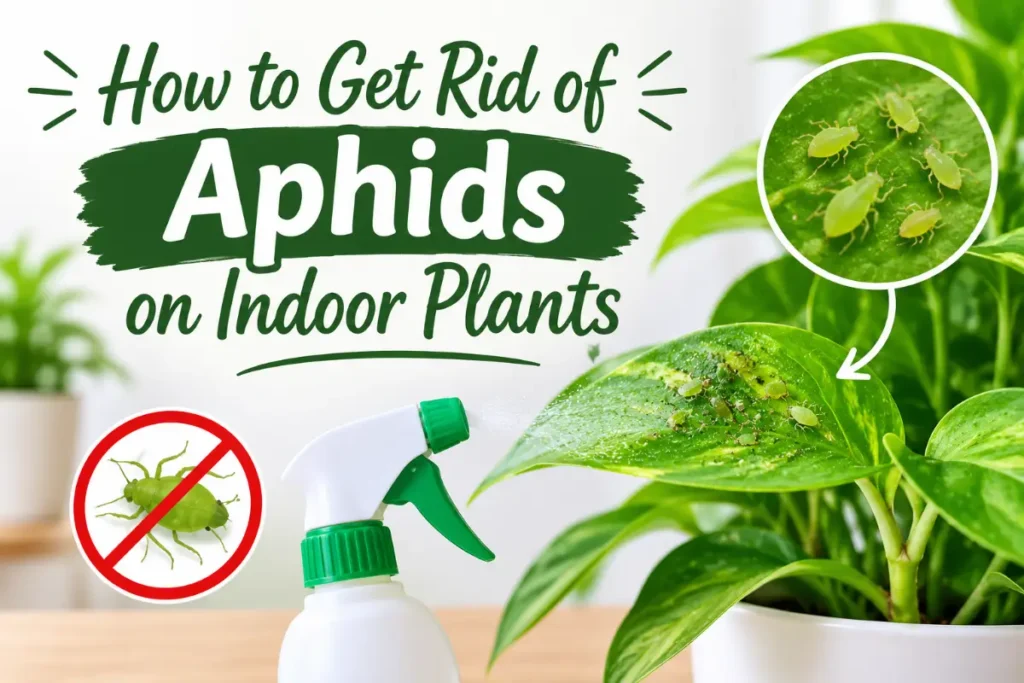
Aphids are among the most common pests found on houseplants, and they can spread quickly if left untreated. Aphids on indoor plants often appear in clusters on tender stems, new growth, and the undersides of leaves. Because they reproduce rapidly, even a small colony can become a noticeable infestation within a short time.
The good news is that aphids are generally manageable with the right approach. Unlike some houseplant pests, they feed on exposed plant surfaces rather than hiding deep in the soil or inside stems. This makes them easier to spot and treat using simple methods such as rinsing, wiping, and appropriate pest-control products.
In this guide, you’ll learn how to identify aphids, explore eight effective ways to get rid of them, and understand how to protect your houseplants from future infestations. From simple physical removal to more targeted treatments, these methods will help you restore your plants and keep them healthy.
How to Identify Aphids on Indoor Plants
Correct identification is the first step — some pest problems (scale insects, mealybugs) look superficially similar to aphids but respond to different treatments.
What aphids look like:
- Tiny (1/16–1/8 inch) pear-shaped insects
- Colors range from green (most common on indoor plants), yellow, white, black, and brown depending on species and host plant
- Soft-bodied — visible to the naked eye but often easiest to spot with a magnifying glass
- Two small tail-like tubes (cornicles) projecting from their abdomen — a definitive aphid identification feature
- Often found in clusters on new growth, stem tips, flower buds, and the underside of leaves
Signs of aphid infestation beyond seeing the insects:
- Distorted, curled, or puckered new leaves — aphids inject saliva that disrupts plant cell development
- Sticky coating on leaves (honeydew) — aphids excrete a sugary liquid that coats leaves and surfaces below the plant
- Black sooty mold growing on the honeydew deposits — a secondary fungal issue caused by the aphid secretions
- Yellowing leaves with no clear cause — sustained aphid feeding damages leaf tissue
Common plants attacked indoors: Roses, chrysanthemums, hibiscus, gardenias, pothos, philodendrons, herbs (basil, mint, dill), and most plants moved from outdoors to indoors in fall.
Method 1: Water Spray (Mechanical Removal)
The simplest and most immediate control method — physically knocking aphids off the plant with a stream of water. Effective for light to moderate infestations and causes zero harm to the plant.
How to do it:
- Move the plant to a sink, shower, or outside (if weather permits)
- Use a moderate-pressure stream from a faucet or spray nozzle — not a direct blast that damages leaves, but strong enough to dislodge insects
- Direct the spray at stem tips, new growth, and the undersides of leaves — the areas where aphids concentrate
- Repeat every 2–3 days for 2 weeks — this is essential, because a single water spray doesn’t kill eggs or any aphids that survive the initial treatment
Water spraying works best as an initial knockdown combined with a follow-up treatment (soap spray, neem oil) that kills survivors and eggs. Alone, it controls but rarely eliminates an established infestation.
Method 2: Insecticidal Soap Spray
Insecticidal soap is the most reliable contact treatment for soft-bodied insects including aphids, spider mites, and whitefly. It works by disrupting the insect’s cell membranes on direct contact — it has no residual effect, meaning it only kills insects it physically touches. This is both an advantage (safe for plants and non-target insects once dry) and a limitation (requires thorough, repeat applications to contact all insects).
Commercial products: Safer Brand Insect Killing Soap (widely available at Home Depot and Lowe’s), Garden Safe Insecticidal Soap. Ready-to-use and concentrate forms available.
DIY insecticidal soap:
- 1 tablespoon pure castile soap (Dr. Bronner’s unscented) per quart of water
- Do not use dish soap with degreasers, fragrances, or bleach additives — these can damage plant tissue
How to apply:
- Spray all plant surfaces including stem tips, new growth, and the underside of every leaf
- Ensure thorough coverage — aphids on areas not reached by the spray will survive
- Apply in the morning or evening, not in direct midday sun, as soap spray in strong light can cause leaf scorch
- Repeat every 3–5 days for at least 2–3 applications to break the reproductive cycle
Important: Test on one leaf first and wait 24 hours before full application — some plants (ferns, some succulents, thin-leafed plants) are sensitive to soap and can show burning.
Method 3: Neem Oil Spray
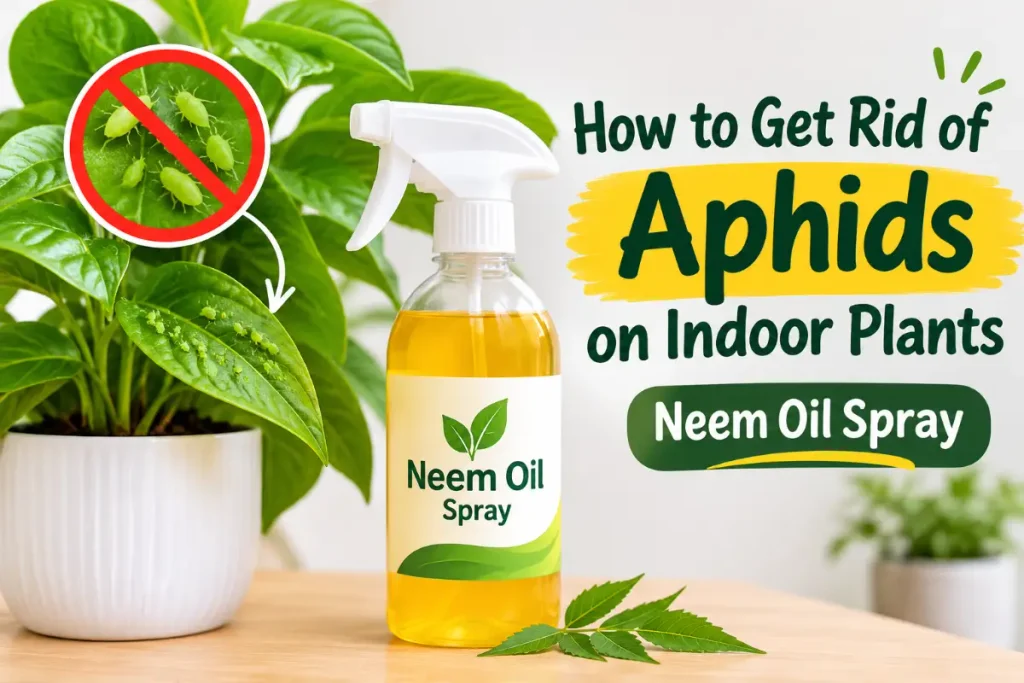
Neem oil is a botanical pesticide derived from the seeds of the neem tree. Unlike insecticidal soap, neem oil has both contact activity (killing insects it touches) and systemic activity (the active compound azadirachtin is absorbed by plant tissue and disrupts aphid feeding and reproduction). This makes it more effective than soap for moderate to heavy infestations.
How to make a neem oil spray:
- 1–2 teaspoons neem oil (cold-pressed, 100% neem)
- ½ teaspoon mild dish soap or castile soap (emulsifier)
- 1 quart warm water
- Shake vigorously before and during application — neem and water separate quickly
How to apply:
- Apply to all plant surfaces in the early morning or evening — not in direct sun
- Cover the undersides of leaves where aphids concentrate
- Repeat every 7–10 days for 3–4 applications
- Neem oil degrades in UV light, so indoor plants retain active residue longer than outdoor applications
Neem oil has a strong earthy odor that some people find unpleasant indoors — it dissipates within a few hours. Keep the plant in a well-ventilated area after application.
Method 4: Rubbing Alcohol Wipe
For small, localized infestations — a cluster of aphids on a stem tip or the underside of a few leaves — rubbing alcohol applied with a cotton swab or cotton ball is a precise, effective control method that kills aphids on contact without harming plant tissue at the right concentration.
How to do it:
- Use 70% isopropyl rubbing alcohol (standard drugstore rubbing alcohol)
- Dip a cotton swab or cotton ball and dab directly onto aphid clusters
- Wipe aphids and their eggs off the plant — the alcohol kills on contact and removes the insects physically
- Dispose of used cotton swabs and balls immediately — do not reuse
- Check the plant every 2–3 days and retreat any new clusters
Rubbing alcohol at 70% concentration is safe for most plant tissues, but test on a leaf edge first for sensitive plants. Higher concentrations (91%+ isopropyl) can cause leaf damage.
Method 5: Yellow Sticky Traps
Yellow sticky traps — flat or roll-style traps coated in a non-drying adhesive — are highly effective at capturing winged aphid adults, which develop in established colonies and fly to new plants. They don’t eliminate an infestation on their own but reduce the spread to other plants and serve as an excellent monitoring tool.
Where to buy: Home Depot, Lowe’s, Amazon, and most garden centers carry yellow sticky traps — Gnat Baron, Katchy, and Sticky Trap brand products are widely available. A pack of 20–30 traps typically costs $8–12.
How to use:
- Place traps at or just above the level of the plant canopy — winged insects fly at or near foliage level
- Use one trap per 1–2 plants in an infested area
- Replace when the trap surface is more than 50% covered with insects — a fully coated trap loses effectiveness
- Yellow is the specific color that attracts aphids, whitefly, and fungus gnats — blue traps attract thrips
Yellow traps work best as a complement to spray treatments rather than a standalone control.
Method 6: Remove Heavily Infested Growth
When aphids are concentrated on specific growth tips, new shoots, or flower buds, removing the infested growth entirely is the fastest way to reduce the population — cutting off the aphids’ food source and removing their eggs simultaneously.
How to do it:
- Identify the most heavily infested stem tips and new growth
- Cut with clean scissors or pruning shears — sterilize blades with rubbing alcohol before and after
- Seal the removed material in a plastic bag immediately — do not leave aphid-covered clippings in the growing area
- Dispose of in an outdoor trash container — not an indoor compost bin
Follow up with a soap or neem oil spray on the remaining plant to address any aphids that were not on the removed growth.
Method 7: Systemic Insecticide (For Severe Infestations)
For severe or recurring infestations that have not responded to repeated soap and neem oil treatments, a systemic insecticide — applied to the soil so the plant absorbs it and makes its tissue toxic to feeding insects — provides more complete control.
Bonide Systemic Houseplant Insect Control (available at Home Depot and Lowe’s) contains imidacloprid, a neonicotinoid insecticide that is absorbed through the roots and transported throughout the plant. Aphids feeding on treated plant tissue are killed within 1–2 days.
How to use:
- Apply granules to the soil surface according to package instructions and water in
- Effects begin within 1–2 weeks as the compound is distributed through plant tissue
- A single application provides 2–3 months of protection
Important caveats: Systemic neonicotinoid insecticides are harmful to pollinators — do not use on flowering plants while they are in bloom if pollinators might have access. For indoor plants not in bloom (or in a dedicated indoor space with no pollinator access), the risk is minimal. Do not use systemics on edible herbs or vegetables.
Method 8: Diatomaceous Earth (Preventive and Light Infestations)
Food-grade diatomaceous earth — the fossilized remains of microscopic aquatic organisms — damages the exoskeleton of soft-bodied insects including aphids on contact, causing dehydration. Applied to soil surfaces and leaf bases, it works as a preventive barrier and mild control measure for light infestations.
How to apply:
- Use food-grade diatomaceous earth (available at Home Depot, Lowe’s, and Amazon — Safer Brand and Harris are common brands)
- Dust lightly on the soil surface and on stem bases
- Avoid applying to wet leaves — it only works when dry
- Reapply after watering, as moisture deactivates it
Diatomaceous earth is most useful as a preventive tool applied after an aphid infestation has been controlled by other methods, to deter re-establishment. Alone, it is too slow-acting for a heavy infestation.
After Treatment: Preventing Aphids From Returning
Successfully learning how to get rid of aphids on indoor plants means eliminating the active infestation as step one — preventing recurrence requires addressing the conditions that made the infestation possible.
Isolate new plants: Keep any new plant — purchased or moved indoors from outside — in a separate room for 2–4 weeks before placing it near other houseplants. Aphids frequently arrive on new plants from garden centers or from outdoor summer placement.
Inspect regularly: Check stem tips, new growth, and leaf undersides during weekly watering. Early detection means small populations that are far easier to control. A magnifying glass makes inspection much more effective — aphid eggs and early-stage nymphs are tiny.
Avoid over-fertilizing with nitrogen: High-nitrogen fertilizer produces lush, soft new growth that is more attractive to aphids. Use balanced fertilizer and avoid excess nitrogen feeding during growing season.
Maintain plant health: Stressed plants — those in inadequate light, inconsistently watered, or pot-bound — are significantly more susceptible to aphid infestations than healthy plants. Good cultural practices are the foundation of pest prevention.
Monthly neem oil wipe: A preventive monthly wipe of all leaves with diluted neem oil solution (as described in Method 3) creates a deterrent surface that discourages aphid settling.
Aphid Species Common on Indoor Plants
Not all aphids are identical — knowing which species you are dealing with helps confirm identification and understand host plant preferences.
Green Peach Aphid (Myzus persicae)
The most common aphid found on indoor plants worldwide. Pale green to yellow-green, occurring on a very wide range of host plants including roses, chrysanthemums, many herbs, and most common houseplants. Produces winged and wingless forms — the winged form spreads infestations to new plants.
Black Bean Aphid (Aphis fabae)
Dark green to black. Common on hibiscus, dahlias, and beans grown indoors. Often mistaken for a different pest entirely — the dark coloring makes them harder to spot against dark bark or soil.
Foxglove Aphid (Aulacorthum solani)
Pale green with a distinctive darker green spot at the base of the cornicles. Found on a very wide range of plants but particularly common on potted orchids, cyclamen, and gloxinia in indoor settings.
Melon/Cotton Aphid (Aphis gossypii)
Yellow to dark green. Extremely common on hibiscus grown indoors and on ornamental peppers. One of the fastest-reproducing aphid species — infestations can develop from undetectable to severe within 10 days in warm indoor conditions.
Root Aphids
Root aphids are an entirely different group of species that feed on plant roots rather than foliage. They cause symptoms similar to overwatering (wilting despite moist soil) and are confirmed by removing the plant from its pot and inspecting the root ball for small white or pale insects clinging to roots. Root aphids require soil drench treatment — hydrogen peroxide solution (3% hydrogen peroxide diluted 1:4 with water), beneficial nematodes applied to the soil, or a systemic insecticide soil drench.
Natural Predators You Can Introduce
Outdoors, aphids are kept in check by a large range of natural predators — ladybugs, lacewing larvae, parasitic wasps, and aphid midges. Indoors, these predators are absent, which is why aphid populations explode without intervention.
For indoor growers with significant aphid problems — particularly those with a large indoor garden or plant room — introducing natural predators is a chemical-free long-term management option:
Ladybug larvae: More effective than adult ladybugs (adults fly away in indoor conditions; larvae are flightless and stay on plants). Available from biological control suppliers like Arbico Organics and available online. Release on infested plants in the evening.
Green lacewing larvae: Generalist predators that consume aphids, spider mites, thrips, and other small insects. Released as eggs or young larvae. Available from the same biological control suppliers. Effective in enclosed indoor garden spaces.
Parasitic wasps (Aphidius species): These tiny wasps lay eggs inside individual aphids, killing them. Available commercially and effective in greenhouse and indoor garden settings. They are specific to aphids and harmless to plants, pets, and people.
Natural predator introductions work best in enclosed indoor growing spaces — a basement grow room, a greenhouse, or a sun room. In an open home environment, the predators tend to disperse rather than staying concentrated on the infested plants.
Treating Aphids on Herbs
Aphid infestations on edible herbs — basil, mint, cilantro, dill — require more careful product selection since you will be consuming the plant.
Safe options for edible herbs:
- The first step in how to get rid of aphids on indoor plants using safe methods: water spray mechanical removal
- Insecticidal soap (safe once dry — allow 24 hours between treatment and harvest)
- Neem oil (safe once dry — follow the 24-hour pre-harvest interval; neem oil is approved for organic production)
- Rubbing alcohol cotton swab spot treatment
Avoid on edible herbs:
- Systemic insecticides (imidacloprid, etc.) — absorbed into plant tissue including the edible parts
- Any product not labeled for edible crop use
For severe aphid infestations on edible herbs grown indoors, the most practical approach is to harvest the plant aggressively (cutting it back to 2–3 inches) to remove the bulk of the infestation with the plant material, treat the bare stems with diluted soap spray, and allow the plant to regrow from clean growth.
Aphids vs. Similar Pests: Quick Identification Guide
Several common houseplant pests are mistaken for aphids — correct identification ensures you use the right treatment:
Aphids vs. Mealybugs: Mealybugs are larger (up to ¼ inch), have a distinctive white waxy coating, and prefer stem joints and leaf bases rather than stem tips. Mealybugs require alcohol wipe treatment; soap spray is less effective.
Aphids vs. Scale insects: Scale insects are immobile once mature, have a hard protective shell (brown or tan), and attach firmly to stems. They do not cluster at stem tips the way aphids do. Scale requires neem oil or alcohol wipe treatment.
Aphids vs. Spider mites: Spider mites are even smaller than aphids (barely visible without magnification), produce fine webbing on the undersides of leaves, and cause a characteristic stippled, bronze-tinted leaf damage. Spider mites concentrate on leaf undersides rather than stem tips. Spider mite treatment uses the same soap and neem oil sprays as aphids but requires even more thorough underside coverage.
Aphids vs. Fungus gnats: Fungus gnats are flying insects (not crawling) that emerge from the soil. They do not cluster on stems or leaves. Fungus gnat treatment targets the soil, not the foliage.
Conclusion
Aphids on indoor plants are easier to control when caught early and treated consistently. Remove visible pests with a gentle water spray or careful wiping, then apply insecticidal soap or neem oil as directed. Repeat treatments as needed to eliminate newly hatched aphids and prevent the infestation from returning.
Regularly inspect your plants and isolate new additions to reduce the risk of future outbreaks. For more practical houseplant care and pest management advice, explore the University of Minnesota Extension’s houseplant resources.
FAQs
What causes aphids on indoor plants?
Aphids arrive on indoor plants most commonly from newly purchased plants from garden centers, from plants moved indoors from outdoor summer positions, or from open windows during spring and summer. Once indoors, their populations grow rapidly without natural predators.
Can aphids kill indoor plants?
A severe, long-standing infestation can stunt plant growth and distort new leaves significantly — but direct death from aphids alone is uncommon. The greater risk is secondary damage: the sooty mold that grows on aphid honeydew blocks light, and plant stress from heavy feeding makes plants more vulnerable to other problems.
How long does it take to get rid of aphids?
With consistent treatment (soap or neem spray every 3–5 days), most aphid infestations are controlled within 2–3 weeks. A single treatment is almost never sufficient — the reproductive cycle means survivors will rebuild the population quickly.
Do aphids live in the soil?
Most aphid species that attack indoor plants live on stems and leaves, not in soil. A small number of species (root aphids) do infest soil and roots, causing wilting similar to overwatering. Root aphids require soil drench treatment rather than foliar sprays.
Is neem oil safe for all houseplants?
Neem oil at recommended dilutions is safe for most houseplants. Avoid applying to hairy or textured-leafed plants (African violets, begonias) where oil residue can collect in leaf hairs. Test on one leaf 24 hours before full application on any unfamiliar plant.
Are aphids contagious to other plants?
Yes — winged adult aphids (which develop in established colonies) fly to new plants readily. Isolate any aphid-infested plant immediately. Treat all plants in the same room even if aphids are not yet visible on them.