
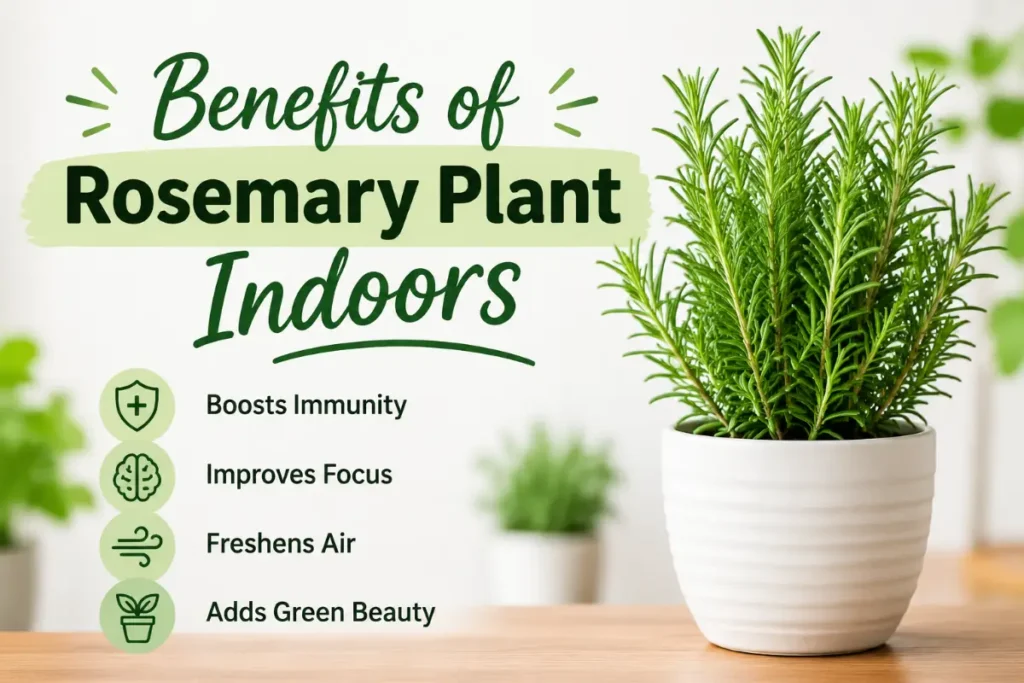
Most people think of rosemary as a kitchen herb — something that belongs in a pot on the windowsill strictly for culinary use. That framing undersells it considerably. The benefits of rosemary plant indoors extend well beyond the cooking supply: documented cognitive and memory effects from its aromatic compounds, air purification through phytoremediation, natural pest deterrence, stress reduction, and the year-round ornamental value of a fragrant, drought-tolerant evergreen shrub that handles indoor conditions better than most culinary herbs.
For US homeowners, rosemary is one of the most practical indoor plants available — widely sold at Home Depot, Lowe’s, and garden centers nationwide, low-maintenance once established, and genuinely multifunctional. Here are eight reasons to grow it indoors.
1. Memory and Cognitive Performance Support
The most surprising and well-documented of all benefits of rosemary plant indoors is the effect its primary aromatic compound — 1,8-cineole (eucalyptol) — has on cognitive performance, particularly memory and concentration.
A landmark study published in Therapeutic Advances in Psychopharmacology (Moss et al., 2016) found that people working in rooms diffused with rosemary essential oil performed significantly better on working memory and mental arithmetic tests than those in unscented rooms. Blood analysis found measurable levels of 1,8-cineole in participants — confirming that simply being in a rosemary-scented environment delivers the compound systemically.
A living rosemary plant continuously releases 1,8-cineole into the surrounding air — not at the concentration of a diffuser, but as a steady ambient presence. Research by the University of Northumbria found that even modest ambient rosemary scent improved memory test scores by up to 15% compared to unscented control conditions.
For a home office, study space, or work area, a rosemary plant on or near the desk is a genuinely evidence-based cognitive support tool — one of the very few houseplants with direct human performance research behind it.
2. Fresh Culinary Supply Year-Round
The most immediate practical benefit: a living rosemary plant indoors provides a year-round supply of fresh rosemary within arm’s reach of the kitchen — no grocery store run, no wilted plastic-wrapped herb bundles, no waste from using two sprigs of a bunch that then sits forgotten in the refrigerator.
Fresh rosemary has significantly more aromatic intensity than dried — the volatile compounds that carry flavor and fragrance are most concentrated in live tissue. For roasted vegetables, grilled meats, bread, and infused oils, fresh rosemary from a living plant produces noticeably better results than the dried equivalent.
The economics are straightforward: a $5–$8 rosemary plant from Home Depot or Lowe’s, properly cared for, produces harvestable stems continuously for years — far less expensive than purchasing fresh rosemary bundles at $2–$4 per use. A single well-grown indoor rosemary plant in a 6-inch pot provides enough for weekly kitchen use with appropriate trimming.
Harvesting is itself beneficial for the plant: regular light pruning of stem tips encourages branching and a more compact, bushy form. Never remove more than one-third of the plant at a time, and always cut above a leaf node to promote regrowth.
3. Air Quality Improvement
Rosemary contributes to indoor air quality through two mechanisms: phytoremediation (VOC absorption through leaves and root-zone microbial activity) and the natural antimicrobial properties of its released volatile compounds.
VOC absorption: Like other aromatic plants in the Lamiaceae family, rosemary absorbs volatile organic compounds including formaldehyde, benzene, and toluene through its stomata as part of normal gas exchange. These compounds — released by furniture, flooring, adhesives, and cleaning products — are among the most common indoor air pollutants in US homes.
Antimicrobial volatile release: The essential oil compounds rosemary releases — including 1,8-cineole, camphor, and α-pinene — have demonstrated antimicrobial activity in laboratory settings against common airborne bacteria and mold spores. Research on rosemary essential oil diffusion in clinical settings has found reductions in airborne microbial counts, suggesting that ambient rosemary scent from a living plant provides a mild ongoing antimicrobial effect in the room.
This air quality benefit is enhanced by grouping rosemary with other aromatic plants — lavender, basil, mint — in a sunny window. The combined VOC absorption and aromatic volatile release of multiple plants creates a more robust air quality effect than any single specimen.
4. Natural Pest Deterrence
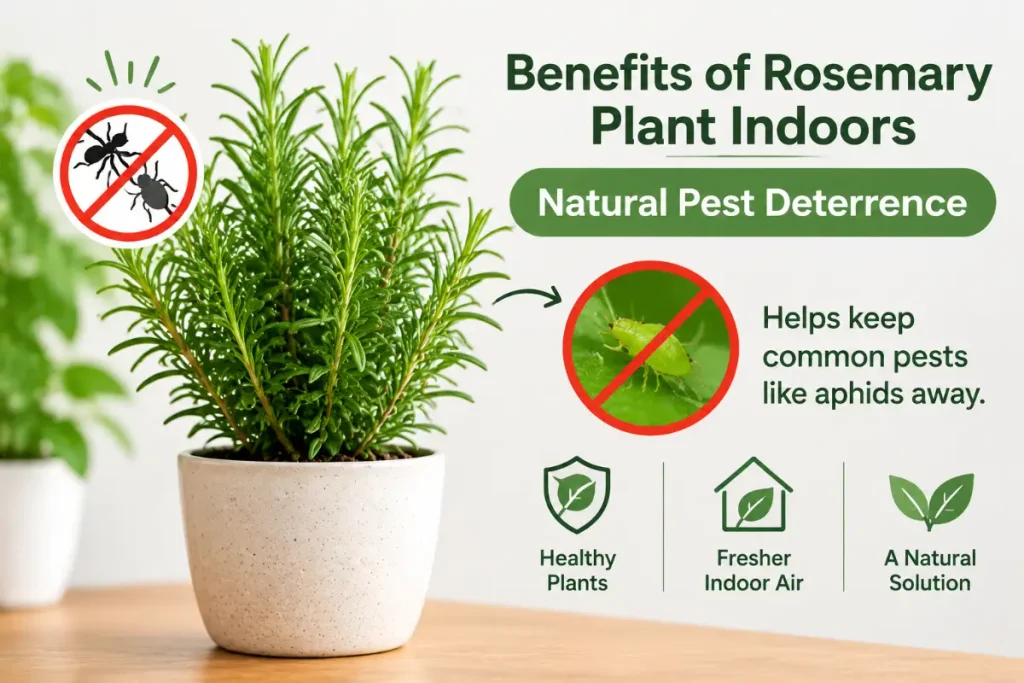
One of the most practically valuable benefits of rosemary plant indoors for US homeowners is natural pest deterrence. The concentrated essential oils rosemary releases are aversive to a range of common household insects.
Mosquitoes: Research on rosemary as a mosquito deterrent has found that the volatile compounds it releases — particularly camphor and 1,8-cineole — reduce mosquito activity in treated areas. A rosemary plant near an open window or outdoor-adjacent space provides passive deterrence during warm months.
Moths: Rosemary is a traditional natural moth repellent — the strong aromatic oils are aversive to clothes moths (Tineola bisselliella). Sachets of dried rosemary in closets have been used for generations as a natural alternative to mothballs. A living plant in a bedroom provides ongoing passive deterrence.
Flies: Rosemary is among the aromatic plants used in traditional Mediterranean households to deter flies from food preparation areas. A plant on a kitchen windowsill provides passive fly deterrence during summer months.
Aphids and spider mites on nearby plants: The volatile compounds rosemary releases are aversive to many soft-bodied pest insects. Rosemary planted near susceptible plants (roses, basil) has been used as a companion deterrent — the scent disrupts aphid host-finding behavior.
This deterrence effect is passive and ambient — it does not replace treatment for established pest infestations — but as an ongoing preventive measure, it is a genuine and cost-free benefit of growing rosemary indoors.
5. Stress Reduction and Mood Improvement
Aromatherapy research on rosemary consistently finds positive effects on mood, anxiety, and subjective wellbeing. Studies using both diffused rosemary essential oil and ambient rosemary scent from living plants have found:
- Reduced anxiety scores on validated psychological assessment tools
- Increased ratings of alertness, contentment, and energy
- Reduced cortisol levels (a primary physiological stress marker) in participants exposed to rosemary scent compared to unscented controls
The compound primarily responsible for these mood effects appears to be 1,8-cineole, the same compound linked to the memory and cognitive performance benefits. Unlike lavender — which produces calming, sedating effects — rosemary aromatherapy consistently produces an activating, invigorating response: reduced tension with increased energy and focus rather than drowsiness.
This profile makes rosemary particularly well-suited to daytime work environments where cognitive alertness is valued alongside stress reduction — the combination of mood improvement and cognitive enhancement is unusual among aromatic plants.
The stress-reduction benefit is also augmented by the visual presence of the plant itself: environmental psychology research consistently finds that the presence of living plants in indoor spaces lowers physiological stress markers independent of any aromatic effect. For rosemary, the visual and aromatic stress-reduction pathways combine.
6. Year-Round Ornamental Value
Rosemary is a genuinely attractive indoor plant in its own right — not merely a utilitarian herb kept for cooking. As an evergreen Mediterranean shrub, it maintains its needled, aromatic foliage year-round without the seasonal die-back that affects many culinary herbs. Its upright or trailing form (depending on variety), dark green needle-like leaves, and — in good light — small lavender-blue flowers that appear in late winter and spring make it a visually interesting specimen across all seasons.
Popular ornamental varieties for indoor growing include:
Rosmarinus officinalis ‘Tuscan Blue’ — upright habit to 4 feet, strong fragrance, good indoor tolerance. The classic rosemary form for a kitchen windowsill or plant stand.
Rosmarinus officinalis ‘Prostratus’ (Creeping Rosemary) — trailing habit; stems cascade over the edge of a pot making it ideal for elevated plant stands or hanging baskets. Smaller leaves with strong flavor and fragrance.
Rosmarinus officinalis ‘Arp’ — one of the most cold-tolerant varieties, with slightly gray-green foliage and excellent vigor indoors. Tolerates the temperature fluctuations of US homes better than some Mediterranean varieties.
Rosmarinus officinalis ‘Spice Island’ — broad upright habit, very high oil content in the leaves (intensely fragrant), good flowering indoors. A good choice for maximizing the aromatic benefits.
In late winter and spring, indoor rosemary plants in good light frequently bloom — producing clusters of tiny lavender-blue flowers along the stems that add color at a time of year when few other plants are flowering indoors.

7. Drought Tolerance Makes It Forgiving
One of the most practical benefits of rosemary plant indoors for busy plant owners is the plant’s exceptional drought tolerance. Rosemary is native to the rocky, dry slopes of the Mediterranean coast — it has evolved specifically to handle periods of water scarcity without damage, making it one of the most forgiving common houseplants for owners who travel, forget to water, or simply want a low-maintenance plant.
Unlike moisture-sensitive herbs (basil wilts dramatically within hours of drying out), rosemary can tolerate several days of dry soil without permanent damage. It signals water need subtly — slightly softened needle tips and a mild reduction in fragrance before any wilting occurs — giving plant owners a generous window to water before damage occurs.
The care requirements are simple: water thoroughly when the top 2 inches of potting mix are dry, allow the pot to drain completely (never allow to sit in standing water — root rot is the main killer of indoor rosemary), and provide as much bright light as possible. Beyond these basics, rosemary needs minimal attention to thrive.
This low-maintenance profile makes rosemary appropriate for plant owners at all experience levels — it is genuinely harder to kill through neglect than through overcare. The most common cause of indoor rosemary failure is overwatering and poor drainage, not underwatering.
8. Supports Pollinators When Moved Outdoors
A benefit that extends beyond the indoor environment: rosemary is one of the most valuable early-season pollinator plants available to US gardeners. When moved outdoors in spring (or placed on a balcony or porch in warmer months), flowering rosemary attracts bees intensely — particularly honeybees and native bumblebees, which value rosemary as an early nectar source when few other plants are in bloom.
For environmentally conscious plant owners, this seasonal outdoor pollinator support adds ecological value to the year-round indoor plant. The pattern of overwintering rosemary indoors and moving it outside in warmer months — where it both grows vigorously in direct sun and supports pollinators through bloom — maximizes the plant’s value across the full year.
Growing Rosemary Indoors: Essential Requirements
To experience all of these benefits, rosemary needs specific conditions that differ from many tropical houseplants:
Light: The most critical requirement. Rosemary is a full-sun Mediterranean plant that needs 6+ hours of bright direct or near-direct sun per day indoors. A south-facing window is ideal; east or west windows may be adequate in summer but typically insufficient in winter. Supplemental full-spectrum LED grow lighting (6500K, 14–16 hours) is often necessary in northern US states from October through March. Without adequate light, rosemary becomes leggy, loses fragrance, and becomes susceptible to powdery mildew — the most common indoor rosemary problem.
Water: Allow potting mix to dry significantly between waterings — the top 2 inches should be completely dry before watering again. Water thoroughly, then allow the pot to drain completely. Never leave rosemary sitting in a saucer of water.
Potting mix: Fast-draining is essential. Use standard potting mix cut with 25–30% perlite or coarse sand. Alternatively, use a cactus/succulent mix. Standard potting mix alone is too moisture-retentive for rosemary and leads to root rot.
Humidity: Rosemary prefers 30–50% RH — moderate humidity. It handles the drier conditions of winter-heated US homes better than most tropical houseplants, making it ideal for homes where humidity management is not a priority.
Temperature: 55–80°F. Rosemary tolerates cool nights (down to 30°F for cold-hardy varieties like ‘Arp’) and warm days. Keep away from freezing drafts but do not worry about cool windowsills — cool nights actually improve aromatic compound concentration in the leaves.
Fertilizer: Apply a half-strength balanced liquid fertilizer (such as 10-10-10) monthly during active growth (spring through summer). Do not over-fertilize — excess nitrogen produces lush but less fragrant growth. Under-fertilizing slightly produces more intensely aromatic leaves.
Common Indoor Rosemary Problems and Fixes
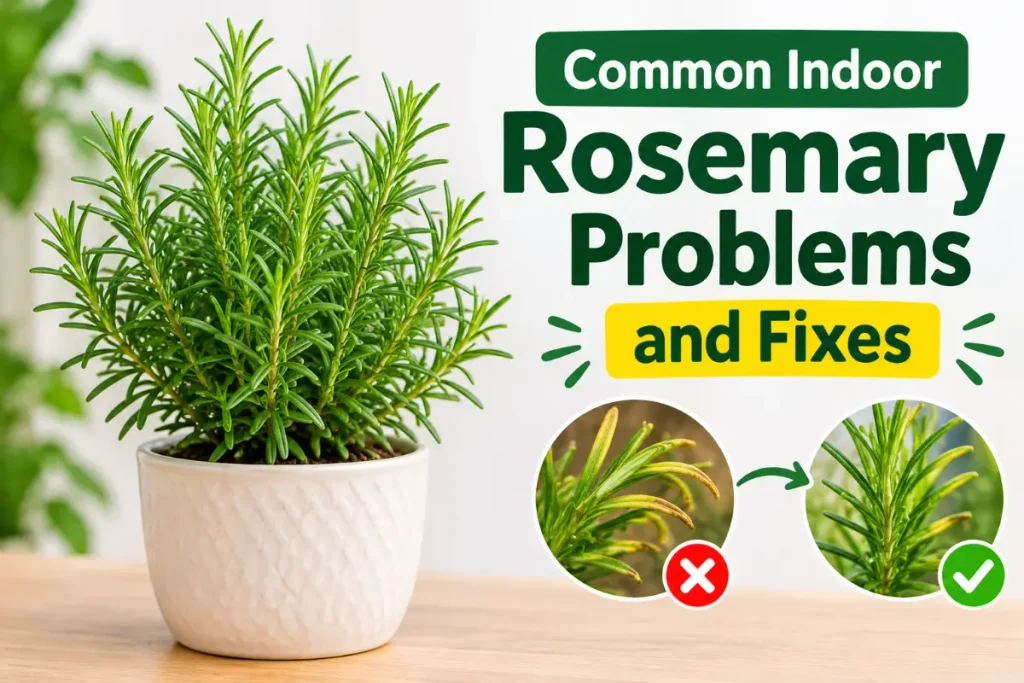
Powdery mildew (white coating on leaves): Almost always caused by insufficient airflow and high humidity — common in winter when windows are closed. Fix: improve air circulation (a small fan nearby), reduce humidity, and ensure adequate light. Remove affected stems; treat with diluted neem oil spray if severe.
Leggy, sparse growth: Insufficient light. Move to a brighter window or add supplemental grow lighting. Prune the leggy stems back to encourage branching.
Yellowing leaves at the base: Usually normal lower-leaf senescence as the plant grows — remove yellowed leaves. If yellowing is widespread and accompanied by soft stems at the base, check for root rot (overwatering/poor drainage).
No fragrance: Almost always a light problem. Insufficient light reduces essential oil production dramatically. Ensure 6+ hours of bright light daily.
Conclusion
The benefits of rosemary plant indoors make it one of the most genuinely multifunctional plants available to US homeowners: culinary supply, evidence-backed cognitive and memory support, air purification, natural pest deterrence, stress reduction, ornamental value, and low-maintenance drought tolerance — all from a $5–$8 plant widely available at Home Depot and Lowe’s. Meeting its high light requirement is the main care challenge, but for growers who can provide a bright south window or supplemental grow lighting, rosemary delivers more practical value per square inch than almost any other houseplant.
For comprehensive guidance on growing herbs indoors and their documented health benefits, the University of Florida IFAS Extension guide to herbs in the Florida garden covers cultural requirements, culinary uses, and health properties of rosemary and related aromatic herbs.
FAQs
Is rosemary a good indoor plant?
Rosemary is an excellent indoor plant for homes with a bright south-facing window or supplemental grow lighting. It is drought-tolerant, low-maintenance once established, produces fresh culinary herbs year-round, and delivers genuine aromatherapy and cognitive benefits from its volatile compounds.
Does rosemary improve memory?
Research published in peer-reviewed journals has found that 1,8-cineole — the primary aromatic compound rosemary releases — measurably improves working memory and mental arithmetic performance at ambient concentrations. A living rosemary plant in a work or study space provides ongoing low-level exposure to this compound.
How much light does rosemary need indoors?
Rosemary needs 6+ hours of bright direct or near-direct sun per day. A south-facing window is ideal. In northern US states during winter, supplemental full-spectrum LED grow lighting is typically necessary to prevent legginess and maintain fragrance and health.
Why does my indoor rosemary keep dying?
The most common causes: overwatering with poor drainage (root rot), insufficient light, and powdery mildew from poor airflow. Rosemary is easier to kill with too much water and too little light than through neglect. Use fast-draining potting mix, water only when the top 2 inches are dry, and provide maximum available light.
Can rosemary survive indoors in winter?
Yes — with adequate light and careful watering, rosemary survives and grows through winter indoors. Cold-tolerant varieties like ‘Arp’ handle the temperature fluctuations of US homes well. The main winter challenge is maintaining sufficient light — a grow light is often necessary in northern states from October through March.