
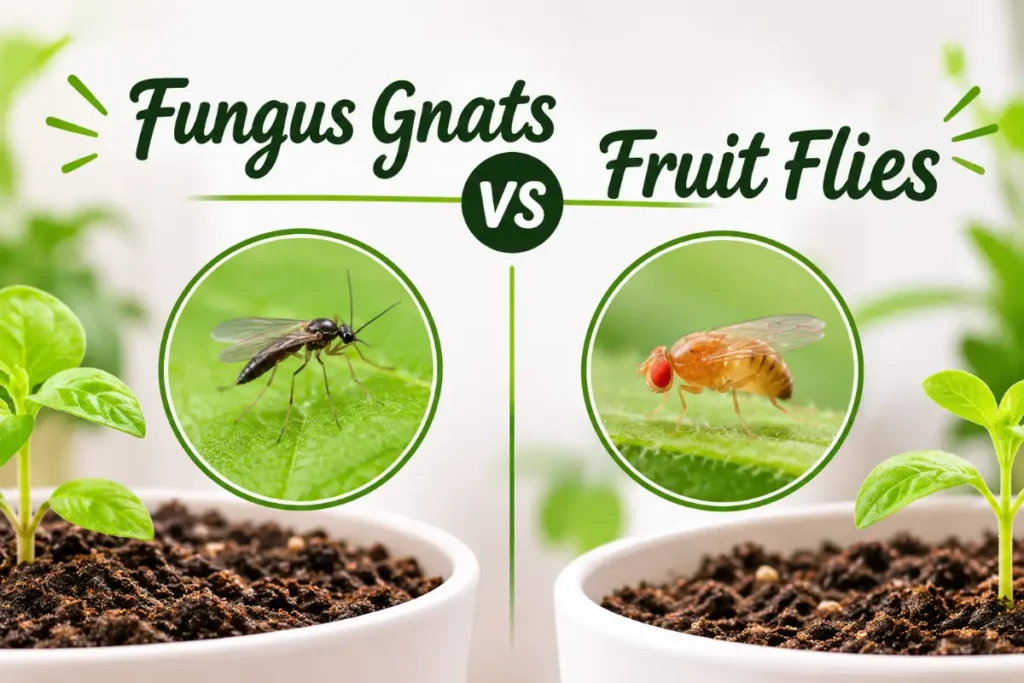
You notice tiny flies hovering around your houseplants — but before you can fix the problem, you need to know exactly what you are dealing with. The fungus gnats vs fruit flies in houseplants question matters because the two pests look similar at a glance, breed in completely different ways, and require different treatments to eliminate. Misidentifying them means weeks of ineffective treatment while the population grows.
This guide tells you exactly how to tell them apart in under a minute, what causes each infestation, and the most effective treatments for both.
How to Tell Them Apart: 60-Second Identification
When resolving the fungus gnats vs fruit flies in houseplants problem, the fastest identification method is to observe where the flies concentrate and what they do.
Fungus gnats hover close to or sit on the soil surface. When you water your plant or disturb the pot, they fly up briefly from the soil, then return to it. They are weak, slow fliers that move erratically and do not travel far from the plant. They show no interest in fruit, food, or drinks.
Fruit flies hover near ripening or rotting fruit, compost bins, drains, or any fermented or sugary food source. They move faster and more purposefully than fungus gnats and may be near your plants incidentally — especially if the plant is near a kitchen — but they are not attracted to the soil itself. If the flies follow you to your fruit bowl, they are fruit flies. If they stay near the pot, they are almost certainly fungus gnats.
Physical Differences Up Close
If you can get a close look at one (a magnifying glass helps):
Fungus gnats (Bradysia species): 2–3 mm long; slender, mosquito-like body; long legs that dangle when flying; long antennae; dark gray to black body; clear wings with a distinctive Y-shaped vein pattern.
Fruit flies (Drosophila melanogaster and relatives): 3–4 mm long; stockier, rounded body; short legs; short antennae; tan or yellowish-brown body; bright red eyes visible under magnification; slightly iridescent wings.
Quick rule: If the fly looks like a tiny mosquito and stays near soil, it is a fungus gnat. If it looks like a tiny tan or brown fly and gravitates toward food sources, it is a fruit fly.
What Causes Fungus Gnats in Houseplants
Fungus gnats are caused by one thing: consistently moist soil. Female fungus gnats seek out damp potting mix with active fungal growth — the fungal hyphae in soil are the primary food source for larvae. When the top inch or more of potting mix stays consistently moist, it creates ideal conditions for egg-laying.
The lifecycle:
- Adults lay eggs (up to 200 per female) in the top inch of moist potting mix
- Eggs hatch in 3–6 days
- Larvae feed on soil fungi and, in heavy infestations, plant roots for 12–14 days
- Pupation occurs in the soil; adults emerge in 5–6 days
- Adults live 7–10 days and immediately begin laying eggs
The complete cycle takes approximately 3–4 weeks at room temperature. A small population can grow exponentially within 6–8 weeks if conditions remain favorable — this is why fungus gnat infestations seem to appear suddenly and in large numbers.
Root damage: In light infestations, fungus gnat larvae cause minimal plant damage — they feed primarily on decaying organic matter and fungi. In heavy infestations, larvae feed on root hairs and fine roots, causing wilting, yellowing, and stunted growth that is often mistaken for overwatering. Seedlings and young plants are most vulnerable to root damage.
What Causes Fruit Flies Near Houseplants
Fruit flies near houseplants are typically attracted to the plant area for reasons unrelated to the plant itself:
- Overripe or fermenting fruit in the same room or kitchen
- Moist organic material in the saucer or on the soil surface — decomposing leaf debris, over-ripe fallen plant material
- Fermentation in potting mix — occasionally, heavily overwatered soil containing decomposing organic matter produces the fermentation odors that attract fruit flies
- Nearby drains — fruit flies breed in the organic film inside kitchen and bathroom drains
Fruit fly larvae do not feed on plant roots and cause no direct plant damage. They are a nuisance pest attracted to the environment around your plants, not to the plants themselves.
Getting Rid of Fungus Gnats: Step-by-Step
Step 1: Let the Soil Dry Out
The single most effective fungus gnat control strategy is allowing the top 2 inches of potting mix to dry completely between waterings. This breaks the breeding cycle by removing the moist environment eggs and young larvae require. Adult females will not lay eggs in dry soil; larvae in dry soil die quickly.
For most houseplants, this means extending the interval between waterings significantly — checking with your finger rather than watering on a schedule. This adjustment alone resolves most light to moderate fungus gnat infestations within 2–4 weeks.
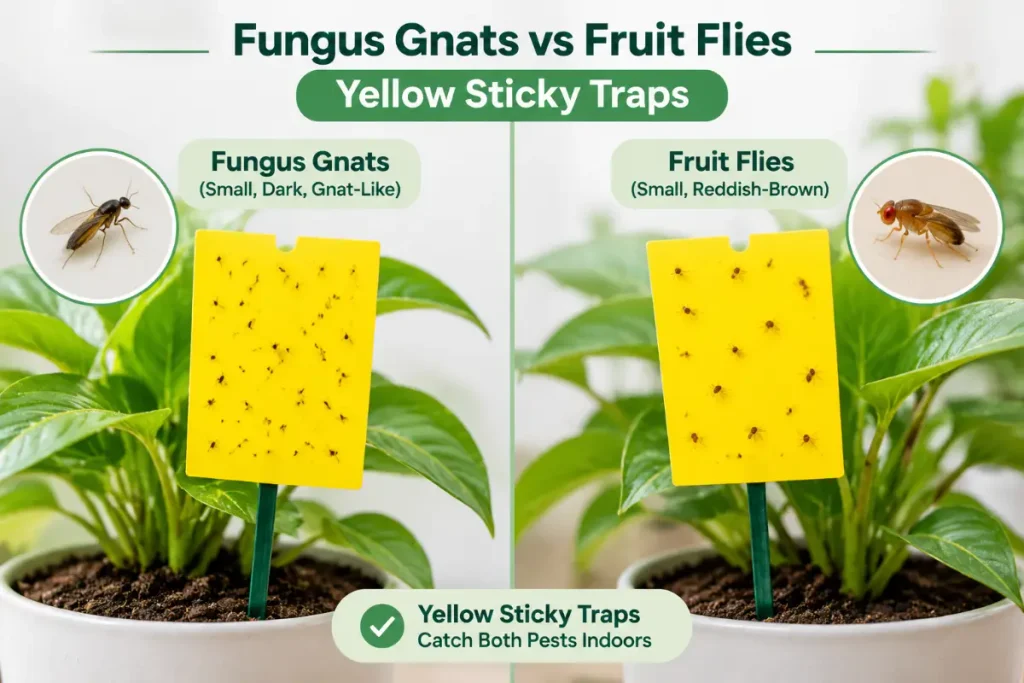
Step 2: Yellow Sticky Traps
Place yellow sticky traps horizontally on the soil surface or just above it. Adult fungus gnats are strongly attracted to yellow. Sticky traps catch adults, reducing egg-laying and providing a visual monitor of population levels. Replace traps when covered with insects. Available at Home Depot and Lowe’s in packs of 20–30 for $8–$12.
Step 3: Bacillus thuringiensis israelensis (Bti)
Bti is a naturally occurring soil bacterium that is toxic specifically to fungus gnat larvae — it disrupts their digestive system without harming plants, humans, pets, or beneficial insects. Available as Mosquito Bits (Summit Chemical) at Home Depot and Lowe’s — the same product used for mosquito control also controls fungus gnat larvae.
How to use: Soak Mosquito Bits in water for 30 minutes, then use the treated water to water your plant. The Bti-infused water reaches the soil zone where larvae are feeding. Apply with every other watering for 4–6 weeks until the infestation clears.
Step 4: Hydrogen Peroxide Soil Drench
For a faster kill of larvae already in the soil, mix 1 part 3% hydrogen peroxide (standard drugstore variety) with 4 parts water and water the plant thoroughly with this solution. The hydrogen peroxide oxidizes on contact with organic matter in the soil, killing larvae. It is completely safe for plants — the fizzing reaction is harmless and the solution breaks down into water and oxygen within minutes.
Apply once; repeat after 1 week if adult gnats persist. Do not use more frequently — repeated application can disrupt beneficial soil microorganisms.
Step 5: Diatomaceous Earth Top Dressing
Apply a 1/4-inch layer of food-grade diatomaceous earth (DE) over the top of the potting mix. DE is a physical deterrent — the microscopic sharp edges damage the bodies of larvae and adult gnats that cross it. It also absorbs surface moisture, making the top layer of soil less hospitable for egg-laying.
Reapply after watering, as DE loses effectiveness when wet. Available at Home Depot and Lowe’s.
Getting Rid of Fruit Flies: Step-by-Step
Step 1: Eliminate the Breeding Source
Fruit flies cannot be eliminated by treating plants — the breeding source must be found and removed. Check: fruit bowls (remove any overripe fruit), kitchen compost bins (empty and clean), sink drains (clean with a drain brush and baking soda/vinegar flush), and anywhere else organic matter may be fermenting.
If the flies persist near a houseplant specifically, check the saucer for accumulated organic debris and the soil surface for decaying plant material — remove any decomposing leaves or debris from the soil surface.
Step 2: Apple Cider Vinegar Trap
Fill a small jar or bowl with 2 tablespoons of apple cider vinegar, 1 tablespoon of sugar, and a few drops of dish soap. The vinegar and sugar attract fruit flies; the dish soap breaks surface tension so they drown. Place near the problem area. This trap catches adults quickly but does not address breeding sources — use alongside source elimination.
Step 3: Keep Fruit Refrigerated
During a fruit fly infestation, store all fruit in the refrigerator until the population is under control. This removes the primary attraction and prevents new generations from hatching.
When Both Pests Are Present
It is possible to have fungus gnats and fruit flies simultaneously — particularly in a kitchen with houseplants. In this case, treat both simultaneously: allow houseplant soil to dry (fungus gnats), use Bti (fungus gnat larvae), set apple cider vinegar traps (fruit flies), and eliminate all fruit and organic debris sources (fruit flies).
Understanding the fungus gnats vs fruit flies in houseplants situation helps when both are present simultaneously — the two populations are entirely independent and require their respective treatments to resolve.
Prevention: Keeping Both Away Long-Term
For fungus gnats:
- Water only when the top 2 inches of potting mix are dry
- Use well-draining potting mix with perlite to prevent waterlogging
- Top-dress pots with a layer of coarse sand or perlite — this dries quickly and deters egg-laying
- Quarantine all new plants for 2–4 weeks to prevent introducing infested soil
For fruit flies:
- Store fruit in the refrigerator or in a closed fruit bowl
- Empty compost bins frequently
- Clean sink drains weekly with a drain brush
- Remove fallen leaves and organic debris from soil surfaces promptly
Common Mistakes When Treating Fungus Gnats
Even plant owners who correctly identify fungus gnats often make errors that extend infestations for months. Here are the most common:
Continuing to water on a schedule: The most persistent mistake. Many plant owners water on a fixed schedule (every 7 days, for example) regardless of whether the soil has dried. Fungus gnats thrive in this predictable moisture environment. Switching to soil-moisture-based watering — checking with a finger before every watering — is the foundational change that makes every other treatment work.
Using insecticide sprays on adult gnats: Spraying flying adults with insecticide has essentially no effect on the population — adults live only 7–10 days and there are always new adults emerging from larvae in the soil. Killing adults without addressing larvae is treating symptoms while ignoring the cause. Focus treatments on the soil where eggs and larvae live.
Treating once and stopping: A single hydrogen peroxide drench or one round of Bti does not eliminate the entire population because all life stages are present simultaneously. Some eggs will not yet have been laid; some larvae will be deep in the soil. Consistent treatment over 4–6 weeks — covering multiple breeding cycles — is necessary for complete elimination.
Repotting into new soil without treating first: Repotting a fungus-gnat-infested plant into fresh potting mix can help, but adult gnats will simply lay new eggs in the fresh soil if the breeding conditions (moist soil, available adults) remain unchanged. If repotting is part of the treatment strategy, allow the new soil to dry between waterings and use Bti with the first several waterings.
Using sand as a top dressing incorrectly: Coarse horticultural sand or perlite as a top dressing is effective — it dries quickly and deters egg-laying. Fine play sand or regular builder’s sand, however, can compact over potting mix and actually retain moisture. Use only coarse horticultural sand or perlite for top dressing.
Natural Predators for Persistent Fungus Gnat Infestations
For severe or persistent fungus gnat infestations where conventional treatments are not achieving control, biological control using predatory organisms can be highly effective:
Beneficial nematodes (Steinernema feltiae): Microscopic roundworms that actively seek out and parasitize fungus gnat larvae in the soil. Applied as a soil drench (mixed with water and poured into the potting mix), they establish in the soil and provide ongoing control. Available online from specialty garden suppliers including Arbico Organics. Most effective in moist soil — the one situation where allowing the soil to stay slightly moister than usual is appropriate.
Predatory mites (Hypoaspis miles / Stratiolaelaps scimitus): Small predatory mites that live in the top layer of potting mix and feed on fungus gnat larvae, pupae, and eggs. Sprinkled onto the soil surface, they establish and provide persistent biological control. Available from specialty biological control suppliers. Compatible with Bti treatments.
Rove beetles (Dalotia coriaria): Predatory beetles that prey on fungus gnat larvae in potting mix. Less commonly available than nematodes or mites but highly effective in large collections or greenhouse settings.
Biological controls are most useful for large plant collections where treating dozens of pots with Bti and sticky traps becomes impractical. For one to five plants, Bti plus soil drying is the most straightforward path to control.
Identifying Fungus Gnat Larval Damage
Because fungus gnat larvae live underground, their damage is often misattributed to other causes — particularly overwatering, which shares several of the same symptoms. Here is how to tell the difference:
Symptoms of larval root damage:
- Wilting despite moist soil — roots are damaged and cannot transport water even when available
- Yellowing lower leaves with no other obvious cause
- Stunted new growth despite apparently good care
- Fine roots visibly chewed or missing when plant is removed from pot
Confirming larval presence: To confirm fungus gnat larvae in the soil, press a raw potato slice against the soil surface and leave it for 24–48 hours. Fungus gnat larvae are attracted to potato tissue and will congregate near it — checking the underside of the slice reveals larvae if present. This simple test confirms whether larvae are the cause of plant symptoms before investing in treatment.
Plants most vulnerable to larval damage: Seedlings and young plants with undeveloped root systems; orchids with sparse aerial roots; recently repotted plants with damaged roots; plants in heavy peat-based potting mix that retains moisture near the roots.
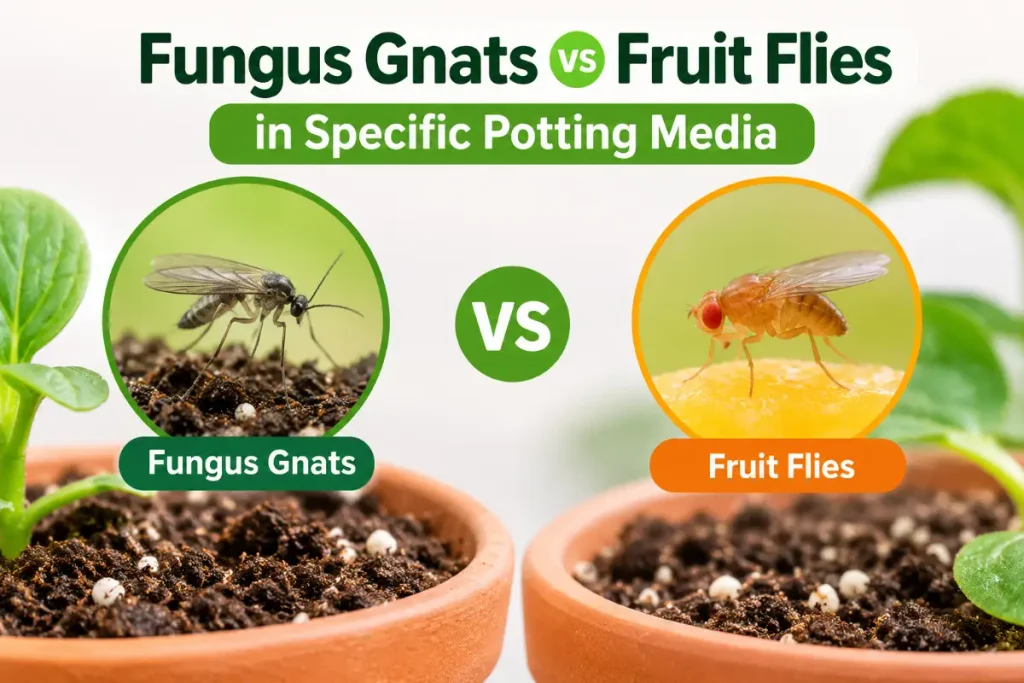
Fungus Gnats in Specific Potting Media
The type of potting mix used has a significant effect on fungus gnat susceptibility — not all media are equally hospitable to egg-laying and larval development.
Peat-based potting mix: The highest risk medium. Peat retains moisture effectively — a quality valued for plant growth — but this same property makes it ideal fungus gnat habitat. Standard commercial potting mixes (like Miracle-Gro All Purpose) are peat-based and prone to fungus gnats when overwatered.
Perlite and pumice: Both are inorganic and provide no food source for larvae. Mixes with high perlite or pumice ratios (30%+) drain faster, dry out more quickly, and support smaller larval populations than pure peat mixes. Switching to a perlite-rich aroid mix or cactus mix for susceptible plants significantly reduces fungus gnat pressure.
LECA (Lightweight Expanded Clay Aggregate): Semi-hydroponic growing in LECA eliminates fungus gnats almost entirely. The clay balls provide no food source for larvae; the water reservoir at the bottom is separated from the root zone by an air gap that larvae cannot bridge. Plant owners with chronic fungus gnat problems often transition susceptible plants to LECA for this reason.
Coco coir: Similar moisture retention to peat but with slightly different fungal profiles. Fungus gnats can still colonize coco coir but tend to do so less aggressively than in pure peat.
Bark-based mixes (orchid mix): Chunky bark mixes drain rapidly and dry out quickly at the surface — a less hospitable environment for egg-laying than fine potting mix. Orchid growers rarely deal with fungus gnats for this reason.
The practical takeaway: if fungus gnats are a recurring problem despite correct watering, switching to a chunkier, more perlite-rich potting mix — or transitioning to semi-hydroponics — addresses the problem at its root rather than requiring ongoing treatment.
Conclusion
The fungus gnats vs fruit flies in houseplants distinction comes down to behavior: gnats stay near soil and are caused by overwatering; fruit flies congregate near food and fermentation sources and are rarely a true plant pest. Identifying which you have takes under a minute using the behavioral and visual clues above. Fungus gnats are treated by drying out soil and using Bti or hydrogen peroxide drench; fruit flies are resolved by eliminating breeding sources and setting vinegar traps.
For comprehensive, research-based guidance on identifying and managing flying insect pests in indoor plant environments, the Colorado State University Extension guide to fungus gnats and shore flies covers identification, biology, and integrated management of the most common houseplant flying pests.
FAQs
How do I know if I have fungus gnats or fruit flies?
Watch where the flies concentrate. Fungus gnats hover near and on the soil surface and show no interest in food. Fruit flies gather near ripening fruit, drains, and food sources. Up close, fungus gnats are slender and dark like tiny mosquitoes; fruit flies are stockier with tan bodies and red eyes.
Can fruit flies damage houseplants?
No — fruit fly larvae do not feed on plant roots or leaves. They are attracted to fermenting organic matter, not plants. Any plant damage associated with a fruit fly presence is coincidental (usually overwatering that attracted both fruit flies and fungus gnats to the same area).
How long does it take to get rid of fungus gnats?
With consistent treatment — allowing soil to dry between waterings and applying Bti with alternate waterings — most fungus gnat infestations clear within 3–6 weeks. The lifecycle takes 3–4 weeks, so at least one full cycle must pass for new hatchings to stop.
Does cinnamon kill fungus gnats?
Cinnamon has antifungal properties and can suppress the soil fungi that fungus gnat larvae feed on, reducing the habitat’s attractiveness. It is a mild preventive measure rather than a primary treatment — most effective as a top dressing alongside soil-drying practices, not as a standalone solution.
Are fungus gnats harmful to humans?
Fungus gnats do not bite humans and are not known to transmit disease. They are a plant pest and a household nuisance, but pose no direct human health risk.
Pingback: Spider Mites on Houseplants: 9 Quick Fixes (2026 Guide) - Plant Quill