
Insecticide soap for indoor plants is one of those pest control tools that sounds simple but gets misused often enough to cause plant damage and treatment failures that are entirely avoidable. Understanding how insecticide soap for indoor plants actually works before applying it explains why technique matters more than the product itself, why some plants react badly while others tolerate it easily, and why a single application almost never solves an infestation even when it kills a significant portion of the visible pest population.
This guide covers the 7 most important things to understand about insecticide soap for indoor plants before you use it: how it works, which pests it actually kills, which plants need special handling, how to make it correctly at home, the best commercial products available at garden centers, common mistakes that reduce effectiveness, and when to move beyond soap to other treatments.
Quick Answer
Insecticide soap for indoor plants kills soft-bodied insects including aphids, spider mites, whiteflies, mealybugs, and thrips by breaking down their protective outer coating through direct contact, causing dehydration and death. Mix 1 teaspoon of plain dish soap per quart of water, spray every plant surface including leaf undersides thoroughly, and repeat every 3 to 4 days for two full weeks. Test on one leaf before full application since sensitive plants including ferns, succulents, and orchids can show damage even at correct dilutions.
1. How Insecticide Soap Actually Works
Most people assume insecticide soap works like a poison that insects absorb and die from over time. It does not work that way, which is important to understand because it directly affects how you apply it and how often.
Insecticide soap is a contact killer that works through a purely physical mechanism. When the soap solution hits a soft-bodied insect directly, the fatty acids in the soap penetrate and break down the waxy cuticle that forms the insect’s protective outer layer. This cuticle normally keeps moisture locked inside the insect’s body. Once it is compromised, the insect dehydrates rapidly and dies. The soap also physically blocks the spiracles, which are the breathing pores on the insect’s surface, which accelerates death through suffocation alongside the dehydration effect.
The critical limitation this creates is that once the soap spray dries on the plant surface, it becomes completely inert. There is no residual toxicity, no lingering chemistry, and no systemic uptake into plant tissue. It kills what it hits while wet and nothing else.
This explains why complete coverage of every plant surface including leaf undersides is absolutely essential with insecticide soap in a way that is less critical with some other treatments. A spider mite on a leaf underside that the spray nozzle never reached is completely unaffected by a soap treatment that thoroughly covered the top of the same leaf.
2. Which Pests Insecticide Soap Kills and Which It Does Not
Insecticide soap works on soft-bodied insects whose thin protective cuticle can be penetrated by fatty acids. It does not work on hard-shelled insects whose thicker outer casing resists penetration.
Pests insecticide soap kills effectively:
- Aphids at all mobile life stages
- Spider mites including nymphs and adults
- Whiteflies (nymphs and adults, not eggs)
- Mealybugs (young crawlers more than adults)
- Thrips (nymphs and adults)
- Fungus gnat adults
- Soft scale crawlers
- Leafhoppers
Pests insecticide soap does not kill:
- Aphid, spider mite, and whitefly eggs (the waxy egg surface resists penetration)
- Hard-shelled beetles
- Adult armored scale (shell too thick for fatty acid penetration)
- Caterpillars
- Soil-dwelling larvae including fungus gnat larvae
- Ants
The egg-resistance limitation is the primary reason insecticide soap requires consistent reapplication on a strict schedule rather than a single thorough treatment. Eggs surviving the first application hatch within days and the newly emerged nymphs are susceptible to the next application, but only if that application happens before those nymphs mature and begin laying their own eggs. Missing the two-week treatment window by even a few days gives the next generation time to establish and rebuild the population.
3. Which Indoor Plants Are Sensitive to Insecticide Soap
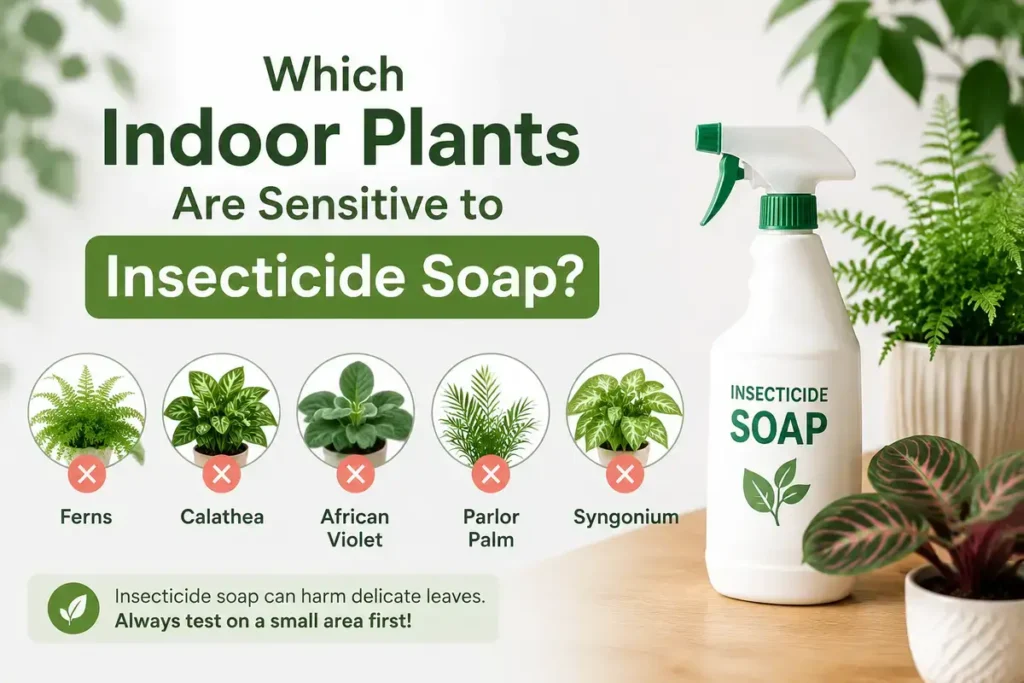
Most common houseplants tolerate insecticide soap at normal dilutions without damage. A smaller group of species is genuinely sensitive and requires either a lower concentration, a shorter contact time before rinsing, or a switch to a commercial insecticidal soap product that is pH-balanced for plant safety.
Plants that commonly show sensitivity:
- Ferns (most varieties, particularly maidenhair and Boston ferns)
- Succulents and cacti
- Orchids (particularly phalaenopsis)
- African violets
- Jade plants
- Some palms including areca and parlor palm
- Impatiens
- Newly rooted cuttings of any species
Sensitivity shows up as yellowing, browning, spotting, or tip burn on leaves within 24 to 48 hours of application. The damage is typically irreversible on affected leaves but does not spread to unaffected growth if treatment stops immediately.
For sensitive plants, reduce the soap concentration by half to half a teaspoon per quart of water, apply in the evening rather than any time direct light hits the plant, and rinse with plain water within one hour of application rather than the standard two to three hours. Alternatively, switch to a commercial insecticidal soap product specifically formulated for plant safety since these are pH-balanced to reduce the risk of tissue damage on borderline-sensitive species.
Always test on a single leaf and wait 24 hours before treating the entire plant regardless of species. This 30-second step is the most reliable protection against unexpected sensitivity reactions.
4. How to Make Insecticide Soap at Home Correctly
Homemade insecticide soap is effective for most common indoor plant pest situations and costs almost nothing if you already have dish soap in your kitchen. The key is using the right soap and the right concentration since both wrong soap choice and incorrect dilution reduce effectiveness and increase plant damage risk.
What you need:
- 1 quart of room temperature water (filtered or distilled if your tap water is very hard)
- 1 teaspoon of plain liquid dish soap
The soap that works: Dawn Original Blue is the most consistently recommended dish soap for this purpose across plant care communities. It contains the fatty acid profile needed for insect cuticle penetration without the added moisturizers, antibacterial agents, bleach, or degreasers that can damage plant tissue. Avoid Dawn Platinum, any antibacterial formula, any soap with added hand lotion, and any product labeled as a degreaser.
What does not work: Laundry detergent, dishwasher tablets or gel, dish soap with added moisturizers, concentrated commercial cleaners, and castile soap without added fatty acids. These either fail to kill insects effectively, damage plants at the concentrations needed for pest control, or both.
How to mix it: Combine water and soap in a clean spray bottle and shake gently. Do not shake vigorously since this creates excessive foam that clogs the nozzle and reduces the volume of solution you can apply before the bottle needs refilling.
Hard water consideration: Very hard tap water with high mineral content can reduce soap effectiveness by binding with fatty acids before they reach insects. If your tap water is noticeably hard, filtering or using distilled water for your spray solution improves results and prevents mineral deposits on leaves.
For a detailed comparison of how homemade insecticide soap performs against commercial products for each specific pest species and plant type, insecticidal soap for indoor plants covers every option with specific product recommendations and side-by-side effectiveness comparisons.
5. Best Commercial Insecticide Soap Products for Indoor Plants
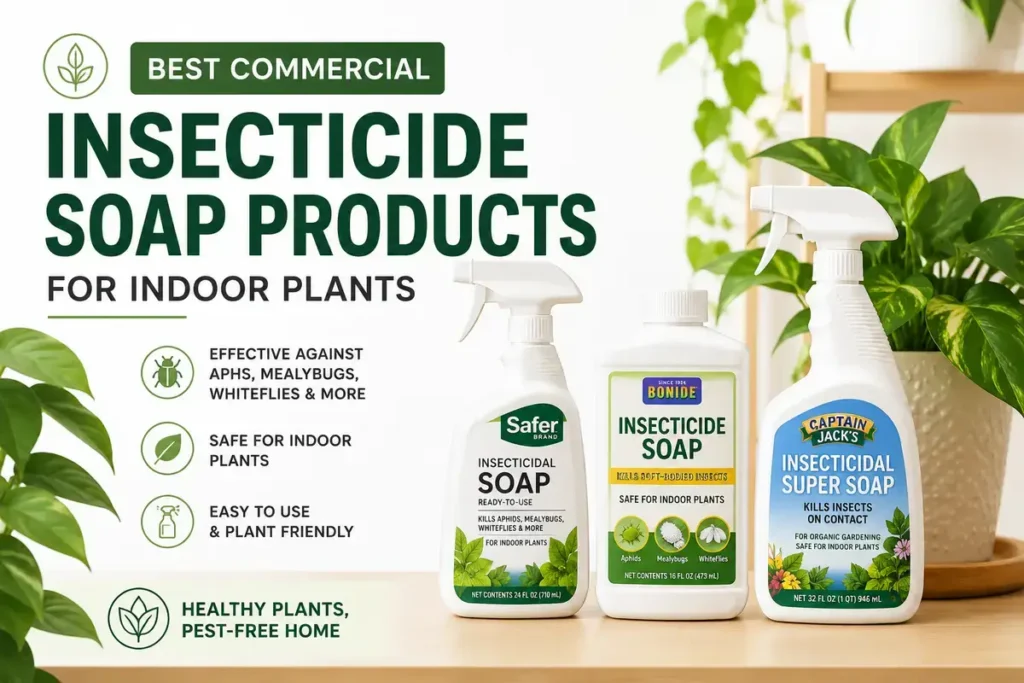
If you prefer a ready-made product or if your plants have shown sensitivity to homemade dish soap spray, these are the most widely available and consistently effective commercial insecticidal soap options at garden centers.
Safer Brand Insect Killing Soap is the most widely recommended commercial insecticidal soap for indoor plant use in the country. It uses potassium salts of fatty acids specifically pH-balanced for plant safety, making it significantly less likely to cause leaf burn than homemade dish soap versions. Available at Home Depot, Lowe’s, Walmart, Target, and Amazon in both ready-to-use spray bottles and concentrate forms. The concentrate is more economical for larger plant collections treated regularly.
Bonide Insecticidal Soap performs comparably to Safer Brand and is equally widely available at major retailers. It comes in a ready-to-use formulation that is convenient for smaller collections where buying a concentrate is impractical.
Garden Safe Insecticidal Soap is the best choice for anyone growing edible plants alongside ornamental houseplants since it is specifically OMRI listed for organic use on food crops. Safe for herbs, indoor tomatoes, and other edibles with the same 24-hour pre-harvest interval as the other two products.
All three commercial products are safe for use around children and pets once dry, break down naturally in the environment, and leave no residual chemical toxicity on plant surfaces after drying.
6. The 5 Most Common Mistakes That Make Insecticide Soap Less Effective
Mistake 1: Missing leaf undersides. This single error is responsible for more treatment failures than any other. Aphids, spider mites, and whiteflies live, feed, and lay eggs on leaf undersides specifically because that sheltered surface protects them from rain, predators, and surface treatments. A spray that only hits the top of leaves leaves the majority of the pest population completely untreated.
Work slowly and deliberately under each leaf when applying any soap spray. Take three times as long as feels necessary. The extra time spent on thorough application determines whether the treatment works or fails more than any other factor.
Mistake 2: Stopping treatment too early. The most common reason indoor plant pest infestations return after soap treatment is stopping after one or two applications when visible insects disappear. Eggs that survived the first application hatch within days of treatment ending and the next generation rebuilds the population rapidly. Continue treating every 3 to 4 days for a full two weeks even when the plant looks completely clean.
Mistake 3: Applying in bright direct sunlight. Soap spray applied to leaves in direct intense sunlight dries faster than it can work, reducing contact time with target insects and increasing the risk of leaf burn through solar concentration of the soap residue. Always apply in the morning before direct sun hits the plant, in the evening after it has moved off, or when the plant is out of direct sun entirely.
Mistake 4: Using the wrong soap. Dish soaps with added moisturizers, antibacterial agents, and degreasers either damage plant tissue or fail to kill insects effectively. Use only plain dish soap without additives or a commercial insecticidal soap product. Check the ingredient list before buying any new soap for this purpose.
Mistake 5: Treating only the affected plant. By the time you notice a pest infestation on one plant, neighboring plants typically have early-stage infestations that are not yet visible. Treating one plant while leaving infested neighbors untouched results in rapid reinfection from the untreated population. Treat every plant within 2 to 3 feet of the affected plant simultaneously even if they appear pest-free.
7. When to Move Beyond Insecticide Soap to Other Treatments
Insecticide soap resolves most soft-bodied pest infestations on indoor plants when applied correctly and consistently. There are specific situations where a different or additional treatment is more appropriate.
Move to neem oil when: A two-week consistent soap treatment has not produced clear improvement, or you are dealing with spider mites that have developed resistance from repeated soap-only treatment. Neem oil’s azadirachtin content adds hormonal disruption that contact-only soap cannot provide, and rotating between soap and neem oil prevents resistance development. The complete guide to neem oil and other spray options matched to specific pests is covered in bug spray for indoor plants.
Move to spinosad when: Thrips are the identified pest and two or more weeks of soap and neem oil treatment has not resolved the infestation. Thrips are notoriously resistant to soap spray and spinosad-based products like Captain Jack’s Deadbug Brew are significantly more effective against them at every life stage.
Move to rubbing alcohol when: Mealybugs with heavy waxy coating are not responding to soap spray. The alcohol dissolves the waxy protective layer that water-based sprays bead off of, making direct contact with the insect body beneath.
Move to biological controls when: Three or more weeks of consistent spray treatment has not resolved the infestation and you want to avoid escalating to systemic insecticides. Predatory insects and beneficial nematodes address pest populations in locations sprays cannot reach. For the complete guide to biological pest control options that work alongside or instead of spray treatments, beneficial bugs for indoor plants covers every species with specific guidance on introduction and use.
Move to systemic insecticide as a true last resort when: Every organic and biological method has been tried consistently for three or more weeks without meaningful improvement. Systemic products absorbed through roots and distributed through plant tissue kill insects that feed on the plant regardless of location, including those hidden in furled leaves and deep in plant structures that no spray reaches. Use only on ornamental plants, never on edibles.
How Insecticide Soap Fits Into a Complete Pest Management Approach
Insecticide soap works best as one component of a broader approach rather than as the sole treatment method. For the most common indoor plant pest scenarios:
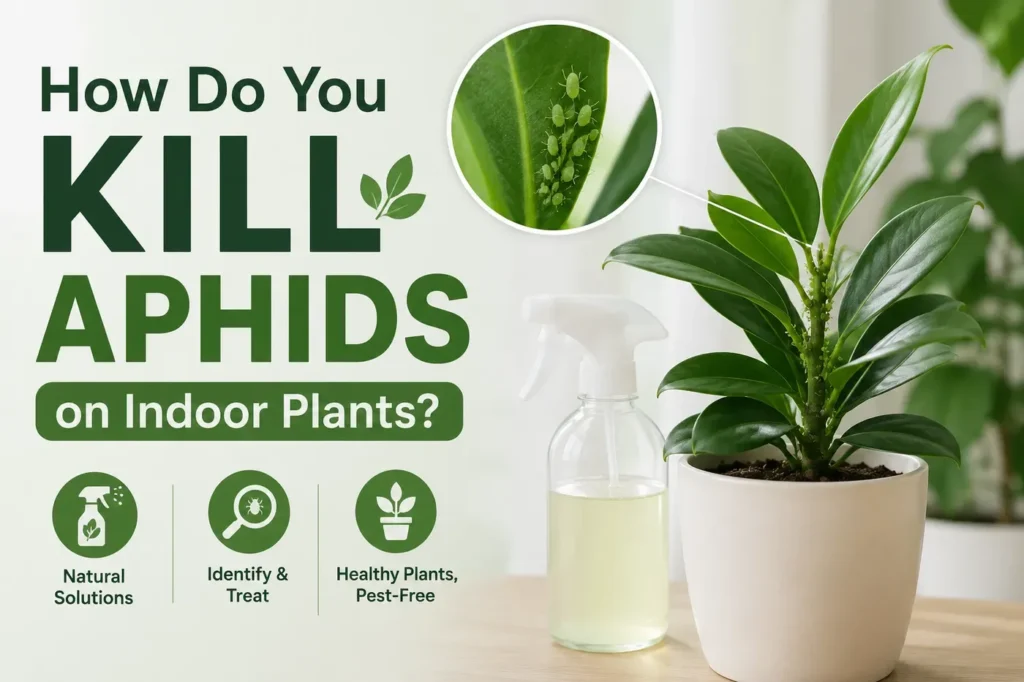
For aphid infestations: Start with manual removal of visible clusters, apply soap spray every 3 to 4 days, switch to neem oil or add it to the rotation if soap alone is not producing improvement after the first week. How do you kill aphids on indoor plants covers every method in order of severity for the complete aphid treatment process from first identification through to complete elimination.
For spider mites: Rotate soap and neem oil every other application to prevent resistance development. Increase indoor humidity simultaneously since spider mites specifically thrive in the dry conditions of heated indoor spaces.
For whiteflies: Combine soap spray with yellow sticky traps. Soap kills nymphs and adults during the application. Traps catch flying adults between spray sessions and prevent them from laying new eggs on clean plants nearby.
For fungus gnats: Soap spray addresses adult gnats on plant surfaces but does not reach larvae in the soil. Combine with hydrogen peroxide soil drenching for larvae and yellow sticky traps for adult monitoring. For the complete soil-dwelling pest treatment approach that complements above-ground soap spray, indoor plants insects in soil covers every soil-dwelling species with specific treatment guidance.
Conclusion
Insecticide soap for indoor plants is one of the most practical, safe, and cost-effective pest control tools available for home use when you understand its actual mechanism and apply it with the technique that mechanism requires. It kills what it hits while wet and nothing else, which means complete coverage of every plant surface on a consistent schedule is the difference between treatment that works and treatment that does not.
Mix it correctly using plain dish soap without additives at one teaspoon per quart of water. Test on a single leaf before full application. Apply every 3 to 4 days covering every leaf surface including undersides until the spray drips freely. Continue for two full weeks after visible insects disappear. Treat every plant in the area simultaneously. Rinse sensitive plants with plain water two to three hours after application.
Those steps, applied consistently, make insecticide soap one of the most reliable pest control tools available for indoor plant use. When they are not enough, the escalation path through neem oil, spinosad, and biological controls handles the cases that soap alone cannot resolve.
Frequently Asked Questions
Is insecticide soap the same as insecticidal soap?
Yes. Insecticide soap and insecticidal soap refer to the same type of product: a solution of fatty acids or potassium salts of fatty acids that kills soft-bodied insects through direct contact. The terms are used interchangeably in gardening contexts. Commercial products are typically labeled as insecticidal soap while homemade versions are sometimes called insecticide soap or dish soap spray. All versions work through the same contact-killing mechanism regardless of what they are called.
How do I know if insecticide soap is working on my indoor plants?
Signs that insecticide soap treatment is working include visible reduction in aphid, spider mite, or whitefly populations between spray applications, new plant growth coming in undistorted and healthy rather than curled or stippled, and a declining catch rate on yellow sticky traps if you have them in place. If none of these signs appear after two full weeks of every 3 to 4 day applications with thorough leaf underside coverage, the treatment is either not reaching the pest population adequately or the infestation severity warrants escalation to neem oil or another treatment.
Can I use insecticide soap on succulents and cacti?
Use with significant caution. Succulents and cacti have a waxy surface coating that soap spray can strip away, causing damage that appears as soft, discolored spots or a dulled surface finish. If succulents or cacti must be treated with soap spray, dilute to half the normal concentration, test on a small hidden area first, and rinse with plain water within 30 minutes rather than the usual two to three hours. A commercial insecticidal soap product formulated for plant safety is preferable to homemade dish soap versions for these sensitive species.
How long does insecticide soap remain effective after mixing?
Homemade soap spray degrades and loses effectiveness within one week when stored at room temperature in a sealed spray bottle. Beyond that, the fatty acid content breaks down and the solution becomes less reliable at penetrating insect cuticles. Mix fresh batches for each treatment session rather than making large quantities to store. Commercial ready-to-use products have a shelf life of one to two years when stored in a cool, dark place as indicated on the product label.
Does insecticide soap harm earthworms or soil organisms?
At the dilutions used for plant pest control, insecticide soap that drips into the soil during application has minimal impact on earthworms and most soil organisms since soil particles bind with the fatty acids and neutralize them rapidly. Deliberate application of soap solution to soil as a drench, however, can harm beneficial soil organisms including earthworms, nematodes, and mycorrhizal fungi. Use soap spray for above-ground pest treatment only and use hydrogen peroxide drenching or neem oil for soil-dwelling pest treatment to preserve the beneficial soil ecosystem.
Can I use insecticide soap as a preventive treatment?
Yes, though monthly application at reduced concentration is more appropriate for prevention than the every 3 to 4 day schedule used for active infestations. A monthly preventive application of half-strength insecticide soap across your entire plant collection during spring and summer, when pest pressure is highest, kills any insects that have recently landed on plant surfaces before they establish colonies. This preventive approach is less disruptive to plant tissue than the intensive treatment schedule and significantly reduces the frequency of active infestations developing in the first place.
Pingback: How to Remove Aphids From Indoor Plants: 7 Methods Ranked by Effectiveness - Plant Quill