Overwatering indoor plants is the most common cause of houseplant death in US homes, and it is also the most preventable. What makes overwatering particularly insidious is that its symptoms — yellowing leaves, wilting, and apparent distress — look identical to the symptoms of underwatering, causing well-intentioned plant owners to respond to an already overwatered plant by giving it even more water.
Understanding the specific mechanism by which overwatering kills plants, recognizing the signs accurately, and knowing the intervention steps that can save an overwatered plant before root rot becomes irreversible gives you the tools to recover plants that most people would discard and to prevent the conditions that create this problem in the first place.
Quick Answer
Overwatering kills plants by depriving roots of oxygen in waterlogged soil, causing root rot that prevents the plant from absorbing water even when water is present. Signs include yellow leaves (especially older lower leaves), soft stem bases, soil that stays wet for more than a week, and musty smell from the pot. Fix by stopping watering immediately, improving drainage, removing the plant from its pot to assess and trim damaged roots, repotting in fresh well-draining soil, and adjusting the watering frequency going forward.
How Overwatering Actually Kills Plants
Most people understand overwatering as giving too much water, but the mechanism of death is more specific than that. Overwatering kills plants through oxygen deprivation, not water toxicity.
Plant roots require oxygen to function. In well-draining soil with appropriate dry periods between waterings, oxygen occupies the air pockets in the soil structure between water uptake events. When soil is chronically waterlogged, water fills these air pockets permanently, creating anaerobic (oxygen-free) conditions in the root zone.
In anaerobic conditions, anaerobic bacteria and fungi thrive. These organisms attack root tissue, producing the rot that gives root rot its name. As rot progresses through the root system, the plant loses its ability to absorb water and nutrients even though it is surrounded by water. The plant then shows symptoms of drought stress — wilting, yellowing, and decline — despite sitting in wet soil.
This is why overwatered plants often look exactly like underwatered plants. In both cases the plant cannot access adequate water. The cause is opposite (too much versus too little) but the symptoms converge because the outcome — insufficient water reaching the leaves — is the same.
The progressive timeline: Root rot in most common houseplants progresses from initial waterlogging to significant root damage in two to four weeks. Above-ground symptoms typically appear one to three weeks after root damage begins. By the time yellow leaves and wilting are visible, significant root loss has often already occurred. This delay between cause and visible symptom is why prevention matters more than treatment.
Signs of Overwatering: How to Read Them Accurately
Accurately distinguishing overwatering signs from underwatering signs is the most important diagnostic skill in indoor plant care.
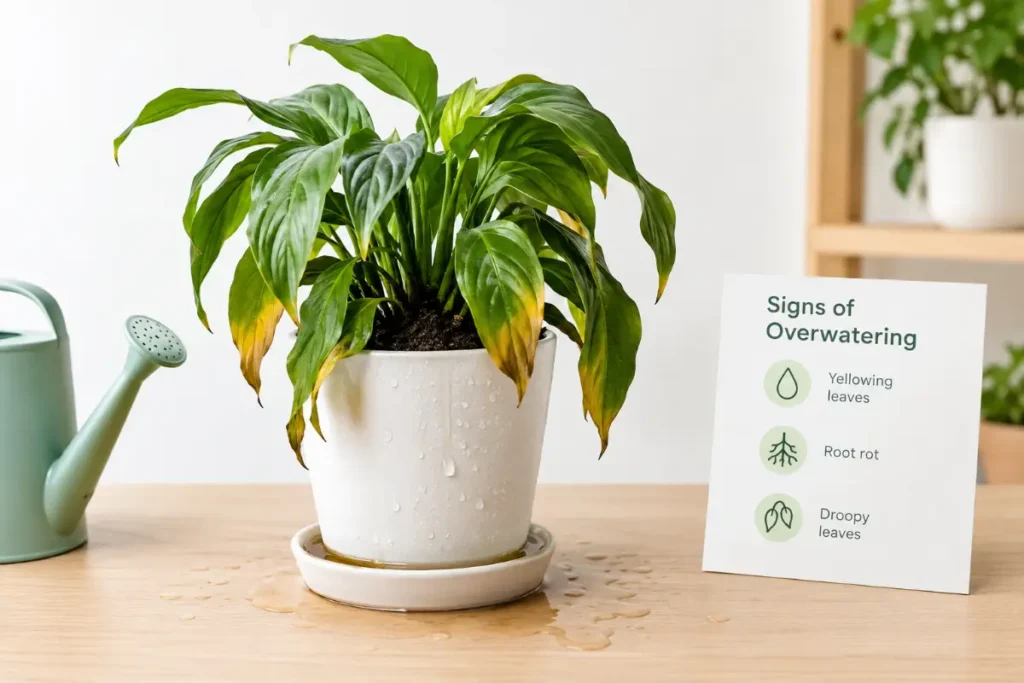
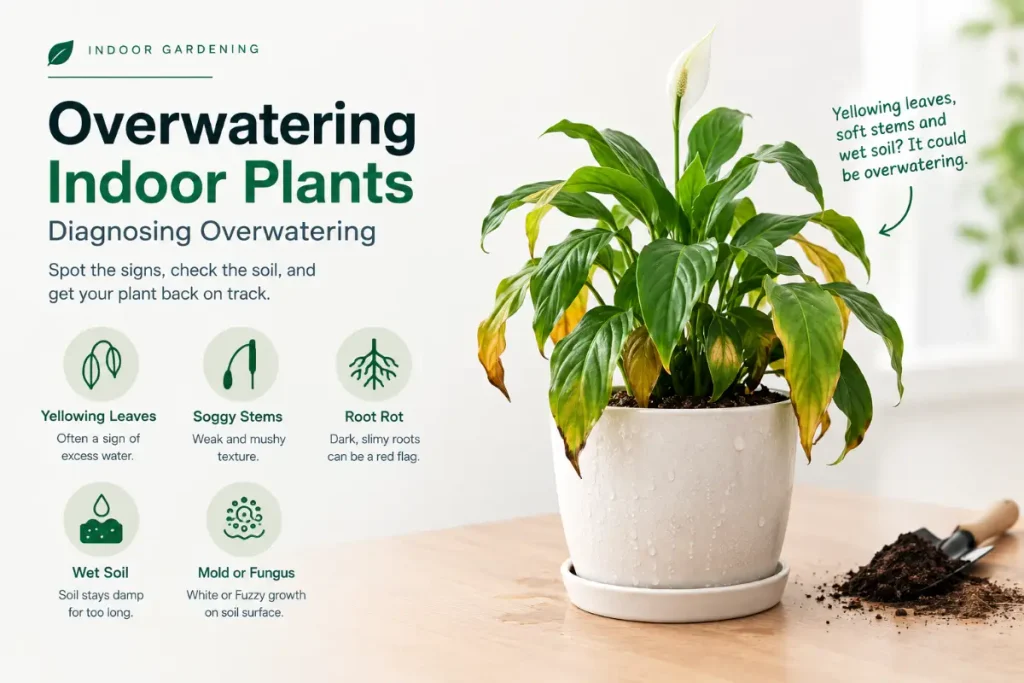
Yellow leaves: Yellowing from overwatering typically starts in the oldest leaves at the base of the plant and progresses upward. The yellowing is often uniformly distributed across the leaf surface rather than appearing at tips or edges first. Multiple leaves may yellow simultaneously. Yellowing from nitrogen deficiency also starts in older leaves but is typically more gradual and associated with pale new growth throughout the plant.
Wilting despite moist soil: The most diagnostic sign of advanced overwatering. A plant that wilts despite having moist soil at the checking depth indicates that roots are no longer able to transport water to leaves. This symptom is the opposite of underwatering where wilting accompanies dry soil.
Soil staying wet for more than a week: Normal soil in adequate light should reach the appropriate dryness checkpoint (one inch for most tropicals) within four to seven days of thorough watering in typical indoor conditions. Soil that remains wet for more than a week indicates either drainage problems, compacted soil, low light conditions dramatically reducing water uptake, or overwatering that never allows the drying cycle the plant needs.
Soft, dark stem bases: One of the earliest physical signs of root rot beginning. The stem base at soil level becomes slightly soft or mushy to the touch before above-ground yellowing appears. This symptom precedes visible leaf symptoms and represents a critical intervention window.
Musty or sour smell from the pot: Anaerobic decomposition in the root zone produces characteristic musty or sour odors detectable when the pot is sniffed closely. This smell in wet soil indicates active anaerobic conditions regardless of whether above-ground symptoms are visible yet.
Leaves falling while still green: A more advanced symptom where the plant sheds intact green leaves rather than yellowing them first. This indicates the plant has cut off the vascular connection to leaves to minimize water loss from a compromised root system.
Algae or fungus gnats: Consistently moist soil at the surface creates ideal conditions for algae growth (green or white surface coating) and fungus gnats (tiny flies around the plant). While not caused by root rot, both indicate chronically moist surface conditions that contribute to overwatering problems.
Diagnosing Overwatering: The Soil and Root Check
When you suspect overwatering but are not certain, two diagnostic checks confirm the problem before you begin treatment.
The soil check: Push your finger to two to three inches depth in the soil. If the soil feels moist or wet after a week or more since the last watering, overwatering or drainage failure is occurring. For context: adequately drained soil in standard indoor conditions typically reaches dryness at one inch within four to seven days of thorough watering. If soil remains wet for longer, either the watering interval is too short or the drainage conditions need improvement.
The root inspection: Remove the plant from its pot gently. Healthy roots are white, cream, or light tan and feel firm. Roots affected by root rot are brown or black and feel soft, mushy, or stringy. They may fall apart when touched. The proportion of healthy to damaged roots determines whether recovery is likely and how aggressive the intervention needs to be.
Recovery prognosis by root damage level:
- Less than 25% of roots affected: Good recovery potential with appropriate intervention
- 25 to 50% of roots affected: Recovery possible with careful intervention and ideal conditions post-treatment
- More than 50% of roots affected: Recovery uncertain. Attempt treatment but consider propagating healthy stem sections as insurance
- 75% or more of roots affected: Recovery unlikely. Propagate any healthy stem material and replace the plant
Step-by-Step: Saving an Overwatered Plant
Step 1 — Stop watering immediately. Do not water the plant again until the soil has dried to the appropriate depth and you have addressed the underlying cause. Continuing to water while root rot is active accelerates the damage.
Step 2 — Improve air circulation around the pot. Move the plant to a brighter, warmer position if possible. Increased light and temperature accelerate soil drying. Run a fan nearby to improve air circulation around the pot surface, which increases evaporation from the soil.
Step 3 — Remove from the pot and inspect roots. Gently tip the plant from its container and examine the root system as described above. This is the most critical diagnostic and treatment step.
Step 4 — Trim all damaged roots. Using clean, sharp scissors or pruning shears, cut away all dark, soft, or mushy roots. Cut back to where the root tissue is firm and light-colored. Sterilize cutting tools between cuts with diluted rubbing alcohol to prevent spreading rot-causing organisms to healthy tissue.
Step 5 — Treat remaining healthy roots. Dust the trimmed root ends with powdered cinnamon (a natural antifungal) or powdered sulfur. Allow the plant to sit out of its pot for thirty to sixty minutes to allow cut root ends to begin callusing over.
Step 6 — Prepare fresh, well-draining potting mix. Do not reuse the original soil which contains the rot-causing organisms. Mix fresh potting mix with adequate perlite (20 to 30% for most plants, more for drought-tolerant species) in a clean pot with multiple drainage holes.
Step 7 — Repot in appropriate-sized container. Choose a container that is the appropriate size for the remaining healthy root system — not the pot the plant came from if it was oversized. Excess soil volume in an oversized pot increases root rot risk during recovery.
Step 8 — Do not water immediately. After repotting, wait forty-eight to seventy-two hours before the first watering. This allows cut root ends to fully callus and reduces immediate rot risk in the recovery period.
Step 9 — Resume conservative watering. Begin the soil check method described in the watering frequency guide, checking at the appropriate depth for the plant type and watering only when that depth is dry. Err on the side of watering slightly less frequently than you normally would for the first four to six weeks as the root system reestablishes.
Step 10 — Provide ideal conditions for recovery. Bright indirect light, appropriate temperature, and good air circulation support the fastest root regrowth from remaining healthy tissue. Avoid the direct intense sun or temperature extremes that would stress an already-compromised plant during recovery.
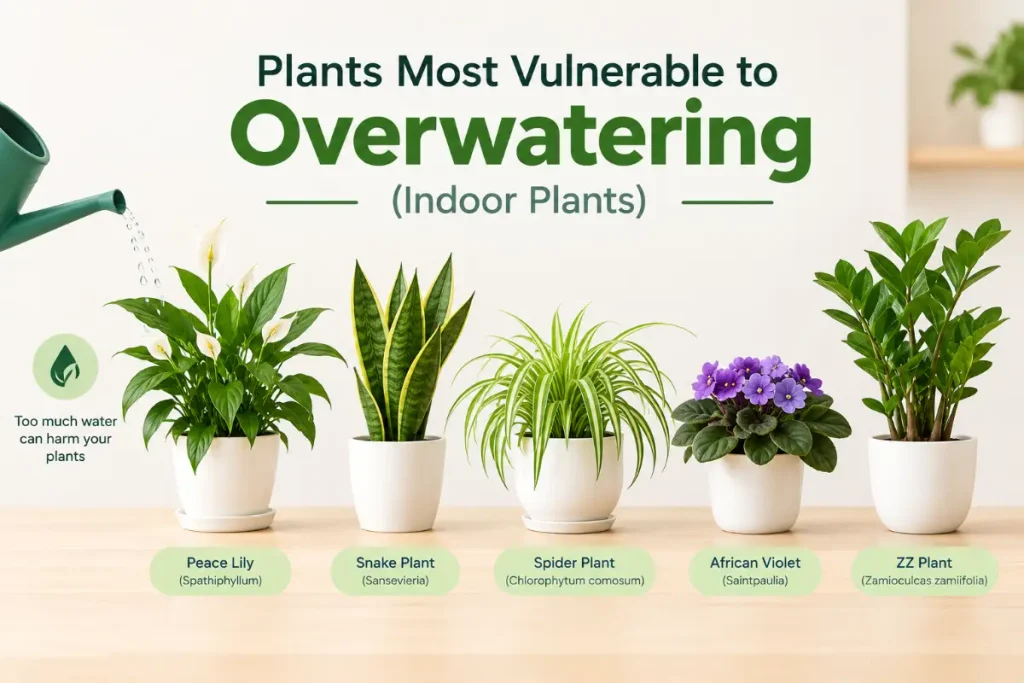
Special Cases: Plants Most Vulnerable to Overwatering
Cacti and succulents: Root rot progresses faster in cacti and succulents than in almost any other group of indoor plants because their roots are specifically adapted to very dry conditions and have essentially no adaptation to prolonged moisture. A cactus that shows overwatering symptoms above ground has often lost most of its root system already. Prevention is far more important than treatment for these species.
Orchids (in bark medium): Orchids in bark-based growing medium are sometimes inadvertently overwatered when owners unfamiliar with the bark medium’s long dry-down time treat it like potting mix. Bark stays visually dark and heavy-feeling for much longer than it needs to before orchid roots have dried to the appropriate level. Use the root color rather than the bark appearance to assess orchid watering needs — grey-silver roots need water, green roots are adequately hydrated.
Newly repotted plants: Plants within the first four to six weeks after repotting are particularly vulnerable to overwatering because their root system is disturbed and less actively absorbing water than an established plant. Water uptake is reduced, so the same watering frequency that suited the plant before repotting may now overwater it. Reduce watering frequency after repotting until new growth indicates root re-establishment.
For the complete guide to correcting overwatering in specific plant types including the Mediterranean herbs and succulents that are most commonly killed by this mistake, indoor plants that repel bugs covers rosemary, lavender, and other aromatic Mediterranean herbs whose fragrant appeal leads many growers to place them in inappropriate moisture conditions that result in the overwatering deaths described in this guide.
Preventing Overwatering: The Sustainable Approach
Prevention of overwatering is more effective and less stressful than treatment after the fact. These practices together make overwatering essentially avoidable.
Always use the soil check method: Check soil moisture at the appropriate depth for your plant type before every watering. Never water based on a fixed schedule, visual appearance of the soil surface alone, or how long it has been since the last watering. The soil check takes five seconds and eliminates the guesswork that causes most overwatering.
Ensure drainage always functions: Drainage holes must be unobstructed. Never block drainage holes with gravel layers (a persistent myth that actually creates perched water tables rather than improving drainage). Empty saucers within thirty minutes of watering. Never leave pots in standing water in decorative outer containers without drainage.
Match pot size to root ball: Oversized pots hold excess soil that stays wet long after the root zone has dried, creating the conditions for root rot even when watering frequency seems appropriate. Choose pots that are two to four inches larger than the root ball, not dramatically larger.
Use appropriate soil for each plant type: Standard potting mix retains significantly more moisture than the fast-draining mixes appropriate for cacti, succulents, and Mediterranean herbs. Amending potting mix with appropriate amounts of coarse perlite for each plant type dramatically reduces overwatering risk by accelerating the dry cycle between waterings. For the complete guide to matching soil mix to plant type, soil mixture for indoor plants covers every combination with specific perlite ratios for different water tolerance levels.
Overwatering Versus Root Rot: Understanding the Distinction
Overwatering and root rot are related but distinct conditions that are worth understanding separately since their treatment timing differs.
Before the soil has dried to the appropriate level for the plant overwatering is the practice of applying water too frequently. Overwatering creates the anaerobic conditions that enable root rot but does not immediately cause visible plant damage. A plant can be overwatered for weeks before root rot establishes and before any above-ground symptoms appear.
Root rot is the fungal or bacterial infection of root tissue that occurs in chronically anaerobic (oxygen-deprived) soil conditions that overwatering creates. Root rot is the mechanism that actually kills the plant. By the time above-ground symptoms of yellow leaves and wilting appear, root rot is typically already established and active.
Why this distinction matters for treatment timing: Stopping overwatering before root rot establishes requires only adjusting watering frequency and ensuring drainage — no root inspection or repotting necessary. Once root rot has established (confirmed by soft, dark roots on inspection), treatment requires physical removal of affected roots and repotting in fresh soil. The earlier you catch the progression — ideally at the overwatering stage before root rot begins, or at the very early root rot stage before significant root loss — the faster and more complete the recovery.
The intervention window: Most plants have an intervention window of approximately two to four weeks from the onset of root rot to the point where root damage becomes irreversible. Acting when you notice the first above-ground symptoms (earliest yellowing, slight stem base softening) rather than waiting for dramatic wilting or leaf loss maximizes the chance of full recovery.
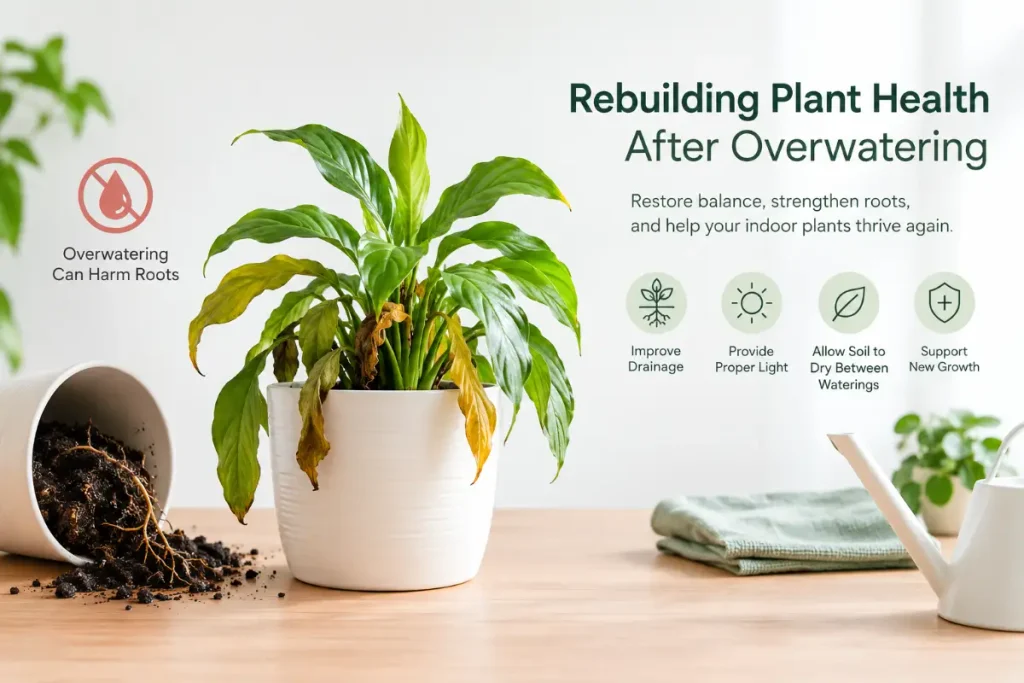
Post-Recovery Care: Rebuilding Plant Health After Overwatering
Once a plant has been treated for root rot and begins showing signs of recovery (new growth, firm stem bases, no further leaf yellowing), a specific recovery-phase care approach accelerates the return to full health.
The first four weeks post-repotting: Maintain the plant in bright indirect light — brighter than it may have been in before if low light contributed to the slow water uptake that enabled overwatering. Avoid direct intense sun that would stress roots still re-establishing. Water at the conservative end of appropriate frequency for the plant type, erring toward slightly drier rather than slightly wetter as roots rebuild.
Weeks four to eight: As new growth appears and confirms root reestablishment, resume normal fertilizing at half rate. Do not rush to full fertilizing since new roots are more sensitive to fertilizer salt concentration than established roots. Full-rate fertilizing can be resumed at eight to twelve weeks post-treatment once robust new growth confirms healthy root function.
The adjusted watering habit: The recovery period is the ideal time to permanently adopt the soil check method that prevents future overwatering. The experience of recovering a plant from root rot provides concrete motivation to develop the habit of checking soil moisture before every watering rather than following a schedule. For the complete guide to building the watering practice that prevents overwatering from occurring in the first place, how often to water indoor plants covers every aspect of the soil check method with specific depth guidance for each plant category.
Conclusion
Overwatering indoor plants is the most preventable cause of plant death and the one that most consistently catches plant owners who are trying hard to care for their plants well. The trap is that more water feels like more care, when for most indoor plants most of the time, less frequent watering produces better outcomes.
Adopt the soil check method as a non-negotiable practice. Ensure drainage functions after every watering. Match soil mix to your specific plants’ drought tolerance. And if you suspect overwatering has already begun, act quickly — the window between initial root damage and irreversible decline is narrow, but plants caught early and treated correctly recover fully and go on to thrive with adjusted watering habits.
Frequently Asked Questions
How do I know if I’m overwatering my indoor plant?
The most reliable signs of overwatering are yellowing older leaves at the base of the plant, soil that stays wet for more than a week after watering, a musty smell from the pot, and wilting despite moist soil. Confirm by removing the plant from its pot to inspect roots — healthy roots are white or cream and firm, while roots damaged by root rot are dark and mushy.
Can an overwatered plant be saved?
Yes, if caught early enough. Plants with less than 50% of their roots affected by root rot have good to reasonable recovery potential with appropriate intervention — stopping watering, removing damaged roots, repotting in fresh well-draining soil, and adjusting the watering approach going forward. Plants with more than 75% root damage have poor recovery prospects but may provide salvageable stem material for propagation.
How long does it take for an overwatered plant to recover?
Four to eight weeks for plants with mild to moderate root damage after appropriate intervention. During recovery, expect slow or no above-ground growth as the plant directs energy toward root regeneration. New healthy growth emerging after this period indicates successful root reestablishment. Plants with severe root damage that survive initial treatment may take three to six months to fully recover their vigor.
What is the difference between overwatering and underwatering symptoms?
Both produce wilting and can produce yellowing, which is why accurate diagnosis requires soil inspection rather than symptom observation alone. Overwatering: wilting despite moist soil, yellowing starting in oldest lower leaves simultaneously, musty soil smell, soft stem bases. Underwatering: wilting with dry soil at the check depth, brown crispy leaf tips and edges, soil pulling away from pot sides. Check soil moisture at two to three inches depth before drawing conclusions.
Why does my plant look droopy even though I water it regularly?
Drooping despite regular watering is a classic sign of root rot from overwatering. The roots are damaged and cannot transport water from the soil to the leaves even though water is present. This symptom requires immediate intervention — stop watering, remove from pot, inspect and trim roots, repot in fresh soil. Continuing to water a plant showing this symptom accelerates the root damage and reduces recovery chances.
How do I prevent overwatering my indoor plants?
Check soil moisture at the appropriate depth for your plant type (one-half inch for moisture-loving plants, one inch for most tropicals, two inches for drought-tolerant plants) before every watering. Water only when that depth feels dry. Ensure pots have adequate drainage holes and saucers are emptied after watering. Use well-draining soil mixes appropriate for each plant’s drought tolerance. Never water on a fixed calendar schedule without first checking soil moisture.