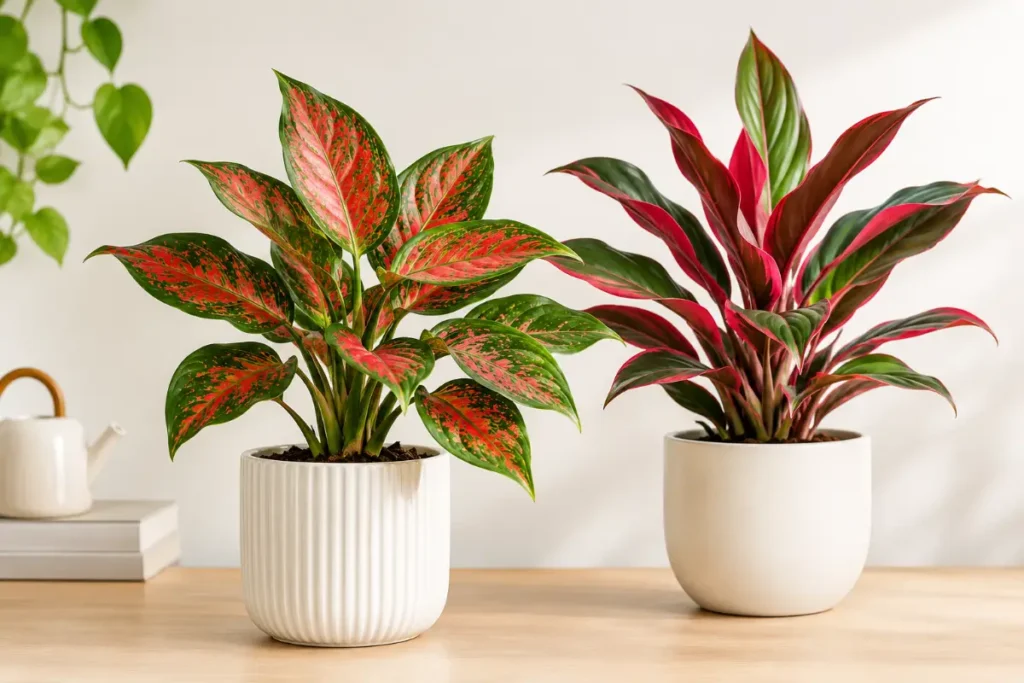
Green is the baseline of the plant world, but it is far from the limit. An indoor plant with colorful leaves transforms a room in a way that green foliage alone cannot — the colours are bold and permanent, the display lasts all year, and the variety available runs from deep jewel tones to soft pastels, from intricate painted patterns to vivid graphic stripes. Unlike flowers, colourful foliage does not have a season. It simply continues.
This guide covers the best varieties of indoor plant with colorful leaves across different room types, light levels, and sizes — with practical care guidance for keeping that colour vibrant long-term rather than watching it fade to a muddy green.
Why Do Some Indoor Plants Have Colourful Leaves?
The colour in plant foliage comes from several different pigment groups:
Anthocyanins produce reds, purples, and blues — found in Caladiums, Crotons, Coleus, and many Rex Begonias. Light intensity directly regulates anthocyanin production; brighter conditions produce richer colour.
Carotenoids produce yellows and oranges — responsible for the gold colouring in variegated plants like Pothos ‘Golden’ and some Dracaena varieties.
Betalains produce the vivid magenta and pink of some succulents and tropical plants.
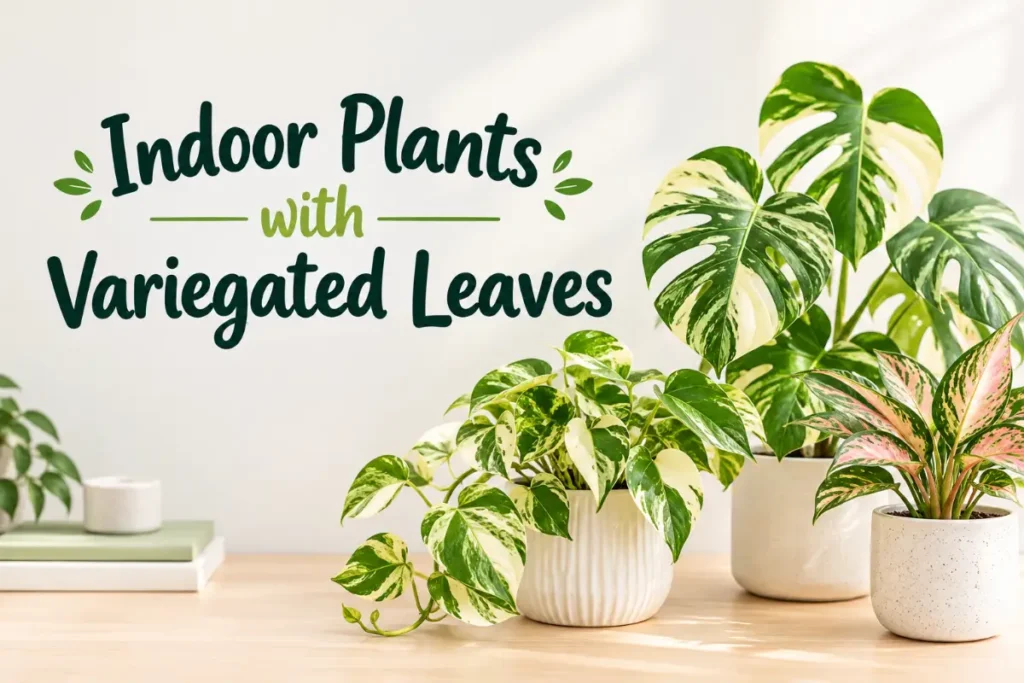
Variegation — the white, cream, or yellow patterning in Monstera, Pothos, and Dieffenbachia — occurs when areas of leaf tissue lack chlorophyll entirely, due to genetic mutation or chimeric cell development.
The practical implication for indoor gardeners: most colourful pigments are light-dependent. Insufficient light causes colour to fade as plants prioritise chlorophyll production for photosynthesis. The brighter the indirect light, the richer and more saturated the colour.
Best Varieties by Light Level
High Light (Bright Indirect or Some Direct Sun)
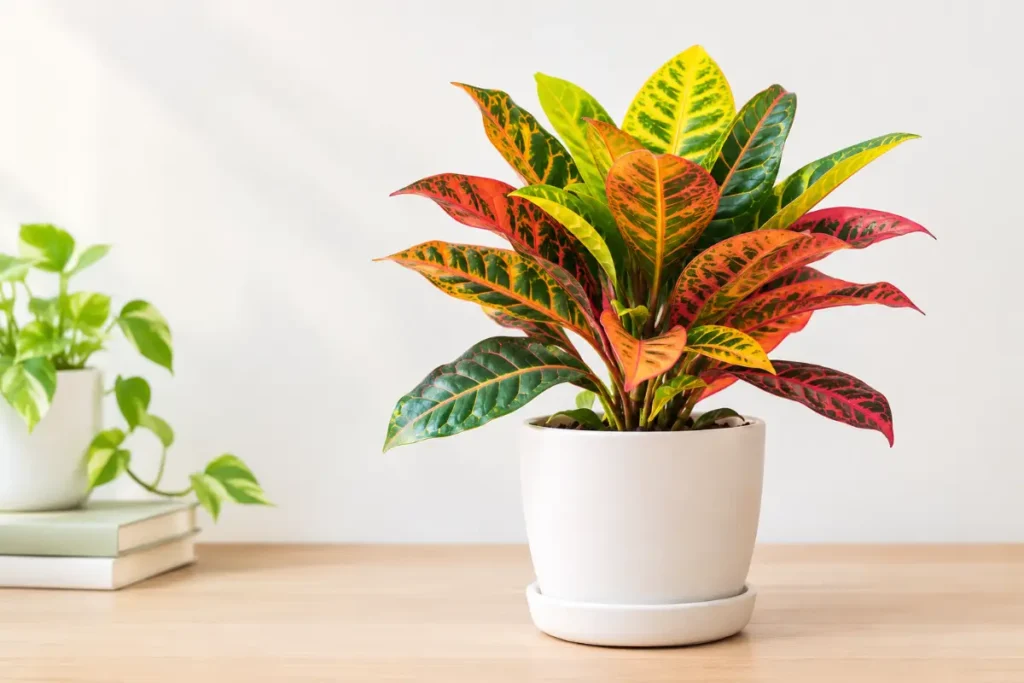
Croton (Codiaeum variegatum) The undisputed champion of indoor colour, Croton produces leaves painted in combinations of red, orange, yellow, green, and black — sometimes all five on a single leaf. The range of cultivars is extraordinary: ‘Petra’ has large ovate leaves in warm tones; ‘Mammy’ has twisted, dark leaves in deep burgundy and yellow; ‘Gold Dust’ produces small green leaves spotted generously in gold.
Care: Croton demands the brightest position you can offer — a south or west-facing windowsill is ideal. Without strong light, the colours fade rapidly and the plant becomes leggy. Keep above 15°C, maintain moderate humidity, water consistently, and avoid moving the plant once settled.
Caladium Caladiums are grown for their paper-thin, translucent leaves in combinations of white, pink, red, green, and burgundy that resemble watercolour paintings. ‘White Christmas’ has white leaves veined in green; ‘Red Flash’ features deep red centres with green edges and pink spots; ‘Florida Elise’ produces shell-pink leaves with green margins.
Care: Warmth is non-negotiable — minimum 18°C, and they sulk below 15°C. They need bright indirect light to maintain colour, consistent moisture (never dry out), and high humidity. Caladiums die back in winter and reshoot from tubers in spring — this is normal dormancy.
Coleus (Solenostemon) Coleus offers some of the widest colour variety of any indoor plant with colorful leaves — from deep burgundy-black to vivid lime-green, electric magenta, and complex multicoloured combinations. ‘Black Dragon’ has near-black leaves with red edges; ‘Wizard Scarlet’ has bright red centres with green borders; ‘The Line’ produces narrow green leaves with a vivid red central stripe.
Care: Bright indirect light is essential for colour intensity — direct summer sun bleaches colour. Keep compost consistently moist, feed fortnightly, and pinch growing tips regularly to keep plants bushy and prevent flowering.
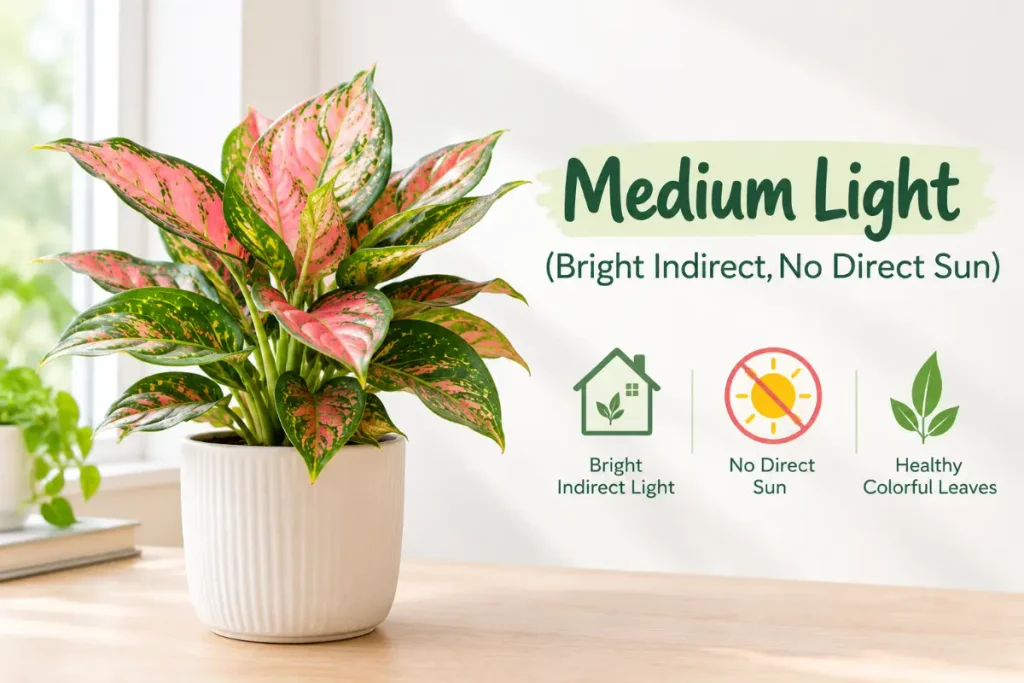
Medium Light (Bright Indirect, No Direct Sun)
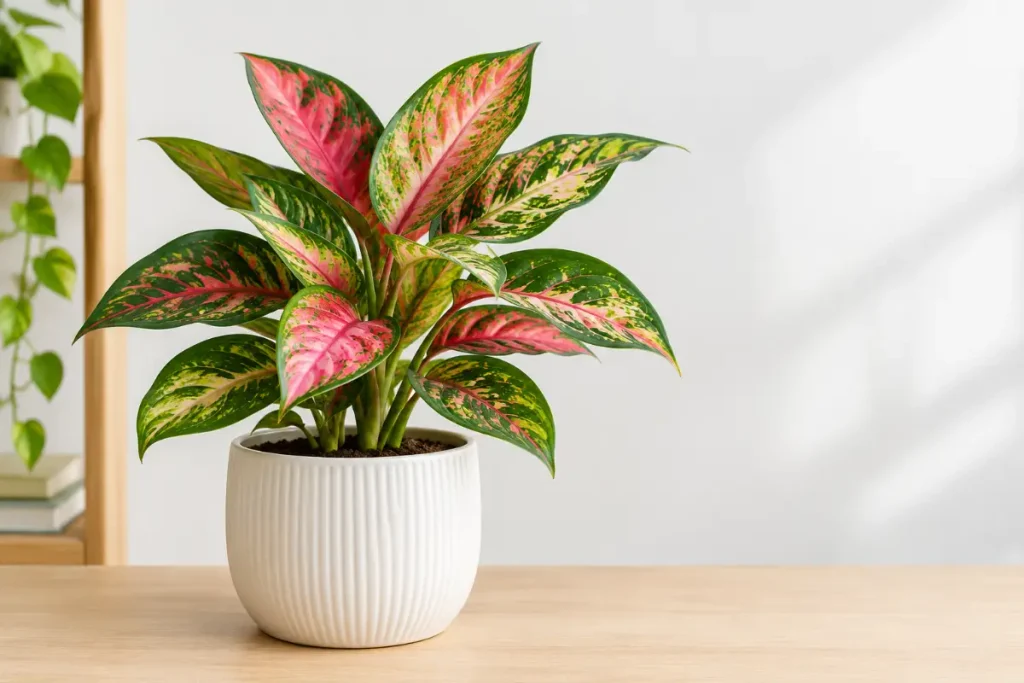
Aglaonema (Chinese Evergreen) Coloured Varieties Modern Aglaonema hybrids have been bred in extraordinary colour combinations — ‘Pink Splash’ has green leaves splashed generously with pink; ‘Wishes’ produces leaves patterned in orange and green; ‘Cutlass’ has narrow silver-green foliage. They are among the most forgiving of all colourful indoor plants — tolerating lower light than most.
Care: Medium to bright indirect light is ideal. Aglaonema tolerates lower light than most colourful plants while retaining reasonable colour. Water when the top 3 cm of compost dries. Feed monthly in the growing season. Avoid cold draughts.
Rex Begonia Rex Begonias are bred almost entirely for foliage rather than flowers — and the results are extraordinary. Leaves display complex patterns of silver, red, purple, bronze, and green in swirling, metallic combinations. ‘Escargot’ has a striking spiral pattern; ‘Fireworks’ produces dark leaves with silver streaks and red undersides; ‘Red Kiss’ has deep crimson with a metallic sheen.
Care: Bright indirect light, moderate humidity, and careful watering are essential. Water when the surface just dries — Rex Begonias are susceptible to both overwatering and drought. Avoid wetting the leaves; they are prone to powdery mildew in wet conditions.
Tradescantia (Spiderwort) Tradescantia pallida ‘Purpurea’ (Purple Heart) produces intense purple-violet leaves on trailing stems — not green at all unless light levels are very low, when they revert to a dull purple-green. Tradescantia fluminensis ‘Tricolor’ has green, white, and pink striped leaves. Both are vigorous growers, easy to propagate, and excellent for hanging planters and shelves.
Care: Bright indirect light for the richest colour. Water when the top 2–3 cm dries. Very easy to propagate from stem cuttings rooted in water.
Low to Medium Light
Calathea / Marantaceae Calathea and its closely related genera (Maranta, Ctenanthe, Stromanthe) produce some of the most intricate leaf patterning in the plant kingdom — dark green backgrounds painted with lighter green stripes, red and purple undersides, and geometric patterns that look almost hand-drawn. ‘Orbifolia’ has large round leaves with silver-green stripes; ‘Rattlesnake’ (Goeppertia insignis) has long, ruffled leaves with dark spots; ‘Medallion’ has an oval leaf with an intricate medallion pattern in two greens with a burgundy underside.
Care: The most demanding care of any plant in this category. Calathea requires distilled or rainwater (sensitive to fluoride and chlorine in tap water), high humidity (above 60% ideally), consistently moist but never waterlogged compost, and indirect light — never direct sun. In return, the foliage display is unmatched.
Maranta leuconeura (Prayer Plant) Similar in care to Calathea but somewhat more forgiving. The classic ‘Fascinator’ has green leaves decorated with bold red veins and a herringbone pattern. Leaves fold upward at night (prayer movement) and open again during the day — a charming behaviour alongside the striking patterning.
Care: Indirect light, high humidity, consistently moist compost, rainwater or distilled water preferred. Relatively compact and well-suited to terrariums or humidity trays.
Dracaena marginata (Dragon Tree) Dracaena marginata produces long, narrow leaves with a deep red-purple margin against grey-green centres. Slow-growing and architecturally dramatic, it suits contemporary interiors and tolerates lower light than most colourful plants while retaining its characteristic edge colour.
Care: Allow compost to dry between waterings. Use filtered or rainwater to reduce fluoride browning of leaf tips. Tolerates relatively low light, though colour is best in brighter positions.
Best Varieties for Small Spaces
Fittonia (Nerve Plant) Fittonia remains small — rarely exceeding 15 cm in height — and produces leaves covered in a vivid network of veins in red, pink, or white against deep green. Ideal for terrariums, small pots on desks, and windowsill arrangements. The white-veined ‘White Anne’ and red-veined ‘Frankie’ are among the most popular.
Care: Fittonia is extremely humidity-sensitive — it wilts dramatically at low humidity, recovers equally dramatically when humidity is restored, but repeated wilting eventually damages the plant. Terrariums are ideal for this reason. Indirect light, consistent moisture.
Hypoestes phyllostachya (Polka Dot Plant) Compact and cheerful, Polka Dot Plant produces green leaves spotted generously in red, pink, or white. Stays under 30 cm with regular pinching. An excellent desk or windowsill plant that brings colour without demanding much space.
Care: Bright indirect light for vivid spot colour. Low light causes rapid fading. Regular pinching keeps the plant bushy.
Peperomia caperata and variants Peperomia offers extraordinary variety in a compact package — ‘Watermelon’ has green leaves striped in silver like a watermelon rind; ‘Rosso’ has dark green corrugated leaves with vivid red undersides; ‘Ginny’ (Tricolour) has green leaves edged in cream and pink. All are compact, slow-growing, and tolerant of imperfect care.
Care: Moderate indirect light, infrequent watering (Peperomia stores water in thick leaves and is susceptible to rot if overwatered), minimal feeding. One of the most forgiving colourful houseplants.
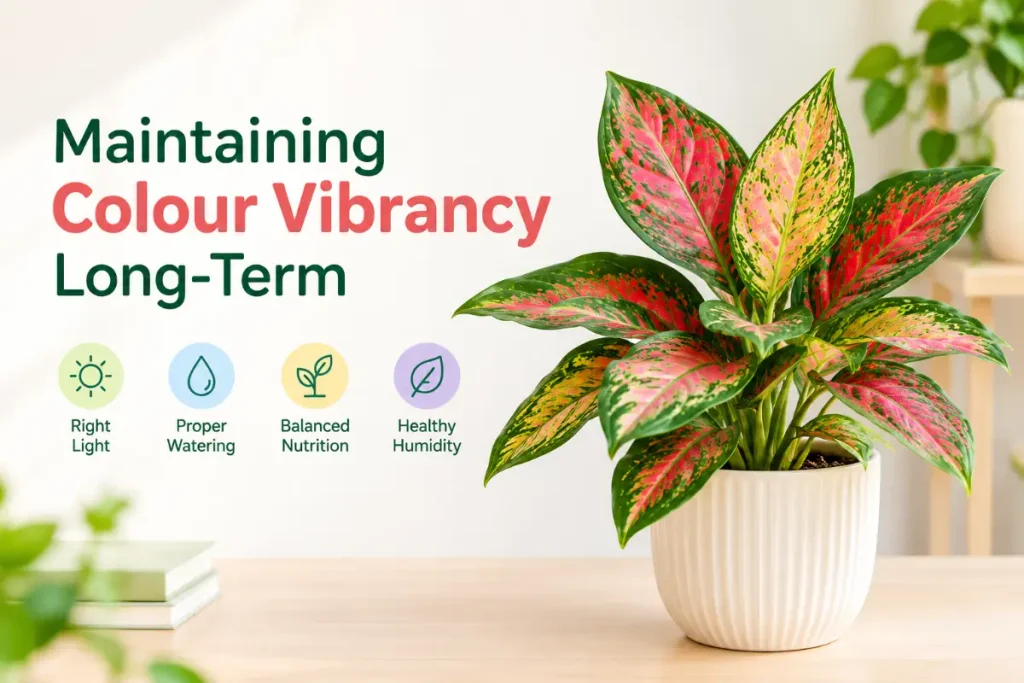
Maintaining Colour Vibrancy Long-Term
The most common disappointment with a colourful indoor plant is watching vivid colour fade over the weeks following purchase. Understanding why it fades makes prevention straightforward.
Light is the primary factor. Most plants arrive from nurseries grown under very high light levels — commercial greenhouses provide conditions few homes can match. When moved to a typical home environment, the plant acclimates by increasing chlorophyll production (which is green) relative to anthocyanins (which are coloured). The result is gradual greening. The fix: position the plant as close to your brightest window as possible. East-facing windowsills work well for most species; south or west-facing is better for Croton, Coleus, and Caladium.
Feeding matters. A fertiliser lower in nitrogen and higher in potassium encourages secondary metabolite production including anthocyanins. During the growing season, a tomato feed (high potassium) applied monthly can help maintain colour intensity in Croton and Coleus. High-nitrogen feeds encourage lush green growth at the expense of colour.
Pot size and root health. A root-bound plant under water stress produces less secondary pigmentation. Repotting into a pot 2–3 cm larger in spring, with fresh compost, often results in noticeably improved colour on new growth.
Colourful Foliage Plants for Edible Gardens
Several food crops produce striking colourful foliage and integrate beautifully with ornamental houseplants in mixed indoor displays:
Red and Rainbow Chard: Bold architectural edible with vivid red, orange, or yellow stems. Harvest outer leaves regularly to keep the plant productive and compact.
Red-leaf basil: ‘Purple Ruffles’ and ‘Dark Opal’ basil produce intensely purple-red foliage that is as decorative as it is fragrant. Regular harvesting keeps plants bushy.
Red-leaf lettuce: Compact, colourful, and highly productive in windowsill containers. Varieties like ‘Lollo Rosso’ and ‘Red Oak Leaf’ provide a continuous harvest from a relatively small space.
Chilli peppers: Many varieties produce colourful fruits — purple, orange, red, yellow — against bright green foliage, creating vivid seasonal colour. They appreciate the same bright light and consistent watering that suits most colourful ornamentals.
Consistent moisture is critical for both ornamental and edible colourful foliage plants. Tracking watering with a moisture meter for indoor plants prevents both the colour fade of underwatering and the root damage of overwatering in a mixed display.
Designing with Colourful Foliage
A thoughtfully assembled collection of indoor plants with colorful leaves creates an interior impact beyond what individual specimens achieve alone. Some practical principles:
Contrast with background: Bold coloured foliage — Croton, Caladium, Rex Begonia — reads most dramatically against plain, neutral backgrounds. A white or grey wall behind a vivid Croton creates a natural focal point.
Texture alongside colour: Combining textured leaves (corrugated Peperomia caperata, crinkled Rex Begonia) with smooth ones (Aglaonema, Caladium) adds depth to a display.
Vary scale: A tall statement plant (Rubber Plant ‘Burgundy’, Dracaena marginata), a mid-height specimen (Aglaonema, Tradescantia in a hanging planter), and a compact foreground plant (Fittonia, Peperomia) creates a tiered display with visual rhythm.
Use pot material consistently: Terracotta creates a warm, earthy context that suits red and orange-toned foliage. White ceramic creates the highest contrast and suits pink, silver, and pastel-toned plants like Caladium and pink Aglaonema.
Common Mistakes That Ruin Colourful Foliage
Understanding what goes wrong is as useful as knowing what to do right. These are the most frequent mistakes that dull or destroy colourful foliage:
Placing the plant too far from the window. Even a metre from a bright windowsill can halve the light reaching a plant. Light intensity drops rapidly with distance from the source. If you want colour, the plant needs to be close to glass.
Overwatering Peperomia and succulents with coloured foliage. These store water in thick leaves and stems and are highly susceptible to root rot when watered too frequently. Allow the compost to dry substantially between waterings.
Using hard tap water on Calathea. Calathea and Maranta are acutely sensitive to fluoride and chlorine — their leaves brown at the tips and margins, and the intricate patterns become obscured by damage. Use rainwater, distilled water, or water left overnight in an open container.
Repotting into an oversized container. When a colourful plant that prefers to be slightly root-bound is moved into a much larger pot, the excess moist compost leads to root rot — and a stressed plant with poor colour. Match pot size to the root ball.
Feeding heavily in winter. Most colourful foliage plants are in slow growth or dormancy in winter. High-nitrogen feeds push weak, pale new growth at the expense of colour. Reduce or stop feeding from October to February.
Ignoring pests on undersides of leaves. Spider mites and thrips — the two most common pests on colourful-leaved plants indoors — colonise leaf undersides and are often missed until damage is extensive. Monthly checks with a hand lens catch infestations early, when a straightforward spray treatment resolves them. For treatment options, the guide on indoor plant spray for bugs covers the most effective approaches for each pest type.
Seasonal Care Adjustments for Colourful Foliage Plants
Colourful-leaved houseplants respond noticeably to seasonal changes, and adjusting your care routine across the year maintains colour vibrancy and plant health more effectively than a fixed year-round approach.
Spring: Resume feeding as day length increases and new growth begins. For Caladiums, resume watering dormant tubers to trigger resprouting. Spring is the best time to repot plants that have become root bound — fresh compost supports strong, richly coloured new growth.
Summer: The peak growing season. Feed fortnightly, water consistently as compost dries faster in warm conditions, and monitor closely for spider mites, which proliferate in hot, dry indoor air. Move plants that have been struggling further into a room back toward windows — summer light is intense enough that they can handle positions that would be too dark in winter.
Autumn: Begin reducing feeding as growth slows. Caladiums will begin dying back — allow this to happen naturally rather than trying to force continued growth. Move plants closer to windows as day length shortens.
Winter: Most colourful foliage plants slow or stop growing. Reduce watering significantly — many overwatering incidents occur in winter when gardeners continue their summer watering frequency despite dramatically reduced plant uptake. Move plants as close to windows as possible to compensate for reduced daylight. Run a humidifier when central heating is running to counteract humidity drops.
Conclusion
The range within the category of indoor plant with colorful leaves is genuinely remarkable — from the complex medallion patterns of Calathea to the vivid painted symmetry of Caladium, the intense multicolour of Croton, and the subtle metallic sheens of Rex Begonia. The unifying principle is light: brighter conditions produce richer, more saturated colours across every species. Position your plants well, feed appropriately through the growing season, and you will find that colourful foliage is not just sustainable — it improves with attentive care.
For detailed growing guides on specific species mentioned in this article, the RHS houseplant pages at rhs.org.uk/plants/types/houseplants are an authoritative reference covering Calathea, Croton, Begonia, Peperomia, and many others.
FAQs
What is the easiest indoor plant with colorful leaves to care for?
Aglaonema (Chinese Evergreen) coloured varieties — particularly ‘Pink Splash’ or ‘Red Siam’ — are the most forgiving. They tolerate lower light than most colourful plants, are relatively drought-tolerant, and maintain their colour well compared to more demanding species like Calathea or Caladium.
Why is my colourful houseplant turning green?
Almost certainly insufficient light. Colourful pigments (anthocyanins, carotenoids) require light to be produced — in lower light, plants shift resources toward chlorophyll production for photosynthesis, and the coloured foliage gradually greens out. Move the plant to a brighter position and the next flush of new growth should come in with richer colour.
What is the most colourful indoor plant available?
Croton (Codiaeum variegatum) produces the most intense and varied colour of any common houseplant — leaves can simultaneously display red, orange, yellow, and deep green, often all on a single plant. However, it demands bright light and dislikes being moved. Caladiums offer equally striking colour with a wider range of pattern styles.
Can colourful-leaved plants grow in low light?
Some can tolerate it — Aglaonema, Maranta, and Calathea are the most shade-tolerant colourful species — but almost all will lose some vibrancy in genuinely low light. Artificial grow lighting is the practical solution for darker rooms.
Are Calathea leaves supposed to move?
Yes — Calathea and Maranta perform nyctinasty, folding their leaves upward at night and opening them during the day. This is entirely normal and healthy behaviour, not a sign of stress.
How do I stop my Croton from dropping leaves?
Croton drops leaves in response to temperature fluctuation, cold draughts, and being moved. Once placed in a consistently warm (above 15°C), bright position, it stabilises. Avoid moving it and keep it away from doors, windows that draughts reach, and heat sources that cycle on and off.
What colourful houseplant suits a bathroom?
Calathea, Maranta, and Fittonia all thrive in bathroom conditions — the higher ambient humidity suits them well. Tradescantia also tolerates bathroom light levels. Avoid Croton and Caladium in bathrooms without excellent natural light — they need brightness to maintain their colour.
Is Caladium safe for pets?
No — Caladium is toxic to cats and dogs if ingested, causing mouth irritation, drooling, and vomiting. Keep it out of reach of pets. Many colourful houseplants including Croton, Dracaena, and Coleus are also toxic to pets — if you have animals, research specific toxicity before purchasing.
How do I increase humidity for my Calathea?
A cool-mist humidifier placed nearby is the most effective method — aim for above 60% relative humidity. Grouping plants together helps, as does placing pots on a tray of damp pebbles. Misting is insufficient on its own as it raises humidity only momentarily.
Can I mix colourful ornamental plants with food crops in the same display?
Absolutely — see the edible foliage section above. Red chard, red-leaf lettuce, burgundy basil, and chilli peppers are all attractive and pair naturally with ornamental colourful plants. They share similar light and watering requirements, making mixed displays practical to maintain. For more on growing edibles indoors, including tips relevant to keeping plants healthy, see the guide on indoor plant spray for bugs to protect both your ornamentals and edibles from pests.