

Diatomaceous earth is one of the oldest and most studied natural pest control materials in use — a fine powder made from the fossilized shells of microscopic aquatic organisms that kills insects and other arthropods through a purely mechanical action, leaving no chemical residue, no toxicity to mammals, and no risk of pest resistance. Diatomaceous earth for indoor plants is effective against fungus gnat larvae, crawling pests at the soil surface, and any soft-bodied or lightly-armored insect that crosses a treated surface.
Used correctly, it is one of the safest pest management tools available to houseplant growers. Used incorrectly — wrong grade, wrong application, mismatched pest target — it underperforms and frustrates.
This guide covers the science, the right grade to buy, how to apply it, which pests respond to it, and what it cannot do.
What Diatomaceous Earth Is and How It Works
Diatomaceous earth (DE) is composed of the fossilized remains of diatoms — single-celled algae with intricate silica shells that have accumulated in lake and ocean sediments over millions of years. When mined, dried, and ground, the result is a fine powder of microscopic glass-like particles with sharp, irregular edges.
The kill mechanism is entirely physical:
The particles of diatomaceous earth are small enough to penetrate the gaps in an insect’s exoskeleton — particularly around joints, leg segments, and the softer cuticle at abdominal flexion points. The sharp silica edges abrade and puncture the protective waxy layer (the epicuticle) that prevents insects from desiccating. Once this layer is compromised, the insect loses water rapidly through its exoskeleton and dies of dehydration, typically within 24–72 hours of contact.
Why this matters for resistance management: Because the kill mechanism is mechanical rather than chemical, insects cannot develop resistance to diatomaceous earth the way they develop resistance to pyrethroids, neonicotinoids, or other conventional pesticides. A population of fungus gnats exposed repeatedly to DE never evolves tolerance to dehydration through physical abrasion.
Effectiveness depends on dryness: The kill mechanism requires that the DE particles remain dry and in contact with the insect’s exoskeleton. Wet or moist DE clumps together, loses its abrasive particle geometry, and becomes ineffective. This is the most important limitation for soil surface applications in potted plants — watering wets the DE and neutralizes it until it dries again.
The Critical Difference: Food-Grade vs. Pool-Grade DE
This distinction matters for safety and must not be overlooked.
Food-grade diatomaceous earth is produced from freshwater deposits, minimally processed, and contains crystalline silica at concentrations low enough to be safe for humans, pets, and livestock at label-use concentrations. It is registered for use in food storage, as an animal feed additive, and as a pesticide in agricultural and home garden settings. This is the only grade appropriate for use on houseplants.
Pool-grade (filter-grade) diatomaceous earth is chemically treated with high heat (calcination), which converts the amorphous silica to crystalline silica at much higher concentrations. It is used as a filtration medium in swimming pool filters. Pool-grade DE has significantly higher crystalline silica content that poses a genuine inhalation hazard for humans and animals with repeated exposure. It should never be used on plants, in soil, or anywhere it could be disturbed and inhaled.
How to identify food-grade DE: The product label will state “food grade” explicitly. Common food-grade brands available in the US include Harris Diatomaceous Earth Food Grade (widely available at Home Depot and Walmart, $10–$15 for 4 lb), Safer Brand Diatomaceous Earth, and DiatomaceousEarth.com brand. If the label mentions swimming pools or filtration, it is pool grade — do not use it.
Application Method 1: Soil Surface Topdressing
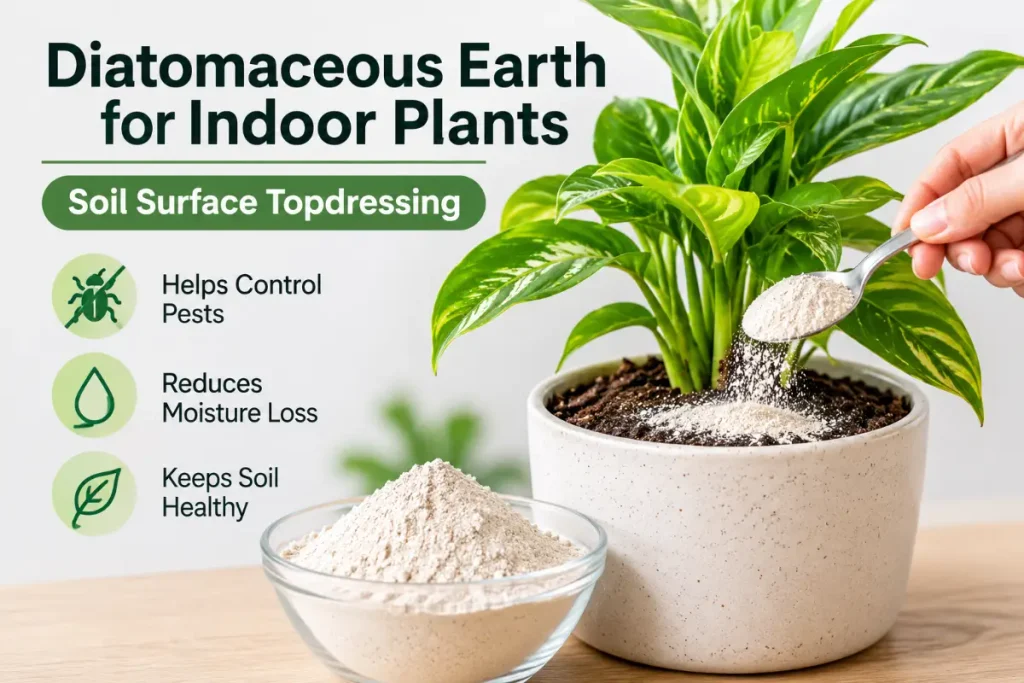
The most common application of diatomaceous earth for indoor plants is as a topdressing on the potting mix surface — where it creates a dry, abrasive barrier that kills crawling larvae and deters adult insects from landing to lay eggs.
How to apply:
- Allow the potting mix to dry to the appropriate level for the plant before applying — this gives the DE the best chance of remaining dry on the surface between waterings
- Sprinkle food-grade DE in an even layer over the entire potting mix surface; use enough to visibly cover the soil — approximately ⅛ to ¼ inch deep
- Work it gently into the top ¼ inch of potting mix to bring it into contact with larvae just below the surface
- Do not water from above immediately after application — allow the DE to remain dry on the surface for at least 24–48 hours for maximum effectiveness against surface-crawling larvae
- After watering, the DE will be temporarily neutralized — reapply a fresh layer once the surface dries
Reapplication: Every time you water from above. For plants watered via bottom watering (setting the pot in a tray of water), DE on the soil surface remains effective much longer since the surface stays dry.
Combining with cinnamon: A mixture of DE and cinnamon powder applied to the soil surface combines the mechanical kill (DE) with antifungal food-source suppression (cinnamon) — a very effective surface layer treatment for fungus gnat control.
Application Method 2: Pot and Drainage Tray Dusting
Crawling pests that travel between pots — spider mites, mealybug crawlers, thrips on the move — can be intercepted by dusting DE along the outer rim of pots, drainage trays, and the shelving surfaces where pots sit.
How to apply: Dust a thin layer of DE along:
- The outer rim of each pot
- The surface of drainage trays before placing pots back
- Shelf surfaces directly under pots
- Along the base of walls where pots sit on the floor
This creates a “moat” of abrasive material that crawling pests must cross. It is particularly useful for controlling the spread of mealybug crawlers between pots — crawlers are highly mobile and responsible for infestations spreading through a collection.
Important: Keep DE in the tray dry — if water from drainage wets the tray DE, replace it after each watering. The small inconvenience is worth it for the protection it provides.
Application Method 3: Foliar Dusting (Limited Use)
DE can be applied as a dust to leaf surfaces to kill crawling insects — spider mites, thrips nymphs, and mealybug crawlers on plant surfaces. This application has significant limitations: it must be applied to dry leaves, it makes leaves look coated with white powder (aesthetically unpleasant), and it is washed off by any subsequent spraying or misting.
When it is worth doing: For a heavy spider mite infestation on a plant with large, flat leaves (rubber plant, monstera) where the mite population is concentrated on the top leaf surface, a light DE dusting can provide quick knockdown while other treatments (neem oil, insecticidal soap) are prepared.
How to apply: Use a DE duster (a small bellows duster available from most pest control suppliers) or a makeup brush to apply a very thin, even layer to affected leaf surfaces. Work in calm air to avoid inhaling the dust — wear a dust mask.
Rinse before the next spray treatment: Always rinse DE off leaf surfaces before applying neem oil, insecticidal soap, or any liquid treatment — DE mixed with spray creates a paste that is harder to remove and may block stomata.
Which Pests Diatomaceous Earth Works On
High effectiveness:
- Fungus gnat larvae at the soil surface and in the top ½ inch of potting mix — the larvae are soft-bodied with minimal cuticle protection; DE is very effective against them
- Mealybug crawlers traveling on pot surfaces and shelving — the waxy coating of crawlers is penetrated by DE abrasion
- Thrips moving across treated surfaces (soil, pot rims, shelves)
- Shore flies — the stocky adults are killed by DE contact on treated surfaces
Moderate effectiveness:
- Spider mites on dry leaf surfaces — DE applied as a foliar dust causes desiccation but must remain dry to work; not as practical as neem oil or insecticidal soap for spider mite management
- Fungus gnat adults walking across treated soil surfaces — most adult gnats fly rather than walk, limiting the effectiveness of soil DE against adults; sticky traps are better for adults
Low or no effectiveness:
- Scale insects — the hard or waxy scale covering is essentially impervious to DE abrasion; isopropyl alcohol and systemic insecticides are more effective
- Flying insects — DE has no effect on insects in flight; it works only on contact with treated surfaces
- Aphids on foliage — aphids feed on aerial plant surfaces where DE cannot be maintained in a dry, effective state; insecticidal soap is the correct tool for aphids
Safety: What You Need to Know About DE and Inhalation
Food-grade diatomaceous earth is classified as a nuisance dust rather than a hazardous substance at label-use concentrations. However, inhalation of any fine silica powder in quantity causes irritation to the respiratory tract, and prolonged repeated inhalation of crystalline silica (found at low levels even in food-grade DE) is a known occupational health concern.
Practical safety measures for houseplant use:
- Apply DE in a well-ventilated area or move the plant near an open window before applying
- Wear a simple dust mask (N95 or comparable) when applying DE indoors — particularly when applying to multiple plants in an enclosed room
- Avoid applying DE near children, pets with respiratory sensitivities, or birds (birds are particularly sensitive to airborne particles)
- Wash hands after handling DE
- Do not apply DE near running fans or air vents that will distribute the dust through the room
Pet safety: Food-grade DE is considered safe for dogs and cats at the concentrations used for pest control. It is widely used in pet bedding for flea control. The main concern for pets is the same as for humans: inhalation. Prevent pets from sniffing directly at freshly applied DE, particularly cats who may investigate newly treated pots.
Food plants: Food-grade DE is safe for use on edible herbs and indoor vegetable plants. It is approved for contact with food crops and leaves no chemical residue.
Plants and Situations Where DE Is Most Useful
Knowing when to reach for diatomaceous earth versus another tool helps you use it where it delivers maximum value.
Best situations for DE:
- Active fungus gnat infestation in a collection of several plants — a consistent soil surface application across all pots creates a collective barrier that reduces larval survival throughout the collection, not just on individually treated plants
- Seedling trays and propagation setups — where chemical treatments may be too harsh for delicate root systems, food-grade DE is safe for direct use around germinating seeds and young seedlings
- Herb gardens and edible indoor plants — the absence of chemical residue makes DE uniquely appropriate for mint, basil, parsley, and other herbs where food safety matters
- Mealybug crawlers spreading through a collection — a DE barrier at pot rims and tray surfaces slows the spread of crawlers between plants, buying time for targeted alcohol treatment of active colonies
- Preventive maintenance on high-risk plants — ferns, peace lilies, pothos, and other perpetually moist-soil plants benefit from a monthly DE surface application as a preventive fungus gnat measure
When to choose a different tool:
- Scale insects — DE does not penetrate the protective covering; use isopropyl alcohol and neem oil instead
- Aphid colonies on foliage — aerial applications of DE are impractical; insecticidal soap is faster and more effective
- Established, large fungus gnat infestations — DE alone is too slow; lead with Bti drenches for immediate larval kill, then maintain DE as a surface layer
- Plants that must be watered very frequently — for plants that need daily watering, DE is constantly being neutralized and reapplication burden is high; Bti drenches provide more durable larval control in these conditions
Common Mistakes When Using Diatomaceous Earth for Indoor Plants
Knowing what goes wrong helps you avoid the most common reasons diatomaceous earth for indoor plants underperforms.
Using pool-grade DE. This is the most consequential mistake. Pool-grade DE looks identical to food-grade and may cost less, but its high crystalline silica content is a genuine inhalation hazard and it is not registered for use on plants or in soil. Always verify “food grade” on the label before purchase.
Applying DE to wet soil. DE applied to freshly watered potting mix becomes wet, clumps together, and loses all effectiveness immediately. Always apply to dry or mostly-dry soil surfaces. If you water first and then remember to apply DE, wait until the surface dries before applying — the following day for most plants.
Not reapplying after watering. Many growers apply DE once and expect extended coverage. After any overhead watering, the DE on the soil surface is wet and neutralized. The habit of reapplying a light layer after each watering — it takes about 15 seconds per pot — is what makes DE consistently effective rather than intermittently effective.
Applying too thickly. A thick, heavy layer of DE on the soil surface can form a water-resistant crust that causes water to run off the soil surface rather than penetrating to the roots. Apply a light, even dusting — enough to visibly cover the surface, not enough to form a solid layer.
Inhaling DE during application. Food-grade DE is not acutely dangerous, but no fine silica dust should be inhaled repeatedly without protection. Apply with a mask, in ventilated conditions, with pets and children out of the room during application. This is a brief precaution — once applied and settled, the risk is minimal.
Combining DE with Other Treatments
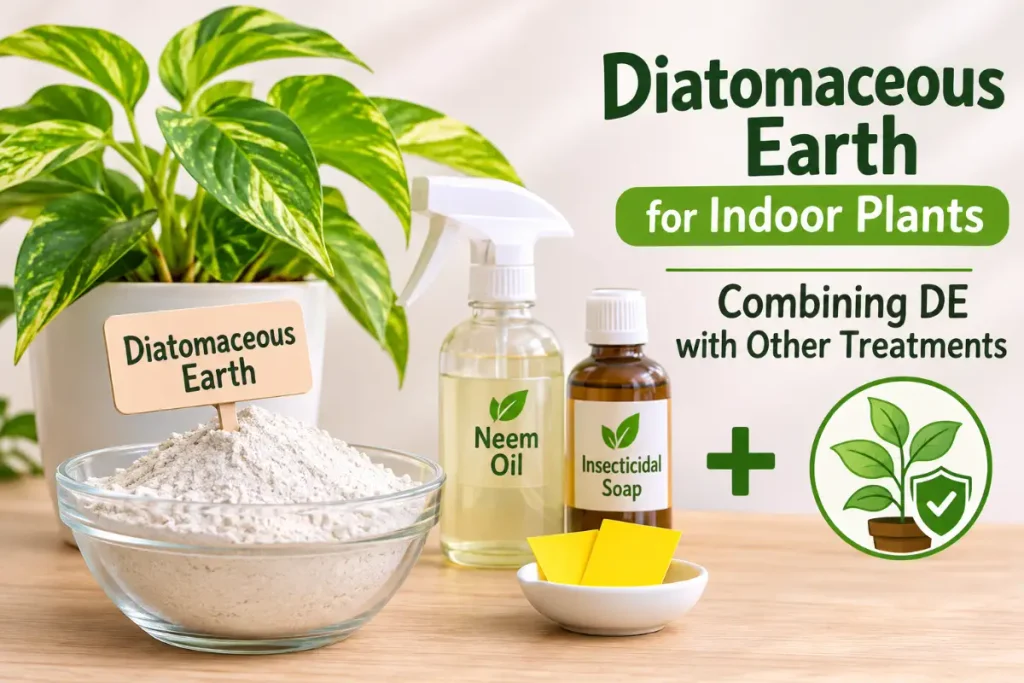
Diatomaceous earth integrates well with every other natural pest management tool used on houseplants:
DE + Bti (Mosquito Bits): DE on the soil surface kills larvae near the surface; Bti drench kills larvae throughout the potting mix. These two address the same pest (fungus gnat larvae) through entirely different mechanisms and work in parallel without interference.
DE + cinnamon: Combine as a soil surface mixture — the cinnamon suppresses the fungal food source, the DE kills larvae physically. Apply as a combined dusting: a light layer of DE followed by a dusting of ground cinnamon on top.
DE + neem oil spray: Neem oil spray on plant surfaces and DE on soil surfaces address different zones. Apply neem oil to the plant; apply DE to the soil. Do not apply neem oil over DE on the soil — the oil wets and neutralizes the DE. If applying both, let the neem soil drench dry before reapplying DE to the surface.
DE + yellow sticky traps: Traps catch adult flying gnats; DE kills crawling larvae. Run both simultaneously for complete fungus gnat management — traps for adults, DE (and Bti) for larvae.
Conclusion
Diatomaceous earth for indoor plants provides mechanical, chemical-free pest control that works through physical abrasion rather than toxicity — making it resistant-proof, safe for humans and pets, and appropriate for use on edible herbs and food plants. Its effectiveness is highest against soft-bodied soil-dwelling larvae (fungus gnats), crawling pests on pot surfaces (mealybug crawlers), and any insect crossing a treated dry surface. Its limitation is the requirement for dryness — watering temporarily neutralizes it and requires reapplication. Used as a consistent soil surface treatment alongside Bti drenches for the larvae and yellow sticky traps for adults, DE is an effective component of integrated fungus gnat management that requires no chemical intervention.
For research-backed information on diatomaceous earth applications in integrated pest management for ornamental plants, the Michigan State University Extension guide to insect pest management covers DE alongside other physical and biological control methods used in US greenhouse and interior plant settings.
FAQs
Is diatomaceous earth safe to use around pets and children?
Food-grade diatomaceous earth is non-toxic to humans and pets at label-use concentrations. The main concern is inhalation of fine dust during application — wear a dust mask when applying indoors, apply in a ventilated area, and prevent pets and children from being present during application. Once DE has settled and is no longer airborne, the risk is minimal.
Does diatomaceous earth kill fungus gnats?
Diatomaceous earth kills fungus gnat larvae in the soil surface and top layer of potting mix through physical abrasion and desiccation. It has limited effectiveness against adult fungus gnats (which fly rather than walk across treated surfaces). For complete fungus gnat management, combine DE for larvae with yellow sticky traps for adults and Bti drenches for larvae throughout the potting mix.
How often do I need to reapply diatomaceous earth on houseplant soil?
Reapply after every watering, since water wets the DE and neutralizes it until it dries again. For plants watered via bottom watering (setting the pot in a tray of water and letting it absorb from the base), DE on the soil surface stays dry much longer and requires less frequent reapplication — often just once per week.
Can I mix diatomaceous earth into the potting mix?
Mixing DE throughout the potting mix provides less effective pest control than a surface application, because moisture from normal watering quickly neutralizes DE below the surface layer. It does slightly improve drainage in some mixes. For pest control, surface application is significantly more effective than mixing in. DE incorporated as a drainage amendment should be considered separate from its pest control function.
What is the difference between food-grade and pool-grade diatomaceous earth for plants?
Food-grade DE is safe for use on houseplants, in soil, and around pets. Pool-grade DE has been treated at high heat, which converts more of the silica to crystalline form — a known inhalation hazard at repeated exposure levels. Never use pool-grade DE in soil or on plants. Always look for a product label that says “food grade” and does not reference swimming pools or filtration.
Pingback: Isopropyl Alcohol for Mealybugs on Plants: 5 Proven Application Methods - Plant Quill