
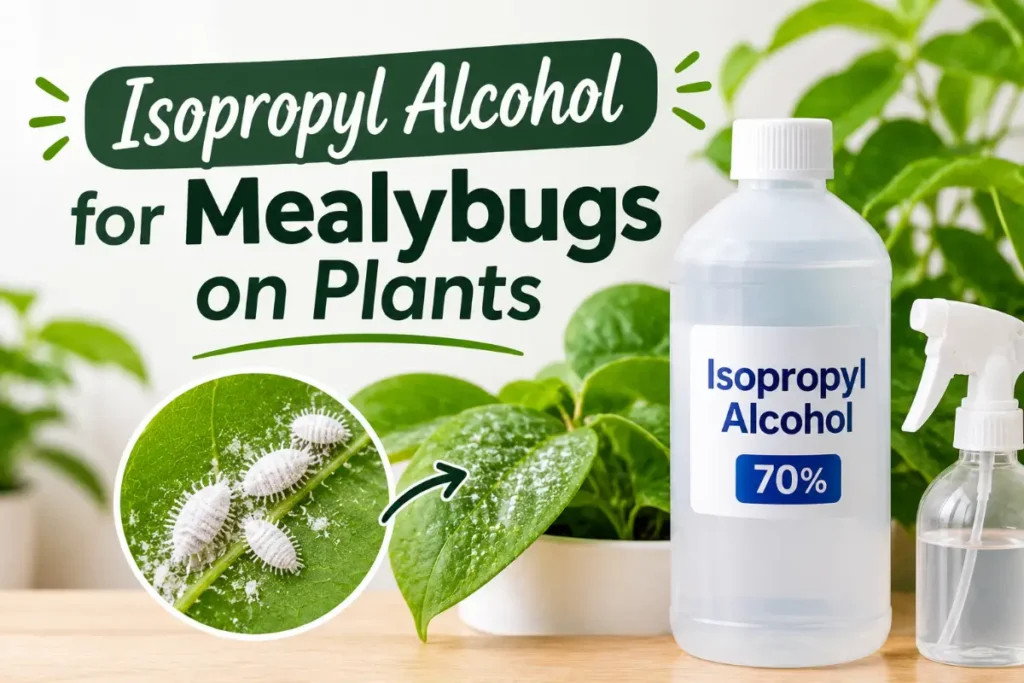
Mealybugs are stubborn, well-protected, and fast-reproducing — but they have one reliable weakness: isopropyl alcohol. The waxy, cottony coating that makes mealybugs resistant to water sprays and many contact insecticides is dissolved on direct contact by isopropyl alcohol, exposing the soft-bodied insect beneath to immediate desiccation.
Isopropyl alcohol for mealybugs on plants is the most reliably effective tool for direct mealybug control, it costs under $2 per bottle, it is available at every drugstore in the US, and it leaves no harmful residue on plant tissue at appropriate concentrations.
This guide covers the right concentration, five application methods for different infestation levels and plant types, safety by plant species, and how to combine alcohol treatment with other methods for complete mealybug elimination.
Why Isopropyl Alcohol Kills Mealybugs
Mealybugs (family Pseudococcidae) produce a distinctive white, cottony, waxy coating that serves as protection against environmental threats — including most water-based insecticide sprays. This waxy coating repels water and many contact insecticides, allowing mealybugs to shelter beneath it while feeding on plant sap.
Isopropyl alcohol (rubbing alcohol) is a solvent — it dissolves waxy and oily substances on contact. When alcohol contacts a mealybug’s waxy coating, it dissolves and strips that coating in seconds, leaving the soft-bodied insect exposed. The alcohol then:
- Desiccates the insect directly — the exposed cuticle loses water rapidly
- Penetrates the cottony egg masses — dissolving the protective wax around eggs and killing them along with adults and nymphs
- Kills on contact with no residual required — unlike some insecticides that require the insect to consume them, alcohol works instantly on direct contact
This combination — wax dissolution, desiccation, and egg mass penetration — makes isopropyl alcohol significantly more effective against mealybugs than neem oil or insecticidal soap alone, both of which struggle to penetrate the waxy coating.
The Right Concentration: 70% vs. 91% vs. 99%
The concentration of isopropyl alcohol matters for both effectiveness and plant safety.
70% isopropyl alcohol is the standard drugstore concentration — sold as rubbing alcohol at CVS, Walgreens, Walmart, and most grocery stores for $1–$2 per bottle. This is the correct concentration for direct application to mealybugs in most situations. The 30% water content in 70% alcohol is not a disadvantage — it actually improves contact kill because the water slows evaporation slightly, giving the alcohol more dwell time on the insect. 70% alcohol is the standard recommendation for mealybug treatment.
91% and 99% isopropyl alcohol are available at some pharmacies and online. These higher concentrations evaporate faster and have a slightly narrower safety margin for plant tissue — they can cause more rapid desiccation of leaf cells if applied heavily. At diluted concentrations (1:1 with water from 91% stock), they work equivalently to 70% undiluted. If 91% is what you have, dilute 1:1 with water before use.
Concentration summary:
- 70% — use undiluted for direct swab/brush application; dilute 1:1 for spray application
- 91% — dilute 1:1 with water before any application
- 99% — dilute 2:1 with water (2 parts water to 1 part alcohol) before use; not recommended for foliar spray
Application Method 1: Cotton Swab (Best for Spot Treatment)
The cotton swab method is the most precise, most effective, and most recommended first-line treatment for isopropyl alcohol for mealybugs on plants — particularly for accessible colonies on leaves, stems, and leaf axils.
What you need: 70% isopropyl alcohol, cotton swabs (Q-tips)
How to do it:
- Dip a cotton swab generously in 70% isopropyl alcohol — saturate the cotton tip
- Press the swab firmly against each visible mealybug colony and individual mealybug, holding contact for 2–3 seconds — the waxy coating dissolves and the insect is killed on contact
- Work methodically through the entire plant — check every leaf axil, stem joint, the base of petioles, and undersides of leaves along the midrib
- Use a fresh swab or re-dip frequently to maintain alcohol saturation
- Discard used swabs immediately — do not reuse between plants
Where to look: Mealybugs concentrate at leaf axils (where the leaf meets the stem), stem joints and branch forks, the base of rosette plants, inside tightly packed new growth, and at the base of the plant near the soil line. Work from the base of the plant upward.
Frequency: Repeat every 5–7 days for 3–4 weeks. Mealybug eggs hatch continuously over several weeks; each session addresses newly emerged nymphs before they reach reproductive maturity.
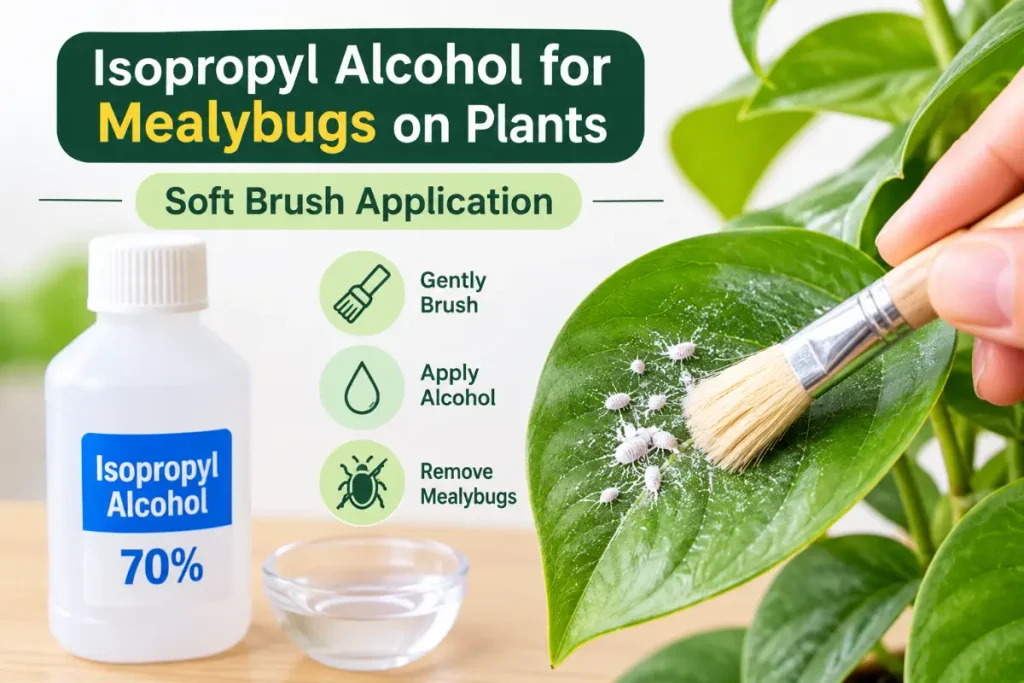
Application Method 2: Soft Brush Application (For Dense Infestations on Stems)
For heavily encrusted stem sections where individual swab treatment is impractical — a stem covered in overlapping mealybug colonies — a soft toothbrush or small paintbrush dipped in alcohol scrubs more effectively than a swab.
How to do it:
- Dip a soft-bristled toothbrush or small paintbrush in 70% isopropyl alcohol
- Scrub gently along heavily infested stem sections — the bristles get into crevices between mealybug colonies and dislodge the waxy material while the alcohol kills on contact
- Work along the full stem length, paying particular attention to nodes and branch joints where colonies are densest
- Rinse the brush in fresh alcohol between sections to avoid redepositing dislodged insects
After brushing: Follow with a cotton swab dip of any remaining individual insects. The brush removes the bulk; the swab catches survivors.
Application Method 3: Diluted Spray (For Widespread, Light Infestations)
For a plant with light, widespread mealybug presence across many leaves — no dense colonies but numerous individual insects scattered throughout — a diluted isopropyl spray covers more area faster than individual swab treatment.
Recipe: Mix 70% isopropyl alcohol 1:1 with water (resulting ~35% solution). Add 1–2 drops of dish soap per cup to improve surface contact. Put in a small spray bottle.
How to apply:
- Test on one leaf first — spray a small area and wait 24 hours before treating the whole plant (see plant sensitivity section below)
- Spray all plant surfaces including leaf undersides, stem joints, and leaf axils
- Apply in the morning so the plant has time to dry during the day — do not apply before direct sun exposure, which increases risk of leaf burn
- Do not apply so heavily that the solution pools on leaves — a light, even mist that covers surfaces without runoff
Frequency: Every 5–7 days. The spray is less targeted than the swab method and may miss insects in protected locations; follow up with swab treatment on any colonies that survive spraying.
Plants to test first: See the sensitivity section below — some plants react poorly to alcohol sprays even at 35% concentration.
Application Method 4: Root Dip (For Root Mealybugs)
Root mealybugs (Rhizoecus spp.) colonize root systems below the soil line — they are often invisible until the plant is unpotted and can cause wilting and decline with no obvious above-ground pest visible. Isopropyl alcohol as a root dip is an effective treatment after unpotting and root trimming.
How to do it:
- Unpot the plant and shake away all old potting mix — do not reuse the old mix, which harbors root mealybug eggs
- Rinse roots thoroughly under lukewarm running water to remove remaining potting mix and dislodge surface root mealybugs
- Prepare a 35% isopropyl alcohol solution (1 part 70% alcohol : 1 part water) in a bowl large enough to submerge the root ball
- Submerge the roots for 10–15 minutes — the solution penetrates the root system and kills mealybugs and their eggs throughout
- Rinse roots thoroughly with clean water after the soak — this removes residual alcohol that could cause root tissue damage over time
- Allow roots to air-dry for 30–60 minutes before repotting in fresh, dry potting mix
- Apply a neem oil soil drench for the first 3–4 weeks after repotting to address any eggs that survived the dip
Important: Do not soak roots in undiluted 70% alcohol — the 35% dilution is the appropriate concentration for root tissue, which is more sensitive than aerial plant parts. Healthy white roots tolerate the 35% dip well; already-damaged roots from the infestation may show some further browning, which is acceptable.
Application Method 5: Preventive Alcohol Wipe (For New Plant Inspection)
The most underused application of isopropyl alcohol in plant care is as a preventive treatment during the quarantine of new plants. When a new plant is introduced — from a nursery, garden center, or another grower — a systematic inspection combined with an alcohol wipe-down of all stems and leaf axils before it joins the existing collection prevents mealybug introduction.
How to do it:
- Inspect the new plant under good light with a magnifying loupe — check all leaf axils, stem joints, and undersides of leaves
- Regardless of what you find, wipe all stems and leaf axils with a 70% alcohol-dampened cotton swab as a precaution
- Place the plant in quarantine for 2–4 weeks (separate room or space from your existing collection)
- Inspect and wipe again at the 2-week mark — mealybug eggs may hatch into nymphs that were not visible on first inspection
- Introduce to the collection only after two consecutive clean inspections
This takes about 10 minutes per new plant and prevents the scenario — familiar to most experienced houseplant growers — of a single unexamined new plant seeding an entire collection with mealybugs within a few weeks.
Plant Sensitivity: Which Plants Tolerate Alcohol and Which Do Not
Isopropyl alcohol is not equally safe on all plants. Knowing which plants need extra care prevents treatment damage on top of pest damage.
Generally safe for direct 70% application:
- Pothos, philodendron, monstera, ZZ plant, snake plant, rubber plant, ficus, dracaena, schefflera, begonias, peace lily, most tropical foliage plants
Test before treating (sensitive to alcohol):
- African violets — the hairy leaves trap alcohol and can develop brown spots; test on one leaf at diluted concentration before full treatment
- Ferns — delicate fronds can be damaged by 70% alcohol; use the 35% spray concentration and test first
- Calathea and maranta — leaves may show discoloration; test on one leaf before treating
- Orchid roots — the silvery velamen layer on aerial roots can be damaged by alcohol; apply only to above-ground stem and leaf tissue, not to roots
Apply with care (waxy or powdery coating):
- Succulents with farina (the powdery blue-white bloom on echeveria, sedum, some aloe) — alcohol dissolves farina permanently; use a cotton swab targeted only at the mealybug colony, avoiding the leaf surface farina
- Cacti — the spines and areoles create gaps alcohol can reach; swab treatment works well, but spray application can cause discoloration on some cactus species
Safe test protocol: Apply a small amount of diluted alcohol (35%) to one inconspicuous leaf. Wait 24–48 hours. If no browning, yellowing, or texture change occurs, proceed with treatment.
Houseplants Most Susceptible to Mealybugs
Mealybugs infest a wide range of houseplants, but certain species are disproportionately targeted. Knowing which plants are highest risk helps you prioritize inspection and apply isopropyl alcohol for mealybugs on plants preventively rather than reactively.
High-risk plants:
- Succulents and cacti — the compact, rosette forms and densely packed growth of echeverias, sedums, and similar succulents provide ideal hidden feeding sites at leaf axils; mealybugs are endemic in US succulent collections and often go unnoticed until populations are large
- Citrus kept indoors — meyer lemon, calamondin, and other indoor citrus are among the most mealybug-prone plants available in the US; check leaf axils and stem joints monthly during the growing season
- Begonias — the dense foliage and nutrient-rich growth of begonias attracts mealybugs; check new growth and stem joints closely
- Ferns — particularly Boston fern and maidenhair fern; mealybugs concentrate at the base of fronds where they emerge from the rhizome
- Hoya — the thick, waxy leaves and vining stems of hoyas are frequently infested; check the vine nodes and the undersides of leaves at the stem attachment point
- Orchids — both above-ground mealybugs (at leaf and pseudobulb junctions) and root mealybugs are common in orchid collections; inspect every 2–3 weeks
- Dracaena and cordyline — the central growth point where new leaves emerge is a primary mealybug hiding site on these plants
- Coleus and impatiens — the tender, nitrogen-rich growth of these plants attracts mealybugs rapidly during active growing periods
- Peace lily — the base of leaf petioles where they emerge from the soil line is a common infestation site; root mealybugs are also documented on peace lily
Lower-risk plants:
- Snake plants (Sansevieria) and ZZ plants — the thick, tough foliage offers fewer feeding sites and is less preferred; infestations occur but are less common
- Rubber plants and ficus — susceptible but tend to show infestations later and progress more slowly than succulents and citrus
Monthly inspection habit: For high-risk plants, run a cotton swab dipped in 70% isopropyl alcohol along all stem joints and leaf axils once per month as a preventive measure — this costs about 5 minutes per plant and eliminates small colonies before they establish. A single mealybug colony caught at 10 insects takes one swab to eliminate; the same colony left for 6 weeks may require 3–4 treatment sessions to clear. Early detection and the targeted alcohol swab are the most efficient combination in the entire mealybug management toolkit, requiring minimal time, minimal product, and no risk to plant tissue.
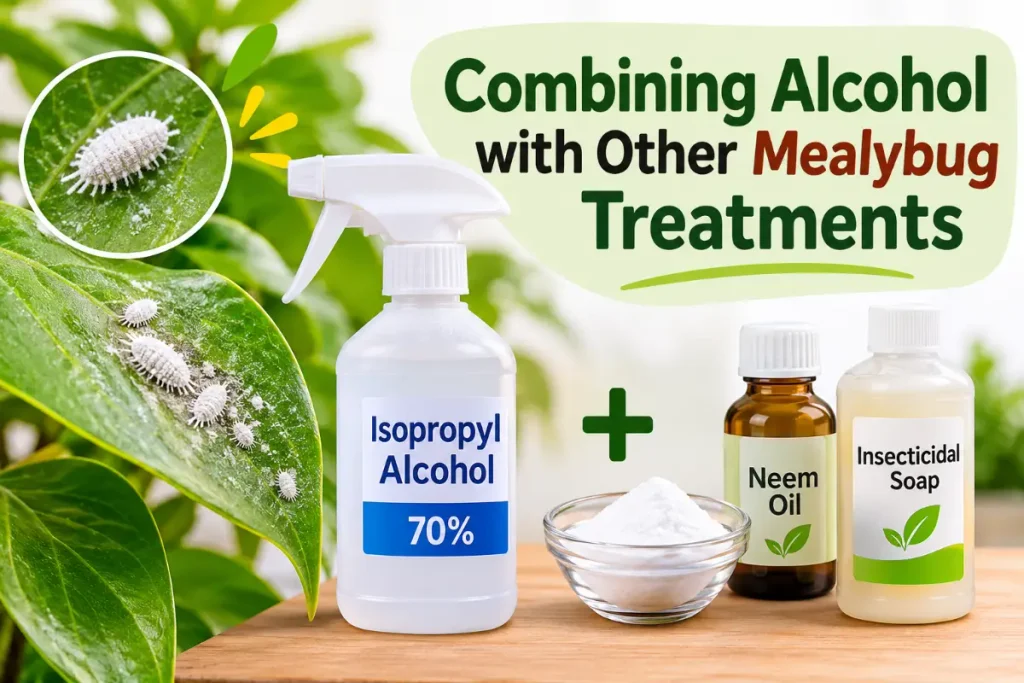
Combining Alcohol with Other Mealybug Treatments
Isopropyl alcohol is the best direct-kill tool for visible mealybug colonies, but complete elimination of a mealybug infestation requires addressing the insects in protected locations (inside new growth, at the root zone) and preventing reinfestation.
Alcohol + neem oil spray: Treat visible colonies with alcohol swabs first, then spray the entire plant with neem oil (1 tsp neem oil + ¼ tsp dish soap + 1 qt water) to address nymphs in protected locations and disrupt reproduction of any survivors. Apply neem oil 24 hours after alcohol treatment — not simultaneously, as mixing solvents can cause leaf damage.
Alcohol + systemic insecticide drench: For severe, persistent infestations where alcohol and neem have not achieved control after 4+ weeks, a systemic insecticide drench (imidacloprid — Bonide Systemic Houseplant Insect Control, available at Home Depot and Lowe’s) makes the plant toxic to mealybugs feeding on its tissue. Surface alcohol treatment kills visible insects; the systemic treatment reaches insects in protected feeding sites that alcohol cannot contact.
Alcohol + quarantine: Any plant with active mealybugs should be isolated from the collection immediately — move it to a separate room, not just a separate shelf. Even while treating with alcohol, mealybug crawlers disperse from the plant continuously on their own or on shared tools, and can infest neighbors within days. Treat in isolation until two consecutive weekly inspections find zero live mealybugs.
Conclusion
Isopropyl alcohol for mealybugs on plants is the most effective direct-contact treatment available for this pest — dissolving the protective waxy coating that makes mealybugs resistant to water sprays, killing adults, nymphs, and eggs on contact, and doing so for under $2 per bottle with no chemical residue concerns. The cotton swab method provides precise, effective treatment for accessible colonies; the brush method handles heavy stem infestations; the diluted spray covers light widespread presence; and the root dip addresses the often-overlooked root mealybug infestations that cause mysterious plant decline. Combined with neem oil for follow-up and systemic insecticide as a last resort, alcohol treatment clears even established mealybug infestations when applied consistently every 5–7 days over 3–4 weeks.
For comprehensive identification and management guidance for mealybugs and related soft-scale insects on US ornamental plants, the Washington State University Extension guide to mealybugs on ornamentals covers species identification, biology, and integrated pest management approaches used by professional growers and home gardeners.
FAQs
What concentration of isopropyl alcohol kills mealybugs?
70% isopropyl alcohol (standard drugstore rubbing alcohol) used undiluted on a cotton swab is the most effective concentration for direct mealybug treatment. For spray applications, dilute 70% alcohol 1:1 with water (35% final concentration) to reduce the risk of leaf damage while maintaining kill effectiveness.
Can isopropyl alcohol damage plants?
At 70% concentration applied with a cotton swab targeted at mealybug colonies, isopropyl alcohol is safe for most common houseplants. Plants with hairy leaves (African violets), delicate fronds (ferns), or powdery coatings (succulents with farina) need a test application before full treatment. For spray application, dilute to 35% and test on one leaf before treating the whole plant.
How often should I treat mealybugs with alcohol?
Treat with isopropyl alcohol every 5–7 days for 3–4 weeks. Mealybug eggs hatch continuously over several weeks; weekly sessions catch each new generation of nymphs before they reach reproductive maturity. Missing a week allows the population to rebound significantly.
Does isopropyl alcohol kill mealybug eggs?
Yes — isopropyl alcohol penetrates and dissolves the waxy cottony egg masses that mealybugs produce, killing eggs along with adults and nymphs on direct contact. This is one of the significant advantages of alcohol over neem oil and insecticidal soap, which are less effective at penetrating egg mass protection.
Why do mealybugs keep coming back after alcohol treatment?
Recurrence after alcohol treatment is usually caused by one of three things: insects in protected locations (inside tightly rolled new growth, at the root zone, inside flower buds) that alcohol could not reach during treatment; a neighboring infested plant that was not treated and is reinfesting the treated plant; or root mealybugs in the potting mix that are not visible during surface inspection. Unpot and inspect the roots if above-ground treatment has not resolved the infestation after 4–5 weeks of weekly alcohol treatment.
Pingback: Houseplant Quarantine Tips: The Complete Guide (2026) - Plant Quill