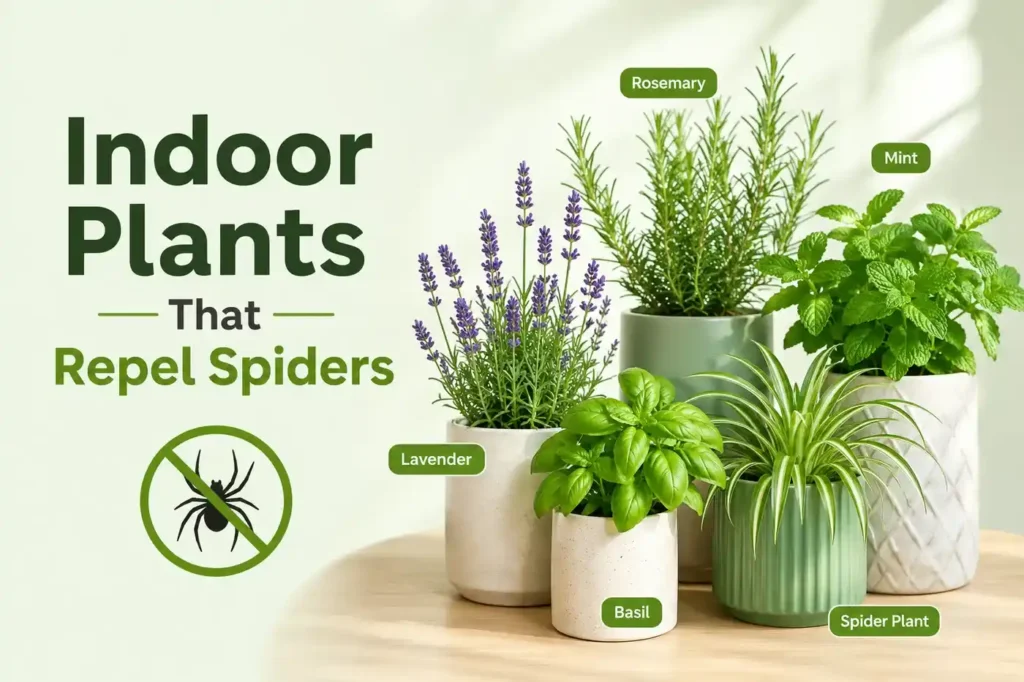
Indoor plants that repel spiders are one of the most practical and underused solutions for homeowners who find spiders consistently appearing in the same corners, windowsills, and entry points season after season. Spiders enter homes for two reasons: warmth and food. They follow the insects they feed on, which means a home with fewer insects has fewer spiders. Several common houseplants produce volatile compounds that both repel spiders directly and deter the insects spiders feed on, addressing both drivers of spider presence simultaneously through nothing more than the plant’s natural chemistry.
This guide covers 10 of the most effective plants for repelling spiders indoors, the specific compounds responsible for the repellent effect, exactly where to place each plant for maximum impact, and the honest answer to how well plants work compared to chemical spider deterrents.
Quick Answer
The best indoor plants that repel spiders include peppermint, lavender, eucalyptus, citronella, lemon balm, basil, rosemary, marigolds, catnip, and chrysanthemums. These plants contain volatile compounds including menthol, linalool, cineole, and pyrethrin that spiders find overwhelming or toxic. Place them near entry points, windowsills, and corners where spiders typically appear for the most effective deterrence.
Why Spiders Dislike Certain Plants
Spiders have chemoreceptors on their legs and body that detect chemical compounds in their environment with significantly greater sensitivity than most insects. The same volatile oils that merely irritate or confuse insects can be genuinely overwhelming to spider sensory systems at concentrations that living plants produce continuously.
Spiders avoid areas saturated with strong terpenes, phenols, and other volatile organic compounds for a practical reason beyond sensory discomfort. These compounds in high concentrations can interfere with the chemical signals spiders use to detect prey and communicate with potential mates. An environment that overwhelms their chemical sensing effectively makes the space useless to them as a hunting ground.
The other mechanism is indirect. Plants that repel the insects spiders feed on remove the food source that attracts spiders to specific areas. A kitchen windowsill with a basil plant has fewer flies than one without, and fewer flies means fewer reasons for spiders to hunt in that area.
10 Indoor Plants That Repel Spiders
1. Peppermint
Peppermint is the single most widely cited and consistently effective spider-repelling plant available for indoor use. The menthol in peppermint leaves is produced in high enough concentrations that spiders actively avoid areas where peppermint plants are growing or where peppermint oil has been applied. Research into peppermint as a spider deterrent consistently shows avoidance behavior across multiple common house spider species.
What makes peppermint particularly practical for indoor spider control is how easy it is to grow, how fast it establishes from a cutting or small plant, and how little care it requires to stay healthy and fragrant year-round.
Active compound: Menthol and menthone
Where to place it: Windowsills where spiders enter, corners where webs consistently appear, near entry doors, and in basements or utility rooms where spiders are most common. For windowsills specifically, a plant on each side of a frequently opened window creates a scent barrier that both spiders and the insects they follow find deterring.
Care: Consistently moist soil, partial to full sun, and its own pot since mint spreads aggressively through any shared container. A 4 to 6 inch pot is large enough for a windowsill plant that will stay productive for months.
Boosting the effect: Gently crush a few leaves between your fingers every few days to release a burst of fresh menthol into the area. The crushed leaf release is significantly more intense than the passive ambient release from an undisturbed plant.
2. Lavender
Lavender’s linalool compound is well established as an insect repellent across a broad range of species, and spiders respond similarly. The continuous passive release of linalool from lavender growing near entry points and windows creates an olfactory barrier that spiders and their prey insects find unwelcoming.
The additional practical benefit of lavender for spider control is its effectiveness against the moth and fly species that many house spiders specifically feed on. Reducing the prey population that draws spiders to specific areas is as effective as directly repelling the spiders themselves.
Active compound: Linalool and linalyl acetate
Where to place it: Entry doors, frequently opened windows, and any room where moths are a problem since moth presence directly attracts spider activity. A sunny south-facing windowsill gives lavender the light it needs to stay vigorous and fragrant at full potency.
Care: Full sun of at least 6 hours daily, well-draining gritty soil in a terracotta pot, and deep infrequent watering. Lavender in consistently moist soil develops root rot quickly, which kills both the plant and its spider-repelling effectiveness. For a full breakdown of how lavender and other fragrant plants work as pest deterrents across multiple pest species, indoor plants that repel bugs covers the complete chemistry and placement strategy for every major bug-repelling plant.
3. Eucalyptus
Eucalyptus releases cineole, a sharp camphor-like compound, continuously into the surrounding air from its leaves without needing to be touched or disturbed. This passive continuous release makes it one of the most effective ambient spider deterrents available since it requires no interaction from you to maintain its repellent effect throughout the day and night.
Cineole is particularly effective against the common house spider species most frequently encountered indoors including cellar spiders, house spiders, and hobo spiders, all of which show strong avoidance behavior in environments with eucalyptus-derived terpene concentrations.
Active compound: Cineole (1,8-cineole)
Where to place it: Rooms where spiders are most consistently present. Because eucalyptus works through passive ambient release rather than requiring the plant to be placed directly in a spider’s path, positioning it in the center of a room or in a corner creates a broader deterrent zone than a windowsill placement would.
Care: Full sun, well-draining soil, deep watering followed by allowing the top 2 inches to dry before watering again. Eucalyptus grows fast indoors and may need repotting annually. It is significantly more likely to die from overwatering than from underwatering once established.
4. Citronella
Citronella is best known for its mosquito-repelling properties but its active compounds, citronellal and geraniol, are effective against a broader range of arthropods including spiders. The living plant releases these compounds continuously, making it a more sustained deterrent than citronella candles that only work while burning.
Active compound: Citronellal and geraniol
Where to place it: Near windows and doors where spiders enter, particularly during warm months when spider activity peaks. Citronella grows large indoors, often reaching 2 feet, so give it a sturdy pot and enough space to spread without being crowded.
Care: Full sun, well-draining soil, and regular watering once the top inch of soil dries. It handles standard indoor temperatures year-round and only struggles near cold drafts in winter.
5. Lemon Balm
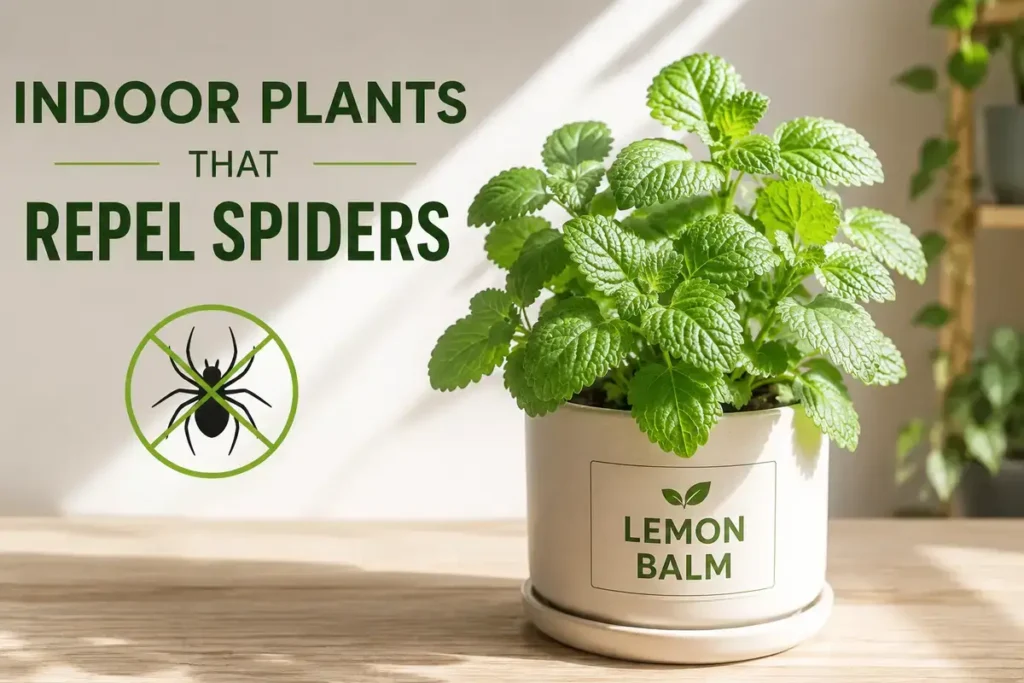
Lemon balm is a member of the mint family that produces high concentrations of citronellal, the same compound found in citronella plants, alongside additional terpenes that contribute to its broad insect and spider-repelling effect. It is easier to find than true citronella at most garden centers and grows vigorously with minimal care, making it one of the most accessible spider-repelling options for indoor use.
Active compound: Citronellal, linalool, and eugenol
Where to place it: Kitchens and bathrooms where spiders are commonly found near water sources. Near windows that face outdoor vegetation where spiders migrate indoors from garden areas in autumn. Lemon balm tolerates partial shade better than most herbs on this list, giving it more placement flexibility in rooms with limited natural light.
Care: Consistently moist soil, partial to full sun, and regular harvesting to encourage bushy growth and maintain high essential oil concentration in the leaves. Like mint, grow lemon balm in its own pot to prevent it from spreading into neighboring plants.
6. Basil
Basil’s estragole and linalool compounds make it effective against flies and mosquitoes primarily, but the same chemistry that drives those insects away also reduces the prey availability that draws hunting spiders into kitchen and living areas. Fewer flies near a basil plant on your kitchen windowsill means fewer reasons for spiders to build webs in that area.
Active compound: Estragole, linalool, and eugenol
Where to place it: Kitchen windowsills and counter areas where flies congregate and where spiders follow. Near fruit bowls and kitchen waste areas where fly activity draws spider hunters. Basil needs 6 to 8 hours of direct sun, making a south-facing kitchen window the ideal location.
Care: Consistently moist soil, direct sun, and regular pinching of flower buds to maintain leaf production and essential oil concentration. A plant allowed to flower loses its repellent potency rapidly as the plant diverts energy from leaf production to seed development.
For a complete guide to how basil and other kitchen herbs function as pest deterrents beyond just spider control, do indoor plants attract bugs covers which plants attract and which repel the full range of common indoor pest species.
7. Rosemary
Rosemary’s camphor and borneol content makes it effective against both the insects spiders prey on and spiders themselves. Its woody, resinous scent is produced at high enough concentrations in a healthy, well-lit plant to deter spider activity in the immediate area around it consistently.
Rosemary has an additional advantage over many other plants on this list in that it is slow to lose its scent intensity indoors compared to softer-leaved herbs. A healthy rosemary plant maintains its repellent potency for months without the kind of active management that basil or mint requires.
Active compound: Camphor and borneol
Where to place it: Near entry points and frequently opened windows and doors. Rosemary’s tolerance for bright light and dry conditions makes it well-suited to south-facing windowsills that get strong direct light throughout the day, positions that deter both spider entry and the flying insects spiders hunt.
Care: At least 6 hours of direct sun daily, well-draining soil in a terracotta pot, and deep infrequent watering with complete drying of the top inch of soil between waterings. Rosemary is Mediterranean and handles dry indoor conditions significantly better than most herbs, which makes it one of the lower-maintenance spider-repelling plants available.
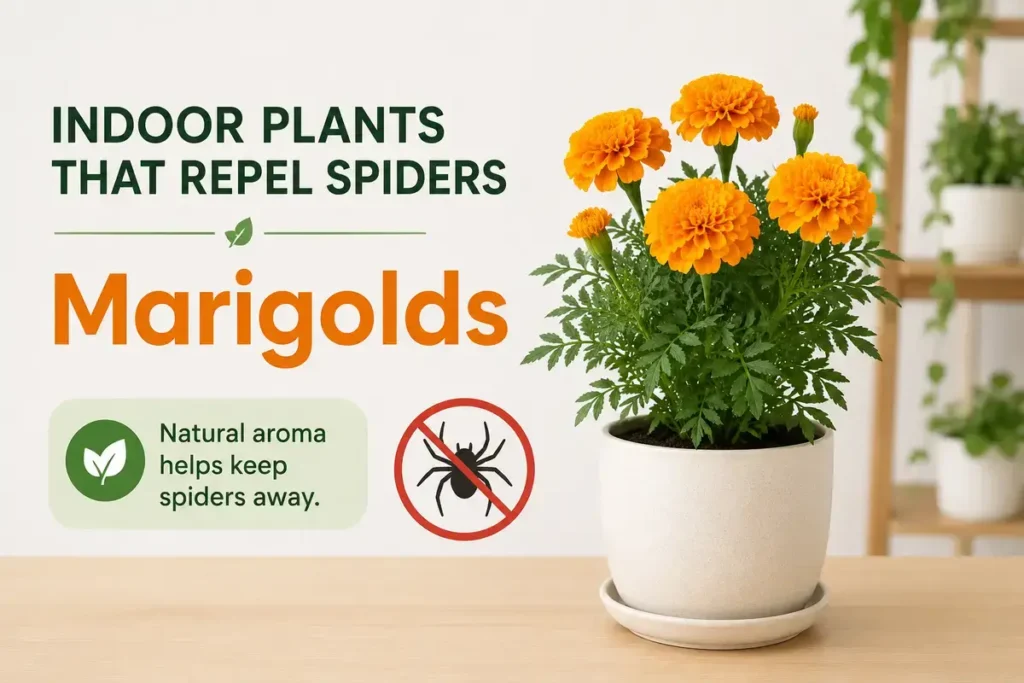
8. Marigolds
Marigolds contain pyrethrum compounds that are effective against a wide range of insects and also have deterrent effects on spiders. Their strong, distinctive scent is produced most intensely from the leaves and stems rather than the flowers, which means deadheaded plants that are no longer blooming retain significant repellent value as long as the foliage remains healthy.
Active compound: Pyrethrum and alpha-terthienyl
Where to place it: Bright sunny windowsills, particularly near points where spiders enter from outside. South or west-facing windows give marigolds the direct light they need to stay in bloom and maintain their highest essential oil production.
Care: At least 6 hours of direct sun, moderate watering with slight drying between waterings, and regular deadheading of spent blooms to encourage new flower production. Marigolds in 6-inch pots stay compact enough for windowsill placement without outgrowing their space.
9. Catnip
Catnip contains nepetalactone, the compound that famously affects cats, which also happens to be one of the most effective insect and spider deterrents produced by any common plant. Research comparing nepetalactone to DEET for mosquito deterrence consistently shows the plant compound performing comparably or better, and the same avoidance response occurs in spider species tested in environments with catnip-derived nepetalactone present.
Active compound: Nepetalactone
Where to place it: Near windows and entry points where spider activity is highest. Catnip grows vigorously in bright indirect light and does not demand much management once established.
Important: If you have cats, catnip will not survive indoors. Cats are intensely attracted to nepetalactone and will destroy the plant rapidly. In a cat-free home, catnip is one of the most potent spider-deterring plants available. For a full breakdown of catnip’s repellent chemistry and effectiveness against multiple pest species, bug spray for indoor plants covers natural repellent compounds and how they compare to commercial spray options.
Care: Well-draining soil, moderate watering, and at least 4 to 6 hours of light daily. Regular harvesting of leaves maintains higher nepetalactone concentration in the remaining foliage and encourages bushier, more productive growth.
10. Chrysanthemums
Chrysanthemums contain pyrethrin, the natural insecticide compound used commercially in a wide range of pest control products. Pyrethrin is effective against a broad spectrum of arthropods including spiders, making chrysanthemums the plant with the widest anti-spider action of any on this list. Unlike most plants that work through scent-based deterrence, chrysanthemums’ pyrethrin content is genuinely toxic to spiders and other arthropods at the concentrations present in the living plant.
Active compound: Pyrethrin
Where to place it: Any room where spider presence is most problematic. Near entry points and at floor level near baseboards where ground-dwelling spider species travel. Chrysanthemums are also visually attractive flowering plants, which means they earn their spot both practically and aesthetically.
Care: Bright indirect to direct light, consistent moisture, and cooler indoor temperatures around 60 to 65 degrees Fahrenheit. Cut back after each blooming cycle to encourage new growth and repeated flowering, which maintains pyrethrin production at its highest levels.
Important: Pyrethrin is toxic to cats even in plant form. If you have cats, skip chrysanthemums and use peppermint or lavender as your primary spider deterrents instead.
Where to Place Spider-Repelling Plants for Maximum Effect
Plant selection matters but placement determines whether the chemistry actually reaches the spiders you are trying to deter.
Entry points first. Spiders enter through doors, windows, gaps around pipes, and vents. A peppermint or lavender plant positioned directly beside your most-used entry points creates a scent barrier right where spiders are crossing the threshold.
Windowsills where webs consistently appear. If the same window corners develop webs season after season, that window is an active spider entry or hunting point. A plant on that windowsill disrupts both entry and web-building activity in that location.
Corners and baseboards in spider-active rooms. Ground-dwelling spiders travel along walls and baseboards. A chrysanthemum or catnip plant positioned at floor level in corners where spiders are regularly seen places the repellent chemistry at exactly the height and location where spiders are most active.
Basement and utility room entries. These are the most consistently spider-inhabited areas of most homes. A eucalyptus or rosemary plant near the entry to these spaces reduces the spider population migrating from these areas into living spaces above.
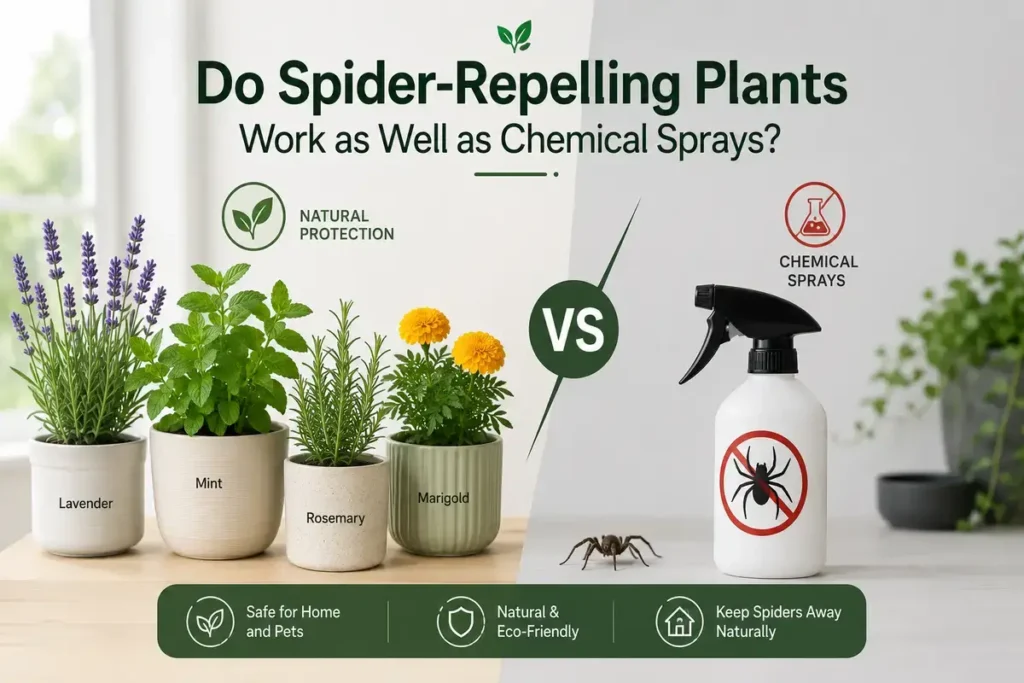
Do Spider-Repelling Plants Work as Well as Chemical Sprays
The honest answer is that plants and chemical sprays work differently and suit different situations.
Chemical spider sprays containing permethrin or bifenthrin kill spiders on contact and leave residual toxicity on treated surfaces for several weeks. They are faster-acting and more immediately effective for an existing heavy spider population.
Spider-repelling plants work preventively. They do not kill spiders already present in your home. They make the environment progressively less attractive to new spiders entering and to the insects that draw spiders into specific areas. A home with peppermint at every entry point and windowsill sees fewer spiders entering over time, but it takes several weeks for the ambient scent concentration to build to levels that consistently deter spider activity.
The most effective approach combines both: use a chemical spray for immediate control of an existing spider population, then establish spider-repelling plants at entry points and problem areas to prevent the population from rebuilding. The plants handle prevention so you are not repeatedly reaching for the spray can every few months.
Conclusion
Indoor plants that repel spiders work through genuine plant chemistry that spiders find deterring or toxic. Peppermint and catnip produce menthol and nepetalactone that overwhelm spider chemoreceptors. Eucalyptus and citronella release compounds that make an area inhospitable as a hunting ground. Chrysanthemums produce pyrethrin that is genuinely toxic to spiders at plant concentrations. Lavender, basil, and rosemary reduce the insect prey that draws spiders to specific areas in the first place.
Start with peppermint at your most active spider entry points since it is the most widely effective, easiest to grow, and fastest to establish. Add lavender near doors and windows. Place a chrysanthemum in the room where spider presence is most consistent. Give these plants 4 to 6 weeks to build ambient scent concentration in their placement areas and the difference in spider activity becomes noticeable.
Plants will not eliminate every spider from your home and that is not the goal. Spiders provide genuine pest control value by eating the insects that would otherwise be more numerous. The goal is keeping them out of living spaces and away from areas where their presence is unwelcome, and the plants on this list do exactly that when placed correctly and kept healthy.
Frequently Asked Questions
Do peppermint plants actually keep spiders away?
Yes. Peppermint is one of the most consistently effective spider-deterring plants available and the evidence for its effectiveness goes beyond anecdote. Multiple studies on spider behavior in environments with menthol-saturated air show consistent avoidance across common house spider species. The key is keeping the plant healthy and actively growing since a struggling plant produces significantly less menthol than a vigorous one.
Which indoor plant repels the most types of spiders?
Chrysanthemums have the broadest action against spider species because their pyrethrin content is genuinely toxic to arthropods rather than merely deterring through scent. Peppermint and eucalyptus are the most broadly effective scent-based deterrents, affecting the widest range of spider species through olfactory avoidance rather than direct toxicity.
How long does it take for spider-repelling plants to work?
Plants that work through passive scent release take 2 to 4 weeks to build ambient compound concentrations in their placement area to levels that consistently deter spider activity. Plants placed near entry points show results faster than those placed in open rooms since the compounds concentrate in the smaller air volume near a window or door. Boosting the effect by gently crushing leaves every few days accelerates the buildup of deterrent compounds in the immediate area.
Are spider-repelling plants safe around dogs?
Most plants on this list are safe around dogs including peppermint, lavender, eucalyptus, basil, rosemary, and marigolds at the levels produced by a living plant. Cats are a different situation: chrysanthemums and catnip (despite the name) both cause reactions in cats and should be avoided in cat-owning households. Always check the ASPCA toxic plant database for specific pet safety information before adding any new plant to a home with pets.
Can I use spider-repelling plants in my bedroom?
Yes, and several of them provide additional benefits in bedroom settings. Lavender is widely associated with improved sleep quality through its linalool content. Peppermint in the bedroom deters both spiders and the moths and flies that spiders follow into sleeping areas. Keep plants on windowsills rather than directly beside the bed for the best combination of spider deterrence and air quality benefit.
How many spider-repelling plants do I need for a noticeable effect?
Two to three strategically placed plants produce a noticeable difference in spider activity in a standard room or apartment. One near the main entry point, one at the most active spider window, and one in the corner where spiders most consistently appear covers the three primary activity zones in most living spaces. More plants concentrated at entry points produce faster results than the same number spread randomly throughout the home.