
If you have ever forgotten to fertilize your houseplants for a month and wondered why they look pale and tired, slow release fertilizer for indoor plants is probably the solution you have been looking for. One application feeds your plants for three to six months without you doing anything else. No measuring, no mixing, no weekly schedules. Just press the granules into the soil and walk away.
Slow release fertilizers work by coating nutrients in a resin or polymer shell that breaks down gradually with each watering, releasing a small, consistent dose of nutrition to plant roots over an extended period. For indoor plants especially, this steady feeding approach produces more consistent growth than the boom-and-bust cycle of applying liquid fertilizer, seeing a growth flush, then watching the plant slow down before the next application.
This guide covers the 7 best slow release fertilizer options for indoor plants, how each one works, which plants respond best, and the one mistake most people make that reduces their effectiveness significantly.
Quick Answer
The best slow release fertilizers for indoor plants are Osmocote Smart Release Plant Food, Jobe’s Organics Granular Fertilizer, Espoma Plant-tone, Miracle-Gro Shake and Feed, Dr. Earth Pump and Grow, worm castings as a top dress, and compost incorporated into potting mix. Apply granular products every three to four months by pressing them into the top inch of soil. Always start at half the label rate for indoor pots since limited soil volume concentrates nutrients more than outdoor beds.
Why Slow Release Fertilizer Works So Well for Indoor Plants
Outdoor garden plants have large soil volumes that buffer nutrient concentrations and drain excess. Indoor potted plants do not have that buffer. A dose of liquid fertilizer that is perfectly safe in a garden bed can reach damaging concentrations in a six-inch pot.
Slow release fertilizers sidestep this problem entirely. The coated granules release a small, dilute amount of nutrients with every watering rather than flooding the soil all at once. Plant roots absorb what they need, and the next dose is not available until the next watering. This matches how plant roots prefer to feed, in small consistent amounts rather than large intermittent flushes.
The other practical advantage for busy plant owners is obvious. One application every three to six months is far easier to maintain consistently than a biweekly liquid fertilizer schedule. Consistency is what produces results with any fertilizer approach, and slow release makes consistency almost automatic.
What to Look for Before You Buy
NPK ratio for your plant type. A balanced ratio like 10-10-10 or 14-14-14 suits most general foliage plants. A higher middle number supports flowering plants. Look for formulas that include micronutrients since these are frequently missing from budget slow release products and become depleted from potting mix faster than primary nutrients.
Release duration. Most products release over three, four, or six months. For indoor plants where you are less likely to notice subtle nutritional decline, longer release periods are more forgiving if you miss a reapplication date.
Indoor vs outdoor formulation. Some slow release fertilizers are specifically formulated for indoor use at lower concentration levels. Outdoor formulations work indoors at half rate.
Coating type. Polymer-coated granules like Osmocote release more predictably than sulfur-coated ones since their release rate responds to watering frequency rather than soil temperature, which matters more outdoors than in a stable indoor environment.
7 Best Slow Release Fertilizers for Indoor Plants
1. Osmocote Smart Release Plant Food
Osmocote is the most widely known slow release fertilizer available. The polymer-coated granules release nutrients based on moisture contact rather than temperature, which is ideal for indoor use where temperatures stay consistent year-round. Its 14-14-14 balanced NPK ratio suits the broadest range of common houseplants without needing plant-specific adjustments.
Release duration: Three to four months per application.
How to apply it: Press granules into the top inch of soil at half the label rate for indoor pots. Water normally after application to activate the release cycle.
Where to buy: Home Depot, Lowe’s, Walmart, and Amazon.
Best for: Tropical foliage plants, mixed houseplant collections, and anyone who wants one reliable product that works across most plant types.
One limitation: Osmocote does not improve soil biology the way organic options do. It feeds the plant but not the soil ecosystem.
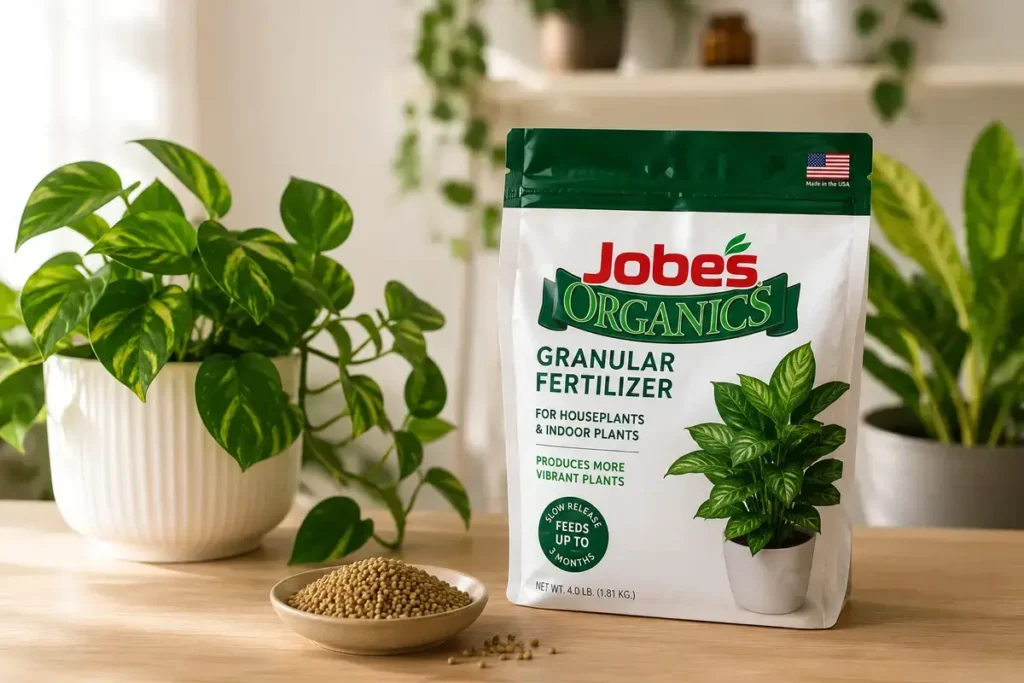
2. Jobe’s Organics Granular Fertilizer
Jobe’s Organics uses a biological approach that sets it apart from synthetic slow release options. It contains their proprietary Biozome blend of bacteria, mycorrhizal fungi, and archaea that colonize potting mix alongside the granular nutrients, improving soil biology and nutrient uptake over the full release period.
The 4-4-4 NPK ratio is gentler than synthetic options, making it the safer choice for sensitive plants and recent repots where roots are still establishing.
Release duration: Two to three months per application.
Best for: Sensitive plants including orchids and ferns, recently repotted plants, and plant owners committed to organic growing. The biological component also makes it a good choice for plants in older potting mix that has lost its natural microbial community.
3. Espoma Plant-tone
Espoma Plant-tone is a slow release organic granular fertilizer with a 5-3-3 NPK formulation that is nitrogen-forward, making it particularly effective for foliage plants grown primarily for their leaves. It contains 15 different nutrients including the full range of primary and secondary macronutrients and a comprehensive trace mineral profile that many budget slow release products omit entirely.
Release duration: Two to three months.
How to apply it: Mix into the top two inches of soil or work in when repotting. Apply every two to three months through spring and summer.
Best for: Foliage-focused plants including pothos, philodendrons, monsteras, and snake plants where nitrogen-driven leaf growth is the primary goal.
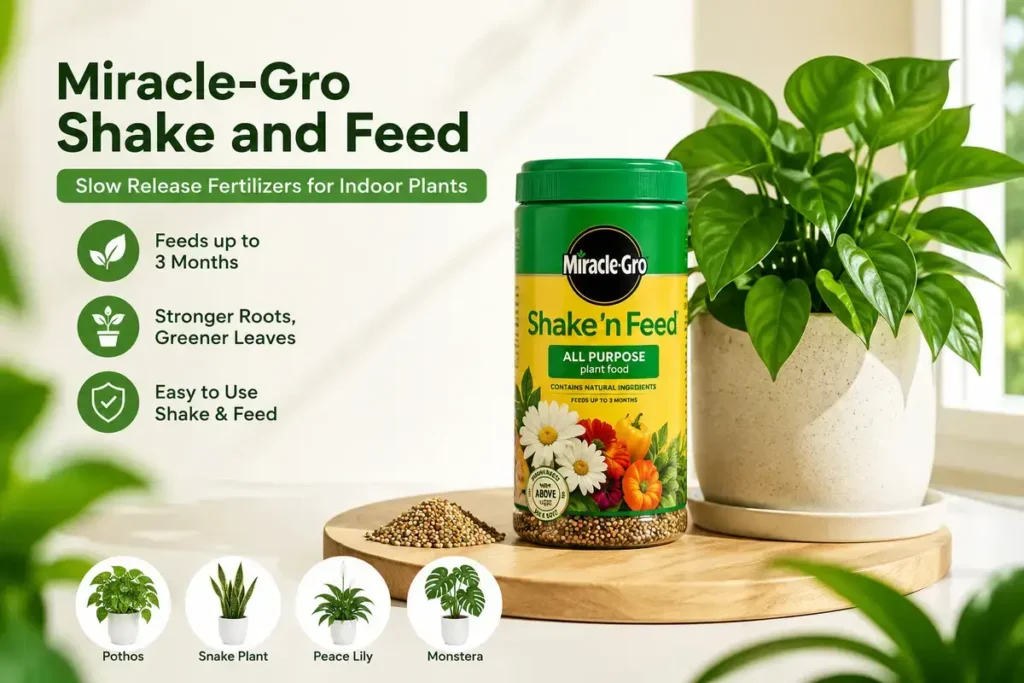
4. Miracle-Gro Shake and Feed
Miracle-Gro Shake and Feed is the most convenient slow release option at major retailers. The tropical plants formulation includes magnesium and iron specifically, which are the two trace minerals most commonly deficient in tropical houseplants grown in potting mix over extended periods.
Release duration: Three months per application.
How to apply it: Shake granules onto the soil surface at half the label rate. Work into the top inch. Water to activate.
Best for: Tropical foliage collections. The magnesium content addresses the interveinal yellowing that commonly appears in monsteras, pothos, and philodendrons after six or more months in depleted potting mix.
5. Dr. Earth Pump and Grow
Dr. Earth Pump and Grow is a liquid slow release option rather than a granular one. Each pump dispenses a measured dose that provides sustained low-level nutrition over several weeks from a single application. It uses an organic formulation with beneficial soil microorganisms alongside the nutrients, making it one of the few liquid options that genuinely improves soil biology rather than just feeding the plant directly.
Release duration: Two to four weeks per application rather than months like granular options.
Best for: Plant owners who want measured dosing without mixing concentrates. Also useful for sensitive plants where granular application risks concentrating nutrients too close to individual roots.
6. Worm Castings as Top Dress
Worm castings function as a natural slow release fertilizer when applied as a top dressing because the nutrients they contain release gradually through soil microbial activity rather than all at once. A half-inch layer on the soil surface, watered in gently, continues releasing nutrition for six to eight weeks.
The advantage over synthetic slow release granules is the comprehensive benefit: balanced nutrition, natural plant growth hormones, beneficial microorganism inoculation, and improved soil biology from a single application with zero burn risk at any application rate.
How to apply: Spread a half-inch layer across the entire soil surface and water thoroughly. Apply every six to eight weeks through the growing season.
Best for: All houseplant types. The safest slow release option for recently repotted plants, sensitive species, and anyone who wants to feed plants without any risk of overfeeding. For everything worm castings do beyond slow release nutrition, worm castings for indoor plants covers every benefit and application method.
7. Compost Incorporated Into Potting Mix
Incorporating finished compost into potting mix at 20 to 25% when repotting creates a slow release nutrient reservoir that continues feeding plants for months through gradual microbial breakdown. This is the most thorough slow release approach because the nutrients are distributed throughout the entire root zone rather than concentrated at the soil surface.
The release timeline is longer and less predictable than commercial granules but the soil biology improvement and structural benefits make it worth including in any repotting mix. For the complete guide to using compost for indoor plants without attracting pests, compost for indoor plants covers every method with specific application guidance.
The One Mistake That Reduces Slow Release Fertilizer Effectiveness
Using the outdoor label rate on indoor plants is the single most common mistake. Label rates are calibrated for outdoor garden beds where soil volume is large, excess nutrients leach away with rain, and plants have significantly higher nutritional demand than the same species growing in a pot indoors.
At the outdoor rate in a small indoor pot, slow release granules can reach concentrations that cause brown leaf tips and white salt crust on the soil surface. At half the label rate, the same product delivers appropriate nutrition without accumulation problems.
Always start at half the outdoor label rate. If growth is strong and healthy after the first application cycle, maintain that rate. If deficiency symptoms appear at the halfway point of the release period, increase to three-quarters rate for the next application.
When to Apply Slow Release Fertilizer
Spring: Apply at the beginning of the growing season when plants are showing new growth. This positions nutrient release to peak during the period of highest demand.
Summer reapplication: Most products need reapplication after three to four months, placing the second application in midsummer when plants are still actively growing.
Fall and winter: Stop applying in October for most houseplants. Granules already in the soil can remain since release slows with reduced watering. Do not add new applications through the dormant period.
After repotting: Wait four to six weeks before applying any slow release fertilizer after repotting since fresh potting mix contains starter nutrients for the establishment period.
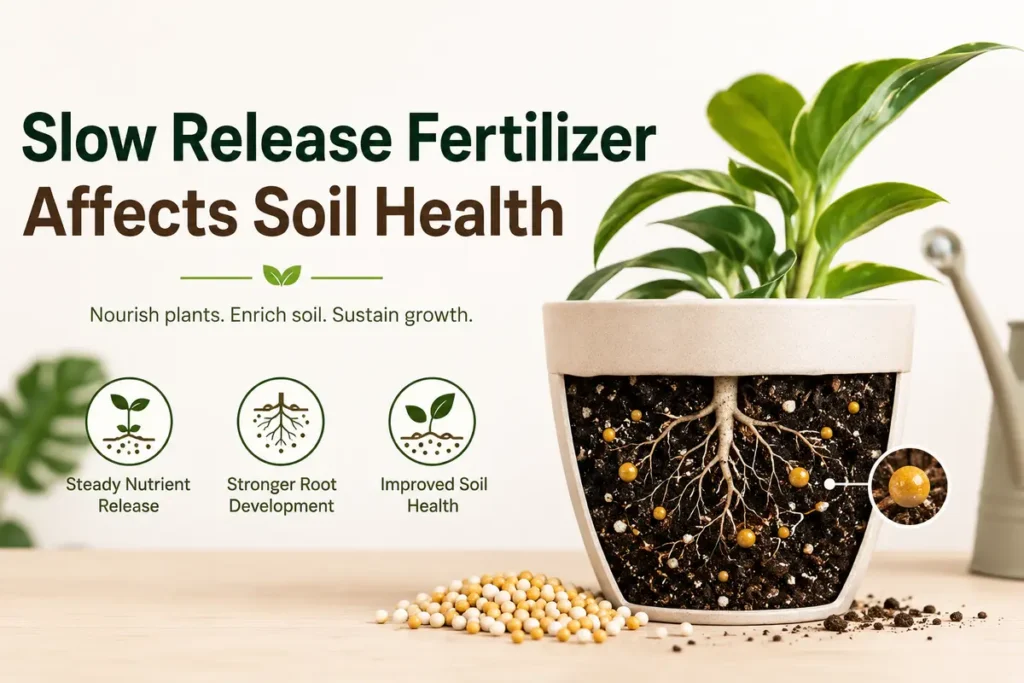
How Slow Release Fertilizer Affects Soil Health Over Time
Synthetic slow release granules like Osmocote deliver nutrients efficiently but contribute nothing to soil biology. After twelve to eighteen months of synthetic-only fertilizing, the potting mix becomes nutritionally supplemented but biologically depleted. The beneficial bacteria and fungi that support healthy root function gradually decline without organic matter to feed on.
The practical result is that plants fed exclusively with synthetic slow release fertilizers for more than a year often need repotting more urgently than plants maintained with organic options, not because they have run out of nutrients but because soil biology has declined.
Rotating between synthetic slow release for convenience and organic options like worm castings and compost tea maintains both adequate nutrition and healthy soil biology. A practical approach: apply synthetic slow release granules in spring for the three to four month release period, then switch to worm casting top dresses and occasional liquid organic fertilizer through summer and fall.
For a complete guide to natural fertilizer options that complement slow release synthetic products, natural fertilizer for indoor plants covers every organic option. For the soil mix foundations that make any fertilizer program more effective, soil mixture for indoor plants covers the potting mix recipes that give slow release nutrients the best possible environment to work in.
Signs Your Slow Release Fertilizer Is Working
After two to four weeks from application, look for these signs that the fertilizer is releasing and your plants are absorbing it.
New leaves that are noticeably larger and darker green than before application. This is the clearest visual indicator of nitrogen uptake working.
More frequent new growth production. A plant moving from one new leaf per month to two or three indicates healthy phosphorus and potassium support alongside nitrogen.
Firmer, more upright stems. Potassium strengthens vascular tissue and its uptake produces physically stronger plant structures you can see and feel.
Earlier flower bud appearance in flowering plants. The phosphorus in balanced slow release products specifically supports the energy-intensive process of flower development.
If none of these signs appear after four weeks, the most likely causes are insufficient light, overwatering creating root damage, or soil pH outside the optimal range locking nutrients into unavailable forms. Address these foundational issues before concluding the fertilizer itself is the problem.
How to Track Whether Your Slow Release Schedule Is Working
One thing most guides skip is how to actually know when to reapply. With liquid fertilizers you count days on a calendar. With slow release products the signal is the plant itself rather than the calendar.
A slow release fertilizer that is still actively releasing does not need reapplication even if the scheduled date has arrived. A plant that is producing healthy new growth, maintaining dark green color, and showing no deficiency symptoms still has adequate nutrition available. Adding more granules on top of an active release cycle creates the same concentration problem as applying liquid fertilizer too frequently.
Conversely, a plant showing pale new growth, slowing production, or interveinal yellowing before the scheduled reapplication date is telling you the granules have exhausted their release and nutrition has run out. Reapply immediately rather than waiting for the calendar date.
The practical check: scratch gently around the top inch of soil every six weeks and look at the granule condition. Osmocote granules that still look plump and round are still releasing. Granules that look flat, collapsed, or hollow have exhausted their nutrition. This visual check takes 30 seconds and tells you exactly where you are in the release cycle without any guesswork.
For liquid natural fertilizers that complement a slow release program during the gaps, diy fertilizer for indoor plants covers every effective homemade option with preparation guidance and rotation schedules that pair well with any slow release approach.
What to Do If Your Plant Stops Responding to Slow Release Fertilizer
After one to two full growing seasons of slow release feeding, some plants plateau and stop responding noticeably to fertilizer applications. This is almost always a soil problem rather than a fertilizer problem.
Old potting mix that has been in use for eighteen months or more loses the structural properties that allow liquid and slow release nutrients to distribute evenly through the root zone. Fertilizer applied to severely compacted old mix flows along the edges of the pot and out the drainage holes without penetrating the dense root mass at the center where most active root tips are located.
If a plant on a consistent slow release program stops responding to fertilizer after one to two years, repot into fresh well-structured mix before changing anything about the fertilizer approach. Almost always the plant responds immediately to the combination of fresh soil and the existing fertilizer schedule without any change to the product itself.
Conclusion
Slow release fertilizer for indoor plants solves the consistency problem that makes liquid fertilizing feel like a chore. One application every three to four months maintains steady nutrition through the entire growing season without measuring, mixing, or setting reminders. Osmocote is the most reliable synthetic option. Jobe’s Organics and Espoma Plant-tone deliver organic nutrition with soil biology benefits. Worm castings as a top dress provide the most comprehensive slow release benefit package with zero burn risk.
Start with half the outdoor label rate for any commercial product. Apply in spring when growth begins. Reapply in midsummer. Stop in October. Watch your plants maintain the steady, healthy growth that comes from consistent nutrition without the peaks and troughs that irregular liquid feeding produces.
Frequently Asked Questions
How long does slow release fertilizer last in indoor plant soil?
Most polymer-coated granular slow release fertilizers last three to four months in indoor conditions. Organic options including worm castings and compost release for six to eight weeks. Sulfur-coated granules designed for outdoor use may release faster indoors than their labels suggest since indoor watering frequency differs from outdoor rainfall patterns. Check your specific product label for the release duration and plan reapplication accordingly.
Can slow release fertilizer burn indoor plants?
At appropriate rates it is very difficult to burn indoor plants with slow release fertilizers since the gradual delivery mechanism prevents the concentration spikes that cause root burn with liquid fertilizers. The risk increases when using outdoor label rates in small indoor pots. Starting at half the outdoor label rate and pressing granules into the soil rather than piling them against plant stems eliminates virtually all burn risk for standard houseplant species.
Should I use slow release or liquid fertilizer for indoor plants?
Both work and combining them often produces the best results. Slow release granules or worm castings provide a consistent nutritional baseline through the growing season without requiring active management. Adding a liquid fertilizer application once monthly during peak summer growth accelerates results when plants are growing vigorously and demanding more nutrition than slow release alone provides.
How do I apply slow release fertilizer to indoor plants correctly?
Press granules into the top inch of soil across the entire soil surface rather than piling them in one spot or against the plant stem. Distribute evenly at half the outdoor label rate. Water thoroughly after application to begin the release cycle. For top-dress organic options like worm castings, spread evenly across the soil surface and water gently to move nutrition into the root zone.
Can I use outdoor slow release fertilizer on indoor plants?
Yes, at half the label rate. Outdoor formulations are typically higher concentration since outdoor plants have greater soil volume, better drainage, and higher nutritional demand from full-sun growing conditions. At half rate, outdoor slow release products perform appropriately for indoor potted plants without salt accumulation risk.
Why are my indoor plant leaves still yellow after applying slow release fertilizer?
Yellow leaves after slow release fertilizer application have three common causes. First, slow release nutrients take two to three weeks to begin showing visible results since the process is gradual. Second, yellowing from overwatering, insufficient light, or root rot does not respond to fertilizer since these are environmental rather than nutritional problems. Third, interveinal chlorosis (yellow between veins, green veins) specifically indicates a trace mineral deficiency that general slow release fertilizers may not fully address without targeted supplementation.
Pingback: Do You Need Nutrients After Repotting Indoor Plants? - Plant Quill