
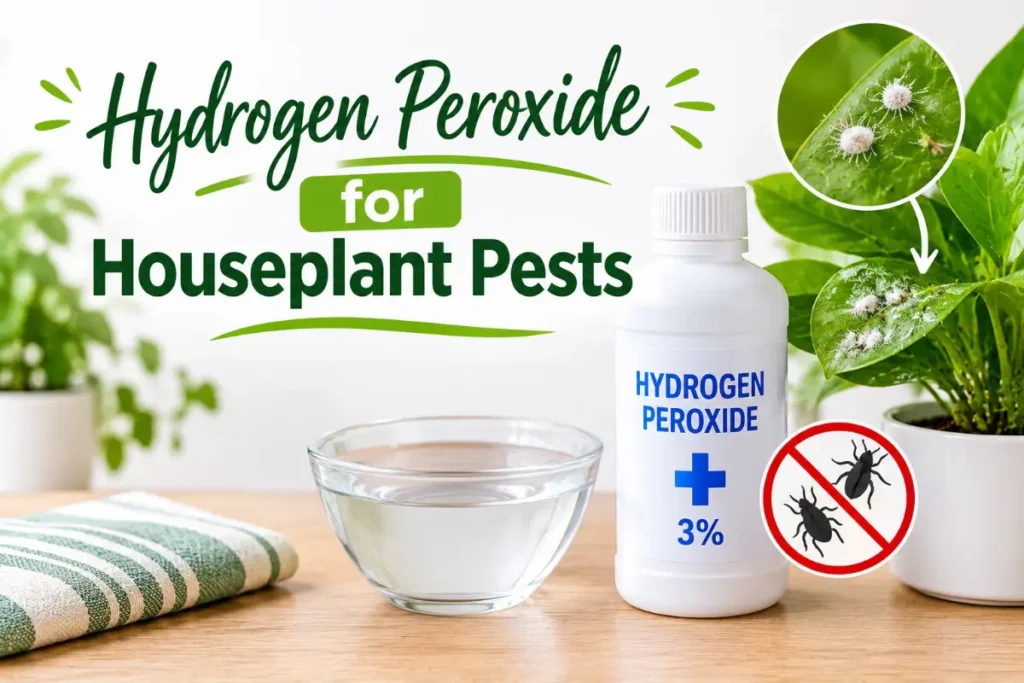
Hydrogen peroxide is one of the most versatile and underused tools in houseplant care. At the correct dilution, it kills soil-dwelling pests on contact, eliminates the bacteria and fungi responsible for root rot, and oxygenates compacted potting mix — all without leaving harmful residues or requiring a trip to a garden center.
Hydrogen peroxide for houseplant pests works specifically against soil-based problems: fungus gnat larvae, root rot pathogens, and anaerobic soil conditions.
This guide covers the science behind how it works, the correct dilutions for each application, what it can and cannot do, and how to integrate it with other pest management tools.
How Hydrogen Peroxide Works on Plants and Pests
Hydrogen peroxide (H₂O₂) is water with an extra oxygen atom. When it contacts organic matter — including bacteria, fungi, insect larvae, and decomposing organic material in potting mix — it releases that extra oxygen atom in an oxidative reaction. This reaction is what makes hydrogen peroxide effective: it disrupts cell membranes and breaks down the structure of single-celled organisms and soft-bodied invertebrates on contact.
Three mechanisms relevant to plant pest control:
1. Direct kill of soft-bodied larvae: Fungus gnat larvae and other soft-bodied soil-dwelling pests are killed on contact by the oxidative burst when hydrogen peroxide solution reaches them in the potting mix. The fizzing you observe when you apply hydrogen peroxide to potting mix is this reaction occurring — the bubbling is oxygen being released as the peroxide contacts organic material.
2. Pathogen elimination: Pythium (water mold), Fusarium, and other root rot pathogens in the potting mix are killed by the same oxidative mechanism. Hydrogen peroxide is an effective tool for rescuing plants suffering from root rot by eliminating the pathogenic organisms in the potting mix and on affected root tissue.
3. Oxygenation of compacted or anaerobic potting mix: Overwatered potting mix becomes oxygen-depleted and anaerobic over time, creating conditions that favor root rot pathogens and harm plant roots. The oxygen released by hydrogen peroxide application temporarily re-aerates the root zone, improving root health independent of its pest and pathogen control effects.
What breaks hydrogen peroxide down: H₂O₂ degrades naturally and quickly in the presence of light, heat, and organic matter. Within 24–48 hours of application, it breaks down completely into water and oxygen — leaving no residue, no toxicity to roots, and no harmful buildup in the potting mix. This rapid degradation is both its advantage (safe, residue-free) and its limitation (no lasting residual activity).
The Right Concentration: Understanding Hydrogen Peroxide Percentages
The concentration of hydrogen peroxide matters significantly. The wrong concentration can damage plant roots — particularly at concentrations above 3% applied directly without dilution.
Common concentrations:
- 3% hydrogen peroxide: Standard drugstore variety — available at CVS, Walgreens, Walmart, and most grocery stores for $1–$2 per bottle. This is the correct starting concentration for all houseplant applications described in this guide. It is sold as a first-aid antiseptic.
- 6–10%: Hair developer (used in hair color formulas) — not recommended for plants; too concentrated for direct use
- 29–35%: Food-grade hydrogen peroxide — sometimes promoted in alternative health contexts; dangerous at these concentrations and not needed for any houseplant application; can cause chemical burns to plant tissue and should not be used undiluted on any plant
Working dilutions from 3%:
| Application | Dilution | Resulting concentration |
|---|---|---|
| Fungus gnat larvae soil drench | 1:4 (1 part 3% H₂O₂ : 4 parts water) | ~0.6% |
| Root rot treatment (severe) | 1:1 (undiluted 3% H₂O₂) | 3% |
| General root zone oxygenation | 1:4 | ~0.6% |
| Foliar spray (surface pathogens) | 1:9 | ~0.3% |
| Seed sterilization (pre-germination) | 1:19 | ~0.15% |
For the vast majority of hydrogen peroxide for houseplant pests applications, the 1:4 dilution of standard 3% hydrogen peroxide is the correct starting point. It is effective against larvae and pathogens while remaining safe for plant roots.
Application 1: Fungus Gnat Larvae Soil Drench
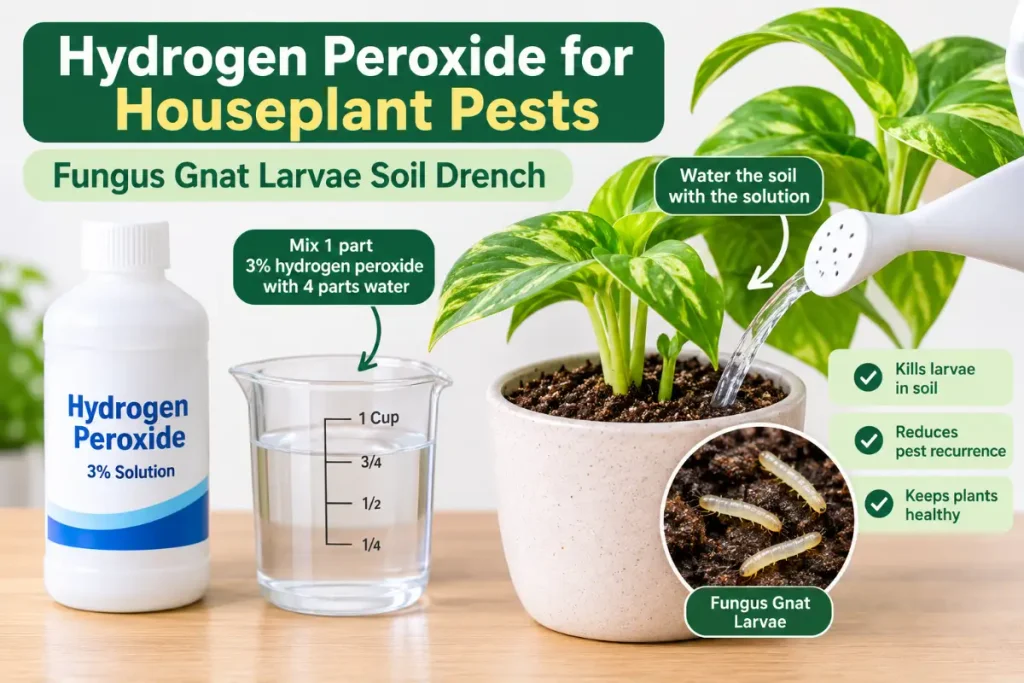
Fungus gnat larvae live in the top 2–3 inches of potting mix and are the most common soil-dwelling pest treated with hydrogen peroxide in houseplants. The 1:4 dilution kills larvae on contact without harming plant roots at reasonable application volumes.
What you need:
- 3% hydrogen peroxide (standard drugstore variety)
- Water
- Watering can
How to mix: Add 1 cup of 3% hydrogen peroxide to 4 cups of water (or scale proportionally — 1 part hydrogen peroxide to 4 parts water). Mix gently and use immediately — the solution degrades quickly once diluted, particularly in light.
Application:
- Allow the potting mix to dry out as much as the plant tolerates before applying — dry conditions are already hostile to fungus gnat larvae, and the hydrogen peroxide application is more effective in moderately dry than saturated mix
- Water the plant normally with the hydrogen peroxide solution, applying until it drains from the drainage holes — this ensures the solution reaches through the top 2–3 inches of potting mix where larvae are concentrated
- The fizzing and bubbling you see as the solution contacts the potting mix is normal and indicates the peroxide is active
- Allow the potting mix to dry thoroughly between applications
Frequency: Once per week for 2–3 weeks. Do not apply more frequently — repeated applications in quick succession can begin to affect the potting mix microbiome and stressed root tissue, particularly at higher concentrations.
What to expect: The hydrogen peroxide drench kills larvae in the treated zone on contact. Because it has no residual activity and breaks down within 24–48 hours, it does not prevent new eggs from hatching — combine with yellow sticky traps to catch adult gnats and reduce egg laying simultaneously.
Application 2: Root Rot Treatment
Root rot — caused primarily by Pythium, Phytophthora, and Fusarium species in overwatered houseplant potting mix — is one of the most common causes of houseplant death. Hydrogen peroxide can rescue plants with early to moderate root rot by eliminating the pathogens in the soil and on affected root tissue.
Signs of root rot:
- Wilting despite adequate (or excessive) soil moisture
- Yellowing leaves, particularly lower leaves, with no nutrient deficiency pattern
- Brown, mushy, or foul-smelling roots when the plant is unpotted
- Potting mix that stays wet significantly longer than expected
- Black or brown discoloration at the stem base at soil level
Treatment protocol:
- Unpot the plant — remove all old potting mix from the roots; rinse roots under lukewarm water
- Remove affected roots — trim away all brown, mushy, or foul-smelling roots with clean scissors sterilized with isopropyl alcohol; healthy roots are white or light tan and firm
- Hydrogen peroxide root soak — place the trimmed roots in a diluted hydrogen peroxide solution (1:1 with water from 3% stock — 1.5% final concentration) for 10–15 minutes; this kills surface pathogens on the root tissue; rinse with clean water after soaking
- Allow roots to air-dry — lay the plant on a clean paper towel for 1–2 hours; allow roots to dry partially before repotting
- Repot in fresh, dry potting mix — use a well-draining mix with added perlite (20–30%); do not reuse the old potting mix
- Post-repotting drench — water the first time after repotting with a 1:4 hydrogen peroxide solution to treat any remaining pathogens in the new mix and around the recovering roots
- Follow-up drenches — apply a 1:4 hydrogen peroxide solution once weekly for 2–3 weeks to prevent pathogen reestablishment
Important: Hydrogen peroxide does not regenerate dead roots — it eliminates the pathogens causing ongoing root death. The plant must have sufficient healthy root tissue remaining to recover. Plants that have lost more than 70–80% of their root system to rot often cannot recover even with effective pathogen treatment.
Application 3: Thrips Pupae and Other Soil-Stage Pests
Several houseplant pests spend part of their life cycle in the potting mix — thrips pupate in the soil before emerging as adults, and some mite species shelter in the upper soil layer. A hydrogen peroxide soil drench addresses these soil-stage pests as a component of integrated treatment programs.
For thrips pupae:
- Apply the standard 1:4 drench (1 part 3% H₂O₂ to 4 parts water) once per week during the thrips treatment period
- Combine with foliar spinosad or neem oil applied on the same day to address adults and nymphs on the plant simultaneously
- Alternate hydrogen peroxide drenches with neem oil drenches (not on the same day — apply one, allow to drain, apply the other on a separate watering)
For root mealybugs: Hydrogen peroxide at 1:4 dilution is effective against root mealybugs when applied as a soil drench. For severe root mealybug infestations, combine the hydrogen peroxide drench with a neem oil soil drench (applied on separate days) and an isopropyl alcohol root dip after unpotting.
What Hydrogen Peroxide Cannot Do
Understanding limitations prevents over-reliance on a tool that is effective within a specific range of problems.
It does not kill fungus gnat eggs. Fungus gnat eggs are protected in the potting mix and are not reliably reached by a single drench application. The hydrogen peroxide kills larvae but eggs hatch in 3–6 days, producing a new larval generation. Weekly application for 2–3 weeks is needed to address successive larval hatches.
It has no residual activity. Hydrogen peroxide breaks down into water and oxygen within 24–48 hours. After that window, it provides no ongoing protection. Any new eggs laid or pests introduced after the hydrogen peroxide degrades encounter untreated potting mix. This is why it must be combined with methods that address adults (sticky traps) and ongoing larval cycles (Bti drenches, which have longer persistence).
It does not kill adult fungus gnats. Adult fungus gnats are on the plant and in the air, not in the soil. Hydrogen peroxide drenches do not affect them. Yellow sticky traps, neem oil spray, and reduced watering address the adult population.
It is not effective against foliar pests. Hydrogen peroxide is a soil-treatment tool. It is not effective against spider mites, aphids, scale, mealybugs on aerial parts, or other foliar insects. At foliar spray concentrations (0.3%), it has limited surface pathogen suppression but no meaningful effect on mobile insects.
Repeated heavy applications can harm beneficial microbes. The potting mix microbiome — including mycorrhizal fungi and beneficial bacteria that support root health — is affected by hydrogen peroxide at the same concentrations that kill pathogens. Weekly applications for 2–3 weeks are appropriate; applying twice-weekly or at higher concentrations for extended periods diminishes beneficial organisms in the root zone. After completing a treatment cycle, allow 2–4 weeks before beginning another.
Safety: Is Hydrogen Peroxide Safe for Plants and People?
For plants: At the 1:4 dilution from 3% stock (approximately 0.6% final concentration), hydrogen peroxide is safe for the roots of the vast majority of houseplants. Some particularly sensitive plants — orchid roots, carnivorous plants, and some aquatic or semi-aquatic species — may be more sensitive; test on a small section or use at further dilution (1:8 or 1:9) for these.
For people: Standard 3% hydrogen peroxide is the same concentration used as a wound antiseptic and is safe for skin contact. It may cause minor skin bleaching at extended contact. Eye contact should be avoided — rinse immediately with water if it occurs. The 29–35% food-grade concentrations used by some alternative health practitioners are genuinely hazardous and should never be used on houseplants.
For pets: Standard 3% hydrogen peroxide is not acutely toxic to pets at the soil drench concentrations used for plants, and the rapid degradation means residue on plant leaves or in drainage water is minimal. The solution breaks down within hours; there is no accumulation risk.
Houseplants That Respond Best to Hydrogen Peroxide Treatment
Not all plants are equally good candidates for hydrogen peroxide soil drenches. Knowing which plants tolerate it well — and which need a lighter hand — helps you apply hydrogen peroxide for houseplant pests confidently across your collection.
Plants that respond well:
- Pothos, philodendrons, and other aroids — robust root systems tolerate the 1:4 dilution with no adverse effects; these are also among the most fungus gnat-prone plants, making hydrogen peroxide particularly useful here
- Monsteras — large root systems handle the drench well; root rot is a common problem with overwatered monsteras and hydrogen peroxide is an effective first intervention
- Peace lilies — frequently overwatered and prone to both fungus gnats and root rot; respond well to the full treatment protocol including root soaking for root rot rescue
- Tropical foliage plants (ficus, schefflera, rubber plants) — tolerate the standard dilution; benefit from hydrogen peroxide as part of fungus gnat management programs
Plants requiring a lighter dilution (1:8 instead of 1:4):
- Orchids — the velamen (the silvery outer layer of orchid aerial roots) is sensitive to oxidative treatments; use a more dilute solution and limit to 1–2 applications
- Carnivorous plants — extremely sensitive to any additives in water; hydrogen peroxide is generally not recommended for sundews, Venus flytraps, or pitcher plants
- Seedlings — the delicate root systems of seedlings tolerate the standard concentration but benefit from using the lower end of the dilution range (1:8) to avoid root stress during early establishment
Plants where hydrogen peroxide is most valuable: Any plant in a consistently overwatered potting mix that shows signs of fungus gnats or early root rot is a good candidate for the 1:4 hydrogen peroxide drench. The combination of immediate larval kill, pathogen suppression, and root zone oxygenation addresses multiple overwatering-related problems simultaneously.
Combining Hydrogen Peroxide with Other Pest Treatments
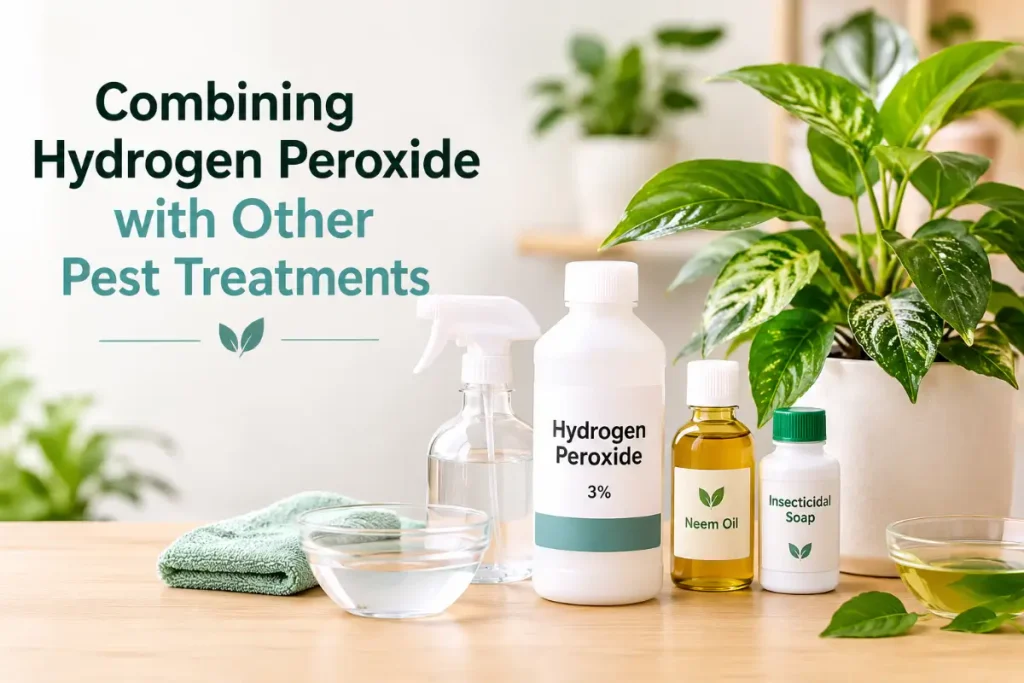
Hydrogen peroxide integrates well with other natural pest management tools. Here is how to combine it effectively:
Hydrogen peroxide + Bti (Mosquito Bits): These two treatments address fungus gnat larvae through different mechanisms — hydrogen peroxide through direct oxidative kill, Bti through its biological larvicidal proteins. Alternate them: apply hydrogen peroxide drench one week, Bti drench the following week. This prevents any resistance development and ensures consistent larval control across the treatment period.
Hydrogen peroxide + neem oil soil drench: Apply hydrogen peroxide drench first; allow potting mix to dry to the appropriate level; apply neem oil drench on the following watering. These address different aspects of the fungus gnat problem — hydrogen peroxide kills existing larvae; neem oil’s azadirachtin disrupts the development of subsequent generations.
Hydrogen peroxide + cinnamon: Apply cinnamon to the soil surface after a hydrogen peroxide drench has dried. Cinnamon suppresses the fungal food source that larvae feed on; hydrogen peroxide kills existing larvae; together they address food source and direct kill simultaneously.
Hydrogen peroxide + yellow sticky traps: Always combine soil drenches with sticky traps to monitor and reduce the adult gnat population. Adults lay eggs continuously — without trapping adults, the egg-laying continues even as larvae are killed in the soil.
Conclusion
Hydrogen peroxide for houseplant pests is most effective as a soil treatment targeting fungus gnat larvae, root rot pathogens, and soil-stage pests including thrips pupae. The standard drugstore 3% concentration, diluted 1:4 with water and applied as a weekly soil drench for 2–3 weeks, is safe for plant roots and kills soft-bodied soil pests on contact. Its rapid degradation means it is most useful as one component of an integrated management program that also addresses adult gnats (sticky traps), egg cycles (Bti), and the moisture conditions that allow fungus gnats to thrive (reduced watering). For root rot specifically, it is one of the most effective and affordable rescue treatments available.
For research-based guidance on integrated pest management for indoor plants, Clemson Cooperative Extension’s Home & Garden Information Center guide to fungus gnats and soil pests on houseplants covers identification, the biology of common soil-dwelling pests, and evidence-based management approaches for US home growers.
FAQs
How much hydrogen peroxide do I use on houseplants for fungus gnats?
Mix 1 part standard 3% hydrogen peroxide (drugstore variety) with 4 parts water. Water the plant with this solution until it drains from the drainage holes. Apply once per week for 2–3 weeks. This 1:4 dilution is effective against fungus gnat larvae and safe for plant roots at the weekly frequency used for infestation treatment.
Can I spray hydrogen peroxide on plant leaves?
Hydrogen peroxide can be used as a dilute foliar spray (1 part 3% H₂O₂ to 9 parts water) for surface pathogen suppression — particularly for powdery mildew and other fungal issues. It is not effective against mobile foliar insects like spider mites, aphids, or scale. At this dilution, it is safe for most houseplant foliage. Avoid applying in direct sun, which can cause leaf scorch when combined with the slight oxidative effect on the leaf cuticle.
How often can I use hydrogen peroxide on plants?
Weekly applications for 2–3 weeks is the recommended treatment cycle. Avoid applying more than twice weekly or for more than 4 consecutive weeks without a break — repeated applications at high frequency reduce the beneficial microbe population in potting mix. After completing a 2–3 week treatment cycle, pause for at least 2–4 weeks before beginning another.
Does hydrogen peroxide kill beneficial fungi in plant soil?
Yes — hydrogen peroxide does not distinguish between pathogenic and beneficial organisms. At the 1:4 dilution applied weekly, the effect on beneficial mycorrhizal fungi is moderate and the microbiome typically recovers within a few weeks. For plants in potting mixes specifically inoculated with mycorrhizal products, consider limiting hydrogen peroxide use to the most acute pest situations and prioritizing Bti as the primary larval control method.
Is 3% hydrogen peroxide safe for all houseplants?
At 1:4 dilution, standard 3% hydrogen peroxide is safe for the roots of the vast majority of common houseplants. Plants that are particularly sensitive — orchids, carnivorous plants, some ferns — may respond better to a higher dilution (1:8 or 1:9). Do not use undiluted 3% hydrogen peroxide as a routine soil drench; reserve the higher concentration for root rot treatment after unpotting and root trimming.
Pingback: Yellow Sticky Traps for Houseplants: A Pest-Free Guide (2026) - Plant Quill