
Round leaves change the feeling of a room in a way that pointed or strap-like foliage does not. Where spiky plants like snake plants and dracaenas read as architectural and structured, an indoor plant with round leaves reads as softer, friendlier, and more relaxed — a quality that makes round-leaved species particularly effective in living rooms and bedrooms where comfort matters as much as drama.
This guide covers twelve species with genuinely circular or disc-like foliage, from the iconic Chinese money plant to the dramatically large rounded leaves of the elephant ear, with care requirements and display notes for each.
1. Chinese Money Plant (Pilea peperomioides)
No indoor plant with round leaves is more recognizable than the Chinese money plant — its perfectly circular, coin-shaped leaves on long individual stems give it an immediately distinctive appearance that photographs well and holds strong appeal across every interior style. Each leaf is attached to its stem at the center of the leaf’s underside (peltate attachment), rather than at the edge, which adds to its unusual, parasol-like silhouette.
Light: Bright indirect light. Rotate the plant a quarter-turn weekly — pilea grows asymmetrically toward the light source and will lean significantly if not rotated.
Water: Allow the top inch of potting mix to dry between waterings. Overwatering is the most common cause of failure — the stems yellow and become soft before the leaves show symptoms.
Propagation: Produces “pups” — small offsets that emerge from the base of the stem and from the soil around the parent plant. These can be separated and potted individually once they have a few leaves.
Size: Typically 8–12 inches as a houseplant; older specimens in good conditions may reach 18–24 inches.
2. Coin-Leaf Peperomia (Peperomia polybotrya and P. obtusifolia)
Peperomia polybotrya (raindrop peperomia) produces teardrop-shaped to almost perfectly round thick, glossy leaves on compact stems. Peperomia obtusifolia (baby rubber plant) similarly has broadly oval to nearly round glossy leaves. Both are compact, slow-growing, and extremely tolerant of indoor conditions.
Light: Moderate to bright indirect light. Tolerates lower light better than most round-leaved species.
Water: Allow the potting mix to dry out significantly between waterings — peperomia stores water in its thick leaves and is highly susceptible to root rot if overwatered.
Size: Compact — typically 8–12 inches. Well suited to desks, shelves, and smaller spaces.
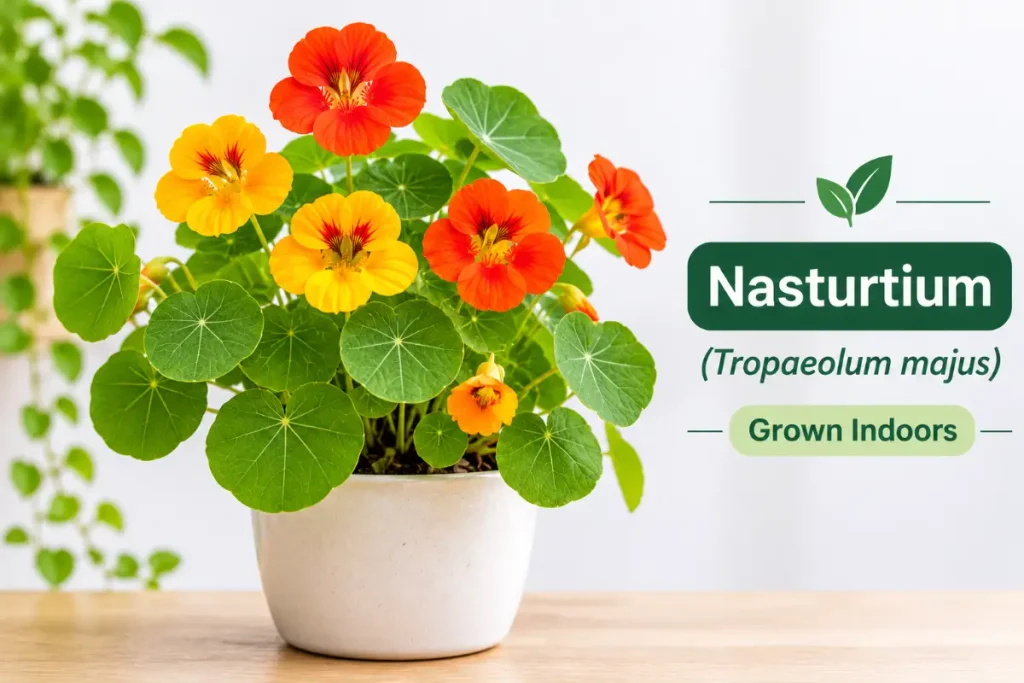
3. Nasturtium (Tropaeolum majus — Grown Indoors)
Nasturtiums have perfectly round, lily-pad-like leaves with the stem attached at the center (peltate) — the same unusual attachment as pilea. When grown near a bright indoor window or under grow lights, they also produce cheerful flowers in orange, yellow, and red. The leaves themselves are attractive even without flowers.
Light: Full sun or very bright indirect light — more light-demanding than most houseplants.
Water: Keep evenly moist; nasturtiums wilt quickly when dry.
Use: Best treated as a short-term bright-window plant — grow from seed in early spring, enjoy through summer, compost and restart. The edible leaves and flowers add value beyond pure display.
4. Elephant Ear (Alocasia and Colocasia species)
Several alocasia species produce dramatically large, rounded or heart-shaped leaves — Alocasia ‘Regal Shields,’ Alocasia macrorrhiza, and related species have leaves that can reach 2–3 feet across in good conditions. The overall effect is tropical and bold; a single well-grown alocasia makes an immediate visual statement.
Light: Bright indirect light; avoid direct sun which burns the large leaf surface.
Water: Keep evenly moist — alocasias do not tolerate drying out. The large leaf surface area increases water demand significantly.
Humidity: Requires moderate to high humidity (50%+). Dry air causes leaf edge browning.
Note: Alocasias go through periods of dropping older leaves while pushing new ones — losing a leaf is not necessarily a sign of a problem.
5. Round-Leaved Calathea (Calathea orbifolia)
Calathea orbifolia is considered one of the most beautiful of all calathea species — it produces large, almost perfectly round leaves in silver-green with pale green banding, reaching 8–12 inches across in mature plants. The color and pattern are subtle compared to more intensely marked calathea varieties, which gives it a sophisticated, understated quality.
Light: Low to moderate indirect light — one of the more tolerant calatheas for lower-light positions.
Water: Keep evenly moist with filtered or overnight-standing water. Tap water fluoride causes leaf tip browning.
Humidity: Moderate to high humidity preferred (50%+).
Why it stands out: The combination of large, round leaves with the silver-green banding makes this one of the most elegant of all foliage houseplants — nothing else quite replicates the look.
6. Lotus Berthelotii / Round-Leaved Pelargonium Varieties
Certain scented pelargonium (geranium) varieties produce nearly round, ruffled leaves with a soft, velvety texture — particularly the ‘Peppermint’ and ‘Attar of Roses’ cultivars. The leaves are the primary attraction rather than the flowers; the soft roundness of the foliage combined with the strong fragrance when touched makes them engaging houseplants for windowsills.
Light: Full sun to bright indirect light.
Water: Allow to dry between waterings — pelargoniums are drought-tolerant and prefer underwatering to overwatering.
7. String of Coins (Peperomia ‘Pepperspot’ / Dischidia nummularia)
Dischidia nummularia produces small, thick, coin-shaped leaves — roughly the size of a dime — on trailing stems. The overall effect is a cascade of miniature round leaves, making it an excellent hanging basket plant for a bright indoor position. It is epiphytic (naturally grows on trees) and prefers excellent drainage and air to the roots.
Light: Bright indirect light.
Water: Allow to dry significantly between waterings; dischidia is very susceptible to overwatering. A bark-based mix rather than standard potting mix works best.
8. Lily Pad Plant (Farfugium japonicum)
Farfugium japonicum (leopard plant) produces large, perfectly round, glossy dark green leaves — some cultivars with yellow spotting (the ‘Aureomaculatum’ form). It is a substantial plant with leaves reaching 8–12 inches across and a bold, architectural presence unusual among round-leaved houseplants.
Light: Low to moderate indirect light — one of the most shade-tolerant round-leaved plants and an excellent choice for north-facing rooms.
Water: Keep evenly moist; does not tolerate drying out.
Temperature: Prefers cooler conditions than most tropical houseplants — ideal for cool rooms and entryways.
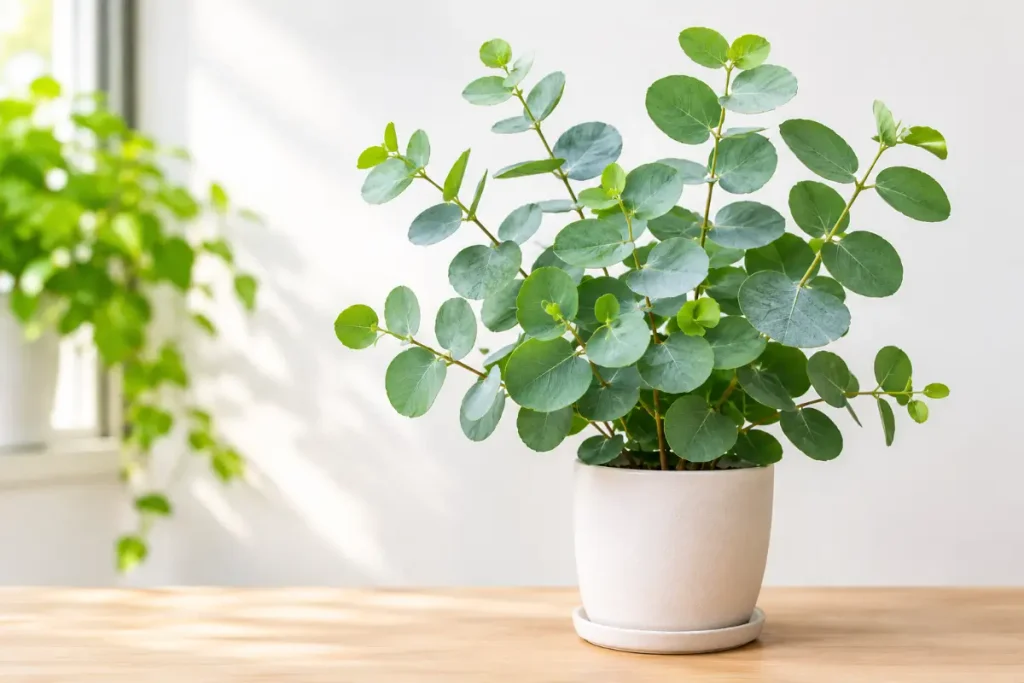
9. Round-Leaved Eucalyptus (Eucalyptus gunnii — Indoor Use)
Young eucalyptus plants — particularly Eucalyptus gunnii (cider gum) — produce perfectly round, silver-green leaves that are highly attractive and have a strong, clean eucalyptus fragrance. As a potted indoor plant, keep the growth pruned regularly to maintain the juvenile round-leaved form; mature eucalyptus develops elongated adult leaves.
Light: Full sun to very bright indirect light — eucalyptus is one of the most light-demanding of all the round-leaved options.
Water: Allow to dry between waterings; does not tolerate waterlogged roots.
Use: Also excellent as cut stems in vases — the round leaves dry attractively and the scent persists.
10. Baby Toes / Living Stones (Fenestraria rhopalophylla and Lithops)
Living stones are compact succulents with nearly circular, slightly flattened leaf surfaces — each “leaf” is a pair of fused succulent leaves, and the overall plant resembles small pebbles or toes. The circular, disc-like upper surface of each leaf is their most distinctive feature.
Light: Full sun to very bright light — these are desert plants that require maximum indoor light.
Water: Very infrequent — water only when leaves begin to wrinkle, typically once a month or less. Overwatering is almost always fatal.
Best position: A south-facing windowsill in direct sun.
11. Victoria Amazonica (Giant Water Lily — Miniature Indoor Varieties)
The giant water lily is not a practical houseplant, but smaller Victoria and Nuphar species can be grown in indoor water gardens (large containers or aquariums) and produce the characteristic round, pad-like floating leaves on a smaller scale. More practically, Nymphaea (hardy water lily) miniature varieties can be grown in a large indoor bowl garden.
Container: At minimum a 12-inch diameter container of water.
Light: Full sun through a south-facing window.
12. Tropaeolum Speciosum / Round-Leaved Fittonia
Fittonia (nerve plant) produces small, oval-to-round leaves with a prominent network of white, pink, or red veins — the round form of the leaf combined with the intricate vein pattern makes it one of the most ornamental small-leaved houseplants available.
Light: Low to moderate indirect light — one of the few round-leaved plants that genuinely thrives in low light.
Water: Keep consistently moist; fittonia wilts dramatically when dry (it dramatically drops flat) but usually recovers quickly after watering.
Humidity: Requires high humidity — a terrarium is the ideal environment.
Displaying Round-Leaved Plants: Design Notes
Round leaves soften a room in a specific way — they counterbalance the hard, angular lines of furniture, shelving, and architecture. A few display approaches make the most of this quality:
Against angular furniture: A Chinese money plant or calathea orbifolia placed on a sharp-cornered desk, shelf edge, or beside a rectangular frame creates an immediate visual contrast that makes both the plant and the furniture more interesting. The round form of the leaves echoes and softens the geometry of the room.
Grouped by leaf size: A display of round-leaved plants at different scales — small peperomia coins at the front, mid-sized pilea in the center, and large calathea orbifolia or alocasia at the rear — creates a cohesive collection based on a single leaf shape at increasing drama. The visual rhythm of repeated rounds at different scales is more satisfying than a random mix of leaf shapes.
Elevated trailing: String of coins (Dischidia nummularia) or a trailing peperomia allowed to cascade from a shelf or stand displays the round leaf pattern most effectively — the individual round leaves read like dots or coins strung together, an effect that is only visible when the stems trail freely.
Pot selection: Round pots echo the leaf shape and reinforce the visual theme — choosing a round container for an indoor plant with round leaves creates a unified, harmonious display. Square or geometric pots create a contrast that can be equally effective — the tension between container geometry and organic leaf shape draws attention to both. Terracotta, matte ceramic, and concrete all work well with most round-leaved species.
Seasonal Care for Round-Leaved Houseplants
Spring: Growth resumes for all species. Resume fertilizing with balanced liquid fertilizer at half strength every 3–4 weeks. Check pilea for new pups emerging at the base — early spring is the best time to separate and pot them while growth is active.
Summer: The most active period for Chinese money plant, alocasia, and peperomia. Water more frequently as temperatures rise. Alocasia in particular may push large new leaves in midsummer — ensure humidity remains adequate to support full leaf development.
Fall: Begin reducing fertilizer from late September. Alocasia may drop a leaf or two as growth slows — this is normal seasonal adjustment. Calathea orbifolia may produce slightly smaller new leaves in lower fall light; a grow light on a 12-hour timer maintains growth quality through winter.
Winter: Reduce watering for all round-leaved species. The primary winter challenges are lower light (which causes legginess in pilea and smaller leaves in calathea) and dry heating air (which causes leaf edge browning in calathea and alocasia). Addressing humidity with a pebble tray or humidifier significantly improves winter performance for moisture-loving species.
Propagating Round-Leaved Houseplants
Chinese money plant (Pilea peperomioides): Separating pups is the standard propagation method. Wait until the offset has at least 2–3 leaves before separating. Use a clean knife to sever the connecting stem below soil level, pot the offset in moist potting mix, and keep in a bright, warm position. Roots establish within 2–4 weeks.
Peperomia (round-leaved varieties): Leaf cuttings work reliably — remove a healthy leaf with its petiole (the stalk), insert the petiole into moist potting mix at a 45-degree angle, and keep in bright indirect light with a clear plastic bag loosely over the cutting to retain humidity. New plantlets emerge from the base of the petiole over 4–8 weeks.
Calathea orbifolia: Division when repotting — separate the clump carefully, ensuring each division has several healthy leaves and a healthy root section. Calathea divisions can look stressed for several weeks before establishing.
Alocasia: Produces offset corms (small bulbs) around the base of the main plant. These can be separated, potted individually in moist mix, and kept warm and humid until new growth appears. Alternatively, when repotting, the main stem can be divided at the rhizome.
Nasturtium: Grows from seed directly — sow seeds 1 inch deep in potting mix in early spring for indoor growing. Germination occurs within 7–14 days at room temperature. Nasturtiums grow fast and are among the quickest plants to go from seed to display.
Potting Mix and Fertilizer for Round-Leaved Plants
Different round-leaved species have significantly different potting mix requirements:
Chinese money plant: Well-draining standard indoor potting mix with 20–25% perlite. Pilea roots need air — dense, compacting mixes cause root problems quickly. Repot in spring when roots emerge from drainage holes.
Peperomia: Fast-draining mix — standard indoor mix with 30–40% perlite, or an African violet mix which drains well while retaining some moisture. Peperomia is very susceptible to root rot in dense mixes.
Calathea orbifolia: Moisture-retaining but well-aerated mix — standard indoor mix with coco coir to retain moisture and perlite for drainage. Repot every 2 years; orbifolia does not need to be very pot-bound before repotting.
Alocasia: A chunky, well-draining mix — standard indoor mix with added orchid bark and perlite. Alocasia roots need oxygen as much as moisture; compacted mixes cause root rot rapidly.
Dischidia (string of coins): Orchid bark or a very open, epiphytic mix — standard potting mix is too dense and moisture-retaining for dischidia, which grows on tree bark in nature and needs roots to dry rapidly between waterings.
Fertilizer: Balanced liquid fertilizer (10-10-10 or 20-20-20) at half strength, every 3–4 weeks during the growing season (March–September), suits all the standard foliage species in this list. Exceptions: calathea prefers quarter strength to avoid fertilizer salt buildup; succulents (living stones, baby toes) need only a very light cactus fertilizer once or twice per growing season.
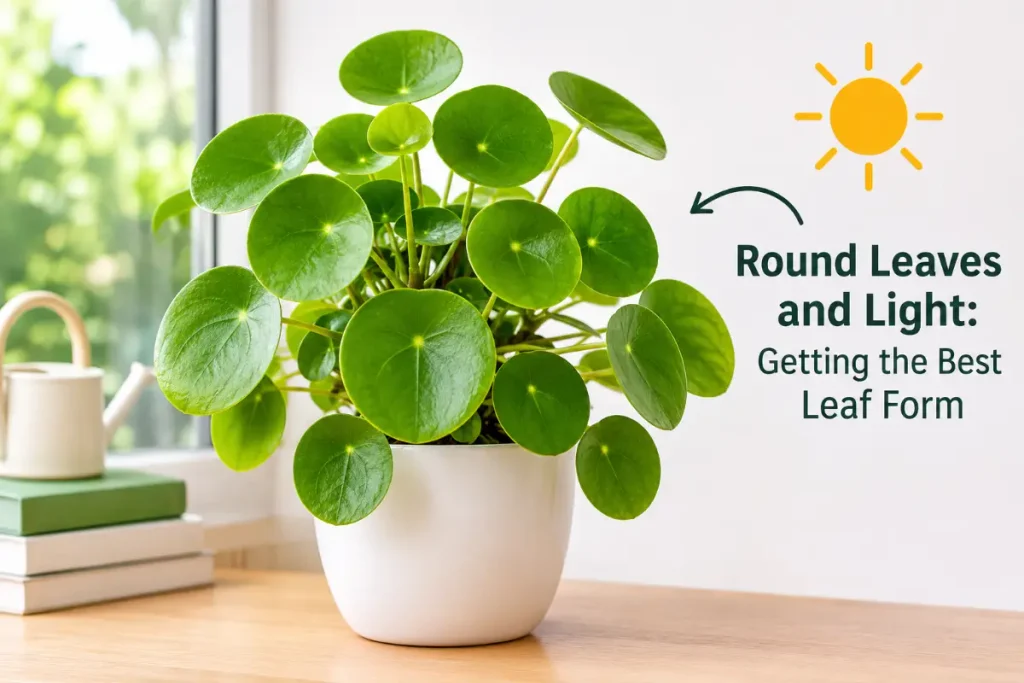
Round Leaves and Light: Getting the Best Leaf Form
The shape and size of new leaves on round-leaved houseplants is directly influenced by the light they receive during leaf development. Understanding this connection helps diagnose problems and improve leaf quality:
Chinese money plant in low light: New leaves emerge on longer, thinner petioles and may be slightly less circular — the plant is reaching toward the light source. Solution: move closer to a bright window and rotate weekly.
Calathea orbifolia in low light: New leaves emerge smaller than mature leaves and with a less pronounced banding pattern. The silver-green coloring also becomes more uniformly green in lower light. Moving to a brighter position (still indirect) improves the size and pattern of subsequent leaves.
Peperomia in bright direct sun: The thick leaves can show a reddish or bronze tinge from UV exposure, and in intense direct sun, leaves may develop pale or bleached patches. A position in very bright indirect light rather than direct sun maintains the best glossy green appearance.
Alocasia in insufficient light: New leaves emerge smaller and on longer, weaker petioles, unable to hold the leaf upright. Move to the brightest available indirect light position and ensure the large leaves are not blocked by other plants from above.
General rule for round-leaved plants: Leaves develop their full size and form only when the plant has adequate light during the period of leaf expansion. A leaf that emerges in dim conditions will be smaller and less perfectly formed than one that develops in bright indirect light — and unlike some growth characteristics, leaf size and shape are set at emergence and do not improve afterward. Improving light conditions benefits the next leaf that emerges, not the current one.
This principle means that round-leaved plants moved from a dim to a bright position show improvement gradually — one leaf at a time — rather than all at once. Patience through three to four new leaf cycles reveals the full effect of an improved growing position.
Conclusion
The right indoor plant with round leaves depends on the scale you want — from the coin-sized leaves of dischidia to the dinner-plate rounds of calathea orbifolia and elephant ear. For beginners, Chinese money plant and round-leaved peperomia are effortless and widely available. For impact in a larger space, calathea orbifolia or alocasia deliver scale and beauty that few other foliage plants match. For a north-facing room, farfugium and fittonia offer genuine low-light performance with distinctive round foliage.
For detailed cultural guidance on tropical foliage houseplants, the University of Florida IFAS Extension foliage plant series covers care requirements for many of the species in this guide.
FAQs
What is the most popular indoor plant with round leaves?
Pilea peperomioides (Chinese money plant) is currently the most sought-after round-leaved houseplant in the US — its perfectly circular leaves on individual peltate stems give it an appearance unlike anything else. It is now widely available at garden centers after years of being a rare plant traded only between growers.
Why are round leaves less common in houseplants than pointed ones?
Most popular houseplants originate in tropical forest understories where elongated, strap-like leaves are common adaptations. Truly circular leaves tend to appear in aquatic, semi-aquatic, or high-light environments — hence water lilies, nasturtiums, and eucalyptus all have round leaves while forest-floor plants typically do not.
Can I grow Chinese money plant in low light?
Pilea peperomioides does best in bright indirect light and will decline in genuinely low-light conditions — the stems become very leggy and the leaves grow smaller and on longer petioles as the plant stretches toward the light source. It tolerates moderate light but is not a true low-light plant.
What round-leaved plant grows best in low light?
Calathea orbifolia and farfugium japonicum are the best round-leaved options for low to moderate light. Fittonia (nerve plant) also has broadly round leaves and genuinely tolerates low light.
How do I keep pilea leaves perfectly round?
Pilea leaves grow rounder in good light and may become slightly more oval in lower light. Rotate the plant regularly for even light exposure, water consistently, and feed with balanced liquid fertilizer during the growing season. New leaves emerging in good conditions are naturally more circular than those produced in stress.