The majority of the houseplants sold in the UK originate from tropical regions — and understanding the different types of indoor tropical plants makes it considerably easier to care for them well. Plants from the same broad habitat group share similar needs: light levels, humidity requirements, watering patterns, and temperature tolerances cluster by plant family and origin in ways that make grouping and planning a collection far more intuitive than treating every species as an entirely individual puzzle.
This guide covers the main types of indoor tropical plants by category — aroids, bromeliads, palms, tropical ferns, orchids, gesneriads, tropical succulents, and tropical climbers — with the key species in each group, their shared care requirements, and which categories suit which indoor environments best.
Why Tropical Plants Dominate Indoor Growing
Tropical plants make up the majority of the indoor plant market for straightforward reasons: they are adapted to conditions that closely match those found in centrally heated homes.
Tropical regions close to the equator experience relatively consistent temperatures year-round (18–30°C), high humidity, and light levels that — while much higher than indoor conditions — come with the benefit that even the forest floor, shaded by a dense canopy, receives filtered, indirect light year-round. Indoor plants from these environments have evolved to manage lower light than their open-habitat relatives, making them more adaptable to the conditions a house or flat can provide.
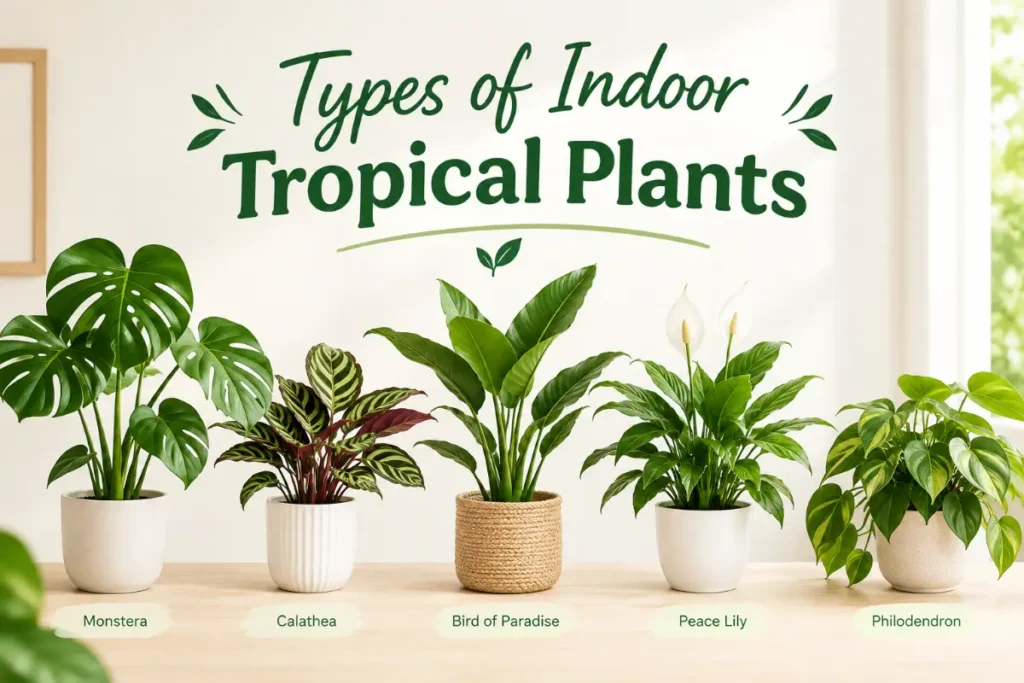
This is why the tropical forest floor is disproportionately well-represented in indoor plant collections — Monstera, Philodendron, Pothos, Calathea, Peace Lily, and similar plants are all adapted to filtered light conditions in their natural habitats. Understanding this helps calibrate expectations: these plants do not need full sun to survive, but they do need warmth, humidity, and consistent watering that most UK homes can provide with modest effort.
Category 1: Aroids (Araceae Family)
Aroids are the largest and most diverse category of types of indoor tropical plants — and the most popular. The Araceae family includes Monstera, Philodendron, Pothos, Peace Lily, Anthurium, Alocasia, Colocasia, Caladium, Dieffenbachia, Aglaonema, ZZ Plant, and many others. They are united by their distinctive inflorescence (a spadix surrounded by a spathe) but vary enormously in leaf size, form, and growing habit.
Shared care requirements: Most aroids prefer bright indirect light (though ZZ Plant and Aglaonema tolerate lower light), consistently moist but well-draining compost, and humidity above 50%. Overwatering is the most common aroid problem — aroid roots in waterlogged compost develop root rot relatively quickly.
Key species and their niches:
Monstera deliciosa and Thai Constellation: Large-leaved climbers suited to living rooms with bright indirect light. Among the most architectural of indoor tropical plants. Require moss pole support for mature growth and best leaf development.
Pothos (Epipremnum aureum): One of the most forgiving of all types of indoor tropical plants — genuinely tolerates low light, irregular watering, and temperature variation. Available in green, golden, neon, marble queen, and N-Joy variegations. Excellent for hanging positions or training along shelves.
Philodendron: A huge genus ranging from compact heartleaf types (Philodendron hederaceum) to the large, deeply lobed Philodendron bipinnatifidum. Most prefer bright indirect light and moderate humidity. The velvet-leafed types (Philodendron gloriosum, micans) are particularly popular for their tactile leaf surfaces.
Peace Lily (Spathiphyllum): One of very few tropical plants that flowers reliably in low-light indoor conditions. Droops dramatically when thirsty — useful as a self-indicating watering alarm. Toxic to pets.
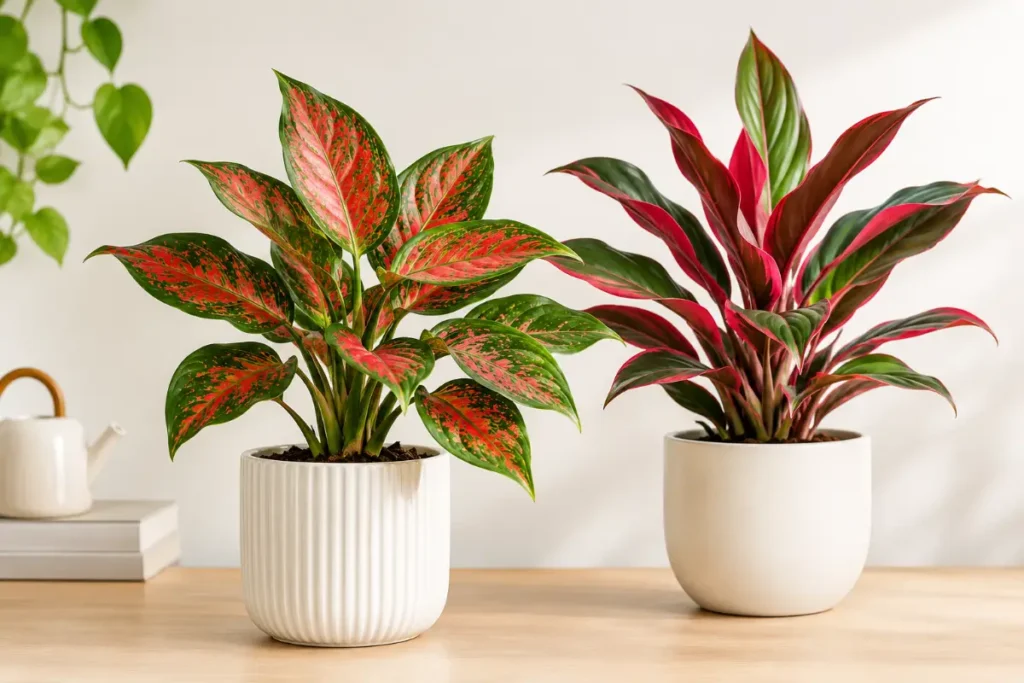
Aglaonema (Chinese Evergreen): Among the most tolerant of low light and inconsistent watering. Available in green, pink, red, and variegated forms. An excellent beginner plant or office plant.
ZZ Plant (Zamioculcas zamiifolia): Stores water in its rhizomes and tolerates drought and low light better than almost any other tropical. Glossy, deep green leaves. Extremely slow-growing. Near-indestructible.
Anthurium: Distinctive waxy spathes (typically red, pink, or white) that are long-lasting and produced reliably with adequate light. Compact size suits windowsill or shelf positions. Prefers humidity above 60%.
Category 2: Bromeliads
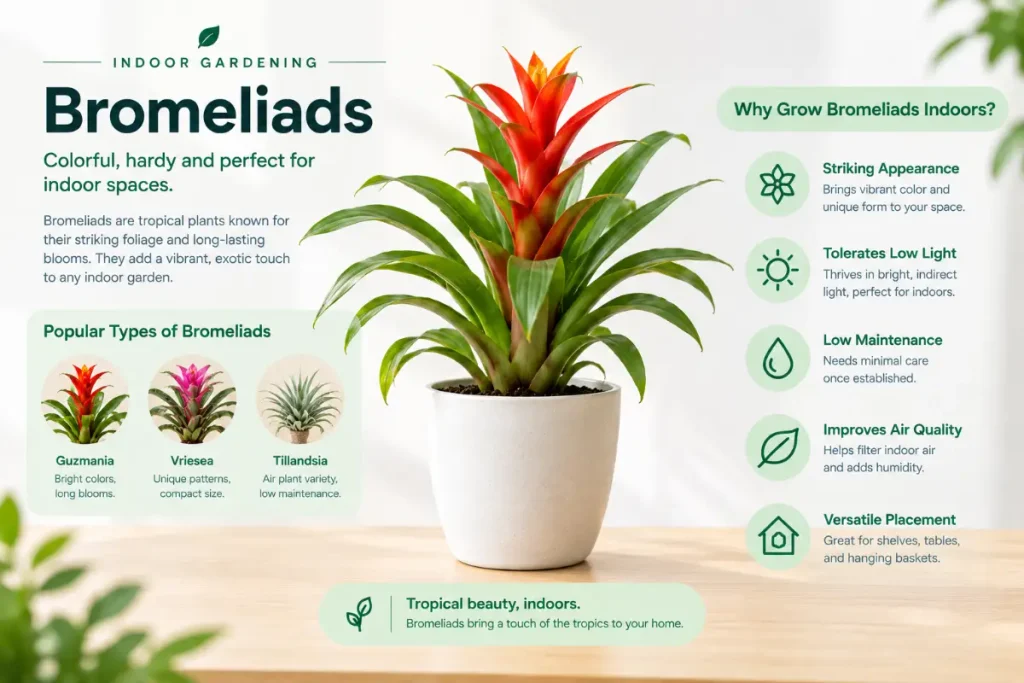
Bromeliads are a family (Bromeliaceae) of plants native primarily to the Americas — from the tropical rainforests of Brazil to the deserts of the American southwest. They are one of the most distinctive types of indoor tropical plants, characterised by their rosette-forming growth habit, often brightly coloured foliage, and dramatic flower spikes.
Key genera for indoor growing:
Guzmania: The classic supermarket bromeliad — dramatic flower spikes in red, orange, and yellow emerging from a central cup of water (the tank). After flowering, the main rosette dies but produces offsets (pups) that can be separated and grown on. Water into the central tank rather than the compost.
Aechmea: More robust than Guzmania, with striking silvery or patterned foliage and long-lasting pink flower bracts. Aechmea fasciata is the most widely grown — its pink bracts last for months.
Tillandsia (air plants): Epiphytic bromeliads that require no compost at all — they absorb moisture and nutrients through specialised trichomes on their leaves. Mount on wood, cork, or shells and mist 2–3 times per week (or soak in water for 20 minutes weekly). High humidity and good air circulation are essential.
Cryptanthus (earth stars): Low-growing, ground-dwelling bromeliads with dramatically patterned leaves in green, pink, bronze, and variegated forms. Unlike most bromeliads, they prefer to be grown in compost rather than as epiphytes.
Shared care: Most tank bromeliads need the central cup kept filled with water (rainwater preferred — tap water leaves calcium deposits in the cup). Compost should be barely moist — bromeliads have small root systems used primarily for anchoring rather than nutrient uptake.
Category 3: Tropical Palms
Palms are among the most recognisable types of indoor tropical plants and bring an immediately tropical character to an interior. Most indoor palms originate from tropical and subtropical regions and require warm conditions, consistent watering, and good light to perform well.
Key species:
Kentia Palm (Howea forsteriana): The most tolerant of indoor palms — adapts to lower light levels than most, is relatively slow-growing (an asset in terms of maintaining manageable size), and is long-lived in good indoor conditions. The classic choice for large interior spaces.
Parlour Palm (Chamaedorea elegans): Compact size makes it suitable for smaller rooms and lower shelves. Tolerates low light reasonably well. Among the most affordable and widely available indoor palms.
Areca Palm (Dypsis lutescens): Fast-growing with a more feathery appearance than Kentia. Requires brighter light than Kentia or Parlour Palm and higher humidity. Excellent for large, bright spaces.
Majesty Palm (Ravenea rivularis): Bold, architectural palm for large spaces. Requires consistent moisture and bright indirect light — less forgiving than Kentia if conditions are suboptimal.
Shared care: Most indoor palms dislike root disturbance — repot only when essential. Brown leaf tips are the most common problem, caused by low humidity, fluoride in tap water, or cold draughts. Do not cut off brown tips as this causes further dieback — trim just inside the brown edge with clean scissors.
Category 4: Tropical Ferns
Ferns are among the most ancient types of indoor tropical plants — they predate flowering plants by hundreds of millions of years. Tropical fern species have adapted to the humid, shaded forest floor environments that make them well suited to certain indoor positions.
Key species:
Boston Fern (Nephrolepis exaltata): The classic hanging fern — long, arching fronds suit hanging baskets or elevated shelf positions. Requires high humidity and consistent watering. Leaf drop is rapid in dry air.
Bird’s Nest Fern (Asplenium nidus): Broad, undivided fronds forming a rosette — very different in appearance from typical ferns. More tolerant of lower humidity and irregular watering than Boston Fern. The crinkled cultivar (‘Crispy Wave’) adds textural interest.
Maidenhair Fern (Adiantum): The most delicate of commonly grown indoor ferns — thin stems and finely divided fronds require very high humidity and consistent moisture. Not suitable for centrally heated rooms without active humidity management.
Tree Fern (Dicksonia antarctica): Technically a temperate rather than tropical species, but grown indoors as a large specimen plant. Requires a cool conservatory or porch rather than a warm living room.
Shared care: Tropical ferns need consistently moist compost (never waterlogged), high humidity (60%+), and filtered light. The majority of fern failures indoors are caused by low humidity — the fronds desiccate rapidly in heated rooms. Grouping ferns with other moisture-transpiring plants and using pebble trays or humidifiers significantly improves outcomes.
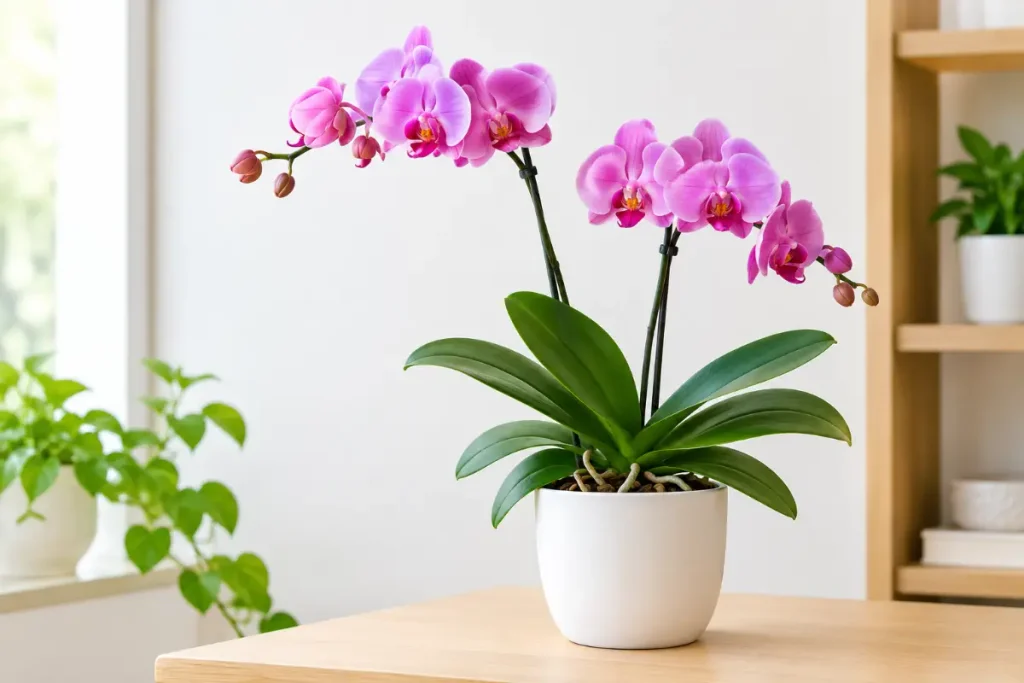
Category 5: Orchids
Orchids represent the largest flowering plant family, with over 25,000 species — and many of the most popular cultivated orchids are tropical in origin. The types available for indoor growing range from the ubiquitous Phalaenopsis to specialist collectors’ genera.
Key types:
Phalaenopsis (moth orchid): By far the most widely grown indoor orchid — long-lasting flower spikes in white, pink, purple, and yellow, produced on and off year-round with adequate light. Grown in bark-based compost in clear pots (roots are photosynthetic and need light). Water by soaking in room-temperature water for 20 minutes, then draining fully.
Cymbidium: Larger, more robust orchid with long-lasting flower spikes. Requires a cool period in autumn (outdoor positioning or cool conservatory, 10–15°C) to initiate flowering. Terrestrial — grows in compost rather than bark.
Dendrobium: Diverse genus with different care requirements by type (cool-growing vs warm-growing). Many produce clusters of flowers along the canes. Require good light and a distinct dry rest period to flower reliably.
Oncidium: Produces sprays of small, dancing flowers in yellow, brown, and red. Requires bright indirect light and good air circulation. More drought-tolerant than Phalaenopsis.
Shared care: Most indoor orchids require excellent drainage (bark-based compost or equivalent), bright indirect light, and careful watering — allowing the growing medium to approach dryness before watering again. Overwatering, poor drainage, and cold water are the primary causes of orchid failure indoors.
Category 6: Gesneriads
Gesneriads (family Gesneriaceae) include some of the most rewarding small-scale flowering types of indoor tropical plants, well suited to windowsill growing under artificial light.
Key species:
African Violet (Saintpaulia): The classic windowsill flowering plant — compact rosettes of velvety leaves and continuous flowers in purple, pink, white, and bicoloured forms. Prefers bottom watering (water on leaves causes spotting). Requires bright indirect light — south or east-facing windowsill, or under fluorescent grow lights.
Streptocarpus (Cape Primrose): Prolific flowering over a long season — trumpet-shaped flowers in blue, purple, pink, and white. More forgiving of temperature variation than African Violet. Leaf propagation is straightforward — a single leaf produces multiple plantlets.
Episcia: Grown primarily for its strikingly patterned and coloured leaves — silver, bronze, green, and pink combinations — in a trailing or creeping habit. Flowers are small and often red or orange. Requires high humidity.
Shared care: Most gesneriads prefer bright indirect light, consistent warmth (above 15°C), and bottom watering or careful top watering that avoids wetting the leaves. They are rewarding choices for indoor plant collections where flowering performance is a priority.
Choosing Types of Indoor Tropical Plants by Room
Low-light rooms (north-facing, interior rooms): ZZ Plant, Aglaonema, Peace Lily, Pothos, Parlour Palm, Cast Iron Plant (Aspidistra — technically not tropical but similarly shade-tolerant), Snake Plant (Sansevieria).
Bright indirect light (east or west-facing, within 2m of window): Monstera, Philodendron, Calathea, Ferns, Anthurium, most Aroids, Bromeliads, Phalaenopsis orchids.
High humidity rooms (bathroom, kitchen): Ferns, Calathea, Tillandsia, Episcia, Orchids, Nerve Plant (Fittonia).
Large spaces requiring architectural plants: Kentia Palm, Areca Palm, Monstera deliciosa, Bird of Paradise (Strelitzia), Fiddle Leaf Fig, large Philodendron.
Category 7: Tropical Climbers and Trailers
Beyond the major categories above, tropical climbers and trailing plants form a significant and growing segment of the indoor plant market — particularly suited to hanging positions, shelving displays, and vertical growing systems.
Hoya (wax plant): A large genus of tropical climbing and trailing plants with waxy, often succulent leaves and clusters of intensely fragrant, star-shaped flowers. Hoyas store water in their leaves and are more drought-tolerant than most tropical plants. They prefer bright indirect light and relatively infrequent watering (allow the compost to partially dry between waterings). Popular species include Hoya carnosa, Hoya kerrii (sweetheart plant), Hoya pubicalyx, and the corrugated-leaved Hoya compacta. Hoyas flower most reliably when slightly root-bound — repot infrequently. The post on indoor plants with variegated leaves covers some of the most striking variegated Hoya varieties available.
Tradescantia: Fast-growing trailing plants with lance-shaped leaves in green, purple, and variegated combinations. Tradescantia zebrina (the classic spiderwort) and Tradescantia fluminensis are among the most vigorous and forgiving of all trailing tropical plants. They prefer bright indirect light to maintain colour intensity but will grow (with less vivid colouring) in lower light. Pinching growing tips regularly prevents the trailing stems from becoming too leggy. For colour variety within a trailing plant collection, the post on indoor plant with colorful leaves profiles Tradescantia alongside other strongly coloured trailing options.
String of Pearls / String of Hearts (Senecio rowleyanus / Ceropegia woodii): Unusual trailing succulents with distinctive bead-like or heart-shaped leaves on fine trailing stems. Require bright light and very infrequent watering — they store water in the leaf structures and are prone to root rot in wet compost. Best positioned in a bright, south-facing window and watered only when the compost has fully dried.
Passiflora (passionflower): Vigorous tropical and subtropical climbers that produce the extraordinarily complex passionflower blooms. Indoors, they require very bright light (ideally a south-facing conservatory) and a climbing support. The tropical species (Passiflora edulis, the edible passionflower) requires warmth year-round.
Category 8: Tropical Succulents
Not all succulents are from arid environments — a significant category of tropical succulents originates from seasonally dry tropical regions and brings different characteristics to a collection compared to desert cacti and succulents.
Euphorbia tirucalli (pencil cactus): A tropical African succulent with narrow, cylindrical stems and minimal leaves. Striking architectural form. All parts contain caustic white latex — handle with care and keep away from children and pets. Requires bright light and infrequent watering.
Kalanchoe: Tropical African succulents with some of the most reliably produced indoor flowers — bright clusters of red, orange, yellow, and pink blooms on compact plants. Most widely available as short-season flowering plants, but with good light they reflower with some encouragement (a 6-week low-light period to initiate bud set). The leaves are succulent and store water — water infrequently and allow to dry between waterings.
Pachira aquatica (money tree): A tropical wetland tree that has become popular as a braided-stem indoor plant. Despite its swamp-plant origins, it is grown as a moderately drought-tolerant indoor plant in pots, requiring good drainage and allowing the compost to partially dry between waterings. Tolerates a range of light conditions and is considered a low-maintenance choice.
Zamioculcas zamiifolia (ZZ plant): Already mentioned in the aroid section, but worth noting here that its rhizomatous water-storing structure gives it near-succulent drought tolerance that separates it from most true aroids.
Building a Balanced Tropical Plant Collection
The most satisfying indoor plant collections combine types of indoor tropical plants from different categories — creating variety in leaf texture, form, colour, and seasonal interest.
A starter collection (5–10 plants) might include:
- One large architectural aroid (Monstera or Philodendron)
- One trailing plant for a hanging or shelf position (Pothos or Tradescantia)
- One flowering plant for seasonal interest (Peace Lily, Anthurium, or Phalaenopsis)
- One bromeliad for colour and unusual form (Guzmania or Aechmea)
- One fern or calathea for textural contrast (Bird’s Nest Fern or Calathea orbifolia)
An intermediate collection (15–25 plants) builds on this with:
- A range of Philodendron and Hoya species for variety within reliable genera
- One or two bromeliads and orchids for flowering interest
- A palm or large-specimen plant for scale
- Specialty small plants (African Violets, Fittonia, Peperomia) for windowsill and shelf filling
Grouping by care requirements: The most practical approach for larger collections is to group plants with similar needs — high-humidity tropicals (ferns, calatheas, orchids) in one area with a humidifier; drought-tolerant types (ZZ, Hoya, trailing succulents) in another; bright-light flowering types near the best-lit windows. This reduces the risk of applying the wrong care routine to a plant in the wrong group and simplifies the daily and weekly care schedule considerably. Using a moisture meter for indoor plants eliminates the guesswork when caring for mixed collections where different plants have different moisture requirements. A drip irrigation system for indoor plants can automate the watering of mixed collections, with adjustable emitter flow rates calibrated to each plant’s needs.
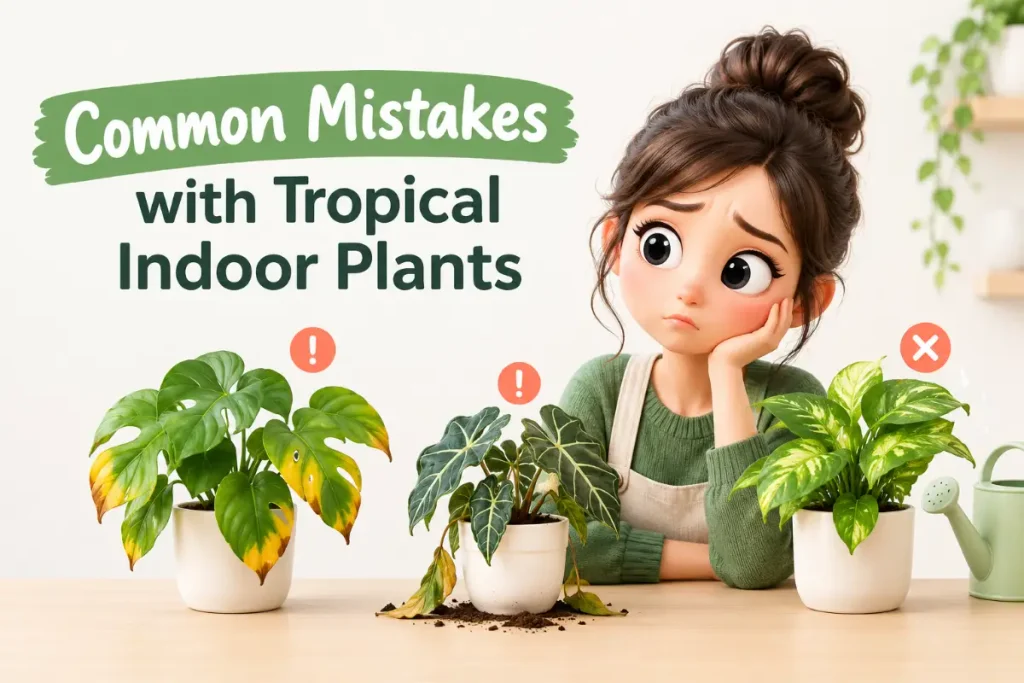
Common Mistakes with Tropical Indoor Plants
Treating all tropical plants the same: The diversity across types of indoor tropical plants means that care routines appropriate for one category can damage another. Watering a Hoya on the same schedule as a Calathea, or placing a ZZ Plant in the same position as an Anthurium, produces poor results for one or both. Understanding the category a plant belongs to is the starting point for getting care right.
Underestimating humidity requirements: The single most common gap between what tropical plants need and what most UK homes provide. Plants that appear to be struggling despite correct watering and light often recover dramatically when humidity is raised to 60%+.
Overwatering in winter: Tropical plants reduce water consumption significantly when light levels drop and temperatures fall. Maintaining summer watering frequency through autumn and winter is the most reliable route to root rot for aroids, palms, and most other tropical types.
Insufficient light for flowering: Most tropical flowering plants — Anthurium, Strelitzia, Bougainvillea, Jasmine, most Orchids — require significantly better light than the average UK living room provides to flower consistently. Supplement with grow lights if flowering is a priority.
Repotting too frequently or into too large a pot: Most tropical plants are best repotted every 2–3 years into the next pot size only. Frequent repotting stresses root systems; oversized pots hold excess moisture and increase root rot risk.
Conclusion
Understanding the main types of indoor tropical plants — and the care logic that each category shares — transforms houseplant growing from a series of individual puzzles into a coherent system. Aroids want consistent moisture and indirect light; bromeliads want tank watering and minimal root compost; palms want space and humidity; ferns want humidity above all; orchids want drainage and bright light; gesneriads want bottom watering and warmth. Once the category logic is clear, adapting care for any new tropical plant becomes intuitive.
For authoritative variety guidance and cultivation advice on specific tropical plant genera, the RHS houseplant pages provide detailed profiles for all the major types of indoor tropical plants covered here.
FAQs
What are the easiest types of indoor tropical plants for beginners?
ZZ Plant, Pothos, Aglaonema, Snake Plant (Sansevieria), and Peace Lily are the most forgiving — they tolerate low light, irregular watering, and temperature variation that would stress more demanding tropical plants.
What types of indoor tropical plants need the most humidity?
Calatheas, maidenhair ferns, Boston ferns, tillandsias, and orchids require the highest humidity — above 60% relative humidity. Most centrally heated UK homes are 40–50%, so these plants benefit most from pebble trays, humidifiers, or grouping with other moisture-transpiring plants.
Can I grow types of indoor tropical plants in a north-facing room?
Some tropical plants genuinely tolerate low light: ZZ Plant, Aglaonema, Cast Iron Plant, Parlour Palm, and Peace Lily all manage in north-facing positions. Most flowering tropicals and variegated plants need more light than a north-facing room provides without supplemental grow lighting.
What are the best tropical plants for large indoor spaces?
Monstera deliciosa, Bird of Paradise (Strelitzia reginae or nicolai), Kentia Palm, Areca Palm, Fiddle Leaf Fig, and large Philodendron species (bipinnatifidum, gloriosum) all provide architectural scale suited to large rooms and hallways.
Are all types of indoor tropical plants toxic to pets?
Many common tropical houseplants are toxic to cats and dogs — aroids (Monstera, Philodendron, Pothos, Peace Lily) contain calcium oxalate crystals; Dracaena contains saponins. Genuinely pet-safe tropical options include Phalaenopsis orchids, Tillandsia (air plants), Calathea, and African Violet (Saintpaulia).
How do I increase humidity for tropical indoor plants?
Pebble trays filled with water beneath the pot (pot sitting above waterline), grouping tropical plants together, a room humidifier positioned near the plants, or growing in a naturally humid room (bathroom, kitchen with good light) all raise local humidity effectively. Misting is largely ineffective at raising ambient humidity.
What types of indoor tropical plants flower reliably indoors?
Peace Lily, Anthurium, Phalaenopsis orchid, African Violet, Streptocarpus, Guzmania bromeliad, and Aechmea all flower reliably in typical indoor conditions with adequate light. Flowering is the area where tropical plants most often disappoint — most require significantly better light than typical UK living rooms provide to bloom consistently.
Do tropical indoor plants need feeding in winter?
Most tropical houseplants reduce their growth rate significantly in winter and should not be fed from October to March. Feeding during winter can lead to salt build-up in compost and root burn without the growth to utilise the nutrients. Resume feeding in spring as growth picks up.
What is the difference between tropical and subtropical indoor plants?
Tropical plants originate within approximately 23° of the equator and require consistent warmth (above 15–18°C) year-round. Subtropical plants (Mediterranean herbs, some palms, citrus) originate between tropical and temperate zones, tolerate cooler winter temperatures, and often benefit from a cooler rest period. Most popular houseplants are tropical; the distinction matters mainly for winter temperature management.
How often should I repot types of indoor tropical plants?
Most tropical houseplants need repotting every 2–3 years — when roots emerge from drainage holes or the plant clearly outgrows its pot. Repot into the next size up only (3–5 cm wider diameter). Spring is the ideal repotting time as growth resumes.