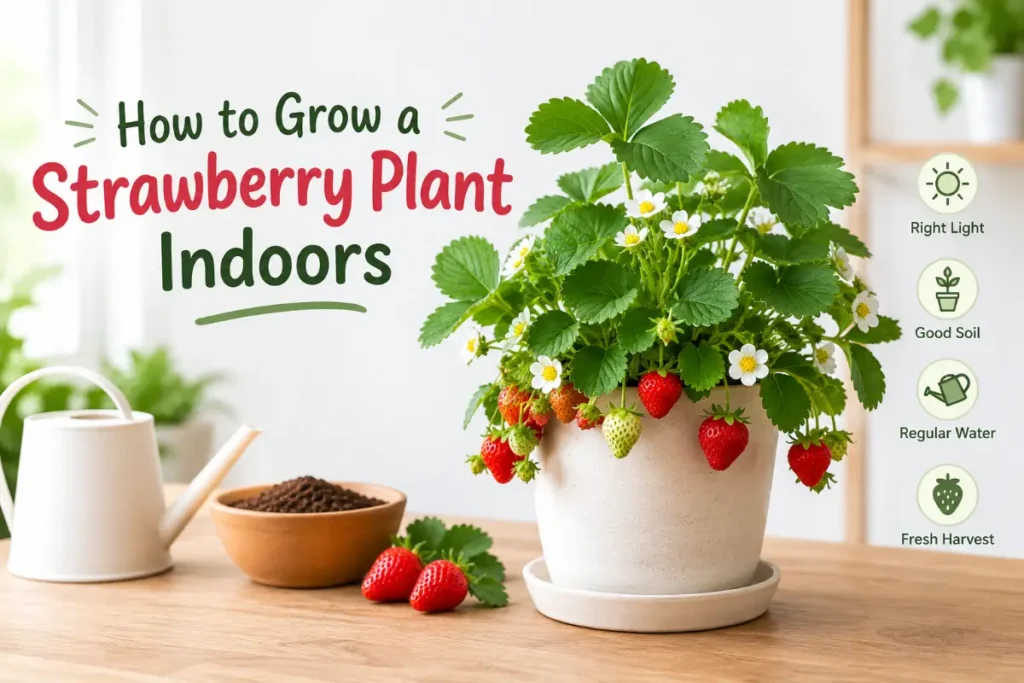
Learning how to grow a strawberry plant indoors opens up one of the most rewarding food growing experiences available in a small indoor space. Strawberries are compact, visually attractive, produce fragrant flowers before the berries, and deliver fruit that tastes noticeably better than most grocery store strawberries because you pick them at full ripeness rather than at the early stage commercial berries must be harvested for shipping durability.
The approach to growing strawberries indoors differs from outdoor strawberry growing in several important ways. Choosing the right variety matters more indoors than outdoors. Light management is essential. And like indoor tomatoes, hand pollination replaces the work that outdoor bees do. Get these right and a kitchen-counter strawberry plant produces fresh berries throughout the year in most indoor climates.
Quick Answer
To grow a strawberry plant indoors, choose an everbearing variety like Albion, Seascape, or Quinault that produces fruit continuously rather than in a single seasonal flush. Provide bright indirect to some direct light, ideally with a grow light running 12 to 14 hours daily. Maintain consistent moisture, temperatures between 60 and 75 degrees, fertilize every two weeks with a balanced formula switching to high phosphorus at flowering, hand pollinate each open flower, and harvest when berries are fully red. Indoor strawberries produce smaller but more intensely flavored berries than outdoor plants.
Understanding Strawberry Types for Indoor Growing
The type of strawberry you choose determines more about your indoor success than any other single decision.
June-bearing varieties: These produce one large crop in late spring or early summer and then produce very little fruit for the rest of the year. They are the most productive strawberries for outdoor summer gardens. Indoors under artificial light without the outdoor seasonal cycle that triggers their single bloom, they perform poorly and are not recommended for indoor year-round growing.
Everbearing varieties: These produce fruit continuously throughout the growing season regardless of day length, making them ideal for indoor growing where you want ongoing production rather than a single seasonal burst. Albion, Seascape, Ozark Beauty, and Quinault are everbearing varieties with good indoor track records.
Day-neutral varieties: A subset of everbearing types that produce continuously and are even less sensitive to light cycle than standard everbearing varieties. Albion and Seascape are technically day-neutral and are the most recommended varieties for indoor year-round growing for this reason.
Alpine strawberries (Fragaria vesca): Wild strawberry varieties including Alexandria, Mignonette, and Yellow Wonder produce tiny, intensely flavored berries continuously and are among the most practical indoor strawberry options. They are smaller plants than garden strawberries, need less light, tolerate lower light conditions better than garden varieties, and produce fruit reliably throughout the year.
Step 1: Source Plants or Start From Seed
Purchasing plants: The fastest path to fruit is purchasing everbearing strawberry starts from a garden center in spring or purchasing bare root plants or runners online from specialty fruit plant suppliers. Plants from a garden center can produce their first berries within six to eight weeks of indoor transplanting.
Starting from seed: Alpine strawberry varieties start readily from seed. Regular garden strawberry varieties are more difficult and slower from seed. Sow alpine strawberry seeds on the surface of moist seed starting mix (do not cover — they need light to germinate), keep at 65 to 75 degrees, and germination occurs in two to three weeks. Transplant to individual small pots when seedlings have their first true leaves.
From runners: If you have outdoor strawberry plants or receive runners from another gardener, rooting runners in moist potting mix produces full plants within three to four weeks and is the most economical way to expand an indoor strawberry collection.
Step 2: Choose the Right Container
Strawberry container choice affects both the plant’s health and the display aesthetic.
Single pots: A six to eight inch pot suits one strawberry plant well. The shallow but wide root system of strawberries does not need depth but does need horizontal spread room. Standard nursery pots, terracotta pots, and bowl-shaped containers all work well.
Strawberry towers and planters: Multi-pocket strawberry planters that hold six to eight plants in vertical pockets are designed specifically for strawberry growing and allow more plants in less horizontal space. They work well under a single grow light and create an attractive display as the plants produce foliage, flowers, and berries at multiple heights simultaneously.
Hanging baskets: Strawberries trail naturally as they produce runners and work beautifully in hanging baskets where the runners, flowers, and berries hang at display height. A hanging basket under a grow light creates one of the most visually appealing indoor food plant displays available.
Drainage: Every container must have drainage holes. Strawberry roots are susceptible to root rot in waterlogged soil. Empty saucers within thirty minutes of watering.
Step 3: Provide the Right Light
Strawberries need more light than most ornamental houseplants for reliable fruit production but are somewhat more tolerant of lower light than tomatoes, making them slightly more achievable in homes with limited grow light investment.
Natural light: A south-facing window with four to six hours of direct sun daily produces adequate conditions for everbearing strawberry fruiting. This is one of the few indoor food crops where a genuinely sunny window can substitute for grow lights, though productivity is lower than under supplemental lighting.
Grow lights: A full-spectrum LED grow light running 12 to 14 hours daily significantly improves fruit production compared to window-only growing. For strawberries specifically, lower-output grow lights that are insufficient for tomatoes may be adequate since strawberries need less light intensity for fruiting.
Alpine strawberries in lower light: Alpine strawberry varieties are among the most shade-tolerant fruiting plants available for indoor growing. In medium indirect light from an east or north-facing window, alpine strawberries maintain slower but genuine fruit production that standard garden varieties cannot sustain in the same conditions.
Step 4: Water Consistently to Maintain Moisture
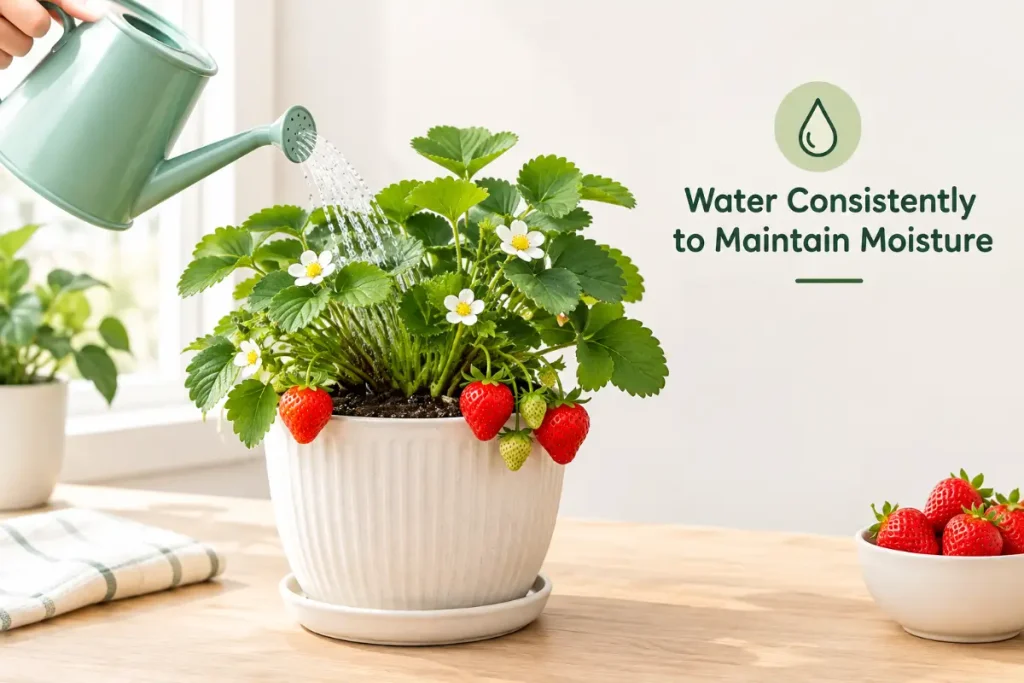
Strawberries prefer consistently moist soil and decline rapidly from the root damage that both drought stress and overwatering cause. Finding the right moisture balance is the most important ongoing management task for indoor strawberries.
The correct check: Water when the top half inch of soil feels dry. In typical indoor conditions this means checking every three to four days and watering every four to six days. Under grow lights the soil dries faster than in natural light and more frequent checking is necessary.
Watering technique: Water at soil level rather than from above since wet foliage and flowers increase the risk of grey mold (botrytis) that specifically targets strawberries in enclosed, humid indoor conditions. Use room temperature water since cold water stresses the shallow root system.
Signs of underwatering: Leaves that curl inward slightly before drooping. Soil pulling away from pot sides. Berries that pucker or remain small before ripening.
Signs of overwatering: Yellow older leaves. Soft mushy crown tissue at soil level. Musty soil smell. Crown rot is one of the most common causes of indoor strawberry plant death and develops quickly in consistently waterlogged soil.
Step 5: Fertilize Through the Production Cycle
Strawberries are moderate feeders that benefit from consistent nutrition through their continuous production cycle.
Through vegetative growth: A balanced fertilizer at half rate every two weeks supports leaf and runner production. The nitrogen component specifically supports the vegetative growth that precedes and follows each flowering and fruiting cycle.
At flowering and fruiting: Switch to a high-phosphorus, potassium-forward formula when flower buds appear. Phosphorus drives flower and fruit development. Potassium supports overall plant health and fruit sugar development. A fertilizer with an NPK ratio like 5-10-10 or any dedicated berry fertilizer suits strawberries in the fruiting phase well.
Organic options: Worm castings top-dressed every six to eight weeks provide slow-release nutrition and the soil biology that supports healthy strawberry roots in container growing. Banana peel water applied every two to three weeks provides potassium alongside the balanced fertilizer program. For the complete guide to organic fertilizer approaches for fruiting indoor plants, natural fertilizer for indoor plants covers every effective option with specific guidance for fruiting crops.
What to avoid: High-nitrogen fertilizers at the flowering stage drive excessive leaf production at the expense of fruit development. Fertilizing through the winter rest period of varieties that naturally slow in winter.
Step 6: Hand Pollinate for Consistent Fruit Set
Like indoor tomatoes, indoor strawberries need manual pollination since no bees access the plants inside. Unlike tomatoes where a single electric toothbrush vibration method works consistently, strawberry flowers are smaller and flatter and benefit from a slightly different technique.
The paintbrush method: Using a small soft artist’s paintbrush (watercolor brush size 0 or 2), gently dab the center of each open strawberry flower in a circular motion. This transfers pollen from the anthers around the edge of the flower to the central receptacle that becomes the strawberry. Do this for every open flower every day or every second day.
The cotton swab method: A cotton swab used in the same gentle circular motion on each open flower accomplishes the same result and is more accessible than buying an artist’s paintbrush specifically.
The electric toothbrush method: The same technique that works for tomatoes also works for strawberries. Hold the vibrating toothbrush against the flower stem rather than the flower itself to release pollen without damaging the delicate petals.
Signs of successful pollination: A strawberry flower that is successfully pollinated develops a small green fruit at its center within five to seven days as the receptacle begins swelling. Flowers that are not pollinated fall off cleanly without any fruit development.
Irregular fruit shape: Indoor strawberries that are partially pollinated (some seeds on the surface pollinated but not all) produce misshapen berries that are flat on one side or have uneven development. This is the visual indicator of incomplete pollination. More consistent daily pollination of every part of each flower produces the more uniform berry shape that complete pollination creates.
Step 7: Harvest at Full Ripeness
The right moment: Unlike outdoor strawberries which can be left to ripen fully on the plant and still hold their shape, indoor strawberries in the warm conditions near grow lights can soften quickly once they reach full color. Harvest when the berry is uniformly red (or appropriate color for the variety) and has a slight give when gently pressed but is not yet soft.
Harvesting technique: Pinch the stem just above the berry rather than pulling the berry from the stem. Pulling can damage the plant’s runner and crown attachment. Using small scissors to cut the stem a quarter inch above the berry cap is the gentlest harvest method.
Enjoying at room temperature: Strawberries develop their fullest flavor at room temperature rather than cold. Indoor home-grown strawberries taken directly from the plant and eaten immediately are noticeably more flavorful than the same variety after refrigeration, which is one of the primary arguments for growing your own even when store-bought berries are available.
After harvest: The plant continues producing new flower buds and fruit after each berry is harvested. Regular harvesting encourages continuous production rather than the plant directing energy to maintaining already-ripe fruit.
Managing Runners Indoors
Outdoor strawberry plants spread aggressively through runners, producing new plants at the runner tips that root wherever they contact soil. Indoors this runner production creates both a management challenge and a propagation opportunity.
Removing runners for productivity: Pinching runners before they develop significantly directs the plant’s energy toward fruit production rather than vegetative spread. For maximum berry production from a single container plant, remove all runners as they emerge.
Using runners for new plants: Allow runners to develop until a small plantlet forms at the tip with visible small leaves. Root this plantlet by pinning it onto the surface of moist potting mix in a small adjacent pot while still attached to the parent plant. Once the plantlet has developed its own roots (typically two to three weeks), cut the runner connecting it to the parent plant. The new plant is now independent and can be moved to any position.
Hanging basket runner display: In a hanging basket, allowing runners to extend freely creates an attractive cascading display of trailing stems with the occasional plantlet forming at runner tips. This natural, somewhat wild appearance suits the hanging basket aesthetic well and the runners can be rooted in small pots placed below the hanging basket where they naturally drape.
Common Indoor Strawberry Problems and Solutions
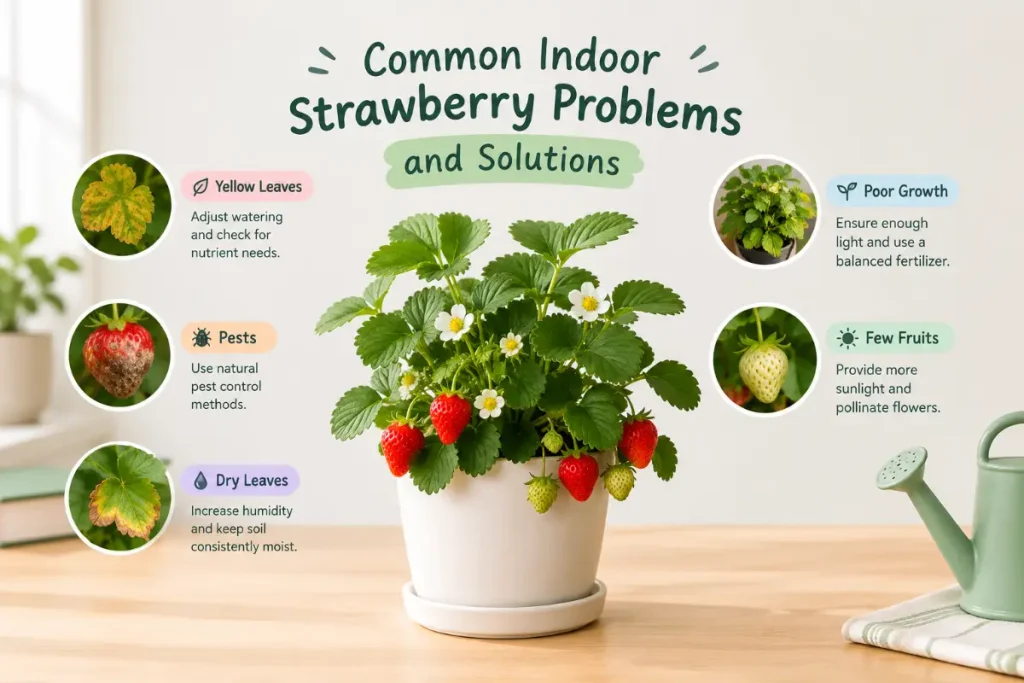
Misshapen or flat berries: Incomplete pollination. Pollinate every open flower more consistently using the circular paintbrush motion that contacts every part of the flower rather than just the center.
Grey mold on flowers or developing berries: Botrytis from high humidity and poor air circulation. Improve air circulation around the plant. Water at soil level rather than from above. Remove any affected flowers or berries immediately. Apply diluted neem oil spray as a preventive measure.
Crown rot: Overwatering causing the crown tissue at soil level to become soft and mushy. Remove from pot, trim affected tissue, allow to dry briefly, repot in fresh well-draining mix, and reduce watering significantly.
No flowers despite healthy foliage: Insufficient light. Move to a brighter position or add grow light hours. Also verify the variety is everbearing rather than June-bearing since June-bearing varieties do not flower reliably without the outdoor day-length cues.
Berries that stay white or remain small: Insufficient light or temperature below 60 degrees. Berries need adequate light and warmth to develop color and sugar. Move to a warmer, brighter position.
Soil and Repotting for Indoor Strawberries
Strawberry roots are shallow but wide-spreading and sensitive to the compaction and nutrient depletion that occurs in container soil over time. Understanding when and how to repot keeps plants performing well through their productive lifespan.
The right soil: A quality potting mix with 20% perlite added provides the balance of moisture retention and drainage that strawberry roots need. The slightly moisture-retentive standard potting mix suits strawberries better than the very fast-draining mixes appropriate for drought-tolerant plants, but the perlite addition prevents the chronic waterlogging that causes crown rot in standard mix without amendment.
When to repot: Annually in spring, or when the plant has visibly slowed fruit production despite adequate light and fertilizing, or when roots emerge from drainage holes in quantity. Fresh potting mix provides the nutrient baseline that supports the next production cycle.
How to repot: Choose a pot one to two inches larger than the current one or the same size with fresh mix if the plant is already in an appropriately-sized container. Handle the crown gently since the central growing point is sensitive to damage. Position the plant at the same depth it was previously, with the crown at soil level rather than buried below it. Burying the crown causes the crown rot that kills strawberry plants more than almost any other single mistake.
Soil pH: Strawberries prefer slightly acidic soil between pH 5.5 and 6.5. Standard potting mix is typically in this range. If your water is very hard and alkaline, occasional watering with water slightly acidified with a few drops of white vinegar per gallon maintains the soil pH that strawberry roots prefer.
Seasonal Rhythm of Indoor Everbearing Strawberries
Even indoors with grow lights and controlled temperature, everbearing strawberries often show a subtle seasonal rhythm that reflects their biological programming rather than a response to actual seasonal conditions.
Spring flush: Most everbearing varieties produce their most vigorous growth and most abundant flowering in spring as day length increases even under indoor conditions. This spring flush typically produces the largest crop of the year.
Summer production: Continuous but somewhat reduced production through the hottest summer months, particularly in homes where indoor temperatures rise above 75 degrees. This is the period when keeping temperatures below 75 degrees through air conditioning or positioning away from heat sources matters most for maintaining fruit set.
Fall resurgence: A secondary production peak in fall as temperatures cool and the plant responds to the changing light signals even when supplemented by grow lights. This fall resurgence produces fruit quality comparable to the spring flush in well-managed plants.
Winter slowdown: Even under adequate grow lights, many everbearing varieties slow production noticeably through the shortest days of winter. This natural slowdown is not a failure of care but a biological rhythm that the plant maintains regardless of artificial light supplementation. Maintaining grow light hours at 14 daily and temperatures between 65 and 70 degrees minimizes the winter slowdown without eliminating it entirely.
For comparison on how indoor strawberry growing relates to other indoor fruit crops and the shared considerations around light, pollination, and variety selection, can you grow a tomato plant indoors covers the indoor tomato approach with specific parallels to indoor strawberry growing that make managing both crops simultaneously more efficient since their care requirements overlap significantly.
Conclusion
How to grow a strawberry plant indoors comes down to choosing an everbearing or alpine variety, providing sufficient light, hand pollinating every flower consistently, maintaining steady moisture, and fertilizing through the continuous production cycle. With those practices in place, an indoor strawberry plant becomes one of the most satisfying food growing experiences available from a kitchen counter or sunlit window — fresh, intensely flavored berries year-round from a plant compact enough to fit in a six-inch pot and attractive enough to display anywhere in the home.
Frequently Asked Questions
What is the best strawberry variety to grow indoors?
Everbearing day-neutral varieties including Albion and Seascape produce fruit continuously without needing the specific seasonal light cycles that June-bearing varieties require. Alpine strawberries including Alexandria and Yellow Wonder are excellent for lower-light indoor conditions and produce intensely flavored small berries reliably. Avoid June-bearing varieties for indoor growing since they produce only one crop per year and perform poorly without outdoor seasonal cues.
Do indoor strawberries need grow lights?
A south-facing window with four to six hours of direct sun provides enough light for modest indoor strawberry production. Grow lights running 12 to 14 hours daily produce significantly more flowers and fruit than window light alone. Alpine strawberry varieties need the least light of any fruiting strawberry and produce reasonably in east-facing windows and medium indirect light positions where garden strawberry varieties would struggle.
How long does it take to grow strawberries indoors?
A purchased everbearing strawberry plant transplanted to an indoor container produces its first flowers within two to four weeks and its first ripe berries within six to eight weeks of planting. Starting from seed takes two to three months longer. Once established, everbearing plants produce fruit continuously for one to two years before their production declines and they benefit from replacement.
Why are my indoor strawberry flowers falling off without producing fruit?
Flower drop without fruit set is usually caused by insufficient or inconsistent pollination. Use a small paintbrush or cotton swab to gently touch every part of each open flower in a circular motion daily. Also check that temperatures are between 60 and 75 degrees since both excessive heat and cold below 60 degrees cause flower drop. Very high humidity combined with poor air circulation can also cause botrytis-related flower drop.
Can I grow strawberries indoors in winter?
Yes, everbearing varieties under grow lights produce fruit year-round regardless of outdoor season. This is one of the primary advantages of indoor strawberry growing. Natural day length and outdoor temperatures do not affect everbearing varieties grown under artificial lighting with controlled indoor temperature. Fresh homegrown strawberries in January are one of the most rewarding outcomes of investing in indoor food growing.
How many strawberries can I expect from an indoor plant?
A well-managed indoor everbearing strawberry plant produces approximately five to fifteen berries per harvest cycle with multiple cycles through the year. This is modest compared to outdoor summer strawberry beds but provides a continuous trickle of fresh berries throughout the year. Alpine strawberry plants produce smaller berries in smaller quantities but with exceptional flavor. Two to three plants provide a more consistently satisfying harvest quantity than a single plant.