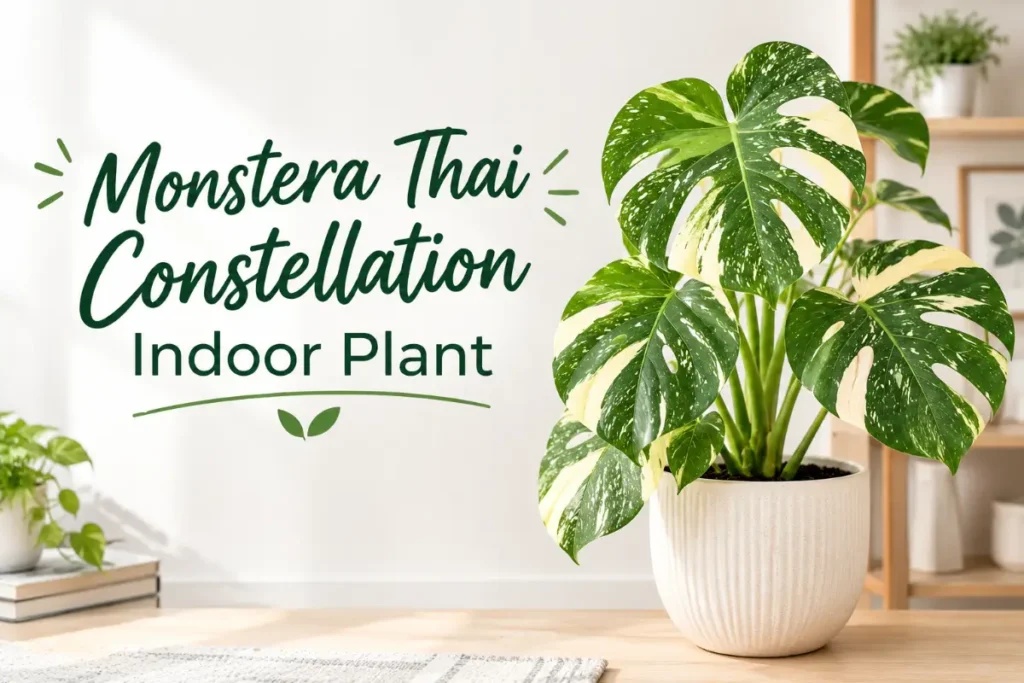
The Monstera Thai Constellation indoor plant is one of the most recognisable and sought-after houseplants in contemporary indoor gardening — a cultivar of Monstera deliciosa distinguished by its creamy white and pale yellow splashes scattered across deep green leaves in a pattern that genuinely resembles a star chart, hence the constellation name. Unlike most variegated plants whose pale sections are confined to margins or stripes, the Thai Constellation’s variegation appears as irregular constellations of cream and white flecks across the entire leaf surface, creating a pattern that is never repeated from one leaf to the next.
This guide covers everything needed to grow a healthy Monstera Thai Constellation indoors: its specific light requirements, watering and humidity needs, feeding, potting and support, propagation, and the realistic expectations that help avoid the common disappointments that come with investing in a premium houseplant.
What Is the Monstera Thai Constellation?
Monstera Thai Constellation is a tissue-culture cultivar of Monstera deliciosa that originated in Thailand — specifically from a Thai plant laboratory that produced the first commercially available specimens in the mid-2010s. The variegation is stable across the plant (unlike chimeric variegation in Monstera albo, which can revert) because it is produced at the cellular level during tissue culture propagation. Every cell in the plant carries the variegation pattern — which means propagated cuttings reliably carry the same colouration as the parent.
The stability of the variegation is one of the primary reasons the Thai Constellation commands a premium price — and why it holds that value more consistently than the botanically similar but genetically less stable Monstera albo variegata.
Mature Thai Constellation leaves develop the characteristic fenestrations (holes and splits) of Monstera deliciosa under the right growing conditions, combined with the distinctive cream-and-green variegation pattern. Juvenile plants produce smaller, less fenestrated leaves, but even these display the constellation pattern from the earliest growth stages.

Light Requirements
Light is the most critical variable in Thai Constellation care — and the area where expectations most often need calibrating.
What the plant needs: Bright indirect light for a minimum of 6–8 hours per day. The pale, cream-coloured sections of the leaves contain no chlorophyll and therefore cannot photosynthesise. This means the green portions of each leaf must work harder to sustain the plant — requiring more light than a fully green Monstera deliciosa would need.
South or east-facing windows: A position near a south-facing or east-facing window (within 1–2 metres, with filtered light through a sheer curtain in summer to prevent direct sun scorching) provides the light levels that support healthy growth and maintain variegation intensity.
Avoid: Low light positions. Unlike standard Monstera deliciosa, which tolerates low light reasonably well, the Thai Constellation declines measurably in dim conditions — growth slows dramatically, new leaves emerge smaller and with less pronounced variegation, and the pale sections may show stress browning. A position more than 3 metres from a window in a room with average natural light is generally insufficient.
Grow lights: If natural light is inadequate, supplementing with a quality grow light for indoor plants is effective. Position the grow light at 30–50 cm above the plant and run for 12–14 hours per day. Full-spectrum LED grow lights are the most suitable for foliage plants at this price point.
Direct sun: Avoid direct sun on the leaves, particularly through south-facing glass in summer. The cream and white sections of Thai Constellation leaves scorch far more quickly than green tissue — brown patches in variegated sections are usually irreversible and reduce the plant’s display value significantly.
Watering
Watering requirements for the Monstera Thai Constellation indoor plant are similar to those of standard Monstera deliciosa — with one important nuance.
General approach: Allow the top 5 cm of compost to dry out before watering. Water thoroughly until water flows freely from the drainage holes, then allow to drain completely. The plant dislikes sitting in water — roots in persistently wet compost develop root rot relatively quickly.
The variegation consideration: Because variegated sections do not photosynthesise, the plant has less capacity for water uptake than a fully green equivalent. Overwatering — watering before the compost has partially dried — is a more significant risk with Thai Constellation than with the standard species. In winter, when growth slows, extend the interval between waterings considerably.
Moisture checking: A moisture meter for indoor plants is particularly useful here. Given the investment represented by a Thai Constellation, the small cost of a moisture meter is well justified — it removes the guesswork that leads to overwatering.
Water quality: Use room-temperature water. Cold water causes stress to the tropical root system. Filtered or rainwater is preferable to hard tap water, which leaves mineral deposits in the compost over time.
Humidity and Temperature
Humidity: Thai Constellation, like all Monsteras, originates in humid tropical forest environments and prefers higher humidity than most UK homes naturally provide. Aim for 60–70% relative humidity if possible. In practice, most Thai Constellations grow acceptably at 50–60%, though growth is faster and leaves are larger at higher humidity.
Methods to increase humidity around the plant:
- Pebble tray filled with water placed beneath the pot (the pot sits above the waterline, not in it)
- Grouping with other tropical houseplants — transpiration from multiple plants raises local humidity
- A room humidifier positioned near the plant
- A position in a bathroom or kitchen with naturally higher ambient humidity, provided light is adequate
Avoid misting directly onto Thai Constellation leaves — the water sits in the fenestrations and on the variegated sections, promoting fungal issues. Pebble trays and humidifiers are more effective and safer.
Temperature: Keep above 18°C year-round. Thai Constellation is more cold-sensitive than many popular indoor plants — at temperatures below 15°C, growth stops and cold damage to the large leaves occurs rapidly. Keep away from cold windowsills in winter, exterior doors, and uninsulated conservatory walls.
Feeding
Frequency: During the growing season (April–September), feed with a balanced liquid houseplant fertiliser at half the recommended dose every 2–4 weeks. Monthly is sufficient for most indoor conditions.
Type: A balanced NPK fertiliser (10-10-10 or similar) or one slightly higher in nitrogen during the growing season. Avoid high-phosphate feeds. Specialist tropical plant fertilisers or foliage plant feeds are well suited.
Winter: Stop feeding from October to March. The plant’s growth rate drops significantly in lower light and cooler temperatures, and fertiliser applied during this period accumulates as salts in the compost without being used.
Avoid: Over-fertilising, which causes salt build-up in the compost and potential root burn. Always water the plant before applying liquid fertiliser — never feed dry compost.
Soil, Potting, and Support
Compost: Thai Constellation needs a free-draining, airy compost mix. A standard peat-free multipurpose is too dense on its own — mix with 30–40% perlite or add orchid bark (20–30%) for a chunky mix that drains freely and allows good root aeration. Some growers use specialist aroid mixes containing coconut coir, perlite, and orchid bark, which are well suited to Thai Constellation’s root requirements.
Pot size: Choose a pot that fits the current root ball with 3–5 cm of space around the roots — not much larger. Oversized pots hold excess moisture that the plant cannot use, dramatically increasing overwatering risk. Terracotta pots are beneficial for Thai Constellation because the porous walls allow the compost to breathe and dry more evenly, reducing root rot risk compared to plastic or glazed ceramic.
Repotting: Repot every 2–3 years or when roots emerge from drainage holes. Repot in spring when growth is resuming. Inspect roots when repotting — trim any brown, mushy roots with clean scissors and allow cut surfaces to dry for an hour before repotting into fresh compost.
Support: Monstera Thai Constellation is a climbing plant in its natural habitat and produces the largest, most fenestrated leaves when given vertical support. A moss pole is the traditional and most effective support — the plant’s aerial roots attach to the moist moss, drawing additional moisture and supporting upright growth. As a Monstera Thai Constellation indoor plant matures, the aerial roots become more prominent and benefit from a moss pole of 1–1.5 metres. For instructions on setting up moss poles and managing aerial roots, the post on indoor plants with variegated leaves covers the climbing support requirements of variegated Monsteras in detail.
Propagation
Thai Constellation can be propagated from stem cuttings — and because the variegation is stable (tissue-culture derived), cuttings reliably carry the same variegation pattern as the parent plant.
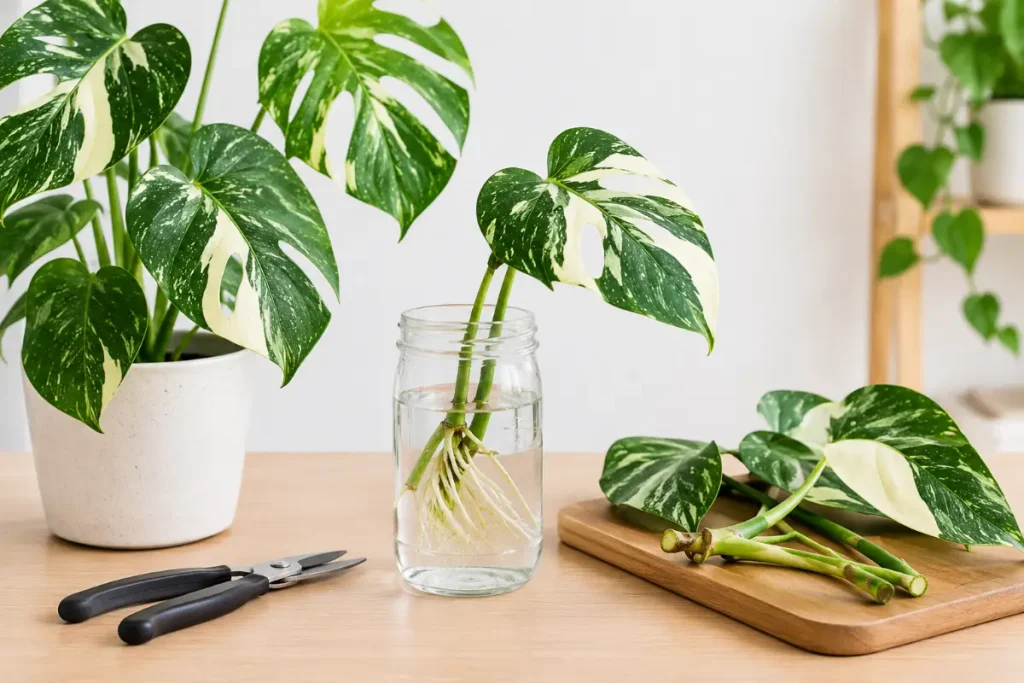
Node cuttings: Cut a stem section containing at least one node (the joint from which a leaf and aerial root emerge). Each cutting should include one leaf and one node minimum. Place in water, moist sphagnum moss, or a mix of perlite and water. New roots emerge from the node in 4–8 weeks in warm, bright conditions.
Water propagation: Submerge only the node in clean water, keeping the leaf above the waterline. Change water every 5–7 days. Once roots reach 3–5 cm, pot into the aroid compost mix described above.
Moss propagation: Wrap the node in damp sphagnum moss, keep in a warm, humid environment (a clear propagator or loosely sealed clear bag). Roots form into the moss and the cutting can be potted once a good root system is established.
Air layering: For thick-stemmed mature plants, air layering at a node allows rooting to occur while the cutting remains attached to the parent, reducing stress on both. Wrap the node with damp sphagnum and clear polythene until substantial roots form, then sever and pot.
Given the value of Thai Constellation plants, propagation is a meaningful financial consideration — a well-rooted cutting from a good parent plant retains significant value and is one of the more rewarding aspects of growing this cultivar.
Common Problems
Brown edges on variegated sections: Low humidity is the most common cause — the pale, non-photosynthesising areas lose water vapour faster than green tissue and desiccate at the margins first. Increase humidity and keep away from radiators and draughts.
Yellowing leaves: Overwatering, especially in winter when growth is slow. Allow the compost to dry more between waterings and check that drainage is unobstructed.
No fenestrations on new leaves: Insufficient light is the primary cause. Juvenile plants also produce non-fenestrated leaves regardless of conditions — fenestrations develop on leaves produced once the plant is larger and more mature. If an established plant stops producing fenestrated leaves, improve light levels.
Reverted (all-green) growth: Unlike Monstera albo, Thai Constellation does not genuinely revert to all-green growth — the variegation is stable at the cellular level. If new leaves emerge entirely green, this is most likely a different plant misidentified as Thai Constellation, or an issue with growing conditions (very low light causing the plant to produce more chlorophyll in new growth as a stress response — though true reversion does not occur). Improving light levels is the response in either case.
Root rot: The consequence of consistent overwatering in poorly draining compost. Remove from pot, trim affected roots, allow to dry, and repot into fresh aroid mix. Given the plant’s value, acting promptly at the first signs — yellowing, soft stems, sour smell — is important.
Realistic Expectations and Long-Term Growth
Thai Constellation is a slow to moderate grower indoors — slower than standard Monstera deliciosa because the non-photosynthesising variegated sections reduce the plant’s overall energy production. In good conditions (bright indirect light, high humidity, warm temperatures), expect 2–4 new leaves per growing season from an established plant.
The leaves produced early in the plant’s life in your home are often smaller than those that will come later — as the plant establishes in its new environment, leaf size typically increases over successive growing seasons.
Patience is a significant part of owning a Thai Constellation. This is not a plant that will fill a wall within a year — but the slow pace of growth means each new leaf is a genuine event, and the variation in constellation patterning from leaf to leaf ensures the plant remains interesting across its lifespan.
Buying a Monstera Thai Constellation: What to Know
Thai Constellation was once extremely expensive — early specimens sold for hundreds of pounds per plant when tissue-culture production was limited. As tissue culture has scaled, prices have fallen substantially, though quality Thai Constellation plants with well-established roots and clear variegation still command a premium over standard houseplants.
What to look for at purchase:
- Clear, defined constellation patterning on existing leaves — each leaf should show cream or pale yellow splashes distributed across the leaf surface, not just marginal whitening
- Firm stems with no soft or discoloured sections at the base
- Healthy, green (and variegated) leaves with no browning except minor margin spotting
- Roots visible at the drainage holes of the nursery pot, indicating an established root system — not a freshly rooted cutting in oversized compost
- Active growth point visible at the crown — a new leaf beginning to unfurl (often a rolled, pale green and cream spike) indicates the plant is actively growing
Sources to consider: Specialist houseplant shops, reputable online plant retailers, and plant fairs typically offer Thai Constellation plants with clear provenance. Auction sites and social media marketplaces offer lower prices but with more variable quality — freshly propagated cuttings without established roots are a higher-risk purchase that requires more care during establishment.
What to avoid:
- Plants with entirely cream or entirely white new growth — these sections contain no chlorophyll and cannot photosynthesise, meaning that leaf will not sustain the plant and may indicate the overall variegation balance is too high for long-term health
- Plants with mushy or discoloured base stems (root rot)
- Plants described as Thai Constellation that show only marginal variegation — genuine Thai Constellation shows scattered constellation-pattern variegation across the full leaf surface, not just white edges (which is more characteristic of other variegated Monsteras)
Seasonal Adjustments for Thai Constellation
Spring (March–May): Resume regular feeding as growth picks up. This is the best time to repot if needed. Begin increasing watering frequency as light levels and temperature rise.
Summer (June–August): Peak growing season. Water more frequently — check compost every 5–7 days. Feed monthly or every 3–4 weeks. Move away from direct south-facing sun. Monitor humidity — warm air holds more moisture but indoor air conditioning reduces it significantly.
Autumn (September–November): Begin reducing watering and feeding from September. Move away from windows as outdoor temperatures drop — cold radiating through glass affects the root zone. Stop feeding by October.
Winter (December–February): Minimum watering — allow compost to dry considerably between waterings. No feeding. Maintain temperature above 18°C. If natural light is very low, consider supplementing with a grow light for 12–14 hours per day to prevent growth stagnation. The self-watering system for indoor plants post discusses automated watering setups useful for maintaining consistent moisture during winter without overwatering.
Displaying Thai Constellation Indoors
The visual impact of a mature Thai Constellation is considerable — but maximising that impact requires thinking about position and context carefully.
Height and scale: Thai Constellation reads best as a centrepiece or focal plant rather than a supporting element. A mature specimen on a plant stand or elevated shelf — allowing the large leaves to display at eye level — makes far more visual impact than the same plant on the floor, where the fenestrated and variegated leaf surfaces are viewed at an angle.
Backdrop: The constellation pattern of cream against deep green shows most clearly against a plain, dark wall. Positioned in front of busy wallpaper or a cluttered bookshelf, the leaf pattern is lost. A clean, neutral or dark wall brings out the full visual complexity of each leaf.
Moss pole aesthetics: A natural coir or moss pole adds to the plant’s tropical feel. Wooden or bamboo canes are functional but less visually appealing at this plant’s price point. For a specimen-quality Thai Constellation, a quality coir or live moss pole suits the plant’s premium character.
Companion plants: Thai Constellation works well alongside plants with contrasting leaf textures and colours — the bold, fenestrated leaves pair naturally with the fine-textured fronds of a tree fern, the deep burgundy of a Rubber Plant ‘Burgundy’, or the strongly contrasting variegation of a large Calathea orbifolia. For a broader collection of indoor plants with variegated or colourful leaves that complement Thai Constellation’s colouring, the post on indoor plants with colorful leaves provides a range of companion options at different price points.
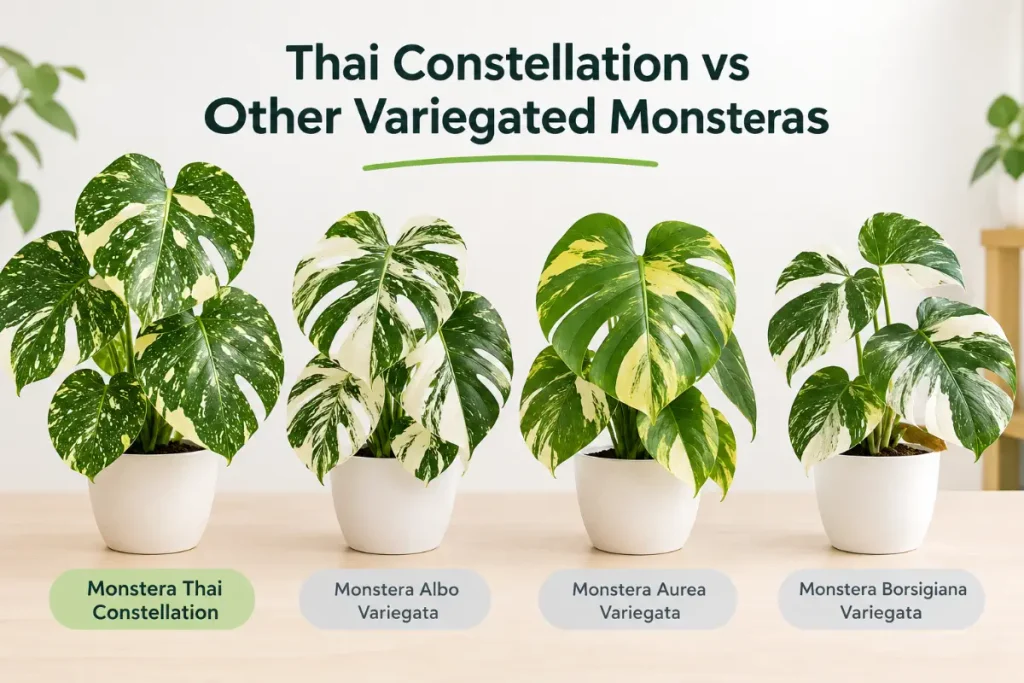
Thai Constellation vs Other Variegated Monsteras
For anyone navigating the variegated Monstera market, a brief comparison is useful:
Thai Constellation vs Monstera albo (Monstera deliciosa var. albovariegata): Albo has whiter, more strongly contrasting variegation — often producing half-and-half leaves split between deep green and pure white. Its variegation is chimeric (naturally occurring, not tissue-culture induced) and can revert to all-green growth. Thai Constellation’s cream-and-green constellation pattern is more subtle but stable — no reversion risk.
Thai Constellation vs Monstera Sport: Monstera Sport (or Monstera deliciosa ‘Sport’) is another naturally occurring variegated form, with irregular splashes of yellow-green variegation. It is typically less expensive than Thai Constellation and less dramatically variegated.
Thai Constellation vs Monstera Peru or Monstera pinnatipartita: These are different Monstera species entirely — not variegated forms of deliciosa. Care requirements and appearance differ significantly.
For indoor plant collections where budget allows only one variegated Monstera, Thai Constellation’s stable variegation, reliable propagation, and growing availability at reasonable prices make it the stronger long-term choice over Monstera albo — particularly for growers who want the confidence of a plant whose distinctive patterning will not suddenly disappear.
Conclusion
The Monstera Thai Constellation indoor plant rewards the effort invested in its care with foliage that is genuinely unlike any other widely available houseplant. Its stable variegation, reliable propagation, and striking appearance at all stages of growth make it one of the most satisfying long-term investments in a premium indoor plant collection. The care requirements — bright light, careful watering, good drainage, high humidity — are demanding by houseplant standards but entirely achievable with the right setup.
For comprehensive guidance on Monstera species, care troubleshooting, and variety selection, the RHS houseplant pages provide authoritative reference material.
FAQs
How much light does a Monstera Thai Constellation need indoors?
Bright indirect light for at least 6–8 hours per day. Because the pale variegated sections cannot photosynthesise, the plant needs more light than a standard Monstera to sustain healthy growth. Within 1–2 metres of a south or east-facing window is ideal. Avoid deep shade, which causes slow growth and fading variegation.
Why is my Thai Constellation growing so slowly?
Slow growth is normal for this cultivar — the non-photosynthesising variegated sections reduce overall energy production compared to a fully green Monstera. In lower light or winter months, growth slows further. Improving light and maintaining high humidity are the most effective ways to encourage faster growth during the growing season.
Can I propagate Thai Constellation and will the cuttings keep the variegation?
Yes — Thai Constellation’s variegation is stable (tissue-culture derived) and reliably carries through to cuttings. Take a node cutting with one leaf, propagate in water or moist sphagnum, and the resulting plant will display the same constellation variegation as the parent.
What humidity does Thai Constellation need?
Aim for 60–70% relative humidity. Most UK homes are 40–50%, which is manageable but not optimal. A pebble tray, grouped planting, or room humidifier all help. Avoid misting directly onto the leaves, which can promote fungal issues on the pale variegated sections.
Is Thai Constellation the same as Monstera albo?
No — both are variegated Monstera deliciosa cultivars, but they are genetically different. Monstera albo has chimeric variegation (white sections), which can revert to all-green growth. Thai Constellation has stable tissue-culture variegation (cream/yellow sections), which does not revert. Thai Constellation is generally more reliable as an indoor plant for this reason.
Why does my Thai Constellation have brown edges on the pale sections?
Low humidity is the most common cause — the non-photosynthesising pale areas desiccate faster than green tissue. Increase humidity, move away from radiators and draughts, and avoid placing near air conditioning vents.
What compost should I use for Thai Constellation?
A free-draining aroid mix: standard peat-free compost with 30–40% perlite, or a chunky mix of coco coir, perlite, and orchid bark. Standard multipurpose compost is too dense and retains too much moisture, increasing root rot risk.
Does Thai Constellation need a moss pole?
A moss pole is strongly recommended for established plants. It provides the vertical support the climbing plant naturally seeks, encourages larger leaf development and more pronounced fenestrations, and allows aerial roots to attach and draw additional moisture. Without support, the plant grows more slowly and produces smaller leaves.
How often should I repot Thai Constellation?
Every 2–3 years, or when roots visibly emerge from drainage holes. Move up by only one pot size — excess compost around the roots stays wet longer and increases overwatering risk. Repot in spring when growth is resuming.
Is Monstera Thai Constellation toxic?
Yes — like all Monsteras, Thai Constellation contains calcium oxalate crystals that cause irritation if leaves are chewed or ingested, and can cause skin irritation from the sap. Keep out of reach of children and pets.