
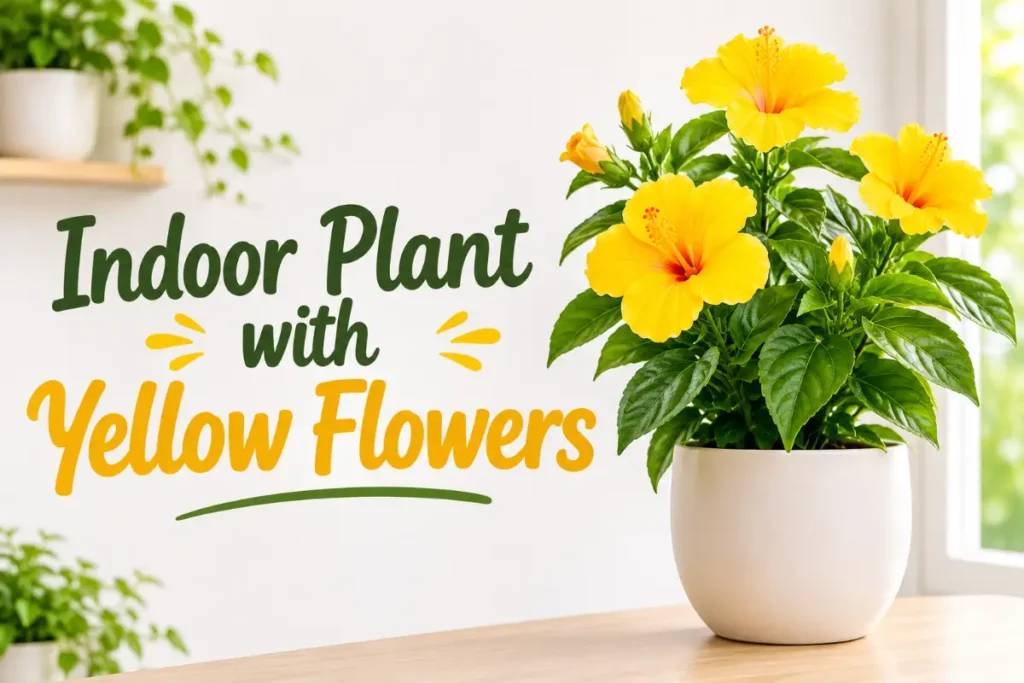
Yellow is one of the hardest colors to find in flowering houseplants — most catalogs lean toward pink, white, and purple — but an indoor plant with yellow flowers brings a warmth and energy to a room that no other color delivers quite the same way. From compact windowsill bloomers to bold tropical statement plants, there is a yellow-flowering species for almost every indoor condition.
This guide covers twelve reliable options, what conditions each needs to flower indoors, and how to keep blooms coming season after season.
1. Kalanchoe (Kalanchoe blossfeldiana)
Kalanchoe is the most widely available flowering houseplant in the US, and the yellow-flowered varieties are among the easiest to find at grocery stores and garden centers from late fall through spring. Clusters of small, waxy, long-lasting flowers sit above thick succulent-type leaves — a single flush of blooms can last 6–8 weeks without any special attention.
Light: Bright indirect light; tolerates some direct morning sun. A south or east-facing windowsill works well.
Water: Allow the top inch of potting mix to dry between waterings. Overwatering is the primary cause of failure — kalanchoe is a succulent and holds water in its leaves.
To rebloom: After the first flush fades, give the plant 6 weeks of shorter days (14 hours of darkness per night) to trigger the next bloom cycle. A spare bedroom or closet for part of each day achieves this. New buds emerge after the rest period.
Beginner-friendly: Yes — one of the most forgiving flowering houseplants available.
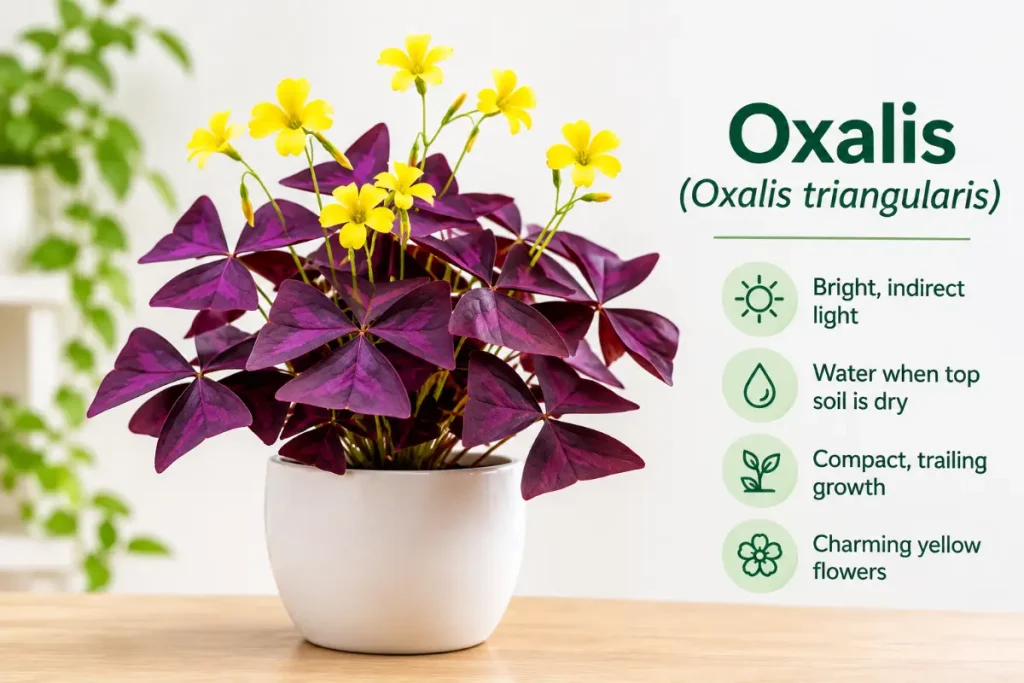
2. Oxalis (Oxalis triangularis — Yellow-Flowering Varieties)
While the most common oxalis sold as a houseplant has purple leaves and pink flowers, yellow-flowering oxalis species (particularly Oxalis stricta and Oxalis corniculata) produce cheerful small yellow blooms above clover-like foliage. The flowers are small but produced abundantly in the right conditions.
Light: Bright indirect light. Oxalis in lower light produces fewer flowers and more leggy foliage growth.
Water: Keep the potting mix evenly moist during the growing season; reduce in winter when the plant may go semi-dormant.
Note: Oxalis grows from small bulbs and will die back periodically — this is normal dormancy, not plant death. Keep the pot, stop watering, and new growth emerges after a rest period of 4–8 weeks.
3. Oncidium Orchid (“Dancing Lady”)
Oncidium orchids produce long arching sprays of small yellow flowers — sometimes dozens of blooms on a single spike — earning them the common name dancing lady orchid. The yellow coloring is often combined with brown or red markings, but many varieties are pure bright yellow.
Light: Bright indirect light; more light-tolerant than phalaenopsis orchids. An east-facing window is ideal.
Water: Water thoroughly when the potting medium (bark) is almost dry; never let the roots sit in water. Oncidiums prefer to dry out slightly more between waterings than other orchids.
Temperature: A drop of 10–15°F at night in fall encourages spike production — a natural consequence of cooler nights near a window.
Blooming: Typically once or twice a year; spikes develop over several weeks before flowers open. The bloom period lasts 4–6 weeks.
4. Golden Trumpet (Allamanda cathartica)
Allamanda is a tropical vine producing large, trumpet-shaped yellow flowers — 3–4 inches across — against glossy green leaves. In the US it is grown as a houseplant in most regions (it is only winter-hardy outdoors in USDA zones 10–12), where it makes a dramatic indoor plant with yellow flowers when given sufficient light.
Light: Full sun or very bright indirect light. A south-facing window is the minimum for reliable flowering indoors.
Water: Keep evenly moist during active growth; reduce in winter. Does not tolerate drought as well as succulent-type yellow bloomers.
Size: Can grow vigorously — provide a small trellis or support for the vining stems, or keep it compact by pinching growth tips regularly.
Note: All parts of allamanda are toxic if ingested — keep away from children and pets.
5. Freesia (Freesia species)
Freesia bulbs are widely available in the US in fall and can be grown indoors in pots for winter and spring blooms. The yellow varieties have a particularly strong, sweet fragrance — one of the best-scented of all flowering bulbs — and the nodding flower spikes make a distinctive indoor display.
How to grow: Plant bulbs 2 inches deep in fall, several per pot. Keep cool (50–60°F) while roots establish (6–8 weeks), then move to a brighter, warmer spot as shoots appear. Flowers follow 10–12 weeks after planting.
Light: Bright light once shoots appear; full sun if available.
After blooming: Allow foliage to die back naturally, then store dry bulbs for replanting the following fall.
6. Calceolaria (Calceolaria herbeohybrida — Pocketbook Plant)
Calceolaria produces extraordinary pouched flowers — often bright yellow, sometimes spotted with orange or red — that look almost artificial. The blooms are produced prolifically over a period of 4–6 weeks, making calceolaria one of the most visually striking of all yellow-flowering houseplants.
Light: Bright indirect light; avoid direct sun which fades the flowers quickly.
Water: Keep consistently moist — calceolaria does not tolerate drying out. Use room-temperature water; cold water can shock the roots.
Temperature: Prefers cool conditions (55–65°F). In warmer rooms, the blooming period is shorter.
Lifespan: Calceolaria is typically sold as a short-term flowering plant — enjoy the blooms, then compost. It rarely performs well for a second season as a houseplant.
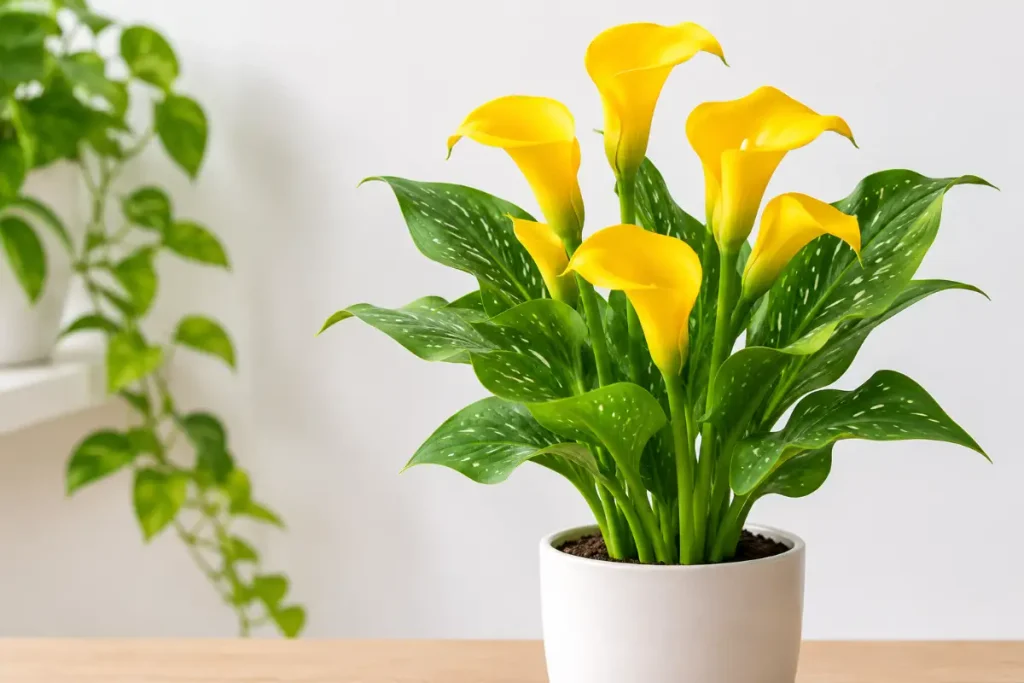
7. Yellow Calla Lily (Zantedeschia — Yellow Varieties)
Calla lilies in yellow — varieties like ‘Mango’ and ‘Captain Safari’ — produce elegant funnel-shaped spathes in deep gold to butter yellow above striking arrow-shaped leaves that may feature white spotting. They are grown from rhizomes and reliably rebloom with the right care.
Light: Bright indirect light; some direct morning sun is beneficial.
Water: Keep evenly moist during active growth. After flowering, allow the foliage to die back naturally, then store the rhizomes dry for 2–3 months before repotting and resuming watering.
Fertilizer: Feed with a balanced liquid fertilizer every 2 weeks during active growth to support strong blooming.
8. Dendrobium Orchid (Yellow Varieties)
Dendrobium orchids — particularly Dendrobium nobile and its hybrids — include many yellow-flowering varieties, with blooms appearing along the length of the cane rather than on a single upright spike. The flowers are long-lasting (4–6 weeks) and often fragrant.
Light: Bright indirect light to some direct morning sun. More light-demanding than phalaenopsis.
Water: Water thoroughly, then allow to dry almost completely before watering again. Dendrobiums prefer a distinct dry rest period in fall and winter to trigger blooming.
Temperature: A cool dry winter rest (50–55°F at night, reduced watering) is essential for reliable reblooming in spring.
9. Abutilon (Abutilon hybridum — Yellow Varieties)
Abutilon, also called flowering maple, produces pendulous bell-shaped flowers in yellow, orange, or red throughout the growing season. Yellow varieties like ‘Canary Bird’ bloom from late spring through fall with relatively little effort. The maple-like foliage is attractive even when the plant is not in flower.
Light: Bright indirect light to full sun. More light produces more blooms — a south or west-facing window is ideal.
Water: Keep evenly moist during active growth; reduce in winter. Consistent moisture produces the most continuous flowering.
Size: Abutilon can grow large (3–5 feet) in a pot over several years — prune in early spring to maintain a compact size.
10. Black-Eyed Susan Vine (Thunbergia alata)
Black-eyed susan vine produces bright orange-yellow flowers with a distinctive dark center throughout summer and into fall. In most of the US it is grown as an annual outdoors, but it thrives as an indoor plant with yellow flowers when given a bright sunny window and a small trellis to climb.
Light: Full sun or very bright indirect light — the minimum for consistent flowering indoors.
Water: Keep evenly moist; do not allow to dry out completely during active growth.
Use: Excellent in a hanging basket near a bright window, where the vining stems trail attractively.
11. Forsythia (Forced Branches)
Not a conventional houseplant, but forcing forsythia branches indoors in late winter is a reliable way to bring vivid yellow blooms indoors weeks before they would appear outdoors. Cut branches when buds are swelling (late January to February in most of the US), place in a vase of water in a warm bright room, and flowers open within 1–3 weeks.
Best for: A dramatic seasonal display that requires no ongoing plant care.
12. Primrose (Primula vulgaris — Yellow Varieties)
Yellow primroses are sold at garden centers in late winter and early spring throughout the US and make cheerful short-term indoor plants. They prefer cool conditions, which is actually an advantage — a cool bright windowsill in January or February is ideal primrose habitat.
Light: Bright indirect light; avoid hot direct sun.
Water: Keep evenly moist; primroses wilt quickly when dry.
After blooming indoors: Plant out in the garden after the last frost — primroses are perennial in USDA zones 4–8 and will return the following spring.
Getting the Most Blooms Indoors: Key Principles
Across almost all yellow-flowering houseplants, three factors consistently determine whether a plant flowers reliably or refuses to bloom:
Light is the primary driver. Most flowering plants need significantly more light than foliage plants to produce blooms. A location that keeps a pothos healthy may not be bright enough to trigger flower production in a kalanchoe or orchid. When a plant fails to rebloom, insufficient light is the most common cause — move it closer to the brightest window available before trying other fixes.
Temperature fluctuation triggers many bloomers. Orchids, kalanchoe, and several others use the difference between day and night temperatures as a cue to initiate flowering. A natural cool-down of 10–15°F at night — which happens near windows in fall — is often enough to set buds.
Rest periods matter. Many flowering plants need a period of reduced water, lower temperatures, or shorter days to reset for the next bloom cycle. Skipping the rest period and keeping plants in warm, bright, well-watered conditions year-round produces healthy foliage but fewer flowers.
Styling Yellow Flowers in Your Home
Yellow flowers have specific placement advantages indoors that make them more effective in some rooms than others.
Living rooms and entryways: Yellow is energizing and welcoming — well-suited to high-traffic, social spaces. A cluster of yellow kalanchoe near a front door or on a side table creates an immediate visual impression that white or pink flowers do not match.
Home offices: Studies on color psychology consistently associate yellow with focus, creativity, and optimism. An indoor plant with yellow flowers on a desk or nearby surface adds a warm, uplifting element that plants with purely green foliage do not provide. Kalanchoe or a small oncidium orchid in a sunny window works well here.
Kitchens: Yellow pairs naturally with the warm tones common in kitchen spaces — natural wood, warm whites, terracotta. A small yellow primrose on a windowsill in late winter or a calceolaria on the counter during its bloom period brightens the space without competing with food preparation surfaces.
Rooms with cooler color palettes (grays, blues, whites): Yellow provides contrast against cool backgrounds. A single yellow calla lily or oncidium orchid against a gray or white wall reads as a deliberate design choice. Keep the pot simple — white, matte black, or natural terracotta — so the flower color is the focal point.
Pairing with other plants: Yellow-flowering plants combine well with deep green foliage plants — the contrast between vivid yellow and dark, glossy leaves (monstera, ZZ plant, rubber plant) is more visually dynamic than pairing yellow with other flowering plants. Keep flowering plants as accent elements within a predominantly foliage collection for the most cohesive result.
Seasonal Yellow Flowers: What to Grow When
Some yellow-flowering houseplants have natural bloom seasons that align with times of year when color is most welcome indoors.
Winter (December–February): Forced forsythia branches, yellow primrose, and kalanchoe (which can be triggered to bloom at almost any time but is most commonly sold in late fall and winter) provide yellow blooms during the months when outdoor gardens offer little color. A yellow primrose on a bright windowsill in January is particularly effective.
Spring (March–May): Freesia bulbs planted in fall bloom in spring, filling a room with fragrance. Calla lilies emerge from their winter rest and begin to push new growth and buds. Abutilon resumes active growth and flowering after a winter slowdown.
Summer (June–September): Black-eyed susan vine peaks in summer with continuous bloom in a sunny window. Oncidium orchids may rebloom following a rest period. Allamanda flowers most prolifically in the longest, brightest days of the year.
Fall (October–November): Kalanchoe triggered with a short-day rest in late summer blooms in fall. Dendrobium orchids begin setting buds after the cooler nights of early fall, with flowers opening in winter.
Planning around these natural bloom times means year-round yellow color is achievable with a collection of just three or four species — rather than relying on a single plant to perform continuously.
Troubleshooting Common Yellow-Flower Problems
Buds dropping before opening: Most commonly caused by sudden changes in temperature, drafts, or very low humidity. Keep flowering plants away from air conditioning vents, heating registers, and drafty windows. Maintain consistent temperatures through the bud development period.
Flowers fading quickly: Direct strong afternoon sun bleaches flower pigment and shortens bloom time. Move the plant back from a hot south- or west-facing window during the peak blooming period — bright indirect light extends the display.
Plant looks healthy but won’t flower: Classic insufficient-light or skipped-rest-period problem. Audit the light level honestly — many rooms are dimmer than they appear to the human eye. A plant that fails to flower in a position that seemed bright enough usually needs to be moved closer to the window or to a window with better exposure.
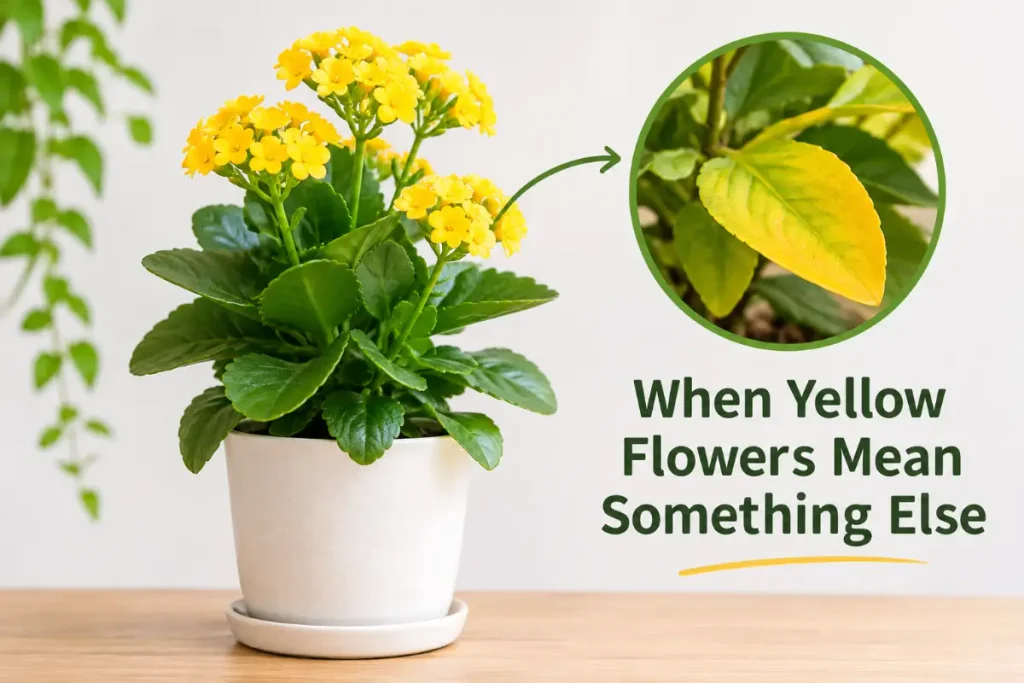
Yellowing leaves on a flowering plant: Distinct from yellow flowers — yellowing leaves while the plant is in or about to bloom often indicates overwatering, particularly in succulent-type yellow bloomers like kalanchoe. Check potting mix moisture before assuming a nutritional deficiency.
Leggy growth, few flowers: Too little light causes stems to elongate toward the light source rather than putting energy into flowers. Prune leggy growth back to encourage bushier, flower-producing stems, and improve the light situation at the same time.
Potting and Soil for Yellow-Flowering Houseplants
Different yellow bloomers have very different potting mix requirements — matching the mix to the plant type is as important as light and water for consistent flowering.
Succulents and succulent-type bloomers (kalanchoe): A fast-draining cactus and succulent mix, or standard potting mix combined with 30–40% perlite. These plants flower best when their roots dry out between waterings — dense, moisture-retaining mixes suppress flowering and invite root rot.
Orchids (oncidium, dendrobium): Orchid bark mix — never standard potting mix, which suffocates orchid roots. Repot every 2–3 years or when the bark breaks down and compacts.
Bulbs (freesia, calla lily): A well-draining standard potting mix works for most bulbs. Add 20–25% perlite to improve drainage if the base mix is dense.
Tropical bloomers (allamanda, abutilon, black-eyed susan vine): Standard indoor potting mix with good drainage is sufficient. These plants are heavier feeders than other houseplants — a balanced liquid fertilizer every 2 weeks during the growing season supports continuous flowering.
Short-term bloomers (primrose, calceolaria): Keep in the nursery potting mix they arrive in — these plants are purchased for their blooms rather than long-term cultivation, and repotting during the bloom period often accelerates decline.
When Yellow Flowers Mean Something Else
A brief clarification: some plants described as having “yellow flowers” are actually more accurately described as having yellow spathes, bracts, or modified leaves rather than true flowers. This matters for care, because the structures involved age differently:
Anthurium (yellow varieties): The yellow “flower” is actually a spathe (a modified leaf) surrounding a small true flower spike. The spathe lasts much longer than a conventional flower — 2–3 months is common. Yellow anthurium varieties are less common than red and pink but available from specialty houseplant retailers.
Peace lily with yellow tones: Peace lily spathes are white but age to a greenish-yellow — this is normal aging, not a problem. If spathes emerge already yellow or pale, insufficient light is usually the cause.
Understanding these distinctions helps set realistic expectations for bloom duration and appearance.
Conclusion
Finding a reliable indoor plant with yellow flowers takes a little more searching than other colors, but the options in this guide cover a wide range of conditions — from the beginner-friendly kalanchoe to the fragrant freesia to the dramatic allamanda vine. Match the plant to the light available (the single most important variable), respect rest periods for reblooming species, and yellow blooms will reward the effort with a warmth that few other flowering colors match indoors.
For comprehensive species profiles on flowering houseplants, the University of Florida IFAS Extension flowering houseplant guide covers cultural requirements for dozens of species suited to US indoor conditions.
FAQs
What is the easiest indoor plant with yellow flowers?
Kalanchoe is the easiest and most widely available. It blooms for 6–8 weeks with minimal care, tolerates low watering, and is sold at most grocery stores and garden centers. Yellow kalanchoe varieties are common alongside red and orange.
Why won’t my yellow-flowering houseplant rebloom?
The most common causes are insufficient light and skipping the rest period. Most flowering houseplants need a period of cooler temperatures, reduced watering, or shorter days to initiate the next bloom cycle. Move the plant to the brightest available window and allow a natural seasonal rest before expecting flowers.
Can I grow yellow-flowering plants in low light?
Most yellow-flowering houseplants need bright indirect light as a minimum. Truly low-light conditions (north-facing rooms, interior rooms away from windows) are not suitable for most bloomers. If light is the limiting factor, choose foliage plants for low-light positions and reserve the brightest spots for flowering plants.
Are yellow-flowering houseplants safe for pets?
It depends on the species. Kalanchoe is toxic to cats and dogs. Allamanda is toxic to children and pets. Calla lily is toxic if ingested. Oxalis is mildly toxic. Always check the ASPCA toxic plant database before adding a new flowering plant to a home with pets.
How long do yellow houseplant flowers last?
Kalanchoe: 6–8 weeks. Orchid spikes: 4–6 weeks. Calla lily: 3–4 weeks per bloom. Primrose: 3–5 weeks. Calceolaria: 4–6 weeks. Most yellow-flowering houseplants have bloom periods of 4–8 weeks per flush, with some (like abutilon) flowering almost continuously through the growing season.
Pingback: Indoor Plants with White Flowers: 14 Species for Elegant Displays - Plant Quill