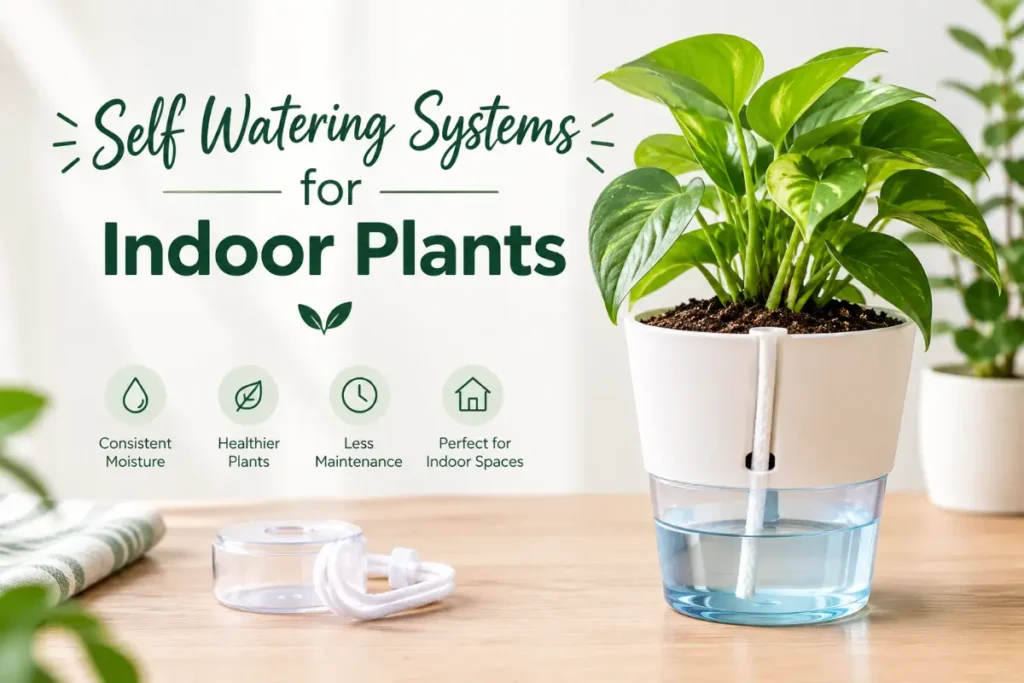
Self watering systems for indoor plants cover a range of solutions — from self-watering pots with integrated reservoirs, to wicking systems made from household items, to automated drip setups running from a timer and reservoir. What they share is the goal of delivering water to plant roots more consistently than hand-watering allows, with less active effort from the grower.
For indoor gardeners, self watering systems for indoor plants solve several real problems: the feast-and-famine watering cycle that stresses moisture-sensitive plants, the practical challenge of keeping plants alive during holidays, and the difficulty of maintaining consistent moisture for large indoor collections. This guide covers each system type in detail — what it does, when to use it, how to set it up, and which plants it suits best.
Why Consistent Watering Matters for Indoor Plants
Before choosing a system, it helps to understand why consistency is worth engineering for.
Most indoor plants — particularly popular tropical foliage species — evolved in environments where rainfall was relatively predictable and roots could access moisture through well-draining but consistently moist soil. The indoor growing environment is quite different: centrally heated homes with low humidity dry compost faster than outdoor conditions would, watering schedules are irregular, and the consequences of a missed watering are more severe in a pot with a limited root zone than in open ground.
The result is that many indoor plants spend their lives cycling between too-wet (immediately after watering) and too-dry (just before the next watering is remembered). Self watering systems for indoor plants smooth this cycle — delivering water gradually and allowing plants to draw moisture as they need it, which more closely replicates the consistent moisture availability of their natural growing environments.
Type 1: Self-Watering Pots
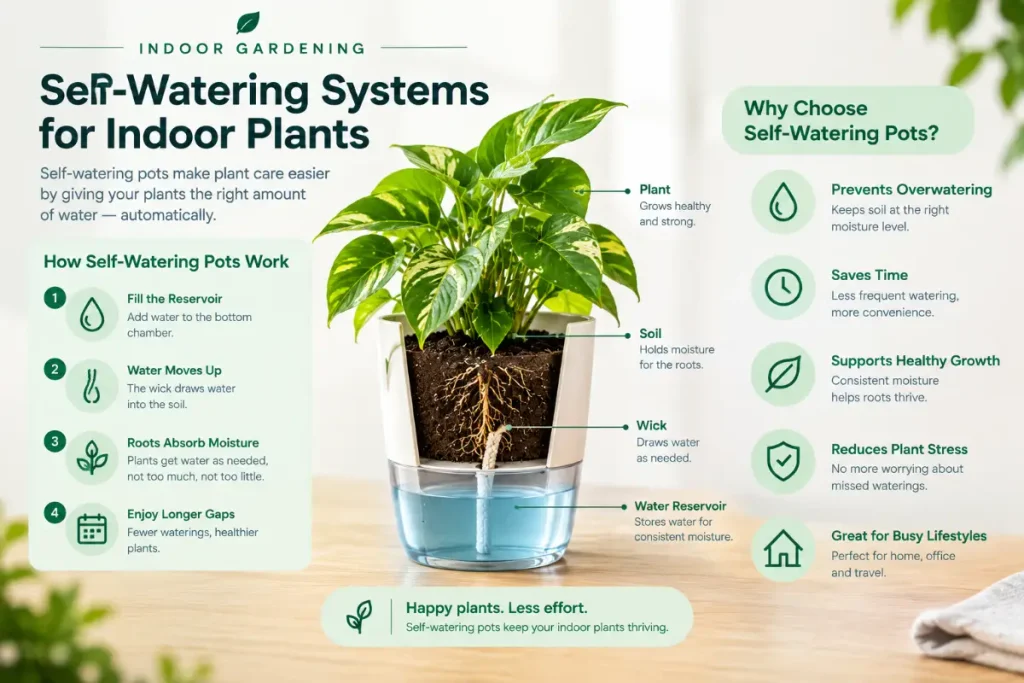
Self-watering pots are the most integrated and low-maintenance solution. They consist of a growing container that sits above a water reservoir, connected by a wick or drainage tube that allows water to move from the reservoir into the root zone through capillary action.
How they work: The plant’s compost draws water upward from the reservoir by capillary action as the roots extract moisture. The reservoir is filled from a fill tube at the top or side of the pot, and a float or indicator rod shows the water level. The grower fills the reservoir every 1–4 weeks depending on plant size, pot size, and environmental conditions — rather than checking and watering every few days.
Advantages: No additional setup required, aesthetically integrated, reliable for a wide range of moisture-loving plants, widely available at garden centres and online retailers.
Limitations: Not suitable for plants that need to dry out between waterings — succulents, cacti, and Mediterranean herbs do not benefit from continuous capillary moisture and may develop root rot in self-watering pots. Also, the reservoir must be allowed to empty and dry periodically (every 4–6 weeks) to prevent anaerobic conditions and algae build-up at the base.
Best plants for self-watering pots: Peace lilies, ferns, calatheas, pothos, spider plants, herbs that prefer consistent moisture (basil, mint, chives).
Setup: Fill the reservoir with water to the maximum fill line. Place the plant (in its growing compartment above the reservoir) in position. Top up the reservoir when the indicator shows low or empty. Flush the compost from the top every 4–6 weeks to clear any salt build-up from the growing medium.
Type 2: Wicking Systems
Wicking systems use an absorbent material — typically cotton string, fabric wicks, or lengths of shoelace — to draw water from a separate reservoir into the compost through capillary action.
How they work: One end of the wick is buried 5–8 cm into the compost, passing through the drainage hole or inserted directly into the pot from above. The other end sits in a water reservoir positioned below the pot. Water moves up the wick through capillary action as the compost dries, maintaining a degree of consistent moisture.
DIY wicking: The most accessible form of self watering system for indoor plants — all you need is cotton string or a cotton shoelace, and any container as the reservoir. Thread the wick through the drainage hole before potting, leave the lower section coiled in the bottom of the pot for improved moisture uptake, then run the external section into a jar or bowl of water placed below or beside the pot.
Advantages: Extremely inexpensive to set up, easily scaled to multiple plants by using a single large reservoir with multiple wicks, fully reversible — remove the wick and return to hand-watering instantly.
Limitations: Wicking systems work best for plants in small to medium pots (up to about 25 cm diameter). For large pots, the wick flow rate may not keep pace with plant water demand during active summer growth. The reservoir needs refilling every 1–3 weeks depending on the number of pots and plant size.
Best plants for wicking systems: Pothos, spider plants, peace lilies, African violets (particularly well suited — African violets dislike water on their leaves, making wicking from below ideal), ferns, small tropical foliage plants.
Type 3: Drip Irrigation Systems
Drip systems deliver water directly to the root zone through narrow tubes or drip emitters, controlled by a timer and fed from a reservoir or direct mains connection. They represent the most automated and scalable self watering solution for indoor plants.
How they work: A timer controls a small pump (for reservoir-fed systems) or a solenoid valve (for mains-connected systems) that releases water through distribution tubing into individual drip emitters positioned at the base of each plant. The timer is programmed to deliver water at set intervals — daily, every other day, or as required.
Types of indoor drip systems:
- Battery-powered timer with gravity-fed reservoir: A raised reservoir (bucket, drum, or commercial watering reservoir) connected by tubing to individual emitters. No electricity required at the emitter — the timer releases water from the elevated reservoir and gravity does the rest. Well suited to conservatories and indoor growing areas where mains water connections are unavailable.
- Pump-fed timer system: A small submersible pump sits in a reservoir (any container from 10 to 100 litres) and is connected to a timer. The timer activates the pump at programmed intervals, pushing water through distribution tubes to emitters. More reliable flow rates than gravity-fed systems.
- Mains-connected timer: Connects directly to an outdoor tap or indoor water supply through a micro-irrigation connector. No reservoir to fill — but requires a water connection and is more complex to install.
Full setup guidance: The companion post on drip irrigation for indoor plants covers drip system setup for indoor use in detail — including timer programming, emitter selection, and flow rate calibration for different pot sizes.
Advantages: Highly scalable — a single system can water 10, 20, or more plants simultaneously. Programmable to precise frequency and duration. Essential for large indoor collections, conservatories, and indoor growing systems (grow tents, hydroponic setups).
Limitations: More complex setup than pots or wicking. Requires periodic maintenance — checking emitter blockages, cleaning tubing, verifying timer function. Higher initial cost than simpler systems.
Best plants for drip systems: Any indoor plant collection, particularly mixed collections with different watering needs (by adjusting emitter flow rates per plant), and fruiting/edible plants that require consistent moisture during flowering and fruiting — indoor tomatoes, peppers, cucumbers.
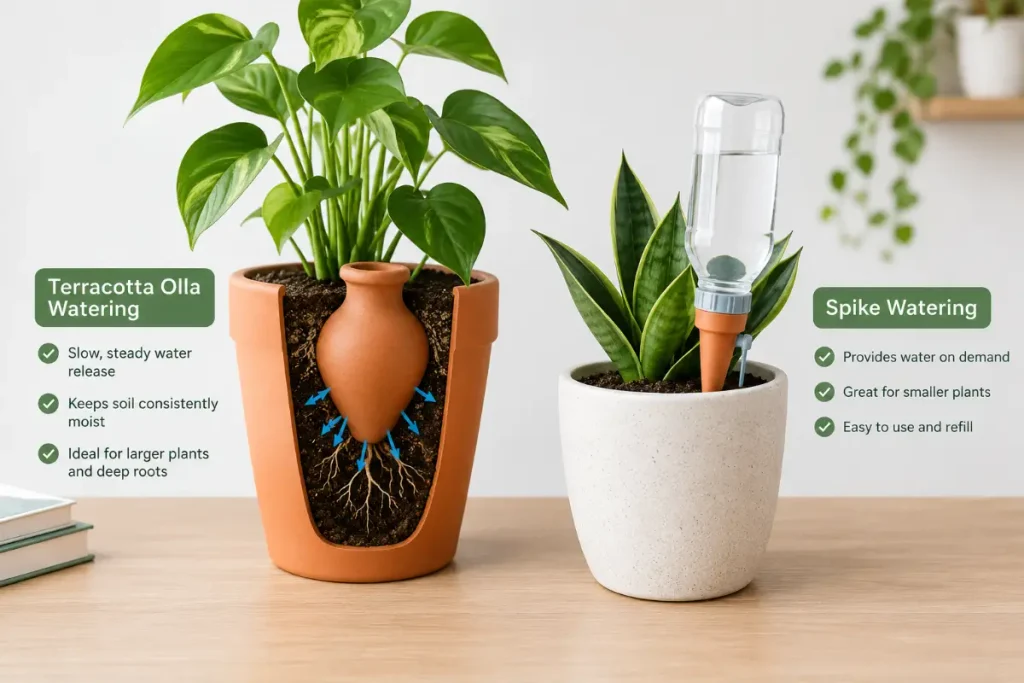
Type 4: Terracotta Olla and Spike Watering
A traditional approach that has seen renewed interest — terracotta ollas (porous clay vessels buried in the growing medium) and terracotta watering spikes (hollow cones inserted into the compost, connected to an inverted water bottle or reservoir).
How they work: Terracotta is naturally porous — water seeps slowly through the clay walls directly into the surrounding compost. An olla buried in a pot or raised bed releases water at exactly the rate the roots demand — as the compost dries and capillary tension increases, water moves through the clay more readily. A watering spike works on the same principle: the porous terracotta spike inserted in the compost draws water slowly from the inverted bottle above.
Advantages: Completely passive — no timers, no electricity, no pumps. Water is delivered precisely where roots are. Very low evaporation compared to surface watering. Terracotta spikes with inverted wine bottles are an elegant low-cost solution for single plants during holidays.
Limitations: Ollas must be refilled periodically (every 1–3 weeks). Commercial terracotta spikes vary considerably in quality — cheap versions may have inconsistent porosity. Flow rate cannot be adjusted for different plants.
Best for: Individual specimen plants during holidays, conservatory borders and large planters where burying an olla is practical, herbs and vegetables in larger indoor containers.
Type 5: Hydroponic and Semi-Hydroponic Systems
Semi-hydroponic systems — growing plants in inert media (LECA, perlite, pumice) with a standing water reservoir at the base — are a growing alternative to traditional soil-based growing for certain indoor plant collections.
How they work: Plants are grown in net pots or containers filled with expanded clay aggregate (LECA) or other inert media. A reservoir at the base of the pot holds water, and the LECA wicks moisture upward to the roots. Nutrient solution is added to the reservoir rather than applied as liquid fertiliser to soil.
Advantages for the right plants: Consistent moisture delivery, eliminates the guesswork of when to water, significantly reduces root rot risk (roots in LECA are never truly waterlogged), and reduces pest pressure (no organic soil for fungus gnats). A growing community of indoor plant growers has transitioned tropical aroids — Monstera, Philodendron, Pothos, Hoyas — to semi-hydroponic setups with good results.
Limitations: Transition from soil to LECA requires careful root washing and an adaptation period. Not suitable for all plants — particularly those with fine, soil-dependent root systems. Requires nutrient solution management that soil-based growing does not.
Choosing the Right Self Watering System
| System | Best For | Initial Cost | Maintenance |
|---|---|---|---|
| Self-watering pots | Individual moisture-loving plants | Low–Medium | Monthly reservoir refill |
| Wicking systems | Small collections, holiday watering | Very low | Weekly–fortnightly refill |
| Drip irrigation | Large collections, edibles | Medium–High | Periodic emitter checks |
| Terracotta spikes/ollas | Single plants, holidays | Low | Weekly–fortnightly refill |
| Semi-hydroponics | Aroids and tropical foliage | Medium | Nutrient solution management |
The most important factor is matching the system to the plant’s watering requirements. Self watering systems for indoor plants deliver consistent moisture — which suits moisture-loving plants but can damage dry-preferring ones. Using a moisture meter for indoor plants to calibrate any new system to each plant’s specific needs prevents overwatering during the adjustment period.
Self Watering Systems for Holiday Plant Care
The most common trigger for investigating self watering systems for indoor plants is an upcoming holiday. A two-week absence is long enough to kill plants that need regular watering, and the combination of summer heat and reduced attention is particularly high-risk.
For up to 1 week: Wicking systems from a large reservoir and terracotta spikes with inverted wine bottles both work reliably for most indoor plants for a week. Move plants away from south-facing windows to reduce water demand.
For 1–2 weeks: Self-watering pots with large reservoirs, or a drip timer system with a 10–20 litre reservoir, are the most reliable options. Group plants together in a cool, bright position to reduce individual water demand.
For longer absences: A programmed drip system with sufficient reservoir capacity, or arranging for someone to visit and refill wicking reservoirs, is the practical solution. Automatic systems should be tested for a full week before departure to confirm they are delivering water correctly. The post on indoor plant watering schedule covers pre-holiday watering preparation in detail.
Maintaining Self Watering Systems
Any self watering system for indoor plants requires periodic maintenance to continue functioning reliably. The specific tasks depend on the system type.
Self-watering pots:
- Empty the reservoir completely every 4–6 weeks to prevent anaerobic conditions and algae build-up at the base of the pot
- Flush the compost from the top with plain water at the same interval to remove salt accumulation from fertiliser and tap water minerals
- Check the wicking connection between the reservoir and the growing compartment annually — wicks can become clogged with mineral deposits or root material over time
- If algae growth appears in the reservoir, empty, clean with a dilute solution of one part white vinegar to ten parts water, rinse thoroughly, and refill
Wicking systems:
- Inspect wicks every 2–3 months for mineral build-up — white deposits on the wick reduce its capillary efficiency. Replace wicks annually or when flow appears to have slowed
- Clean reservoirs monthly to prevent algae growth, particularly in summer when temperatures are higher and algae grow faster
- If a plant appears dry despite the wicking system being in place, check that the wick has not separated from the compost — the wick must remain in contact with the compost throughout its run
Drip systems:
- Check emitter flow rates monthly by measuring output over a set period (e.g., how much water each emitter delivers in one minute) — emitters clog gradually with mineral deposits, reducing flow rate
- Soak clogged emitters in dilute white vinegar for 30 minutes to dissolve mineral deposits, then rinse and reinstall
- Inspect tubing for kinks, blockages, or rodent damage (in conservatory environments)
- Clean the pump filter every 2–3 months — the filter prevents debris from the reservoir entering the pump and tubing
- Verify timer battery life before holidays — a dead timer battery is the most common cause of drip system failure during absences
Terracotta spikes:
- Clean spikes between uses by soaking in water for 24 hours to rehydrate the clay fully
- Check for hairline cracks that develop with age — cracked spikes release water too rapidly
- Store dry between seasons to prevent mold growth
Self Watering Systems for Edible Indoor Plants
Growing food indoors — tomatoes, chillies, cucumbers, herbs, salad leaves — benefits particularly from self watering systems because consistent moisture is critical to productive cropping.
Tomatoes and peppers: These are high-water-demand crops during flowering and fruiting, and irregular watering is one of the primary causes of blossom end rot (a calcium deficiency caused by inconsistent moisture uptake) and fruit splitting. A drip system calibrated to deliver consistent daily moisture is the most effective solution for indoor fruiting plants. The plant requires different volumes at different growth stages — less during establishment, more during flowering and fruiting — so a programmable timer allows adjustment as the season progresses.
Herbs: For kitchen herbs grown on a windowsill or under grow lights, a simple wicking system from a shared reservoir is an effective and low-cost solution. Basil, mint, chives, and parsley all prefer consistently moist compost and grow productively with wicking moisture from below. Mediterranean herbs (rosemary, thyme, lavender) should not be wicked — they need to dry between waterings and are better hand-watered with careful frequency management.
Salad leaves and microgreens: Fast-growing salad crops benefit from bottom watering — placing the growing tray in a shallow reservoir of water and allowing the compost to absorb from below. This also keeps leaf surfaces dry, reducing the risk of fungal issues on the growing crop. Bottom watering is the simplest form of self watering for short-cycle crops.
Strawberries: Indoor strawberries grown in pots under grow lights benefit from self-watering pots — consistent moisture during fruit development prevents the skin cracking and flavour dilution that results from feast-and-famine watering cycles.
The broader context of growing food indoors, including irrigation and environmental management for productive indoor food crops, is covered in detail in the posts on growing lemon trees indoors and indoor tomato growing with grow lights.
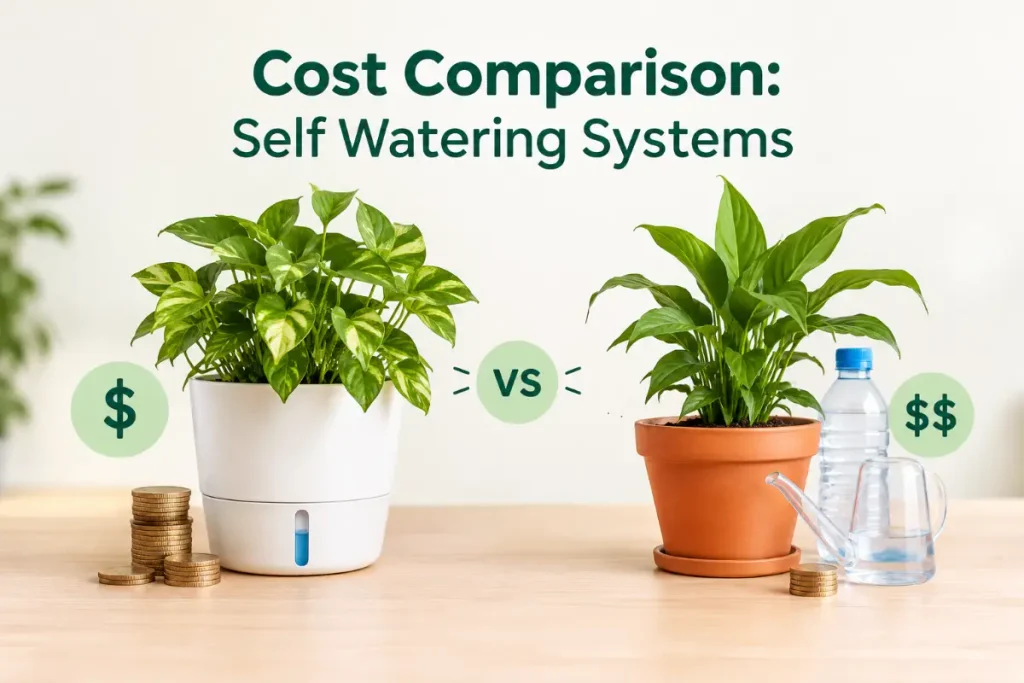
Cost Comparison: Self Watering Systems
For those making a practical purchasing decision, a rough cost guide:
DIY wicking system: Under £2 — cotton string (or repurposed cotton shoelace) and any available container as reservoir. Scales to multiple plants with negligible additional cost.
Commercial wicking systems (e.g., Plant Nanny, Blumat spikes): £3–8 per spike, with terracotta options at the higher end. A set of 5–10 spikes covers a small to medium collection.
Self-watering pots: £5–30 per pot depending on size and quality. A 15 cm pot with integrated reservoir is available from around £5; larger decorative options cost more. Quality matters — cheap self-watering pots often have poorly designed wicking connections that deliver inconsistent moisture.
Gravity-fed drip timer kit: £20–50 for a basic kit covering 10–20 plants. Includes timer, distribution tubing, and emitters. Requires a raised reservoir (a bucket or commercial container purchased separately).
Pump-fed automated drip system: £40–120 for a complete system covering 20–40 plants, including pump, timer, reservoir, and distribution components. The investment is justified for collections of 20+ plants or for productive indoor food growing setups.
Semi-hydroponic setup per plant: £3–10 per plant for LECA (1–2 litres) plus a suitable net pot and outer reservoir. Scales economically across a collection once LECA is purchased in bulk.
For most indoor gardeners with a collection of 5–15 plants, the combination of self-watering pots for the highest-maintenance moisture-loving plants and DIY wicking for holiday cover represents the most cost-effective entry into self watering systems for indoor plants — under £50 total for a well-covered collection of medium size.
Conclusion
Self watering systems for indoor plants range from a length of cotton string in a jar of water to fully programmed drip irrigation covering dozens of plants simultaneously. The right choice depends on the size of your collection, the specific moisture requirements of your plants, and how much automation is genuinely needed. For most indoor gardeners, a combination of self-watering pots for moisture-loving tropicals and a simple wicking or spike system for holiday cover represents the most practical and cost-effective approach. For larger collections or indoor food-growing setups, a timer-controlled drip system is worth the additional setup effort.
The RHS watering advice provides guidance on watering principles and technology that underpins all self-watering system selection.
FAQs
What is the simplest self watering system for indoor plants?
A wicking system using cotton string and a jar of water is the simplest — thread a cotton wick through the drainage hole, coil one end in the compost, and place the other end in a jar of water beneath the pot. No equipment beyond string and a jar is needed, and it works reliably for small to medium pots.
Are self-watering pots suitable for all indoor plants?
No — self-watering pots continuously provide capillary moisture, which suits moisture-loving plants (ferns, calatheas, pothos, peace lilies) but risks overwatering for plants that need to dry between waterings (succulents, cacti, lavender, rosemary). Use self-watering pots only for plants that prefer consistent moisture.
How long will a self-watering pot keep my plants alive while I am on holiday?
Depends on pot and reservoir size, plant species, and indoor temperature. Most self-watering pots with a full reservoir last 1–3 weeks for medium-sized plants in average indoor conditions. Larger reservoir pots, and positioning plants in a cool, bright but not sun-facing position before departure, extends this period.
What is the best self watering system for a large indoor plant collection?
A timer-controlled drip system with a pump and reservoir is the most scalable solution for large collections — it can water 10–40+ plants simultaneously, is programmable to precise frequency, and requires only periodic reservoir refilling and emitter maintenance.
Can I make a wicking system from materials I already have?
Yes — cotton string, a cotton shoelace, or strips of cotton fabric all work as wicks. Any container (jar, bowl, bucket) can serve as the reservoir. The key is using natural cotton fibre, which has good capillary properties. Synthetic string or nylon does not wick water effectively.
Do self-watering systems prevent overwatering?
They reduce the risk of the feast-and-famine watering cycle but do not eliminate overwatering risk. Self-watering pots in particular can over-supply moisture in winter when plant growth slows. Allow the reservoir to empty completely every 4–6 weeks and check compost moisture with a meter during the adjustment period.
How do I set up a drip system for indoor tomatoes?
Position drip emitters at the base of each tomato plant, connected by micro-tubing to a pump in a 10–20 litre reservoir. Program the timer to deliver water once or twice daily in small volumes (200–500 ml per plant per day) during the fruiting period. Adjust frequency based on pot size and compost moisture — check with a moisture meter initially until you have calibrated the system to each plant’s needs.
Are terracotta watering spikes reliable for holiday plant care?
For most standard indoor foliage plants in pots up to 25 cm, a quality terracotta spike with a 750 ml inverted wine bottle will last approximately 5–10 days depending on temperature and plant water demand. Test the system for 3–4 days before departure to confirm the flow rate is adequate for each plant.
Should I use tap water or rainwater in a self-watering reservoir?
Rainwater is preferable for moisture-sensitive plants such as calatheas, ferns, and carnivorous plants, as it is free from the chlorine, chloramine, and fluoride in tap water. For most other indoor plants, tap water in a self-watering reservoir is acceptable. Empty and clean reservoirs regularly to prevent algae growth.
How often do I need to refill the reservoir in a self-watering system?
Varies by system and plant: self-watering pots typically need refilling every 1–3 weeks; wicking system reservoirs every 1–2 weeks; drip system reservoirs every 1–4 weeks depending on reservoir size and number of plants. During summer or in warm rooms, refill more frequently; in winter, less often.