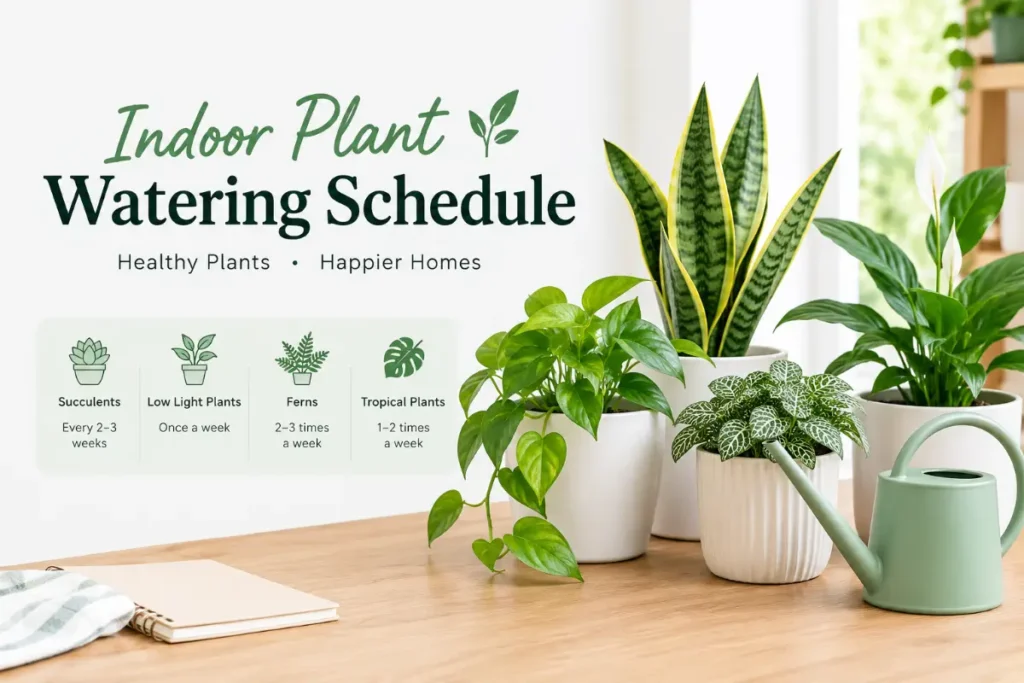
An indoor plant watering schedule sounds like the solution to the most common plant care problem — forgetting to water or watering too much. The reality is more nuanced. A rigid calendar schedule (water every Tuesday and Friday) causes more plant problems than it solves because plants do not consume water on a fixed schedule. Their water demand varies with season, light, temperature, pot size, soil type, and their own growth rate. A schedule that suited them in summer will overwater them in winter.
What actually works is a structured checking routine with flexible watering decisions based on soil moisture. This guide shows you how to build that routine — organized by plant group, adjusted seasonally, and anchored by the soil check that makes every watering decision accurate rather than guessed.
Quick Answer
Build your indoor plant watering schedule around a weekly soil-check routine rather than fixed watering days. Group your plants by moisture need (moisture-loving, standard tropical, drought-tolerant). Check each group at their appropriate soil depth once a week and water only the plants that the check indicates are ready. Adjust checking frequency by season — more frequent in summer, less frequent in winter. This approach prevents both overwatering and underwatering across a diverse collection better than any fixed calendar schedule.
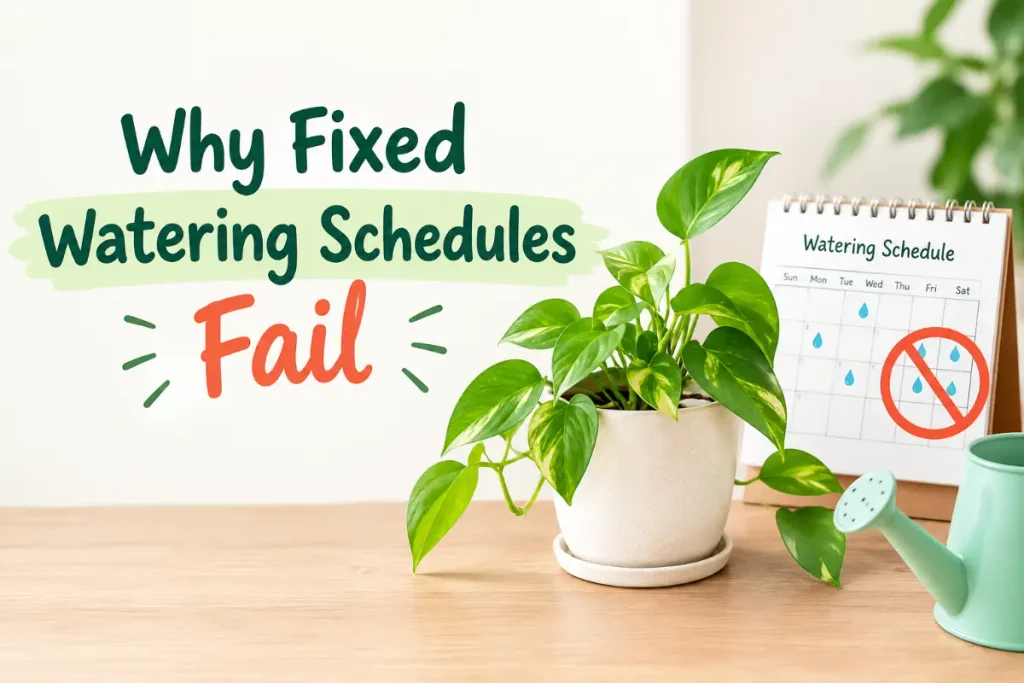
Why Fixed Watering Schedules Fail
Fixed watering schedules fail because they attempt to impose human calendar regularity on a biological process that responds to environmental conditions rather than dates.
The summer-winter problem: A plant that needs water every seven days in summer may need water only every twenty-one days in winter. Reduced light in winter slows photosynthesis and transpiration, dramatically reducing water demand. Maintaining summer watering frequency through winter is one of the most common causes of winter plant decline in US homes.
The position variable: Two identical plants in identical pots with identical soil — one on a south-facing windowsill receiving six hours of direct sun, one on a north-facing shelf receiving no direct sun — will have dramatically different watering needs. The south-facing plant may need water twice as frequently as the north-facing one. A single schedule applied to both will overwater one and potentially underwater the other.
The new plant problem: A new plant recently purchased from a nursery arrives in soil, pot, and light conditions that may differ completely from your home. Its watering need in your specific conditions must be established empirically by observation rather than assumed from a general schedule.
What a schedule should actually do: A watering schedule should prompt you to check plants regularly and consistently. The schedule creates the checking habit. The soil determines the watering decision. This is the approach that produces consistently healthy plants across a diverse collection.
Step 1: Group Your Plants by Moisture Need
Before building any schedule, categorize every plant in your collection into one of three moisture groups. This grouping determines both the soil check depth and the general expected interval between waterings.
Group 1 — Moisture-loving plants (check at half-inch to one-inch depth): Peace lily, calathea, maranta, maidenhair fern, Boston fern, nerve fern, baby tears, and most moisture-loving herbs including basil and mint. These plants prefer consistently moist soil and show stress quickly when soil dries beyond one inch. Check at one inch depth and water when that depth feels dry.
Expected interval: Every four to seven days in summer. Every seven to ten days in winter.
Group 2 — Standard tropical houseplants (check at one to two inch depth): Pothos, philodendron, monstera, spider plant, rubber plant, dracaena, ZZ plant, snake plant, peace lily (can also be Group 1), Chinese evergreen, dieffenbachia, and most common foliage houseplants. These plants want to dry moderately between waterings without reaching drought stress.
Expected interval: Every seven to fourteen days in summer. Every fourteen to twenty-one days in winter.
Group 3 — Drought-tolerant plants (check at two to three inch depth): Cacti, succulents, aloe vera, haworthia, rosemary, lavender, thyme, and other Mediterranean herbs. These plants need extended dry periods between waterings and are damaged by the consistently moist soil that Group 1 plants prefer.
Expected interval: Every ten to fourteen days in summer. Every three to six weeks in winter.
Step 2: Set a Weekly Checking Routine
With your plants grouped, set a single recurring weekly reminder — not to water, but to check. Sunday morning, Wednesday evening, or whenever fits consistently into your week. The specific day matters less than the consistency.
The checking session: Move through your collection with your finger or a moisture meter. Check Group 1 plants at one inch. Check Group 2 plants at one to two inches. Check Group 3 plants at two to three inches. Water any plant where the check indicates dryness at the appropriate depth. Skip any plant where the check indicates remaining moisture.
Time required: For a collection of twenty plants, a weekly checking and watering session takes fifteen to twenty minutes. For smaller collections, five to ten minutes. This is the total weekly time investment for a checking-based schedule — less than most plant owners spend on plant-related anxiety about whether they are watering correctly.
What to record (optional): For larger collections or new plant owners building their understanding of each plant’s patterns, a simple notebook or phone note recording which plants were watered each week helps identify patterns. After three to four weeks of observation, you know which plants always need water at the weekly check (potential underwatering or very fast drying) and which almost never need it (slow drying position or potential overwatering risk).
Step 3: Seasonal Adjustments to the Schedule
The weekly checking session remains constant year-round, but what you find when you check changes dramatically with the seasons.
Spring (March to May — growth resuming): Day length increases in spring, triggering new growth across most indoor plant species. Water demand increases as growth accelerates. Plants that needed water every fourteen days in winter may need it every seven to ten days by mid-spring. Increase checking frequency for Group 1 plants from weekly to every five days through early spring transition.
Begin fertilizing at reduced rate as new growth appears. Spring is also the best time for repotting, which temporarily reduces water demand as disturbed roots re-establish.
Summer (June to August — peak demand): Maximum water demand across all groups. High temperatures and longer days drive maximum transpiration and growth. Check Group 1 plants every five to six days rather than waiting for the full weekly interval if they showed signs of drought at recent checks. Keep weekly checks for Groups 2 and 3.
Air conditioning reduces indoor humidity, which increases plant water demand compared to naturally humid summer conditions. Monitor plants near air conditioning vents — they may dry faster than plants in other positions.
Fall (September to November — demand reducing): Extend checking intervals gradually as day length shortens. Plants that needed water every seven days in summer may be ready every ten to twelve days by late October. Begin reducing fertilizing frequency through fall in preparation for winter dormancy.
Watch for houseplants brought in from outdoor summer positions — they need a two to three week adjustment period as they adapt from outdoor humidity and light to indoor conditions, and their watering needs may shift during this transition.
Winter (December to February — minimum demand): Minimum water demand across all groups. Reduced light slows photosynthesis and growth, dramatically reducing water uptake. Group 1 plants that needed water weekly in summer may need it every ten to fourteen days. Group 3 drought-tolerant plants may need water only once a month or less.
The most common winter plant mistake is maintaining summer watering frequency through winter. The weekly check prevents this — soil simply will not be dry at the appropriate depth within seven days during winter dormancy, so the check naturally reduces watering frequency as conditions change.
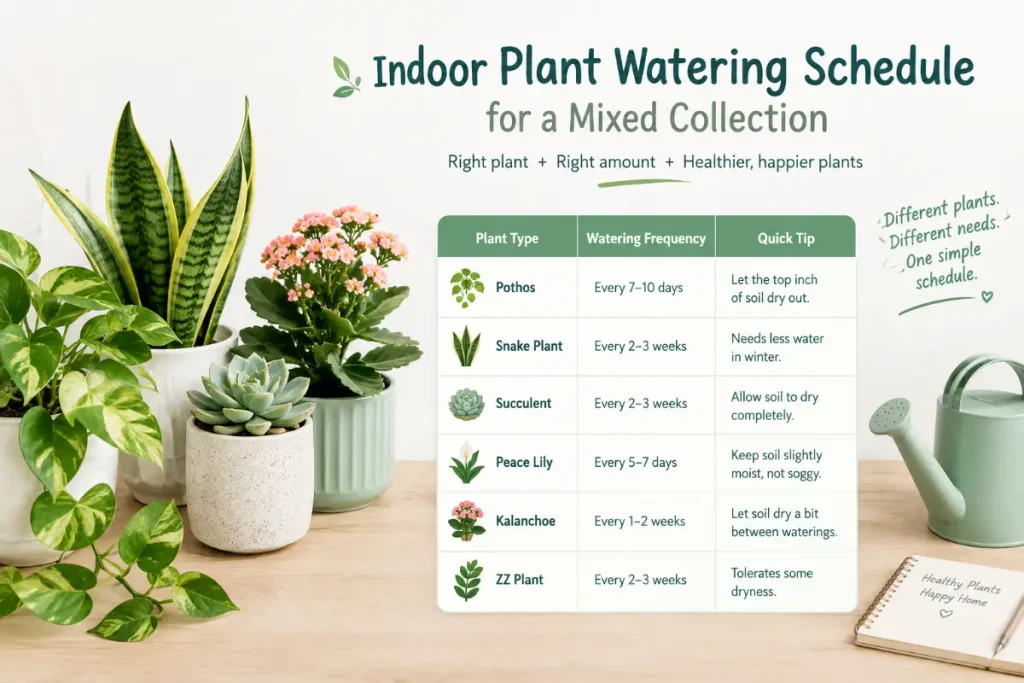
Sample Watering Schedule for a Mixed Collection
Here is a practical example schedule for a collection of fifteen plants across all three groups.
The collection: Group 1 (moisture-loving): Peace lily, calathea, maidenhair fern (3 plants) Group 2 (standard tropical): Pothos, monstera, philodendron, spider plant, ZZ plant, rubber plant, dracaena, Chinese evergreen (8 plants) Group 3 (drought-tolerant): Aloe vera, echeveria, haworthia, rosemary (4 plants)
Summer schedule: Every Sunday: Check all Group 1 plants at one inch. Water those that are dry — likely all three most weeks. Every Sunday: Check all Group 2 plants at one to two inches. Water those that are dry — typically five to seven of the eight plants each week. Every Sunday: Check all Group 3 plants at two to three inches. Water those that are completely dry — typically one to two plants per week.
Winter schedule: Every Sunday: Check all Group 1 plants at one inch. Water those that are dry — typically two of three plants. Every Sunday: Check all Group 2 plants at one to two inches. Water those that are dry — typically two to four plants. Every Sunday: Check all Group 3 plants at two to three inches. Water those that are completely dry — typically zero to one plant per month.
This single weekly session handles the entire fifteen-plant collection in fifteen minutes year-round while automatically adjusting to seasonal demand changes through the soil check rather than calendar assumptions.
Adjusting the Schedule for Specific Situations
After repotting: Reduce watering frequency for four to six weeks after any repot. Disturbed roots take up water more slowly than established roots. The weekly check will naturally show slower drying during this period — trust the check and do not assume the plant needs water on its pre-repotting schedule.
After a vacation: Do not water all plants immediately upon return from a trip out of guilt or assumption of drought. Check each plant at the appropriate depth. Many plants — especially Group 2 and 3 — will be fine after a ten to fourteen day absence. Water only those that the check indicates are ready.
New plants: Check new plants daily for the first two weeks to establish their actual drying rate in your specific home conditions. After two to three observed dry cycles, you know how this plant behaves in your home and can integrate it into the weekly checking routine with confidence.
Plants that consistently dry before the weekly check: A plant that is always dry at the weekly check and showing mild drought stress (slightly less firm leaves) needs either more frequent checking (every five days) or a move to a position where it dries more slowly, or consideration of a self-watering pot. For the complete guide to self-watering solutions for moisture-demanding plants, self-watering pots for indoor plants covers every option for plants that consistently need more moisture than a weekly watering routine provides.
Using Apps and Reminders to Support Your Schedule
Technology tools can support the checking habit without replacing the judgment that soil checks provide.
Phone reminders: A simple weekly phone alarm labeled “check plants” is the most reliable way to maintain the checking habit. Set it for a consistent time when you are reliably home and unhurried — Sunday morning with coffee is a common choice. The reminder prevents the forgetting that causes underwatering without imposing the rigid watering-on-demand that causes overwatering.
Plant care apps: Several plant care apps (Greg, Planta, and others) track watering history and provide care reminders. These apps are most useful for new plant owners building their understanding of each plant’s patterns and for large collections where tracking individual plant histories provides useful pattern data. The app reminds you to check — the soil check still determines whether you water.
Photography tracking: Photographing plants monthly provides a reference for subtle changes in size, color, and leaf quality that are difficult to notice day-to-day. Comparing a photo from three months ago to today shows whether the plant is growing well and whether the current schedule is producing healthy outcomes. This is particularly useful for slow-growing plants where daily observation reveals little.
For the complete guide to the soil check method that determines watering decisions within your schedule, how often to water indoor plants covers the depth-specific checking technique for every plant category that makes the schedule described in this guide work accurately across a diverse collection.
Common Schedule Mistakes and How to Correct Them
Even with a checking-based approach, certain patterns indicate the schedule needs refinement.
Mistake: Checking but not adjusting. Some plant owners develop a checking habit but override what they find based on gut feeling (“it looks dry on top so I’ll water it”) or worry (“it’s been a week, it must need water by now”). Trust the check. The check depth is calibrated to the plant’s root zone, not the surface. A dry surface with moist soil below the check depth means the plant does not need water yet regardless of how long it has been.
Mistake: Grouping plants incorrectly. A plant placed in Group 2 (standard tropical) that actually prefers Group 1 moisture levels will consistently show drought stress between weekly checks. Observe each new plant for two to three dry cycles before finalizing its group placement. Plants that wilt, show brown tips, or look generally stressed between checks may need to move to a higher-frequency group or a moister microenvironment.
Mistake: Not adjusting for position changes. Moving a plant to a new position — a brighter window, a shelf closer to a heat vent, a spot in a humid bathroom — changes its drying rate without changing its group membership in your schedule. Reassess drying rate after any position change by checking every three to four days for two weeks until the new pattern is established.
Mistake: Seasonal schedule inertia. The most common version of this mistake is continuing summer watering into fall and winter without noticing the seasonal signal in the soil checks. The signal is there — plants simply stop being dry at the weekly check as frequently as they were in summer. If you notice you are watering Group 2 plants less often than your summer frequency without having consciously adjusted, that is the schedule working correctly through the check-based approach.
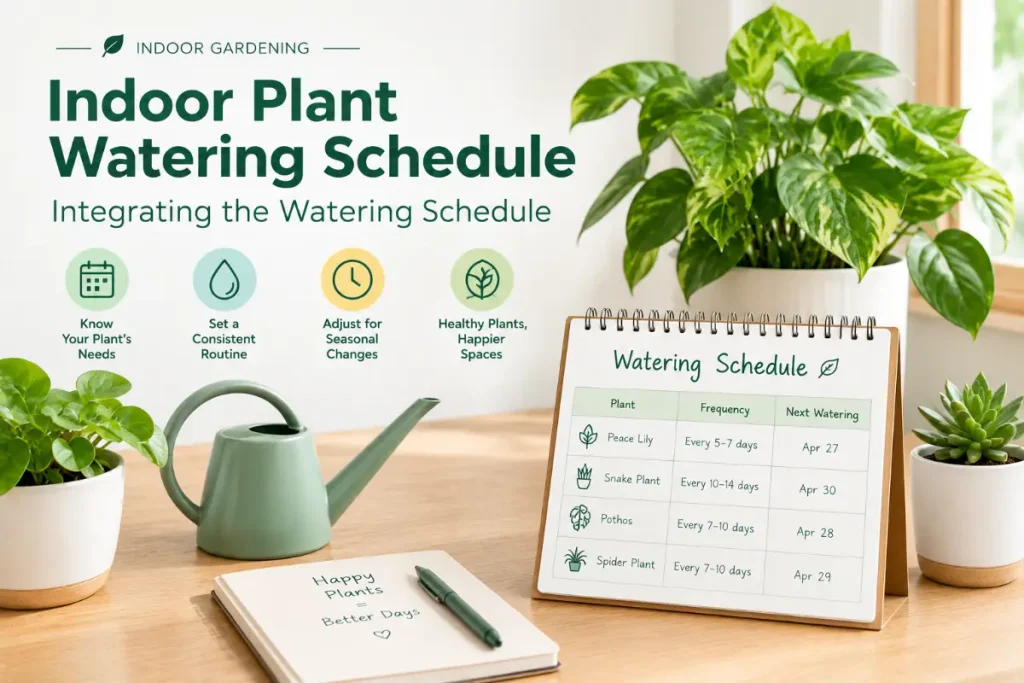
Integrating the Watering Schedule With Other Plant Care Tasks
The weekly checking session is a natural anchor for other regular plant care tasks that also benefit from consistent scheduling.
Pest inspection: The close attention required during the soil checking session is ideal for a quick pest inspection. Check leaf undersides for spider mites, aphids, and mealybugs while your hands are already around the plant. Early detection during routine checking prevents infestations from reaching damaging levels. For the complete guide to identifying and treating the most common indoor plant pests, how to get rid of spider mites on indoor plants covers the identification and treatment of the pest most commonly found during routine plant inspection.
Leaf cleaning: While checking soil moisture, wipe dust from large smooth leaves with a damp cloth monthly. Dust accumulation reduces photosynthetic efficiency by blocking light absorption and clogging stomata. Monthly leaf cleaning during the watering session adds five minutes to the routine and meaningfully improves plant health in dusty indoor environments.
Fertilizing integration: During the active growing season (spring through summer), add diluted liquid fertilizer to the watering can during one watering session per month for Group 1 and Group 2 plants. This integration prevents the separate task of fertilizing from becoming an afterthought that gets skipped. For Group 3 drought-tolerant plants, fertilize once in spring and once in early summer at the recommended dilution rate. For the complete guide to fertilizing timing and rates for indoor plants, how often to fertilize indoor plants covers every aspect of integrating fertilizing into an efficient plant care routine.
New growth assessment: The weekly session is the right moment to notice and record new growth — new leaves unfurling, stems lengthening, flower buds developing. This weekly observation builds the pattern awareness that tells you when a plant’s growth has slowed or stopped, which is often the first signal of a care problem (inadequate light, root-bound conditions, soil degradation) before visible symptom damage appears.
Conclusion
An effective indoor plant watering schedule is a checking schedule, not a watering calendar. Set weekly reminders to check every plant at the appropriate soil depth for its group. Water only those that the check indicates are ready. Adjust what you find — not when you check — with the seasons. Track patterns for new plants until you know their specific behavior in your home.
This approach takes fifteen to twenty minutes per week for most home collections, eliminates both overwatering and underwatering as chronic problems, and adapts automatically to seasonal changes without requiring manual schedule updates. It is the sustainable, accurate watering practice that keeps diverse collections of plants with different needs all thriving under one consistent routine.
Frequently Asked Questions
How often should I water my indoor plants?
It depends on the plant type. Moisture-loving plants (peace lily, ferns, calathea) need checking every five to seven days and watering when the top inch of soil is dry. Standard tropical plants (pothos, monstera, philodendron) need checking weekly and watering when the top one to two inches are dry. Drought-tolerant plants (cacti, succulents, Mediterranean herbs) need checking every ten to fourteen days and watering only when completely dry at two to three inches. Always check soil before watering rather than following a fixed interval.
Should I water all my plants on the same day?
You can check all plants on the same day — this creates an efficient weekly routine. But you should water only the plants that the check indicates need water, not all plants on the same day automatically. Some plants in your collection will be ready for water at the weekly check while others still have adequate moisture. Watering all plants on a fixed day regardless of moisture level is the most common cause of overwatering in mixed collections.
How do I know if my watering schedule is working?
Healthy plants with your current schedule show: firm, appropriately sized leaves, consistent new growth during the growing season, stable plant color without yellowing or browning, and soil that alternates between moist after watering and appropriately dry before the next watering. If plants show yellowing lower leaves and stay wet for extended periods, reduce watering frequency. If plants show brown tips, slight wilting, or seem to be always dry at the weekly check, increase checking frequency.
How does a watering schedule change in winter?
In winter, reduced light slows plant growth and dramatically reduces water demand. Most plants need water two to three times less frequently in winter than in summer. Maintain the same weekly checking routine but expect to find fewer plants ready for water at each check. Do not maintain summer watering frequency through winter — the weekly soil check will naturally show soil staying moist longer as the season changes.
Can I use a plant watering app instead of checking soil?
Plant care apps are useful for tracking watering history and building pattern awareness, but they cannot replace soil checks. Apps base their reminders on general species information rather than the specific conditions of your home, your pot size, your soil mix, and your seasonal light levels. Use an app as a reminder to check — then check the soil and make the actual watering decision based on what you find, not what the app suggests.
How do I build a watering schedule for a large collection?
Group plants by moisture need and check group by group rather than plant by plant individually. Set up a single weekly checking session with a phone reminder. For collections over thirty plants, a moisture meter speeds up the checking routine significantly. Consider self-watering pots for the moisture-loving plants in the collection that most frequently need water — this reduces the active watering load by removing the most high-frequency plants from the weekly manual routine.