
Self-watering pots for indoor plants generate more divided opinion than almost any other plant care product. Enthusiastic users credit them with transforming their plant care, eliminating the guesswork of watering schedules, and keeping moisture-loving plants consistently healthy with far less attention. Skeptical users report plants that rotted despite the self-watering design, or pots that seemed to do nothing useful for their collection.
Both groups are right about their specific experiences because self-watering pots genuinely work very well for some plants and genuinely cause problems for others. The variable that determines which outcome you get is almost entirely about plant selection: self-watering pots are excellent for moisture-loving plants and actively harmful for drought-tolerant plants. Understanding this distinction clearly before purchasing saves money and plants.
Quick Answer
Self-watering pots work well for moisture-loving plants including peace lily, pothos, ferns, calathea, herbs like mint and basil, and leafy greens. They are not appropriate for cacti, succulents, snake plant, ZZ plant, or any plant that needs extended dry periods between waterings. The built-in reservoir provides consistent bottom moisture that benefits moisture-preferring plants while causing root rot in drought-tolerant species. A quality self-watering pot costs $15 to $60 depending on size and is worth the investment for the right plant types.
How Self-Watering Pots Actually Work
Understanding the mechanism clarifies both why they work for some plants and why they fail for others.
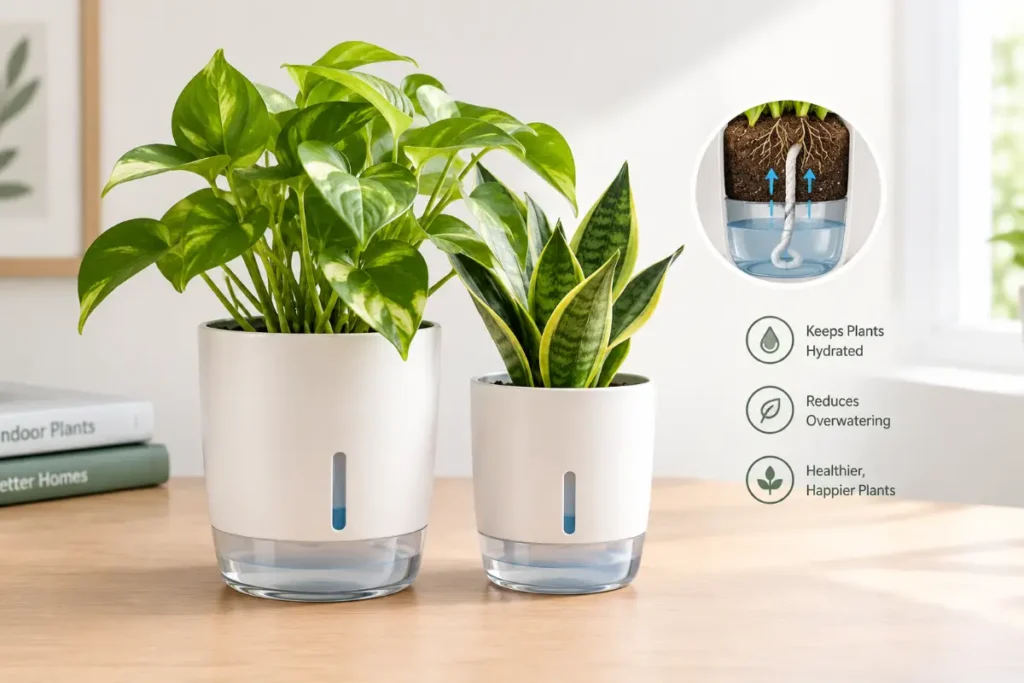
A self-watering pot consists of two chambers: an upper growing chamber containing the plant and potting mix, and a lower reservoir chamber that holds water. A wick, capillary mat, or perforated plate connects the two chambers. As the soil in the growing chamber dries, capillary tension draws water upward from the reservoir into the lower portion of the growing medium, maintaining consistent moisture near the lower root zone.
The upper portion of the growing medium remains drier than the lower portion. This creates a moisture gradient within the pot — drier at the surface, consistently moist at depth. Plants that draw water upward from this consistently moist lower zone thrive. Plants that need their entire root zone to dry periodically suffer because the lower root zone never fully dries regardless of how the surface is managed.
The fill tube: Most self-watering pots have a fill tube that allows refilling the reservoir without disturbing the plant or watering through the soil surface. The reservoir level is visible through an indicator window or float indicator on most designs.
Reservoir capacity: Self-watering pot reservoirs range from approximately half a liter in small pots (four to six inches) to two to three liters in large statement pots (twelve to fourteen inches). Reservoir capacity relative to plant water demand determines how frequently the reservoir needs refilling — typically every one to two weeks for actively growing moisture-loving plants in warm conditions.
Plants That Benefit Most From Self-Watering Pots
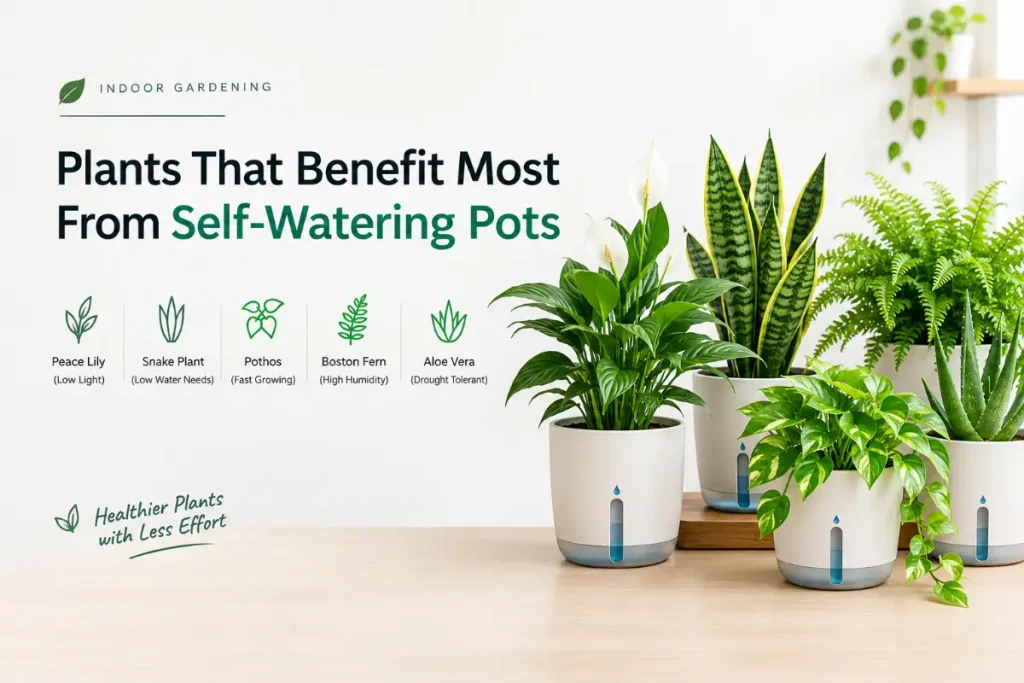
Peace lily (Spathiphyllum): The single plant that benefits most dramatically from self-watering pot use. Peace lily prefers consistently moist soil and provides one of the clearest signals of drought stress — dramatic, highly visible wilting. In a self-watering pot, peace lily never reaches the wilting threshold because the reservoir maintains consistent lower soil moisture. This eliminates the stressful drought-and-recovery cycle that standard pots require when watering is imprecise or infrequent.
Ferns: Consistently moist soil is the primary requirement for fern health and the most commonly failed one in standard pot growing. A self-watering pot eliminates most of the overwatering and underwatering cycles that cause fern decline in standard pots. Boston fern, maidenhair fern, and bird’s nest fern all perform noticeably better in self-watering pots compared to standard pots in the same growing conditions.
Calathea and prayer plants: Among the most demanding in terms of consistent moisture. Self-watering pots eliminate one of the three most common calathea failure causes (inconsistent watering) while the other two — water quality and humidity — require separate management.
Pothos: Not as dependent on consistent moisture as peace lily or ferns but grows more vigorously and with better leaf color in self-watering pots than in standard pots where watering consistency varies. The reservoir provides a buffer that prevents the brief drought periods that standard pot growing regularly produces.
Indoor herbs (mint, basil, parsley, chives): Moisture-loving culinary herbs grown in self-watering pots require significantly less daily attention than herbs in standard pots, where small pot volumes dry out within two to three days. A self-watering herb pot with an adequate reservoir reduces watering from every two to three days to reservoir refilling every one to two weeks.
Leafy greens (lettuce, spinach, kale): The consistently moist soil that self-watering pots maintain is ideal for the moisture-loving leafy greens that produce the most tender, least bitter harvests with consistent moisture. For indoor food garden applications, self-watering planters specifically designed for herbs and salad greens are commercially available with multiple growing cells and a shared reservoir.
Plants That Should Not Use Self-Watering Pots
Cacti and succulents: The continuously moist lower root zone that self-watering pots maintain kills cacti and succulents through root rot within weeks to months. These plants need their entire root system to dry between waterings. The self-watering mechanism actively prevents this drying.
Snake plant (Dracaena trifasciata): Despite its reputation for tolerating neglect, snake plant is one of the most commonly killed houseplants in self-watering pots. The continuously moist lower root zone causes the root rot that standard pot growing prevents by allowing complete drying. Leave snake plants in standard pots with infrequent thorough watering.
ZZ plant: Same issue as snake plant. ZZ plant stores water in its rhizomes and needs extended drying between waterings. Self-watering pot moisture maintenance causes rhizome rot in ZZ plant despite the plant’s general tolerance of imperfect conditions.
Mediterranean herbs (rosemary, lavender, thyme, oregano): These herbs from dry Mediterranean hillsides need soil that dries completely between waterings. A self-watering pot that maintains continuous lower moisture is the opposite of what they need. Mediterranean herbs in self-watering pots develop the root rot that kills them on a timeline of weeks to a few months.
Aloe vera and jade plant: Drought-tolerant succulents that need the same complete drying between waterings that self-watering pot moisture maintenance prevents.
What to Look for When Buying Self-Watering Pots
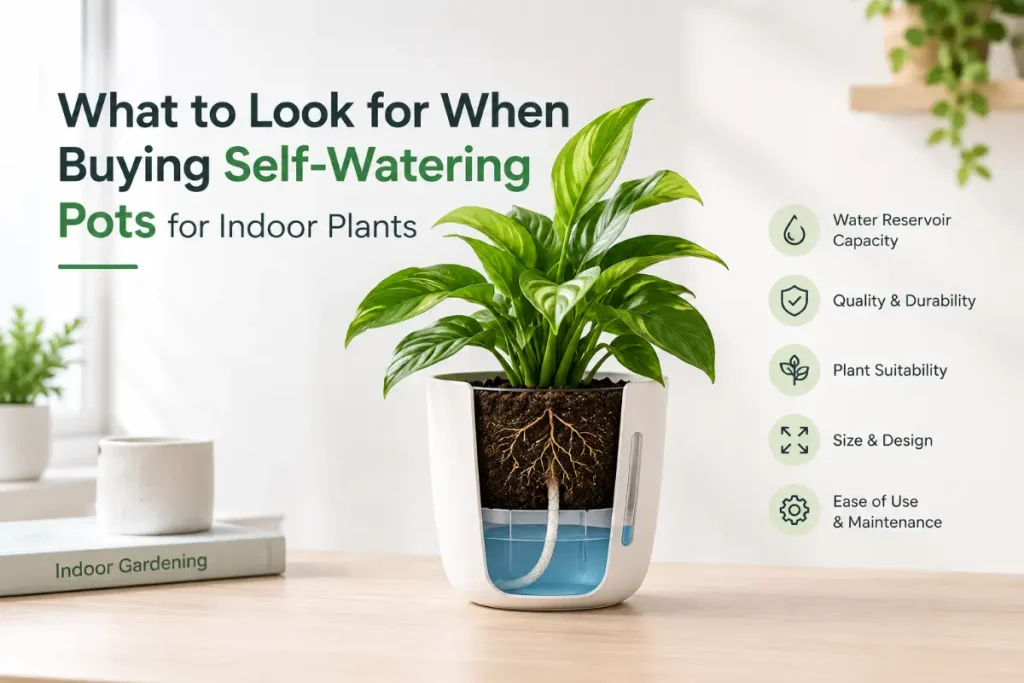
Reservoir size relative to plant size: The reservoir should hold enough water to sustain the plant for at least one week and ideally two weeks between refilling. Check the stated reservoir capacity against the pot’s growing volume. A reservoir that is too small requires daily refilling, eliminating most of the convenience benefit.
Clear reservoir indicator: A visible water level indicator — either a float gauge with a high/low indicator or a transparent section of the reservoir — prevents the common problem of overfilling that leads to the growing chamber sitting in standing water, or running dry without notice. Some designs have a simple overflow hole that signals a full reservoir when water appears.
Drainage option: Quality self-watering pots include a plug or valve in the reservoir that can be opened to drain the reservoir completely. This is essential for two reasons: flushing accumulated mineral salts from the growing medium (important every two to three months), and being able to use the pot for different plants whose needs change over time.
Growing chamber depth: The growing chamber should be deep enough for the plant’s root system. Self-watering pots with very shallow growing chambers limit root depth development below what many plants need for healthy growth. Check that the growing chamber depth suits the plant you intend to use it for.
Wicking material quality: The wick or capillary mat connecting the reservoir to the growing medium should be made of material that wicks water consistently without developing the mold or bacterial growth that degrades performance over time. Nylon and polyester wicks outlast cotton wicks which decompose within a year of use in consistently moist conditions.
Material and aesthetics: Self-watering pots are available in plastic, ceramic, terracotta-look composite, and metal finishes. Plastic is lightest and most affordable. Ceramic is heaviest and most durable but significantly more expensive. Most decorative self-watering pots use composite materials that look like ceramic or terracotta while maintaining the lighter weight and lower cost of plastic.
Self-Watering Pot Sizes and Applications
Small (four to six inches): Suitable for individual herbs, small peace lily, small pothos, and similar compact moisture-loving plants. Reservoir capacity of half to one liter. Appropriate for windowsill herb gardens and small desk plants.
Medium (eight to ten inches): The most versatile size for most common moisture-loving houseplants. Reservoir capacity of one to one and a half liters. Appropriate for established pothos, medium peace lily, ferns, and indoor herb collections.
Large (twelve to sixteen inches): Statement plant sizes for large peace lily, large ferns, and substantial tropical plants. Reservoir capacity of two to three liters. These pots are heavier when filled and require less frequent reservoir refilling due to their larger water volume.
Planter boxes and troughs: Rectangular self-watering planters designed for multiple plants or succession-sown crops. Particularly well-suited to herb gardens and salad green growing where a single rectangular planter holds multiple plants sharing a common reservoir.
Common Self-Watering Pot Problems and Solutions
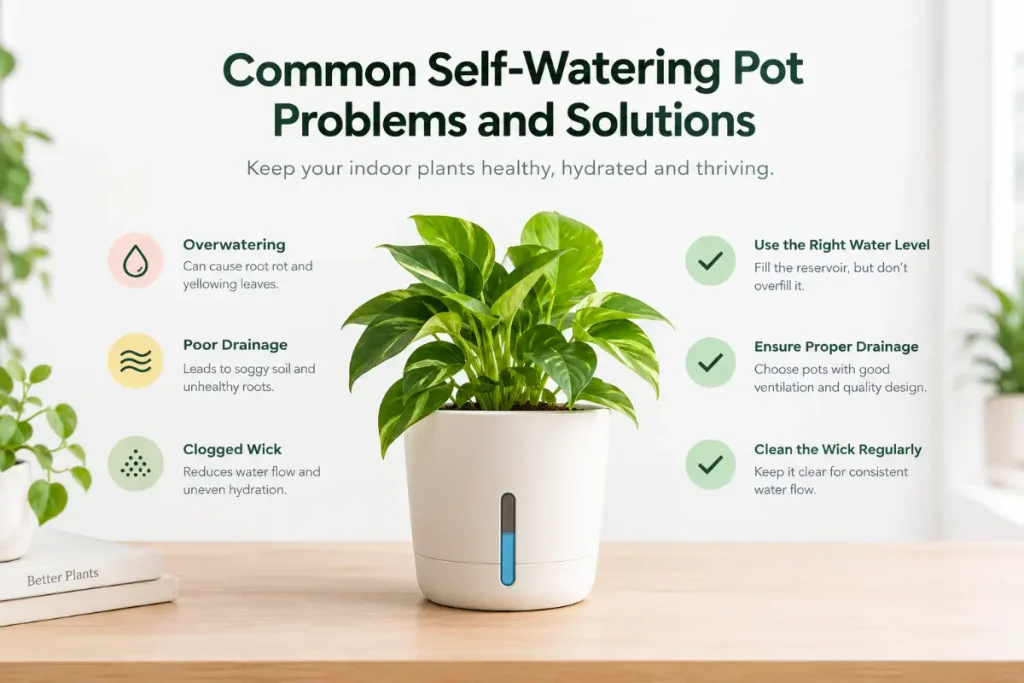
Plants developing root rot despite self-watering design: The plant is not appropriate for consistent moisture. Move to a standard pot with appropriate drought cycles. Or the reservoir was overfilled, keeping the growing medium saturated rather than consistently moist. Check that the overflow indicator is functioning and the reservoir is not filled above the maximum level.
Reservoir emptying too quickly: The plant’s water demand exceeds the reservoir capacity in the current conditions. This is most common in actively growing plants in warm, bright conditions during summer. Refill more frequently, upgrade to a larger reservoir pot, or accept that some plants in peak growing season need more frequent attention even with self-watering pots.
White mineral deposits on soil surface or pot interior: Hard water mineral accumulation. Use filtered or distilled water for refilling. Flush the growing medium with two to three times the normal water volume through the top of the pot every two to three months to leach accumulated minerals from the growing medium.
Algae growth in the reservoir: Algae establishes in light-exposed water. Choose self-watering pots with opaque rather than transparent reservoirs. Keep the reservoir covered and away from direct light. Clean the reservoir with a diluted bleach solution (one teaspoon per gallon) every three to four months, rinse thoroughly before refilling.
Wicking failure after several months: The wick has degraded or become blocked with mineral deposits or biological growth. Replace the wick with fresh nylon or polyester wick material available at craft stores or from the pot manufacturer. Clean the reservoir while replacing.
For the complete guide to watering tools that complement self-watering pots in a comprehensive indoor plant care toolkit, best watering can for indoor plants covers the precision watering tools that remain necessary for the plants in your collection that are not appropriate for self-watering pot use.
Self-Watering Pots for Specific Situations
For frequent travelers: Self-watering pots are one of the most practical vacation watering solutions for moisture-loving plants. A two-liter reservoir in a medium self-watering pot sustains most moisture-loving plants for ten to fourteen days without any intervention, covering the majority of common trip lengths without requiring plant sitters or elaborate watering setups. Combining self-watering pots with the grouping and position adjustment methods described in the vacation watering guide provides reliable coverage for trips of two to three weeks.
For busy households: The reduced watering frequency of self-watering pots suits households where watering is frequently forgotten or deprioritized. A peace lily in a standard pot that wilts every five to seven days when watering is forgotten becomes a thriving, stress-free plant in a self-watering pot where the reservoir extends the acceptable inattention period to two weeks.
For office plant collections: Self-watering pots are particularly well-suited to office plant care where weekend gaps in watering represent the most challenging period for moisture-loving plants. A properly filled self-watering pot sustains most moisture-loving office plants through a standard two-day weekend or even a long weekend without staff attention.
For new plant owners: Self-watering pots remove the most common skill gap for new plant owners — learning when to water — for the moisture-loving plants they are appropriate for. New owners who lose plants repeatedly to overwatering and underwatering in standard pots often find their success rate dramatically improves with self-watering pot use for appropriate moisture-loving species.
Transitioning Plants Into Self-Watering Pots
Moving an established plant from a standard pot to a self-watering pot requires some adjustment in care expectations as the plant adapts to the new moisture delivery system.
The transition period: During the first two to four weeks in a self-watering pot, water the plant through the top of the growing medium as normal rather than relying immediately on reservoir wicking. This establishes consistent moisture throughout the full growing medium volume before transitioning to reservoir-only management. Wicking is most effective once the growing medium is consistently moist from top to bottom — initially dry growing medium wicks water up slowly and inconsistently.
Choosing the right potting mix: Standard potting mix works adequately in self-watering pots but mixes specifically formulated for self-watering applications (sometimes labeled as wicking or self-watering mix) wick water more efficiently than standard mixes. These mixes typically have finer particle size and higher peat or coco coir content that improves capillary transport of water from the reservoir upward through the growing medium.
Root adaptation: Plant roots in self-watering pots gradually grow toward the reservoir where consistent moisture is available. Over several months, more of the plant’s root mass concentrates in the lower portion of the growing chamber near the moisture source. This root distribution is healthy and normal in appropriate moisture-loving plants but represents a dramatic change in root architecture that makes returning the plant to a standard pot with top-down watering temporarily stressful.
For the complete guide to how watering tools including self-watering pots, watering cans, moisture meters, and misting bottles work together in a comprehensive indoor plant care approach, moisture meter for indoor plants covers the diagnostic tool that helps confirm when self-watering pot reservoirs need refilling and when growing medium moisture is at the appropriate level for the plants in your collection.
Conclusion
Self-watering pots for indoor plants are genuinely excellent tools for moisture-loving plants and genuinely harmful tools for drought-tolerant ones. For peace lily, ferns, calathea, pothos, indoor herbs, and leafy greens — plants that prefer consistent moisture and suffer from inconsistent watering — self-watering pots reduce care effort, reduce plant stress, and produce consistently better plant health than standard pot growing with variable watering.
For cacti, succulents, snake plant, ZZ plant, and Mediterranean herbs — plants that need extended dry periods between waterings — self-watering pots cause the root rot that kills these plants more reliably than almost any other care mistake.
The decision of whether to invest in self-watering pots comes down entirely to which plants you are caring for. Match the technology to the plant’s actual water needs and self-watering pots deliver on their promise. Ignore the plant-type limitation and they become the most reliable way to kill drought-tolerant plants in your collection.
Frequently Asked Questions
Do self-watering pots prevent overwatering?
Self-watering pots prevent the type of overwatering that occurs from watering too frequently through the top of the pot. They do not prevent overwatering in the broader sense — for drought-tolerant plants, the continuously moist lower root zone that self-watering pots maintain is itself a form of overwatering that causes root rot over time. For moisture-loving plants, self-watering pots maintain the consistently moist but not waterlogged conditions these plants prefer, which is not overwatering but appropriate moisture management.
How often do you need to refill self-watering pot reservoirs?
Every one to two weeks for most moisture-loving plants in medium to large self-watering pots during the active growing season. Small pots with limited reservoir capacity may need refilling every five to seven days. In winter when plant growth and water demand decrease, the same reservoir may last three to four weeks. The reservoir level indicator on most self-watering pots provides a direct visual signal rather than requiring a fixed refilling schedule.
Can you use self-watering pots for succulents?
No. Succulents need their entire root zone to dry between waterings. The continuously moist lower root zone that self-watering pots maintain causes root rot in succulents within weeks to months. Self-watering pots are specifically not appropriate for any drought-tolerant plant including cacti, succulents, snake plant, ZZ plant, and Mediterranean herbs.
Are self-watering pots worth the extra cost?
For moisture-loving plants that the owner struggles to water consistently, self-watering pots are worth their cost through improved plant health, reduced plant losses, and significantly reduced care frequency. A self-watering pot that keeps a peace lily or fern healthy for years pays for itself many times over compared to repeatedly replacing plants that declined from inconsistent watering. For drought-tolerant plants, self-watering pots are not worth any cost since they cause harm rather than benefit.
How do you clean a self-watering pot?
Empty the reservoir by removing the drain plug or pouring out the remaining water. Rinse the reservoir with clean water. For mineral deposits, soak with a white vinegar solution for thirty minutes before scrubbing. For algae, use a diluted bleach solution of one teaspoon per gallon, scrub, and rinse thoroughly multiple times before refilling. The growing chamber can be flushed with water poured from the top that drains through the drainage holes in the usual way.
What plants grow best in self-watering pots?
Peace lily, Boston fern, maidenhair fern, calathea, pothos, heartleaf philodendron, moisture-loving herbs including mint and basil, leafy greens including lettuce and spinach, and spider plant all thrive in self-watering pots. These plants share a preference for consistently moist but not waterlogged soil — exactly the moisture condition that self-watering pot design maintains automatically.
Pingback: Indoor Plant Watering Schedule: 7 Simple Steps That Work (2026) - Plant Quill