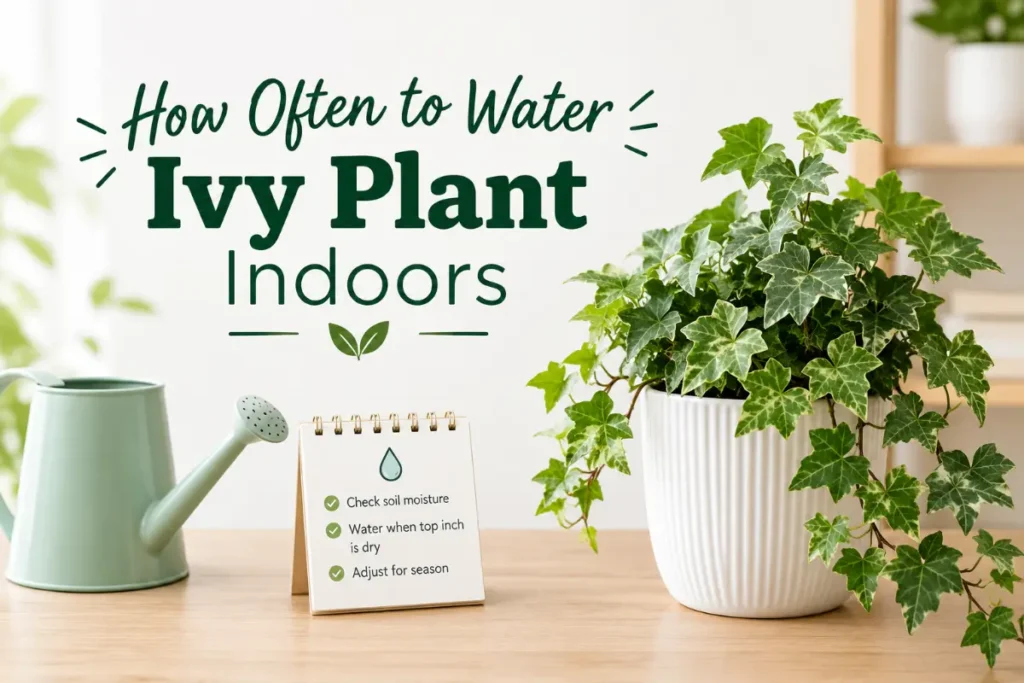
Ivy is one of the few houseplants that actively suffers from too much care. Overwatering kills more indoor ivy than any other cause — it is a woodland plant adapted to well-drained soil that dries out between rain events, not a tropical plant craving constant moisture. Understanding how often to water ivy plant indoors comes down to learning to read the plant and the conditions rather than following a fixed schedule, because the same ivy in a 12 cm terracotta pot in a sunny window needs water twice as often as an identical plant in a glazed ceramic pot in a north-facing room.
This guide gives five practical rules that remove the guesswork, covers how to adjust through the seasons, and explains the signs that distinguish thirst from overwatering before the damage becomes serious.
Rule 1: Let the Top Third of the Compost Dry Before Watering
The single most reliable guide to how often to water ivy plant indoors is the state of the growing medium — not the calendar. Push a finger 3–4 cm into the compost (roughly the top third of a standard 12–15 cm pot). If it feels moist, wait. If it feels dry and slightly crumbly, water thoroughly.
In practice, this translates to:
- Spring and summer: every 5–7 days for most UK indoor conditions
- Autumn: every 7–10 days as growth slows
- Winter: every 10–14 days, or longer in cool rooms
These are starting points only. A terracotta pot in a warm, bright room may need water every 3–4 days in July. A glazed ceramic pot in a cool hallway may need water every 14 days in May. The compost test overrides any schedule.
Rule 2: Adjust for Pot Type and Size
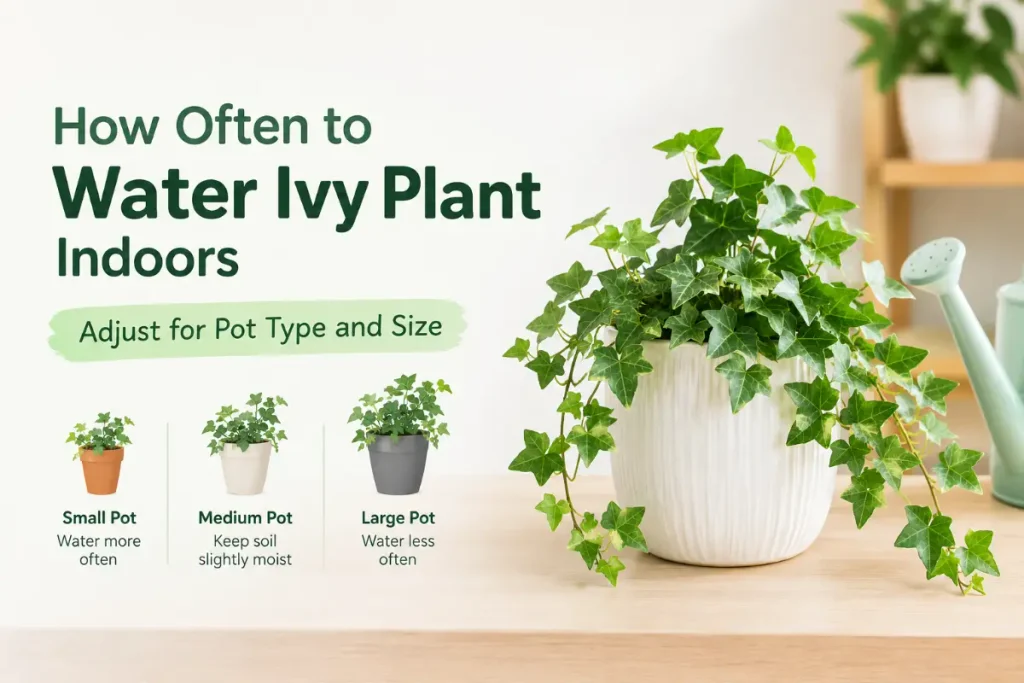
Pot material is one of the strongest predictors of watering frequency and is worth understanding before settling any routine.
Terracotta: Porous walls allow moisture to evaporate from the sides of the pot, not just the surface. Compost dries significantly faster than in plastic or glazed containers. Ivy in terracotta often needs water every 4–6 days in summer — check every 3 days rather than waiting a full week.
Plastic or glazed ceramic: Non-porous walls retain moisture at the sides. Compost dries from the top down only. The same ivy in plastic typically lasts 7–10 days between waterings in summer. Higher overwatering risk if you water on a fixed schedule without checking.
Pot size: Small pots (10–12 cm) dry out quickly — a small volume of compost has proportionally more surface area relative to its volume. Large pots (20 cm+) hold more moisture for longer. An ivy that has been potted up into a significantly larger container than its root ball justifies will take far longer to dry out — overwatering risk is highest immediately after repotting into a large pot.
A moisture meter for indoor plants removes the guesswork entirely — a probe reading in the lower half of the pot shows whether roots are sitting in damp or dry compost regardless of surface appearance.
Rule 3: Water Thoroughly, Then Wait
Frequent light waterings — topping up the pot with a small splash every day or two — is one of the most damaging watering habits for ivy. It keeps the surface compost perpetually moist while the lower root zone stays dry, encouraging roots to stay near the surface rather than penetrating deeper into the pot, and keeping surface conditions that invite fungus gnats.
The correct approach: when ivy needs water, water until it flows freely from the drainage holes, allow to drain completely (empty saucers after 30 minutes), then leave completely alone until the top third of the compost dries again.
Thorough watering ensures the entire root zone receives moisture. Waiting for genuine dryness ensures the roots have access to air between waterings — root health depends on the wet-dry cycle, not constant saturation.
Rule 4: Reduce in Winter, Don’t Stop
Ivy in UK conditions slows its growth significantly from October through to February — reduced light, shorter days, and cooler temperatures all reduce the plant’s water demand. A watering schedule that worked in August will overwater the same plant in November.
Signs that winter watering frequency is still set too high:
- Compost surface still damp when you check 10 days after watering
- Lower leaves yellowing in small numbers (a few yellowing lower leaves is normal dormancy; continuous yellowing across the plant is overwatering)
- Compost smelling musty rather than fresh — early sign of anaerobic conditions from excess moisture
In winter, err on the side of underwatering. Ivy tolerates mild drought far better than waterlogged roots — a slightly dry plant recovers with the next watering; root rot from sustained overwatering is much harder to reverse.
Cold water in winter: Ivy brought indoors from cool conditions, or watered from a cold tap in winter, can suffer temperature shock at the roots. Fill a watering can the night before and allow it to reach room temperature before using.
Rule 5: Increase Humidity, Not Watering Frequency
Indoor ivy suffers significantly in the dry air of centrally heated UK homes — but the solution is not more water at the roots. Increased root watering to compensate for dry air leads to root rot while the leaves continue to suffer from low humidity. The two problems require separate solutions.
For dry air: Mist the foliage lightly every 2–3 days, group ivy with other plants to create a localised humid microclimate, or position near a humidity tray (a tray of pebbles kept topped up with water, with the pot sitting above the waterline). Ivy thrives in 40–60% relative humidity — the dry, heated winter air of most UK homes is typically 30–40%.
Signs of low humidity vs underwatering:
- Crispy brown leaf edges with otherwise healthy-looking green centres → low humidity
- Wilting, drooping stems with dry compost throughout → underwatering
- Wilting with moist compost → overwatering causing root damage
Getting this distinction right prevents the common error of increasing root watering when the plant’s problem is actually in the air around it.
Seasonal Watering Calendar: How Often to Water Ivy Plant Indoors
January–February: Every 12–16 days. Room temperature water. Check compost before every watering — do not water if any moisture remains in the top half of the pot. Mist foliage weekly in heated rooms.
March–April: Transition period — growth resumes as light improves. Increase to every 8–12 days. Watch for the plant drinking faster than winter; compost may be drying out more quickly from late March onward.
May–June: Every 6–8 days for most conditions. Growth is active; check every 5 days and water when the top third is dry. Begin regular feeding alongside watering (balanced liquid fertiliser at half strength, every 2–3 weeks).
July–August: Most active growing and watering period. Every 4–7 days depending on pot type and room conditions. Check every 3–4 days in hot weather — a terracotta pot in a south-facing window may need water every 3 days in a UK heatwave.
September–October: Wind down. Water every 7–10 days. Stop feeding from late September. Begin adjusting to the plant’s reducing demand rather than maintaining a summer schedule into autumn.
November–December: Every 10–16 days. Check compost carefully before each watering. The plant is at its lowest water demand; this is the period when overwatering causes the most damage.
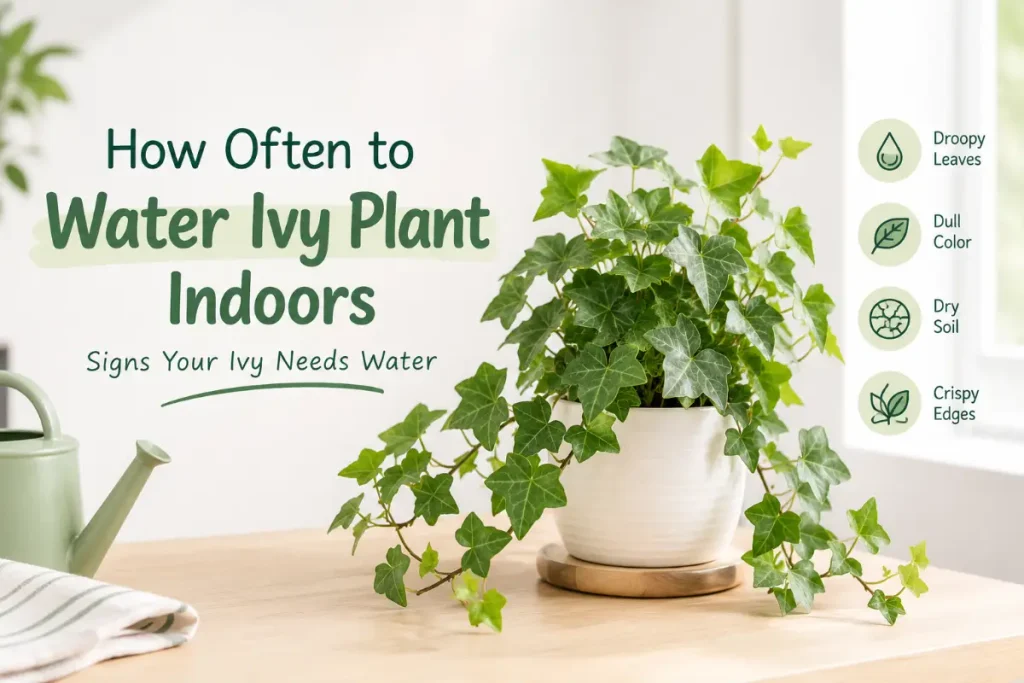
Signs Your Ivy Needs Water
- Compost dry in the top third when pressed firmly with a finger
- Pot feels noticeably lighter than after the last watering (weight is an excellent guide — lift the pot right after thorough watering to learn its weight, then again when dry)
- Leaves very slightly soft or less crisp than usual (ivy wilts less dramatically than some plants before showing drought stress)
- Compost pulling away from the pot edges as it shrinks on drying
Signs Your Ivy Is Overwatered
- Lower leaves turning yellow, starting with the oldest (lowest) leaves
- Compost surface staying damp for more than 10 days in summer, 14 days in winter
- Musty or sour smell from the growing medium
- Soft, dark stems at the base
- Fungus gnats (small flies) hovering around the pot — they breed in persistently moist surface compost
If overwatering is suspected, do not water again until the compost has dried thoroughly to at least halfway down the pot. If the base of stems is soft and dark, the plant may have root rot — unpot, check roots, trim any dark and mushy roots, allow to dry for 24 hours, and repot in fresh compost with improved drainage. The guide to drainage for indoor plants covers compost amendment and drainage improvement in detail.
Which Ivy Species Affects Watering Needs
Several species are sold as indoor ivy in the UK, with slightly different watering tolerances:
Hedera helix (English ivy): The most common indoor ivy. Tolerates brief dryness well. Prefers cool to moderate temperatures (15–21°C) — in warmer rooms it may need water more frequently than the general guidance above. The most spider-mite-prone of the indoor ivies; low humidity combined with overwatering creates ideal spider mite conditions.
Hedera canariensis (Canarian ivy): Larger leaves, slightly more drought-tolerant than H. helix. Handles the occasional missed watering without leaf drop.
Hedera algeriensis ‘Gloire de Marengo’: Variegated, silver-green. Similar watering needs to H. helix but prefers a brighter position — which increases watering frequency slightly.
Epipremnum (pothos) and Scindapsus — often sold as “ivy”: Not true ivy. These tropical aroids prefer warmer conditions and more consistent moisture than Hedera species — water when the top 3–4 cm is dry, which in practice may be more frequently than true ivy in the same conditions.
Ivy Watering and Common Pest Connections
Watering habits directly influence pest pressure on indoor ivy — and the connection is worth understanding because treating the pest without addressing the underlying watering problem means the pest returns.
Spider mites are the most common indoor ivy pest in the UK. They thrive in hot, dry conditions — the underside of leaves in a warm, under-humidified room provides ideal spider mite habitat. Their presence is not a watering problem at the roots but a humidity problem around the foliage. Misting leaves (particularly the undersides) and maintaining adequate humidity is more effective prevention than any spray. The post on indoor plant spray for bugs covers treatment options for established infestations.
Fungus gnats are the opposite problem — they appear when the surface compost stays persistently moist. The adult gnats are harmless nuisances; their larvae, which feed on fine roots and organic material in the compost, are the real concern for young plants. The fix is watering correctly: let the surface compost dry out between waterings, as larval development requires consistently moist conditions in the top 3–4 cm of compost. A 2 cm layer of coarse horticultural grit on the compost surface disrupts the adult’s ability to lay eggs in the compost.
Root mealybugs are harder to detect and more directly related to watering. They colonise roots in stressed plants — typically those that have experienced periods of both drought and waterlogging. Consistent, correct watering that avoids extremes in both directions is the primary prevention.
Ivy in Different Indoor Positions: Adjusting Watering for Location
Where ivy is positioned in the home affects how quickly it uses water — and therefore how often it needs attention.
South or west-facing windowsill: Bright light and potential direct sun drive faster growth and higher evaporation. Check every 3–4 days in summer. Protect from the hottest midday sun (particularly relevant in July and August) — ivy tolerates some direct morning sun but can scorch in extended afternoon direct light.
North or east-facing rooms: Lower light levels mean slower growth and slower water consumption. Watering frequency at the lower end of the seasonal ranges above. Monitor for the leaf elongation and pallor that indicate the plant is in insufficient light — ivy in very low light also becomes more susceptible to overwatering as it grows too slowly to use the moisture available.
Shelf or hanging basket (trailing display): Air circulation is higher around a hanging or elevated pot — evaporation from all sides of a terracotta or unglazed pot can be significant. Check more frequently than a pot sitting on a solid surface with no airflow underneath.
Bathroom: Bathroom humidity is typically higher than the rest of the home — particularly if the bathroom has a shower used regularly. Ivy in a bathroom benefits from the higher ambient humidity (reduces spider mite pressure, reduces foliage crisping) but the same compost moisture rules apply regardless of room humidity.
Watering Newly Potted Ivy
Newly purchased ivy — whether from a garden centre or online retailer — often arrives in peat-based compost that behaves quite differently from peat-free multipurpose mixes. Peat compost holds water differently: it can appear dry on the surface while remaining moist in the centre, and conversely can become hydrophobic (water-repelling) when completely dried out.
For newly purchased ivy in peat compost:
- Water from the bottom for the first few waterings (sit in a tray of water for 20–30 minutes) to ensure the full compost volume is moistened, not just the surface
- Repot into peat-free compost within the first growing season — UK garden centres increasingly stock peat-free options, and the more predictable moisture behaviour of peat-free mixes makes watering decisions easier
For ivy repotted into fresh compost:
- The new compost around the root ball retains significantly more moisture than the compacted root ball itself — the outer compost may appear dry while the root ball centre is still damp
- Use a moisture meter probe pushed to different points around the pot to assess moisture at the root zone rather than relying on the surface or compost edge
Using the Indoor Plant Watering Schedule Alongside This Guide
A general indoor plant watering schedule provides useful structure for a mixed collection — a framework of when to check and what to look for across many different plants at once. For ivy specifically, that schedule should be treated as a checking prompt rather than a watering prompt: when the schedule says “check your trailing plants,” the decision to water or wait is made by the compost feel test, not by the schedule day itself.
Ivy is best understood as a plant that tells you when it is ready for water, rather than one that follows a fixed timetable. The rules in this guide — and the compost test above all — translate that signal into a consistent, reliable watering practice across all conditions and seasons.
What Good Watering Looks Like in Practice
Describing the correct technique in abstract is one thing — seeing it as a concrete practice is more useful for building the habit. Here is what a correct watering session for indoor ivy looks like from start to finish:
Before watering: Push a finger 3–4 cm into the compost. If any moisture is detectable, close the watering can and check again in 2 days. If the compost is dry and crumbly at that depth, proceed.
During watering: Use room-temperature water. Pour slowly and evenly across the full surface of the compost — not just at one edge, which waters one side of the root zone and leaves the other dry. Continue until water flows freely and steadily from the drainage holes, not just a trickle.
After watering: Allow the pot to drain for 20–30 minutes, then empty any water from the saucer or cache pot. Leaving ivy sitting in a saucer of water is one of the fastest routes to root rot — the drainage holes that allow excess water out must not be blocked by standing water below.
The wait: Record the date (a sticky note on the pot, a note in a phone app, or simply a mental note). Check again in 5 days in summer, 7 days in autumn, 10 days in winter. Water only when the compost passes the dry-to-touch test — not because the interval has elapsed.
Repeat. The simplicity of this routine is the point: ivy does not need complex care, just consistent application of a straightforward principle. Most of the mistakes that kill indoor ivy come from adding complexity — watering on a rigid schedule, guessing from the surface, or treating a humidity problem with root water — rather than from following the basic approach described above.
Conclusion
How often to water ivy plant indoors has no single answer — but the five rules in this guide give a reliable framework for any ivy, any pot, and any season. Let the top third of the compost guide the timing, water thoroughly when you do, reduce significantly in winter, keep the pot type in mind, and address humidity separately from root watering. Those five adjustments, applied consistently, will keep indoor ivy healthy through years of growing without the overwatering that kills most specimens within their first winter indoors.
For further guidance on ivy care and growing conditions, the RHS Hedera cultivation guide provides authoritative species information and UK-specific growing advice.
FAQs
How often should I water indoor ivy in summer?
Every 5–7 days is a reasonable starting point, but check the compost first — water only when the top third is dry. In a terracotta pot in a warm, bright room, this may be every 3–4 days. In a glazed pot in a cooler room, it may stretch to 8–10 days.
Why are my indoor ivy leaves turning yellow?
The most common cause is overwatering — lower leaves yellow first, often accompanied by moist compost and a musty smell. Less commonly, yellowing indicates nutrient deficiency (particularly nitrogen) or insufficient light. Check compost moisture before assuming the plant needs more water.
Can I water ivy from the bottom?
Yes — placing the pot in a tray of water for 20–30 minutes and allowing it to absorb from below avoids wetting the leaves and surface compost. Empty the tray after each bottom-watering session; do not leave the pot sitting in standing water permanently.
Does indoor ivy need misting?
Misting helps with the low humidity of heated UK homes, which causes crispy brown leaf edges. Mist the foliage lightly every 2–3 days in winter when heating is running. Do not mist in poor air circulation conditions — wet leaves in still air promote fungal disease.
How do I know if my ivy has root rot?
Unpot the plant and examine the roots. Healthy ivy roots are pale cream to white. Rotten roots are brown to black, soft, and often smell sour. Trim all affected roots with clean scissors, allow to dry for 24 hours, and repot in fresh, free-draining compost.
Is tap water OK for indoor ivy?
Yes — ivy is not sensitive to the mineral content or chlorine in standard UK tap water. Standing water overnight before use is a good habit but not strictly necessary for ivy specifically.
Should I water ivy differently in winter?
Yes — significantly less often. Aim for every 10–16 days and check compost carefully before each watering. Overwatering in winter, when growth is slow and evaporation is lower, is the most common reason healthy summer ivy declines over the colder months.