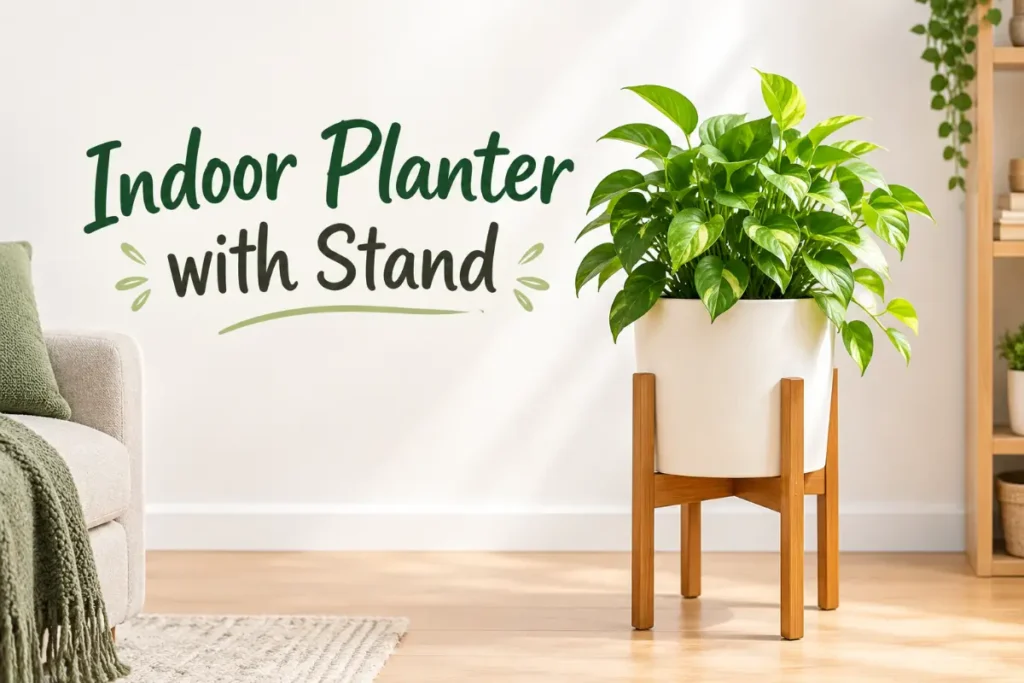
An indoor planter with stand does two things at once: it solves the practical problem of displaying plants at a height where they can be properly seen and where trailing stems can fall freely, and it makes a design statement in a room. The stand elevates the plant from floor level — pulling it into the sightline, freeing it from the visual clutter of a surface, and giving trailing or arching plants the height they need to look their best.
This guide covers the eight main styles available in the US, the materials and their practical trade-offs, drainage considerations that most buyers overlook, and which plant types pair best with elevated display.
Why Display Height Matters for Indoor Plants
Plant height affects both aesthetics and plant health. Trailing plants — pothos, string of pearls, tradescantia, spider plants — look dramatic when given 24–32 inches of vertical drop for stems to fall. On a shelf or windowsill, stems bunch together and lose the open, flowing quality that makes these plants distinctive. Elevated on a stand, they hang freely and show their full character.
Height also affects light access. A floor-standing pot in a room corner may receive far less light than the same pot elevated 24 inches on a stand that brings it closer to the window and raises it above furniture that would otherwise block light from the side.
For taller, upright plants — snake plants, fiddle-leaf figs, tall dracaenas — a stand adds architectural presence and keeps the plant from disappearing behind furniture. The elevated base draws the eye down to the plant rather than to the floor.
8 Styles of Indoor Planter with Stand

1. Mid-Century Wood Tripod Stand
The most recognizable plant stand style — three angled legs (typically in oak, walnut, or beech) meeting at a central ring or platform that holds the pot. Clean lines, warm material, pairs with almost any interior. Available in heights from 12 to 36 inches.
Best for: Round terracotta or ceramic pots, 5–8 inch diameter. Ferns, peace lilies, small monsteras, pothos. Mid-century modern, Scandinavian, and natural interior styles.
Practical notes: Most tripod stands support pots without a built-in drainage tray — place a cork mat or felt pad between pot and stand to protect both surfaces, and water in a sink before returning to the stand.
2. Rattan and Bamboo Woven Stand
Woven rattan or bamboo stands wrap the pot in natural woven material, creating a basket-style planter with stand as one integrated piece. The pot usually lifts out for watering. Lightweight and typically inexpensive ($15–40).
Best for: Tropical and bohemian interior styles. Works best with plain terracotta pots inside — the rattan exterior is the decorative element. Spider plants, tradescantia, pothos, string of hearts.
Practical notes: Rattan degrades if it stays wet — remove the inner pot for watering every time, allow to drain completely, and do not leave a dripping pot inside the rattan sleeve. Avoid positioning in very humid rooms where bathroom steam can accelerate deterioration.
3. Metal Wire Stand (Hairpin or Geometric)
Wire stands — typically powder-coated steel in black, white, or brass finish — provide a minimal, industrial aesthetic with maximum visual lightness. The open wire construction means the pot is highly visible, making the plant and pot combination the focus rather than the stand itself.
Best for: Geometric, industrial, and contemporary interior styles. Cacti and succulents in statement pots, snake plants, ZZ plants. The minimal stand suits plants with architectural form.
Heights available: 6–32 inches typically. Multi-tier wire stands (two or three platforms at different heights) allow displaying several plants in the footprint of one stand.
4. Concrete or Ceramic Pedestal Stand
A solid pedestal — square or cylindrical, in concrete, ceramic, or stone — functions as a sculptural base as much as a functional stand. Substantial weight, permanent positioning, high visual impact.
Best for: Single statement plants — a large monstera, a fiddle-leaf fig, an architectural snake plant. The pedestal becomes part of the display; reposition only occasionally.
Practical notes: Heavy — position before filling with soil and plant. Ensure the floor surface can take the combined weight of stand, pot, potting mix, and plant. This is worth checking in upper-floor rooms in older homes with timber floors.
5. Adjustable Height Metal Stand
Telescoping or height-adjustable metal stands allow the display height to be changed without buying a new stand — useful for plants that grow taller over time or for repositioning between rooms with different ceiling heights and furniture layouts.
Best for: Growing collections where plant size changes; growers who like to rearrange displays seasonally. Less visually refined than a fixed stand but more flexible.
6. Hanging Planter with Stand (Freestanding Arc)
An arc or boom-arm stand suspending a hanging planter — a freestanding version of a ceiling hook that requires no wall or ceiling fixings. The pot hangs from the end of a curved arm, typically at 48–64 inches height.
Best for: Rental properties where ceiling hooks are not permitted. Trailing plants that benefit from hanging display (string of pearls, string of hearts, burro’s tail, pothos) without needing any fixings. Bohemian and plant-focused interior styles.
Stability note: Top-heavy once a plant is hung — position against a wall or in a corner to prevent tipping. Heavier plants may require a base-weighted design.
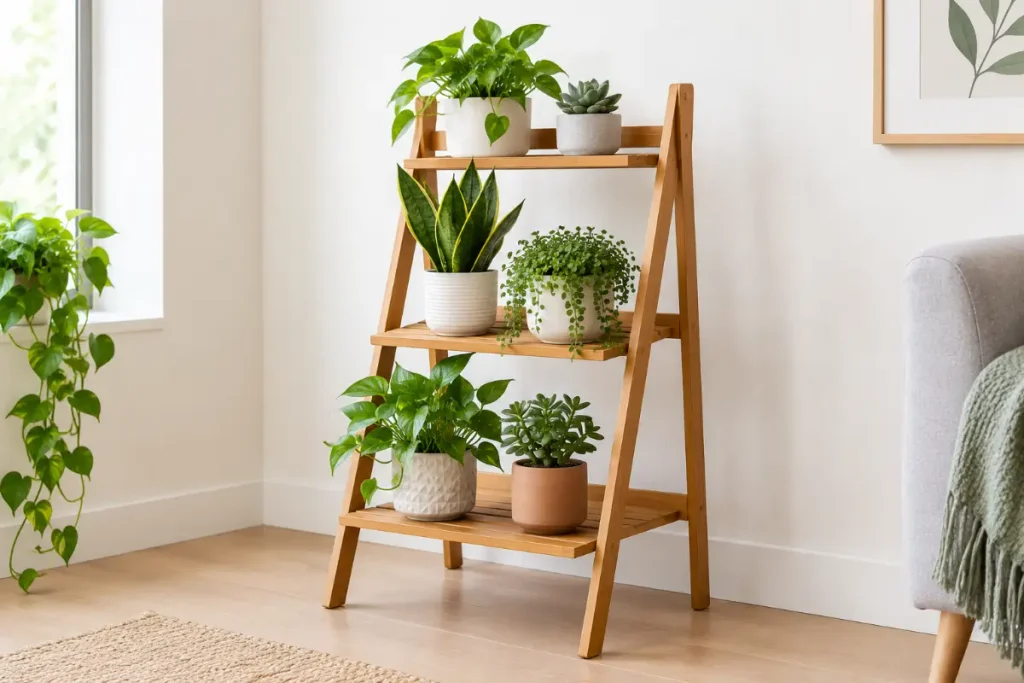
7. Tiered Ladder Stand
A flat-to-wall ladder stand with horizontal rungs at intervals — each rung holds one or more pots at different heights, creating a vertical plant display against a wall. Effective for displaying 4–8 plants in the footprint of a single wall section.
Best for: Plant collections rather than individual statement plants. North-facing walls where window-adjacent display maximizes light access for multiple plants simultaneously.
Practical notes: Allow enough depth on each rung for the pot size — a rung that’s only 8 inches deep cannot safely hold an 8-inch pot; ensure at least 2 inches of clearance. Water plants on the stand in place using a long-spout watering can to reach lower levels, or remove each pot to water separately.
8. Self-Watering Planter with Stand (Integrated Reservoir)
A newer category — planters with built-in reservoir bases, sold with a matching stand as a single unit. The reservoir delivers water upward by capillary action, and the stand raises the unit to a display height. Combines the function of a self-watering system for indoor plants with elevated display in one piece.
Best for: Productive herb displays in a kitchen; moisture-loving plants in a prominent display position; growers who want low-maintenance watering alongside elevated aesthetics.
Materials: Trade-Offs at a Glance
| Material | Durability | Weight | Water resistance | Style fit |
|---|---|---|---|---|
| Solid wood (oak, walnut) | High | Medium | Moderate (oil regularly) | Natural, mid-century, Scandi |
| Bamboo | Medium | Low | Low (avoid prolonged wet) | Bohemian, tropical |
| Rattan | Medium | Low | Low | Bohemian, coastal |
| Powder-coated steel | Very high | Medium | High | Industrial, contemporary, minimal |
| Concrete/stone | Very high | Very high | Very high | Brutalist, architectural |
| Brass/copper metal | High | Medium | High (patinas over time) | Luxury, maximalist |
Drainage: The Detail Most Buyers Miss
The most common practical problem with an indoor planter with stand is drainage. An elevated pot that drips onto the floor or stand after watering damages flooring and the stand itself over time. Three approaches handle this correctly:
Water before placing on the stand. Take the pot to a sink, water thoroughly, allow to drain completely for 15–20 minutes, then return to the stand. The most damage-free approach — no drips on stand or floor.
Use a saucer or drip tray. Most stand designs accommodate a saucer beneath the pot. Choose a saucer slightly wider than the pot base. Empty after 30 minutes — ivy, pothos, and most trailing plants should not sit in standing water.
Use a cache pot. Place a plain drainage-hole pot inside a slightly larger pot with no drainage hole (a cache pot). Water into the inner pot and the outer cache pot catches excess water. The cache pot also hides the less decorative growing pot inside a more attractive exterior, which suits most stand display applications.
Avoid placing an elevated pot directly on bare hardwood, laminate, or tile flooring without any protection below — even brief drips during misting or after watering leave mineral rings and moisture damage over time.
Which Plants Suit an Indoor Planter with Stand?
Trailing and cascading plants are the strongest case for elevated display — the stand provides the height for stems to fall freely:
- Pothos (Epipremnum) — fast-growing, tolerant, dramatic when given 24+ inches to trail
- String of pearls (Senecio rowleyanus) — particularly striking when hanging at eye level
- String of hearts (Ceropegia woodii) — delicate trailing stems that show best at 24–32 inches above floor
- Tradescantia — trailing or cascading habit, colorful foliage
- Spider plant — arching stems and spiderette production most visible at elevated height
Upright architectural plants use the stand as a pedestal:
- Snake plant (Sansevieria) — stands gain visual weight on a substantial pedestal stand
- ZZ plant — glossy foliage and upright stems suit minimal wire or metal stands
- Peace lily — elevated stand brings flowers to sitting height, where their fragrance is most appreciated
Compact plants for tiered or ladder stands:
- Cacti and succulents — the grouped, multi-level display of a tiered stand suits the collector aesthetic of succulent growing
- Herbs — a kitchen ladder stand holds multiple herb pots in one display footprint
Sizing: Matching Stand Height to Plant and Room
Stand height is one of the most overlooked decisions in buying a planter with stand — and it has a significant effect on how the finished display reads in the room.
Low stands (8–16 inches): Raise a floor-level plant to table height. Useful for larger pots (9–12 inch) that would be too heavy for a tall stand. Creates a grounded display — the plant becomes more prominent without competing with the ceiling line. Good for rooms with lower furniture or for large, spreading plants like big monsteras or bird of paradise.
Mid-height stands (16–26 inches): The most versatile range — puts a 6–7 inch pot at sitting-height when combined with typical sofa and chair heights. Trailing plants on a mid-height stand have enough drop for 16–20 inches of stem fall. Works in most US living room and bedroom contexts.
Tall stands (26–36 inches): Designed primarily for smaller pots and trailing plants where the height maximizes stem drop. Also useful for bringing foliage closer to eye level when standing — for hallways and entrances where the display is viewed in passing rather than while seated. Less stable with large heavy pots — check the stand’s stated maximum weight before using a large, soil-heavy pot on a tall stand.
Ceiling clearance: In rooms with lower ceiling heights (7.5–8 ft, common in ranch-style homes and 1960s–70s builds), a 36-inch stand with an upright plant of 24 inches already takes up most of the vertical space. In rooms with higher ceilings (modern builds, traditional homes), taller stand-and-plant combinations read proportionally better.
Weight and Stability: What Stands Can Support
This is a practical safety consideration, not just an aesthetic one. A pot, potting mix, and plant at full saturation (immediately after watering) is significantly heavier than it is when dry.
Weight guide by pot size:
- 5-inch pot: 2–4 lbs saturated
- 6-inch pot: 4–7 lbs saturated
- 7-inch pot: 7–10 lbs saturated
- 8-inch pot: 10–16 lbs saturated
- 10-inch pot: 16–24 lbs saturated
Most lightweight stands (rattan, bamboo, thin wire) state weight limits of 6–10 lbs — suitable for small to medium pots only. Heavy stands (solid wood, wrought iron, concrete pedestal) may support 20–30 lbs or more. Always check the manufacturer’s stated maximum before placing a large, saturated pot.
Stability: Wide-base stands are more stable than narrow-base ones at equivalent heights. For stands over 24 inches, a base width of at least 12 inches provides meaningful stability — narrow-base tall stands with small-footed legs can topple if a heavy plant is placed off-center, or if the stand is on an uneven surface.
For households with children or pets, consider stands that lock the pot in place with a ring or indentation rather than simply providing a flat platform — plants at child or pet height are at greater risk of being knocked.
Finish Care: Keeping Stands Looking Good
Solid wood stands: Oil with linseed or tung oil every 6–12 months to prevent drying and cracking. Wipe any water marks immediately — rings from saucers, particularly on oiled (rather than lacquered) wood, leave permanent marks over time. Always use a saucer or cork mat between pot and stand.
Bamboo stands: Wipe clean with a damp cloth rather than submerging in water. Avoid sustained high-humidity placement — bathroom steam long-term can cause splitting and mold on untreated bamboo. A light coat of bamboo oil or wood wax once a year extends lifespan significantly.
Rattan: Vacuum with a soft brush attachment to remove dust from the woven gaps. Spot-clean with a barely damp cloth; do not saturate. Keep away from direct sunlight over long periods — UV fades and dries rattan, eventually causing it to become brittle.
Powder-coated steel: By far the lowest maintenance option. Wipe down with a damp cloth. Check the base feet occasionally — the plastic or rubber caps that protect the floor can come off over time, and a bare steel foot will scratch floors.
Brass and copper metal: Will patina naturally over time — the surface oxidizes to a darker, aged finish. This is considered attractive in many interior styles. To maintain a bright finish, polish with a specialist brass or copper cleaner every few months. To embrace the patina, simply leave it — the finish is not structural and does not indicate deterioration.
Buying Guide: What to Look for in the US Market
Price tiers in the US:
- Budget ($15–30): Rattan sleeves, basic bamboo stands, thin wire designs. Functional for light pots; limited lifespan for heavier use.
- Mid-range ($30–80): Better quality powder-coated steel, solid bamboo, basic wood tripods. Good balance of aesthetics and durability for most homes.
- Premium ($80–250+): Solid hardwood (oak, walnut), wrought iron, designer wire designs. Heirloom quality; will outlast multiple plant and pot changes.
Where to buy in the US:
- Big-box stores: Home Depot, Lowe’s, Target — wide availability, budget to mid-range pricing, limited design selection but reliable for basic stands.
- Online retailers: Amazon, Wayfair, Anthropologie, West Elm — wide range, good photography, but quality varies; read reviews carefully for durability and actual dimensions.
- Specialist plant shops: Online plant retailers like The Sill, Bloomscape, and Léon & George often stock stands sized to fit their pot ranges — a useful way to ensure pot-to-stand sizing compatibility.
- Antique and vintage markets: Cast iron and old hardwood stands are often found in antique markets and can be exceptional quality. Victorian-era cast iron plant stands in particular are durable and distinctive.
The most common buying mistake: Purchasing a stand before confirming the pot diameter. The stand ring or platform must accommodate the pot’s outer diameter at its widest point — many pots flare outward toward the base and are wider at the base than at the rim. Measure both before ordering.
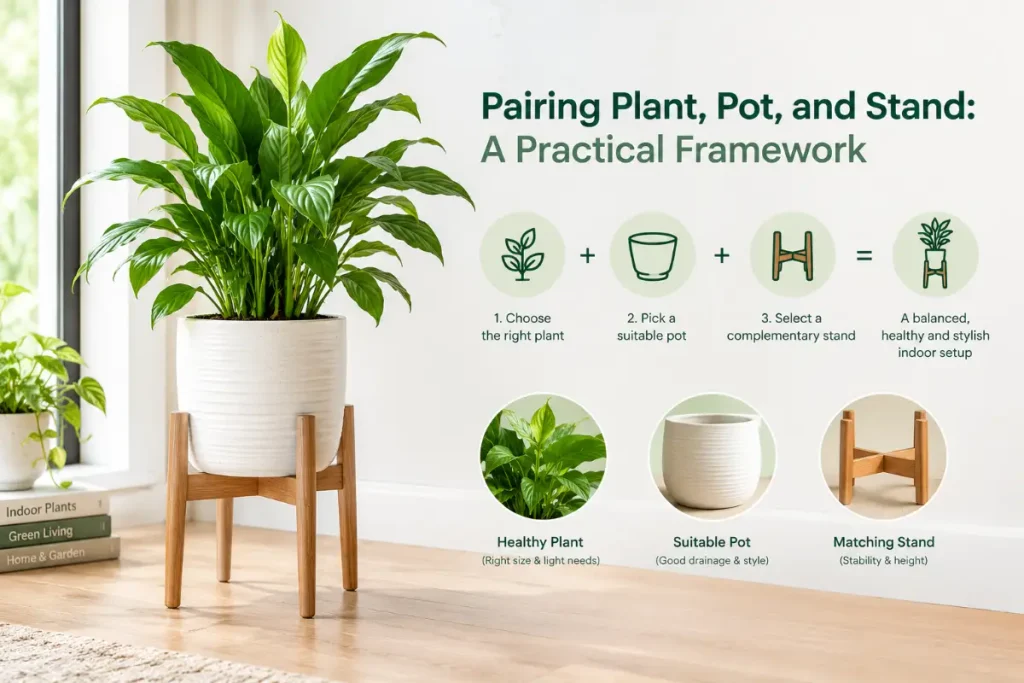
Pairing Plant, Pot, and Stand: A Practical Framework
A cohesive display comes from matching these three elements deliberately rather than combining whatever is available:
Natural materials pairing: Terracotta pot + wood tripod or bamboo stand + foliage plant with warm tones (pothos, calathea, prayer plant). Creates a warm, organic aesthetic that works in natural and Scandi interior styles.
Minimal pairing: Plain white or gray ceramic + thin black wire stand + architectural plant (snake plant, ZZ plant, cactus). The restraint in both pot and stand puts full focus on plant form — works in industrial, Japandi, and contemporary spaces.
Maximalist pairing: Bold pattern or color ceramic + brass arc stand + lush tropical foliage. High visual impact; reserve for a room with sufficient space to absorb the combination without it feeling cluttered.
Earthy pairing: Matte stoneware or handmade-look ceramic + rattan sleeve stand + trailing soft-foliage plant (tradescantia, string of hearts). Bohemian and relaxed; works well in bedrooms and informal living spaces.
The principle underlying each pairing: one element leads (the plant, the pot, or the stand) and the other two support. When all three compete for visual attention simultaneously, the display looks busy rather than considered.
Conclusion
An indoor planter with stand brings together display function and design intent in a way that a pot sitting directly on a surface cannot match. The eight styles covered in this guide — from the classic wood tripod to the integrated self-watering stand — cover the full range of interior styles, plant types, and practical requirements. Prioritize drainage before the first watering, match the stand height and weight rating to your plant and pot combination, and pair materials deliberately for a result that reads as a considered display rather than a collection of unrelated elements. For guidance on the full range of houseplants suited to elevated display, the University of Florida IFAS Extension guide to houseplants covers species selection and display principles for indoor growing.
FAQs
What size pot works with most indoor plant stands?
Most tripod and wire stands are sized for 5–7 inch diameter pots — the most common size for US indoor plants. Always check the stand’s maximum pot diameter before purchasing. Large statement stands (pedestal style) accommodate 8–12 inch pots.
Do I need drainage holes for a planter on a stand?
Yes — plants in pots without drainage holes on a stand cannot drain excess water and are highly prone to root rot. Use a cache pot (an outer pot without holes containing an inner grow pot with holes) if you want a waterproof outer, but always ensure the actual root zone has drainage.
How do I stop an indoor plant stand from scratching the floor?
Stick small felt pads or rubber feet to the base of each leg. Most metal and wood stands do not include these but benefit significantly from them — particularly on hardwood, laminate, or tiled floors.
What is the best indoor plant stand for trailing plants?
A freestanding arc or hanging stand provides the most drop height for trailing plants, typically 32–48 inches from pot to floor. A tripod stand of 24–36 inches height also gives a useful trailing length for medium-speed growers like pothos and tradescantia.
Can I use an outdoor plant stand indoors?
Yes, with caveats. Outdoor stands are typically more durable and weather-resistant, which translates well indoors. However, many outdoor metal stands are not powder-coated for interior use and may mark floors; check the base finish and add felt pads regardless.
Are self-watering planters with stands worth the extra cost?
For moisture-loving plants in prominent display positions — herbs, ferns, peace lily — the combination of convenient watering and elevated display is genuinely practical. The premium over a standard stand-plus-pot setup is typically $20–40, and the reduced watering frequency and improved consistency may justify that for the right plant type.
How many plants look good on a tiered stand?
A three-tier ladder stand works best with 4–6 plants — enough variety to make the display interesting without overcrowding. Leave some breathing space between pots; plants touching each other on a stand can spread pests and restrict air circulation around individual pots.