
White flowers do something in a room that color cannot: they read clearly against any background, complement every other color, and make a space feel fresh without competing with existing decor. Indoor plants with white flowers range from the effortless peace lily — content in low light and reliably flowering year after year — to the demanding gardenia, which rewards the effort with one of the most intensely fragrant blooms in the plant kingdom.
This guide covers fourteen species, organized by how easy they are to flower indoors, so you can match the plant to your willingness to work for the blooms.
Easy to Flower Indoors
1. Peace Lily (Spathiphyllum wallisii)
The peace lily is the benchmark for low-effort white blooms indoors. It flowers in low to moderate indirect light — conditions that most flowering plants cannot tolerate — and will bloom in spring and often again in fall with no special treatment beyond regular watering. The white spathes (modified leaves surrounding a central flower spike) are elegant and long-lasting, remaining attractive for 3–4 weeks per flush.
Light: Low to bright indirect light. Will flower in a north-facing room, though brighter conditions produce more blooms.
Water: Keep evenly moist; the peace lily wilts dramatically when dry but usually recovers quickly after watering. Do not let it sit in standing water.
Toxicity: Toxic to cats, dogs, and humans if ingested — contains calcium oxalate crystals.
Fragrance: Mild, pleasant; not strong enough to be noticed across a room.
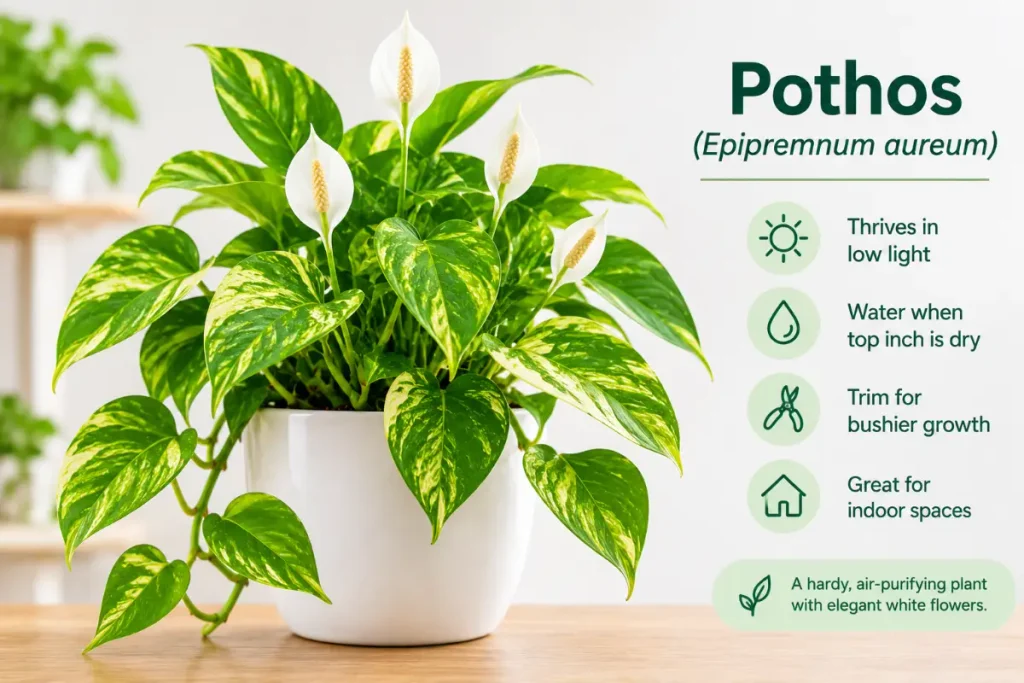
2. Pothos (Epipremnum aureum)
Pothos rarely flowers as a houseplant — it almost never blooms indoors in standard conditions. However, it earns its place on this list because a pothos that has matured in a very bright, humid environment (a large greenhouse or a very large, bright indoor space) will occasionally produce small white spathes. This is not a reliable flowering plant for most homes, but it is worth noting for large indoor growing spaces.
For consistent white blooms with similar care demands, see the peace lily above.
3. Anthurium (White Varieties)
White anthurium varieties — ‘White Champion,’ ‘Vanilla,’ and similar cultivars — produce the same waxy, long-lasting spathes as the more common red types, but in crisp white or cream. The spathes persist for 2–3 months, making anthurium one of the longest-lasting flowering houseplants available.
Light: Bright indirect light; avoid direct sun which bleaches the white spathes quickly.
Water: Allow the top inch of potting mix to dry between waterings. More drought-tolerant than peace lily.
To rebloom: Bright light and a monthly balanced liquid fertilizer during the growing season are the two most reliable triggers for continuous anthurium flowering.
4. Kalanchoe (White Varieties)
White kalanchoe is slightly less common in grocery stores than red and orange, but readily available at garden centers. The clusters of small, waxy flowers last 6–8 weeks and the care is the same as colored varieties — minimal watering, bright light, and a short-day rest period to trigger reblooming.
Light: Bright indirect light to some direct morning sun.
Water: Allow the top inch of potting mix to dry between waterings. Kalanchoe is succulent-type and extremely tolerant of underwatering.
To rebloom: 6 weeks of 14-hour darkness per night triggers the next bud set.
Moderate Effort to Flower
5. Phalaenopsis Orchid (White Varieties)
White phalaenopsis — the classic white moth orchid seen at every florist and home store — is the most popular flowering houseplant in the US, and for good reason. A single spike carries 8–20 flowers that last 2–4 months, and with the right conditions the plant reliably produces a new spike every 8–12 months.
Light: Bright indirect light; an east-facing window is ideal. The leaves should be light green — yellow-green indicates too much light, dark green too little.
Water: Water thoroughly when the potting bark is almost dry (roots turn silvery-gray rather than green). Never let roots sit in water.
To rebloom: Move to a cooler location (55–60°F at night) in fall to trigger a new spike. Once the spike appears, return to normal conditions.
Fragrance: Most white phalaenopsis are unscented; fragrant varieties exist but are less common.
6. Hoya (Hoya carnosa and related species)
Hoyas produce clusters of small, waxy, star-shaped flowers — many species have white or white-and-pink varieties — with a sweet honey fragrance that is strongest in the morning. The star-shaped flower clusters (called umbels) are produced from the same spurs year after year, so never cut off old flower stalks.
Light: Bright indirect light to some direct morning sun. More light produces more flowers.
Water: Allow to dry significantly between waterings — hoyas are semi-succulent and prefer drought over overwatering.
Patience required: Hoyas can take 2–5 years from a young cutting to first flowering. Mature plants in a bright position may flower multiple times per year.
7. Stephanotis (Stephanotis floribunda — Madagascar Jasmine)
Stephanotis produces clusters of waxy white tubular flowers with an intense, sweet fragrance — this is the flower traditionally used in wedding bouquets. As a houseplant it requires attention but rewards it with one of the finest white flower displays available indoors.
Light: Bright indirect light; some direct morning sun is beneficial.
Water: Keep evenly moist in summer; reduce significantly in winter.
Temperature: Does not tolerate temperatures below 55°F. Keep away from drafts and cold windows in winter.
To flower: A cool, drier winter rest (reduced watering, cooler temperatures) followed by resuming normal care in spring reliably triggers flowering in established plants.
8. Spathiphyllum Sensation (Large Peace Lily)
The ‘Sensation’ cultivar of peace lily grows significantly larger than standard varieties — leaves can reach 18–24 inches and the plant overall may reach 4–5 feet in a large pot — producing proportionally larger white spathes. The care is identical to standard peace lily but the display is considerably more dramatic.
Best for: Corners, large rooms, and spaces that need a substantial plant with reliable white flowers without demanding care.
More Demanding — Worth the Effort
9. Gardenia (Gardenia jasminoides)
Gardenia is the most fragrant of all white-flowering houseplants — a single open bloom scents an entire room — and also one of the most demanding. It drops buds at the slightest stress, dislikes dry air, requires acidic soil, and needs bright light to flower reliably. Most gardenia failures come from one of these four factors.
Light: Bright indirect light to some direct morning sun.
Water: Keep evenly moist with soft or filtered water (gardenias are sensitive to fluoride in tap water). Never allow to dry out.
Humidity: Requires 50%+ relative humidity — a pebble tray with water beneath the pot (not touching the pot base) helps, as does grouping with other plants.
Soil: Acidic potting mix (pH 5.0–6.0); use a fertilizer formulated for acid-loving plants.
Temperature: Keep above 60°F; avoid cold drafts and air conditioning vents.
Fragrance: Exceptional — one of the finest scents in the plant world.
10. Jasmine (Jasminum polyanthum — Pink Jasmine)
Despite the common name, the flowers of Jasminum polyanthum are white (pink in bud), and the fragrance is extraordinary — sweet, heady, and strong enough to fill a large room when the plant is in full bloom in winter and early spring.
Light: Full sun or very bright indirect light indoors.
To flower: The key trigger is a cool, well-lit fall and winter period before blooming. Bring the plant indoors in September or October and keep in the brightest, coolest room available (50–60°F at night). Flower buds set during this period; blooms open from January onward.
Water: Keep evenly moist; jasmine wilts quickly when dry.
After blooming: Move outdoors for summer in a sheltered sunny position; bring back in before frost.
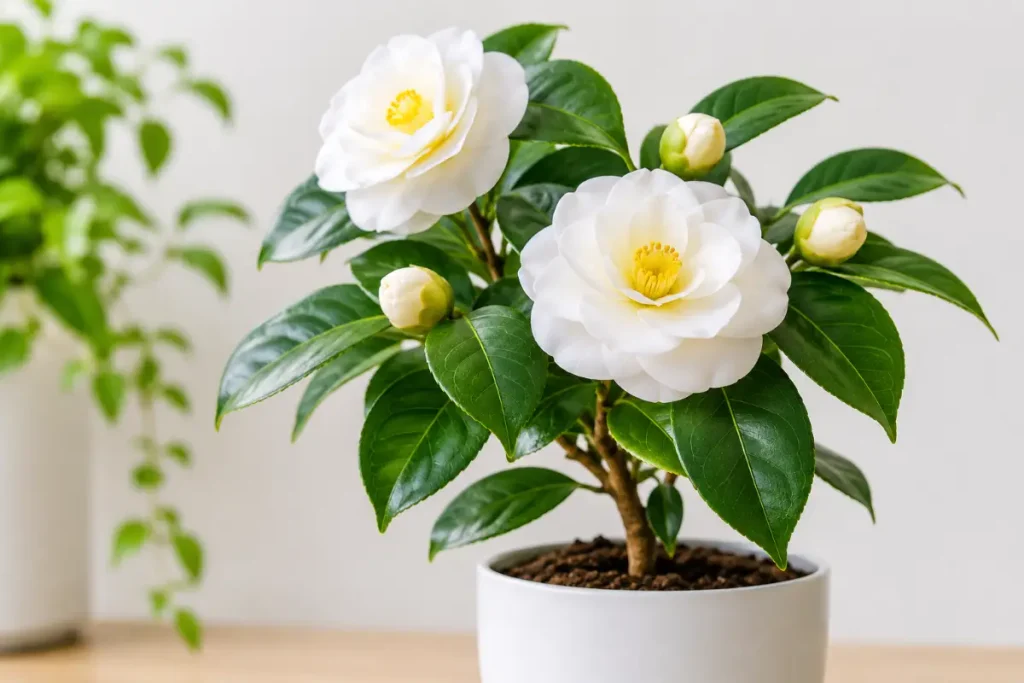
11. Camellia (Camellia japonica and sinensis — White Varieties)
Camellias produce formal, rose-like white flowers in late winter and early spring — a time of year when almost nothing else is blooming indoors. They prefer cool conditions, which limits where they can be kept in a typical home but makes them ideal for an unheated sunroom or cool bright porch.
Light: Bright indirect light; avoid hot direct afternoon sun.
Temperature: Prefers 45–60°F during bud development (fall and winter). Warmer conditions cause bud drop.
Water: Keep evenly moist with soft water; camellias are sensitive to hard water and fluoride.
Soil: Acidic potting mix, as for gardenia.
12. Tuberose (Polianthes tuberosa)
Tuberose bulbs grown in pots produce tall spikes of intensely fragrant white waxy flowers in summer — one of the strongest and most distinctive floral fragrances available from any indoor plant. Plant the tubers in spring for summer blooms.
Light: Full sun; a south-facing window is the minimum for reliable flowering.
Water: Keep evenly moist during active growth; reduce after flowering.
Note: Tuberose tubers do not reliably reflower in subsequent years; most gardeners treat them as annuals and replant each spring.
Seasonal and Forcing Options
13. White Paperwhite Narcissus (Narcissus papyraceus)
Paperwhite bulbs can be forced indoors in fall for blooms from late November through January. The white flowers have a distinctive musky fragrance (divisive — some love it, others find it too strong). No soil is needed — bulbs can be grown in a shallow dish with pebbles and water.
How to force: Place bulbs close together on pebbles with water just touching the base; keep in a cool bright location until shoots appear (2–3 weeks), then move to a warmer room for flowering.
Bloom time: 3–4 weeks of flowers per bulb planting.
14. White Cyclamen (Cyclamen persicum — White Varieties)
White cyclamen — with their swept-back petals and attractive marbled leaves — are widely sold as winter houseplants from October through March. They prefer cool conditions and will flower for 2–3 months in a bright, cool room.
Light: Bright indirect light; avoid hot windowsills.
Temperature: 50–65°F is ideal; warmer rooms shorten the bloom period significantly.
Water: Water from below (bottom-watering) to keep moisture off the crown, which rots easily.
After blooming: Allow to dry out and go dormant in spring; repot the tuber in summer for potential reblooming the following fall.
Fragrance Guide: Choosing White Flowers by Scent
Not all white-flowering houseplants are fragrant, and fragrance intensity varies enormously. For rooms where scent is part of the purpose — a bedroom, a living room, an entryway — these are the fragrant white options ranked by intensity:
| Plant | Fragrance intensity | Character |
|---|---|---|
| Gardenia | Very strong | Sweet, heady, complex |
| Jasmine (Jasminum polyanthum) | Strong | Sweet, floral |
| Tuberose | Strong | Sweet, slightly spicy |
| Stephanotis | Strong | Sweet, clean |
| Hoya | Moderate | Honey, sweet |
| Paperwhite narcissus | Moderate | Musky (divisive) |
| White cyclamen | Mild to none | Faint floral |
| Peace lily | Mild | Faint, pleasant |
| Phalaenopsis orchid | None (most varieties) | — |
| White anthurium | None | — |
Caring for White Flowers: Keeping Blooms Looking Their Best
White flowers show dirt, marks, and age more visibly than colored ones — a petal that discolors on a red anthurium is barely noticeable, while the same discoloration on a white one is immediately obvious. A few practices help keep white indoor blooms at their best:
Keep water off the petals. Water spots from misting or splashing during watering leave visible marks on white spathes and petals. When misting for humidity, direct the spray at the foliage and away from open flowers. Water at the base of the plant or into a saucer.
Remove spent flowers promptly. Aging white flowers turn yellow, then brown, at a rate that is more visible than on colored flowers. Removing individual spent blooms — rather than waiting for an entire flower cluster to finish — keeps the display cleaner throughout the bloom period.
Dust petals gently. In dusty rooms, white flowers accumulate visible surface dust over their 4–8 week display period. A very soft dry brush (a clean makeup brush works well) can gently remove surface dust without marking petals.
Avoid ethylene sources. Ethylene gas, produced by ripening fruit, causes premature petal aging and drop in many flowering plants. Keep white-flowering plants away from fruit bowls, particularly in warm rooms. Aging cut flowers in the same room also produce ethylene — another reason to remove spent blooms quickly.
Light Requirements: Matching Species to Your Windows
The most common mistake with white-flowering houseplants is placing demanding bloomers in positions that would suit a foliage plant. This table summarizes light requirements by species:
| Species | Minimum light | Ideal light |
|---|---|---|
| Peace lily | Low indirect | Moderate indirect |
| White anthurium | Moderate indirect | Bright indirect |
| White kalanchoe | Bright indirect | Some direct morning sun |
| Phalaenopsis orchid | Moderate indirect | Bright indirect (east window) |
| Hoya | Bright indirect | Some direct morning sun |
| Stephanotis | Bright indirect | Some direct morning sun |
| Gardenia | Bright indirect | Direct morning sun + bright indirect |
| Jasmine | Bright indirect | Full sun (south window) |
| Camellia | Bright indirect | Bright indirect (avoid hot afternoon sun) |
| White cyclamen | Bright indirect | Bright indirect (cool windowsill) |
| Paperwhite narcissus | Bright indirect | Bright direct |
The practical implication: if your brightest available spot is moderate indirect light (typical for most rooms away from south or west windows), peace lily, white anthurium, and phalaenopsis orchid are the most reliably flowering options. Gardenia, jasmine, and stephanotis genuinely need the brightest position you can provide.
Potting and Repotting White-Flowering Houseplants
When to repot: Most white-flowering houseplants do best when slightly pot-bound — roots filling the pot without being severely cramped. Repot when roots emerge from drainage holes or circle the top of the pot. For most species, this means repotting every 2–3 years, one pot size up at a time.
Timing: Repot after flowering, never during. Moving a plant to a new pot during bud development or open flowering almost always causes bud drop or shortened bloom time — the stress of root disturbance is enough to abort flowers.
Potting mixes by type:
- Peace lily, anthurium: standard indoor potting mix with added perlite (1 part perlite to 3 parts mix)
- Orchids (phalaenopsis, oncidium): orchid bark mix only — never standard potting mix
- Gardenia, camellia: acidic potting mix (azalea or camellia mix, or standard mix amended with sulfur)
- Hoya, kalanchoe: well-draining cactus/succulent mix or standard mix with 30% perlite
- Bulbs (paperwhite, cyclamen): standard mix with good drainage; paperwhites are often grown in pebbles and water
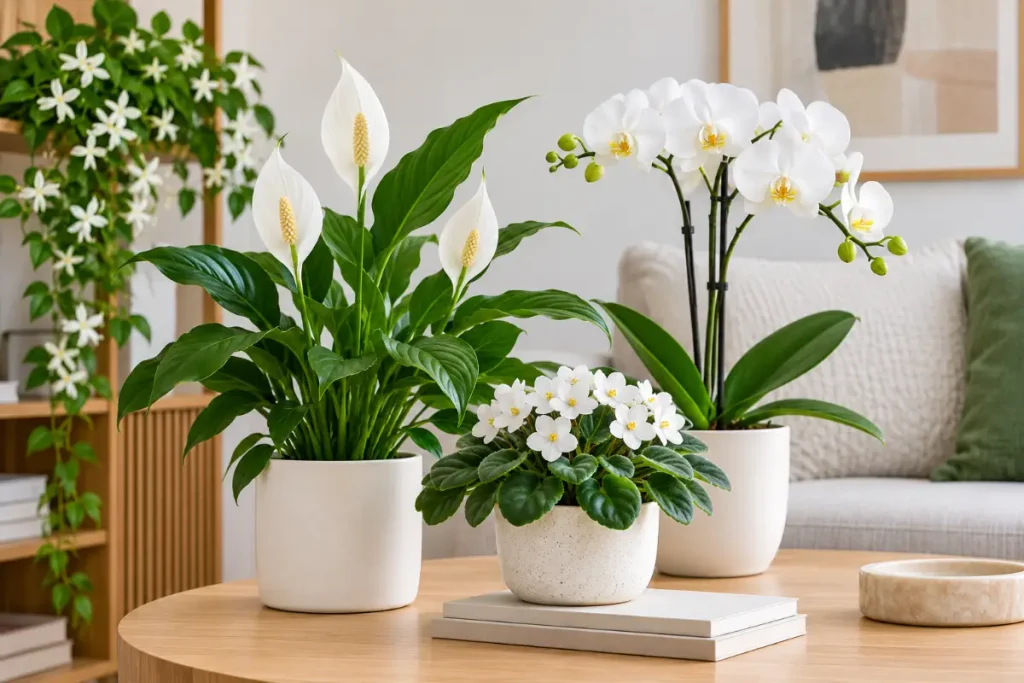
White Flowers and Interior Design
White-flowering plants have specific strengths in interior design applications that make them useful in ways colored bloomers are not.
Universal background compatibility: White flowers work against every wall color, furniture tone, and textile palette. A red-flowering plant can clash with pink or orange decor; a white one never does. This makes white-flowering houseplants the safest choice when you want a flowering accent in a room with an established palette.
Brightening low-light spaces: White reflects more light than any other color, giving white-flowering plants a visual brightness that lifts a dim corner or a north-facing room. A peace lily in a low-light position does this effectively — it is one of the few indoor plants with white flowers that genuinely thrives in dim conditions.
Formal and minimalist interiors: White flowers pair particularly well with formal, minimalist, and monochromatic interior styles where colored flowers would feel out of place. A single white phalaenopsis orchid in a plain white pot on a black console table is a classic minimalist plant display.
Against dark backgrounds: Dark painted walls (charcoal, navy, deep green) make white flowers glow. The contrast is striking and intentional-looking — one of the most effective plant display combinations in contemporary interior design.
Massed displays: Multiple indoor plants with white flowers grouped together — three peace lilies at different heights, or a collection of white kalanchoe in matching white pots — creates a calm, cohesive display that would look busy with mixed colors.
Conclusion
The best indoor plants with white flowers for your home depends on how much effort you want to invest and what conditions you can provide. For reliable, low-effort white blooms — peace lily, white anthurium, and white kalanchoe deliver consistently without demanding conditions. For fragrance as the priority — gardenia and jasmine are exceptional but need bright light, cool winters, and attention to humidity. For an impressive seasonal display — forced paperwhite bulbs and winter cyclamen require nothing more than a cool bright room and a few weeks of patience.
For further guidance on flowering houseplant care, the University of Florida IFAS Extension guide to flowering potted plants provides detailed cultural information for dozens of species suited to US indoor conditions.
FAQs
What is the easiest indoor plant with white flowers?
Peace lily is the easiest — it tolerates low light, is forgiving of irregular watering, and blooms reliably without any special treatment. It’s the starting point for anyone who wants white flowers indoors without significant effort.
Which white-flowering houseplant has the best fragrance?
Gardenia is widely considered the finest fragrance in the white-flowering houseplant category — rich, complex, and unmistakable. Jasmine and stephanotis are close alternatives that are somewhat easier to grow.
Why is my peace lily not flowering?
The most common cause is insufficient light. Peace lily will survive in low light but flowers best in moderate to bright indirect light. Move it closer to a window and ensure it is receiving consistent moisture. A dose of balanced liquid fertilizer in early spring can also encourage blooming.
Are white-flowering houseplants safe for cats and dogs?
Not all of them. Peace lily, white anthurium, and cyclamen are toxic to pets. Phalaenopsis orchids are considered non-toxic. Always check the ASPCA toxic plant database before adding a new plant to a home with animals.
Can I grow white orchids indoors year-round?
Yes — phalaenopsis orchids are among the most adaptable flowering houseplants and will grow comfortably indoors year-round in most US homes. A cool fall period near a window (55–60°F at night) triggers the next flower spike, which develops over 8–12 weeks and then blooms for 2–4 months.
How do I get my gardenia to stop dropping buds?
Bud drop in gardenia is almost always caused by one of four factors: low humidity, inconsistent watering (drying out between waterings), temperature fluctuation or drafts, or being moved after buds set. Keep humidity above 50%, water consistently with soft water, keep away from drafts and vents, and avoid moving the plant once buds appear.
Pingback: Indoor Plant with Curly Leaves: 11 Varieties with Stunning Texture - Plant Quill