
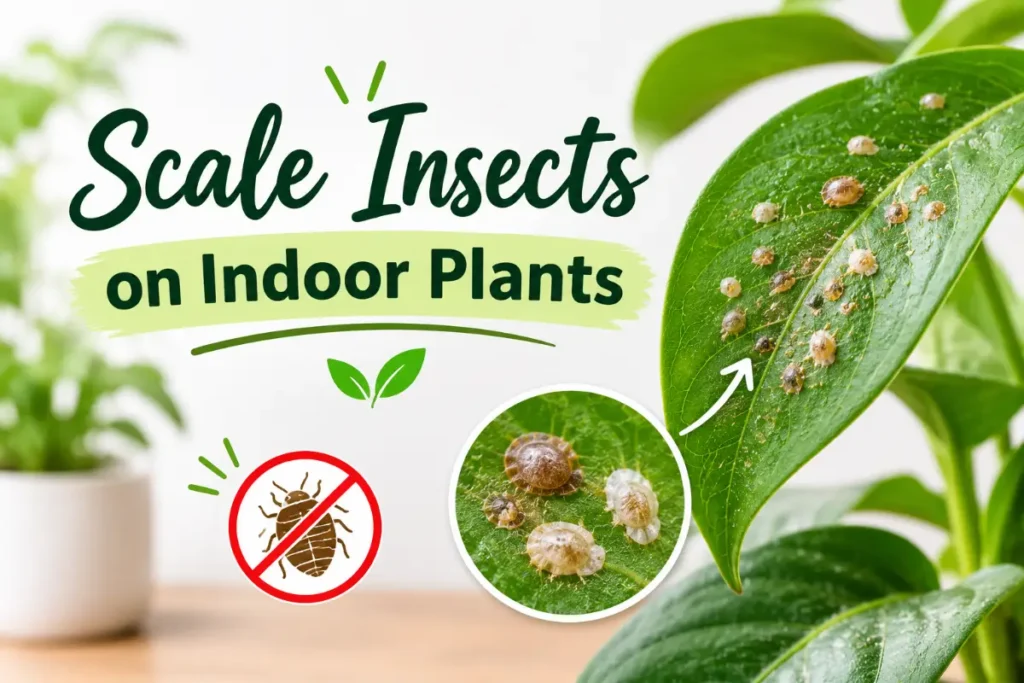
Scale insects are among the most deceptive houseplant pests. Unlike spider mites or fungus gnats, they do not move visibly — they sit still on stems and leaves looking like small bumps, bark irregularities, or harmless growth features. By the time most growers recognize them for what they are, scale insects on indoor plants have been feeding and reproducing for weeks, quietly draining plant sap and excreting honeydew that invites sooty mold.
The good news: scale is very beatable with the right approach. This guide covers identification, the two main types you will encounter, and eight treatment methods ordered from first response to last resort.
What Scale Insects Actually Are
Scale insects are piercing-sucking insects in the order Hemiptera — the same order as aphids and mealybugs. They feed by inserting a stylet (a needle-like mouthpart) into plant tissue and extracting phloem sap. Unlike most insects, adult females of most scale species are immobile — once they settle at a feeding site, they produce a protective covering (the “scale”) and remain stationary for the rest of their lives.
This protective covering is what makes scale both hard to identify and hard to treat. It can be waxy, shell-like, cottony, or smooth depending on the species, and it ranges in color from pale tan to dark brown to almost black.
Life cycle:
- Eggs: Laid beneath the female’s scale covering; a single female can produce 100–300 eggs
- Crawlers: Newly hatched juveniles are tiny (barely visible), mobile, and highly vulnerable to contact treatments — the most treatable life stage
- Settled nymphs: Crawlers settle at a feeding site within a few days and begin producing their protective covering; treatment at this stage requires penetrating the cover
- Adults: Females are immobile and fully covered; males (rarely seen) are small winged insects
The crawler stage is the window of maximum treatment effectiveness. Once nymphs are settled and covered, most contact insecticides cannot reach them through their protective layer.
Soft Scale vs. Hard Scale: What You Are Dealing With
The two major categories of scale require different treatment approaches, so identification matters.
Soft Scale
Soft scale (family Coccidae) produces a waxy or leathery covering that is not separate from the insect’s body — you cannot remove the covering without crushing the insect. Soft scale excretes large quantities of honeydew, so infested plants often show sticky residue on leaves and sooty mold growth.
Common soft scale species on US houseplants:
- Coccus hesperidum (brown soft scale) — flat, oval, brown; common on ficus, citrus, schefflera
- Saissetia coffeae (hemispherical scale) — dome-shaped, brown-black; common on ferns, palms
- Pulvinaria floccifera (cottony camellia scale) — produces white cottony egg masses at the rear; common on camellias, hollies brought indoors
Hard Scale (Armored Scale)
Hard scale (family Diaspididae) produces a hard, waxy cover that is entirely separate from the insect’s body underneath — you can lift the cover and find a much smaller, pale insect beneath it. Hard scale does not produce honeydew (the cover prevents secretion from exiting). Hard scale is generally harder to kill than soft scale because the cover is more protective.
Common hard scale species on US houseplants:
- Aspidiotus nerii (oleander scale / ivy scale) — white to gray circular covers; very common on indoor plants
- Diaspis boisduvalii (Boisduval scale) — white covers; extremely common on orchids
- Hemiberlesia lataniae (latania scale) — yellow-brown circular covers; common on palms
Quick identification test: Try to lift the scale covering with a fingernail. If it lifts cleanly away from the stem, leaving a small pale insect underneath — it is armored (hard) scale. If it crushes or smears and there is no separate insect beneath — it is soft scale.
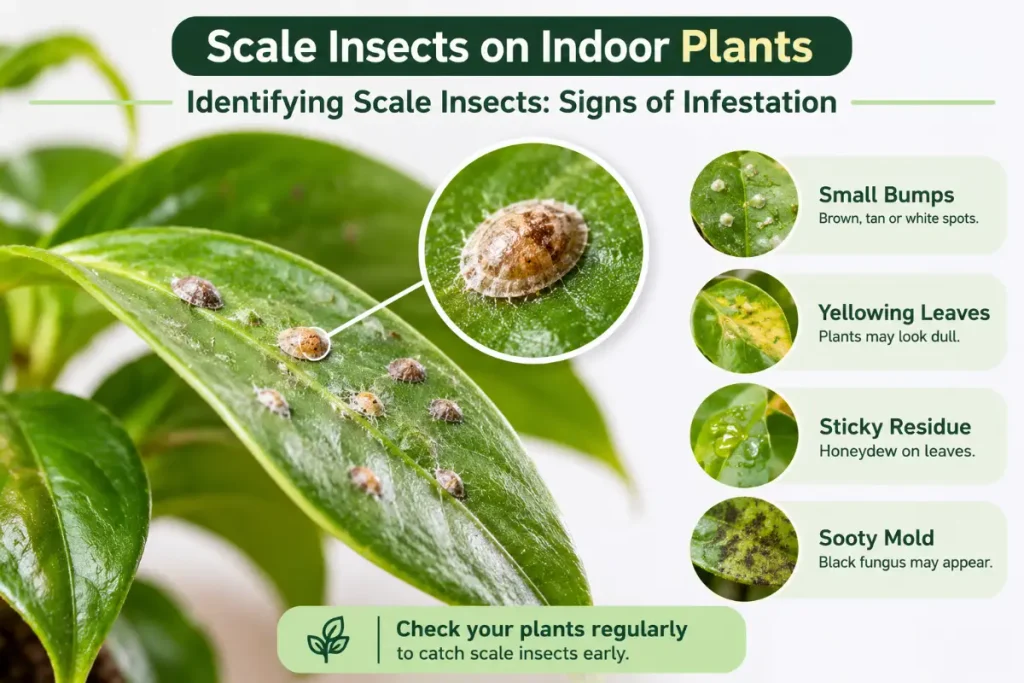
Identifying Scale Insects: Signs of Infestation
On stems and branches:
- Small brown, tan, or white bumps along stems — may look like natural lenticels (bark pores) but are more numerous and irregular
- Bumps that do not match the stem texture; slightly raised with a rounded dome shape
- Waxy, cottony, or crusty buildup in crevices at branch joints
On leaves:
- Bumps on the midrib or main veins (where scale often concentrates on leaf surfaces)
- Yellow patches on the leaf surface above a feeding site
- Sticky, shiny honeydew residue on leaf surfaces and surrounding surfaces (pots, shelving, floor)
- Black sooty mold growing on honeydew deposits
On orchids specifically:
- White, crusty scale under leaves, on pseudobulbs, and along the central stem — Boisduval scale is endemic to orchid collections and spreads rapidly between plants
Confirm with a loupe: A 10× magnifying loupe shows the scale covering clearly and allows you to identify the crawler stage (tiny, moving specks) during active hatch periods.
Treatment Method 1: Manual Removal with Isopropyl Alcohol
This is the most effective first treatment for scale insects on indoor plants — particularly for adult scale on accessible stems and leaves.
How to do it:
- Dip a cotton swab or soft toothbrush in 70% isopropyl alcohol
- Rub directly over each scale — the alcohol penetrates the waxy covering and kills the insect; the mechanical rubbing dislodges the cover and removes the feeding site
- For heavy infestations on smooth stems, dip a soft cloth or toothbrush in alcohol and scrub the entire stem surface
- Work systematically — section by section from the base of the plant upward
- Discard cotton swabs and rinse the brush between plants to avoid transferring crawlers
Frequency: Every 5–7 days for 3–4 weeks. Repeat applications catch newly settled crawlers before they produce a protective cover.
What it does not do: This method is excellent for adult scale on exposed surfaces but cannot reach scale in tight crevices, on root systems, or on heavily encrusted stem sections with dozens of overlapping scales.
Treatment Method 2: Neem Oil Spray
Neem oil’s azadirachtin disrupts the development of crawler-stage scale before they settle and produce protective covers. It also has some contact activity against soft scale adults whose protective layer is less impenetrable than hard scale.
Recipe: 1 teaspoon cold-pressed neem oil + ¼ teaspoon liquid dish soap + 1 quart lukewarm water (pre-mix oil and soap, then add to water; use within 1 hour).
Application: Spray all stems, branch joints, and leaf surfaces — particularly undersides. For orchids, spray pseudobulbs and the base of leaf stems where Boisduval scale concentrates. Apply in the evening to avoid leaf burn from photosensitization.
Frequency: Every 7 days; alternate with isopropyl alcohol treatments.
Best for: Catching the crawler stage; ongoing suppression between manual removal sessions; soft scale adults.
Treatment Method 3: Horticultural Oil (Dormant or Summer Weight)
Horticultural oils (highly refined petroleum or plant-based oils) kill scale insects by physically blocking their breathing pores (spiracles), causing suffocation. Unlike neem oil, horticultural oil has no systemic activity — it works only by direct contact and suffocation.
Products: Bonide All Seasons Horticultural & Dormant Spray Oil, Monterey Horticultural Oil — widely available at Home Depot and Lowe’s.
Application: Mix according to label directions (typically 2–4 tablespoons per gallon). Spray all plant surfaces thoroughly; complete coverage is critical because there is no residual activity after the oil dries. Apply in the evening or on overcast days.
Effectiveness: High against soft scale and crawler-stage hard scale; moderate against settled hard scale (the oil can penetrate less heavily armored species). Particularly effective when combined with manual removal — remove adult scale first, then spray to kill remaining crawlers and eggs.
Phytotoxicity risk: Do not apply to drought-stressed plants, plants that have been recently sprayed with sulfur-based products, or in temperatures above 90°F. Can cause leaf burn on sensitive foliage. Test on one leaf before full application.
Treatment Method 4: Insecticidal Soap
Insecticidal soap kills crawler-stage scale and soft scale adults through the same cuticle-disruption mechanism that kills spider mites and aphids. It is less effective against hard scale adults (the cover is impermeable) but very effective during the crawler hatch period.
Recipe: 1 tablespoon pure liquid castile soap or Safer Brand Insect Killing Soap per 1 quart water.
Application: Complete coverage of all surfaces; reapply every 5–7 days. The key is timing — if you can observe and treat during the crawler hatch period (typically 1–3 weeks after adult females become visible), insecticidal soap is highly effective.
How to identify the crawler hatch: Place double-sided tape around infested stems. Crawlers walking across the tape are caught and become visible as tiny amber dots. When crawlers appear on the tape, the hatch is active — this is the moment for the most aggressive soap and neem treatment.
Treatment Method 5: Systemic Insecticide Drench
Systemic insecticides are absorbed through roots and distributed throughout plant tissue; scale insects feeding on treated tissue ingest the insecticide.
Products: Bonide Systemic Houseplant Insect Control (imidacloprid) — available at Home Depot, Lowe’s, and online. Apply as a soil drench at the dosage on the label.
Effectiveness: Imidacloprid is effective against soft scale; its effectiveness against hard scale is lower because hard scale feeds primarily on phloem (where systemic insecticide concentration is higher) but the feeding rate of armored scale is lower overall.
When to use: When surface treatments have been applied for 4+ weeks without adequate control; for large plants where manual treatment of every stem is impractical.
Important: Keep children and pets away from treated plants. Imidacloprid is a neonicotinoid with documented effects on pollinators — not relevant for indoor use, but do not use treated plants outdoors or in areas accessible to bees.
Treatment Method 6: Rubbing Alcohol Spray (Diluted)
For plants with widespread crawler infestations — when scale bumps are small and numerous but not yet fully armored — a diluted isopropyl spray covers more area faster than individual swab treatment.
Recipe: Mix 70% isopropyl alcohol 1:1 with water (resulting 35% solution). Spray all surfaces.
Test first: Some plants are sensitive to alcohol sprays — test on one leaf 24 hours before full treatment. Succulents with farina (powdery coating), orchid roots, and some ferns may be damaged by alcohol spray at any concentration.
Treatment Method 7: Prune Heavily Infested Branches
When specific stems or branches are heavily encrusted with scale — to the point where individual removal is impractical — cutting and disposing of those sections is often the most efficient approach.
Seal pruned material in a plastic bag before disposal. Sterilize pruning shears with isopropyl alcohol before and after each cut to avoid spreading crawlers. After pruning, treat remaining plant tissue with neem oil or alcohol to address any crawlers that may have dispersed from the removed sections.
Treatment Method 8: Beneficial Insects (Biological Control)
Several commercially available beneficial insects prey specifically on scale:
- Chilocorus spp. (twospotted lady beetle) — predates both hard and soft scale; available from specialty insectary suppliers
- Metaphycus helvolus (parasitic wasp) — parasitizes soft scale; tiny, non-stinging; available from Arbico Organics and similar US suppliers
- Encarsia spp. — parasitizes scale crawlers at the settled nymph stage
Biological control is most practical in greenhouse and large collection settings rather than typical home use. It is an excellent option for growers who prefer to minimize chemical treatments or who have recurrent scale problems on large plants.
Treatment Schedule for Scale Insects on Indoor Plants
Week 1:
- Manual removal with isopropyl alcohol on all visible adult scale
- Neem oil spray in the evening
- Set double-sided tape to monitor for crawlers
Week 2:
- Check tape for crawlers — if active, apply insecticidal soap spray
- Manual alcohol treatment on any newly detected scale
- Neem oil spray
Week 3:
- Alcohol swab treatment on remaining adult scale
- Horticultural oil spray (if scale persists on hard-to-reach areas)
- Monitor tape
Week 4:
- Final neem oil spray
- Inspect entire plant with magnifying loupe
- If significant scale remains, consider systemic drench
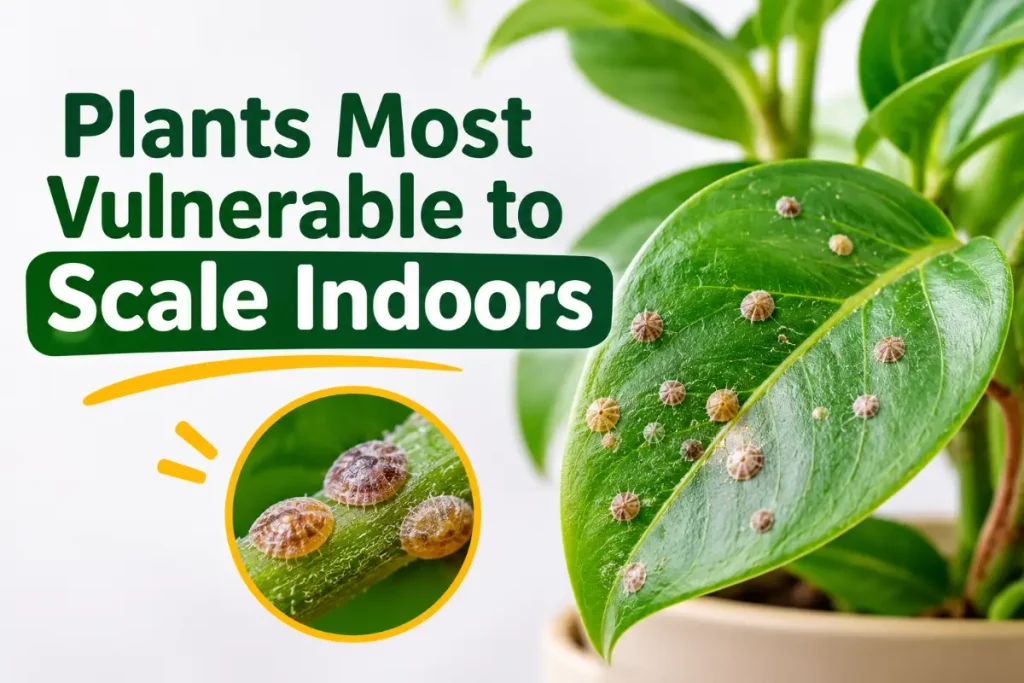
Plants Most Vulnerable to Scale Indoors
High-risk plants:
- Ficus (rubber plant, fiddle leaf fig, weeping fig) — brown soft scale is extremely common on ficus; check the undersides of branches at every node
- Citrus — multiple scale species; check stems, branch joints, and leaf undersides
- Orchids — Boisduval scale spreads rapidly in orchid collections; inspect pseudobulbs and leaf undersides monthly
- Palms — hemispherical scale and latania scale are endemic in US indoor palm collections
- Ferns — hemispherical scale; check frond undersides and the base of fronds at the rhizome
- Schefflera — brown soft scale; stems at branch junctions
- Ivy — oleander scale; check stems and leaf undersides
Scale and Sooty Mold: Fixing the Secondary Problem
One of the lasting effects of a scale infestation is sooty mold — the black, powdery fungal growth that colonizes honeydew deposits on leaves, pots, and surfaces beneath the plant. Sooty mold itself does not attack plants, but heavy coating blocks light from reaching leaf surfaces and reduces photosynthesis. It is also unsightly and signals to any observant grower that a sap-feeding insect has been active.
Sooty mold does not need to be treated with a fungicide — it disappears naturally once the scale infestation is eliminated and the honeydew supply stops. However, you can speed up its removal by wiping affected leaves with a damp cloth or sponge moistened with lukewarm water. For stubborn deposits, add a small amount of dish soap to the water. Work gently — rough scrubbing can damage leaf cuticles. Wipe each leaf individually, rinse the cloth between leaves, and avoid spreading sooty mold residue to clean plant tissue.
For pots, shelves, and saucers coated with honeydew and sooty mold, clean with soapy water followed by a wipe with diluted isopropyl alcohol. This also removes any scale crawlers that may have wandered from the plant.
If sooty mold persists on a plant after the scale is eliminated, it means honeydew is still present on the leaf surface from the previous infestation — it will naturally weatherize away with normal watering and air circulation within a few weeks.
Preventing Scale Re-Infestation
Quarantine new plants: Scale insects enter collections on new plants — this is by far the most common introduction route. Keep all new purchases isolated for 4 weeks and inspect stems and leaves with a magnifying loupe before introducing them to your collection.
Monthly inspection routine: Check high-risk plants (ficus, orchids, palms, citrus) monthly during routine watering. Run your finger along stems — scale bumps have a distinct raised texture and do not wipe away like dust.
Preventive neem spray: A monthly neem oil spray on susceptible plants during the growing season maintains azadirachtin levels that deter crawler settlement.
Avoid over-fertilizing: Excess nitrogen produces tender growth that scale crawlers preferentially colonize. Use a balanced fertilizer at the recommended rate rather than exceeding it.
Keep plants healthy: Stressed, root-bound, or drought-stressed plants are significantly more susceptible to scale establishment than plants growing vigorously in appropriate conditions. A scale crawler that lands on a healthy, well-watered plant in good light is less likely to establish successfully than one landing on a weakened specimen. Repot root-bound plants, maintain appropriate watering, and provide adequate light — basic plant health is the most durable long-term defense against all houseplant pests, including scale.
Clean tools and pots regularly: Scale crawlers can survive on dry pot surfaces, trays, and tools for several hours. Wipe pruning shears with isopropyl alcohol between plants and wash pots that held infested plants before reuse.
Conclusion
Scale insects on indoor plants are persistent but manageable with consistent treatment over 3–4 weeks. The key is addressing both adult scale (manual removal with isopropyl alcohol) and the crawler stage (neem oil, insecticidal soap, horticultural oil) simultaneously — adult removal without crawler control allows the cycle to restart from newly hatched individuals. Identifying the crawler hatch period using sticky tape and treating aggressively during that window is the single most effective tactical move in scale management.
For comprehensive identification and management guidance across all scale species found on US ornamental plants, the Penn State Extension guide to scale insects on ornamentals covers the full range of species, life cycles, and integrated management approaches in detail.
FAQs
What do scale insects look like on houseplants?
Scale insects look like small brown, tan, gray, or white bumps on stems and leaves — they are often mistaken for part of the plant itself. Brown soft scale is flat and oval; hemispherical scale is dome-shaped and dark brown; armored scale species are rounder with a removable cover. Try lifting the bump with a fingernail — if a small pale insect is underneath, it is armored scale.
Can scale insects kill a houseplant?
Yes — severe, long-established scale infestations can kill a houseplant by depleting its sap reserves and introducing sooty mold that blocks photosynthesis. Most infestations caught within a few months are treatable without permanent plant damage.
Why does my plant have sticky stuff on it?
Sticky residue on houseplant leaves is almost always honeydew — the sugary excretion of sap-feeding insects. Soft scale is a common cause in houseplants; aphids and mealybugs also produce honeydew. The black sooty mold that often accompanies the stickiness is a secondary fungal growth on the honeydew, not a primary pathogen.
Does neem oil kill scale insects?
Neem oil is effective against soft scale adults and crawler-stage scale of all species. It has limited effectiveness against settled hard scale adults because the armored cover blocks penetration. Use isopropyl alcohol for adult hard scale removal and neem oil for follow-up and crawler control.
How did scale get on my indoor plant?
Scale most commonly enters homes on newly purchased plants — inspect any new addition carefully before placing it near existing plants. Scale can also arrive on cut branches brought in from outdoors and, rarely, through open windows (crawlers are light enough to be airborne).
Pingback: Thrips on Houseplants How to Get Rid of: 2026 Pest Control Guide - Plant Quill