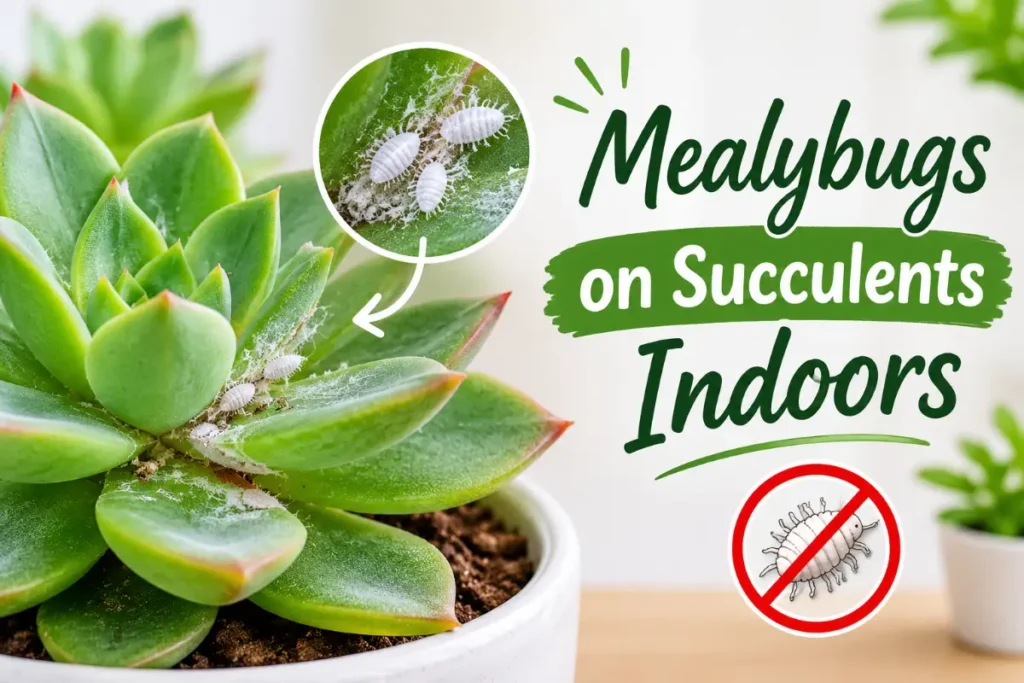
Of all the pests that target indoor succulents, mealybugs are the most common and the most persistent. They are well-adapted to the tight rosette structures and waxy leaf surfaces of succulents — hiding in crevices, feeding slowly enough to escape notice for weeks, and protecting their eggs in cottony masses that resist most spray treatments.
Dealing with mealybugs on succulents indoors requires a methodical approach: identify them early, treat with the right tools in the right sequence, and follow up consistently enough to break the reproductive cycle.
This guide gives you the complete 8-step process.
What Mealybugs Are — and Why Succulents Are Particularly Vulnerable
Mealybugs are soft-bodied insects in the family Pseudococcidae. The most common species attacking indoor succulents in US homes is Planococcus citri (citrus mealybug) and Pseudococcus longispinus (long-tailed mealybug). Both produce the characteristic white, waxy, cottony coating that gives them their name.
Their life cycle has three main stages:
- Eggs: Laid in a cottony wax mass containing 100–600 eggs. The egg mass is water-resistant and protects eggs from most spray treatments.
- Crawlers (nymphs): Newly hatched juveniles are tiny, mobile, and highly vulnerable to contact treatments — this is the stage most susceptible to isopropyl alcohol and insecticidal soap.
- Adults: Female adults are wingless and largely immobile once established at a feeding site. Males are tiny winged insects that live only a few days. Females can reproduce without males (parthenogenesis), meaning a single female can establish an infestation alone.
Why succulents are particularly vulnerable:
- The tight rosette structure of echeverias, sempervivums, and aloes creates sheltered crevices at leaf axils — the perfect hiding spots for mealybugs
- Many succulents produce waxy or powdery leaf coatings (farina) that visually camouflage white mealybugs
- Succulents require very infrequent watering, meaning plants are inspected less often than other houseplants
- Mealybugs are adapted to the high-sugar, low-water plant tissue of succulents — the same characteristics that make succulents drought-tolerant also make them ideal mealybug hosts

Step 1: Identify the Infestation and Assess Its Severity
Before treating, determine how widespread the infestation is across the plant and whether it has spread to neighboring plants.
Signs of mealybugs on succulents:
- White, cottony fluff in leaf axils, between rosette leaves, or along stems
- White waxy residue on leaf surfaces
- Honeydew — a sticky, shiny secretion mealybugs produce from excess plant sap; visible as a glossy coating on leaves below the infestation
- Sooty mold — black fungal growth that colonizes honeydew deposits; looks like soot on leaf surfaces
- Stunted new growth, shriveled leaves, or yellowing at the site of feeding
- Ants on the plant — ants farm mealybugs for their honeydew and may be an early indicator
Severity assessment:
- Mild: A few cottony spots on one or two leaves; confined to a single growth point
- Moderate: Multiple growth points affected; some honeydew visible; mealybugs present on stems
- Severe: Widespread cottony masses; heavy honeydew and sooty mold; multiple plants in the vicinity likely already infested
Step 2: Isolate the Infested Plant Immediately
Move the infested succulent away from all other plants — place it in a separate room or at minimum 3 feet from any other plant. Mealybug crawlers are mobile and spread easily to adjacent plants through leaf-to-leaf contact or by crawling across shared surfaces (saucers, windowsills, shelves).
Do not wait until after treatment to isolate — do it the moment you identify mealybugs. Infestations on neighboring plants, if any, may not yet be visible. Check all plants that were within 2 feet of the infested one immediately.
Step 3: Remove Heavy Infestations Manually
For moderate to severe infestations, manual removal before applying chemical treatments significantly increases effectiveness. Trying to treat a plant covered in cottony mealybug masses without first removing the masses is like trying to disinfect a wound without cleaning it — the protective wax coating blocks penetration.
How to remove mealybugs manually:
- Use a soft toothbrush, cotton swab, or small paint brush dipped in 70% isopropyl alcohol to physically scrub cottony masses from leaf axils, stems, and crevices.
- Work systematically from the top of the plant downward and from the center outward.
- For rosette succulents (echeveria, haworthia), gently separate outer leaves to expose the center — the highest-density mealybug zone is typically at the innermost leaf bases where the most tender tissue is accessible.
- Collect removed material in a sealed bag for disposal — do not compost.
The isopropyl alcohol on the brush kills mites on contact while cleaning; the mechanical action removes the egg masses that chemical sprays cannot penetrate.
Step 4: Treat with 70% Isopropyl Alcohol
This is the most effective direct treatment for mealybugs on succulents indoors because the alcohol penetrates the waxy coating that protects mealybugs and kills them on contact. It evaporates quickly, leaving no harmful residue, and is safe for most succulent foliage (though it removes farina — the powdery coating on some succulents — so test on one leaf first if you want to preserve the bloom).
Two application methods:
Spot treatment (best for mild to moderate infestations): Dip a cotton swab in 70% isopropyl alcohol and dab directly onto each visible mealybug and cottony egg mass. Hold the swab against each colony for 5–10 seconds — this ensures the alcohol penetrates the waxy coating. Work through the entire plant systematically.
Spray treatment (for widespread infestations): Pour 70% isopropyl alcohol into a spray bottle and spray all plant surfaces, including leaf axils and stem joints, until fully covered. The alcohol evaporates within seconds and does not need to be rinsed off.
Frequency: Repeat every 3–5 days for 3–4 weeks. The first application kills visible mealybugs; repeat applications catch newly hatched crawlers from eggs that survived.
Step 5: Follow with Neem Oil Soil Drench
Root mealybugs — a related species (Rhizoecus spp.) that colonizes roots and the base of stems beneath the soil line — are common on indoor succulents and are frequently overlooked because they are invisible during normal inspection. Plants with root mealybugs show stunted growth and decline despite apparently good care; unpotting reveals white, waxy masses on roots.
A neem oil soil drench addresses both root mealybugs and any crawlers that have dropped to the potting mix surface:
Recipe: 2 teaspoons cold-pressed neem oil + ½ teaspoon liquid dish soap + 1 quart lukewarm water (pre-mix oil and soap, then add to water; shake vigorously).
Application: Pour slowly and evenly over the potting mix surface until it drains from the drainage holes. Apply once per week for 3–4 weeks during the treatment period.
Note: Let the potting mix dry fully between drenches — succulents are susceptible to root rot if kept too moist. The neem drench fits naturally into a normal watering schedule: drench once per week in place of one regular watering.
Step 6: Apply Neem Oil Foliar Spray
After the initial alcohol treatment, follow with a neem oil foliar spray to maintain pressure on the mealybug population between alcohol applications. Neem oil’s azadirachtin disrupts mealybug reproduction and development; the oil coating also physically suffocates soft-bodied crawlers.
Recipe: 1 teaspoon cold-pressed neem oil + ¼ teaspoon liquid dish soap + 1 quart lukewarm water.
Application: Spray all leaf surfaces, stem joints, and leaf axils. Apply in the evening. For rosette succulents, angle the spray to reach inside the rosette — mealybugs in tight rosette centers are the hardest to reach and the most likely to survive surface-level treatment.
Frequency: Every 7 days, alternating with the alcohol treatment (alcohol on Day 1, neem on Day 7, alcohol on Day 14, neem on Day 21).
Caution: Neem oil removes or disrupts farina on powdery-coated succulents (echeveria, pachyphytum, some sedums). If preserving the powdery bloom matters, use the alcohol spot treatment method exclusively and avoid foliar neem sprays.
Step 7: Repot in Fresh Potting Mix
For moderate to severe infestations — particularly when root mealybugs are suspected or confirmed — repotting in fresh potting mix is the most reliable way to eliminate the problem at the root level.
How to repot to clear mealybugs:
- Unpot the succulent carefully and shake all old potting mix from the roots.
- Inspect roots closely for white, waxy mealybug colonies. Root mealybugs on succulents typically appear as white cottony clusters at root junctions and at the crown just below the soil line.
- Rinse roots with lukewarm water to remove residual potting mix and visible mealybug colonies.
- Dip roots in a 70% isopropyl alcohol diluted 1:1 with water solution (35% alcohol) for 10–15 seconds. This kills mealybugs on root surfaces without damaging the roots at this concentration.
- Allow roots to dry for 24–48 hours before repotting — this is a standard succulent practice after root disturbance.
- Repot in fresh, completely dry succulent potting mix in a clean pot. Discard the old potting mix; wash the old pot with soapy water and rinse with isopropyl alcohol before reuse.
Step 8: Monitor and Prevent Reinfestation
After the infestation is resolved, weekly monitoring for the next 2 months is essential — mealybugs from eggs deep in crevices can hatch weeks after the visible infestation appears cleared. A single undetected survivor can restart the infestation.
Monitoring routine: During watering, inspect every leaf axil and stem joint with a magnifying loupe or just strong light. Look for the smallest cottony specks — newly hatched crawlers are very small. Any sign of recurrence gets immediate alcohol spot treatment.
Prevention practices:
- Quarantine all new succulents for 4 weeks before adding them to your collection — mealybugs are most commonly introduced on new plants
- Use a preventive neem oil drench once per month during the growing season (spring through early fall) to maintain an inhospitable root zone environment
- Avoid over-fertilizing with high-nitrogen fertilizers — excess nitrogen produces the soft, tender new growth that mealybugs prefer to feed on
- Inspect any plant sharing a saucer, shelf, or windowsill with previously infested plants — shared surfaces are common mealybug highways
Which Succulents Are Most Susceptible?
Understanding which plants in your collection are highest-risk helps you focus monitoring efforts where they matter most.
Highest-risk succulents:
- Echeveria — the tight, overlapping rosette structure creates numerous sheltered crevices at every leaf axil; mealybugs are nearly endemic in echeveria collections
- Aloe vera — the dense leaf packing at the center and the smooth, tender new growth are ideal mealybug habitat
- Haworthia — small, compact rosettes with a lot of sheltered leaf bases; infestations often go undetected longer than on other genera
- Crassula (jade plant and relatives) — stem joints and leaf axils are common infestation sites; the waxy leaves camouflage white mealybug cottony masses
- Sempervivum (hens and chicks) — tightly packed offsets and dense rosettes create ideal hiding spots; infestations can spread between connected offsets rapidly
- Adenium (desert rose) — particularly vulnerable at the crown and base of branches where mealybugs feed on the tender cambium tissue
Moderate-risk succulents:
- Sedum — susceptible but the more open leaf arrangement makes inspection easier
- Gasteria — moderate risk; similar structure to haworthia
- Agave — susceptible at the leaf bases and near the growing tip; large leaf spines make inspection and treatment more challenging
Lower-risk succulents:
- Kalanchoe — occasionally targeted but not a preferred host
- Sansevieria (snake plant) — the tough, leathery leaves and upright growth are less hospitable than rosette-forming succulents
Cacti and mealybugs: Cacti are absolutely susceptible to mealybugs — both the cottony form at areoles and spine clusters, and root mealybugs in the soil. Inspect cactus areoles (the spine clusters) closely; mealybugs blend into the spine material. The mealybugs on succulents indoors issue extends fully to cacti kept as houseplants — treat cacti with the same isopropyl alcohol and neem oil protocol used for other succulents.
Treating a Collection: When Multiple Plants Are Infested
In a large succulent collection, mealybugs frequently spread to multiple plants before the infestation is detected. Treating the visible infested plants while ignoring their neighbors allows the cycle to continue.
Collection-wide response protocol:
- Remove all plants from shared shelves, windowsills, and saucers
- Inspect every plant individually with a magnifying loupe, paying close attention to leaf axils and stem joints
- Classify each plant: clean (no visible mealybugs), suspected (near an infested plant), or confirmed infested
- Treat all confirmed and suspected plants with the full 8-step protocol, even if suspected plants show no visible signs
- Clean and disinfect shelves, saucers, and any shared tools with diluted isopropyl alcohol before returning plants
- Do not return plants to shared display until all have been treated and monitored for 2 weeks
Preventive treatment for the whole collection: After clearing an infestation, apply a preventive neem oil soil drench to all plants in the collection once per month for 3 months. This addresses any root mealybugs that may have spread undetected and maintains an inhospitable root zone environment across the collection.

Common Mistakes When Treating Mealybugs on Succulents
Treating only the visible colonies. Mealybugs hide deep in rosette centers, in soil near the stem base, and on roots. If you treat only what you can see, the population survives in the hidden areas and re-establishes.
Stopping treatment too early. The cottony masses disappear quickly with alcohol treatment, giving the impression that the infestation is resolved. Crawlers hatching from surviving eggs are invisible — you will not see them. Continue the full 3–4 week treatment schedule regardless of how clean the plant looks after the first treatment.
Using dish soap alone as a treatment. Soap sprays kill mealybugs on direct contact but do not penetrate the waxy egg masses. Soap works as a supplement (and as an emulsifier in neem oil recipes) but should not be the primary treatment for mealybugs.
Watering infested succulents more frequently to compensate for decline. Mealybug-stressed succulents often look wilted or tired. The instinct is to water more — but overwatering a mealybug-infested succulent adds root rot risk to the existing pest problem. Maintain normal watering frequency and address the pest, not the symptom.
Not separating farina-sensitive succulents from your treatment approach. Many growers hesitate to use isopropyl alcohol on succulents with a powdery farina bloom (echeveria, pachyphytum) because the alcohol removes it. While this is true, the alternative — letting mealybugs on succulents indoors remain untreated to preserve the cosmetic bloom — results in a declining or dead plant. The farina regrows as new leaves emerge. Treat the infestation first; the bloom recovers on its own.
Skipping the root zone inspection. Root mealybugs are common, often invisible from the surface, and cause significant damage. If a succulent is declining without obvious above-ground pest pressure, root mealybugs are the first thing to rule out. Unpot the plant, inspect the root system, and treat with a neem soil drench if any white, waxy residue is found on roots or at the crown. This takes five minutes and can save a plant that would otherwise gradually decline despite surface-level treatments.
Using the same succulent potting mix over for previously infested plants. Mealybug eggs can survive in potting mix. After clearing an infestation, discard the old mix, clean the pot with soapy water followed by an isopropyl wipe-down, and repot in fresh, dry succulent mix. The cost of a fresh bag of potting mix is negligible compared to the time spent retreating a reinfestation from surviving eggs in the old soil.
Conclusion
Eliminating mealybugs on succulents indoors requires a systematic approach across 3–4 weeks: isolate the plant, manually remove colonies, treat with isopropyl alcohol every 3–5 days, follow with neem oil foliar sprays and soil drenches, and repot when root mealybugs are suspected. No single application ends an infestation — but consistent, rotating treatments break the reproductive cycle at every life stage. After clearing the infestation, monthly preventive neem drenches and careful quarantine of new plants keeps mealybugs from re-establishing.
For detailed guidance on integrated pest management approaches to mealybugs on ornamental plants, the University of California IPM Program’s guide to mealybugs covers biology, monitoring, and both chemical and biological control options in depth.
FAQs
What kills mealybugs on succulents instantly?
70% isopropyl alcohol kills mealybugs on direct contact within seconds — dab it directly onto mealybug colonies with a cotton swab for immediate kill. It penetrates the waxy protective coating that blocks most other contact treatments.
Can mealybugs spread to other succulents?
Yes — mealybug crawlers (newly hatched juveniles) are mobile and spread rapidly between plants through direct contact or by crawling along shared surfaces. Isolate any infested plant immediately to prevent spread to your collection.
How did mealybugs get on my indoor succulent?
The most common source is new plants introduced to the collection without quarantine. Mealybugs are also sometimes present on nursery plants at purchase, or brought in on fresh-cut herbs or flowers. Less commonly, they enter through open windows on air currents.
Does neem oil kill mealybugs?
Neem oil’s azadirachtin disrupts mealybug reproduction and development, and the oil fraction kills soft-bodied crawlers on contact. It is effective as part of a treatment rotation but less immediately effective than isopropyl alcohol for killing established adult colonies. Use alcohol for direct kill, neem oil for follow-up and prevention.
Why do mealybugs keep coming back on my succulents?
Recurrence after treatment almost always means surviving egg masses in hidden locations — deep inside rosette centers, at the soil line, or on roots. The solution is extending the treatment schedule to the full 3–4 weeks and checking for root mealybugs by unpotting the plant to inspect the root zone directly.