
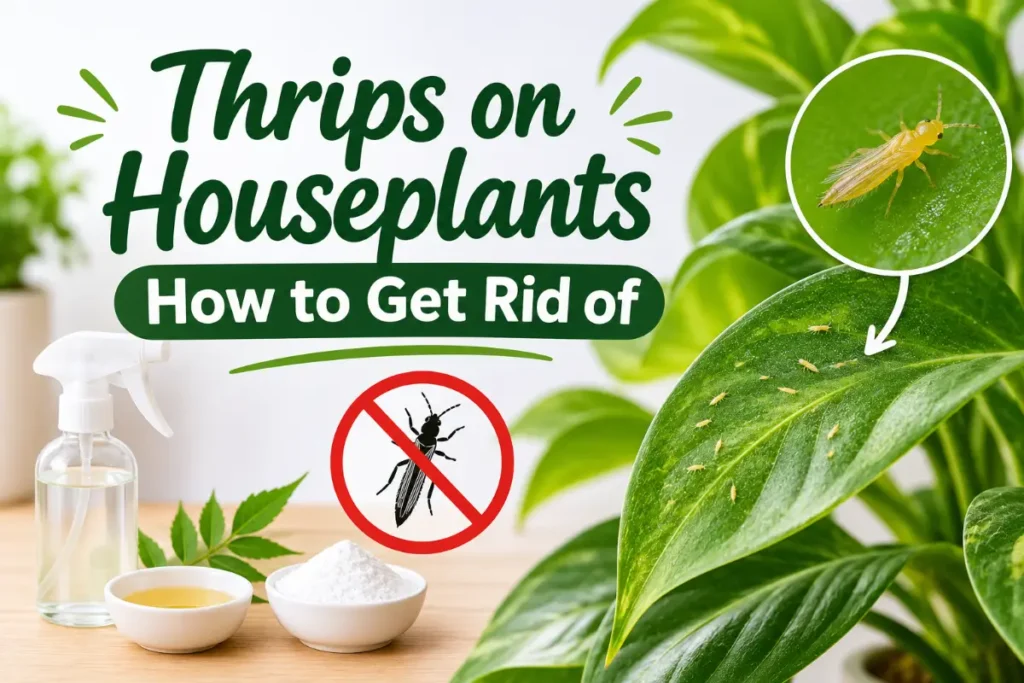
Thrips are small, fast, and infuriatingly hard to treat. They feed inside flower buds and between new leaf folds where most sprays cannot reach, they pupate in the soil out of contact range, and their fast reproduction means populations rebuild quickly if treatment gaps occur. Understanding thrips on houseplants how to get rid of them requires tackling multiple life stages simultaneously — adults and nymphs on the plant, pupae in the soil, and eggs tucked inside plant tissue.
This guide covers identification, the biology that makes thrips so persistent, and eight treatment methods ranked from first response to heavy-duty intervention.
What Are Thrips?
Thrips (order Thysanoptera) are slender insects 1–2 mm long — roughly the size of a sesame seed — with fringed wings in the adult stage. They move rapidly on plant surfaces, jumping or flying when disturbed. Most houseplant thrips infestations involve:
- Frankliniella occidentalis (western flower thrips) — the most common species globally; attacks a wide range of houseplants and flowers
- Thrips tabaci (onion thrips) — common on broad-leafed plants
- Heliothrips haemorrhoidalis (greenhouse thrips) — prevalent in greenhouse and indoor conditions
Why thrips are hard to see: Adult thrips are pale yellow to dark brown; nymphs are pale yellow and nearly translucent. They move quickly when disturbed and prefer to hide inside flower buds, in curled new leaves, and along leaf veins where they blend with plant tissue.
How to Identify Thrips Damage
Before treating, confirm you are dealing with thrips rather than another pest. Thrips damage has distinctive characteristics:
Leaf damage:
- Silver or bronze streaking on leaf surfaces — caused by the thrips feeding method (they rasp leaf cells open and drink the contents, leaving silver-colored collapsed cells)
- White or silver stippling similar to spider mite damage but typically more linear and in streaks rather than dots
- Distorted, curled, or scarred new growth — thrips feeding inside rolled new leaves causes the leaf to emerge deformed and scarred
- Black fecal spots (frass) — tiny black or brown specks on leaf surfaces, often in groups; a distinctive thrips sign
Flower damage:
- Streaked, discolored, or prematurely aborted flower buds
- Brown or silver streaking on flower petals
- Distorted or failed flower opening
How to confirm: Hold a white sheet of paper under a suspected branch and tap it sharply. Thrips dislodged from the plant are visible on white paper as tiny pale or dark slivers that move quickly. Use a 10× loupe to examine leaf surfaces and check inside flower buds — both nymphs and adults will be visible on close inspection.
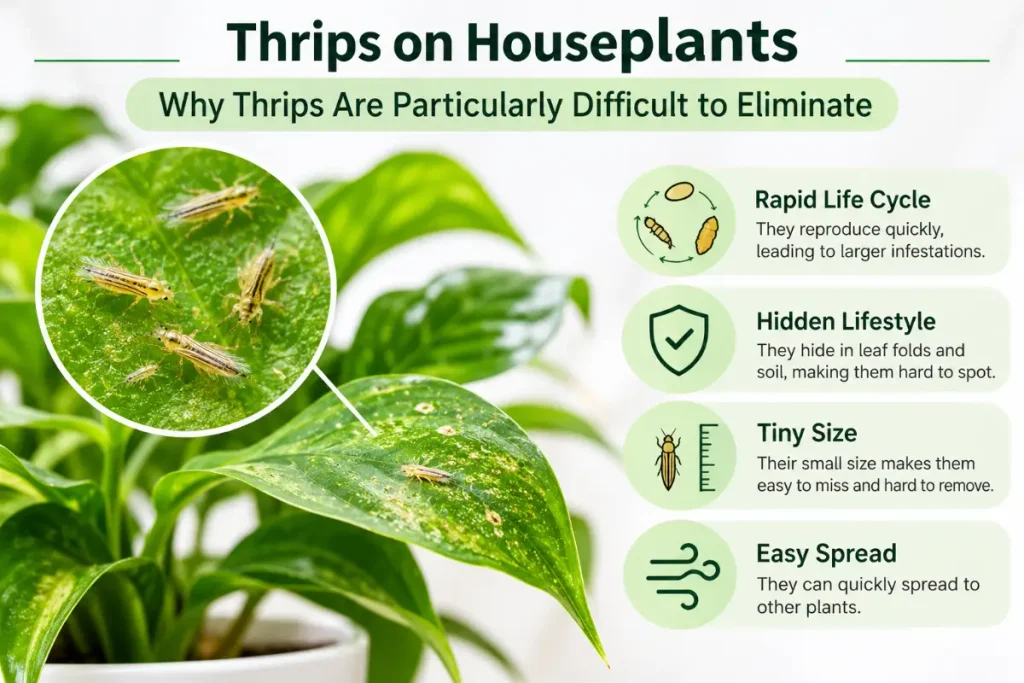
Why Thrips Are Particularly Difficult to Eliminate
Understanding thrips biology explains why they resist simple spray treatments:
1. They pupate in the soil. Unlike most foliar insects, thrips drop to the soil to pupate. The pupal stage is not feeding and not on the plant — it is entirely protected from foliar sprays in the potting mix. Any treatment that only addresses the plant leaves the pupal population intact.
2. They feed inside protected tissues. Thrips prefer to feed and lay eggs inside flower buds, rolled new leaves, and between tightly packed leaf clusters — locations that foliar sprays cannot fully penetrate.
3. They reproduce rapidly. A female thrips lays 150–300 eggs over her lifespan, inserting them into plant tissue with a saw-like ovipositor. Eggs are inside plant tissue and completely protected from contact treatments. At 75°F, the egg-to-adult cycle takes about 2 weeks — meaning without consistent weekly treatment, each generation restores the population.
4. They develop pesticide resistance. Thrips populations that survive repeated applications of pyrethroids or other contact insecticides develop resistance within a few generations.
The implication: effective thrips on houseplants how to get rid of protocols must simultaneously treat the plant (adults and nymphs), the soil (pupae), and the surrounding area (adults that have flown or walked to neighboring surfaces).
Treatment Method 1: Blue Sticky Traps
What they do: Unlike most pests, thrips are attracted to the color blue rather than yellow. Blue sticky traps are significantly more effective for catching adult thrips than the yellow sticky traps used for fungus gnats and whiteflies.
How to use: Hang blue sticky traps at plant canopy height — one trap per 1–2 plants for monitoring, more for active control. Position them directly among the foliage rather than above it. Replace every 2 weeks or when covered.
Purpose: Blue sticky traps serve two functions — monitoring (how many thrips are on the traps tells you whether the population is growing or declining) and direct control (trapping significant numbers of adult thrips). They do not eliminate an infestation alone but are an essential part of an integrated management program.
Available from: Amazon, specialty garden retailers, and suppliers including Arbico Organics.
Treatment Method 2: Neem Oil Spray
Neem oil is the most practical first treatment for thrips on houseplants how to get rid of in a standard home setting. Azadirachtin disrupts thrips reproduction and development; the oil fraction kills nymphs and adults on contact.
Recipe: 1 teaspoon cold-pressed neem oil + ¼ teaspoon liquid dish soap + 1 quart lukewarm water (pre-mix oil and soap, then add to water; use within 1 hour).
Application: Spray all leaf surfaces (top and undersides), stems, inside flower buds (if accessible), and the top inch of potting mix. Applying neem to the potting mix surface helps address adults and nymphs that have dropped from the plant, though it does not reach deep pupae.
Frequency: Every 5–7 days for 3–4 weeks. Rotate with spinosad (see Method 4) to prevent resistance.
Treatment Method 3: Insecticidal Soap
Insecticidal soap kills thrips nymphs and adults on direct contact by disrupting their outer cuticle. It has no residual activity and no effect on eggs or pupae, so frequent reapplication is required.
Recipe: 1 tablespoon pure liquid castile soap or Safer Brand Insect Killing Soap per quart of water.
Application: Complete coverage of all leaf surfaces including undersides. Ensure the spray reaches inside any rolled or folded leaves. Reapply every 5–7 days.
Best for: Nymph populations on foliage; use as an alternating treatment between neem oil applications.
Treatment Method 4: Spinosad (Most Effective Organic Treatment)
Spinosad is a naturally derived insecticide produced by the soil bacterium Saccharopolyspora spinosa. It is widely regarded as the most effective organic treatment for thrips — it has both contact and systemic activity, kills all life stages it reaches including those in protected locations, and has a good safety profile for humans and pets.
Products: Monterey Garden Insect Spray (spinosad) — available at Home Depot, Lowe’s, and online. Captain Jack’s Deadbug Brew is the same active ingredient under a different brand name.
How to apply: Mix according to label directions (typically 4 tablespoons per gallon for houseplant use). Spray all plant surfaces thoroughly. Spinosad can also be applied as a soil drench to address pupae — mix the same concentration and water into the potting mix until it drains from the drainage holes.
Frequency: Every 7–10 days. Rotate with neem oil — alternating spinosad and neem oil prevents resistance development.
Important limitation: Spinosad degrades rapidly in UV light — apply in the evening and store unused solution in a dark container. Its effectiveness drops significantly on a plant that is in direct sun all day; reapply more frequently in high-light positions.
Safety: Spinosad is considered safe around humans and pets once dry. Avoid applying to open flowers if pollinators are present (not relevant for most indoor settings but worth noting if plants are on a porch or by an open window).
Treatment Method 5: Neem Oil Soil Drench
Since thrips pupate in potting mix, treating the soil is an essential component of elimination that most growers skip.
Recipe: 2 teaspoons cold-pressed neem oil + ½ teaspoon liquid dish soap + 1 quart lukewarm water.
Application: Pour slowly and evenly over the potting mix surface until it drains from the drainage holes. The solution penetrates the top 2–3 inches of potting mix where pupal chambers are located. Apply once per week during the treatment period as a replacement for one normal watering.
Combined approach: Apply neem soil drench and neem or spinosad foliar spray on the same day for maximum simultaneous coverage of all thrips life stages.
Treatment Method 6: Remove Flowers and Heavily Infested New Growth
Thrips concentrate in flower buds and new growth — these are their preferred feeding and egg-laying sites. Removing open flowers and flower buds during an active infestation eliminates the highest-density thrips populations and removes the tissues where eggs are embedded.
How to do it: Clip all open flowers and flower buds with clean scissors; seal removed material in a plastic bag before disposal. For new leaves that have emerged distorted and scarred from thrips feeding inside the rolled leaf, remove these as well — they harbor eggs and their deformed tissue will never recover.
This is a significant step for flowering plants like begonias, impatiens, and peace lilies — but removing flowers is worthwhile to end a thrips infestation quickly rather than enduring weeks of partial treatments while thrips continue to breed in the buds.
Treatment Method 7: Hydrogen Peroxide Soil Drench
A hydrogen peroxide soil drench kills thrips pupae in the potting mix through oxidation, without harming established root systems at appropriate concentrations.
Recipe: Mix 1 part 3% hydrogen peroxide (standard drugstore variety, $1–$2 per bottle at CVS, Walgreens, or Walmart) with 4 parts water.
Application: Water the plant normally with this solution until it drains from the drainage holes. The fizzing action as hydrogen peroxide contacts organic matter in the potting mix is normal and indicates the peroxide is active. Apply once per week for 2–3 weeks; do not apply more frequently as repeated applications can alter the potting mix microbiome.
Availability and cost: This is one of the cheapest components of a thrips treatment program — a $2 bottle of 3% hydrogen peroxide makes enough for multiple drenches.
Treatment Method 8: Predatory Insects (Biological Control)
For growers with large collections or recurrent thrips problems, biological control offers a pesticide-free long-term solution.
Amblyseius cucumeris (predatory mite) — available from Arbico Organics and similar US specialty suppliers; predates thrips larvae and eggs; available in slow-release sachets that hang in plant foliage and release predators over 4–6 weeks.
Orius insidiosus (minute pirate bug) — an aggressive generalist predator that feeds on adult and larval thrips; available commercially for greenhouse use but also works in indoor settings with large plant collections.
Steinernema feltiae (entomopathogenic nematode) — microscopic roundworms that parasitize and kill thrips pupae in potting mix; applied as a soil drench; available from Arbico Organics.
Biological controls are most practical for growers who want to avoid repeated chemical applications or who have greenhouses or large indoor plant rooms where maintaining a predator population is feasible.
The 4-Week Treatment Protocol
Combining methods on a consistent schedule is essential. Here is an integrated approach:
Week 1:
- Remove all flowers and distorted new growth
- Apply neem oil foliar spray (evening)
- Apply neem oil soil drench
- Hang blue sticky traps
Week 2:
- Apply spinosad foliar spray and soil drench (evening)
- Apply hydrogen peroxide soil drench mid-week
- Check sticky traps — count thrips to gauge population trend
Week 3:
- Apply neem oil foliar spray (evening)
- Apply neem soil drench
- Inspect with loupe — check leaf undersides and any new buds
Week 4:
- Apply spinosad foliar spray
- Final hydrogen peroxide drench
- Inspect sticky traps and foliage — confirm population is declining
If significant populations remain after 4 weeks, check for untreated infested plants nearby that are reinfesting treated plants, and consider a systemic insecticide drench (imidacloprid) as a last resort.

Common Mistakes That Allow Thrips to Persist
Knowing what not to do is as important as knowing what treatments to apply. These are the mistakes that most often result in failed thrips treatment.
Treating foliage only and ignoring the soil. This is the single most common reason thrips infestations persist despite weeks of spraying. Adults and nymphs on leaves may be reduced significantly, but pupae in the potting mix complete their development undisturbed and emerge as adults within 1–2 weeks. Always pair foliar treatment with a soil drench (neem or hydrogen peroxide) on the same day.
Treating too infrequently. At 75°F, thrips can complete an egg-to-adult cycle in about 14 days. Treating every 2–3 weeks allows new adults to emerge, lay eggs, and establish the next generation between applications. Weekly treatment — alternating between neem oil and spinosad — is the minimum frequency for meaningful population reduction.
Not removing infested flowers and buds. Thrips breeding inside closed flower buds are almost entirely protected from foliar sprays. A plant that is actively flowering during treatment provides a continuous protected breeding site. Remove all flowers and buds at the start of treatment and do not allow the plant to reflower until two consecutive weekly inspections show zero thrips.
Using yellow sticky traps instead of blue. Many growers already have yellow sticky traps for fungus gnats and use them to monitor for all pests. For thrips specifically, yellow traps catch far fewer adults than blue traps. If you are using yellow traps and seeing few catches while still observing thrips damage, switch to blue — you will get a much more accurate picture of your population and significantly better adult capture.
Treating the infested plant but not checking neighbors. Adult thrips fly and walk readily between plants. While treating one infested plant, the population disperses to neighbors — which then reinfest the treated plant once treatment ends. Inspect all plants within 3 feet of the confirmed infested plant and treat any that show damage signs, even if the infestation appears light.
Stopping treatment the moment symptoms disappear. Thrips damage (silver streaking, scarring) persists on affected leaves long after the thrips population is eliminated. The absence of new damage — not the absence of old damage — is the sign that treatment is working. Continue the full 4-week protocol regardless of how the plant looks; evaluate success by checking sticky traps and doing loupe inspections, not by looking at leaf appearance.
Houseplants Most Vulnerable to Thrips
High-risk plants:
- Peace lily — thrips consistently target the flowers and emerging leaves
- Begonias — flowers are prime thrips habitat
- Monstera and pothos — the rolled new leaf is a preferred egg-laying site
- Ficus — particularly during the period when new leaves are unfurling
- Impatiens — extremely high susceptibility; flowers infested rapidly
- Orchids — thrips in orchid flowers cause characteristic petal streaking and browning
Lower-risk plants:
- Succulents and cacti (less targeted due to thick, dry foliage)
- Snake plants and ZZ plants (tough foliage with limited feeding sites)
Conclusion
The question of thrips on houseplants how to get rid of them effectively comes down to a multi-front approach: foliar treatments for adults and nymphs (neem oil, spinosad, insecticidal soap), soil treatments for pupae (neem drench, hydrogen peroxide drench, beneficial nematodes), physical removal of infested flowers and growth, and blue sticky traps for adult monitoring and capture. No single treatment eliminates thrips — but a consistent 4-week protocol hitting every life stage simultaneously breaks the reproductive cycle and clears the infestation.
For detailed biological information on thrips species and evidence-based treatment guidance for greenhouse and indoor ornamentals, the NC State Extension guide to thrips management on ornamental plants covers identification, monitoring, and integrated pest management strategies — a useful companion resource whether you are dealing with a first infestation or a recurring problem across a larger collection.
FAQs
What kills thrips on houseplants immediately?
Spinosad (Monterey Garden Insect Spray or Captain Jack’s Deadbug Brew) kills thrips most effectively among organic options — it has both contact and some systemic activity. For immediate contact kill, 70% isopropyl alcohol applied directly kills thrips on contact. Neither eliminates eggs or pupae, so weekly reapplication for 3–4 weeks is still needed.
Can thrips live in potting soil?
Yes — thrips pupate in potting mix. The pupal stage lasts 1–2 weeks and is completely protected from foliar sprays. This is why soil drenches (neem oil, hydrogen peroxide, or beneficial nematodes) are essential components of thrips treatment — foliar-only programs leave the pupal population intact and allow continuous reinfestation.
How do I know if I have thrips or spider mites?
Both cause stippling on leaves, but the patterns differ: spider mite damage creates fine dots across the whole leaf, often with webbing. Thrips create linear silver streaks and cause distorted new growth. The black fecal spots (frass) on leaf surfaces are a distinctive thrips sign with no spider mite equivalent. Tap the plant over white paper — thrips are slender slivers; mites are rounded dots.
Why do thrips keep coming back?
Recurrence is almost always from one of three causes: untreated pupae in the potting mix hatching after foliar treatments end, a nearby infested plant that was not treated, or new thrips entering through an open window (thrips are strong fliers and common outdoors in summer). Extend treatment to include soil drenches, isolate and treat all neighboring plants, and screen windows during summer if outdoor thrips pressure is high.
Are blue sticky traps better than yellow for thrips?
Yes — thrips are attracted to blue significantly more than to yellow. Yellow sticky traps are better for fungus gnats and whiteflies. Use blue traps when thrips are your primary target, or use a mix of blue and yellow if monitoring for multiple pest types simultaneously.
Pingback: White Fuzz on Houseplant Soil: 7 Causes & Fixes (2026) - Plant Quill