
Cinnamon has become one of the most discussed home remedies for houseplant pests — specifically for fungus gnats. The claim is straightforward: sprinkle cinnamon on the potting mix surface and it eliminates fungus gnats. The reality is more nuanced.
Cinnamon for fungus gnats in plants does work, but not in the way most people assume, not against every life stage of the pest, and not as a standalone solution for established infestations.
This guide explains the science behind why cinnamon is effective, how to apply it correctly, what it cannot do on its own, and what to combine it with for complete fungus gnat control.
What Are Fungus Gnats and Why They Are in Your Potting Mix
Before evaluating any treatment, it helps to understand what you are actually fighting. Fungus gnats (primarily Bradysia spp.) are small flies — roughly 2–3 mm — whose adults hover around houseplants and whose larvae live in the top 2–3 inches of potting mix.
The life cycle:
- Eggs: Laid in moist potting mix; hatch in 3–6 days
- Larvae: Transparent to white maggots that feed on fungi, decaying organic matter, and (in heavy infestations) plant roots and root hairs; this is the damaging stage
- Pupae: Form in the soil; emerge as adults in 3–5 days
- Adults: Live only 7–10 days; females lay up to 200 eggs in moist soil
The key insight: the larvae are the problem, not the adults. Adult fungus gnats are annoying but do not harm plants. The larvae damage roots — particularly in seedlings and young plants — and their presence signals consistently moist potting mix conditions that also promote root rot.
The conditions that allow fungus gnats to establish and reproduce are simple: moist potting mix + organic material to feed on + a surface layer hospitable to egg laying. Any effective treatment must address at least one of these conditions.
Why Cinnamon Works Against Fungus Gnats
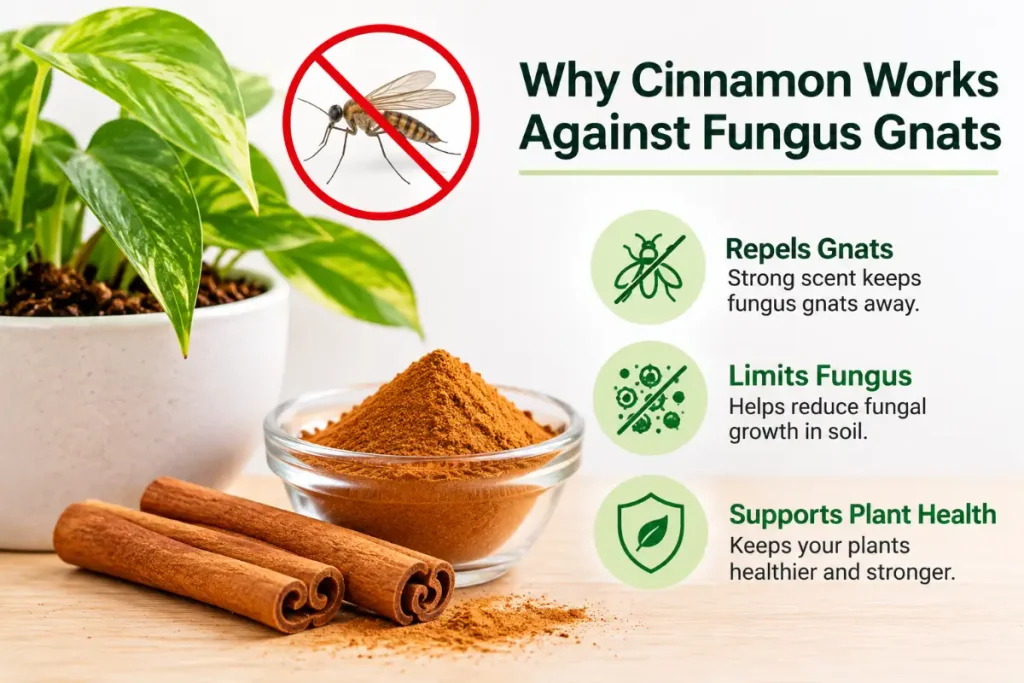
Cinnamon’s effectiveness against fungus gnats comes from two properties:
1. Antifungal action (cinnamaldehyde)
The primary active compound in cinnamon is cinnamaldehyde — the volatile compound responsible for its characteristic smell. Research published in the Journal of Agricultural and Food Chemistry has confirmed that cinnamaldehyde has significant antifungal activity against a wide range of fungal species, including soil-dwelling fungi. Cinnamon oil has been used as a natural fungicide in agricultural settings for this reason.
Fungus gnat larvae feed primarily on fungal mycelium in the potting mix — the white thread-like network of decomposer fungi that colonizes moist, organic potting media. By suppressing the fungal food source, cinnamon reduces the ability of fungus gnat larvae to find adequate nutrition in the soil, disrupting larval development and reducing the reproductive success of breeding populations.
2. Direct deterrence
Cinnamon is also a direct deterrent to fungus gnat adults — the strong volatile compounds are aversive to small insects and may deter adult females from laying eggs in treated soil. This is a secondary mechanism, but it contributes to the overall effectiveness of a surface cinnamon application.
What cinnamon does NOT do:
- It does not kill larvae directly on contact
- It does not kill eggs
- It does not eliminate an established, large larval population quickly
- It does not replace the effect of letting soil dry out — the single most important fungus gnat management step
How to Apply Cinnamon for Fungus Gnats in Plants
What you need:
- Ground cinnamon (standard grocery store ground cinnamon — Ceylon or Cassia, either works; Ceylon has slightly higher cinnamaldehyde concentration but the difference is not significant for plant use)
- A small spoon or shaker
Application steps:
- Allow the potting mix to dry out as much as the plant tolerates before applying — this addresses the moisture condition that supports fungus gnats and maximizes cinnamon’s contact with the soil surface
- Sprinkle ground cinnamon evenly over the entire surface of the potting mix — use enough to form a visible light dusting across the soil; approximately ¼–½ teaspoon per 6-inch pot
- Do not mix it into the soil — the application is specifically on the surface where adult females lay eggs and where larval activity is highest near the soil surface
- Reapply after each watering — water washes the cinnamon into the potting mix and reduces its surface concentration; a fresh application after each watering maintains the deterrent effect
Frequency: Reapply after every watering for 3–4 weeks during active infestation treatment; once monthly as a preventive measure.
Does the type of cinnamon matter? Ground cinnamon from any grocery store brand works. Cinnamon essential oil is more concentrated but requires careful dilution (1–2 drops per cup of water, applied as a light soil spray) — undiluted essential oil can burn plant tissue. For most growers, ground cinnamon is simpler, safer, and cheaper than the essential oil.
What Cinnamon Cannot Do Alone
Using cinnamon for fungus gnats in plants as the only treatment is likely to disappoint — particularly for established infestations. Here is why:
It addresses the food source but not the larvae directly. A large existing larval population in the potting mix has access to fungal mycelium throughout the root zone, not just at the surface. Cinnamon applied to the surface takes time to suppress the fungal network through the whole depth where larvae feed — during which existing larvae continue developing and completing their life cycle.
It does not kill eggs. Fungus gnat eggs hatch in 3–6 days. During the period it takes cinnamon to reduce the fungal food source meaningfully, multiple egg batches can hatch.
It does not catch or kill adult gnats. Adults hovering around the plant are actively laying eggs; cinnamon does nothing to reduce the adult population directly.
For mild, early infestations in plants that can tolerate drying out, cinnamon combined with reduced watering may be sufficient on its own. For moderate to established infestations, cinnamon works best as one component of a multi-method approach.
The Complete Fungus Gnat Treatment: Cinnamon as Part of a System
Cinnamon is most effective when combined with methods that address the other life stages and conditions:
Step 1: Reduce Watering (Most Important Step)
Allow the top 2 inches of potting mix to dry completely between waterings. Fungus gnat eggs and young larvae cannot survive in dry soil — this single step disrupts the life cycle more effectively than any chemical treatment. Most houseplants tolerate this drying period without harm; succulents and cacti should already be watered this way.
Step 2: Apply Cinnamon to the Soil Surface
After the soil has dried, dust the surface with ground cinnamon as described above. The dry soil + cinnamon surface is now hostile to egg laying and to larval survival near the surface.
Step 3: Bti Soil Drench (Larval Control)
Bacillus thuringiensis israelensis (Bti) is a naturally occurring bacterium that produces proteins toxic specifically to fungus gnat larvae — it kills larvae in the soil without harming plants, beneficial insects, earthworms, pets, or humans. Apply as a soil drench using Mosquito Bits (available at Home Depot and Lowe’s for $8–$15): soak 1 tablespoon of Mosquito Bits in 1 gallon of water for 30 minutes, then water plants normally with the solution. Apply every 7–10 days for 3–4 treatments.
Bti addresses the larval population directly — the mechanism that cinnamon lacks. Together, cinnamon (surface deterrence and food-source suppression) and Bti (direct larval kill) cover both above and below the soil surface.
Step 4: Yellow Sticky Traps (Adult Control)
Yellow sticky traps hung at plant canopy level capture adult fungus gnats and prevent egg laying. Place one trap per plant near the soil surface. Replace every 2 weeks or when covered. Yellow sticky traps do not eliminate an infestation alone but reduce the adult population significantly and monitor whether the population is declining (fewer gnats on new traps each week = treatment is working).
Step 5: Neem Oil Soil Drench (Optional, Reinforcement)
A neem oil soil drench (2 teaspoons cold-pressed neem oil + ½ teaspoon dish soap per quart of water) applied monthly reinforces the Bti treatment and provides an additional layer of larval disruption through azadirachtin’s insect hormone-disruption mechanism. This is especially useful for large collections where fungus gnats spread between pots.
Cinnamon for Fungus Gnat Prevention
One of cinnamon’s strongest applications is as a preventive measure rather than a cure. Applied monthly to susceptible plants — particularly those in rich, moisture-retaining potting mixes — cinnamon maintains the soil surface conditions that discourage adult females from selecting that pot for egg laying.
Preventive application:
- After each watering of susceptible plants (tropical houseplants, seed starts, plants in peat-heavy mixes), dust the soil surface lightly with ground cinnamon
- Combine with a monthly Bti drench for comprehensive prevention
- Maintain appropriate watering frequency (never keep the potting mix surface continuously moist)
This preventive approach is particularly valuable for:
- Seed starting — fungus gnat larvae are severely damaging to seedlings and are extremely common in the warm, moist, organic seed-starting mixes that germination requires
- Herb gardens and edible indoor plants — cinnamon is food-safe, making it one of the few pest treatments appropriate for use on edible plants without concern about chemical residue
- Large plant collections where fungus gnats spread easily between pots
Cinnamon on Seedlings: Safe and Effective
For seed starters, cinnamon is particularly valuable because it is one of the few treatments safe to use in direct contact with germinating seeds and seedlings without risk of harm. Many conventional pest treatments — neem oil, insecticidal soap, hydrogen peroxide — can be damaging to delicate seedling root systems or germinating seeds if applied too heavily.
Cinnamon applied to the surface of seed-starting mix suppresses the damping-off fungi (Pythium, Fusarium, Rhizoctonia) that cause seedling collapse at the soil line — the same antifungal action that makes it useful against the fungal food source of fungus gnat larvae. A light dusting of cinnamon on seed-starting mix after seeding serves double duty: fungus gnat deterrence and damping-off prevention.
Application for seedlings: Dust the seed-starting mix surface very lightly after sowing. Avoid applying so heavily that cinnamon directly contacts germinating seeds in the top layer of mix — keep the application to a visible light dusting rather than a thick layer.
Other Natural Methods That Work Alongside Cinnamon
For growers who prefer to avoid synthetic pesticides entirely, these natural methods combine effectively with cinnamon for complete fungus gnat control:
Hydrogen peroxide drench: Mix 1 part 3% hydrogen peroxide (standard drugstore variety) with 4 parts water; water plants with this solution. The oxidizing action kills larvae on contact in the root zone. Apply once weekly for 2–3 weeks, alternating with Bti drenches.
Diatomaceous earth (food-grade): Sprinkle a thin layer of food-grade diatomaceous earth on the potting mix surface alongside cinnamon. DE mechanically damages the exoskeleton of larvae and adults that cross it. It is most effective when dry — reapply after watering.
Sand topdressing: A ½-inch layer of coarse sand on the potting mix surface dries quickly after watering and creates a physically hostile surface for egg laying — adult gnats prefer moist organic material for egg deposition. Sand combined with cinnamon creates an extremely effective surface barrier against egg laying.
Houseplants Most Susceptible to Fungus Gnats
Knowing which plants attract fungus gnats most readily helps you apply cinnamon preventively rather than reactively.
High-risk plants:
- Pothos and philodendrons — often kept in rich, moisture-retaining potting mixes that stay damp; fungus gnats establish easily in these conditions
- Peace lilies — prefer consistently moist potting mix; this watering requirement creates ideal fungus gnat conditions
- Ferns — high humidity and moisture requirements make them one of the most fungus gnat-prone plant categories
- African violets — require careful moisture management; the rich organic mixes they prefer support fungal growth
- Herbs (basil, parsley, mint) — grown in small pots that dry unevenly; seed starting and seedling herbs are especially vulnerable
- Seedlings of any species — the warm, moist, organic seed-starting mix required for germination is essentially ideal fungus gnat habitat
- Tropical aroids (monsteras, alocasias, anthuriums) — often potted in bark-heavy aroid mixes that harbor decomposer fungi; fungus gnat larvae thrive in these environments
Lower-risk plants:
- Succulents and cacti — the dry, fast-draining potting mix and infrequent watering required for these plants is inhospitable to fungus gnats; infestations are uncommon and usually introduced from neighboring pots
- Snake plants and ZZ plants — prefer to dry out thoroughly between waterings; this naturally hostile-to-gnats moisture regime makes them poor fungus gnat hosts
- Air plants (tillandsias) — grown without soil entirely; immune to soil-based fungus gnat issues
For high-risk plants, preventive monthly cinnamon applications and consistent Bti drenches keep populations from establishing. For low-risk plants, cinnamon is rarely needed unless a neighboring plant has an active infestation.
Common Mistakes When Treating Fungus Gnats with Cinnamon
Understanding what not to do prevents wasted time and persistent infestations.
Applying cinnamon without reducing watering. Cinnamon cannot compensate for continuously moist potting mix. If the soil surface stays wet between waterings, fungus gnats will continue laying eggs and completing their life cycle regardless of the cinnamon application. Letting the top 2 inches of potting mix dry between waterings is non-negotiable — cinnamon works with this, not instead of it.
Using cinnamon essential oil undiluted. Ground cinnamon is safe at any reasonable dusting concentration. Undiluted cinnamon essential oil applied to potting mix or leaf surfaces can cause chemical burn to plant tissue and roots. Always dilute essential oil to 1–2 drops per cup of water before any application, and test on a small area first.
Applying only once and expecting results. Cinnamon volatiles dissipate within days, and each watering washes the application into the soil. A single application provides no meaningful lasting protection. Consistent reapplication after every watering — for 3–4 weeks during active infestation — is what produces results, not a one-time treatment.
Using cinnamon alone for established infestations. For heavy infestations where adult gnats are numerous and visible, relying on cinnamon alone extends the infestation by weeks. Bti drenches (Mosquito Bits) are needed to kill existing larvae in the soil; cinnamon addresses the surface and food source but does not directly eliminate an established larval population.
Applying such a thick layer it blocks water penetration. A heavy crust of cinnamon on the potting mix surface can create a hydrophobic layer that causes water to run off rather than penetrate to the roots. Keep the application to a visible light dusting — enough to cover the surface, not enough to form a solid crust. If cinnamon is caking between waterings, you are applying too much.
Not treating the whole collection. Fungus gnats fly freely between plants. Treating one infested plant while neighboring plants remain untreated allows the population to cycle back once treatment ends. Apply preventive cinnamon applications to all nearby plants simultaneously, not just the visibly infested one. A yellow sticky trap placed between plants helps confirm whether adults are moving from plant to plant — if traps placed between pots catch significant numbers, every plant within 3 feet should be on the same treatment schedule.
Conclusion
Cinnamon for fungus gnats in plants works through two mechanisms — antifungal suppression of the larval food source and adult deterrence — making it a genuinely useful tool rather than a folk remedy without basis. Its limitations are real: it does not kill larvae directly, does not affect eggs, and is not fast enough alone for established infestations. Used correctly, as part of a system that includes reduced watering, Bti drenches for larval control, and yellow sticky traps for adult monitoring, cinnamon is an effective, safe, food-safe, and inexpensive component of a complete fungus gnat management program.
For evidence-based guidance on fungus gnat biology and integrated management in indoor settings, the University of Minnesota Extension guide to fungus gnats covers the life cycle, monitoring, and control options for US houseplant growers.
FAQs
How much cinnamon should I put on houseplant soil for fungus gnats?
Apply enough to form a visible light dusting across the entire potting mix surface — approximately ¼–½ teaspoon per 6-inch pot. Reapply after every watering, as water washes cinnamon into the mix and reduces its surface concentration.
How long does cinnamon take to work on fungus gnats?
Cinnamon works gradually by suppressing the fungal food source larvae depend on — expect to see improvement over 2–4 weeks with consistent reapplication. For faster results, combine cinnamon with a Bti soil drench (Mosquito Bits), which kills larvae directly within days of application.
Can cinnamon hurt houseplants?
Ground cinnamon at normal dusting concentrations is safe for the vast majority of houseplants. Cinnamon essential oil can burn plant tissue if applied undiluted — always dilute to 1–2 drops per cup of water before applying as a spray. Avoid applying so heavily that cinnamon forms a crust that prevents water from penetrating the potting mix.
Is cinnamon safe to use on herbs and edible plants?
Yes — cinnamon is food-safe and is one of the few pest deterrents appropriate for edible indoor plants. It leaves no chemical residue and is harmless if ingested in the quantities used for plant treatment.
Does cinnamon prevent other plant problems?
Cinnamon’s antifungal properties make it useful beyond fungus gnats. A light soil surface dusting suppresses damping-off fungi in seedlings, helps prevent surface saprophytic fungal growth caused by overwatering, and may deter other soil-dwelling pests. It is a broadly useful soil surface treatment for general plant health maintenance.
Pingback: Hydrogen Peroxide for Houseplant Pests: Does It Work? - Plant Quill
Pingback: When to Repot a Houseplant: 2026 Growth Guide - Plant Quill