

Yellow sticky traps are one of the simplest and most cost-effective pest management tools available to houseplant growers — and one of the most commonly misused. Stuck randomly into a pot or dangled above a plant, they catch a few gnats and give a false sense of control. Used correctly — right size, right position, right height, right timing — yellow sticky traps for houseplants both monitor pest populations accurately and reduce adult numbers enough to meaningfully slow infestation cycles.
This guide covers which pests they work for, how to position them for maximum catch, what their limitations are, and how to integrate them into a complete pest management approach.
Why Yellow? The Science Behind the Color
The effectiveness of yellow sticky traps is not arbitrary. Many flying insects — including fungus gnats, whiteflies, aphids, shore flies, and leafminers — are attracted to the wavelength of yellow light because it mimics the visual signature of young, tender, nitrogen-rich plant growth. Healthy new leaves and shoots reflect strongly in the yellow-green portion of the spectrum (roughly 520–580 nm), and flying plant pests have evolved to seek out exactly this signal when searching for feeding sites.
A yellow sticky trap exploits this attraction: insects fly toward the yellow surface, land, and are caught by the pressure-sensitive adhesive coating. Because the attraction is visual and not chemical (unlike pheromone traps, which are species-specific), yellow traps are broad-spectrum — they catch any yellow-attracted flying pest in the area, which makes them useful for general monitoring as well as targeted pest control.
What yellow traps do NOT attract:
- Thrips — which are attracted to blue, not yellow (blue sticky traps are the correct choice for thrips)
- Spider mites — not flying insects; not caught by sticky traps
- Scale insects and mealybugs — not flying in their most damaging stages; crawler-stage insects occasionally contact sticky surfaces but traps are not an effective control method for these pests
Pests Yellow Sticky Traps Catch Effectively
Fungus Gnats
Fungus gnats are the primary target for yellow sticky traps for houseplants in most US home collections. Adult fungus gnats are strong fliers attracted to yellow and are caught in significant numbers by properly placed traps. Trapping adults serves two purposes: direct reduction of the breeding population (each adult caught cannot lay up to 200 eggs) and population monitoring (the number of gnats on a fresh trap each week tells you whether the population is growing, stable, or declining).
Yellow sticky traps are not sufficient as the sole fungus gnat treatment — they catch adults but do not address the larvae in the soil that cause root damage. They are most effective combined with Bti soil drenches (which kill larvae) and reduced watering (which prevents egg laying).
Whiteflies
Whiteflies are strongly attracted to yellow and are caught by sticky traps effectively. For whitefly management on indoor plants — particularly begonias, fuchsia, poinsettias, and hibiscus — yellow sticky traps placed at the leaf canopy level can significantly reduce the adult flying population while contact insecticide sprays address the nymphs on leaf undersides.
Winged Aphids
Most aphid reproduction on houseplants is by wingless females, but winged aphids (alates) are produced when colonies become crowded and need to disperse to new host plants. Yellow sticky traps placed among susceptible plants catch winged aphids before they establish new colonies, making them valuable as a monitoring tool for early aphid introduction detection.
Leafminers and Shore Flies
Less common in typical home collections but significant in greenhouse settings, leafminers and shore flies are both attracted to yellow and caught by sticky traps. If you notice small flies in your collection that you cannot identify as fungus gnats or whiteflies, the sticky trap catch will help you identify what you are dealing with.
How to Position Yellow Sticky Traps for Maximum Catch
Placement is the single most important variable in sticky trap effectiveness. A trap in the wrong position catches far fewer insects than the same trap placed correctly.
Height Matters: Match the Pest
For fungus gnats: Place traps just above the potting mix surface — 1–3 inches above the soil level. Fungus gnat adults emerge from and return to the soil; they spend most of their time flying low, near the pot. A trap hung at canopy height catches far fewer fungus gnats than one positioned close to the soil surface. If your pot sits on a shelf or table, position the trap so its lower edge is level with or just above the rim of the pot.
For whiteflies: Place traps at the leaf canopy — the same height as the foliage, slightly above the midpoint of the plant. Whiteflies shelter and feed on leaf undersides; when disturbed they fly upward briefly before resettling. Traps at canopy height intercept this movement.
For winged aphids: Canopy height or just above the top of the plant — winged aphids are looking for landing sites on new growth.
Orientation: Horizontal vs. Vertical
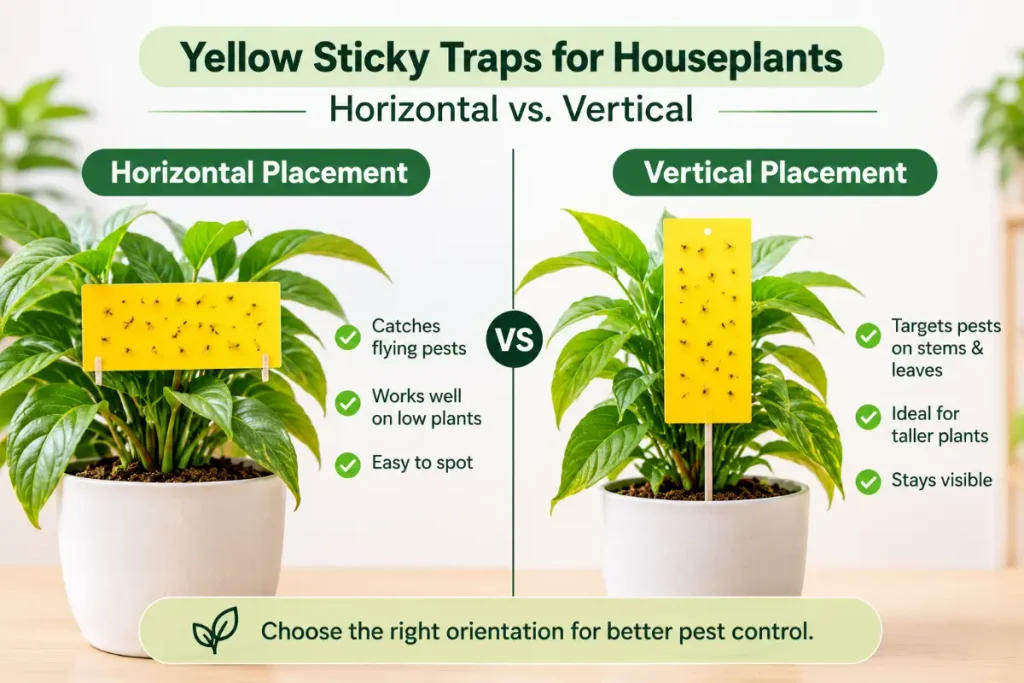
Most sticky traps are designed to be used vertically (the standard stake-mounted or hanging trap). Vertical placement works well for most applications. For fungus gnats specifically, a horizontal trap (laid flat, adhesive side up, on the soil surface) is significantly more effective than a vertical trap — gnats walking on the soil surface are caught directly on contact. Some growers use both: a horizontal trap on the soil and a vertical trap just above it.
DIY horizontal trap: Cut a yellow sticky trap into sections and lay adhesive-side up on the potting mix surface, anchored at the edges with small stones so it does not blow off. Replace weekly.
Distance from the Plant
For hanging or stake-mounted vertical traps, position the trap touching or just within the outer foliage of the plant rather than several inches away. Traps placed away from the plant are less effective — the yellow surface needs to be in the zone where flying insects are actively navigating.
Number of Traps
For monitoring: One trap per plant (or one per 2–3 small plants grouped together) is sufficient for population monitoring. Consistent placement — same position, replaced on the same schedule — allows meaningful week-to-week comparison.
For active control: One trap per pot during heavy infestation periods; replace every 7–10 days or when covered. For large plants (tree-form ficus, large monsteras), use 2–3 traps at different heights.
Reading the Trap: What Your Catch Tells You
The insects caught on yellow sticky traps are diagnostic information — not just numbers but identification of what pest you are dealing with and how severe the pressure is.
Fungus gnats appear as small (2–3 mm), slender, dark-bodied flies with long legs and antennae — they look like tiny mosquitoes. If the majority of your catch is fungus gnats, the problem is in the potting mix (larvae) and watering frequency.
Whiteflies appear as tiny (1 mm) bright white insects — they look like white powder when caught densely. Check leaf undersides immediately if you catch whiteflies.
Winged aphids are larger (2–3 mm), soft-bodied, pear-shaped, in various colors (green, black, yellow). A winged aphid catch signals potential new colony establishment — inspect new growth closely.
Fungus gnats vs. shore flies: Shore flies are stockier, shorter-legged, with spotted wings — often confused with fungus gnats. Shore flies feed on algae in wet potting mix and do not harm plant roots, but their presence indicates potting mix that is staying too wet.
Using catch numbers as a trend indicator: Count the new catches on a fresh trap each week and track the number. A declining catch week over week confirms your treatment is working. A stable or increasing catch means the infestation is not under control — reassess your treatment approach.
Yellow Sticky Traps vs. Blue Sticky Traps: Choosing the Right Color
For thrips, blue sticky traps outperform yellow significantly. Thrips are attracted to blue wavelengths and largely ignore yellow. If your collection has thrips as well as fungus gnats, run both colors:
- Yellow traps: fungus gnats, whiteflies, winged aphids, shore flies
- Blue traps: thrips (western flower thrips, Frankliniella occidentalis, is the most common species on US houseplants)
If you use only yellow traps and have a thrips problem, your monitoring data will undercount the thrips population and give a false impression of low pest pressure. Many growers run one yellow and one blue trap per area and get complete coverage of the flying pest spectrum.
The Limitations of Sticky Traps: What They Cannot Do Alone
Yellow sticky traps are a valuable component of pest management but have real limitations that are important to understand.
They do not address larvae, nymphs, or eggs. Sticky traps catch adult flying insects only. The larvae in the soil (fungus gnats), nymphs on leaf undersides (whiteflies, aphids), and eggs embedded in plant tissue (thrips, aphids) are completely unaffected by sticky traps. For complete control, traps must be combined with treatments that address these non-adult stages.
They do not eliminate large infestations on their own. A female fungus gnat can lay up to 200 eggs before being caught on a trap. Unless traps are extremely dense and the flying population is small, trap-only management will not drive populations to zero.
They become ineffective when covered. A trap covered with insects and debris has reduced adhesive surface and reduced visual effectiveness — the yellow color is obscured. Replace traps every 7–10 days regardless of how full they appear.
They can catch beneficial insects. Fungus gnat predators (some parasitic wasps), beneficial flies, and occasionally small pollinators can be caught by yellow sticky traps. This is rarely a significant issue in typical indoor settings but is worth noting for growers using biological control programs.
Sticky Trap Maintenance: Getting the Most From Every Trap
A few simple habits extend trap effectiveness and improve the quality of your monitoring data.
Replace on a schedule, not by appearance. It is tempting to leave a trap in place as long as it still has visible adhesive area. The problem: a trap left for 3 weeks accumulates gnats from multiple monitoring periods, the adhesive gradually loses tackiness from humidity and dust, and the yellow color may fade or be obscured by debris. Replacing every 7–10 days ensures you are always working with a fresh, fully effective trap and allows accurate week-to-week comparison of catch numbers.
Record your catches. A simple log — date, plant, number of gnats on the replaced trap — takes 30 seconds and provides useful trend data. If week 1 shows 40 gnats and week 3 shows 8, treatment is working. If week 3 shows 60, something is wrong. Without tracking, you lose the ability to evaluate whether any treatment is effective.
Keep traps away from air vents and fans. Air movement dislodges small insects from the adhesive surface and reduces effective catch. Position traps in still-air zones within plant foliage rather than on the outer edges of shelves where household air circulation is higher.
Use fresh traps when starting a new treatment. When you begin an integrated treatment program — adding Bti drenches, hydrogen peroxide, cinnamon — start with fresh traps at the same time. This gives you a clean before-and-after comparison: the first trap’s catch represents baseline population, and subsequent traps show the treatment trend.
Store unused traps in the original packaging. The protective film over the adhesive keeps traps effective until use. Remove the film only when positioning the trap — exposed adhesive picks up dust and debris quickly in household conditions, reducing effectiveness before the trap is even placed. If you buy in bulk (packs of 30 or more), store unused traps flat in a cool, dry location away from direct sunlight, which can degrade the adhesive over time.
Common Mistakes When Using Yellow Sticky Traps for Houseplants
Placing traps too high. The most common positioning error. For fungus gnats — the most common target — placing yellow sticky traps for houseplants at canopy height rather than soil level catches a fraction of the available population. Gnats fly low; the trap needs to be where the gnats are.
Using traps as the only treatment. Yellow sticky traps catch adults. They do nothing about larvae in the soil, eggs in plant tissue, or nymphs on leaf undersides. A trap-only approach for fungus gnats will reduce the visible annoyance of flying adults while the larval population continues growing in the potting mix unimpeded. Always combine traps with a soil treatment (Bti, hydrogen peroxide drench) for complete management.
Using yellow traps to monitor thrips. This produces misleadingly low population readings. If you have or suspect thrips, use blue traps — yellow traps give the impression of lower thrips pressure than actually exists, leading growers to delay or under-treat a pest that reproduces rapidly and is difficult to eliminate once established.
Not replacing traps often enough. A saturated, dusty, faded trap is significantly less effective than a fresh one but takes up the same position. Many growers leave traps for 3–4 weeks because they are still visually catching insects. For best results, treat trap replacement as a routine 7–10 day task rather than something done only when the trap looks full.
Ignoring what is on the trap. The insects caught are diagnostic information. Many growers glance at the number of gnats and nothing else. Taking 30 seconds to look at what is on the trap — are there any whiteflies? Winged aphids? Unfamiliar flies? — often reveals a pest introduction before it becomes an established infestation.
Where to Buy and What to Look For
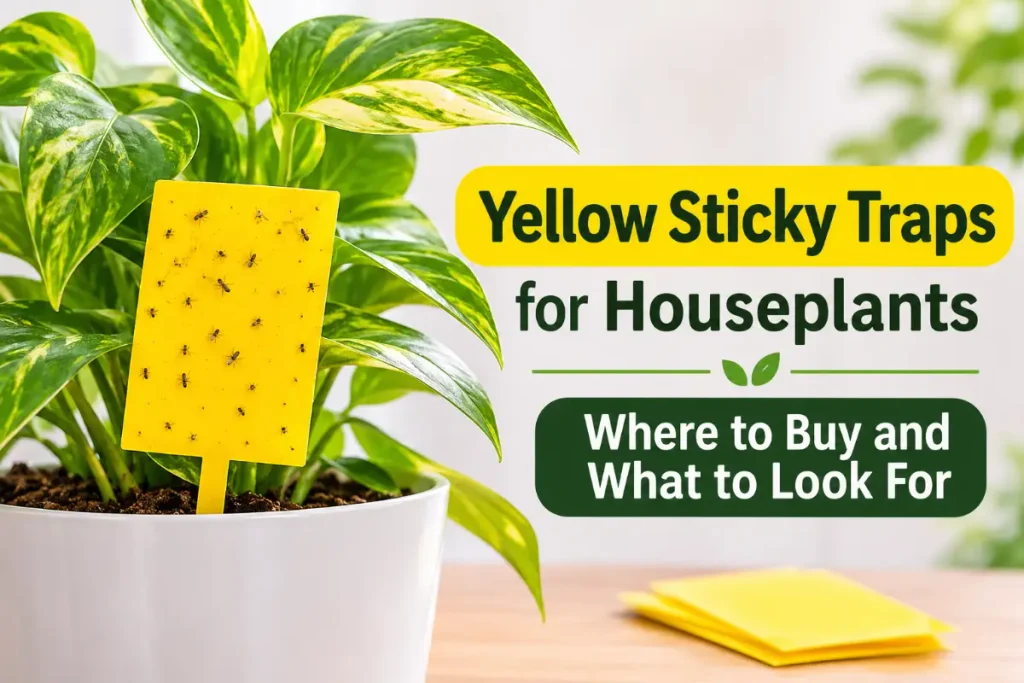
Yellow sticky traps are widely available and inexpensive. A pack of 20–30 traps typically costs $5–$10 and provides several weeks of coverage for a medium-sized collection.
Recommended US sources:
- Home Depot and Lowe’s — carry Safer Brand and Garsum yellow sticky traps in garden departments
- Amazon — large variety; Garsum, Gideal, and Faicuk brands are widely reviewed and effective
- The Sill and Bloomscape — sometimes carry branded pest control kits that include sticky traps
What to look for in a trap:
- Double-sided adhesive — both sides catch insects, doubling effectiveness over single-sided traps
- Stakes included — allow positioning at exact heights in pots without hanging hardware
- UV-resistant yellow coating — the yellow color should maintain brightness over the trap’s lifespan; faded traps are less effective
- Weatherproof coating — especially relevant if used near windows where humidity is high
Avoid: Traps marketed primarily for outdoor garden use that are very large (8×12 inches or larger) — these are awkward in indoor settings and not more effective than standard 3×5 inch houseplant traps.
Conclusion
Yellow sticky traps for houseplants do two jobs: they monitor pest populations so you know what you are dealing with and whether your treatments are working, and they directly reduce adult flying pest numbers — particularly fungus gnats and whiteflies. Neither job is done well by a trap carelessly stuck into a pot. Correct positioning (close to the soil surface for fungus gnats, canopy height for whiteflies), regular replacement, and reading the catch data each week transforms sticky traps from a passive accessory into an active, informative component of your pest management routine. Combined with Bti drenches for larvae, neem oil for contact treatment, and reduced watering, they complete a system that addresses every life stage of the most common houseplant flying pests.
For comprehensive information on monitoring and managing flying houseplant pests, the Purdue Extension guide to insect pest management for interiorscapes covers identification, monitoring strategies, and integrated management approaches for the full range of indoor plant pest species.
FAQs
Where should I put yellow sticky traps for fungus gnats?
Position yellow sticky traps just above the soil surface — 1 to 3 inches above the potting mix — not at canopy height. Fungus gnat adults fly low, near the pot, emerging from and returning to the soil. Traps positioned close to the soil surface catch significantly more fungus gnats than traps hung above the foliage. For even better results, place a section of sticky trap horizontally on the soil surface, adhesive side up.
How often should I replace yellow sticky traps?
Replace yellow sticky traps every 7–10 days, or sooner if they become covered with insects and debris. A covered trap has reduced adhesive surface and reduced visual effectiveness — the yellow color may be obscured by dead insects. Even a trap that looks partially empty should be replaced on schedule so you get consistent monitoring data week over week.
Do yellow sticky traps work for thrips?
No — thrips are attracted to blue, not yellow. Yellow sticky traps catch very few thrips. Use blue sticky traps for thrips monitoring and control. If your collection has both fungus gnats and thrips, run yellow and blue traps simultaneously for complete coverage.
Are yellow sticky traps safe around children and pets?
Yellow sticky traps use pressure-sensitive adhesive that is non-toxic and not chemically harmful. The main hazard is the adhesive getting on skin, fur, or feathers. Keep traps out of reach of curious pets and children — a trap stuck to a cat’s whiskers or a child’s hair is not dangerous but is very unpleasant to remove. Position traps inside the plant foliage rather than at accessible edges of shelves.
How many yellow sticky traps do I need per plant?
For monitoring purposes, one trap per plant (or per 2–3 small plants grouped together) is sufficient. For active control during a heavy fungus gnat or whitefly infestation, use one trap per pot and replace every 7 days. For large plants — tree-form ficus, large monsteras — use 2–3 traps positioned at different heights within the foliage.
Pingback: Diatomaceous Earth for Indoor Plants: Safe or Risky? (2026) - Plant Quill