
Finding the best liquid fertilizer for indoor plants is more straightforward than the crowded garden center fertilizer aisle makes it seem. The majority of houseplants need roughly the same nutritional support through the growing season, and the products that deliver that support consistently are a short list once you filter out the marketing noise. What makes a liquid fertilizer genuinely effective for indoor use comes down to three things: the right nutrient ratio for what your plant is actually doing (growing leaves, producing flowers, or sitting dormant), a concentration safe for the limited soil volume of a pot, and a form that plant roots in potting mix can access without needing extensive microbial processing first.
This guide covers the 8 best liquid fertilizers for indoor plants available right now, how to read NPK ratios so you know exactly what you are buying, which fertilizer type suits which plant and growth stage, and the application mistakes that turn good products into disappointing results.
Quick Answer
The best liquid fertilizers for indoor plants include Miracle-Gro Indoor Plant Food for general use, Espoma Organic Indoor Liquid Plant Food for organic feeding, Jack’s Classic All Purpose for precision feeding, Fish and Seaweed blend for organic broad-spectrum nutrition, Dyna-Gro Foliage-Pro for foliage plants, Schultz Cactus Plus for succulents and cacti, Bonide Liquid Plant Food for flowering plants, and homemade worm casting tea for cost-free organic feeding. Apply liquid fertilizers at half the label-recommended rate every two weeks through spring and summer and stop fertilizing from October through February for most common houseplants.
Understanding NPK Ratios Before You Buy
Every liquid fertilizer label displays three numbers separated by dashes: the NPK ratio. Understanding what these numbers mean is the single most useful piece of knowledge for choosing the right fertilizer for your specific plant and growth stage.
N (Nitrogen) is the first number and drives leafy green growth. Plants with high nitrogen needs produce large, healthy, dark green leaves. Foliage plants like pothos, philodendrons, monsteras, and ferns respond most visibly to nitrogen. A fertilizer with a high first number like 12-4-8 or 10-5-5 delivers more nitrogen than the other nutrients.
P (Phosphorus) is the second number and supports root development, flower production, and fruit development. Flowering houseplants have elevated phosphorus needs during and leading up to their blooming period. A fertilizer with a higher middle number like 5-10-5 or 15-30-15 emphasizes phosphorus for flowering performance.
K (Potassium) is the third number and supports overall plant health, disease resistance, water regulation, and fruit quality. Potassium needs are relatively consistent across plant types but increase during fruiting and in drought-stressed plants. A balanced fertilizer with equal or near-equal numbers across all three provides general support without emphasizing any single nutrient.
For most common houseplants through their general growing season, a balanced fertilizer with equal or close-to-equal NPK numbers performs well. Switch to a higher phosphorus option when flowering plants are approaching their blooming period and back to a balanced formula after flowering ends.
8 Best Liquid Fertilizers for Indoor Plants
1. Miracle-Gro Indoor Plant Food — Best General Purpose Option
Miracle-Gro Indoor Plant Food is the most widely available liquid fertilizer for houseplants in the country and consistently performs well for general foliage plant feeding when used correctly. It comes in a concentrated liquid form that mixes with water and in ready-to-use pump spray bottles for smaller collections.
The NPK ratio is 1-1-1 in the ready-to-use formulation, which is intentionally gentle for indoor use where nutrient accumulation in limited pot soil volume is a greater risk than in outdoor garden beds. This balanced formula makes it appropriate for most common foliage houseplants without adjustment.
What it does well: Consistent, predictable performance across a wide range of common houseplant types. Widely available at every major retailer. Easy to use with clear dilution instructions. Fast-acting synthetic formula shows visible results within two to three weeks of the first application.
Limitations: As a synthetic fertilizer it does not improve soil biology the way organic options do. Requires consistent schedule adherence since synthetic nutrients do not release gradually. The ready-to-use formulation is more expensive per feeding than the concentrate.
How to use it: Dilute the concentrate according to label instructions, typically a few pumps per quart of water. Apply as a regular watering every two weeks through spring and summer. Half the recommended rate is often sufficient for houseplants in smaller pots where nutrient accumulation happens faster.
Best for: General foliage plants including pothos, philodendrons, peace lilies, snake plants, and spider plants. Beginning houseplant owners who want a reliable, straightforward product with clear instructions.
2. Espoma Organic Indoor Liquid Plant Food — Best Organic Option
Espoma Organic Indoor Liquid Plant Food uses a blend of hydrolyzed poultry manure, kelp, and other organic sources to deliver nutrients alongside beneficial microorganisms that improve soil biology over time. Unlike synthetic fertilizers that deliver nutrients in immediately soluble form, Espoma’s organic formula feeds the soil ecosystem as well as the plant roots directly.
The NPK is 2-2-2, which is gentle enough for virtually every common houseplant type including sensitive species like orchids and ferns that can show burn from higher-concentration products.
What it does well: Safe for the full range of common houseplant types including sensitive species. Improves soil biology alongside direct nutrition. Produces visible results more gradually but more sustainably than synthetic options. OMRI listed for organic use.
Limitations: Slower visible response than synthetic fertilizers. Slightly more expensive per feeding than basic synthetic options. Has a mild organic smell during and immediately after application.
How to use it: Dilute according to label instructions and apply every two to four weeks through spring and summer. Can be used through fall at reduced frequency for plants that continue active growth.
Best for: All common houseplant types, particularly for plant owners who prefer organic growing practices. Sensitive plants including orchids, ferns, and African violets that have shown burn reactions to higher-concentration synthetic options.
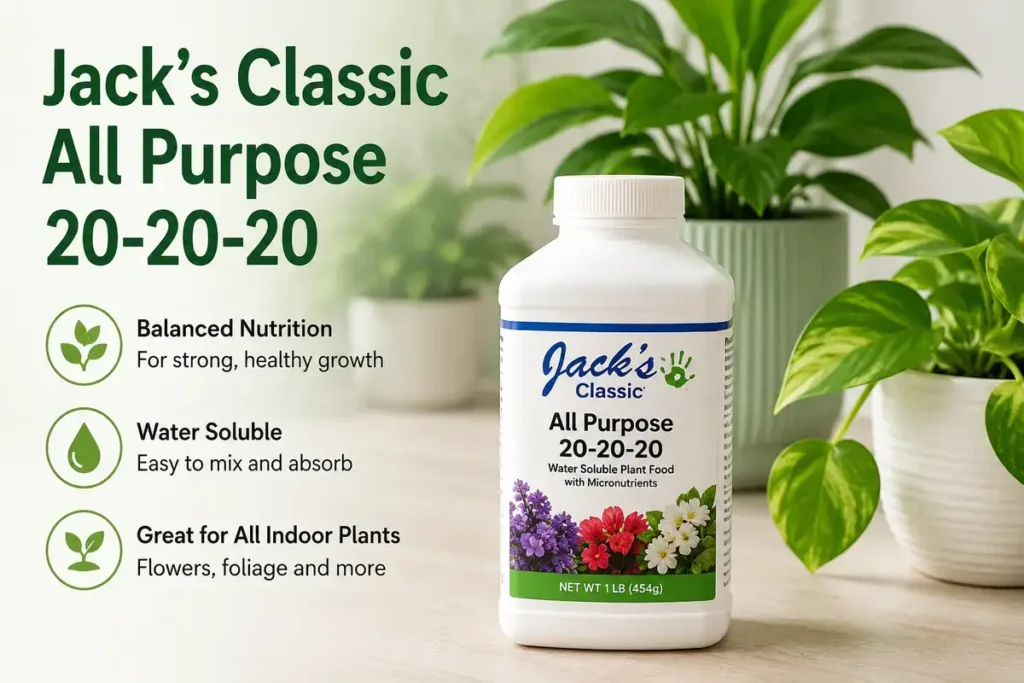
3. Jack’s Classic All Purpose 20-20-20 — Best for Precision Feeding
Jack’s Classic is a professional-grade water-soluble fertilizer used by commercial greenhouse growers and available to home gardeners in powder form that mixes with water. The 20-20-20 balanced NPK ratio delivers equal emphasis across all three primary nutrients, making it appropriate for general houseplant feeding without plant-type-specific adjustments.
The high concentration of 20-20-20 means the dilution rate matters significantly for indoor houseplant use. The label rate for outdoor use is too strong for the limited soil volume of most pots. Use at one-quarter to one-half the label rate for houseplants to avoid the salt accumulation that causes root damage in repeated applications.
What it does well: Precise, consistent nutrient delivery at a very competitive price per feeding when bought in the larger powder sizes. Widely trusted by professional growers. Dissolves completely in water with no residue.
Limitations: Requires careful dilution calculation for indoor use since the standard label rate is formulated for outdoor applications with significantly more soil volume and drainage. Powder format requires more preparation than ready-to-use options. Not an organic product.
How to use it: Dissolve at one-quarter the label-recommended rate for small to medium houseplants. Apply every two weeks through the growing season. Flush the soil with plain water every six weeks to prevent salt accumulation from synthetic fertilizer use.
Best for: Experienced indoor gardeners comfortable with precise dilution. Plant collections with multiple plant types that benefit from the same balanced formula. Cost-conscious growers who want professional-grade nutrition at a lower per-feeding cost than retail indoor plant fertilizers.
4. Neptune’s Harvest Fish and Seaweed Fertilizer — Best Organic Fast-Acting Option
Neptune’s Harvest combines fish emulsion with liquid seaweed extract to deliver a broad-spectrum organic fertilizer that provides primary nutrients from the fish component alongside the trace minerals and plant growth hormones from the seaweed component. It is the fastest-acting organic liquid fertilizer available for houseplants, showing visible growth response within two to three weeks of the first application in most actively growing plants.
The NPK is 2-3-1, which provides a slight phosphorus emphasis beneficial for flowering plants alongside adequate nitrogen for healthy foliage development.
What it does well: Faster visible response than most organic options. Broad nutrient spectrum covering primary nutrients, trace minerals, and growth hormones in a single product. OMRI listed for organic use on edible plants including indoor herbs.
Limitations: Has a strong fish smell that is noticeable during and for several hours after application indoors. Apply near an open window. The smell dissipates completely once the fertilizer is absorbed by the soil.
How to use it: Dilute at the label-recommended rate (typically one tablespoon per gallon of water) and apply every two to four weeks through the growing season. Open a window during application and allow an hour before the room is fully enclosed again.
Best for: Foliage plants needing a nitrogen and trace mineral boost. Flowering plants during and leading up to their blooming period. Indoor herb gardens where organic certification matters for culinary use. Plant owners who want organic performance with response times closer to synthetic fertilizers.
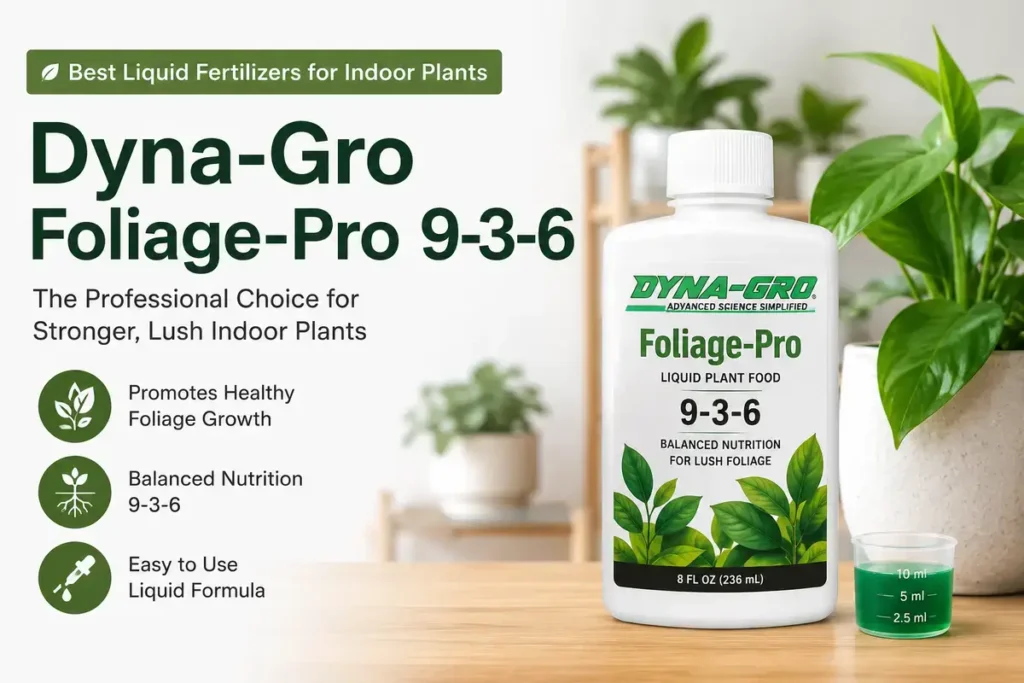
5. Dyna-Gro Foliage-Pro 9-3-6 — Best for Foliage Plants Specifically
Dyna-Gro Foliage-Pro is formulated specifically for leafy, non-flowering houseplants with a higher nitrogen emphasis (9-3-6) that drives the strong, healthy leaf production that foliage plants like monsteras, pothos, philodendrons, and fiddle leaf figs are grown for. It also contains all 16 essential plant nutrients rather than just the primary three, which makes it one of the most nutritionally complete liquid fertilizers available for indoor plant use.
What it does well: Complete nutrition covering all 16 essential plant nutrients in a single product, eliminating the need for separate trace mineral supplements. The nitrogen emphasis produces noticeably larger and darker green leaves on foliage plants compared to balanced formulas. Low in phosphorus which prevents the excessive root-bound growth that high-phosphorus formulas can encourage in purely foliage plants.
Limitations: The higher nitrogen ratio makes it less appropriate for flowering plants during their blooming period where phosphorus emphasis produces better flower performance. Not an organic product.
How to use it: Dilute at one-quarter to one-half teaspoon per gallon of water and apply with every other watering through the growing season. The frequent dilute application approach that Dyna-Gro recommends produces more consistent growth than the biweekly full-rate applications common with other fertilizers.
Best for: Tropical foliage plants including monsteras, philodendrons, pothos, snake plants, ZZ plants, and fiddle leaf figs. Any houseplant grown primarily for its foliage rather than its flowers. Plant owners who want a single complete fertilizer that eliminates the need for separate trace mineral supplementation.
6. Schultz Cactus Plus Liquid Plant Food — Best for Succulents and Cacti
Succulents and cacti have nutritional needs significantly different from tropical foliage plants, requiring lower nitrogen concentrations and a nutrient balance that supports their slow growth habits and drought-adapted physiology. Applying standard houseplant fertilizers formulated for fast-growing tropical plants to succulents and cacti often results in soft, leggy, unattractive growth rather than the compact, healthy form these plants are known for.
Schultz Cactus Plus uses a 2-7-7 NPK ratio that provides low nitrogen alongside higher phosphorus and potassium, supporting root development and plant health without driving the excessive soft growth that high-nitrogen formulas cause in slow-growing desert plants.
What it does well: Appropriate nutrient balance for the slow-growth habit of succulents and cacti. Available at Home Depot, Lowe’s, and most major retailers. Easy to use with a built-in dropper for precise measurement. Inexpensive per feeding.
Limitations: The 2-7-7 ratio is specifically optimized for succulents and cacti and is not appropriate as a general houseplant fertilizer for tropical foliage plants.
How to use it: Add 7 drops per quart of water and apply once a month through spring and summer. Reduce to once every six to eight weeks in fall. Stop entirely in winter when succulents and cacti enter their most dormant period.
Best for: All succulent and cactus species. Desert-adapted plants including haworthias, aloes, echeverias, and agaves grown indoors. Any plant with low water and nutrient requirements that would be harmed by higher-nitrogen general fertilizers.
7. Bonide Liquid Plant Food 10-10-10 — Best for Flowering Houseplants
Bonide Liquid Plant Food provides a balanced 10-10-10 formula at a concentration and price point that makes it one of the most practical general fertilizers for home plant collections. It is available at most garden centers and hardware stores across the country and performs reliably for the range of common flowering and foliage houseplants most people grow.
For flowering plants specifically, the balanced formula supports healthy foliage through the growing season and the equal phosphorus content provides adequate support for flower production without overemphasizing any single nutrient.
What it does well: Consistent availability at garden centers and hardware stores. Reliable balanced performance across diverse plant collections. Inexpensive per feeding in the concentrate form.
Limitations: Not an organic product. The 10-10-10 ratio, while balanced, is on the stronger end for indoor pot use and benefits from dilution to half or quarter strength for most common houseplant applications.
How to use it: Dilute to half the label rate for indoor houseplants and apply every two weeks through spring and summer. Quarter strength applied every week is an alternative approach that delivers more consistent nutrition with lower risk of salt accumulation.
Best for: Mixed plant collections with both foliage and flowering plants where a single balanced product simplifies the fertilizing routine. Beginning indoor gardeners who want a readily available, inexpensive option without needing to match multiple products to different plant types.
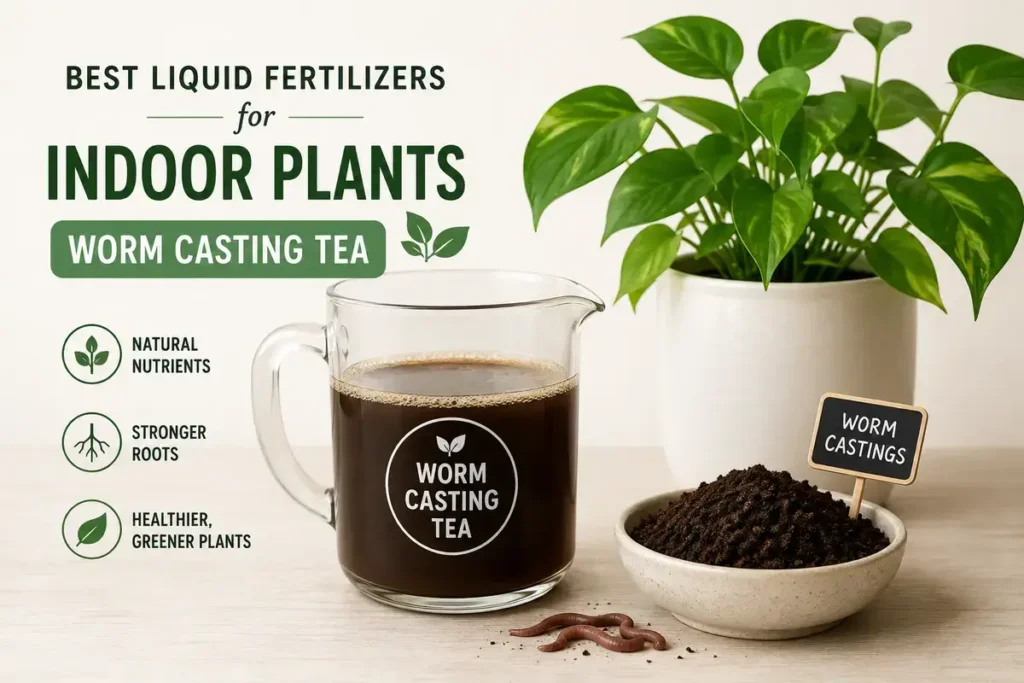
8. Worm Casting Tea — Best Zero-Cost Organic Option
Worm casting tea made by steeping purchased or home-produced worm castings in water provides broad-spectrum organic nutrition alongside beneficial microorganisms that improve soil biology in ways no commercial fertilizer, organic or synthetic, can match. It is the only option on this list that is completely free if you maintain a home worm bin, and very low cost even when using purchased castings.
How to make it: Steep one cup of worm castings in one gallon of dechlorinated water for 24 hours. Aerate with an aquarium air pump and airstone throughout the steeping period for maximum beneficial microorganism population. Use immediately after steeping.
What it does well: Complete and balanced nutrition from natural sources. Soil biology improvement that synthetic and even most organic commercial fertilizers cannot provide. Virtually impossible to overapply. Safe for every common houseplant type without adjustment. Free with a home worm bin.
Limitations: Requires preparation time and an aquarium air pump for optimal results. Worm castings need to be purchased if you do not maintain a home worm bin, adding a material cost. Slower visible response than synthetic or fish emulsion options.
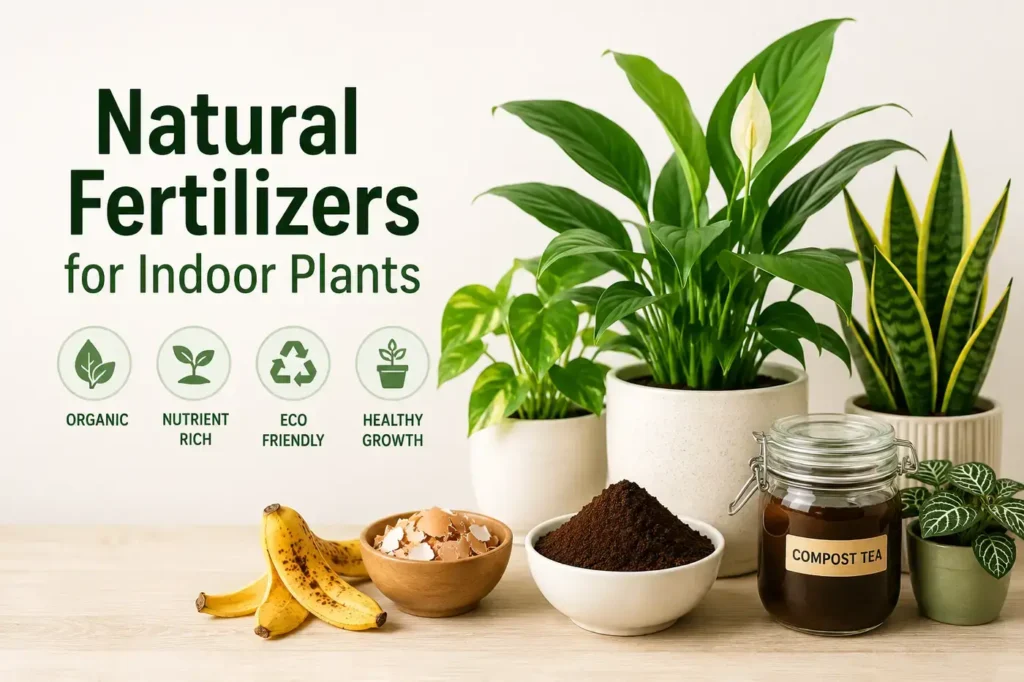
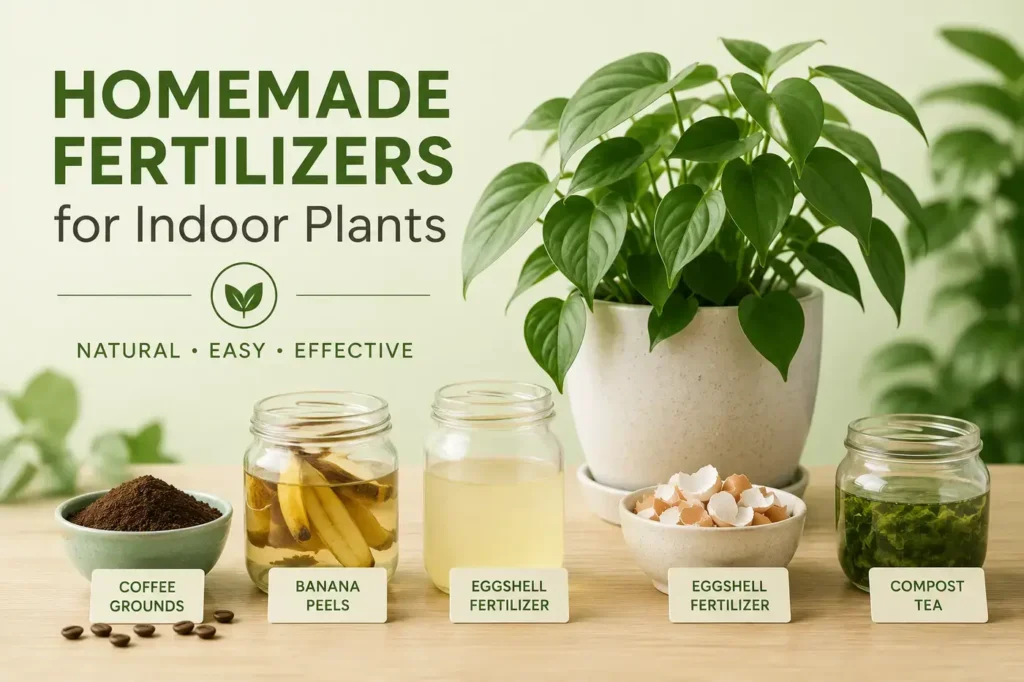
Best for: All houseplant types. Plant owners committed to organic growing practices. Anyone who maintains a home worm composting bin and wants to convert kitchen scraps into complete houseplant nutrition. A complete guide to every natural and homemade fertilizer option for indoor plants including worm casting tea and how it compares to other natural feeding approaches is covered in natural fertilizer for indoor plants and homemade fertilizer for indoor plants.
How to Apply Liquid Fertilizer to Indoor Plants Correctly
Always water before fertilizing. Apply liquid fertilizer to moist soil rather than dry. Dry roots absorb fertilizer solution in concentrated bursts that can cause burn even with gentle products. Water the plant normally 24 hours before applying fertilizer and let the soil settle to moist but not waterlogged before the fertilizer application.
Start at half the label rate. Fertilizer labels are typically calibrated for outdoor garden use where larger soil volumes dilute concentrations more effectively and excess nutrients drain away more readily. For the limited soil volume of indoor pots, starting at half the label rate and increasing only if plants show deficiency symptoms prevents the salt accumulation that damages roots over time.
Feed during the growing season only. Most houseplants slow their growth significantly from October through February. Applying fertilizer to plants that are not actively growing causes unused nutrients to accumulate in the soil rather than being taken up by roots. Feed consistently from early spring through late summer and reduce frequency or stop entirely through fall and winter.
Flush the soil every six to eight weeks. Water the plant heavily with plain water until it flows freely from the drainage holes to leach accumulated fertilizer salts from the potting mix. This prevents the white crusty mineral deposits on soil surfaces and pot rims that indicate harmful salt buildup from regular fertilizer application.
Observe the plant’s response. Signs that fertilization is working include noticeably larger new leaves than the plant was producing before feeding, darker green color in foliage plants, and increased flower production in blooming species. Signs of overfeeding include brown leaf tips, soft leggy growth, white crust on soil surfaces, and wilting despite adequate watering. Reduce rate or frequency if overfeeding symptoms appear.
Signs Your Indoor Plant Needs Fertilizer
Many plant owners begin fertilizing only after obvious deficiency symptoms appear. By that point the plant has already experienced weeks of nutritional stress that set back its growth and weakened its resistance to pests and disease. Learning to recognize early signals of nutritional need lets you intervene before visible deficiency develops.
Pale or yellowing older leaves while new growth appears normal suggests nitrogen deficiency since nitrogen moves from older to newer tissue when supplies are limited. Slow or stalled growth during the active growing season despite adequate light and watering suggests general nutritional depletion. Small new leaves noticeably smaller than previous growth suggests phosphorus or overall nutritional deficiency. Purple tinting on the undersides of leaves indicates phosphorus deficiency specifically in some plant species.
A plant that has been in the same potting mix for more than a year without fertilization has almost certainly depleted the available nutrients in that mix regardless of whether obvious deficiency symptoms have appeared yet. Starting a consistent fertilizer routine after repotting into fresh mix or after a year in the same pot prevents deficiency from developing rather than correcting it after the fact.
Conclusion
The best liquid fertilizer for indoor plants is the one matched correctly to what your plant is doing right now and applied consistently enough through the growing season to maintain nutritional support between applications. Miracle-Gro Indoor Plant Food and Espoma Organic provide the most accessible starting points for most plant owners. Dyna-Gro Foliage-Pro delivers the most complete nutrition for dedicated foliage plant collections. Neptune’s Harvest Fish and Seaweed is the organic option with the fastest visible response. Schultz Cactus Plus addresses the specific nutritional needs of succulents and cacti that standard houseplant fertilizers cannot meet effectively.
Start with a balanced formula at half the label rate every two weeks through spring and summer. Watch the plant’s response over four to six weeks and adjust rate or frequency based on what you observe. Flush with plain water every six to eight weeks to prevent salt accumulation. Stop feeding in fall and winter. That consistent, simple approach produces better results than the most expensive product applied inconsistently or without attention to the plant’s actual response.
Frequently Asked Questions
How often should I use liquid fertilizer on indoor plants?
Most liquid fertilizers for indoor plants work best applied every two weeks through the spring and summer growing season at half the label-recommended rate. Some very dilute formulas like Dyna-Gro at very low concentration can be applied with every other watering. Reduce to monthly in early fall for plants still showing active growth and stop entirely through winter when most houseplants slow down significantly and cannot use the nutrients provided.
What NPK ratio is best for indoor plants?
For general foliage houseplants a balanced ratio with equal or near-equal numbers like 10-10-10 or 20-20-20 used at appropriate dilution performs well through the growing season. A higher middle number (phosphorus) like 5-10-5 or 15-30-15 supports better flower production for flowering houseplants approaching their blooming period, . For succulents and cacti, a lower nitrogen formula like 2-7-7 prevents the soft, leggy growth that high-nitrogen products cause in slow-growing desert plants.
Can I use liquid fertilizer on all indoor plants?
Most common liquid fertilizers are appropriate for the majority of houseplants when used at the correct dilution. Succulents and cacti need a specialized low-nitrogen formula rather than standard houseplant fertilizer. Orchids benefit from a fertilizer specifically formulated at low concentrations for their sensitive roots. Carnivorous plants like pitcher plants and Venus flytraps should never be fertilized since they get their nutrients from the insects they catch and fertilizer application damages their sensitive root systems.
Why are the tips of my indoor plant leaves turning brown after fertilizing?
Brown leaf tips after fertilizing almost always indicate fertilizer burn from too high a concentration or application to dry soil. Flush the soil immediately with large volumes of plain water to leach excess salts. Allow the soil to drain completely and do not fertilize again for at least four weeks. When you resume fertilizing, reduce the concentration to half or quarter of what you were using and always water the plant the day before fertilizer application to ensure roots receive it in moist soil conditions.
Is organic or synthetic liquid fertilizer better for indoor plants?
Both work effectively for indoor plant nutrition with different trade-offs. Synthetic fertilizers like Miracle-Gro and Jack’s Classic produce faster visible results due to their immediately water-soluble form and deliver precisely measured nutrient concentrations. Organic fertilizers like Espoma and Neptune’s Harvest improve soil biology alongside direct nutrition, are significantly harder to overapply, and support long-term soil health in ways synthetic products do not. For most indoor plant owners, organic fertilizers used consistently produce comparable or better long-term plant health than synthetic ones despite their slower initial response.
Should I fertilize a newly repotted indoor plant?
Wait at least four to six weeks after repotting before applying any fertilizer. Fresh commercial potting mix contains starter nutrients that are sufficient for the initial establishment period. Applying fertilizer to a freshly repotted plant adds nutrient stress to roots that are already managing the disruption of repotting and re-establishing in new soil. After six weeks in fresh mix, the starter nutrients have been largely depleted and regular fertilizer applications through the growing season support healthy continued growth.
Pingback: 11 Espoma Organic Indoor Plant Food: Honest Review for Houseplant Owners - Plant Quill