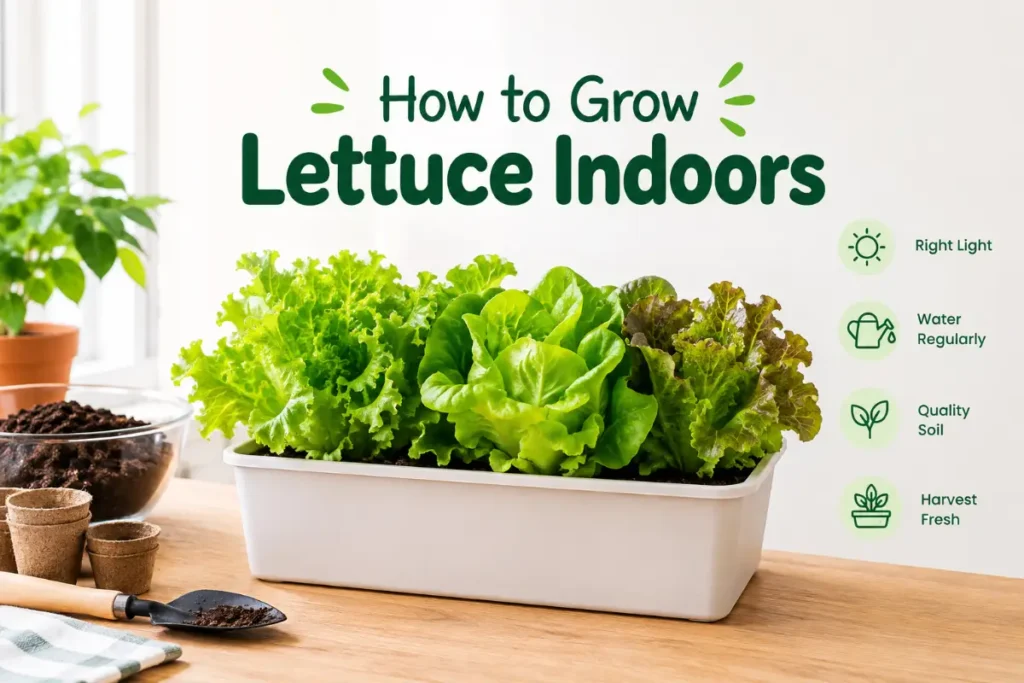
Learning how to grow lettuce indoors is one of the most immediately rewarding food growing projects you can undertake. Unlike tomatoes and peppers that require weeks or months before the first harvest, indoor lettuce produces its first cuttings within three to four weeks of sowing seed and continues producing through a cut-and-come-again harvest approach for two to three months per planting. For someone new to indoor food growing, lettuce provides the fastest feedback loop of any crop.
It is also one of the most practically useful indoor food crops. Fresh lettuce from a kitchen container is nutritionally superior to store-bought lettuce that has spent days in transit and refrigerated storage after harvest. The flavor difference between lettuce cut and eaten within minutes and store-bought lettuce is immediately noticeable to anyone who makes the comparison.
Quick Answer
How to grow lettuce indoors: sow seed directly into a wide, shallow container with standard potting mix, cover lightly with soil, water gently, and place in bright indirect light or under grow lights running 12 to 14 hours daily. Keep temperatures between 60 and 70 degrees Fahrenheit since lettuce is a cool-season crop that bolts in heat. Begin cut-and-come-again harvests when leaves reach three to four inches by cutting the outer leaves, leaving the central growing point intact for continuous regrowth. Succession sow a new container every three to four weeks for continuous harvest.
Understanding Lettuce as an Indoor Crop
Lettuce (Lactuca sativa) is a cool-season crop native to the Mediterranean region that evolved to grow in the relatively mild, moist conditions of spring and fall. This seasonal preference makes it the most practical indoor food crop for year-round growing since homes maintain the cool temperatures lettuce prefers even in summer, unlike outdoor gardens where summer heat forces lettuce to bolt (flower and become bitter) quickly.
The indoor environment’s temperature control solves lettuce’s main outdoor challenge. The primary indoor challenge is providing adequate light without the direct summer sun that lettuce actually cannot tolerate at outdoor intensities. The balance of enough light for growth without the heat that triggers bolting is easier to manage indoors than outdoors.
Leaf lettuce versus head lettuce: For indoor growing, loose-leaf varieties that are harvested leaf by leaf using the cut-and-come-again method are significantly more practical than head-forming varieties like iceberg and romaine that must be harvested all at once when the head matures. Loose-leaf varieties produce continuous yield over weeks from a single planting rather than a single harvest event.
Step 1: Choose the Right Lettuce Varieties
The range of loose-leaf lettuce varieties suited to indoor growing is enormous and provides visual variety alongside flavor diversity that makes an indoor lettuce garden as attractive as it is useful.
Best loose-leaf varieties for indoors:
Oak Leaf (green and red): Fine-textured, deeply lobed leaves with mild flavor. One of the slowest to bolt of the loose-leaf types. Excellent for indoor growing where heat is less controlled.
Black Seeded Simpson: Light green, crinkled leaves with mild buttery flavor. Fast-growing. One of the most commonly recommended indoor lettuce varieties.
Red Sails: Deep red-bronze loose-leaf variety with attractive color that makes indoor containers visually striking. Slightly more heat-tolerant than many red varieties.
Buttercrunch: Forms loose heads rather than tight balls, allowing cut-and-come-again harvesting between full head harvests. Rich, buttery flavor. More compact than standard head varieties.
Mesclun mixes: Pre-blended seed mixes containing multiple loose-leaf varieties and sometimes other salad greens including arugula, mizuna, and mustard. Provides the most visual and flavor variety from a single sowing. Ideal for first-time indoor lettuce growers.
Baby leaf varieties: Varieties specifically bred for harvest at small leaf size produce more tender, milder leaves than the same varieties harvested at full size. Baby Oakleaf, Tom Thumb, and similar miniature varieties suit indoor container growing particularly well.
Step 2: Set Up the Right Container
Lettuce roots are shallow, making it one of the few food crops genuinely suited to very shallow containers that would be inadequate for tomatoes, peppers, or strawberries.
Container depth: Three to four inches of soil depth is sufficient for lettuce. This means window boxes, seed trays, shallow bowls, and even repurposed food containers with drainage holes added provide adequate growing volume.
Container width: More important than depth. Wider containers allow more plants per container and produce larger harvests. A standard twelve-inch-long window box holds a generous lettuce planting. A twenty-four-inch window box under a single grow light produces enough lettuce for regular salad harvests for one to two people.
Drainage: Essential for any container. Lettuce roots rot quickly in waterlogged soil. Drill or punch drainage holes in any container that does not already have them.
The soil: Standard potting mix without additional amendments suits lettuce well. The moisture retention of standard potting mix matches lettuce’s preference for consistent moisture. Avoid cactus mix and other fast-draining mixes appropriate for drought-tolerant plants since lettuce needs consistently available soil moisture.
Step 3: Sow Seeds Correctly
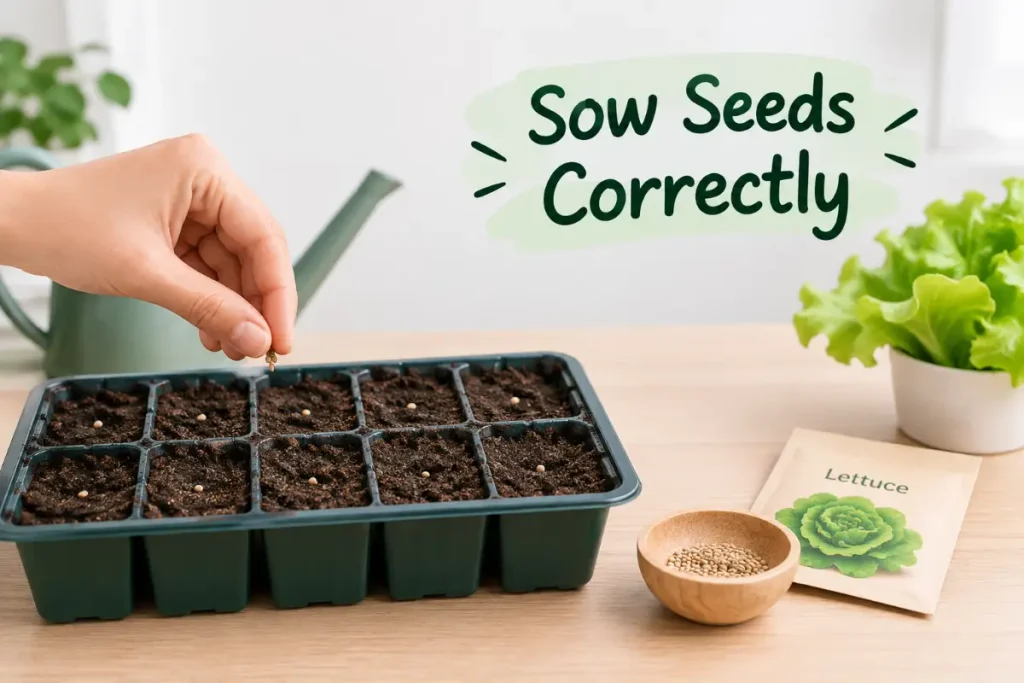
Lettuce seeds are among the smallest and most easily sown of any food crop. They require light to germinate (do not bury them deeply) and sprout quickly under appropriate conditions.
Sowing method: Sprinkle seeds thinly and evenly across the moistened soil surface. Cover very lightly with a thin layer of fine vermiculite or potting mix — no more than one-eighth inch. Gently mist the surface with a spray bottle to settle the covering without washing seeds away.
Germination conditions: Lettuce germinates best at soil temperatures between 60 and 70 degrees Fahrenheit. At these temperatures germination occurs within three to seven days. Above 75 degrees germination rate drops. If your home is warm, germination under grow lights that maintain slightly cooler soil than a heat mat positions lettuce seed starting for better results than the warm-soil methods appropriate for tomatoes and peppers.
Thinning: Once seedlings reach one inch tall, thin to one plant every two to three inches by snipping unwanted seedlings at soil level rather than pulling (which disturbs neighboring seedling roots). Thinned seedlings are the first micro-green harvest.
The cut-and-come-again approach: For continuous harvest, leave all plants in place once thinning is complete. The close spacing of the remaining plants does not matter for cut-and-come-again harvesting since you are harvesting individual outer leaves rather than whole plants.
Step 4: Provide the Right Light
Lettuce is one of the most light-flexible food crops, requiring less light intensity than tomatoes, peppers, or strawberries while still needing more than typical ornamental shade plants.
Natural light: A bright indirect east or north-facing window position provides enough light for lettuce growth. A south-facing window is also appropriate since, unlike direct-sun food crops, lettuce does not need maximum intensity — it needs adequate photons without the heat of intense direct sun that triggers bolting.
Grow lights: A grow light running 12 to 14 hours daily, even at modest output, produces significantly faster and more vigorous lettuce growth than window light alone. For year-round lettuce production in any indoor space regardless of window quality, grow lights are the reliable solution. Lettuce does not require the high-output grow lights that tomatoes need — a modest full-spectrum LED running 12 to 14 hours daily is sufficient.
Temperature and light interaction: Lettuce in bright light and warm temperatures bolts faster than lettuce in cooler, slightly less intense light. If your indoor space runs warm, a north-facing window with lower light intensity and slightly cooler temperature extends the productive life of each planting more than a south-facing window with intense light and heat.
Step 5: Water Consistently for Optimal Growth
Lettuce is composed primarily of water and grows most rapidly when soil moisture is consistently available. It has shallower roots than most other food crops and dries out faster than deeper-rooted plants in the same container size.
The correct frequency: Check soil moisture daily and water when the top half inch feels dry. In typical indoor conditions this means watering every two to four days. Under grow lights that warm the soil surface, daily or every-other-day checking is appropriate.
Watering technique: Water gently to avoid washing tiny lettuce seeds or young seedlings from the soil surface. A fine-nozzle watering can or spray bottle provides appropriate control for the delicate lettuce growing environment.
Temperature of water: Room temperature water prevents the cold shock that can stress lettuce roots. Allow tap water to sit for thirty minutes before use if it is significantly colder than room temperature.
The humidity benefit: Lettuce in a kitchen environment benefits from the ambient humidity of cooking activity. Placing near a kitchen sink or in a kitchen where water evaporation maintains moderate humidity produces noticeably more vigorous growth than lettuce in very dry rooms.
Step 6: Harvest Cut-and-Come-Again for Continuous Yield
The cut-and-come-again harvest method is the most important practical technique in indoor lettuce growing and the one that transforms a single sowing into weeks of continuous harvest rather than a one-time event.
How it works: When outer leaves reach three to four inches in length (typically three to four weeks after sowing), cut them at the base leaving one inch of the leaf stem attached. Do not cut the central growing point or the small leaves clustered at the center of the plant. The outer leaves grow back from their base while the central growing point continues producing new leaves that become the next outer leaves available for cutting.
Harvest frequency: Cut outer leaves every five to seven days in good growing conditions. More frequent cutting before leaves fully develop reduces the total harvest size per cutting. Less frequent cutting allows leaves to become larger and coarser in texture than optimal.
Whole-plant cutting: An alternative approach that maximizes a single harvest cuts all leaves one inch above the soil level. New growth emerges from the growing point within seven to ten days. This method produces a larger single harvest but slower continuous production than the outer-leaf method.
How long one sowing lasts: A single lettuce sowing under appropriate conditions produces cut-and-come-again harvests for six to eight weeks before the plants exhaust their productive energy, start bolting in response to warmth or age, or become tough and bitter. Replanting at six-week intervals maintains continuous harvest without gaps.
Step 7: Succession Sow for Continuous Year-Round Harvest
The most important system-level practice for indoor lettuce growing is succession sowing: starting a new container of lettuce every three to four weeks so that as one planting ends its productive life, the next is entering its peak harvest period.
The succession schedule: Sow Container 1 on Week 1. Sow Container 2 on Week 4. Begin harvesting Container 1 on Week 4. Sow Container 3 on Week 8. Begin harvesting Container 2 on Week 8. Replace Container 1 (exhausted) with a fresh sowing on Week 8. This rolling schedule maintains at least one actively productive container at any time.
Space requirements: Two to three containers at different stages require three to five square feet of grow light coverage or window space. This is achievable on a standard kitchen countertop or windowsill without dedicated growing space.
Variety rotation: Sow different varieties in each successive container. The variety rotation provides flavor and texture variety in harvests while also helping identify which varieties perform best in your specific indoor conditions for future succession sowing decisions.
For guidance on building a comprehensive indoor kitchen garden that combines lettuce succession sowing with the fruiting crops covered earlier in this cluster, can you grow a tomato plant indoors and how to grow a strawberry plant indoors cover the fruiting crop companions that complete a productive indoor kitchen garden alongside continuous lettuce growing.
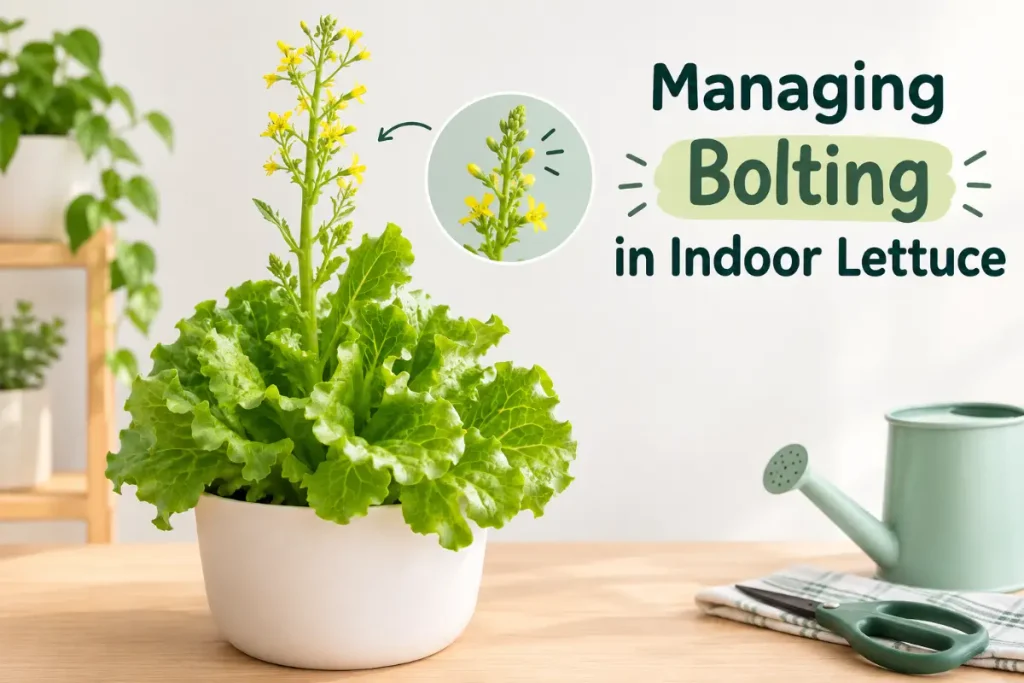
Managing Bolting in Indoor Lettuce
Bolting, where lettuce sends up a tall flower stalk and becomes bitter and inedible, is the primary end-of-life signal for each lettuce planting and understanding what triggers it helps you extend the productive life of each sowing.
What triggers bolting: High temperatures above 75 degrees consistently, increasing day length (which grow lights set to consistent hours prevent), and plant age all trigger the bolting response. Indoors, temperature is the most controllable bolting trigger.
Prevention: Keep indoor temperatures below 75 degrees during the lettuce growing period. Position away from heating vents and radiators. A cooler room (65 to 70 degrees) extends productive life significantly compared to a warm room (75 to 80 degrees).
Early bolting signals: A central stem beginning to elongate upward from the middle of the plant rather than producing new flat leaves. Leaf taste becoming noticeably bitter even in young leaves. Once these signals appear, harvest everything remaining and start the next succession sowing.
The cool-crop advantage indoors: The temperature control of indoor environments is the greatest practical advantage of indoor lettuce over outdoor growing. In outdoor gardens, summer temperatures above 80 degrees force most lettuce varieties to bolt within days regardless of variety. Indoors with air conditioning or natural insulation maintaining 65 to 72 degrees, lettuce grows through summer without the rapid bolting that defeats outdoor summer salad gardens in most US climates.
Nutrient Management for Indoor Lettuce
Lettuce is a light feeder compared to fruiting crops like tomatoes and peppers, but regular light fertilizing through the cut-and-come-again harvest period maintains the vigorous leaf production that makes the harvest most productive.
What lettuce needs nutritionally: Nitrogen is the primary nutrient driving the rapid leaf production that makes cut-and-come-again lettuce most satisfying. A fertilizer with elevated nitrogen relative to phosphorus and potassium suits lettuce during its vegetative harvest stage, the opposite of the phosphorus-forward formula appropriate for fruiting crops.
How often: A diluted liquid fertilizer at one-quarter to half the label rate every two weeks through the active harvest period. This is significantly less frequent than the biweekly full-rate fertilizing appropriate for tomatoes and peppers but provides the nitrogen replenishment that standard potting mix cannot sustain through multiple weeks of continuous leaf production.
Organic options: Liquid fish emulsion or worm casting tea applied every two weeks provides the nitrogen-forward nutrition that lettuce leaf production requires in the most gentle, burn-safe form. These organic liquid fertilizers are particularly appropriate for the delicate lettuce root system that is more susceptible to salt burn from full-rate synthetic fertilizers than the more robust root systems of tomatoes and peppers.
What to avoid: High-phosphorus fertilizers that drive flowering rather than leaf production. These are appropriate for fruiting crops but counterproductive for lettuce where leaf production is the goal and premature flowering (bolting) is the primary problem to prevent.
Growing Lettuce Under Different Light Conditions
One of the most useful aspects of indoor lettuce growing is its adaptability to different light environments, which makes it the most accessible indoor food crop for growers with varied window and lighting situations.
North-facing windows: Medium indirect light from a north-facing window produces slower but genuine lettuce growth. Growth rate is approximately half what the same variety achieves under grow lights or in a south-facing window. The cooler temperatures typical of north-facing rooms also extend the productive life of each planting by reducing the heat-induced bolting risk. For patients growers without south-facing windows, a north-facing window with a simple grow light supplement produces excellent indoor lettuce.
East-facing windows: Morning direct sun followed by bright indirect light provides near-ideal conditions for indoor lettuce. The morning sun intensity drives vigorous growth without the heat accumulation of afternoon south or west-facing sun that can accelerate bolting. East-facing windows in kitchens, which are common in many US apartment layouts, are often the best natural light positions for indoor lettuce.
Grow light only (no windows): Even in windowless spaces with only artificial lighting, a modest grow light running 12 to 14 hours daily produces fully functional indoor lettuce. This makes lettuce the most practical food crop for grow light-only indoor setups since it requires less light intensity than any other commonly grown indoor food crop and produces the fastest return on the electricity investment of running grow lights daily.
For the complete guide to how grow light spectrum and UV content affects indoor food crop quality and production, UV light for plants indoor covers the specific wavelengths that benefit leafy greens like lettuce alongside the fruiting crops that have higher intensity requirements.
Conclusion
How to grow lettuce indoors comes down to cool temperatures, consistent moisture, adequate light from a window or modest grow lights, and the cut-and-come-again harvesting technique that transforms a single planting into weeks of continuous salad greens. Succession sow every three to four weeks to maintain a rolling harvest cycle. Keep temperatures below 75 degrees to prevent bolting. Choose loose-leaf varieties over head types for cut-and-come-again practicality.
Indoor lettuce is the ideal starting point for anyone new to growing food inside because it produces results faster than any other indoor food crop, requires less investment in equipment than tomatoes and peppers, and delivers a practical culinary outcome, fresh salad greens available year-round, that has immediate everyday value in any kitchen.
Frequently Asked Questions
How long does it take to grow lettuce indoors?
First harvest is possible three to four weeks after sowing seed in good growing conditions. Cut-and-come-again harvests continue every five to seven days for six to eight weeks from a single sowing. From sowing to end of productive harvest life is approximately eight to twelve weeks, after which fresh succession sowing provides the next harvest cycle.
Does lettuce need a grow light indoors?
Lettuce grows in bright indirect window light from an east, north, or south-facing window without a dedicated grow light. A grow light running 12 to 14 hours daily produces faster growth and larger harvests than window light alone. Lettuce requires less light intensity than fruiting crops like tomatoes and peppers, making it the most accessible indoor food crop for growers without high-output grow light setups.
What temperature is best for growing lettuce indoors?
Between 60 and 70 degrees Fahrenheit is ideal. Lettuce germinates well in this range and grows most productively. Above 75 degrees growth slows and bolting is triggered more quickly. Below 55 degrees growth slows significantly. The moderate temperatures of most US homes in the 65 to 72 degree range are nearly ideal for indoor lettuce production.
How often should I water indoor lettuce?
Check moisture daily and water when the top half inch of soil feels dry, typically every two to four days. Lettuce roots are shallow and dry out faster than deeper-rooted plants. Consistent moisture produces the fastest, most tender leaf growth. Drought stress causes toughened, bitter leaves even before visible wilting.
Can I regrow lettuce from store-bought lettuce?
Yes, to a limited extent. Placing the base of a romaine lettuce head in a shallow dish of water and keeping it in bright indirect light produces new leaf growth from the cut base within one to two weeks. This regrowth produces a modest amount of new leaves suitable for one small salad before the energy stored in the original base is exhausted. It is an interesting experiment but not a practical ongoing production method compared to sowing seeds in potting mix.
Why is my indoor lettuce bitter?
Bitterness in indoor lettuce is most commonly caused by temperature above 75 degrees triggering the beginning of the bolting response, plant age beyond the productive harvest window, or harvesting leaves that are too large and mature rather than the young outer leaves at the optimal three to four inch size. Move to a cooler position, harvest younger leaves more frequently, and succession sow fresh containers to replace plants that have exceeded their productive life.