
Knowing how to water succulents indoors is the single most important skill for keeping these plants alive. More succulents die from overwatering than from any other cause — including neglect, low light, and pests combined. The frustrating part is that overwatered succulents often look exactly like underwatered succulents in the early stages, leading well-meaning owners to respond to a drowning plant by giving it even more water.
This guide gives you the complete picture: the biological reason succulents need to be treated differently from other houseplants, the specific technique that produces healthy succulents consistently, and the seasonal adjustments that match your watering to the plant’s actual needs across the year.
Quick Answer
Water succulents indoors thoroughly — until water flows freely from drainage holes — then allow the soil to dry completely to at least two inches depth before watering again. In typical indoor conditions this means watering every ten to fourteen days in summer and every three to six weeks in winter. Always check soil dryness before watering rather than following a fixed schedule. Use well-draining soil and a pot with drainage holes. Never let succulents sit in standing water.
Why Succulents Need Different Watering Than Other Houseplants
Succulents store water in their leaves, stems, and roots as an adaptation to environments where rainfall is infrequent but sometimes heavy when it does occur. This storage adaptation is what gives succulents their characteristic plump, fleshy appearance.
The native environment model: In their natural habitats — deserts, rocky hillsides, and semi-arid regions — succulents experience infrequent but thorough rainfall events followed by extended dry periods where the soil dries completely between rains. The roots of succulents are adapted to absorb water quickly during these brief wet periods and then survive extended drought by drawing on their stored reserves.
What this means for indoor watering: Replicating this pattern indoors means watering thoroughly (saturating the entire root zone) and then waiting for complete dryness before watering again. The “little and often” approach that many new plant owners instinctively apply — a small amount of water every few days — is the opposite of what succulents need. Small frequent waterings keep the soil surface perpetually damp without fully saturating the root zone, creating conditions that promote rot while never delivering the deep saturation that triggers proper root uptake.
Root physiology: Succulent roots are finer and more numerous near the soil surface than deeply, adapted to capture rain before it evaporates from shallow desert soils. These surface roots are highly susceptible to rot when kept in perpetually moist conditions. The brief wet period followed by complete drying that mimics natural rainfall allows these roots to function correctly and remain healthy.
The Complete Watering Technique for Indoor Succulents
Step 1 — Check soil dryness first: Push your finger two inches into the soil. The soil must feel completely dry at this depth before you water. If any coolness or moisture is detectable at two inches, wait two to three more days and check again. Never water succulents on a fixed calendar schedule without first confirming the soil is dry at depth.
Step 2 — Water thoroughly from the top: When the soil is confirmed dry at two inches, water thoroughly from the top until water flows freely from the drainage holes. This thorough saturation ensures the entire root zone receives moisture, not just the surface layer. Water slowly around the base of the plant rather than directly onto the leaves or the central rosette of rosette-forming succulents.
Step 3 — Allow complete drainage: Let the pot drain freely for thirty minutes after watering. Empty the saucer completely — do not allow the pot to sit in standing water. Succulents sitting in saucers of water develop root rot in the bottom root zone even when the upper soil appears to have dried appropriately.
Step 4 — Wait for complete dryness: Return to Step 1. Do not water again until the soil is completely dry at two inches depth. In typical summer indoor conditions this takes ten to fourteen days. In winter it may take three to six weeks or longer. The interval varies with season, light, temperature, pot material, and soil composition — check the soil rather than assuming a fixed interval.
How Often to Water Succulents Indoors: Seasonal Guide
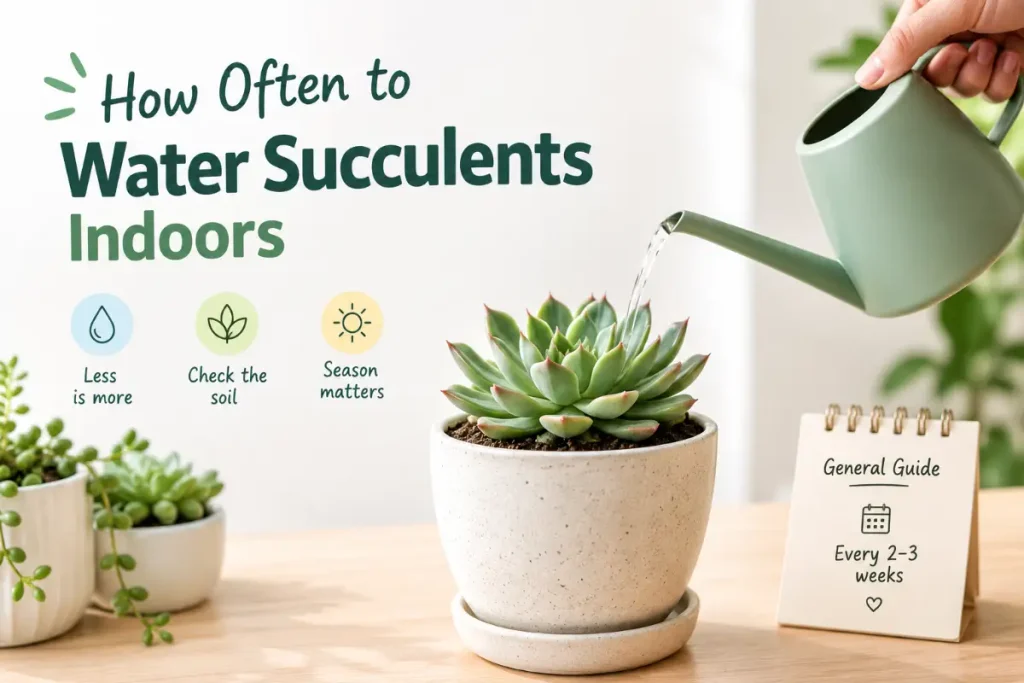
Spring (March to May): Succulents begin their active growing season in spring as day length increases. Water every ten to fourteen days when soil is dry at two inches. New growth appearing from the center of the plant confirms active growth and appropriate moisture management.
Summer (June to August): Peak growing season with the highest water demand. Water every ten to fourteen days, checking soil dryness before each watering. Succulents in bright south-facing windows or under grow lights may dry faster — check at ten days and adjust based on actual soil dryness rather than assuming the two-week interval is always correct.
Fall (September to November): Growth slows as day length shortens. Extend the watering interval to every two to three weeks. Continue checking soil dryness before each watering. Some succulents begin their dormancy period in fall — reduced watering supports this natural transition.
Winter (December to February): Most indoor succulents enter a semi-dormant or fully dormant period. Water every three to six weeks, checking soil dryness at two to three inches depth before each watering. In very low light winter conditions, succulents may need water as infrequently as once a month or less. Underwatering in winter is far less harmful than overwatering during dormancy.
Reading Your Succulent: Signs That Tell You When to Water
Rather than relying solely on calendar-based schedules or even soil checks, learning to read your succulent’s physical condition adds another layer of accuracy to watering timing.
Signs the succulent needs water: Leaves that were previously plump begin to look slightly deflated, wrinkled, or less firm than usual. The lowest leaves may begin to look thinner or slightly shriveled. The plant’s color may shift slightly — some succulents show more intense color (red, purple, or orange tones) when mildly stressed from mild drought. The pot feels noticeably lighter than when freshly watered.
Signs the succulent has been overwatered: Leaves that feel soft or mushy rather than firm. Leaves that are translucent or water-soaked in appearance. Lower leaves yellowing and falling away while still plump rather than dry. Stem base feeling soft at soil level. Musty smell from the soil. These signs indicate overwatering has already begun causing damage — stop watering immediately and assess root condition.
Signs the succulent is healthy: Firm, plump leaves with consistent color. New growth emerging from the center. Stable, upright form. Roots visible at drainage holes indicating healthy root development. Soil that alternates between moist after watering and completely dry before the next watering.
Soil and Drainage: The Foundation of Correct Succulent Watering
Even perfect watering technique fails if the soil mix and drainage are incorrect. Succulents in standard potting mix without amendment will stay wet too long regardless of how carefully you water, creating root rot conditions between waterings.
The right soil mix: Standard potting mix amended with 50% coarse perlite, or commercial cactus and succulent mix, provides the fast-draining medium succulents need. This mix saturates fully when watered but drains rapidly and dries completely between waterings within the appropriate timeframe. Unamended standard potting mix retains too much moisture for most succulents — it may stay damp at two inches depth for two to three weeks after watering, far longer than succulents tolerate.
Testing your soil mix: After watering, the soil should drain freely within sixty seconds at the drainage holes. The surface should appear dry within twenty-four hours of watering. The two-inch depth should reach complete dryness within seven to ten days in summer growing conditions. If your soil takes longer than this to dry, add more perlite at the next repotting.
Pot material and drainage: Terracotta pots dry faster than plastic or glazed ceramic because moisture evaporates through the porous walls. This makes terracotta ideal for succulents — the faster drying rate reduces overwatering risk and more closely mimics the rapid drainage of desert soils. All succulent pots must have drainage holes. No exceptions. A succulent in a pot without drainage holes has no reliable route to correct moisture management regardless of how carefully you try to control watering volume.
For the complete guide to building appropriate soil mixes for succulents and other drought-tolerant plants, soil mixture for indoor plants covers every ingredient and ratio for the full range of indoor plant drought tolerance profiles.

Common Succulent Watering Mistakes and How to Fix Them
Misting instead of deep watering: Misting succulents with a spray bottle delivers surface moisture that evaporates before reaching roots, keeps the surface perpetually damp (encouraging rot and fungus gnats at the soil surface), and never provides the deep saturation that triggers proper root uptake. Stop misting succulents entirely and switch to thorough bottom-to-top watering followed by complete drying.
Watering on a fixed weekly schedule: Weekly watering is almost always too frequent for indoor succulents, especially in winter or low light conditions. The soil determines the schedule, not the calendar. Check at two inches depth before every watering.
Watering a little at a time: Small amounts of water wet only the top inch or two of soil without reaching the deeper root zone. This creates perpetual surface moisture with drought below — the worst of both worlds. Water thoroughly until drainage occurs, then wait for complete dryness.
Leaving water in the saucer: This is one of the most common and most damaging succulent watering mistakes. The roots at the pot base sit in standing water continuously, creating permanent wet conditions in the lower root zone where root rot begins. Empty every saucer within thirty minutes of watering.
Overwatering in winter: This is the most common cause of succulent death in US homes. In winter, reduced light slows growth and reduces water demand dramatically. Succulents in winter conditions need water far less frequently than in summer. Maintaining summer watering frequency through winter kills more succulents than any other single practice.
For the complete guide to diagnosing and fixing overwatering damage in succulents and other indoor plants, overwatering indoor plants covers the full intervention process from root inspection through recovery care.
Special Situations: Adjusting Watering for Specific Conditions
Newly purchased succulents: Give a newly purchased succulent one to two weeks to acclimate to your home’s light and humidity conditions before establishing a regular watering routine. The plant’s water demand in your specific conditions may differ from its nursery conditions. Check soil dryness daily for the first two weeks to establish the actual drying rate in your home before extending the checking interval.
Succulents under grow lights: Grow lights increase temperature, evaporation, and plant metabolic activity. Succulents under grow lights dry significantly faster than those in natural light conditions — they may need water every seven to ten days rather than the standard ten to fourteen during the growing season. Check soil dryness more frequently when using grow lights.
Succulents in very small pots: Tiny pots (two to three inch diameter) dry out faster than larger pots due to lower soil volume. Check these more frequently than larger pots in the same position — every seven to ten days in summer rather than waiting for the standard two-week interval.
Succulents recently repotted: Wait seven to ten days after repotting before the first watering. This waiting period allows any roots disturbed during repotting to begin callusing, reducing rot risk from immediate watering of damaged root tissue. After the first post-repotting watering, resume the standard soil check method.
For the complete guide to how drainage for indoor plants works and why it matters so much for succulents specifically, drainage for indoor plants covers the complete drainage system that makes correct succulent watering possible.
Watering Different Types of Indoor Succulents
Not all succulents have identical watering needs. Understanding the differences between common succulent groups helps you fine-tune the general approach for your specific plants.
Echeveria: The most popular rosette-forming succulent group. Water when soil is completely dry at two inches. Avoid getting water into the center rosette — it pools there and causes rot at the crown. Water around the outside of the rosette rather than from directly above. Echeveria are among the most overwatering-sensitive succulents and show root rot symptoms faster than most other groups.
Haworthia: One of the most forgiving succulents for indoor conditions. Tolerates lower light than most succulents and can be watered slightly more frequently — every seven to ten days in summer growth periods for plants in adequate light. Still requires complete soil dryness between waterings, just dries faster than many other succulents due to its active growth in indoor conditions.
Aloe vera: Aloe has larger water storage capacity than most small succulents and tolerates both drought and slightly more frequent watering better than echeveria or other rosette succulents. Water when soil is dry at two inches, which in most indoor conditions means every ten to fourteen days in summer. Mature aloe plants in larger pots need water less frequently than young plants in small pots.
Cacti: Cacti are the most drought-tolerant of all common indoor succulents. In winter they may need water only once every four to six weeks. In summer, water when completely dry at two to three inches depth, which may be every two to three weeks in typical indoor conditions. Ball cacti and other compact forms tolerate drought better than columnar cacti, which have higher water demand proportional to their greater growing season.
Sedum (Stonecrop): Among the easiest succulents to water correctly because they show clear visual signals when they need water (noticeable leaf shrinkage) and recover quickly after watering. Water when soil is completely dry and leaves show the first signs of softening. More forgiving of occasional overwatering than echeveria.
String succulents (String of Pearls, String of Hearts, String of Dolphins): These trailing succulents have smaller individual water storage capacity than rosette-forming succulents and are more sensitive to both drought and overwatering. Check soil dryness at one to two inches rather than two inches, and water when dry at that depth. String of Pearls in particular is notorious for being killed by overwatering — err significantly on the dry side for this species.
Building a Sustainable Succulent Watering Habit
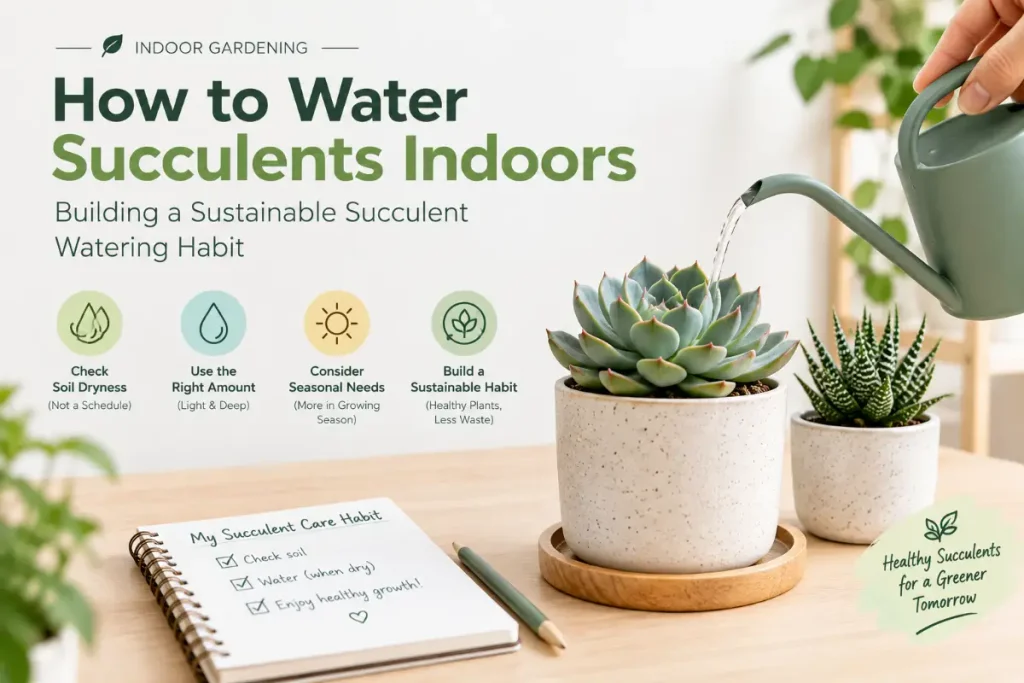
The challenge for most succulent owners is not understanding the correct approach — it is building the checking habit that prevents both overwatering from automatic watering and underwatering from forgetting.
The weekly check approach: Set a single weekly reminder to check all succulents for soil dryness. The reminder is to check, not to water. Check each plant at two inches depth. Water any plant where the soil is completely dry. Skip any plant where any moisture is detectable. This approach takes five to ten minutes per week for most home collections and completely prevents the calendar-based overwatering that kills most indoor succulents.
Seasonal recalibration: At the beginning of each season, spend two weeks checking succulents every three to four days to establish the actual drying rate in your current seasonal conditions. This recalibration is particularly important at the transition from summer to fall (when you should be extending intervals) and from winter to spring (when you can begin watering more frequently again). Without this recalibration, many succulent owners maintain summer watering frequency through winter, which is the most common cause of winter succulent decline.
For the complete guide to watering tools that make the checking and watering routine faster and more consistent across a larger succulent collection, watering tools for indoor plants covers every tool from moisture meters to narrow-spout watering cans that improve the precision and efficiency of the succulent watering routine described in this guide.
Conclusion
Watering succulents indoors correctly comes down to two principles: water thoroughly when the soil is completely dry, and wait patiently for complete dryness before watering again. Everything else — seasonal adjustments, soil mix, pot selection, saucer management — supports these two principles by ensuring the wet-dry cycle that succulents need actually occurs in your specific indoor conditions.
The most common mistake is treating succulents like tropical houseplants that want consistent moisture. They do not. They want the feast-and-famine cycle of their natural desert habitat — a thorough drink followed by a long dry period. Replicate that cycle consistently and succulents reward you with years of low-maintenance, architectural beauty that requires far less ongoing attention than almost any other houseplant category.
Frequently Asked Questions
How often should I water succulents indoors?
Every ten to fourteen days in summer during active growth, and every three to six weeks in winter during dormancy. These are starting points — always check soil dryness at two inches depth before watering rather than relying on a fixed schedule. The actual interval varies with light levels, temperature, pot material, and soil composition in your specific indoor conditions.
How do I know when my succulent needs water?
Check soil dryness at two inches depth — the soil must feel completely dry before watering. Additional signs include leaves that look slightly less plump or firm than usual, a noticeably lighter pot, and in some species, slightly more intense color as mild drought stress develops. Never water based on the soil surface appearance alone, which dries faster than the root zone below.
Why are my succulent leaves mushy?
Mushy leaves indicate overwatering damage, typically beginning with root rot in the lower root zone. Stop watering immediately. Remove the plant from its pot and inspect roots — healthy roots are white and firm, damaged roots are dark and soft. Trim all damaged roots, dust cut ends with cinnamon powder, allow to dry for thirty to sixty minutes, then repot in fresh well-draining cactus mix. Resume watering only after the soil is completely dry at two inches.
Can I water succulents from the bottom?
Yes, for deep rehydration of severely dried succulents whose root ball has become hydrophobic and resists top watering. Place the pot in two inches of water for thirty to forty-five minutes, then remove and drain completely. This is useful for initial deep saturation but not recommended as the routine watering method since bottom watering can maintain more moisture in the lower root zone than succulents tolerate between waterings.
Do succulents need watering in winter?
Yes, but much less frequently than in summer. Water every three to six weeks in winter, checking soil dryness at two to three inches before each watering. In very low light winter conditions, some succulents need water only once a month or less. Overwatering in winter during dormancy is the most common cause of succulent death in US homes.
What happens if I underwater my succulent?
Mild underwatering causes leaves to look slightly wrinkled or deflated — this is easily corrected with thorough watering and the plant recovers within a day or two. Severe underwatering over an extended period causes bottom leaves to dry out and fall, and the plant to shrink as it uses its stored water reserves. Even significantly underwatered succulents usually recover fully with thorough rehydration. Underwatering is far less harmful than overwatering for succulents.