
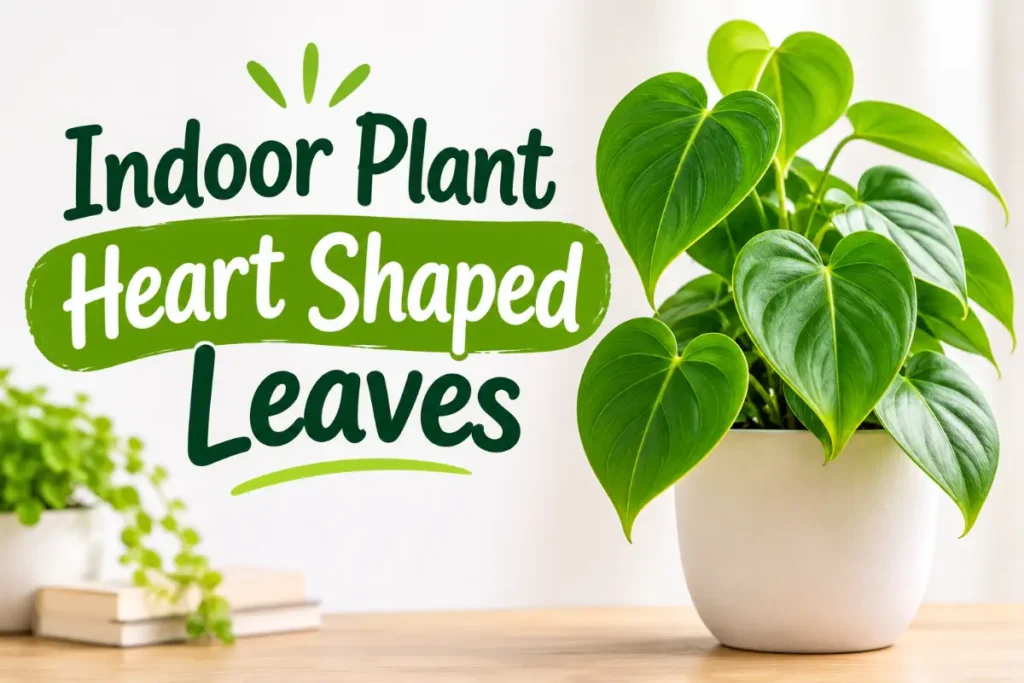
Heart-shaped leaves bring a natural warmth and charm to any indoor space. From the small, coin-shaped leaves of Hoya kerrii to the broad, striking foliage of Anthurium crystallinum, indoor plant heart shaped leaves add personality and visual appeal to a home. Their distinctive shape makes these plants especially popular among indoor gardening enthusiasts.
Many beloved houseplants feature heart-shaped foliage, including pothos, philodendron, hoya, and anthurium. Each offers a unique leaf size, texture, color, and growing habit, making it easy to find a variety that suits different interior styles and preferences.
In this guide, you’ll discover 14 indoor plants with naturally heart-shaped leaves, arranged from easiest to most demanding to grow. Whether you’re a beginner or an experienced plant enthusiast, you’ll find options to match your space, growing conditions, and care routine.
Easy to Grow
1. Heartleaf Philodendron (Philodendron hederaceum)
The heartleaf philodendron is among the easiest and most tolerant of all houseplants — its glossy, dark green heart-shaped leaves emerge on trailing or climbing stems and can reach 4–6 inches across in good conditions. It is a plant that thrives on relative neglect: tolerating low light, infrequent watering, and the variable conditions of most US homes with minimal complaint.
Light: Low to bright indirect light — one of the most light-flexible of all heart-leaved plants. Leaves are larger and glossier in brighter light; the plant simply grows more slowly in lower light.
Water: Allow the top inch of potting mix to dry between waterings. Tolerates underwatering well; overwatering causes yellowing lower leaves.
Display: Trails beautifully from a shelf or hanging basket; climbs a moss pole to produce progressively larger leaves.
Beginner-friendly: Extremely so.
2. Golden Pothos (Epipremnum aureum)
Pothos leaves are not perfectly heart-shaped — they are broadly ovate with a cordate (heart-shaped) base — but they read unmistakably as heart-like, and the plant is so widely beloved that it belongs in any heart-leaved plant list. Varieties include the classic golden pothos (green with yellow variegation), ‘Marble Queen’ (white and green), ‘Neon’ (chartreuse), and ‘N’Joy’ (white and green).
Light: Low to bright indirect light — one of the most adaptable houseplants available.
Water: Allow the top inch to dry between waterings. The leaves develop slight wrinkling when the plant is thirsty — a useful indicator.
Toxicity: Toxic to cats and dogs.
3. Hoya kerrii (Sweetheart Plant)
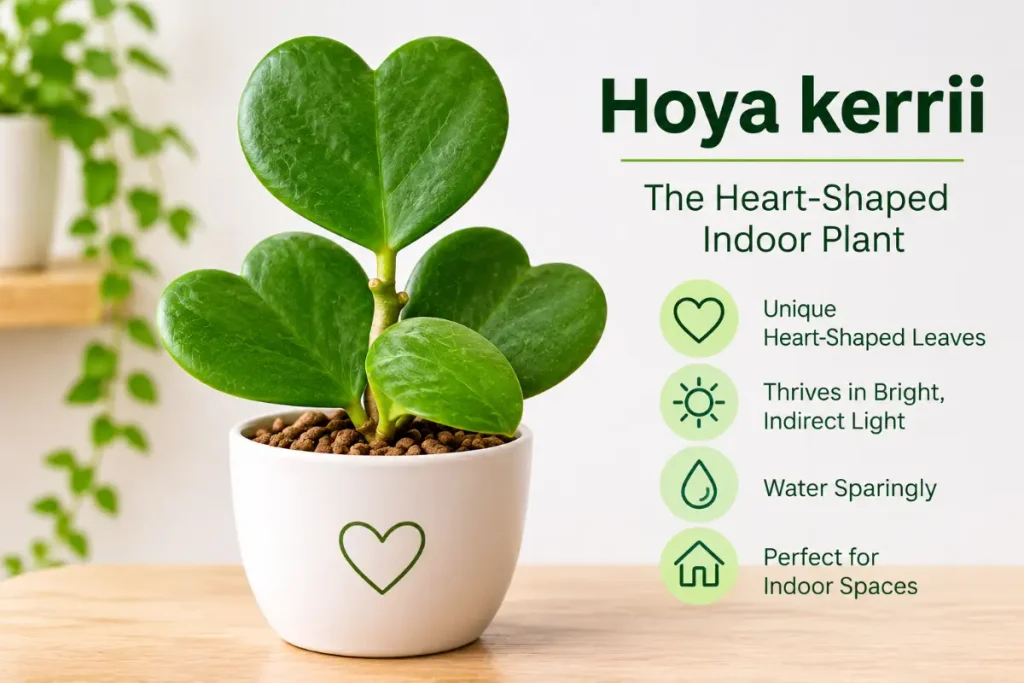
Hoya kerrii produces thick, succulent, perfectly heart-shaped leaves — each one shaped like a Valentine’s Day heart. It is most commonly sold as a single leaf in a small pot (particularly around Valentine’s Day), but single-leaf cuttings without a node will never grow into a full plant. A rooted stem cutting with multiple leaves grows into a vining plant with trailing stems of paired heart-shaped leaves.
Light: Bright indirect light to some direct morning sun. More light produces faster growth and may eventually trigger flowering.
Water: Allow to dry almost completely between waterings — hoya kerrii is succulent-type and very susceptible to overwatering.
Note: The single-leaf hoya sold as a novelty gift will remain a single leaf indefinitely — charming but static. A full rooted plant (available from specialty retailers) grows actively and can trail 2–3 feet over several years.
4. String of Hearts (Ceropegia woodii)
String of hearts produces small, perfectly heart-shaped leaves — about 1 inch across — on delicate trailing vines that can reach 3–4 feet long. The leaves are dark green with silver marbling on the upper surface and purple beneath, and the overall effect of a long trailing stem of paired hearts is one of the most attractive of any hanging houseplant.
Light: Bright indirect light to some direct morning sun.
Water: Allow to dry completely between waterings — string of hearts is a semi-succulent and is very prone to root rot if kept moist.
Display: Most effective in a hanging basket or on an elevated shelf where the long trailing stems fall freely. An indoor planter with stand at 24–30 inches height gives string of hearts the drop it needs to trail dramatically.
Moderate to Grow
5. Anthurium andraeanum (Heart-Spathe Anthurium)
The flowering anthurium produces waxy, heart-shaped spathes (the colored “flower” — actually a modified leaf) above glossy, heart-shaped foliage. While most people grow anthurium for its long-lasting flowers, the foliage itself is genuinely heart-shaped and attractive. Red, pink, white, and orange varieties are available.
Light: Bright indirect light; avoid direct sun which bleaches the spathes.
Water: Allow the top inch to dry between waterings.
To rebloom: Balanced liquid fertilizer every 2–3 weeks during the growing season and bright light are the primary triggers for continuous flowering.
6. Caladium (Heart-Leaved Varieties)
Many caladium varieties produce large, heart-shaped leaves in spectacular color combinations — white with green veins, red with green margins, pink with cream. Large-leaved varieties like ‘White Queen’ and ‘Florida Sweetheart’ produce leaves 12–18 inches across in a distinctly heart-shaped form.
Light: Bright indirect light; direct sun scorches the thin leaves.
Water: Keep evenly moist during the growing season.
Dormancy: Goes completely dormant in fall — this is normal. Store dry tubers above 60°F and replant in spring.
7. Cyclamen (Cyclamen persicum)
Cyclamen produces attractive heart-shaped, silver-marbled leaves alongside its swept-back flowers. The leaf pattern is as ornamental as the flowers, making cyclamen worth growing even after blooms finish.
Light: Bright indirect light in a cool room (50–65°F).
Water: Bottom-water to keep moisture off the crown; the crown rots easily when watered from above.
Season: Available from October through March in the US; the cool temperatures required limit its usefulness as a permanent houseplant in most heated homes.
8. Peperomia caperata (Ripple Peperomia)
Peperomia caperata produces small, deeply corrugated, heart-shaped leaves — the ridged surface texture gives the leaves a deeply dimensional quality. Various cultivars offer dark green, burgundy-red, and silver-green forms.
Light: Moderate to bright indirect light.
Water: Allow to dry between waterings — peperomia stores water in its thick leaves.
Size: Compact — 8–12 inches. Ideal for a desk or small shelf.
9. Epipremnum pinnatum ‘Cebu Blue’
‘Cebu Blue’ pothos produces narrow, elongated heart-shaped leaves in a distinctive blue-gray-green metallic color — quite different from the standard golden pothos. Juvenile leaves are small and heart-shaped; mature leaves on a climbing plant develop fenestrations similar to monstera.
Light: Bright indirect light for the best metallic coloring.
Water: Allow the top inch to dry between waterings.
10. Hoya obovata
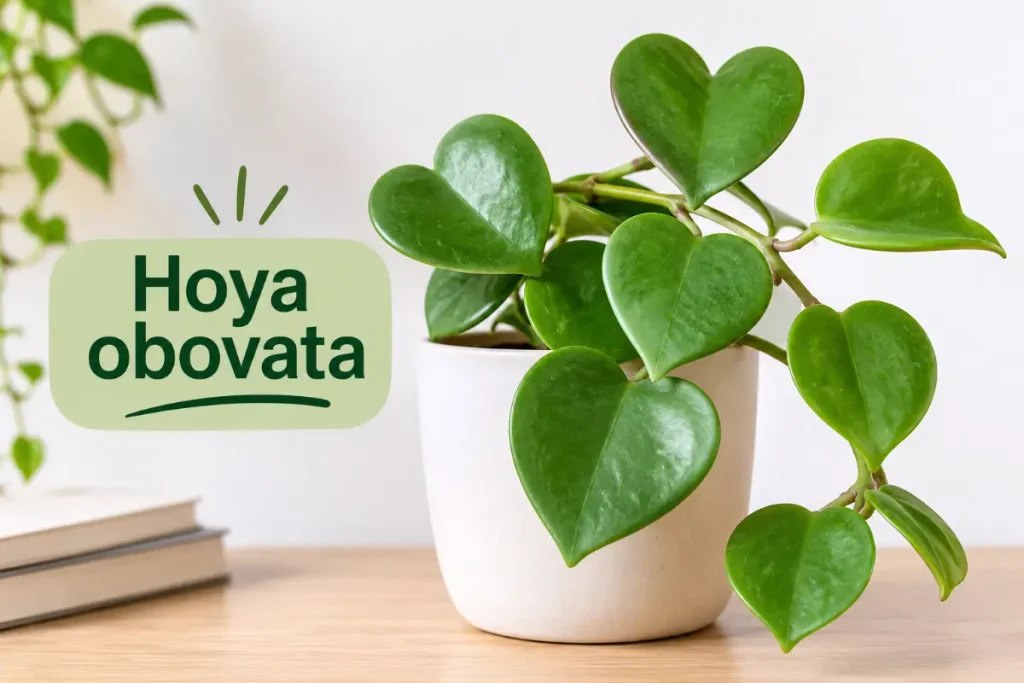
Hoya obovata produces large, round-to-heart-shaped leaves — dark green, thick, and often with silver splashing — in a vining habit. It is more vigorous than hoya kerrii and produces the characteristic hoya star-shaped flower clusters in mature plants.
Light: Bright indirect light to some direct morning sun.
Water: Allow to dry significantly between waterings.
Fragrance: The flower clusters are sweetly fragrant, particularly in the morning.
More Demanding — Collector Favorites
11. Anthurium crystallinum (Crystal Anthurium)
Anthurium crystallinum produces some of the most spectacular heart-shaped leaves of any houseplant — velvety, dark green, and up to 24 inches long with bold, bright white veining that gives the leaf an almost hand-painted quality. It is a collector’s plant that requires attention but delivers extraordinary foliage.
Light: Bright indirect light; never direct sun which destroys the velvety leaf surface.
Water: Allow the top inch to dry between waterings. Well-draining chunky mix is essential — anthurium roots need air.
Humidity: Requires moderate to high humidity (60%+) for the velvety surface to develop properly. In dry air, leaves emerge with a more ordinary matte surface rather than the distinctive velvet texture.
Availability: Specialty plant retailers; not typically available at big-box stores.
12. Philodendron gloriosum
Philodendron gloriosum produces large, velvety, heart-shaped leaves — similar in scale to anthurium crystallinum but in a matte dark green with white veining. A terrestrial philodendron (grows along the ground rather than climbing), it is a collector plant grown primarily for the exceptional foliage.
Light: Bright indirect light.
Water: Keep evenly moist — more moisture-demanding than climbing philodendrons.
Humidity: High humidity preferred (60%+).
Growth habit: Grows horizontally — the rhizome creeps along the surface of the potting mix. Plant in a wide, shallow pot rather than a standard deep one.
13. Caladium ‘White Queen’ (Large Form)
Already mentioned above, but ‘White Queen’ at its largest scale — 18-inch white leaves with green veins and purple spotting — deserves separate mention as one of the most dramatic heart-shaped leaves available to the US home grower.
14. Colocasia esculenta (Taro — Heart-Leaved Form)
While covered under big-leaved plants as well, colocasia deserves mention for its classic large heart-to-arrowhead-shaped leaves, particularly the ‘Black Magic’ cultivar with near-black hearts that contrast dramatically with lighter interiors.
Light: Bright indirect light.
Water: Consistently moist to wet.
Displaying Heart-Leaved Plants: Design Principles
Choosing to display an indoor plant heart shaped leaves variety involves specific design decisions — the rounded, symmetrical softness of heart-shaped foliage lends itself to particular approaches:
Trailing from height: The most effective display for trailing indoor plant heart shaped leaves varieties (pothos, philodendron hederaceum, string of hearts) is from an elevated position where the stems fall freely and the individual leaf shapes are visible from below and from the side. A shelf at 5–6 feet height, an elevated plant stand, or a hanging basket all work. At floor or table level, trailing stems bunch and the heart shape is less visible.
Framing an object: A trailing heart-leaved pothos or philodendron trained to grow along a bookshelf, around a mirror, or beside a window frame softens the hard edge of the object while the heart-shaped leaves add a sense of life to the border.
Solo statement: Large heart-leaved plants — anthurium crystallinum, philodendron gloriosum, large caladium — work best displayed individually in a simple, complementary pot where the leaf can be fully appreciated. These are plants to be seen one at a time rather than grouped with many others.
Pot color pairing: The dark, rich green of heartleaf philodendron and anthurium crystallinum pairs beautifully with terracotta (warm contrast) or matte white or black (clean neutral backdrop). The silver-splashed leaves of hoya obovata and string of hearts suit metallic or brass pot finishes. The colorful, thin leaves of caladium suit simple white or natural woven containers that do not compete with the leaf pattern.
Propagating Heart-Leaved Houseplants
Pothos and heartleaf philodendron: Stem cuttings root in water within 1–2 weeks — one of the fastest-rooting groups of houseplants. Take a 4–6 inch cutting below a leaf node, remove the lower leaves, and place in water in a bright position. Once roots reach 1–2 inches, pot into standard potting mix.
String of hearts: Propagates by stem cuttings (rooted in water or moist mix), by the small tubers that occasionally form along the stems, or by placing a section of stem flat on moist sphagnum moss — roots form from the nodes in contact with the moss. The tuber method is the fastest — small aerial tubers can be potted directly without a rooting phase.
Hoya kerrii: Stem cuttings with at least one node root in water or moist mix; fragile but possible. Single-leaf cuttings root but produce no new growth as noted — always take a stem cutting with multiple leaves and a visible node.
Hoya obovata: Stem cuttings root in water or moist sphagnum moss over 3–6 weeks. Hoya roots grow slowly compared to pothos and philodendron — patience is required.
Anthurium crystallinum and philodendron gloriosum: Division when repotting — separate offsets or rhizome sections that have their own roots. These are slow-growing plants and propagation is correspondingly slow; expect new divisions to take 3–6 months before pushing vigorous growth.
Caladium: Tuber division in spring — cut large tubers into sections, each with at least one growing point, dust cut surfaces with sulfur powder or cinnamon to prevent rot, and plant in moist potting mix in a warm location (70°F+).
Seasonal Care for Heart-Leaved Plants
Spring: The best time for repotting, propagating, and resuming regular feeding. Most heart-leaved houseplants push their most vigorous new growth in spring — a fresh top-dressing of potting mix or a move to a slightly larger pot takes advantage of this natural growth period.
Summer: Active growth continues. Water more frequently as temperatures rise. Watch for spider mites on hoya and philodendron in hot, dry conditions — check leaf undersides regularly. String of hearts may develop small aerial tubers along its stems in summer; these are normal and can be used for propagation.
Fall: Reduce watering and fertilizer as growth slows. Caladium foliage yellows and dies back — this is normal; store dry tubers above 60°F. Cyclamen purchased in fall for winter display thrives now in its preferred cool conditions.
Winter: The primary challenges are low light (which causes pothos and philodendron to grow leggy, with smaller, farther-spaced leaves) and low humidity (which causes tip browning on anthurium and philodendron gloriosum). A grow light on a timer and a pebble tray with water address both issues for the most demanding species. Reduce watering for hoya kerrii and string of hearts significantly in winter — these semi-succulents need even less water than usual when not actively growing.
Common Problems with Heart-Leaved Plants
Yellowing lower leaves: The most common issue across all heart-leaved trailing plants. On pothos and philodendron, occasional yellowing of the oldest (lowest) leaves is normal. Rapid or widespread yellowing across multiple leaves indicates overwatering. Check soil moisture and frequency before concluding the cause.
Small, pale new leaves: Almost always insufficient light. Heart-leaved trailing plants in low light produce progressively smaller leaves on longer internodes (the spaces between leaves on the stem). The plant is stretching toward the light source. Move closer to a window.
Brown leaf tips: Low humidity (particularly on anthurium crystallinum and philodendron gloriosum), fluoride in tap water (affecting philodendron and calathea-adjacent species), or inconsistent watering. Identify the most likely cause from context: if tips brown in winter when heating is running, humidity is the culprit; if tips brown year-round at the very tip only, tap water minerals may be the issue.
Root rot: The primary killer of hoya and string of hearts. Caused by overwatering or a potting mix that retains too much moisture. These semi-succulent species need to dry out substantially between waterings. If root rot is suspected, unpot, trim all dark and mushy roots, allow the remaining roots to air-dry for 24 hours, and repot in fresh fast-draining mix.
Leaf curling inward: Underwatering — the plant reduces its surface area to limit water loss. Water thoroughly and monitor recovery. If leaves do not uncurl within 24 hours after watering, root damage (from previous overwatering or root rot) may have reduced the root system’s ability to take up water efficiently.
Potting Mix and Feeding for Heart-Leaved Plants
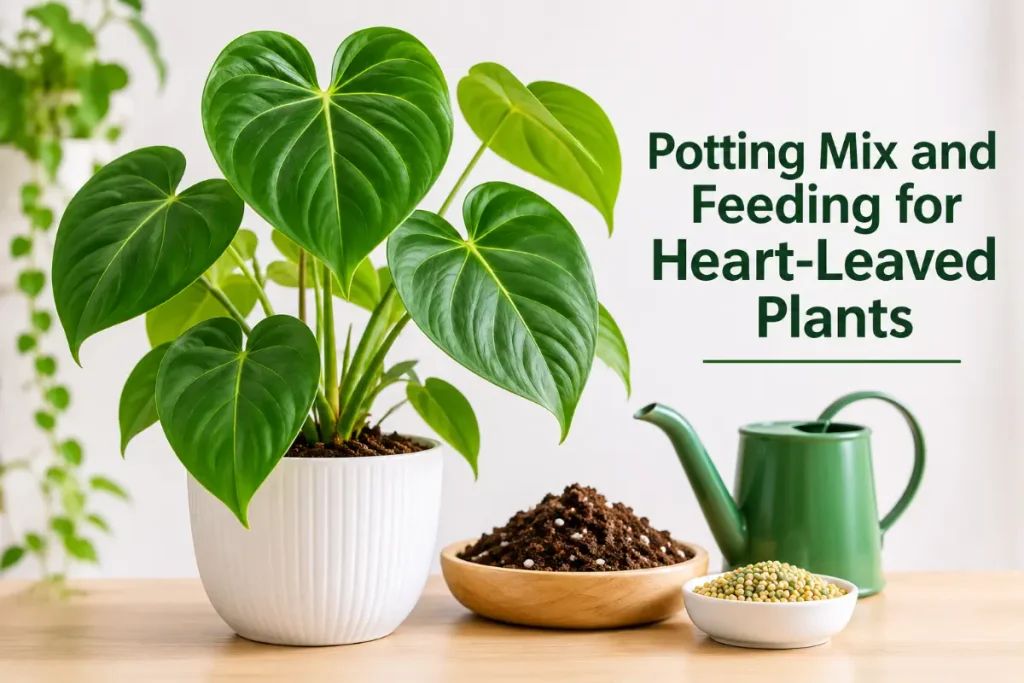
Trailing aroids (pothos, philodendron hederaceum): Standard indoor potting mix with 20–25% perlite. These plants are not fussy about mix composition but benefit from good drainage — compacted, moisture-retaining mixes cause root problems over time.
Semi-succulent heart-leaved plants (hoya kerrii, string of hearts): Fast-draining cactus and succulent mix, or standard mix with 40% perlite. The key requirement is that the mix dries out completely between waterings.
Anthurium crystallinum and philodendron gloriosum: Chunky, well-aerated mix — orchid bark, perlite, and a small amount of standard potting mix works well. These semi-epiphytic plants need root aeration as much as moisture.
Caladium: Standard indoor potting mix with 20% perlite for good drainage during the active growing season.
Fertilizer: Balanced liquid fertilizer at half strength every 3–4 weeks from March through September for all actively growing heart-leaved plants. Stop in October and do not resume until growth is clearly active in spring. For anthurium crystallinum and philodendron gloriosum, a fertilizer with micronutrients and a slight emphasis on nitrogen supports the large leaf development these plants are grown for.
Conclusion
From the delicate trailing vines of string of hearts to the bold foliage of anthurium crystallinum, indoor plant heart shaped leaves add a distinctive charm to any indoor space. Whether you prefer compact plants, cascading varieties, or dramatic statement foliage, there is a heart-leaved plant to suit almost every collection.
Choose a variety that fits your space and lighting conditions, and enjoy the natural beauty of heart-shaped foliage. For more plant identification and care advice, explore the University of Florida IFAS Extension guide to tropical foliage plants.
FAQs
What is the most popular indoor plant with heart shaped leaves?
Heartleaf philodendron (Philodendron hederaceum) and pothos (Epipremnum aureum) are the most widely grown — both are extremely tolerant, widely available, and produce the classic trailing heart-leaf display. For collectors, anthurium crystallinum is the most prized heart-leaved plant.
Is hoya kerrii (sweetheart plant) actually a good houseplant?
A single-leaf cutting sold as a novelty will remain a single leaf forever and never grow — it has no node and cannot produce new growth. A full rooted plant with multiple leaves and a stem is a genuine growing hoya that will trail and may eventually flower. Look for plants with multiple leaves and visible stem structure rather than single-leaf cuttings.
Do heart-shaped leaves need special care?
No — the leaf shape does not determine the care requirements. Heartleaf philodendron is extremely easy; anthurium crystallinum is demanding. The care needs follow the species, not the shape.
What heart-leaved plant grows in low light?
Heartleaf philodendron and golden pothos are the best heart-leaved choices for genuinely low light — both tolerate north-facing rooms and positions away from windows that would cause most other houseplants to decline.
Why does my string of hearts have small leaves?
Small leaves on string of hearts are almost always caused by insufficient light. Move the plant to a brighter position — within 2 feet of a bright window or east/west-facing sill — and new leaves will emerge noticeably larger. String of hearts in good light produces leaves nearly twice the size of those grown in dim conditions.
Pingback: How to Clean Indoor Plant Leaves: 7 Methods That Actually Work - Plant Quill