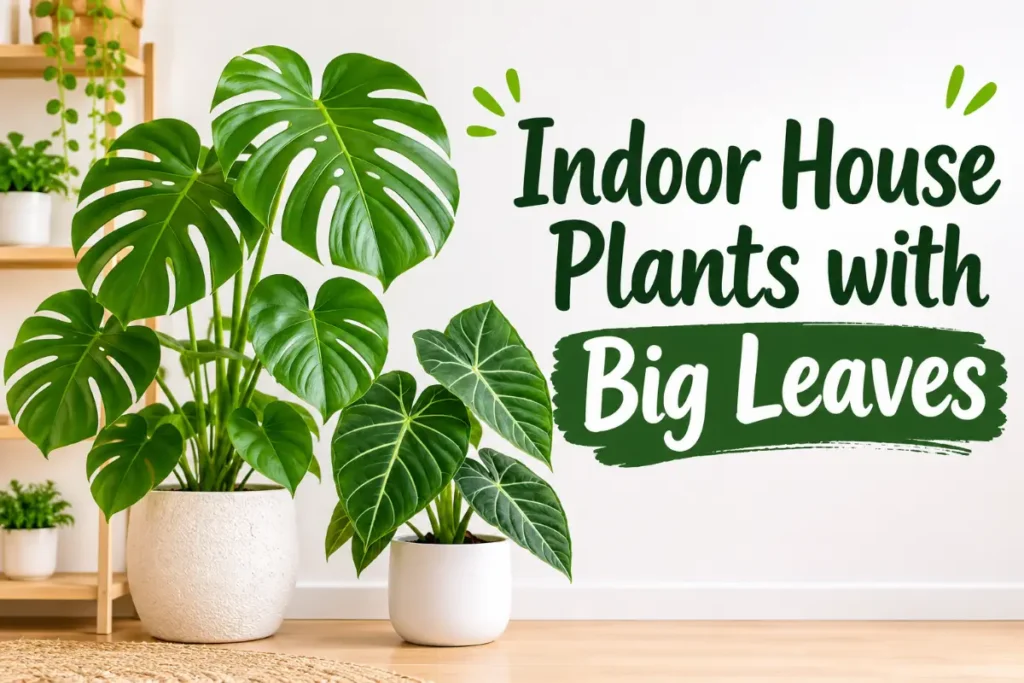
Big leaves change the scale of a room. A plant with leaves that reach 12, 18, or 24 inches across does not simply occupy space — it anchors a room, creates a focal point, and gives the space a sense of lush, tropical richness that no collection of small plants can replicate. Indoor house plants with big leaves are the most effective single addition to any room where impact matters, and several species in this category are genuinely easy to grow once their basic requirements are understood.
This guide covers thirteen of the boldest large-leaved houseplants available in the US, from the iconic monstera to the dramatically sculptural bird of paradise.
1. Monstera deliciosa (Swiss Cheese Plant)
Monstera deliciosa is the defining large-leaved houseplant of the current era — its deeply split and fenestrated (hole-punctuated) leaves are instantly recognizable and have become one of the most reproduced plant images in modern interior design. Mature leaves reach 18–24 inches across and develop their characteristic splits and holes as the plant ages; juvenile leaves are smaller and may be entirely without splits.
Light: Bright indirect light. More light produces larger leaves with more pronounced fenestration faster. In lower light, leaves stay smaller and splits develop more slowly.
Water: Allow the top 2 inches of potting mix to dry between waterings. Monstera is tolerant of occasional underwatering; overwatering causes yellowing of lower leaves.
Support: As monstera grows, it produces aerial roots and benefits from a moss pole or coco coir totem to climb — plants given vertical support produce significantly larger leaves than those allowed to trail or sprawl.
Size: Can reach 6–8 feet or more as a houseplant in good conditions over several years.
2. Fiddle-Leaf Fig (Ficus lyrata)
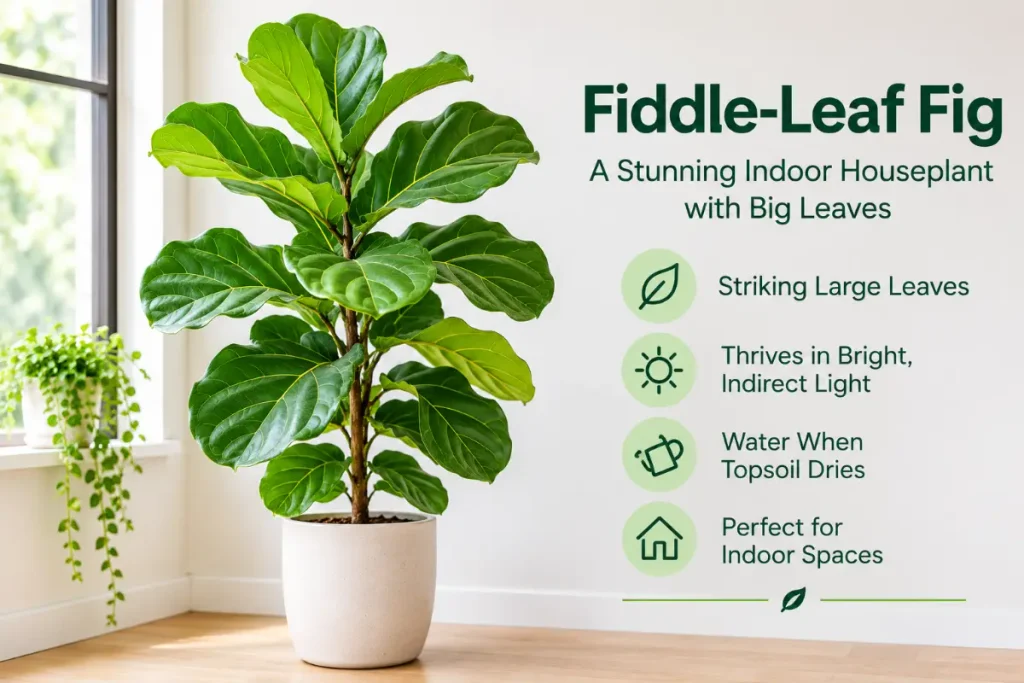
The fiddle-leaf fig produces large, violin-shaped leaves — leathery, dark glossy green, and prominently veined — on an upright, tree-like stem. A well-grown fiddle-leaf fig in a bright room is one of the most dramatic of all large-leaved indoor trees. Individual leaves can reach 12–18 inches long and 10 inches across.
Light: Bright indirect light; some direct morning sun is beneficial. The most common cause of failure is insufficient light or being placed too far from a window.
Water: Allow the top inch of potting mix to dry between waterings. Fiddle-leaf figs are extremely sensitive to overwatering — brown spots spreading from the leaf center indicate rot; brown edges indicate underwatering or low humidity.
Stability: Dislikes being moved once settled — place in its permanent position and leave it. Frequent repositioning causes significant leaf drop.
Size: Can reach 6–10 feet indoors as a tree form.
3. Bird of Paradise (Strelitzia reginae and S. nicolai)
Strelitzia reginae (orange bird of paradise) and S. nicolai (white bird of paradise) both produce large, paddle-shaped leaves on long petioles. S. nicolai in particular is grown primarily as a foliage plant indoors — its leaves can reach 3–4 feet long in a large pot, giving it a dramatic, tropical palm-like appearance. S. reginae produces leaves in the 12–18 inch range and flowers reliably indoors in bright enough conditions.
Light: Full sun to very bright indirect light — bird of paradise is one of the most light-demanding of all large-leaved houseplants. Insufficient light produces large but floppy, pale leaves and prevents flowering in S. reginae.
Water: Allow the top 2 inches to dry between waterings; bird of paradise is moderately drought-tolerant once established.
Leaf splits: The natural splits that appear along the edges of bird of paradise leaves are a normal adaptation — in nature, splits allow wind to pass through without damaging the leaf. They are not a sign of damage.
4. Elephant Ear (Alocasia macrorrhiza and Alocasia ‘Regal Shields’)
Alocasia macrorrhiza (giant taro) produces some of the largest leaves of any houseplant — leaves can reach 2–3 feet across in a large pot in ideal conditions. Alocasia ‘Regal Shields’ produces similar dramatic scale with dark, deeply veined leaves. Both are strongly tropical in character and make an immediate statement.
Light: Bright indirect light; avoid direct sun which burns the large leaf surfaces.
Water: Keep evenly moist; alocasia does not tolerate the drying out that monstera and bird of paradise handle comfortably.
Humidity: Requires moderate to high humidity (50%+). Dry air causes brown leaf edges that are particularly visible on large leaves.
Dormancy: Alocasia may drop leaves and go semi-dormant in winter — reduce watering and do not discard the plant; new growth resumes in spring.
5. Philodendron (Large-Leaved Species)
Several philodendron species and hybrids produce exceptionally large foliage indoors:
- Philodendron gloriosum: Heart-shaped leaves with bold white veining, reaching 18–24 inches across in mature plants.
- Philodendron bipinnatifidum (Tree Philodendron): Deeply lobed, dark green leaves reaching 2–3 feet across on a self-heading (non-climbing) plant.
- Philodendron ‘White Wizard’ and ‘White Princess’: Variegated, with large leaves splashed white and green.
Light: Bright indirect light for the largest leaf production; more tolerant of lower light than monstera or bird of paradise.
Water: Allow the top inch to dry between waterings. Philodendrons are more tolerant of irregular watering than alocasia.
Support: Climbing philodendrons (gloriosum) benefit from a moss pole; self-heading species (bipinnatifidum) do not need support.
6. Banana Plant (Musa and Ensete species)
Banana plants grown indoors produce broad, paddle-like leaves that can reach 3–5 feet long in a large container — the leaves unfurl from a central growing point and add an immediately tropical character to any bright indoor space. Dwarf varieties (Musa acuminata ‘Dwarf Cavendish’) are more manageable indoors than standard-size bananas.
Light: Full sun to very bright indirect light — banana plants need maximum available indoor light.
Water: Keep evenly moist; banana plants are heavy drinkers and large specimens may need watering every 2–3 days in summer.
Humidity: Benefits from moderate to high humidity — leaf edges brown and split in very dry air, which reduces the dramatic leaf impact significantly.
Note: Banana plants grown indoors rarely fruit. The appeal is purely as a large-leaved foliage plant.
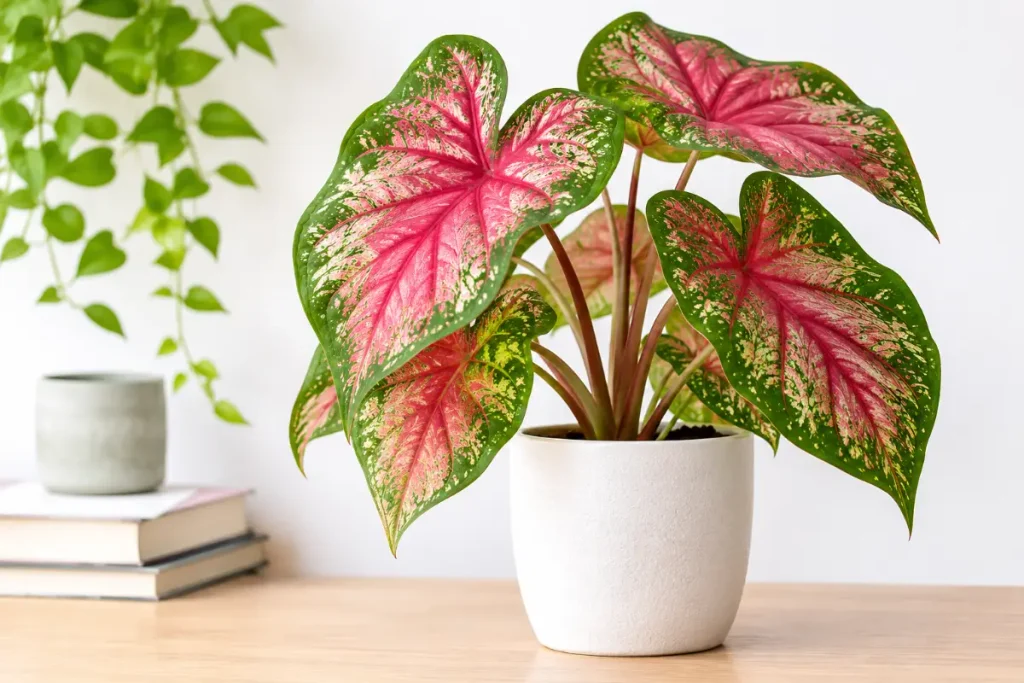
7. Caladium (Large-Leaved Varieties)
Caladiums produce large, paper-thin arrow or heart-shaped leaves in extraordinary color combinations — white, pink, red, and green in patterns that range from subtle to spectacular. Large-leaved varieties like ‘White Queen,’ ‘Candidum,’ and ‘Florida Sweetheart’ produce leaves 12–18 inches across.
Light: Bright indirect light; avoid direct sun which scorches the thin leaves.
Water: Keep evenly moist during the growing season.
Dormancy: Caladiums are tuberous and die back completely in fall — store dry tubers above 60°F and replant in spring.
Why they stand out: No other big-leaved plant offers the color variety of caladiums — they bring large-scale foliage and extraordinary patterning simultaneously.
8. Rubber Plant (Ficus elastica)
The rubber plant produces large, thick, glossy leaves — dark green in the standard form, burgundy-red in ‘Burgundy,’ and variegated green and cream in ‘Tineke’ and ‘Ruby.’ Individual leaves reach 10–14 inches long and have a substantial, leathery quality that holds up well to indoor conditions.
Light: Bright indirect light to some direct morning sun. The standard green form tolerates moderate light; variegated forms need brighter conditions to maintain their coloring.
Water: Allow the top inch of potting mix to dry between waterings. Very tolerant of underwatering; overwatering causes yellowing and leaf drop.
Cleaning: Large glossy leaves accumulate dust visibly — wipe monthly with a damp cloth to maintain the leaf’s natural shine and photosynthetic efficiency.
9. Calathea orbifolia (Large Round Leaves)
Already covered in the round-leaved guide, calathea orbifolia deserves mention here as well — its leaves reach 8–12 inches across and have a silver-green banding pattern that makes them look almost metallic in good light. It is one of the few large-leaved calatheas, most of which have smaller foliage.
Light: Low to moderate indirect light — the best large-leaved option for north-facing rooms.
Water: Keep evenly moist with filtered water.
10. Colocasia (Taro / Elephant Ear)
Colocasia esculenta and its cultivars (including the dramatic ‘Black Magic’ with near-black leaves) produce large, heart-to-arrowhead-shaped leaves that can reach 2 feet across in a large pot. The leaves point downward rather than upward — a distinctive characteristic that separates colocasia from alocasia, which holds leaves more upright.
Light: Bright indirect light to some direct morning sun.
Water: Consistently moist to wet — colocasia is semi-aquatic and tolerates sitting in a tray of water.
Size: Can reach 4–5 feet tall and wide in a large container.
11. Fatsia japonica (Japanese Aralia)
Fatsia produces deeply lobed, palmate leaves — each leaf divided into 7–9 pointed lobes radiating from a central point, reaching 12–16 inches across. The overall effect is lush and jungle-like. Fatsia is one of the most cold-tolerant large-leaved houseplants, making it an excellent choice for cool rooms, entryways, and unheated sunrooms.
Light: Low to bright indirect light — one of the most light-flexible large-leaved plants. Tolerates north-facing rooms.
Water: Allow the top inch to dry between waterings. More drought-tolerant than alocasia or colocasia.
Temperature: Thrives in cool conditions (45–65°F); dislikes the heat of centrally heated rooms.
12. Anthurium (Large-Leaved Species)
Beyond the familiar flowering anthurium, several species are grown primarily for foliage — and the leaves are spectacular. Anthurium crystallinum produces velvety, dark green heart-shaped leaves up to 24 inches long with prominent silver-white veining. Anthurium magnificum and Anthurium warocqueanum produce similarly dramatic large-leaved displays.
Light: Bright indirect light; avoid direct sun.
Water: Allow the top inch to dry between waterings; excellent drainage is essential.
Humidity: Requires moderate to high humidity for the velvety leaf surface to develop fully.
Availability: Large-leaved anthurium species are specialty plants — available from online rare plant retailers rather than big-box stores.
13. Tree Fern (Cyathea and Dicksonia species — Indoor Use)
Tree ferns grown as houseplants produce large, arching fronds that can reach 3–6 feet in suitable conditions. They are challenging to grow indoors due to their high humidity requirements but create a truly dramatic large-leaved display when successful.
Light: Moderate indirect light — tree ferns evolved on the forest floor and prefer shade.
Water: Keep consistently moist; never allow to dry out. Water the trunk as well as the root zone — tree fern trunks absorb moisture directly.
Humidity: Requires very high humidity (70%+) — a bathroom with a window or a plant cabinet with a humidifier is necessary for success indoors.
Keeping Large Leaves Clean and Healthy
Large leaves accumulate dust faster and more visibly than small ones — and dust on leaves reduces photosynthetic efficiency by blocking light from the leaf surface. A monthly wipe with a damp cloth (or a gentle rinse under a lukewarm shower) keeps large leaves clean and maximizes their light-capturing ability.
For glossy leaves (monstera, rubber plant, fiddle-leaf fig): wipe with a soft damp cloth, working from the center outward. A tiny amount of neem oil or leaf shine product can be applied after cleaning, but plain damp cloth is sufficient for routine maintenance.
For matte or velvety leaves (anthurium crystallinum, velvet-leaved philodendrons): use a very soft damp cloth or a soft makeup brush — do not rub, which damages the surface texture of velvety leaves. Never use leaf shine products on matte or velvety-leaved plants.
For large, thin leaves (caladium, banana plant): support the leaf from underneath while wiping — large thin leaves can tear if unsupported during cleaning.
Feeding Large-Leaved Houseplants for Maximum Leaf Size
Large leaves require significant resources to produce — more than a small-leaved plant needs per leaf. Consistent feeding during the growing season directly affects the size and quality of new leaves.
Nitrogen for leaf growth: Nitrogen is the primary nutrient driving foliage development. A balanced fertilizer (10-10-10 or 20-20-20) provides nitrogen alongside phosphorus and potassium. For foliage-focused large-leaved plants (not flowering), a slightly higher nitrogen formula (e.g. 3-1-2 ratio) can be used through the active growing season.
Frequency: Every 2–3 weeks at half the recommended strength during March through September. Do not fertilize in winter when growth is slow — unused fertilizer accumulates as salt in the potting mix and causes root damage and leaf tip browning.
Potassium for leaf integrity: Potassium supports cell wall strength — leaves on potassium-deficient plants may appear large but feel weak, floppy, or thin. A balanced fertilizer provides adequate potassium alongside nitrogen.
Iron and micronutrients: Large tropical foliage plants — particularly monstera and philodendron — can develop interveinal chlorosis (yellowing between the leaf veins while veins remain green) from iron or magnesium deficiency. A liquid fertilizer that includes micronutrients prevents this; alternatively, an occasional dose of Epsom salts (magnesium sulfate) at 1 teaspoon per gallon of water addresses magnesium specifically.
Propagating Large-Leaved Houseplants
Monstera: Stem cuttings with at least one node and one aerial root root readily in water or moist sphagnum moss. The cutting needs a node (the thickened joint on the stem) to root — a leaf alone will not produce a new plant. Air layering is an alternative for very large, established plants where removing a stem cutting would significantly damage the parent.
Rubber plant: Stem tip cuttings root in water or moist potting mix. Allow the cut end to dry for 30 minutes before placing in water to reduce the flow of latex sap, which can inhibit rooting. Alternatively, air layering produces a larger cutting with established roots before separation.
Bird of paradise: Division of mature clumps when repotting — use a sharp, clean knife to separate the rhizome into sections, each with at least one growing point. Divisions from large, mature plants may take a year or more to settle before pushing vigorous new growth.
Philodendron: Stem cuttings root readily in water — one of the easiest large-leaved houseplants to propagate. Take cuttings below a node, remove lower leaves, and root in water in a bright position.
Banana plant: Produces suckers (pups) at the base of the main plant — these can be separated with a clean knife and potted individually. Each sucker should have its own root section before separation.
Alocasia: Produces offset corms around the base, as described in the round-leaves guide. These can be separated and potted to produce new plants, though they may take several months to develop to display size.
Positioning Large-Leaved Plants: Getting the Display Right
Indoor house plants with big leaves require more thought about placement than small ones — their visual weight anchors a space in a way that demands deliberate positioning rather than placing wherever a gap exists.
Corner placement: A large-leaved plant in a room corner reads as an anchor — the plant fills the corner visually without blocking traffic flow, and the corner position means two walls reflect light back onto the plant. A monstera or bird of paradise in a bright corner with a nearby window is one of the most effective indoor plant displays possible.
Beside furniture: Placing a large-leaved plant beside (not behind) a sofa, armchair, or console table creates a layered visual depth — the plant extends the vertical line of the furniture and softens the transition between the furniture and the wall. A rubber plant or fiddle-leaf fig beside a sofa in a bright room is a classic combination.
As a room divider: In open-plan spaces, a large monstera or split-leaf philodendron in a substantial pot can function as a soft room divider — defining the boundary between a living and dining area, or between a home office and a bedroom, without blocking light or sight lines.
Scale matching: Large-leaved plants look best in rooms where their scale is appropriate. A large alocasia in a small room can feel overwhelming; in a large open-plan space, the same plant may barely register. In smaller rooms, medium-sized large-leaved plants (rubber plant, calathea orbifolia) work better than the very largest species.
Single statement vs. grouped: A single, well-grown large-leaved plant in a room with otherwise minimal plant decoration reads as a deliberate statement. Multiple large-leaved plants grouped together creates a lush, jungle-inspired effect. Both approaches work, but mixing large-leaved plants with many small ones can muddy both effects — decide which approach the room calls for and commit to it.
Seasonal Adjustments for Large-Leaved Plants
The large leaf surface area of indoor house plants with big leaves makes them more vulnerable to seasonal extremes than small-leaved species — the larger surface area increases both water loss in dry conditions and cold sensitivity near drafty windows in winter.
Winter: Move large-leaved plants away from cold window glass in winter — a leaf touching a cold window on a freezing night can suffer cold damage. Reduce watering as growth slows. The combination of low light and dry heating air is the hardest winter challenge for large tropical foliage plants; a grow light on a 12-hour timer addresses the light deficit, and a humidifier or pebble tray addresses the humidity deficit.
Summer: Increase watering frequency as temperatures rise and evaporation from large leaves increases. Protect large-leaved plants from strong direct afternoon sun through south and west windows — leaves that handled winter light comfortably can scorch in the same position in July.
Transitioning outdoors for summer: Large-leaved plants placed outdoors for summer (in a shaded or dappled-light position) typically produce noticeably larger, more vigorous leaves than those kept indoors year-round. The higher natural humidity, gentle air movement, and full-spectrum natural light produce measurably better leaf quality. Bring back indoors before nighttime temperatures fall below 55°F.
Conclusion
The best indoor house plants with big leaves transform a room in a way that no collection of smaller plants can match. Monstera and rubber plant are the most accessible starting points — forgiving, widely available, and effective in most indoor light conditions. For maximum impact in bright rooms, bird of paradise and banana plant deliver the most dramatic tropical scale. For lower-light spaces, fatsia and calathea orbifolia offer genuine large-leaf performance without demanding bright conditions. Whichever species you choose, give it the brightest suitable position available and the largest pot it can comfortably fill — large leaves require large root systems, and a plant given room to grow will always outperform one that is cramped.
For detailed guidance on large tropical foliage plant care, the University of Florida IFAS Extension interior landscape plant guide covers cultural requirements for monstera, philodendron, and related large-leaved species.
FAQs
What is the easiest indoor house plant with big leaves?
Monstera deliciosa is the most beginner-friendly large-leaved houseplant — it tolerates a range of light conditions, is forgiving of irregular watering, grows vigorously, and is widely available. A rubber plant in the ‘Burgundy’ or ‘Tineke’ form is a close second for ease.
Why are my monstera leaves staying small?
The two most common causes are insufficient light and lack of vertical support. Monstera produces significantly larger leaves when given bright indirect light and a moss pole to climb. Plants allowed to trail along a surface rather than climb upward consistently produce smaller leaves than those given a vertical support.
How do I keep fiddle-leaf fig leaves from turning brown?
Brown edges indicate underwatering or low humidity; brown spots spreading from the center indicate overwatering or root rot. Identify the pattern before treating. For edge browning: water more consistently and increase ambient humidity. For center spotting: reduce watering frequency and ensure excellent drainage.
What large-leaved plant grows best in low light?
Fatsia japonica is the best large-leaved plant for genuinely low-light conditions — it tolerates north-facing rooms and cool temperatures that most tropical large-leaved plants cannot handle. Calathea orbifolia also produces large leaves in moderate indirect light.
How often should I repot a large-leaved houseplant?
Most large-leaved houseplants benefit from repotting every 2–3 years, one pot size up (typically 2 inches larger in diameter). Repot in spring when growth is resuming. Signs that repotting is needed: roots emerging from drainage holes, the plant becoming top-heavy and tipping the pot, or growth slowing despite good light and regular feeding.