
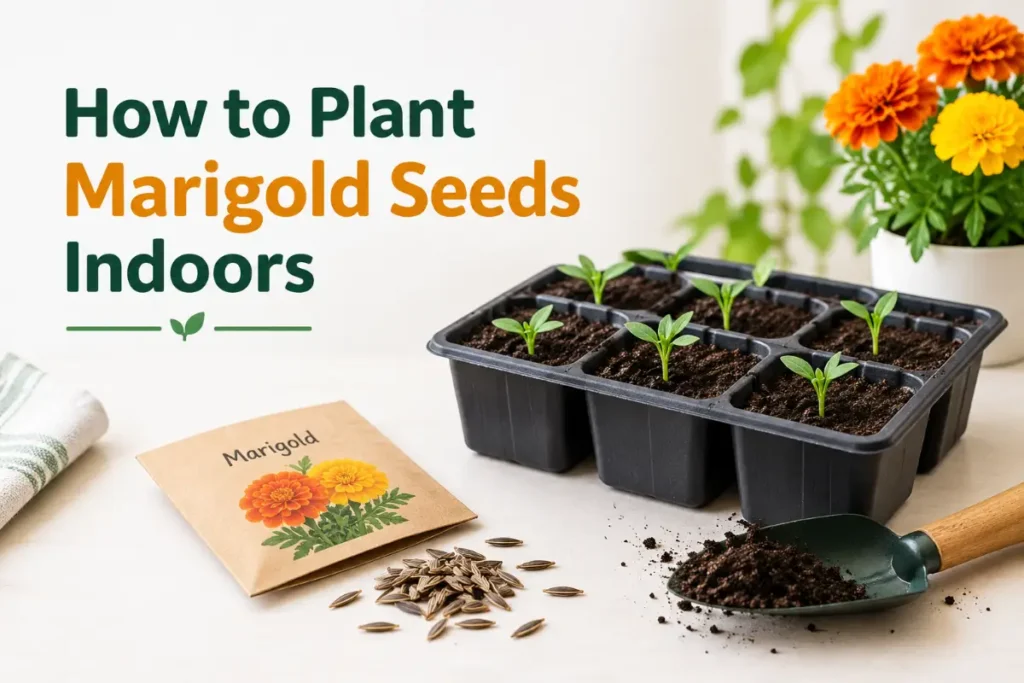
Knowing how to plant marigold seeds indoors gives you a significant head start on one of the most reliable flowering plants available to home gardeners. Marigolds germinate quickly, grow fast, and reward the grower with weeks or months of vibrant blooms — but starting them at the right time, in the right conditions, makes the difference between a slow, struggling seedling and a robust transplant ready to thrive.
This guide covers the complete process: seed selection, germination timing and technique, seedling care, hardening off, and transitioning marigolds to their final container or garden bed. Whether you’re starting seeds for an outdoor garden, a balcony container, or a permanent indoor display, the principles are the same.
Why Start Marigold Seeds Indoors?
Marigolds are fast germinators and can be direct-sown outdoors where winters are mild. But for gardeners in cooler climates — or anyone who wants blooms as early as possible — starting seeds indoors extends the effective growing season by 6–8 weeks.
Reasons to start indoors:
- Get blooms weeks before outdoor planting conditions are ready
- Protect germinating seeds from late frosts and unpredictable spring weather
- Higher germination success rate in controlled indoor conditions
- Start large numbers of plants economically for mass planting or garden borders
Marigolds sown directly outdoors in spring typically bloom in late summer. Marigolds started indoors 6–8 weeks before the last frost date can be blooming by late spring — a meaningful difference if you’re using them for companion planting with vegetables, pest control, or simply to fill your garden earlier in the season.

Understanding Marigold Types
Choosing the right variety before planting affects how you manage the seedlings and what you ultimately get.
French marigolds (Tagetes patula)
The most popular marigolds for home growers. Compact plants (6–18 inches tall), prolific double or single blooms in yellow, orange, red, and bicolor combinations. French marigolds are tough, heat-tolerant, and produce continuously from early summer until frost. Best for container growing indoors and companion planting with vegetables.
Recommended varieties: ‘Bonanza’, ‘Safari’, ‘Boy O Boy’, ‘Durango’.
African marigolds (Tagetes erecta)
Larger plants (24–36 inches), with big pom-pom blooms in golden yellow and deep orange. Take slightly longer to bloom than French types. Impressive as cut flowers. Better for garden borders than indoor containers due to size.
Recommended varieties: ‘Crackerjack’, ‘Inca Gold’, ‘Vanilla’ (cream-white, distinctive).
Signet marigolds (Tagetes tenuifolia)
Smaller, lacy-foliage plants covered in tiny single blooms. The most edible of the marigolds — flowers have a citrusy, spicy flavor used in salads and as garnishes. Very heat-tolerant and drought-resistant once established.
Recommended varieties: ‘Lemon Gem’, ‘Tangerine Gem’, ‘Red Gem’.
Triploid marigolds
Hybrids between French and African types. Sterile (no seeds), so they channel all energy into continuous blooming. Outstanding garden performance but seeds must be purchased new each year.
Timing: When to Start Marigold Seeds Indoors
The timing rule is simple: 6–8 weeks before your last frost date.
Starting earlier than 8 weeks risks producing transplants that are too large and root-bound before outdoor conditions are right. Starting later than 6 weeks means you lose the full season advantage of indoor starting.
How to calculate your timing:
- Find your last frost date for your location
- Count back 6–8 weeks on the calendar
- That window is your ideal indoor sowing period
For example: if your last frost date is May 15, sow indoors from late March to early April.
For purely indoor or container growing:
If growing marigolds entirely indoors — in containers on a windowsill or under grow lights — you’re not constrained by frost dates. You can start seeds any time. Under grow lights providing 14–16 hours of light daily, marigolds can bloom year-round in a warm indoor setting.
What You Need
Seeds: Fresh marigold seeds germinate best. Test viability by placing 10 seeds on a damp paper towel — if 7 or more germinate within a week, viability is good.
Containers: Seed trays with individual cells (72-cell or 128-cell trays) or small 2–3 inch pots with drainage holes. Small cells dry out faster, which reduces damping-off risk.
Seed-starting mix: Use fine-textured seed-starting mix rather than regular potting soil. Lighter, drains faster, and less likely to harbor damping-off pathogens. Do not add fertilizer to the germination mix.
Clear cover: Plastic domes or plastic wrap over the tray retains moisture during germination.
Grow light or bright windowsill: Post-germination, marigolds need strong light immediately — this is non-negotiable.
How to Plant Marigold Seeds Indoors: Step by Step
Step 1: Prepare containers
Fill seed cells or pots with moistened seed-starting mix. The mix should be damp — squeeze a handful and it holds together without dripping. Make a small planting hole in the center of each cell, about ¼ inch (6mm) deep.
Step 2: Plant one seed per cell
Place one marigold seed per cell, narrow (embryo) end facing into the soil if visible. Cover gently with seed-starting mix and press lightly to ensure seed-to-soil contact.
Step 3: Water gently
Use a spray bottle or a fine-rose watering can to mist the surface until evenly moist. Don’t flood the cells — marigold seeds are small and can be dislodged by heavy watering.
Step 4: Cover and place in warmth
Place a clear plastic dome over the tray to retain moisture and warmth. Marigold seeds germinate best at 70–75°F. A spot on top of a refrigerator, near a heating vent, or on a seedling heat mat set to 72°F works well. Do not place under grow lights yet — seeds germinate in the dark.
Step 5: Monitor daily
Check every day. Keep the soil surface evenly moist. Most marigold varieties germinate within 5–7 days at 70–75°F. Cooler temperatures slow this to 10–14 days.
Step 6: Remove cover at first sprout
The moment the first seedling emerges, remove the plastic cover and move the tray immediately under a grow light or to the brightest windowsill available. Marigold seedlings left under a dome quickly stretch toward any available light and become weak and leggy within days.
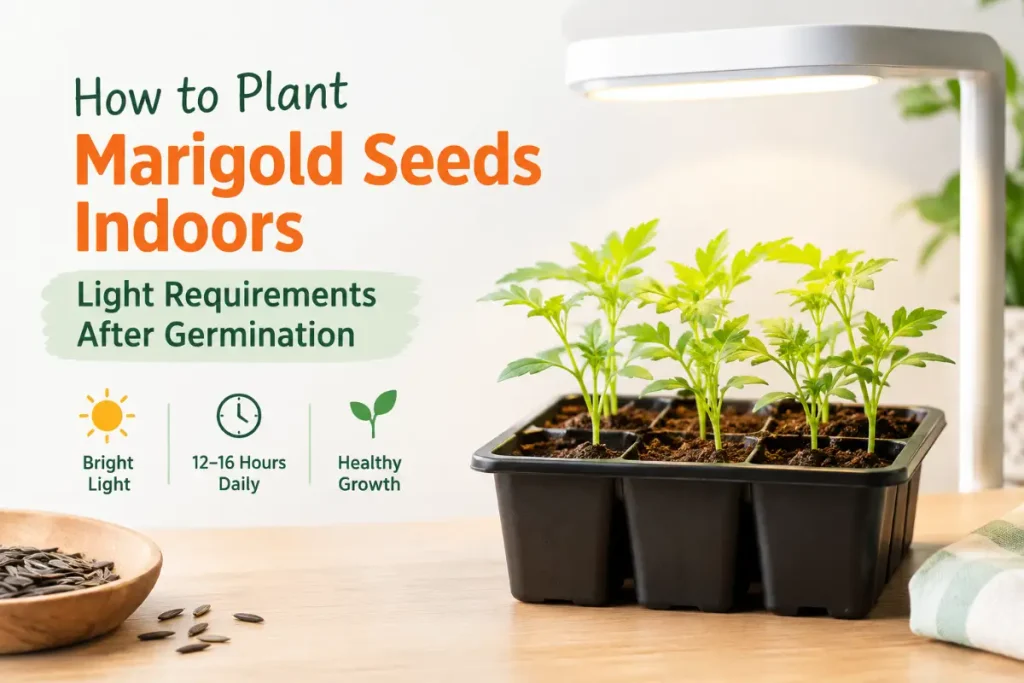
Light Requirements After Germination
The number one cause of weak, stretched marigold seedlings is insufficient light immediately after germination.
Marigold seedlings need 14–16 hours of bright light per day from the moment they emerge. A south-facing window in spring and summer may provide enough. A north or east-facing window almost certainly won’t.
Grow light setup:
A T5 fluorescent or LED grow light hung 2–4 inches above the seedling tray, running 14–16 hours per day on a timer, works well. Raise the light to maintain 2–4 inches of clearance above the tallest plants as they grow.
If using a windowsill, rotate the tray 180 degrees every day to prevent seedlings from leaning toward the light source.
Signs of insufficient light:
- Pale, yellow-green leaves
- Long gaps between leaves (internodal stretching)
- Thin, floppy stems unable to support themselves
- Leaning strongly toward the light source
Caring for Marigold Seedlings Indoors
Watering
After germination, keep soil evenly moist — not wet, not dry. Let the top layer dry slightly between waterings. Water from below: pour water into the tray beneath the cells and allow the mix to absorb upward. This keeps the soil surface drier and reduces damping-off risk significantly.
Fertilizing
Once seedlings have their first set of true leaves, feed every 7–10 days with half-strength balanced liquid fertilizer. Marigolds don’t need heavy feeding at the seedling stage — too much nitrogen produces lush foliage but delays flowering.
Thinning
If you planted multiple seeds per cell, thin to one seedling per cell once the first true leaves appear. Snip extras at soil level with scissors — don’t pull them out.
Pinching for bushier plants
When seedlings reach 3–4 inches tall, pinch out the growing tip above the second or third set of true leaves. This encourages lateral branching and significantly more total flowers over the season, at the cost of delaying the first blooms by approximately one week.
Damping-Off: Prevention and Recognition
Damping-off is the most common seedling killer indoors, caused by fungal pathogens (Pythium, Rhizoctonia, Fusarium) that attack the stem at the soil line.
Signs: Seedlings that looked healthy suddenly collapse. The stem at soil level appears pinched, discolored, or rotted.
Prevention:
- Use sterile seed-starting mix
- Don’t overwater — allow the surface to dry slightly between waterings
- Provide strong airflow over seedlings with a small fan on low
- Remove humidity dome after germination
- Water from below rather than top-watering
- Keep trays clean and sterilize between uses
If it appears: Remove affected seedlings immediately. Reduce watering and improve airflow. There is no cure once a seedling has damped off, but spread can be limited.
Hardening Off Before Transplanting
If your marigolds are destined for an outdoor garden or balcony, they need a gradual transition from indoor conditions to outdoor sun, wind, and temperature variation. Skipping this leads to transplant shock or scorched, dead plants.
Two-week hardening schedule:
Days 1–4: Move seedlings outdoors to a sheltered spot with indirect light for 2–3 hours per day. Bring back indoors before evening.
Days 5–9: Increase outdoor time to 4–6 hours. Introduce some direct morning sun.
Days 10–14: Leave outdoors for a full day including direct afternoon sun. Bring in only if frost threatens.
After two weeks, plants are ready to transplant to their permanent location.
For purely indoor container growing: Hardening off is only necessary if moving the plant from a grow-light environment to direct outdoor sun. Moving from a grow light to a bright south window requires no hardening.
Transplanting to Final Container or Garden Bed
Timing: Transplant after all frost risk has passed for outdoor gardens, or any time the seedling has 3–4 sets of true leaves and roots have filled the cell for indoor container growing.
Container selection for indoor marigolds: French marigolds do well in 6–8 inch diameter pots. African marigolds need at least 10–12 inch containers to reach full size.
Transplanting technique:
- Water seedlings well 1–2 hours before transplanting
- Fill the final container with quality potting mix
- Gently remove the seedling by pressing from the bottom of the cell — never pull by the stem
- Place in the hole so the soil line matches its level in the seedling cell
- Fill in around the root ball, press gently, and water thoroughly
Space French marigolds 8–10 inches apart. African marigolds need 12–18 inches.
Using Marigolds as Companion Plants Indoors
Marigolds earn their space in a food-growing setup through well-documented pest-suppression properties. Indoor edible gardeners who grow chillis, tomatoes, or herbs alongside marigolds often report fewer pest problems.
What marigolds suppress:
French marigolds produce a root exudate that suppresses root-knot nematodes — microscopic soil organisms that damage tomato and pepper roots. Growing marigolds in the same container or nearby reduces nematode populations over time.
Above ground, marigold foliage produces aromatic compounds that repel aphids, whiteflies, and thrips. These pests navigate partly by scent, and the strong volatile signature of marigolds disrupts their host-location behavior.
Edible flowers:
Signet marigold flowers (‘Lemon Gem’, ‘Tangerine Gem’) are genuinely edible with a citrus-spice flavor that works in salads, as a garnish, or infused into vinegar or oil. French and African marigold petals are technically edible but more strongly flavored — best used as a colorful garnish in small quantities.
Extending Bloom Time: Deadheading
Regular deadheading dramatically extends the flowering season by redirecting the plant’s energy from seed production back to flower production.
How to deadhead: Pinch or snip the spent flower head just below its base, where the stem meets the next set of leaves or a side shoot. Remove the entire flower and its calyx (the green cup behind the petals). Deadhead every 3–5 days during peak blooming.
Fertilizing for continuous bloom: Once actively blooming, switch to a higher-phosphorus, lower-nitrogen fertilizer (such as 5-10-10 or a bloom booster). Phosphorus drives flower production; excess nitrogen during blooming causes leafy growth at the expense of flowers.
When to stop deadheading: Stop 4–6 weeks before season end if saving seeds. Allow the last flush of flowers to mature and dry on the plant, then harvest seed heads.
Common Problems and Solutions
No germination after 14 days: Check temperature (too cold is most common), seed viability (paper towel test), and soil moisture (too dry or waterlogged).
Yellow seedling leaves: Nitrogen deficiency or insufficient light. Begin light fertilizing and assess light levels.
Leggy, falling-over seedlings: Insufficient light. Move under a stronger grow light or increase proximity to window. Add a small stake for support while correcting light.
Powdery mildew: White powdery coating on leaves in low-airflow conditions. Improve airflow with a fan. Treat with diluted baking soda solution (1 teaspoon per liter of water) or neem oil.
Aphids on seedlings: Small clusters on new growth. Treat with insecticidal soap spray. Inspect any new plants before bringing them indoors.
Saving Seeds and Starting a Second Generation
One of the most satisfying aspects of growing marigolds from seed is closing the loop — saving seeds from your best plants and starting the next generation from them.
Selecting plants for seed saving:
Choose seed heads from plants that bloomed earliest and most prolifically, with the most vibrant color or best flower form. Only save from open-pollinated or heirloom varieties — not F1 hybrids, which won’t grow true from seed.
If growing multiple varieties, separate them or bag individual flowers before they open to prevent cross-pollination.
Harvesting and processing seeds:
Allow selected flower heads to dry completely on the plant — petals should be papery and faded, and the seed head should feel dry when shaken. Snip the entire dry flower head and bring it indoors.
Over a tray, pull apart the seed head and separate the seeds. Each marigold seed is a small, thin, black-and-white elongated structure. Remove any dried petal debris.
Spread seeds in a single layer on a paper plate. Air-dry for 7–14 days in a warm location with good airflow. Don’t rush — seeds that aren’t fully dry can mold in storage.
Storing seeds:
Label a paper envelope with the variety name and harvest date. Paper envelopes breathe better than plastic bags, reducing moisture buildup. Store in a cool, dark, dry location — a drawer or box away from light and temperature swings. Properly stored marigold seeds remain viable for 3–5 years.
Testing viability before planting:
Before committing to a full seed-starting session with stored seeds, run a germination test: dampen a paper towel, place 10 seeds on it, fold over, and seal in a zip-lock bag at room temperature. After 7–10 days, count germinated seeds. If 7 or more sprouted, viability is good. Fewer than 5 means sow extra seeds per cell to compensate for lower germination rates.
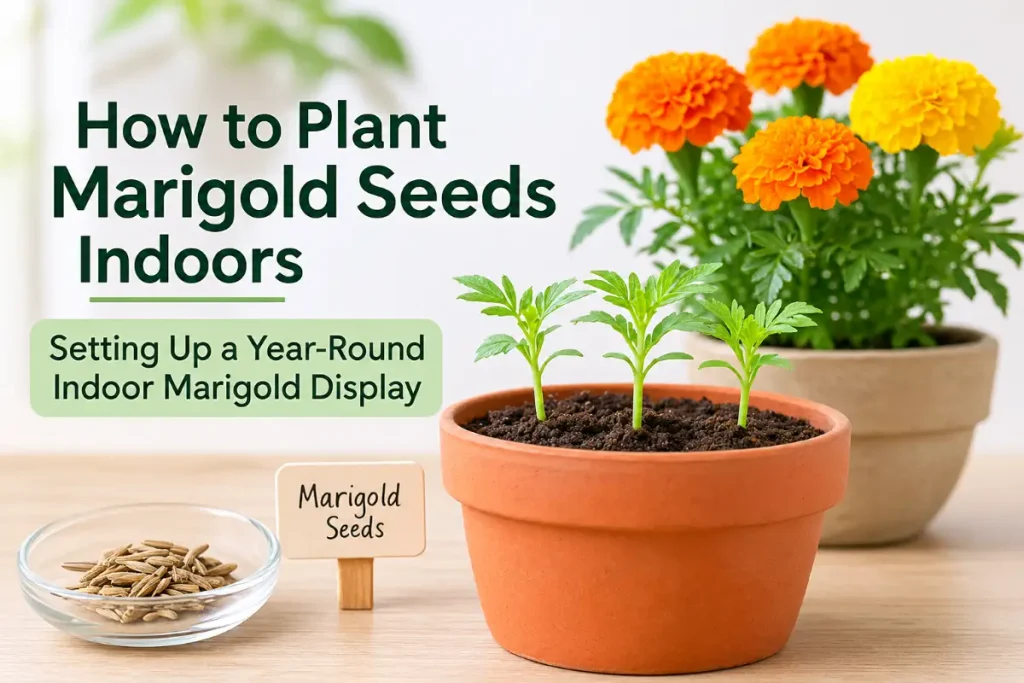
Setting Up a Year-Round Indoor Marigold Display
For growers committed to having marigolds blooming indoors continuously rather than just as a seasonal crop, succession planting is the key strategy.
Staggered sowing:
Start a new batch of seeds every 6–8 weeks. By the time older plants begin declining or are past their peak bloom period, a new batch of seedlings is ready to take their place. A simple rotation of three or four trays at different stages — fresh germination, seedling, established, peak bloom — keeps blooms uninterrupted year-round.
Which varieties suit year-round indoor display:
French marigold compact varieties (under 12 inches) are the most practical. ‘Bonanza Orange’, ‘Safari Yellow’, and ‘Boy O Boy Mix’ stay small enough for 6-inch pots on a windowsill or under a grow light shelf. Signet varieties like ‘Lemon Gem’ also work beautifully indoors — their fine, lacy texture looks different from standard marigolds and the edible flowers add a culinary dimension.
Light setup for year-round growing:
14–16 hours per day of full-spectrum LED grow light is the baseline requirement. In summer, a south-facing window may supplement or replace grow light time. In winter, grow lights carry the full load. A simple mechanical timer keeps the schedule consistent without daily management.
Container turnover:
Marigolds in small pots can become root-bound quickly in a warm, well-lit indoor environment. When you notice rapid drying despite regular watering, or growth slowing significantly despite good light and fertilizer, it’s time to either repot to a larger container or — for most indoor growers — start a fresh plant from the next succession sowing and compost the old one.
Conclusion
Planting marigold seeds indoors is one of the most straightforward seed-starting projects available, and the payoff — vibrant, long-blooming plants ready weeks ahead of the outdoor season — makes it well worth the effort. The keys are simple: warm germination temperature, immediate bright light the moment seedlings emerge, and consistent moisture without overwatering. Get those three right and marigolds practically grow themselves. Whether you’re using them as companion plants alongside indoor tomatoes and chillis, as a windowsill display, or as transplants destined for an outdoor garden, starting from seed gives you more plants, more variety choice, and more satisfaction than buying transplants from a nursery.
For companion planting context, the guide on growing chilli plants indoors covers how marigolds pair with chillis under the same grow light setup. The indoor cherry tomato plant guide explains the same companion planting principles applied to tomatoes. For further reading on marigold varieties and growing practices, the Royal Horticultural Society marigold guide is an authoritative reference.
FAQs
How long do marigold seeds take to germinate indoors?
Most marigold varieties germinate in 5–7 days at 70–75°F. Cooler temperatures slow germination — at 65°F expect 10–14 days. Temperatures below 60°F produce very poor germination rates.
Do marigold seeds need light to germinate?
No. Marigold seeds germinate in darkness or low light. However, the moment seedlings emerge, they need 14–16 hours of bright light per day to develop properly without stretching.
How deep should I plant marigold seeds?
Plant ¼ inch (6mm) deep. Planting too deep delays or prevents germination. Pressed lightly into moist seed-starting mix and covered with a thin layer of mix, germination is reliable.
Can I plant marigold seeds directly from a dried flower head?
Yes. Let the flower head dry completely on the plant before harvesting. Strip seeds from the base of the dried head, allow to dry further for a week, and store in a cool, dry location.
How long until indoor marigolds bloom after planting seeds?
Under ideal conditions (14–16 hours of grow light, warm temperatures), French marigolds typically bloom 50–70 days from seed. African varieties take 70–90 days.
Can marigolds grow entirely indoors without transplanting outside?
Yes. French and signet marigolds grown under sufficient grow light bloom reliably indoors. They need 14–16 hours of full-spectrum light per day. African marigolds can also grow indoors but their larger size makes them less practical for most setups.
Do marigolds come back every year?
In most climates, marigolds are annuals — they don’t survive frost. In frost-free climates (USDA zones 9–11) they can survive year-round. Indoors in a warm, well-lit space, a marigold plant can be kept going indefinitely, though most growers start fresh from seed each season.
Can I save marigold seeds from F1 hybrid varieties?
You can save them, but F1 hybrids don’t grow true from seed — offspring plants may look very different from the parent. For consistent results season after season, save seeds from open-pollinated or heirloom varieties rather than F1 hybrids.