
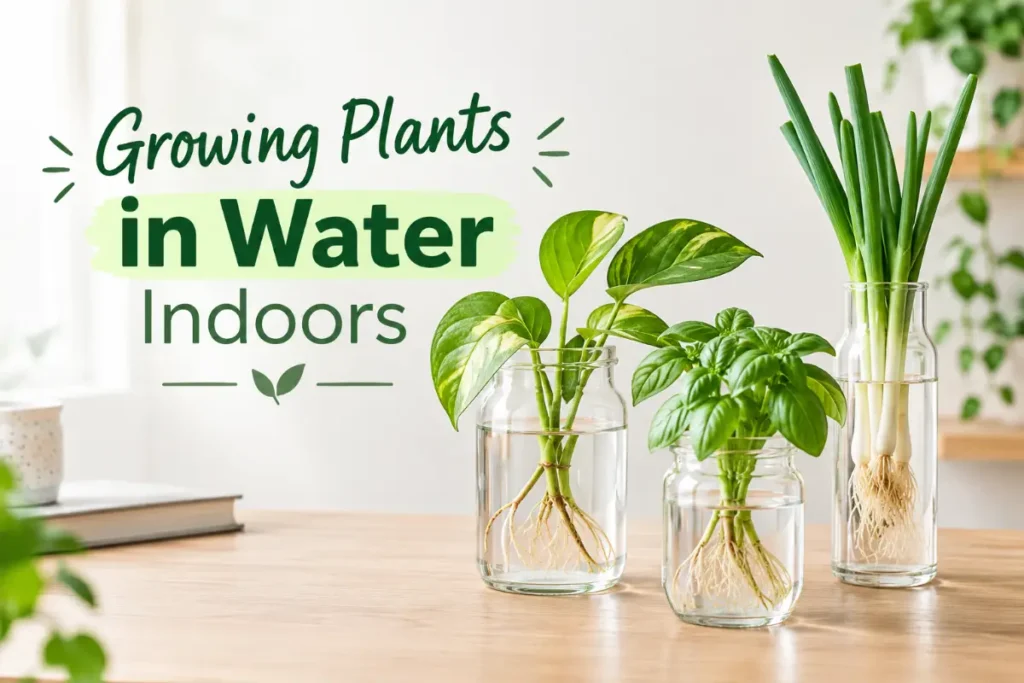
Growing plants in water indoors is one of the most accessible and satisfying ways to cultivate food and foliage at home without soil. The technique ranges from a single herb stem rooting in a glass jar on your kitchen windowsill to a fully managed hydroponic system producing lettuces, herbs, and even fruiting plants in a purpose-built grow tent. Both approaches work on the same fundamental principle: plants derive nutrients from water rather than soil, and when that water contains the right mineral balance, plants grow faster, more cleanly, and often more productively than their soil-grown counterparts.
Growing plants in water indoors eliminates many of the challenges that make traditional soil-based indoor growing difficult. There is no compost to get wrong, no overwatering, no underwatering in the traditional sense, no soil-dwelling pests like vine weevil or fungus gnats, and no mess of fallen compost across your floor. The system is visible at all times — you can see exactly how much water and nutrient solution your plants are using and respond immediately.
This guide covers everything from the simplest water-rooting setups to nutrient-managed systems, with practical guidance on which plants grow best in water, how to feed them, and how to troubleshoot the problems that occasionally arise.
Why Grow Plants in Water Indoors?
The advantages of water growing extend beyond novelty. There are genuine, practical reasons why hydroponic and water-based growing methods have expanded rapidly among home growers over the past decade.
Speed of growth is the most immediately noticeable benefit. Plants grown in oxygenated, nutrient-rich water grow 30 to 50 percent faster than equivalent soil-grown plants. Roots can access nutrients directly without expending energy breaking down organic matter in compost. That energy goes straight into leaf and stem production, which translates to faster harvests and more productive plants overall.
Clean, pest-free growing appeals strongly to indoor growers. The most persistent indoor plant pests — fungus gnats, vine weevils, root aphids — live and breed in compost. Remove the compost and you remove the habitat. Water-grown plants are not immune to all pests, but the most troublesome soil-dwelling species simply cannot establish without growing medium to colonise.
Space efficiency is another practical advantage. Hydroponic systems can be designed and scaled to fit almost any available space, from a single bottle on a shelf to a purpose-built vertical rack filling one wall of a spare room. Because nutrients are delivered directly to roots, plants do not need to spread roots through large volumes of compost searching for nutrition, which means they can be spaced more densely than soil-grown equivalents.
Water efficiency surprises many people. Hydroponic systems use significantly less water than soil-based growing because water is recirculated within the system rather than draining away through the base of a pot. A well-managed recirculating system uses up to 90 percent less water than equivalent container growing.
Year-round growing becomes easier indoors because water-based systems integrate naturally with artificial lighting and climate control. You are not fighting the seasonal limitations of outdoor soil; you are running a managed environment where growth continues at a consistent rate regardless of what the weather is doing outside.
The Simplest Approach: Water Propagation and Passive Growing
The most accessible starting point for growing plants in water indoors requires no specialist equipment, no nutrient solutions, and no technical knowledge. Water propagation — rooting cuttings in plain water — works for a wide range of common herbs and houseplants and can transition directly into long-term water growing for many species.
Take a cutting from a healthy herb plant — basil, mint, oregano, or rosemary work well — ensuring the cutting is 8 to 12 centimetres long and has at least two nodes (the points where leaves join the stem). Remove the lower leaves, leaving only the top two or three sets. Place the cutting in a clean glass or jar filled with room-temperature water, ensuring the lower nodes are submerged while the upper leaves remain above the waterline.
Position the jar on a bright windowsill. Within seven to fourteen days, roots will emerge from the submerged nodes. Once roots reach 3 to 5 centimetres in length, the plant is ready to transfer to a nutrient solution for continued water growing, or to pot up into compost if you prefer a more conventional approach.
The key to successful water propagation is changing the water every three to five days to prevent stagnation and bacterial buildup. Use room-temperature water rather than cold tap water, as cold water slows root development. Keep the glass away from direct hot sunlight, which warms the water rapidly and encourages algae growth.
Many plants can live indefinitely in water with no added nutrients, drawing sufficient minerals from tap water alone, though growth will eventually slow and plants will not reach their full productivity. Adding a diluted liquid fertiliser — one quarter of the standard recommended dose — every two weeks dramatically improves long-term performance without complicating the system.

Best Plants for Growing in Water Indoors
Not every plant thrives in water, but a surprising range of food crops and ornamental plants grow well with water-based methods. Understanding which species perform best helps you choose appropriate plants for your setup and manage expectations realistically.
Herbs are the easiest and most rewarding starting point. Basil, mint, oregano, thyme, lemon balm, and chives all root readily in water and can be grown indefinitely in a nutrient solution. Mint is particularly vigorous — a single cutting can develop into a substantial productive plant within weeks. Basil grows fast and handles water well, though it prefers warmer temperatures than some other herbs.
Lettuces and leafy greens are the ideal crop for more developed hydroponic systems. Loose-leaf lettuces, spinach, kale, rocket (arugula), and Swiss chard grow exceptionally fast in water and produce a continuous harvest when leaves are picked regularly from the outside of the plant. These crops are the backbone of most home hydroponic operations precisely because they are productive, fast, and require no pollination.
Spring onions and chives grow readily from seed or transplant in water and provide a continuous harvest of fresh allium flavour throughout the year.
Tomatoes and peppers can be grown hydroponically but require more nutrient management and substantial light. They are not suitable for simple jar-based systems but perform well in more developed deep water culture or nutrient film technique setups.
Strawberries adapt well to hydroponic growing and can be grown in water-based systems for continuous fruit production. For more on growing strawberries indoors, including variety selection and care requirements, the guide to can strawberry plants grow indoors covers these in detail.
Pothos, philodendron, and peace lily grow indefinitely in water as ornamental plants, though these are not food crops. They are useful for testing your confidence with water growing before committing to food production setups.
Plants that do not generally perform well in long-term water growing include root vegetables (carrots, parsnips, beets), which need a growing medium to develop their edible roots, and heavy-feeding fruit trees, which require more complex nutrient management than most home growers want to manage.
Understanding Nutrient Solutions
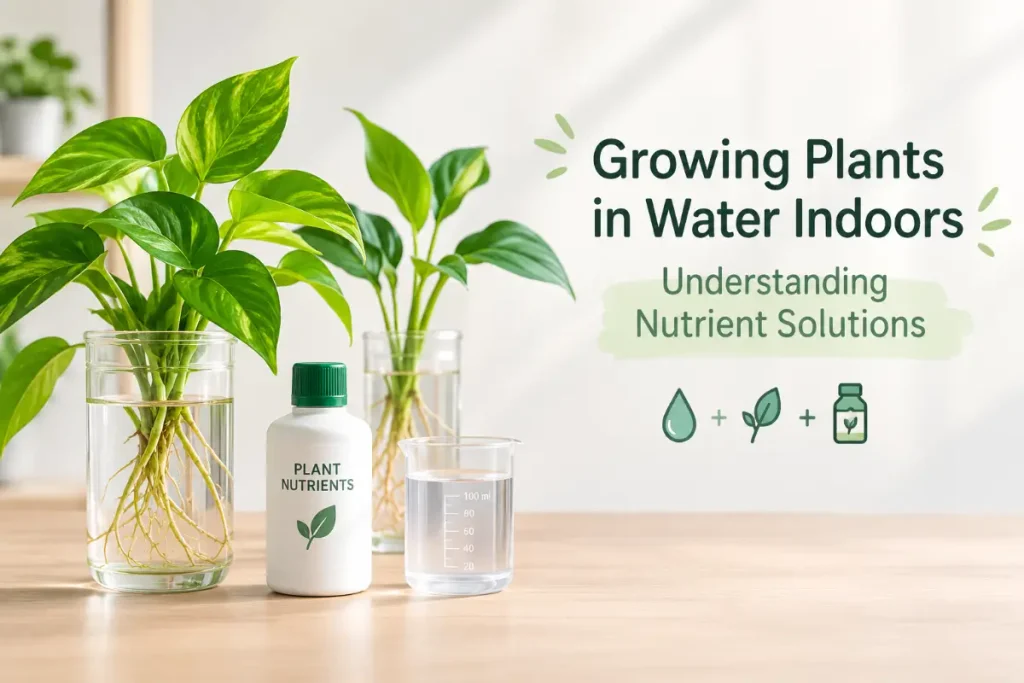
Plain water supports rooting and short-term growth in many plants, but for sustained productivity, plants need nutrients beyond what tap water provides. The major nutrients plants need are nitrogen (N), phosphorus (P), and potassium (K), along with a range of micronutrients including calcium, magnesium, iron, manganese, zinc, copper, and boron.
Dedicated hydroponic nutrient solutions contain all of these in the correct ratios and are available in liquid concentrate form from garden centres and online suppliers. Products are typically sold as two-part or three-part systems — separate concentrates that you mix together in water to create a complete nutrient solution. Follow the manufacturer’s dilution instructions carefully; the ratios matter more than the overall concentration.
For beginners, a simple one-part nutrient solution designed for hydroponic growing is the most practical starting point. These products contain all necessary nutrients pre-balanced and require only dilution in water. While they do not offer the same level of fine-tuning as multi-part systems, they provide everything plants need and perform well for herbs, lettuces, and other leafy crops.
The strength of your nutrient solution is measured using an electrical conductivity (EC) meter. EC measures dissolved mineral content and indicates how nutrient-rich your solution is. For leafy herbs and lettuces, an EC of 1.0 to 1.8 millisiemens per centimetre (mS/cm) is appropriate. Fruiting plants like tomatoes and peppers need higher EC values of 2.0 to 3.5 mS/cm. EC meters are inexpensive and widely available online.
Maintain a pH of 5.5 to 6.5 for most water-grown plants. At this pH range, nutrients remain in a form plants can absorb. Outside this range, certain nutrients become chemically locked out, causing deficiency symptoms even when the solution contains adequate levels. A simple pH test kit or digital pH meter allows you to check and adjust your solution easily. pH Up (potassium hydroxide) and pH Down (phosphoric acid) solutions allow precise adjustment.
Change your nutrient solution completely every one to two weeks to prevent salt buildup and maintain nutrient balance. Between changes, top up with plain water to maintain the correct volume as plants absorb it.
Simple System Setups for Beginners
You do not need elaborate equipment to grow food in water indoors. Several simple system designs are effective, inexpensive to set up, and easy to manage.
The Kratky method is the simplest passive hydroponic approach and requires no electricity, no pump, and no maintenance beyond topping up the reservoir. Plant seedlings in net pots filled with an inert growing medium (hydroton clay pebbles or rockwool work well). Suspend the net pot in the lid of a container so that roots hang into the nutrient solution below. As plants consume the solution, an air gap develops between the water surface and the net pot. This air gap allows roots to access oxygen while the lower portion of the roots remains submerged in nutrient solution. The system is self-managing: as the solution level drops, the air gap grows and roots adapt accordingly.
For a simple Kratky setup, use a food-safe container (a dark-coloured storage box works perfectly), cut holes in the lid sized to fit your net pots, fill with nutrient solution to a level that just touches the bottom of the net pots, and plant seedlings. Check the solution level weekly and top up with plain water between changes. This system works particularly well for lettuces and herbs.
Deep water culture (DWC) is the next step up. It operates on the same basic principle as Kratky but adds an aquarium air pump and air stone to oxygenate the solution continuously. Oxygen-rich solution dramatically accelerates root growth and plant development. A basic DWC system uses the same container-and-net-pot arrangement as Kratky, with an air stone placed at the base of the reservoir connected to an external pump via airline tubing. This setup supports more demanding crops including tomatoes, peppers, and fruiting herbs.
Nutrient Film Technique (NFT) passes a thin, continuous film of nutrient solution over bare roots in a sloped channel or pipe. A small pump circulates the solution from a reservoir up through the channels, where it flows over roots and drains back down. NFT systems produce fast growth and are well suited to herbs and lettuces. They are more complex to set up than Kratky or DWC but are more space-efficient and scalable.
Light Requirements for Water-Grown Plants
Water-based growing does not change a plant’s light requirements. Herbs, lettuces, and other crops grown in water need the same light levels they would require in soil.
Leafy herbs and lettuces need 12 to 14 hours of bright light daily for steady, compact growth. South-facing windowsills provide adequate light in summer but fall short during winter months. A full-spectrum LED grow light positioned 20 to 30 centimetres above the plants on a timer set for 14 hours daily ensures consistent growth year-round regardless of season or window orientation.
Fruiting plants including tomatoes, peppers, and strawberries grown hydroponically need 14 to 16 hours of high-intensity light daily. These crops are less suited to simple windowsill setups and perform best under dedicated grow lights.
One advantage of water-based systems is that they integrate cleanly with grow light setups. A Kratky or DWC container can be positioned anywhere in a room, not just beside a window, and paired with a hanging grow light above. This flexibility means you can use otherwise dead indoor space — a shelf in a spare room, a space under a staircase, a utility area — productively without depending on natural light at all.
Troubleshooting Common Problems
Even well-managed water-growing systems encounter occasional issues. Recognising the symptoms and understanding the causes allows rapid correction before problems escalate.
Algae growth in the reservoir is the most common nuisance in water-based systems. Algae is triggered by light reaching the nutrient solution. Use dark-coloured containers or wrap clear containers in black plastic or foil to block light from the reservoir entirely. Algae does not directly harm plants but competes for nutrients and oxygen and indicates your system needs better light exclusion.
Root rot appears as brown, slimy, foul-smelling roots rather than the healthy white roots of a productive plant. Root rot is caused by insufficient oxygen in the solution. Add an air pump and air stone to improve oxygenation. Beneficial bacteria products designed for hydroponics (such as those containing Bacillus subtilis) can also help prevent and treat early root rot.
Nutrient deficiency symptoms including yellowing leaves, poor growth, or unusual leaf colouration indicate either an imbalanced nutrient solution, incorrect pH preventing nutrient uptake, or a depleted solution that needs changing. Check pH first, as this is the most common cause of apparent deficiency even when the solution is correctly mixed. Adjust to the 5.5 to 6.5 range and monitor for improvement over the following week.
Slow or stalled growth in an otherwise healthy-looking system usually indicates insufficient light rather than a nutrient problem. Increase light duration or intensity before adjusting your nutrient solution.
Maintaining Your Water-Growing System Long-Term
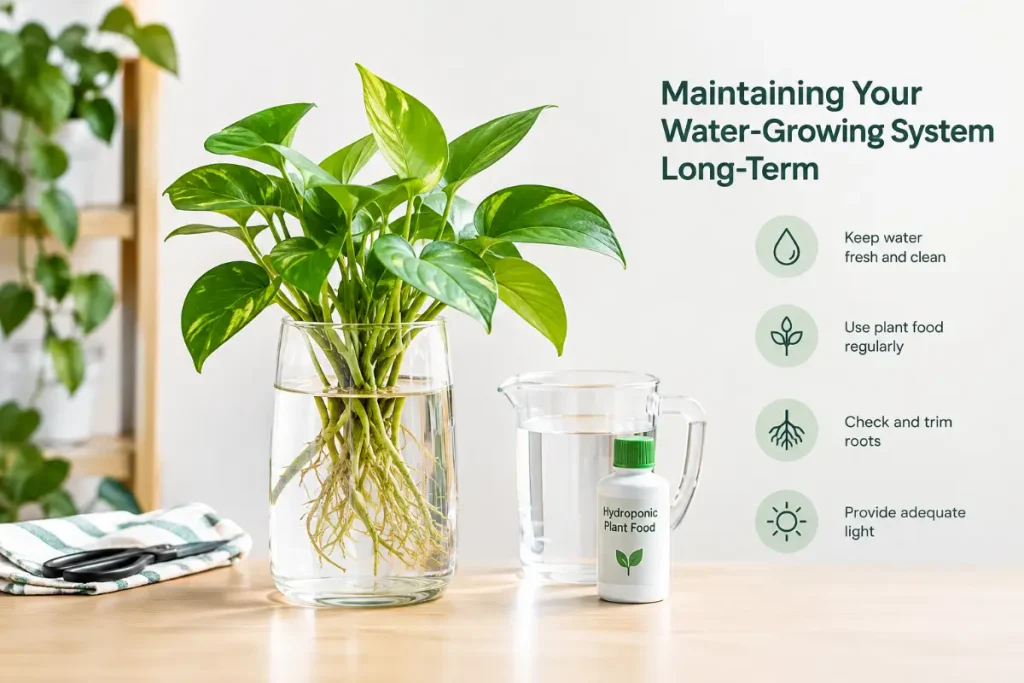
A water-based growing system rewards consistent, light-touch maintenance rather than intensive periodic intervention. Setting up a simple weekly routine keeps your system running cleanly and your plants productive with minimal time investment.
Once per week, check the reservoir level and top up with plain water if the solution has dropped. Check the pH and adjust if it has drifted outside the 5.5 to 6.5 range. Inspect roots for any signs of browning or sliminess. Remove any dead or yellowing plant material promptly to prevent it decomposing in the system.
Every one to two weeks, drain the reservoir completely and refill with freshly prepared nutrient solution. This prevents the buildup of unused mineral salts and maintains correct nutrient ratios as plants absorb different elements at different rates.
Monthly, clean any pump components, air stones, and channels thoroughly to prevent biofilm buildup. A diluted hydrogen peroxide solution (3 percent, available from pharmacies) is effective for sterilising components between plantings without leaving harmful residues.
When harvesting leafy crops like lettuce or herbs, practice cut-and-come-again harvesting by removing outer leaves and stems while leaving the central growing point intact. This extends the productive life of each plant significantly and delivers a continuous harvest rather than a single large cutting.
Replace plants when they show sustained decline in productivity, when root systems become overly dense and tangled, or after approximately six to twelve months of active growth for most leafy crops. Starting with fresh seedlings or cuttings in a cleaned, replenished system resets the cycle and maintains high yields over the long term.
Water-based growing indoors is ultimately a system that becomes more intuitive with practice. The first cycle teaches you what healthy roots look like, how quickly your plants consume solution, and how your particular growing environment affects growth rates and nutrient needs. By the second and third growing cycle, the routine feels natural and the results speak clearly for themselves.
Conclusion
Growing plants in water indoors opens up a flexible, productive, and genuinely enjoyable approach to indoor food growing that works in almost any home. From the simplest jar of rooted basil cuttings on a kitchen windowsill to a managed deep water culture system producing lettuces and herbs year-round, water-based growing scales to match your available space, time, and interest. The absence of soil simplifies many aspects of plant care while delivering faster growth, cleaner conditions, and continuous harvests throughout the year. Starting simply with a few herb cuttings in water is all it takes to discover whether this approach suits your growing style before investing in more developed systems.
FAQs
What plants grow best in water indoors?
Herbs including basil, mint, oregano, and thyme grow very well in water, as do leafy greens such as lettuce, spinach, and rocket. These are the most accessible starting points. Tomatoes, peppers, and strawberries can also be grown hydroponically but require more nutrient management and better lighting.
Do plants grown in water need fertiliser?
Yes, for sustained productive growth. Plain water supports rooting and initial establishment but lacks the full range of nutrients plants need for ongoing health and productivity. Adding a diluted hydroponic nutrient solution — or even a quarter-strength liquid houseplant fertiliser — every one to two weeks makes a significant difference to long-term performance.
How often should I change the water when growing plants in water?
Change the nutrient solution completely every one to two weeks. Between changes, top up with plain water as plants absorb it. Regular changes prevent nutrient imbalances and salt buildup that can interfere with plant health over time.
Can I grow vegetables in just water without special equipment?
Yes. The Kratky method requires only a container, net pots, an inert growing medium, and a nutrient solution — no electricity, no pump, and no specialist equipment. It is the most accessible starting point for growing leafy vegetables and herbs in water and requires minimal ongoing management.
Why are my water-grown plants not growing well?
The most common cause is insufficient light. Plants grown in water have the same light requirements as soil-grown plants. If your system is in a dim spot or relying on a windowsill in winter, adding a grow light will usually resolve slow growth. Other causes include incorrect pH, depleted or imbalanced nutrient solution, or lack of oxygen in the root zone — solvable by adding an air pump to the reservoir.
Pingback: How to Plant Paperwhites Indoors: 7 Easy Steps for Winter Blooms - Plant Quill