
Knowing how to plant lavender seeds indoors gives you access to one of the most fragrant and useful plants you can grow, at a fraction of the cost of buying established plants from a nursery. Lavender from seed is a slower process than most herbs — it takes patience and attention during the germination stage — but the reward is robust, vigorous plants grown entirely from scratch that are well adapted to your specific indoor or outdoor conditions.
Growing lavender from seed indoors is also the most practical way to start large numbers of plants simultaneously, whether for an outdoor planting scheme, an indoor fragrant garden, or a batch of plants for potting on and giving as gifts. A single packet of lavender seeds can produce dozens of plants for the price of one nursery pot.
This guide covers everything from choosing lavender varieties suited to seed growing through cold stratification, sowing technique, seedling care, and transitioning plants to their final positions.
Understanding Lavender Seed Germination
Before getting into the practicalities of sowing, it helps to understand why lavender seed germination is slower and more variable than most annual flowers and herbs. Lavender is a Mediterranean perennial that evolved in conditions of thin, alkaline, free-draining soil and strong seasonal temperature variation. Its seeds have adapted to these conditions and respond to environmental cues that signal safe germination timing.
The most significant of these adaptations is a requirement for cold stratification in many lavender varieties. Stratification is the exposure of seeds to a period of cold and moist conditions that breaks dormancy and prepares seeds for germination. In nature, this happens automatically when seeds fall to the ground in autumn, experience winter cold, and germinate the following spring. For indoor seed starting, you replicate this process artificially by chilling seeds before sowing.
Not all lavender varieties require stratification equally. English lavender (Lavandula angustifolia) and its cultivars benefit most from cold stratification and germinate more reliably with it. French lavender (Lavandula stoechas) and Spanish lavender are less demanding and often germinate without pre-treatment, though stratification still improves germination rates. Hybrid lavandins (Lavandula x intermedia) are mostly sterile and do not produce viable seed reliably — these are better propagated from cuttings than grown from seed.
Germination is also naturally variable in lavender. Unlike marigolds or basil that produce 80 to 90 percent germination rates within a narrow window, lavender may germinate at 40 to 60 percent over a period of two to six weeks. This variability is normal and not a sign that something has gone wrong. Sowing more seeds than you need accounts for this variability and ensures you end up with enough plants regardless.
Cold Stratification: Preparing Seeds Before Sowing
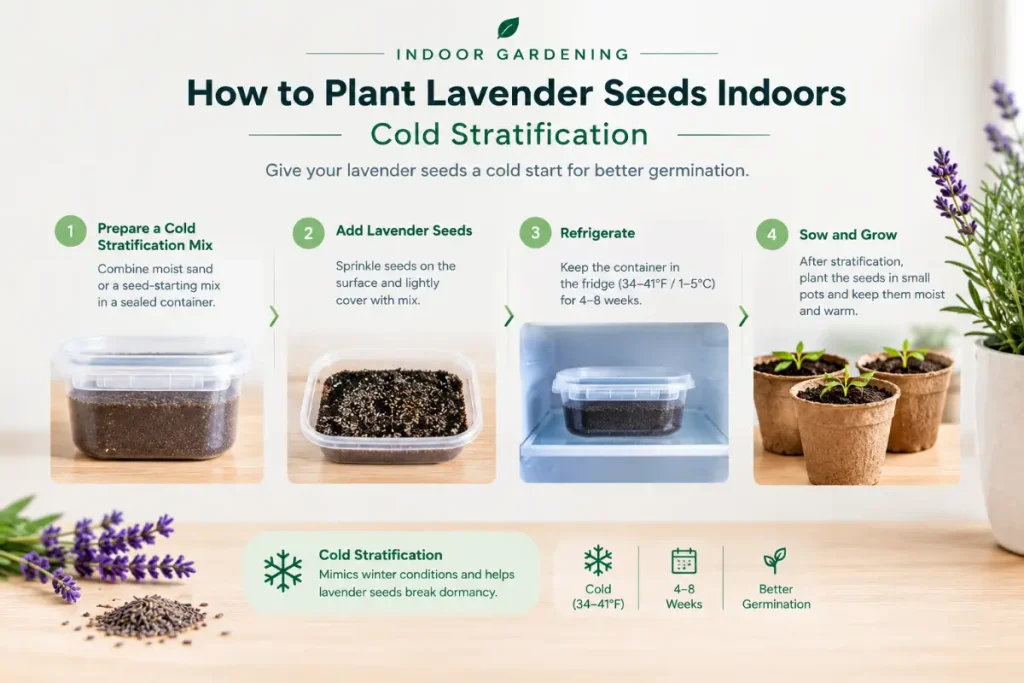
Cold stratification is the step that most significantly improves lavender germination rates and deserves careful attention. There are two main methods: refrigerator stratification and winter sowing.
Refrigerator stratification mimics winter cold artificially and is the most controllable approach. Dampen a small piece of paper towel or a pinch of vermiculite with water — it should feel moist but not dripping. Place your lavender seeds in contact with the moist medium, fold the paper towel or place the vermiculite in a small zip-lock bag, label with variety and date, and place in the refrigerator (not the freezer) for three to six weeks.
During stratification, check periodically to ensure the medium remains moist. Some seeds may begin to germinate in the refrigerator — if this happens, move to sowing immediately rather than continuing the cold period. After three to six weeks, remove seeds from the refrigerator and sow promptly while they are still cold and moist.
Winter sowing outdoors is a simpler approach that works well if you are starting lavender in late autumn or winter. Sow seeds in containers of moist seed compost, cover with a layer of fine grit, and place the containers in a sheltered outdoor position — a cold frame, unheated greenhouse, or sheltered patio corner. The seeds experience natural winter cold through the season and germinate spontaneously in spring as temperatures rise. This method requires no refrigerator management and is entirely passive, but it surrenders timing control to natural seasonal variation.
For indoor seed starting at any time of year, refrigerator stratification is the recommended approach.
Choosing Compost and Containers
Lavender is native to free-draining, nutrient-poor Mediterranean soils and performs poorly in heavy, moisture-retentive composts. The growing medium for lavender seed sowing must drain rapidly and avoid staying wet between waterings.
Use a seed compost mixed with 30 to 40 percent horticultural grit or coarse perlite. This creates the fast-draining, open-textured medium lavender seedlings need. Standard multipurpose compost alone is too dense and moisture-retentive for reliable lavender germination. If only multipurpose compost is available, adding a generous proportion of perlite or grit brings it closer to the appropriate texture.
Lavender prefers a slightly alkaline pH of 6.5 to 7.5. Most commercial seed composts are slightly acidic, so adding a small amount of horticultural lime (calcitic lime or ground limestone, not quicklime) to your seed compost mix at approximately 5 grams per litre of mix brings the pH into the preferred range. This step is optional but improves germination and early seedling health.
For containers, module trays (cell trays) or small individual pots of 5 to 7 centimetres work well. Sowing into individual cells avoids the root disturbance of pricking out, which lavender seedlings dislike. Alternatively, sow into a seed tray and prick out carefully once seedlings have two or three sets of true leaves.
Ensure all containers have adequate drainage holes. Lavender seedlings sitting in any degree of waterlogged compost will rot at the base — drainage is non-negotiable.
Step-by-Step Sowing
Step 1: Prepare compost. Mix seed compost with 30 to 40 percent perlite or grit. Fill module cells or small pots to within 1 centimetre of the rim and firm lightly to create an even surface.
Step 2: Pre-moisten compost. Water the filled containers thoroughly and allow to drain completely before sowing. Pre-moistening avoids disturbing seeds after placement.
Step 3: Sow seeds. Lavender seeds are small but manageable. Place one to two seeds per module cell, or scatter seeds thinly across a seed tray, spacing approximately 2 to 3 centimetres apart. Press seeds lightly onto the compost surface — lavender seeds need light to germinate and should not be buried more than 1 to 2 millimetres deep. A very fine covering of horticultural grit rather than compost is ideal: it holds seeds in position, maintains surface drainage, and allows light through.
Step 4: Cover and position. Cover with a clear propagator lid or plastic bag. Lavender germinates best in warm conditions of 18 to 21 degrees Celsius — cooler than the refrigerator but warm enough to signal active growing conditions. Place in a bright position.
Step 5: Monitor daily. Check moisture daily and mist lightly if the surface shows signs of drying. Germination typically begins two to four weeks after sowing following stratification, and may continue for a further two to four weeks as remaining seeds germinate in stages.
Step 6: Remove cover at germination. As soon as the first seedlings appear, remove the propagator cover and move immediately to the brightest available position to prevent etiolation. Lavender seedlings are slow-growing and need maximum light from their earliest stages.
Caring for Lavender Seedlings
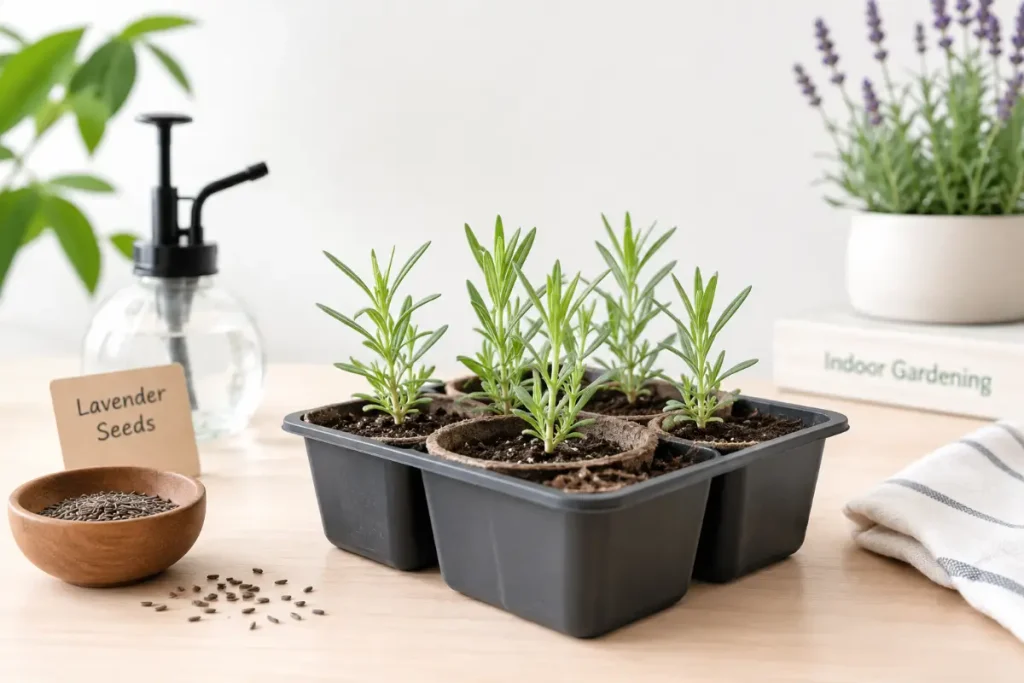
Lavender seedlings are among the slowest-growing herb seedlings you will encounter indoors. In the first four to six weeks after germination, progress seems almost imperceptible — the plants focus on root development before putting on significant above-ground growth. This is normal and not a sign of failure.
Light is the most critical factor for lavender seedlings. They need the brightest available position — a south-facing window in full sun, or a grow light providing 14 to 16 hours of full-spectrum light daily. Insufficient light causes seedlings to stretch and weaken, and weak lavender seedlings are vulnerable to damping off and never develop the compact, bushy habit that mature lavender should have.
Watering requires discipline. Allow the compost surface to dry between waterings — lavender seedlings in consistently moist compost will damp off. Water from below by placing trays in a shallow dish of water and allowing the compost to absorb moisture upward, then removing the tray once the surface feels just moist. This keeps the surface layer slightly drier than the lower compost, which is exactly the condition lavender seedlings prefer.
Feeding should not begin until seedlings have two or three sets of true leaves and are clearly growing actively. At that point, a half-strength balanced liquid fertiliser every two to three weeks supports development without over-fertilising. Lavender does not need high nutrient levels — it evolved in poor soils — and excessive feeding produces soft, disease-prone growth.
Pricking out, if you sowed into a seed tray, should happen once seedlings are 2 to 3 centimetres tall with at least two sets of true leaves. Handle seedlings by their leaves, never the stem. Transplant into individual 7 to 9 centimetre pots of free-draining compost and water gently. Place in a bright position and keep the compost on the drier side for the first week while roots establish in the new compost.
Transitioning Seedlings to Final Positions
For lavender destined for outdoor beds or containers, hardening off is essential before transplanting. Lavender raised indoors is unaccustomed to outdoor wind, temperature fluctuation, and direct sun intensity. Move seedlings to a sheltered outdoor position for increasing periods over two weeks before transplanting to their final position.
For indoor lavender growing — keeping lavender as a permanent indoor fragrant plant — the full guide to can a lavender plant grow indoors covers all the care requirements from established plant through to long-term management indoors.
Lavender transplants best in spring or early autumn when temperatures are moderate. Avoid transplanting during the heat of midsummer or in periods of cold, wet weather. Plant into a position with the best available drainage and as much direct sun as possible — lavender’s long-term success depends on both factors more than almost any other aspect of its care.
Common Problems When Sowing Lavender Indoors
Very slow or no germination is the most common concern. If seeds have not begun to germinate within four weeks of sowing, check temperature — too cold and germination stalls. Check whether stratification was performed if growing English lavender — unstratified English lavender seeds have significantly lower germination rates. Try placing the container somewhere slightly warmer and wait another two weeks before concluding seeds have failed.
Damping off — seedlings collapsing at the base — is the most common seedling problem and is almost always caused by overwatering or poor drainage. Water from below rather than overhead, ensure containers drain freely, and improve air circulation around seedlings by removing the propagator cover as soon as germination begins.
Pale, yellow seedlings indicate either nutrient deficiency or, more commonly, insufficient light. Move to a brighter position first. If yellowing persists with adequate light, begin half-strength liquid feeding to correct any deficiency.
Slow growth throughout is normal for lavender and should not cause concern. These are slow, long-lived perennial plants that invest heavily in root development before putting on visible above-ground growth. Trust the process and maintain consistent light, modest watering, and patience.
Choosing the Right Lavender Variety for Seed Sowing
Not every lavender variety is equally suited to seed propagation, and understanding variety differences helps you set realistic expectations and choose the right plant for your purpose.
English lavender (Lavandula angustifolia) is the most commonly grown lavender and the most rewarding from seed for fragrance, culinary use, and ornamental value. Named cultivars including ‘Hidcote’, ‘Munstead’, and ‘Vera’ produce viable seed, though plants grown from seed may show some variability from the parent rather than producing perfectly identical offspring. For consistent results with a specific named cultivar, vegetative propagation from cuttings is preferred. Open-pollinated English lavender seed produces plants true enough to type for most purposes.
French lavender (Lavandula stoechas) germinates more freely than English lavender and does not require cold stratification as reliably. The distinctive pineapple-shaped flower heads with prominent ‘rabbit ear’ bracts make this an attractive ornamental choice. French lavender is less frost-hardy than English lavender, making it particularly suited to indoor growing.
Fernleaf lavender (Lavandula multifida) is a striking species with finely divided, almost fern-like foliage and bright blue-violet flowers. It is a tender perennial that grows year-round indoors in a warm, bright position and germinates from seed readily without stratification. For purely indoor growing, fernleaf lavender is one of the most rewarding species to raise from seed.
Lavandula dentata (French or toothed lavender) has attractive toothed foliage and flowers almost continuously indoors when given adequate light. It germinates relatively readily from seed. Like fernleaf lavender, it is frost-tender and better suited to indoor culture in cool temperate climates than English lavender.
When selecting seed for indoor sowing, check the packet for any variety-specific germination instructions. Reputable seed suppliers provide specific guidance on stratification requirements and germination temperatures for each variety in their range.
Lavender as a Long-Term Indoor Plant
Many gardeners sow lavender with the intention of growing it outdoors, but lavender also functions well as a long-term indoor fragrant plant when its core requirements are consistently met. Understanding what lavender needs for multi-year indoor success helps you plan the transition from seedling to established plant appropriately.
The most significant indoor challenge for lavender is light. Unlike many common houseplants that tolerate moderate or indirect light, lavender is a full-sun Mediterranean plant that needs direct sunlight for at least four to six hours daily. South-facing windows in winter may fall short of this, particularly in northern climates where sun angles are low and days are short. A supplemental grow light positioned close to the plant significantly extends the productive season and maintains plant health through the winter months.
Lavender kept indoors year-round also benefits from spending summer outdoors or on a sunny balcony or terrace when temperatures allow. The combination of full summer sun, natural breezes that strengthen stems, and outdoor pollinator access (for those plants you want to set seed) produces significantly healthier, longer-lived plants than indoor culture alone.
Pot choice matters significantly for lavender kept as an indoor plant. Choose a terracotta pot rather than plastic — terracotta is porous and allows the compost to dry more rapidly between waterings, which suits lavender’s preference for dry conditions. Ensure the pot has generous drainage holes and place it on a saucer raised on feet to allow water to drain freely away from the pot base.
With appropriate conditions — maximum light, free-draining compost, disciplined watering, and good air circulation — lavender raised from seed can live productively as an indoor container plant for several years, providing fragrance, attractive flowers, and culinary leaves throughout the growing season.
Harvesting and Using Indoor Lavender
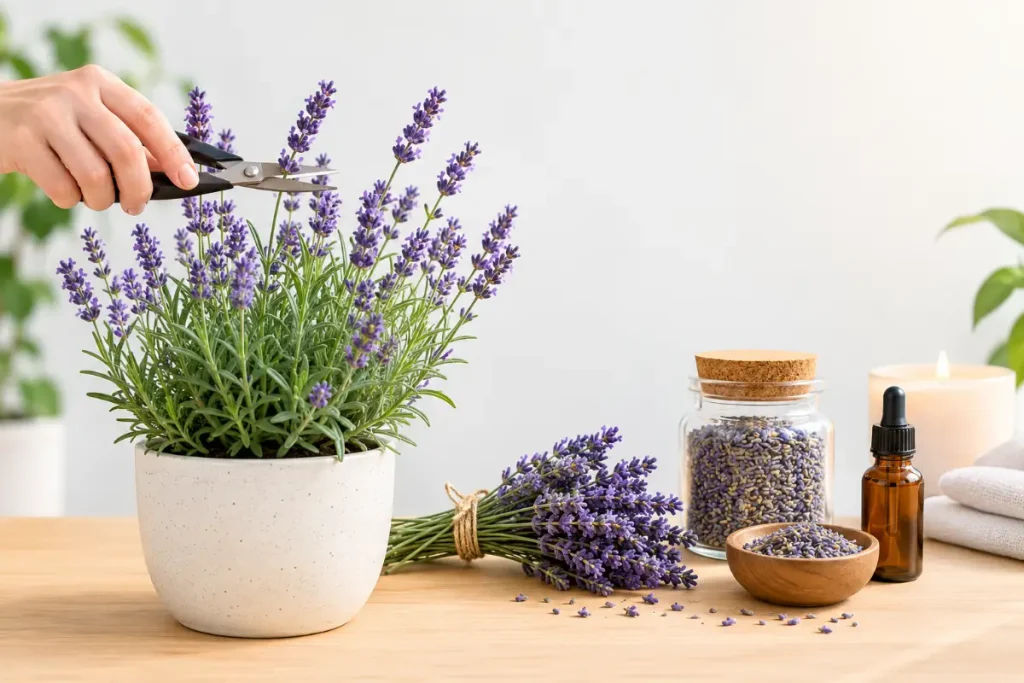
One of the pleasures of growing lavender from seed is eventually harvesting the plants you have raised entirely from scratch. Lavender grown indoors produces all the same fragrant, useful material as outdoor-grown plants, though perhaps in somewhat smaller quantities depending on pot size and light conditions.
Harvesting flowers for fragrance and drying should be done when flower spikes are just opening — the buds should be showing colour but the individual flowers not yet fully open. Cut stems in the morning when volatile oil content is at its highest. Bunches of cut lavender tied loosely and hung upside down in a warm, airy position dry within two to three weeks and retain their fragrance for months.
Harvesting leaves for culinary use can begin once plants are well established — typically from the second year onwards when the plant has enough foliage to sustain regular trimming. Lavender leaves have a more resinous, powerful flavour than the flowers and are used sparingly. They complement lamb, chicken, baked goods, and infused oils and vinegars. Always use English lavender for culinary purposes — other species may have different and less pleasant flavours.
Collecting seed from indoor lavender plants is possible once plants begin flowering, typically in year two. Allow some flower spikes to mature fully and set seed rather than deadheading. Once seed heads are dry and beginning to shatter, cut the spikes and shake seeds into a paper envelope. Store in a cool, dry, dark position and sow the following season after stratification.
Conclusion
Planting lavender seeds indoors is a rewarding if patient process that produces vigorous plants well adapted to your conditions at far lower cost than buying established specimens. Cold stratification, free-draining compost, maximum light, and disciplined watering are the four keys to successful lavender seed starting. For authoritative guidance on lavender varieties and growing techniques, the Royal Horticultural Society’s lavender growing guide is an excellent reference covering variety selection, sowing, pruning, and long-term care in depth.
The slow early growth of lavender seedlings is simply the nature of the plant — beneath the surface, an extensive root system is developing that will support years of fragrant, productive growth above ground.
FAQs
Do lavender seeds need to be stratified before planting indoors?
English lavender (Lavandula angustifolia) benefits significantly from cold stratification before sowing. Place seeds in a moist paper towel in a sealed bag and refrigerate for three to six weeks before sowing. French and Spanish lavender varieties are less demanding but still germinate more reliably with stratification. Skipping this step on English lavender often results in poor, patchy germination.
How long do lavender seeds take to germinate indoors?
Following stratification, lavender seeds typically begin germinating two to four weeks after sowing. Germination is staggered — not all seeds emerge at the same time. Expect the process to continue for a further two to four weeks as remaining seeds germinate in sequence. Total germination period from sowing can be four to eight weeks.
What compost is best for sowing lavender seeds indoors?
Use a seed compost mixed with 30 to 40 percent perlite or horticultural grit to create a fast-draining growing medium. Standard multipurpose compost alone is too moisture-retentive for lavender and increases the risk of damping off. Lavender prefers a slightly alkaline pH of 6.5 to 7.5 — adding a small amount of horticultural lime to the mix improves germination rates.
How deep should lavender seeds be planted?
Lavender seeds need light to germinate and should be sown very shallowly — pressed onto the compost surface and covered with no more than 1 to 2 millimetres of fine material. A light covering of horticultural grit is ideal as it holds seeds in position, maintains surface drainage, and allows light penetration.
Why are my lavender seedlings dying after germination?
Lavender seedlings dying after germination is almost always damping off caused by overwatering or poor drainage. Water from below, ensure containers drain freely, remove the propagator cover immediately once seedlings appear, and improve air circulation. Once damping off occurs, affected seedlings cannot be recovered, but improved conditions protect remaining plants.
How much light do lavender seedlings need indoors?
Lavender seedlings need the maximum light you can provide — a bright south-facing window with direct sun, or a full-spectrum grow light running for 14 to 16 hours daily. Insufficient light causes seedlings to stretch and weaken, making them vulnerable to disease and producing plants that never develop the compact habit of well-grown lavender.
Can I grow lavender from seed indoors in winter?
Yes, with a grow light. Sow stratified seeds in late winter under a full-spectrum grow light and seedlings will germinate and develop through the late winter and spring period. Winter indoor sowing is actually a good strategy as the naturally cooler household temperatures of the period suit lavender’s preference for moderate growing conditions.
How long does lavender take from seed to a flowering plant?
Lavender is slow from seed. Most varieties take 90 to 120 days from germination to produce a plant at flowering size, and many will not flower in their first season from seed. Expect a strong vegetative plant in year one and reliable flowering from year two onwards. This slow timeline is one reason lavender cuttings are often preferred over seed growing for faster results.
Should I thin lavender seedlings?
Yes. If multiple seeds have germinated in the same cell or close together in a seed tray, thin to leave only the strongest seedling per position. Crowded lavender seedlings compete for light and air and are significantly more susceptible to damping off than well-spaced individuals. Thin by snipping unwanted seedlings at the base rather than pulling, to avoid disturbing neighbouring roots.
When is the best time to plant lavender seeds indoors?
Late winter to early spring — January through March — is the ideal time for indoor lavender seed sowing in the northern hemisphere. This gives seedlings the maximum growing season ahead and aligns germination with the improving light levels of late winter. For outdoor transplanting, seedlings started in late winter will be large enough for hardening off and transplanting by late spring.
Pingback: Can a Lavender Plant Grow Indoors? The 2026 Care Guide - Plant Quill