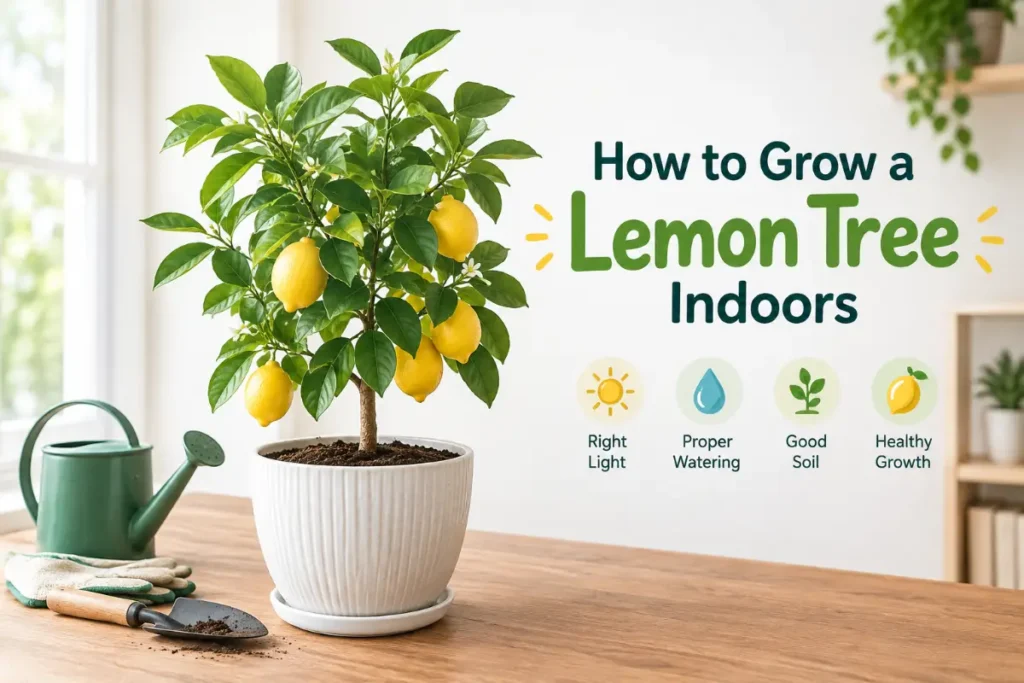
Learning how to grow a lemon tree indoors is one of the most ambitious and most rewarding indoor food growing projects available. A dwarf lemon tree in fruit is genuinely spectacular: glossy dark green leaves, intensely fragrant white flowers that fill a room with their scent, and developing lemons in various stages simultaneously on the same tree. No other indoor food plant delivers the multi-sensory experience of a blooming, fruiting indoor lemon tree.
The honest context is that indoor lemon trees require more consistent attention than most houseplants and more light than most indoor positions naturally provide. But with the right variety, a bright south-facing window or supplemental grow lighting, and the specific care approach this guide covers, indoor lemon trees produce fruit reliably for many years.
Quick Answer
How to grow a lemon tree indoors: choose a dwarf grafted variety such as Meyer Lemon, Eureka Dwarf, or Lisbon Dwarf. Provide six or more hours of direct south-facing window sun daily or supplemental grow lighting at 500 to 700 PPFD for 14 to 16 hours. Plant in a well-draining citrus potting mix in a container with excellent drainage. Water when the top two inches dry out. Fertilize every two weeks through spring and summer with a citrus-specific fertilizer. Maintain humidity above 50%. Hand pollinate flowers. Expect first fruit twelve to eighteen months after purchasing a grafted tree.
Understanding Dwarf Lemon Trees for Indoor Growing
The critical word in indoor lemon tree selection is dwarf, and within dwarf, grafted rather than seed-grown.
Dwarf versus standard lemon trees: Standard lemon trees grow to fifteen or more feet outdoors and are not practical for indoor container growing. Dwarf varieties grafted onto dwarfing rootstock grow to three to six feet in containers, which is manageable in most indoor spaces with adequate ceiling height.
Grafted versus seed-grown: This distinction is often overlooked and causes significant frustration. Seed-grown lemon trees take seven to fifteen years to produce fruit. Grafted dwarf trees purchased from reputable nurseries are already of fruiting age and typically produce their first indoor flowers and fruit within one to two years of purchase. Always purchase grafted trees for indoor growing.
The best indoor varieties:
Meyer Lemon (Citrus × meyeri): The most popular and most recommended indoor citrus. Meyer lemons are a hybrid between a true lemon and a mandarin orange, producing sweet, thin-skinned lemons with slightly lower acidity than standard Eureka lemons. The flavor is excellent for baking, cocktails, and general cooking. Meyer lemon trees bloom and fruit almost continuously indoors in good light, making them the most productive indoor citrus option.
Eureka Dwarf: The standard tart lemon you find in grocery stores, in a dwarf grafted form suited to container growing. Produces standard-sized lemons with classic lemon flavor. Requires slightly more light than Meyer lemon for consistent fruiting.
Lisbon Dwarf: Similar to Eureka in fruit characteristics and care requirements. More cold-tolerant than Eureka which is an advantage in cooler indoor positions.
Improved Meyer Lemon: A virus-free certified version of the standard Meyer lemon that is the standard grafted form available from reputable nurseries. Always choose Improved Meyer Lemon over unstandardized Meyer Lemon sources.
Step 1: Provide Maximum Available Light
Light is the most important and most commonly insufficient factor in indoor lemon tree care. Lemon trees are subtropical trees native to regions receiving intense direct sun year-round. They need the most direct sun of any common indoor plant.
The minimum requirement: Six hours of direct south-facing window sun daily. This is a genuine minimum, not a comfortable baseline. More is better for fruiting performance.
A south-facing window: The only natural light position that realistically provides six or more hours of direct sun daily in most US homes. Position the tree as close to the window as possible within the bounds of cold glass avoidance in winter.
Supplemental grow lighting: For homes without adequate south-facing windows, a full-spectrum LED grow light delivering 500 to 700 PPFD at the canopy level for 14 to 16 hours daily is the reliable solution. This is slightly higher output than required for tomatoes and significantly higher than required for lettuce, reflecting citrus’s higher light demand compared to most indoor food crops.
The seasonal adjustment: In summer the high sun angle reduces direct sun penetration through south-facing windows compared to winter. Position the tree as close to the south-facing glass as practical in summer to maximize direct sun access during the peak growing season.
Step 2: Choose the Right Container and Soil
Container size: Start in a container two to four inches larger than the root ball of the purchased tree. Lemon trees in containers that are too large develop root rot as excess wet soil surrounds a root system too small to use the available moisture. Pot up by two to four inches when the tree becomes root-bound every two to three years.
Drainage: Perfect drainage is non-negotiable for indoor citrus. The combination of high water demand during fruiting and extreme susceptibility to root rot from waterlogged soil requires containers with large, unobstructed drainage holes and saucers that are emptied within thirty minutes of every watering.
Soil: Citrus-specific potting mix is the most convenient option and provides the well-draining, slightly acidic, nutrient-complete profile that lemon trees need. Alternatively, mix standard potting mix with 30% coarse perlite and 10% coarse bark chips. This combination drains rapidly while retaining adequate moisture for the lemon tree’s active growing periods.
Pot material: Terracotta pots dry faster than plastic or glazed ceramic, which suits lemon trees well during winter when the risk of overwatering increases. The weight of terracotta also provides better stability for the increasingly top-heavy lemon tree as it grows.
Step 3: Water Correctly for the Season
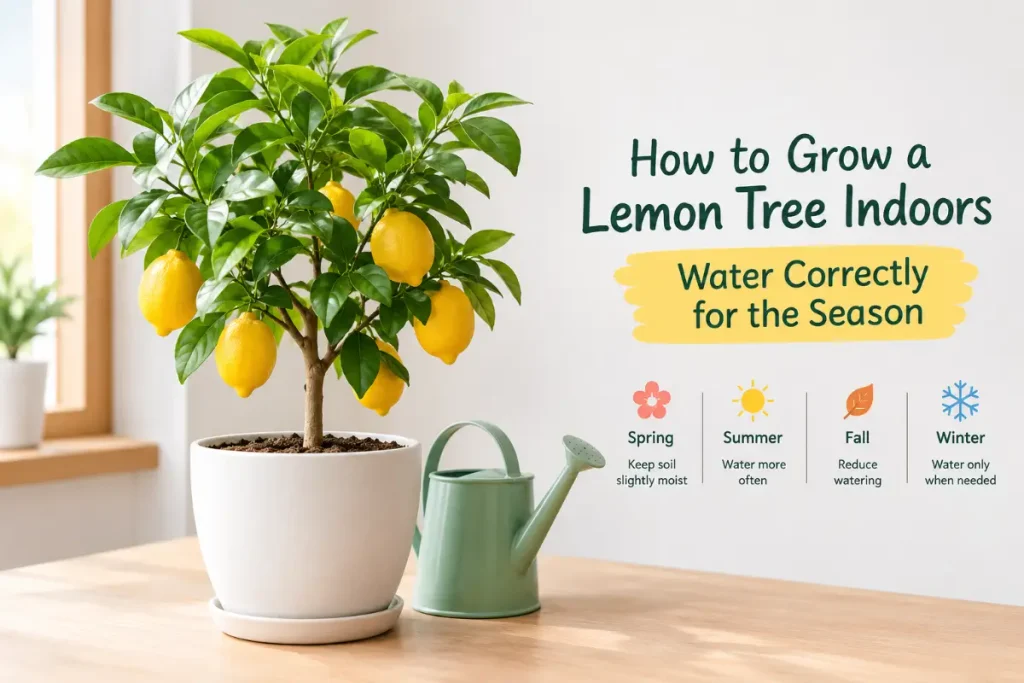
Lemon trees have high water demand during active growth and flowering but are susceptible to root rot from waterlogged soil in all seasons. The watering approach needs to balance these competing considerations.
The correct check: Water when the top two inches of soil feel dry. Push your finger two full inches into the soil before deciding to water. In a south-facing window during summer active growth this may mean watering every five to seven days. In winter or in lower-light positions every ten to fourteen days.
Thorough watering: When you water, water thoroughly until it flows freely from the drainage holes. This ensures the entire root zone is moistened rather than only the surface inches. Shallow watering that moistens only the top layer leaves the lower root zone consistently dry while the surface stays moist, which creates an inverted moisture gradient that stresses roots.
Water quality: Lemon trees are sensitive to fluoride accumulation that causes leaf tip burn, identical to the problem in mass cane and dracaena. Use filtered or distilled water or collected rainwater to prevent fluoride accumulation in the soil and leaf tissue over time.
Winter reduction: Through the shortest, coolest months, lemon trees in cooler indoor conditions need significantly less water than in summer. Maintaining summer watering frequency through winter overwatering is one of the most common causes of indoor citrus decline.
Step 4: Fertilize Precisely for Flowers and Fruit
Lemon trees are heavy feeders during active growth and flowering. Consistent, appropriate fertilizing is one of the most important factors distinguishing productive indoor lemon trees from ones that grow but do not fruit reliably.
What to use: A fertilizer formulated specifically for citrus is the most straightforward choice. Citrus fertilizers balance the nitrogen needed for vegetative growth with the micronutrients including iron, manganese, and zinc that citrus specifically requires for healthy leaf color and fruit development. These micronutrients are often deficient in general-purpose fertilizers.
How often: Every two weeks through spring and summer during active growth. Monthly in fall as growth slows. Stop or use a greatly reduced rate through the coldest winter months.
The yellowing sign of deficiency: Interveinal chlorosis, where leaf veins remain green but the tissue between veins turns yellow, indicates iron or manganese deficiency that is common in indoor citrus on alkaline water or depleted soil. A citrus fertilizer with chelated iron corrects this more reliably than pH adjustment alone.
Avoid high-nitrogen fertilizers at flowering: High-nitrogen fertilizers that drive vegetative growth at the expense of flower and fruit development are counterproductive when the tree is flowering. Switch to a bloom-supporting formula with elevated phosphorus and potassium when buds appear.
Step 5: Maintain Humidity and Temperature
Ideal temperature: 55 to 85 degrees Fahrenheit covers the range where lemon trees grow well. Active growth and fruiting are most vigorous in the 65 to 80 degree range typical of most US homes.
Cold tolerance: Meyer lemon tolerates light frost outdoors to approximately 28 degrees Fahrenheit, which makes it the most cold-tolerant common indoor citrus and suitable for cool sunrooms that drop to 45 to 50 degrees at night. Eureka and Lisbon are somewhat less cold-tolerant.
Humidity management: Lemon trees prefer humidity above 50%. The dry air of heated winter homes causes the leaf tip burn and spider mite pressure that are the most common winter complaints about indoor citrus. A humidifier running nearby through winter dramatically improves leaf condition and reduces spider mite establishment.
The cold-window warning: Position at least three to four inches from south-facing window glass in winter. Cold glass radiates cold toward the nearest plant tissue even in a warm room, causing the cold-stress leaf damage that appears on the side of the tree facing the window.
Step 6: Hand Pollinate for Fruit Set
Indoor lemon trees produce perfect flowers (containing both male and female parts) but still benefit from manual pollination indoors where no bees or wind activate pollen transfer.
The technique: Using a small soft paintbrush, gently transfer pollen from the stamen of one open flower to the stigma at the center of another. Moving pollen between flowers rather than self-pollinating within a single flower produces better fruit set through cross-pollination even within the same variety.
The fragrance indicator: Lemon tree flowers produce one of the most intensely sweet fragrances of any flowering plant. When the flowers are releasing fragrance most strongly (peak fragrance occurs on warm mornings), this is the optimal pollination window. The fragrance intensity correlates with peak pollen release and stigma receptivity.
Flower and fruit drop: Indoor lemon trees normally drop a significant proportion of their flowers and developing fruit before they reach maturity. This is natural thinning behavior rather than a care problem. A tree with twenty flowers typically keeps two to four fruits to maturity. The drop of most flowers and immature fruit is the tree’s resource allocation response, not a sign of failed pollination.
Step 7: Manage the Tree’s Growth and Long-Term Care
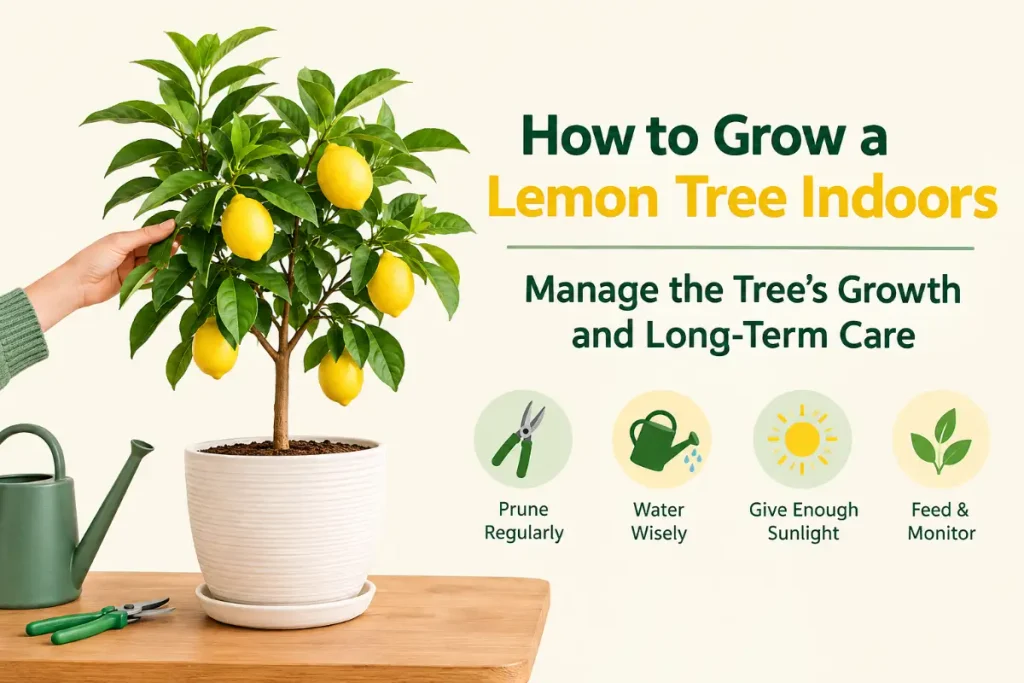
Pruning: Light pruning once or twice per year shapes the tree, removes crossing branches, and maintains the interior light access that supports the fruiting branches throughout the canopy rather than only at the outer tips. Prune after a fruiting period when the tree is entering a new vegetative growth phase.
Repotting: Every two to three years when roots emerge from drainage holes or when the tree dries out within two to three days of thorough watering. Repot in spring before the new growth flush. Choose a container two to four inches larger than the current one.
Pests: Spider mites and scale insects are the most common indoor citrus pests. Spider mites establish most readily in warm, dry, still air. Maintaining humidity above 50% and running a small fan nearby prevents most spider mite pressure. Inspect leaf undersides monthly and treat early infestations with neem oil spray before populations establish.
The multi-year commitment: A well-maintained indoor Meyer lemon tree produces fruit for ten or more years. The visual presence of a mature indoor lemon tree with glossy evergreen leaves, fragrant white flowers, and developing lemons in multiple stages becomes one of the most impressive living elements any indoor space can contain. The investment of appropriate care from the start produces rewards that compound over years rather than a single season.
For companion guidance on other indoor citrus and fruit trees that complement a Meyer lemon in a south-facing sunroom or conservatory, indoor plants that like direct sun covers the range of high-light plants that share the lemon tree’s south-facing window requirements and create cohesive multi-plant displays in the sunniest indoor spaces.
Common Indoor Lemon Tree Problems and Solutions
Yellow leaves throughout the plant: Overwatering causing root stress, nitrogen deficiency from depleted soil, or iron deficiency in alkaline conditions. Check soil moisture at two inches before diagnosing. If soil is consistently wet, reduce watering and improve drainage. If dry, begin or increase fertilizing with a citrus formula containing chelated iron.
Leaf tip burn: Fluoride accumulation from tap water, low humidity, or salt accumulation from fertilizer. Switch to filtered water. Increase humidity. Flush soil with two to three times the normal water volume monthly to leach accumulated salts.
Dropping leaves in winter: Cold draft exposure, sudden temperature change, or overwatering as the tree’s water demand decreases in lower winter light while watering frequency stays the same. Move away from cold windows and drafts. Reduce watering frequency significantly in winter.
No flowers despite healthy growth: Insufficient light is the most common cause. Move to maximum available south-facing sun or increase grow light intensity and hours. Also check that the tree is a grafted dwarf variety since seed-grown trees take many years to reach fruiting age regardless of care quality.
Sticky substance on leaves (honeydew): Scale insects or aphids feeding on the tree and excreting honeydew. Inspect stems and leaf undersides for the flat, shell-like scale insects or clustered aphids. Treat with neem oil spray every seven days for three to four weeks.
Conclusion
How to grow a lemon tree indoors rewards the grower who selects a grafted dwarf Meyer lemon, provides maximum south-facing direct sun, waters carefully with quality water, fertilizes consistently with a citrus-specific formula, and maintains humidity through winter. The resulting indoor lemon tree produces fragrant flowers and genuine lemons for years, creating one of the most satisfying combinations of beauty and productivity available in any indoor plant.
The initial investment of choosing the right variety and setting up appropriate growing conditions pays compounding dividends across the years and decades that a well-maintained indoor lemon tree can produce.
Frequently Asked Questions
Which lemon tree grows best indoors?
Meyer Lemon (Improved Meyer Lemon) is the most recommended indoor variety for its compact size on dwarfing rootstock, near-continuous blooming and fruiting habit, slightly sweeter and less acidic fruit than standard lemons, and tolerance of indoor conditions including slightly lower light than Eureka requires. Always purchase a grafted dwarf tree from a reputable nursery rather than a seed-grown tree or an ungrafted cutting.
How long does it take to grow lemons indoors?
A grafted dwarf Meyer lemon purchased from a nursery typically produces its first indoor flowers within six to twelve months and first ripe fruit within twelve to eighteen months of purchase. Ripe fruit development takes approximately six to nine months from successful flower pollination to harvest. Seed-grown lemon trees take seven to fifteen years to fruit regardless of indoor care quality.
Do indoor lemon trees need direct sunlight?
Yes. Six or more hours of direct south-facing window sun daily is the minimum for reliable indoor fruiting. Without this, the tree grows healthy foliage but produces minimal flowers and fruit. A full-spectrum LED grow light delivering 500 to 700 PPFD for 14 to 16 hours daily is the reliable solution for homes without adequate south-facing windows.
Why is my indoor lemon tree not producing fruit?
The most common causes of no fruit on an indoor lemon tree are insufficient light, seed-grown rather than grafted tree that has not yet reached fruiting age, inadequate fertilizing with a citrus-specific formula, or insufficient hand pollination of flowers. Check light first since it is the most common limiting factor. Confirm the tree is a grafted variety. Begin or improve fertilizing with a citrus formula every two weeks through the growing season.
How often should I water an indoor lemon tree?
Water when the top two inches of soil feel dry, typically every five to seven days during active summer growth and every ten to fourteen days in winter. Use filtered or distilled water to prevent fluoride accumulation that causes leaf tip burn. Water thoroughly until water flows from drainage holes, then do not water again until the two-inch check indicates dryness.
Can I put my indoor lemon tree outside in summer?
Yes, and doing so significantly improves growth and fruiting compared to indoor conditions alone. Move outdoors in late spring when nighttime temperatures consistently stay above 50 degrees. Acclimate gradually over two weeks by starting in a sheltered partially shaded position before moving to full outdoor sun. The natural UV, wind movement, and higher light intensity of outdoor summer conditions produce the most vigorous growth and flower production of any period. Bring back indoors before the first fall frost.