
Can a lavender plant grow indoors? The honest answer is yes — but with conditions. Lavender is a Mediterranean plant that evolved under intense direct sunlight, alkaline thin soils, and excellent drainage, and it will not thrive unless those core conditions are replicated as closely as possible inside your home. Given adequate light, the right compost, careful watering, and good ventilation, lavender not only survives indoors but produces fragrant flowers, useful culinary leaves, and attractive silvery foliage across much of the year.
Understanding where lavender succeeds indoors and where it struggles is the key to keeping plants long-term rather than watching them slowly decline after the first season. This guide covers variety selection for indoor growing, positioning, compost and containers, watering, feeding, pruning, and dealing with the common problems that affect indoor lavender.
Why Lavender Can Be Challenging Indoors
Before covering how to grow lavender indoors successfully, it helps to understand why the plant has a reputation for struggling in indoor conditions. Most lavender failures indoors come from the same two causes: insufficient light and overwatering. These are linked — a plant that is getting inadequate light grows more slowly, uses less water, and becomes more vulnerable to root rot when watered at frequencies that would suit a more actively growing plant.
Lavender in its native Mediterranean habitat grows in full blazing sun for eight to ten hours daily through spring and summer, in soils so free-draining that moisture disappears within hours of rain. The entire plant — its grey-green foliage, its woody stems, its deeply penetrating root system — is adapted to these extremes. Moving such a plant into a typical home with indirect light, heavy multipurpose compost, and enthusiastic watering creates conditions that are almost the exact opposite of its natural habitat.
The good news is that once you understand these preferences, addressing them is entirely practical. Bright windows or supplemental grow lights solve the light problem. Free-draining specialist compost solves the soil problem. Disciplined watering based on compost dryness rather than a schedule solves the overwatering problem. None of these adjustments are difficult — they simply require knowing what lavender needs rather than treating it like a typical houseplant.
Choosing the Right Lavender Variety for Indoor Growing
Variety choice significantly affects indoor lavender success. Not all species and cultivars perform equally well in indoor conditions.
French lavender (Lavandula stoechas) is one of the best choices for indoor growing. It is more tolerant of indoor light conditions than English lavender, flowers prolifically with the distinctive pineapple-shaped heads topped by elongated ‘rabbit ear’ bracts, and has good heat tolerance. Its one limitation is that it is less hardy than English lavender, making it unsuitable for outdoor winter use in cool climates — which actually makes it a stronger candidate for permanent indoor growing.
Fernleaf lavender (Lavandula multifida) is excellent for indoors. Its finely divided, almost fern-like foliage is ornamentally striking, and it flowers reliably with bright blue-violet spikes in a warm, light indoor position. It is tender, so indoor growing suits its needs perfectly in northern climates.
Lavandula dentata (toothed lavender) has toothed grey-green leaves and mauve flower spikes and has a longer flowering season than English lavender, often blooming almost continuously indoors in a good bright position. It is another tender species that adapts well to indoor container growing.
English lavender (Lavandula angustifolia) is the most familiar lavender with the most intense fragrance and the best culinary properties, but it is also the most demanding about light and the most susceptible to the conditions of indoor growing. It can be kept successfully indoors but needs the brightest available position and benefits from summer spells outdoors. Named cultivars like ‘Hidcote’ and ‘Munstead’ are the most compact and best suited to container culture.
For beginners to indoor lavender, French lavender or fernleaf lavender are the most forgiving starting points.
Light Requirements for Indoor Lavender
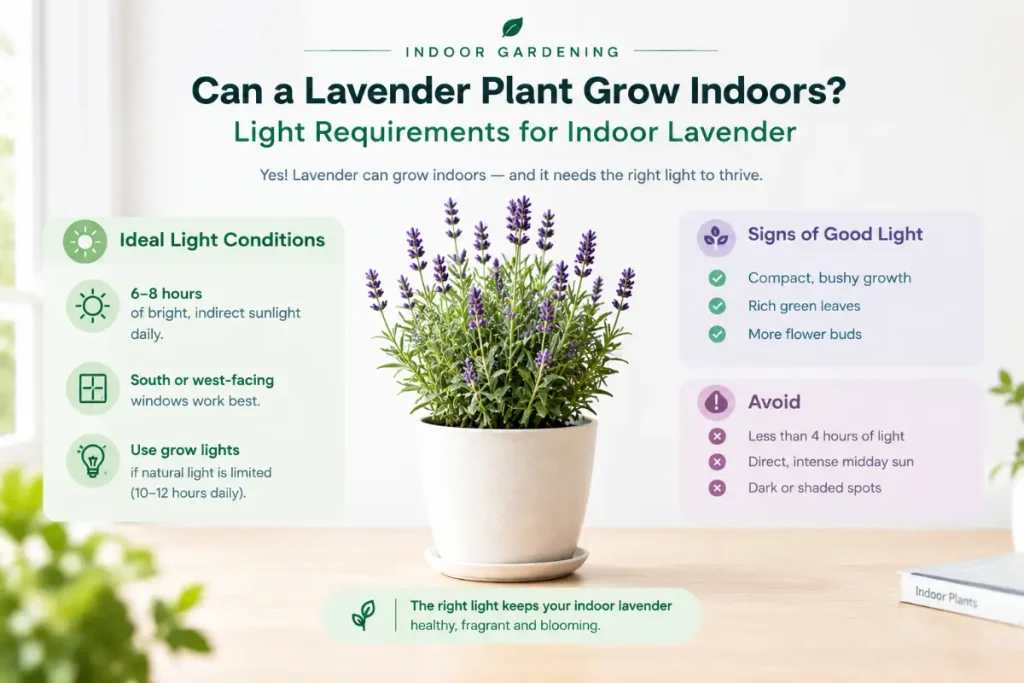
Light is the most critical factor in indoor lavender success and the one most commonly underestimated. Lavender needs direct sunlight — not bright indirect light, not a position near a window, but actual direct sun falling on the plant for four to six hours minimum per day.
In practice, this means a south-facing window that receives unobstructed direct sun throughout the day in winter, when sun angles are low. East or west-facing windows receive direct sun for only part of the day and may not provide sufficient intensity for English lavender, though more tolerant species like fernleaf lavender may manage. North-facing windows are not suitable for any lavender species.
Signs of insufficient light appear relatively quickly. The plant produces new growth that is pale, elongated, and spindly rather than the compact, bushy growth of well-lit lavender. Stems stretch toward the light source. Flowering reduces or stops. The plant has a leggy, weak appearance rather than the dense, rounded habit of healthy lavender.
A full-spectrum LED grow light resolves the light problem entirely and makes indoor lavender viable in any room regardless of window orientation. Position the grow light so it sits 20 to 30 centimetres above the plant and run it for 14 to 16 hours daily to replicate long summer day length. Modern LED grow lights are energy-efficient and can run at very low cost per day while maintaining excellent light output throughout the growing season.
If you are starting lavender from seed indoors, the full process is covered in the how to plant lavender seeds indoors guide, including variety selection, stratification, and seedling care.
Compost and Container Choice
The compost lavender grows in indoors is as important as its light conditions. Lavender needs fast-draining, open-structured growing medium that releases moisture quickly and never stays wet for extended periods.
Standard multipurpose compost alone is too moisture-retentive for lavender. Mix it with 30 to 40 percent horticultural grit or perlite to create a faster-draining blend. Alternatively, use a specialist Mediterranean or cacti and succulent compost as the base — these are formulated with drainage in mind and suit lavender well with minimal additional amendment.
Lavender also prefers a slightly alkaline growing medium with a pH of 6.5 to 7.5. Most commercial composts are slightly acidic. Adding a small amount of ground limestone or calcitic lime at 5 grams per litre of compost mix raises the pH toward the ideal range and improves plant health and longevity.
For containers, terracotta pots are strongly preferred over plastic. Terracotta is porous and allows moisture to escape through the pot walls as well as through drainage holes, which keeps the root zone drier between waterings and replicates more closely the aerated soil conditions of lavender’s natural habitat. Plastic pots retain moisture in the compost longer, increasing waterlogging risk.
Choose a pot that is only slightly larger than the plant’s root ball — lavender performs better slightly pot-bound than in a large container with extensive compost that stays wet long after watering. Ensure the pot has generously sized drainage holes at the base. Elevate the pot on feet or a trivet so water can exit freely and the base of the pot is not sitting in a puddle.
Watering Indoor Lavender
Watering is where most indoor lavender failures occur, and the correct approach is simpler than most gardeners expect: allow the compost to become almost dry before watering, then water thoroughly, and allow to drain completely.
This means ignoring schedules and fixed watering days. Instead, check the compost by pushing a finger 2 to 3 centimetres into the surface. If it feels moist, do not water. If it feels dry at that depth, water thoroughly from above or by placing the pot in a tray of water for 20 minutes, then removing immediately and allowing to drain. Never leave lavender sitting in a tray of water for extended periods.
In winter, when light levels are lower, plant growth slows and water consumption decreases significantly. Water even less frequently during winter — once every two to three weeks is often sufficient for established plants, depending on pot size, compost type, and ambient temperature.
Symptoms of overwatering include yellowing lower leaves, a generally limp and unhealthy appearance despite moist compost, and eventually blackening or softening at the stem base indicating root rot. If the plant is caught early, remove it from the pot, shake away wet compost from the roots, allow the roots to air for a few hours, repot in fresh dry compost, and withhold watering for a week.
Feeding Indoor Lavender
Lavender evolved in nutrient-poor soils and does not require heavy feeding. Excessive fertiliser, particularly nitrogen-heavy feeds, produces the kind of soft, sappy growth that lavender is worst at managing — it looks lush briefly but is weak, vulnerable to fungal disease, and lacks the aromatic oil concentration of less-pampered plants.
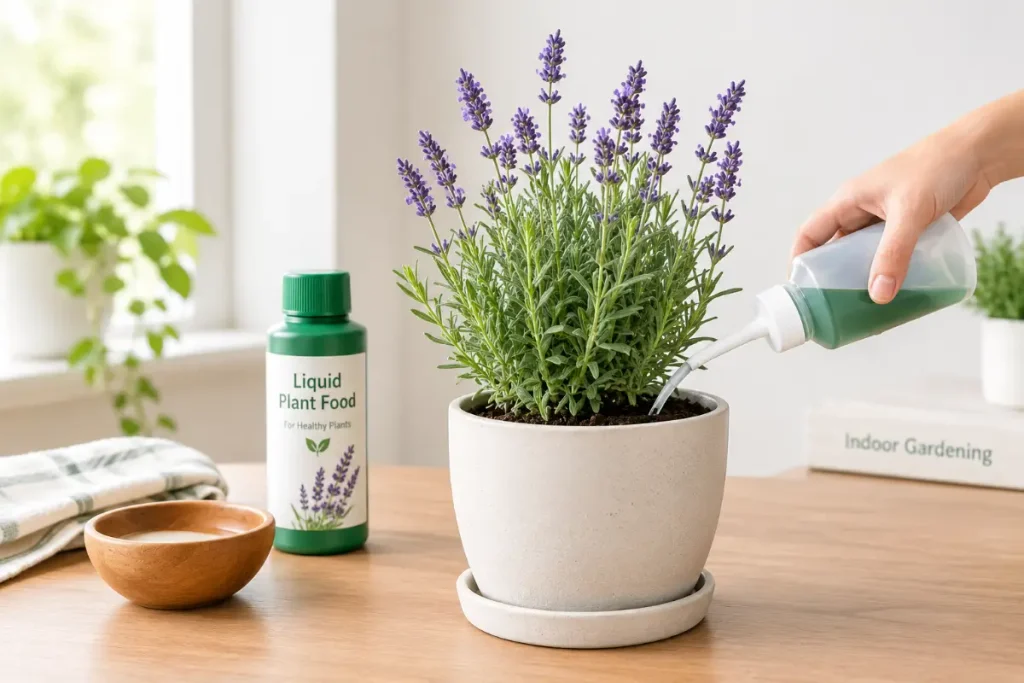
A half-strength balanced liquid fertiliser applied once a month during the active growing season (spring through early autumn) is sufficient for container lavender. Through autumn and winter, withhold feeding entirely and allow the plant to rest. Begin feeding again in spring as growth resumes.
Potassium-rich fertilisers (tomato fertilisers work well) improve flowering at the expense of leafy growth and are a good choice during the flowering period. Alternate between a balanced feed early in the season and a potassium feed as flower buds develop.
Pruning and Shaping Indoor Lavender
Pruning is essential for long-term lavender health and maintains the compact, bushy habit that makes container lavender ornamentally attractive. Unpruned lavender becomes progressively more woody and open, with flowers appearing only at the tips of increasingly long, bare stems.
After flowering: Remove spent flower stems by cutting back to just above the first set of leaves below the flower spike. This tidies the plant and often encourages a second flush of flowers later in the season.
Annual hard pruning: Each spring, before active growth begins, cut all stems back by roughly one-third to one-half, cutting into the green leafy growth but never into bare woody stems. Old wood does not regenerate if cut back into it — always leave green foliage below the cut. Annual spring pruning maintains compact shape, stimulates vigorous new growth, and prolongs the productive life of the plant significantly.
Lavender kept indoors in low light conditions may require lighter pruning than outdoor plants to avoid weakening the plant further. Assess the plant’s vigour before pruning hard — a large, bushy plant in good health tolerates harder pruning than a small, struggling specimen.
Managing Temperature and Ventilation
Lavender grows best in temperatures of 15 to 21 degrees Celsius. It tolerates warmer indoor temperatures in summer but appreciates good air circulation at all times — stagnant, humid indoor air promotes the fungal diseases that lavender is susceptible to indoors.
Place indoor lavender where air moves around it — avoid tucking it into a corner or surrounding it with other plants that restrict airflow. A position near a window that is opened occasionally in mild weather provides the natural ventilation lavender prefers.
Central heating can create very low humidity in winter that is actually beneficial to lavender — most houseplants struggle in dry indoor winter conditions, but lavender appreciates lower humidity. Avoid placing lavender near humidifiers, kitchen steam, or bathroom moisture.
If outdoor temperatures are mild (above 5 degrees Celsius), placing lavender outdoors in a sheltered position for periods in spring, summer, and early autumn provides the natural ventilation and light intensity that indoor conditions can only approximate. Even brief spells outdoors in summer sun improve plant health and flowering significantly.
Repotting Indoor Lavender
Lavender in containers benefits from repotting every two to three years as roots fill the pot and the compost structure breaks down. Repot into a container one size larger, using fresh free-draining compost mix.
Spring is the best time to repot, just before active growth begins. Remove the plant carefully from its existing pot, shake away loose old compost from the roots, and inspect the root ball. Trim away any dead, rotted, or excessively tangled roots with clean scissors. Place in the new pot with fresh compost, firm lightly, and water gently. Place in a bright position and avoid heavy watering for a week while the plant establishes in its new compost.
Seasonal Care for Indoor Lavender
Indoor lavender benefits from adjusted care through the year, even though it is sheltered from outdoor seasonal extremes. Understanding the plant’s natural growth cycle helps you provide the right conditions at each stage.
Spring is the most active growth period. As day length increases, lavender puts on new growth rapidly and begins developing flower buds. This is the time to begin feeding again after the winter rest, to prune back any winter-tired growth, and to check whether the plant needs repotting. Increase watering frequency slightly as the plant’s water consumption rises with active growth.
Summer brings peak flowering and the most intensive growth period. Move indoor lavender outdoors if temperatures allow — even placing the pot on a sunny balcony or terrace for the summer months provides light levels and airflow that indoor positions cannot match. Continue regular feeding through summer. Harvest flowers for drying as they reach the just-opening stage.
Autumn is the time to begin reducing feeding and water frequency. If the plant spent summer outdoors, bring it back inside before the first frost and allow it a brief period of adjustment to indoor conditions. Autumn is also a good time to take cuttings from the season’s new growth to propagate additional plants.
Winter is a rest period for lavender. Growth slows significantly. Reduce watering to every two to three weeks and stop feeding entirely. Maintain the brightest available light position. English lavender in particular needs cool winter conditions — avoid placing it in a very warm room during winter, as artificial warmth without adequate light produces weak, drawn growth. A cool conservatory or hallway with bright light is better than a warm living room with indirect light.
Using Indoor Lavender Around the Home
One of the pleasures of keeping lavender as a permanent indoor plant is its practical usefulness beyond the ornamental. Lavender has been used for centuries for fragrance, culinary purposes, and household applications, and plants grown at a sunny window are entirely usable in these ways.
Fragrance: Fresh lavender in flower perfumes a room naturally. Dried lavender bundles placed in drawers, linen cupboards, and wardrobes provide long-lasting fragrance and are traditionally used to deter moths. Small fabric sachets of dried lavender flowers make useful household items and simple gifts.
Culinary use: English lavender leaves and flowers are culinary ingredients used in baking (lavender shortbread, lavender scones), with savoury dishes (particularly lamb), in flavoured sugars, syrups, infused honeys, and herbal teas. Use sparingly — lavender has an intense flavour and a little goes a long way. Harvest in the morning when aromatic oil content is highest. Flowers used in cooking should be from plants grown without pesticide use.
Wellbeing: Lavender is widely used for relaxation and sleep support. A small pot on a bedside table where leaves can be lightly brushed to release fragrance is a practical use of indoor lavender. Dried flowers added to a warm bath are a traditional use for lavender’s calming properties.
Propagation: Indoor lavender plants can be used as a source of cuttings to propagate additional plants. Take 8 to 10 centimetre softwood cuttings from non-flowering shoot tips in late spring or summer. Remove lower leaves, dip in rooting hormone powder, and insert into free-draining compost. Cover with a clear bag or propagator lid and place in a warm, bright position. Roots develop in four to six weeks.
Conclusion
Lavender can absolutely grow indoors with the right conditions — maximum direct light, free-draining compost, disciplined watering, and good air circulation are the four foundations of indoor lavender success. The plant rewards this attention with beautiful fragrant flowers, culinary leaves, and long-lived growth in a container that suits any sunny windowsill or well-lit indoor space. For comprehensive variety guidance and growing advice, the Royal Horticultural Society’s lavender growing guide covers species selection, pruning techniques, and propagation in authoritative detail.
The plants most likely to fail indoors are those treated like typical moisture-loving houseplants. Understand lavender’s Mediterranean origins and match its conditions as closely as you can, and indoor success follows naturally.
FAQs
Can lavender survive indoors permanently?
Yes, lavender can live permanently indoors provided it receives sufficient direct sunlight — at least four to six hours daily from a south-facing window, or supplemental light from a full-spectrum grow light. Tender species like French lavender and fernleaf lavender are particularly well suited to permanent indoor culture in cool climates where winter outdoor temperatures would damage them. English lavender can be kept permanently indoors but requires the brightest possible position.
Why is my indoor lavender dying?
The two most common causes of indoor lavender dying are overwatering and insufficient light. Overwatered lavender shows yellowing leaves, a limp appearance, and eventual blackening at the stem base from root rot. Under-lit lavender becomes pale, leggy, and weak. Check both factors — allow the compost to dry thoroughly between waterings and move the plant to the brightest available position or add a grow light.
What is the best type of lavender to grow indoors?
French lavender (Lavandula stoechas), fernleaf lavender (Lavandula multifida), and toothed lavender (Lavandula dentata) are the most forgiving indoor varieties. They tolerate indoor conditions better than English lavender and flower reliably with adequate light. English lavender has the best fragrance and culinary properties but is the most demanding about light intensity.
How often should I water lavender indoors?
Water indoor lavender only when the compost is almost completely dry to a depth of 2 to 3 centimetres. In summer, this might mean watering every seven to ten days. In winter, every two to three weeks is often sufficient. There is no fixed schedule — judge by the compost dryness, not the calendar. Overwatering is by far the most common cause of indoor lavender death.
Does indoor lavender need feeding?
Lavender needs only modest feeding. A half-strength balanced liquid fertiliser applied once a month during spring and summer is sufficient. Withhold feeding entirely through autumn and winter. Avoid nitrogen-heavy feeds which produce soft, disease-prone growth. A potassium-rich fertiliser during the flowering period improves flower production and quality.
Can indoor lavender flower?
Yes, indoor lavender can and does flower given adequate light. Plants in direct sun from a south-facing window or under a grow light produce flower spikes reliably in spring and summer. Insufficient light is the most common reason indoor lavender fails to flower. Some varieties, particularly French lavender and toothed lavender, have longer flowering seasons than English lavender and may produce flowers almost continuously in good indoor conditions.
Do I need to prune indoor lavender?
Yes, annual pruning is important for long-term indoor lavender health and shape. Each spring, cut stems back by roughly one-third into the green leafy growth — never into bare woody stems, which do not regenerate. After flowering, remove spent flower stems to tidy the plant and encourage possible repeat flowering. Without pruning, lavender becomes progressively woody and bare, with declining flower production.
What compost should I use for indoor lavender?
Use a fast-draining compost mix — standard seed or multipurpose compost blended with 30 to 40 percent horticultural grit or perlite. Specialist Mediterranean plant compost or cacti and succulent compost with additional grit also works well. Standard multipurpose compost alone retains too much moisture for lavender and increases root rot risk.
Can I use lavender grown indoors for cooking?
Yes, lavender grown indoors is fully usable for culinary purposes. Use English lavender (Lavandula angustifolia) for the best culinary flavour — it has the classic floral-herbal note used in baking, lamb dishes, infused oils, and desserts. Other lavender species have different, sometimes more resinous or camphor-heavy flavours less suitable for cooking. Harvest leaves and flowers in the morning when volatile oil content is at its peak.
How much direct sun does indoor lavender need?
Indoor lavender needs a minimum of four to six hours of direct sunlight daily. A south-facing window that receives unobstructed sun is ideal. East or west-facing windows that receive direct sun for only part of the day may be marginal for English lavender but workable for more tolerant species. If your home cannot provide adequate direct sun, a full-spectrum LED grow light positioned 20 to 30 centimetres above the plant and running for 14 to 16 hours daily is a reliable and practical alternative.
Pingback: Terracotta Pots for Indoor Plants: Benefits, Uses, and Care (2026) - Plant Quill